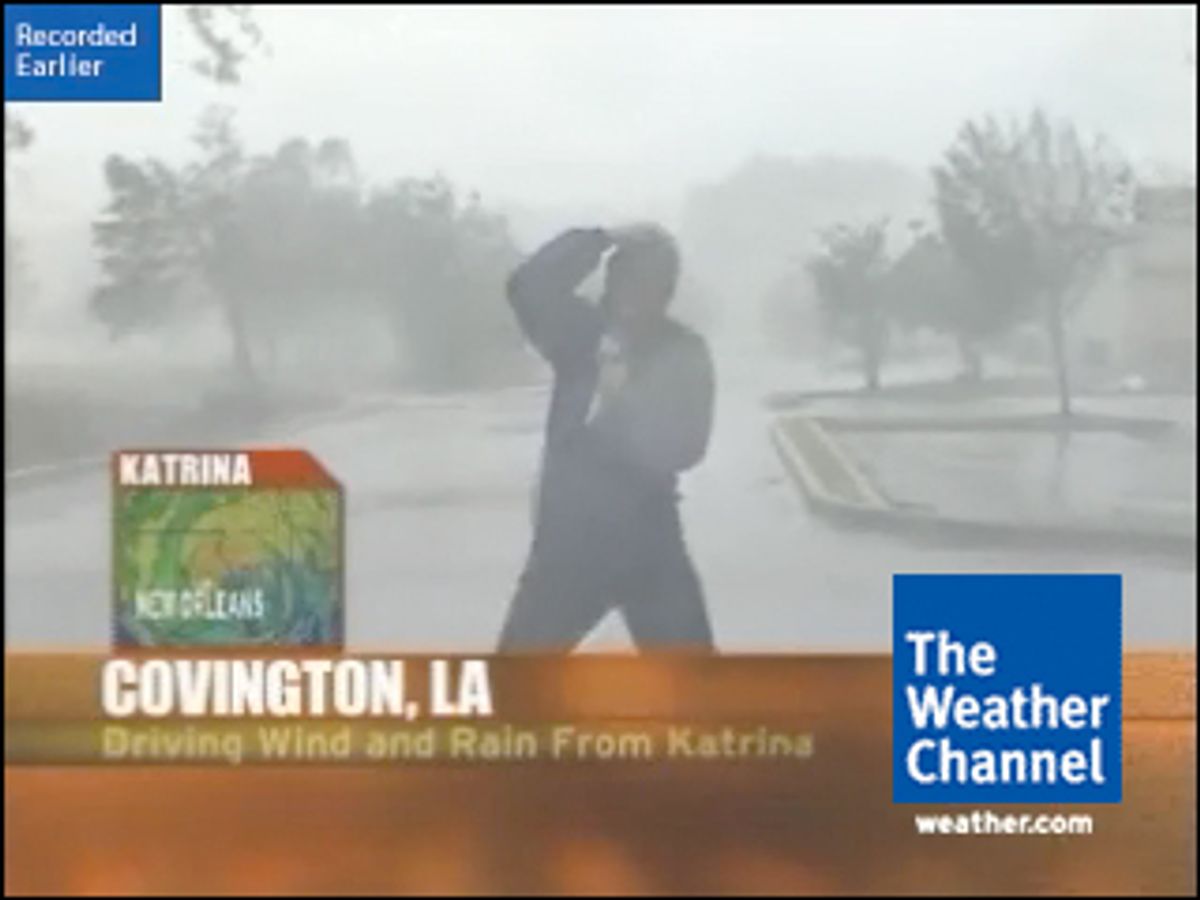
For those who tune in regularly to the Weather Channel during hurricane season, the usual storm-tracking excitement turned to an exercise in dread when Hurricane Katrina gained momentum and appeared to be headed straight for New Orleans on Sunday. Suddenly, all of the worst-case scenarios we've heard over the years, in which Lake Pontchartrain is flooded by storm surges and the levees are breached, seemed to be an impending reality. A mandatory evacuation of New Orleans created traffic jams out of the city; 80 percent of residents were estimated to have evacuated and about 97,000 remained in the city. Tourists and those unwilling or unable to leave grimly lined up by the thousands to enter the Superdome, clutching sleeping bags and pillows, as viewers at home had to wonder just how safe a structure with a massive roof would be during a Category 5 hurricane. Mayor Ray Nagin said that the levee system that protected the city would "most likely" fail. Somberly, he told the camera, "We are facing a storm that most of us have long feared."
The otherwise manic, gleeful storm trackers on the Weather Channel were faced with an unusual challenge: covering a storm that could lead to one of the most devastating natural disasters ever witnessed in America. If the city were filled with 25 feet of water, sewage, debris, and coffins, as scientists have predicted could happen under Category 5 conditions, that might lead to thousands of fatalities and the partial destruction of a major American city. How would the press handle the pressures of covering a potential catastrophe of epic proportions?
The fearful, stern looks were the first indication that the Weather Channel anchors were aware of what they were dealing with. Instead of talking about a storm that "packs a punch" or speculating cheerfully over how brutal the conditions might become, the anchors remained glum for most of Sunday night. Every few minutes, text with the title "The Bottom Line: Hurricane Katrina" kept flashing on the screen:
Unfortunately, the sort of people who remain in a city below sea level when a Category 5 hurricane is headed straight for them are unlikely to fear "severe, widespread impacts of long duration." How about "You might drown in flood waters or get crushed by falling debris"?
Of course, a bastion of intrepid reporters were risking just that on Monday morning once Hurricane Katrina came near the coastline. Maybe it was the fact that the storm had shifted to a Category 4 and then a Category 3, or the fact that it had moved slightly to the east of New Orleans, but many of those out in the rain and wind couldn't help but let a little of their thrill-seeking enthusiasm leak into the picture. TWC's most familiar star spoke breathlessly about the "adrenaline rush" of being out in a major storm, and after another reporter spotted 10 feet of water on the roads by the beach, with boats floating up the street, he tried to convince us that he wasn't enjoying the suspense:
"The bad news is, all right and don't miss this, we haven't even gotten into a fraction of this thing yet, and believe me it's going to get a lot worse before it gets better. We still have a 150 mile-an-hour hurricane out there and the worst of it is yet to come! I'm Jim Cantore in Gulfport!"
Soon after that, CNN reporter Gary Tuchman describes Gulfport as "hell on earth."
Meanwhile, in case we had any lingering doubts about the intelligence of the general public, the coverage cut over to Florida Gov. Jeb Bush at a news conference, warning people not to use generators indoors. Apparently officials had received 33 reports of carbon monoxide poisoning. Luckily, instead of telling viewers that the impact could be "very severe," Bush made his message crystal clear by comparing bringing a generator into your home to bringing your car inside and turning it on.
But Floridians with generators in their living rooms weren't the only dimwits on display: Soon, there were reports that trucks were trying to cross over a bridge on the I-10 in the middle of the hurricane, and there was a barge that broke loose and was ramming into a bridge on which CNN's Anderson Cooper was standing. Reporters documented glass and debris flying through the streets in downtown New Orleans. Ominously, a CNN reporter inside the Superdome told us that the roof was falling away and rain was pouring in. "It looks like one section of the Superdome roof may soon peel away from the actual stadium," he said. "This is supposedly the safest place in New Orleans?"
A few minutes later, CNN anchors tried to downplay the situation at the Superdome, explaining that it was only a very thin roof covering that tore away, and the structure itself hadn't been jeopardized.
As the morning wore on, it became clear that, although the levee had been breached, the disaster wasn't going to reach those epic proportions that everyone had feared the day before. On CNN, this gave them a little leeway to drum up whatever drama they could find. We cut to shots, recorded earlier, of a petite CNN reporter trying desperately to shield herself from the wind. At one point, she blew completely out of the frame, and some crew members had to grab her and bring her back in front of the camera. Next, we went to CNN's Rob Marciano in Biloxi, Miss., who showed us how parts of the roof of his hotel had blown away. He also mentioned that a door in the hotel blew shut on a woman's hand, severing her finger.
Next, CNN aired some footage from a local reporter in Alabama, Kimberly Curth of WKRG, who was shouting as she was blown all over the streets of downtown Mobile. A few loud beeps could be heard, and at first it seemed as if CNN was editing out the reporter's swearing as the wind whipped her around. But it turned out the beeps came from a local tornado warning that began to run along the bottom of the local news screen. Not noticing the tickertape on the bottom of the screen, CNN's midday anchor Daryn Kagan cut in with a sneer of disgust, "Well, glad we had the beep there, to get out some of the expletives."
By the afternoon the worst of the storm had passed over New Orleans, and the worst-case scenario hadn't come to pass. Given the eyewitness accounts of reporters and the amateur footage recorded earlier showing debris flying down Canal Street at an alarming speed, casualties appeared imminent, but no one would know the full extent of the damage until Tuesday morning at the earliest. In the meantime, as the storm moves north, a new slate of reporters prepares to brave the wind and rain to bring us more expletives and those severe, widespread impacts of long duration we were warned about hours earlier.
Shares