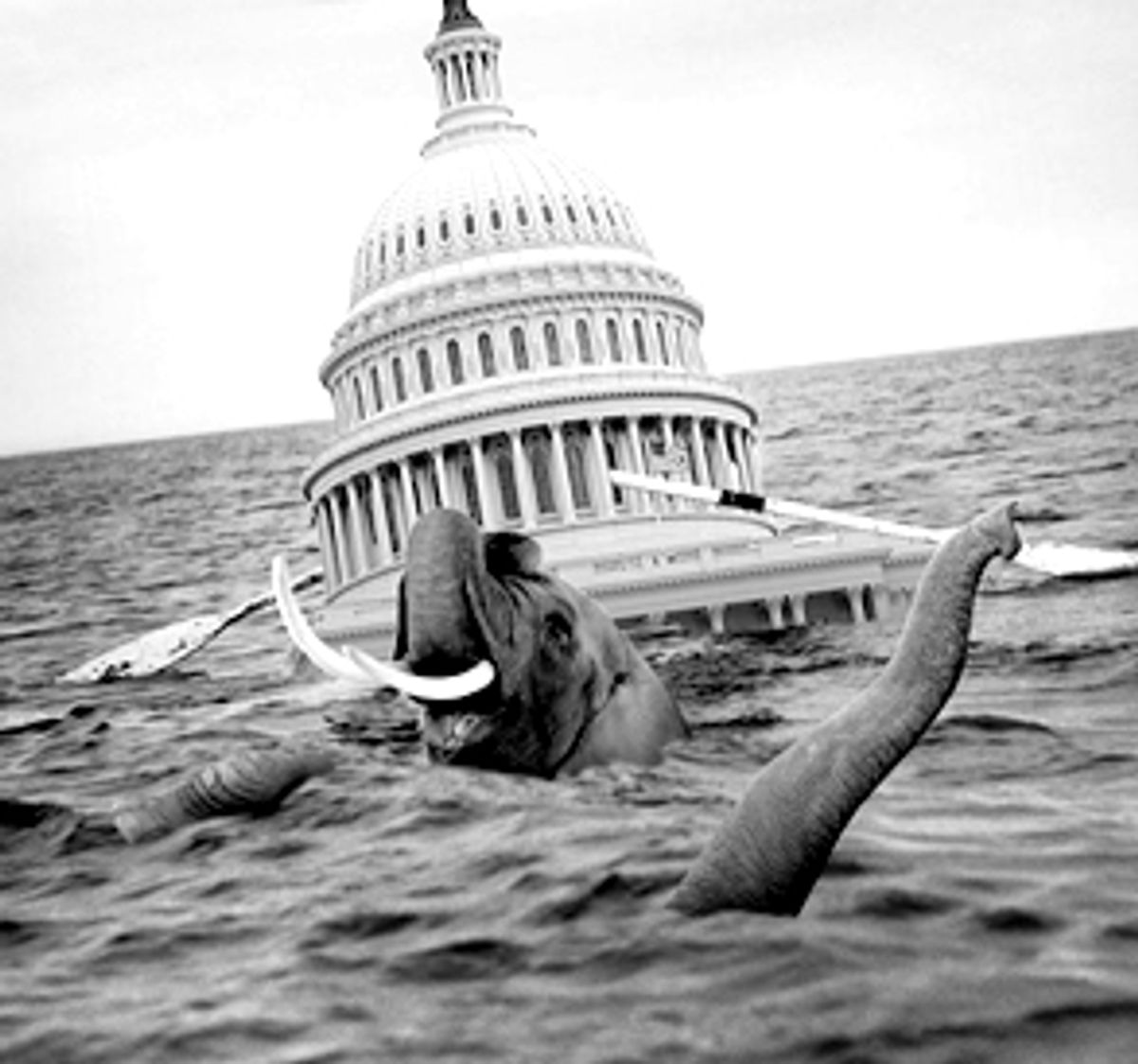
President Bush's absurd question underscores the arrogance of an administration whose "limited government" agenda is responsible for the disastrous federal response to Katrina.
The Bush administration’s mishandling of Hurricane Katrina stands as the pluperfect case study of the Republican Party’s theory and practice of government. For decades conservatives have funded think tanks, filled libraries and conducted political campaigns to promote the idea of limited government. Now, in New Orleans, the theory has been tested. The floodwaters have rolled over the rhetoric.
Under Bush, government has been “limited” only in certain weak spots, like levees, while in other spots it has vastly expanded into a behemoth subsisting on the greatest deficit spending in our history. State and local governments have not been empowered, but rendered impotent, in the face of circumstances beyond their means in which they have desperately requested federal intervention. Experienced professionals in government have been forced out, tried-and-true policies discarded, expert research ignored, and cronies elevated to senior management.
Before Katrina, the Republican theory received its most apposite formulation by a prominent lobbyist and close advisor to House Majority Leader Tom DeLay, Grover Norquist, who said about government that he wanted to “drown it in the bathtub.” In relation to the waters that surround it, New Orleans has been described as a bathtub, and it has served as the bathtub for Norquist’s wish.
Only two people in the light of recent events have had the daring to articulate a defense of the Republican idea of government. House Speaker Dennis Hastert, asked about rebuilding New Orleans, volunteered: “It doesn’t make sense to me.” He elaborated: “I think federal insurance and everything that goes along with it … we ought to take a second look at that.” Thus Hastert upheld rugged individualism over a modern federal union. Just a month earlier, as it happened, Hastert had put out a press release crowing about his ability to win federal disaster relief for drought-stricken farmers in his Illinois district. While he was too preoccupied attending a campaign fundraiser for a Republican colleague to travel to Washington to vote for the $10.5 billion emergency appropriation to deal with Katrina’s aftereffects, he did finally return to the capital to push for even more drought aid from the Department of Agriculture. Hastert’s philosophy is not undermined by his stupendous hypocrisy, for hypocrisy is at the center of the Republican idea. Hastert simply has the shamelessness of his convictions.
The second defender was Michael Brown, director of the Federal Emergency Management Agency, for which he was qualified by a résumé that includes being fired from his previous job as commissioner of the International Arabian Horse Association and, more important, having been the college roommate of Joe Allbaugh, President Bush’s 2000 campaign manager and Brown’s predecessor at FEMA. On Sept. 1, Brown stated: “Considering the dire circumstances that we have in New Orleans, virtually a city that has been destroyed, things are going relatively well.” Brown was unintentionally Swiftian in his savage irony. The next day, President Bush patted him on the back: “Brownie, you’re doing a heck of a job.” Brown exemplifies the Bush approach to government, a blend of cynicism, cronyism, and incompetence presented with faux innocence as well-meaning service and utter surprise at things going wrong.
Even as the floodwaters poured into New Orleans, unimpeded by any federal effort to stanch the flow, the White House mustered a tightly coordinated rapid response of political damage control. Karl Rove assumed emergency management powers. The strategy was to dampen any criticism of the president, rally the Republican base, and cast blame on the mayor of New Orleans and governor of Louisiana, both Democrats. It was a classic Bush ploy against the backdrop of crisis. The object was to polarize the nation along partisan lines as swiftly as possible. While policy collapsed, politics reigned. Once again, Bush the divider, not the uniter, emerged.
The White House released a waterfall of themes. No matter how contradictory, administration officials maintained message discipline. The first imperative was to disclaim and deflect responsibility. White House Press Secretary Scott McClellan admonished the press corps, “This is not a time to get into any finger-pointing or politics or anything of that nature.” The president down to the lowliest talk show hosts echoed the line that criticism during the crisis and reporting its causes were unseemly and vaguely unpatriotic.
After establishing that line, the White House laid out other messages to avoiding responsibility. Bush declared, “I don’t think anybody anticipated the breach of the levees.” From his bully pulpit he intended to drown out the reports trickling into print media that he had cut the funding for rebuilding the levees and for flood control. Then Bush assumed the pose of the president above the fray, sadly calling the response “unacceptable.” Meanwhile, he praised “Brownie.”
After Sept. 11, there was an external enemy, “evildoers” against whom to summon fear and fervor. Now, instead, the flood has brought to the surface the deepest national questions of race, class and inequality. On Aug. 30, the day after the hurricane hit, the Census Bureau released figures showing that the poor had increased by 1.1 million since 2003, to 12.7 percent of the population, the fourth annual increase, with blacks and Hispanics the poorest, and the South remaining the poorest region. Since Bush has been in office, poverty has grown by almost 9 percent. (Under President Clinton, poverty fell by 25 percent.) As these issues began to receive serious attention for the first time in years, Bush reiterated that it was inappropriate to “play the blame game.”
Meanwhile, his aides sought to blame New Orleans Mayor Ray Nagin and Louisiana Gov. Kathleen Blanco. On Sept. 3, the Washington Post, citing an anonymous “senior administration official,” reported that Blanco “still had not declared a state of emergency.” Newsweek published a similar report. Within hours, however, the Post published a correction; the report was false. In fact, Blanco had declared an emergency on Aug. 26 and sent President Bush a letter on Aug. 27 requesting that the federal government declare an emergency and provide aid; and, in fact, Bush did make such a declaration, thereby accepting responsibility. Nonetheless, these facts have not stymied White House aides from their drumbeat that state and local officials — but curiously, not the Republican governors of Mississippi and Alabama — are ultimately to blame.
Yet others operated off-message, casting aspersions on the hurricane’s victims. The president’s mother, Barbara Bush, interviewed on American Public Media’s “Marketplace” program,” said of the displaced from Louisiana who are temporarily housed in Houston’s Astrodome, “What I’m hearing, which is sort of scary, is they all want to stay in Texas. Everyone is so overwhelmed by the hospitality. And so many of the people in the arena here, you know, were underprivileged anyway, so this — this is working very well for them.”
And Sen. Rick Santorum, R-Pa., suggested that the residents of New Orleans who failed to escape the flood should be punished. “I mean, you have people who don’t heed those warnings and then put people at risk as a result of not heeding those warnings. There may be a need to look at tougher penalties on those who decide to ride it out and understand that there are consequences to not leaving.”
The White House sought to turn back the rising tide of anger among blacks by deputizing Secretary of State Condoleezza Rice. During the early days of the hurricane and flood, she had been vacationing in New York, taking in Monty Python’s “Spamalot” and spending thousands on shoes at Ferragamo on Fifth Avenue. In the store, a fellow shopper reportedly confronted her, saying, “How dare you shop for shoes while thousands are dying and homeless!” — prompting security men to bodily remove the woman. A week after the hurricane, Rice mounted the pulpit at a black church in Whistler, Ala. “The Lord Jesus Christ is going to come on time,” she preached, “if we just wait.” One hundred and 10 years after Booker T. Washington counseled patience and acceptance to the race in his famous “Atlanta Compromise” speech in the aftermath of Reconstruction’s betrayal, the highest African-American official in the land updated his advice of forbearance.
After a Cabinet meeting on Tuesday, Bush warned against the “blame game” as he pointed his finger: “Bureaucracy is not going to stand in the way of getting the job done for the people.” His aides briefed reporters on background that “bureaucracy” of course referred to state and local officials. That night, at the White House, Bush met with congressional leaders of both parties, and House Minority Leader Nancy Pelosi urged Bush to fire Brown. “Why would I do that?” the president replied. “Because of all that went wrong, of all that didn’t go right last week,” she explained. To which he answered, “What didn’t go right?”
Bush’s denigration of “bureaucracy” raises the question of the principals responsible in his own bureaucracy. Within hours of the president’s statement, the Associated Press reported that FEMA director Michael Brown had waited five hours after the hurricane struck to request 1,000 workers from Homeland Security secretary Michael Chertoff. Part of their mission, he wrote, would be to “convey a positive image” of the administration’s response.
The New Orleans Times-Picayune disclosed that Max Mayfield, head of the National Hurricane Center, briefed Brown and Chertoff before the hurricane made landfall of its potential disastrous consequences. “We were briefing them way before landfall,” Mayfield said. “It’s not like this was a surprise. We had in the advisories that the levee could be topped.” The day after Bush’s Cabinet room attack on bureaucracy, the St. Petersburg Times revealed that Mayfield had also briefed President Bush in a video conference call. “I just wanted to be able to go to sleep that night knowing that I did all I could do,” Mayfield said.
After its creation in 1979, FEMA became “a political dumping ground,” according to a former FEMA advisory board member. Its ineffective performance after Hurricane Hugo hit South Carolina in 1989 and Hurricane Andrew struck Florida in 1992 exposed the agency’s shortcomings. Then Sen. Fritz Hollings of South Carolina called it “the sorriest bunch of bureaucratic jackasses.” President Clinton appointed James Lee Witt as the new director, the first one ever to have had experience in the field. Witt reinvented the agency, setting high professional standards and efficiently dealing with disasters.
FEMA’s success as a showcase federal agency made it an inviting target for the incoming Bush team. Allbaugh, Bush’s former campaign manager, became the new director, and he immediately began to dismantle the professional staff, privatize many functions and degrade its operations. In his testimony before the Senate, Allbaugh attacked the agency he headed as an example of unresponsive bureaucracy: “Many are concerned that Federal disaster assistance may have evolved into both an oversized entitlement program and a disincentive to effective State and local risk management. Expectations of when the Federal Government should be involved and the degree of involvement may have ballooned beyond what is an appropriate level. We must restore the predominant role of State and local response to most disasters.”
After Sept. 11, 2001, FEMA was subsumed into the new Department of Homeland Security and lost its Cabinet rank. The staff was cut by more than 10 percent, and the budget has been cut every year since and most of its disaster relief efforts disbanded. “Three out of every four dollars the agency provides in local preparedness and first-responder grants go to terrorism-related activities, even though a recent Government Accountability Office report quotes local officials as saying what they really need is money to prepare for natural disasters and accidents,” the Los Angeles Times reported.
After Allbaugh retired from FEMA in 2003, handing over the agency to his deputy and college roommate, Brown, he set up a lucrative lobbying firm, the Allbaugh Co., which mounts “legislative and regulatory campaigns” for its corporate clients, according its Web site. After the Iraq war, Allbaugh established New Bridge Strategies to facilitate business for contractors there. He also created Diligence, a firm to provide security to private companies operating in Iraq. Haley Barbour, the former chairman of the Republican National Committee and now governor of Mississippi, helped Allbaugh start all his ventures through his lobbying and law firm, Barbour Griffith and Rogers. Indeed, the entire Allbaugh complex is housed at Barbour Griffith and Rogers. Ed Rogers, Barbour’s partner, has become a vice president of Diligence. Diane Allbaugh, Allbaugh’s wife, went to work at Barbour Griffith and Rogers. And Neil Bush, the president’s brother, received $60,000 as a consultant to New Bridge Strategies.
On Sept. 1, the Pentagon announced the award of a major contract for repair of damaged naval facilities on the Gulf Coast to Halliburton, the firm whose former CEO is Vice President Dick Cheney and whose chief lobbyist is Joe Allbaugh.
Hurricane Katrina is the anti-9/11 in its divisive political effect, its unearthing of underlying domestic problems, and its disorienting impact on the president and his administration. Yet, in other ways, the failure of government before the hurricane struck is reminiscent of the failures leading into 9/11. The demotion of FEMA resembles the demotion of counterterrorism czar Richard Clarke. In both cases, the administration ignored clear warnings.
In a conversation with a former diplomat with decades of experience, I raised these parallels. But the Bush administration response evoked something else for him. “It reminds me of Africa,” he said. “Governments that prey on their people.”
This story has been changed since it was originally published.
Sidney Blumenthal, a former assistant and senior advisor to President Clinton, writes a column for Salon and the Guardian of London. His new book is titled "How Bush Rules: Chronicles of a Radical Regime." He is a senior fellow at the New York University Center on Law and Security.
More Sidney Blumenthal.
FILE - In this Jan. 26, 2012 file photo, Republican presidential candidates, former House Speaker Newt Gingrich and former Massachusetts Gov. Mitt Romney talk during a commercial break at the Republican presidential candidates debate in Jacksonville, Fla. Remember Gingrich calling Romney a liar? Michele Bachmann saying Romney's unelectable? Rick Santorum calling Romney "the worst Republican in the country" to run against Obama? They're hoping you don't. And acting like it never happened _ even though most of their words are just clicks away online. (AP Photo/Matt Rourke, File)(Credit: AP)
WASHINGTON (AP) — Remember Newt Gingrich calling Mitt Romney a liar? Michele Bachmann saying Romney’s unelectable? Rick Santorum calling Romney “the worst Republican in the country” to run against President Barack Obama?
They’re hoping you don’t. And acting like it never happened (even though most of their words are just clicks away online.)
One by one — with the exception of holdout Ron Paul — the GOP also-rans have coughed up endorsements of their onetime rival. And as they do, they’re pulling rhetorical backflips to distance themselves from their former harsh assessments of Romney.
Don’t try this at home, folks. It takes a professional politician to pull it off with a straight face.
A sampling of the also-rans’ anti-Romney rhetoric when they were candidates and their obligatory niceness after endorsing Romney.
___
RICK SANTORUM
The former Pennsylvania senator still doesn’t have trouble curbing his enthusiasm for Romney. He waited a month after dropping out of the race to endorse Romney, then emailed his tepid endorsement in the dead of night. He finally got out the E-word in the 13th paragraph of his 16-paragraph statement.
THEN:
—”He is the worst Republican in the country to put up against Barack Obama.” Santorum later said he was referring to Romney’s standing on health care reform.
—”If Mitt Romney’s an economic heavyweight, we’re in trouble, because he was 47th out of 50 in job creation in the state of Massachusetts when he was governor. He may have had some success at making money for himself and his partners at Bain Capital, and I give him a lot of credit for doing so, but that’s a very different thing than going out and creating an atmosphere for people to create — that create jobs.”
NOW:
—”There are many significant areas in which we agree: the need for lower taxes, smaller government and a reduction in out-of-control spending. We certainly agree that abortion is wrong and marriage should be between one man and one woman. I am also comfortable with Gov. Romney on foreign policy matters, and we share the belief that we can never allow Iran to possess nuclear weapons. And while I had concerns about Gov. Romney making a case as a candidate about fighting against Obamacare, I have no doubt if elected he will work with a Republican Congress to repeal it and replace it.” — Endorsement emailed to Santorum supporters.
___
NEWT GINGRICH
Gingrich didn’t formally endorse Romney when he dropped out of the race but spoke well of him and later said that was close enough. The guy who promised not to run down his GOP opponents at the start of the race had some withering things to say about Romney during the heat of the campaign. Gingrich, a former House speaker, would rather you forget that now, though: His anti-Romney videos on YouTube, once public, are now private. The man who repeatedly branded Romney a “Massachusetts moderate” now calls him a “solid conservative.”
THEN:
—”Someone who will lie to you to get to be president will lie to you when he is president.”
—Are you calling Mitt Romney a liar? “Yes.” Questioned about his previous comment.
—”Can we drop a little bit of the pious baloney?” To Romney during a debate.
—”Why would you want to nominate the guy who lost to the guy who lost to Obama?”
—”We are not going to beat Barack Obama with some guy who has Swiss bank accounts, Cayman Island accounts, owns shares of Goldman Sachs while it forecloses on Florida and is himself a stockholder in Fannie Mae and Freddie Mac while he tries to think the rest of us are too stupid to put the dots together and understand what this is all about.”
—”I think that a bold Reagan conservative with a very strong economic plan is a lot more likely to succeed in that campaign than a relatively timid Massachusetts moderate who even The Wall Street Journal said had an economic plan so timid it resembled Obama.”
NOW:
—”I’m going to campaign for him, I favor him over Obama. I went through, like, seven different issues where I favor him. I’ll do everything I can to help elect Romney. … As far as I’m concerned, I’ve endorsed him.”
—”Compared to Barack Obama, Mitt Romney is a solid conservative. And I think you have to come down to, what’s the choice this November? And the choice is the most radical president in American history and a failed president at the economy and somebody who has a solid record on jobs and who, in fact, on basic principles, is conservative. And I think you can get into arguments about who’s how conservative, but compared to Obama, Mitt Romney is a solid conservative.”
___
MICHELE BACHMANN
Bachmann waited four months after dropping out before she endorsed Romney. The congresswoman from Minnesota campaigned with him in Virginia earlier this month but didn’t bring up health care in their joint appearance.
THEN:
—”He can’t beat Obama because his policy is the basis of Obamacare. The signature issue of Obama is Obamacare. You can’t have a candidate who has given the blueprint for Obamacare. It’s too identical. It’s not going to happen.”
—”He’s been very inconsistent on his positions. He’s been on both sides of the abortion issue, on both sides of the issue with same-sex marriage … he was for the TARP bill, the $700 billion bailout and the global warming initiatives.”
NOW:
—”I am endorsing Gov. Mitt Romney for president of the United States, a man who will preserve the American dream of prosperity and liberty.”
—”This is what victory looks like.” Campaigning with Romney in Portsmouth, Va., on the day she endorsed him.
—”He’s very smart. He has a very optimistic message. Women trust him because they see, this is a man who started a business from scratch, for heaven’s sake.”
—”One thing that Mitt Romney has demonstrated, he will repeal Obamacare. That’s a big compare and contrast between Barack Obama. We will never get rid of socialized medicine, which is Obamacare, under Barack Obama. Mitt Romney has committed himself to repealing Obamacare. … A lot of people know Mitt Romney’s positive agenda.”
___
RICK PERRY
If he couldn’t have the GOP nomination himself, Perry still wasn’t about to back Romney. As he dropped out of the race, the Texas governor endorsed Gingrich. He didn’t come around to endorsing Romney until Gingrich announced last month that he was planning to drop out.
THEN:
—”While you were the governor of Massachusetts in that period of time, you were 47th in the nation in job creation. … You failed as the governor of Massachusetts.”
—”If you are a victim of Bain Capital’s downsizing, it’s the ultimate insult for Mitt Romney to come to South Carolina to tell you he feels your pain. Because he caused it.”
—”I have no doubt that Mitt Romney was worried about pink slips — whether he’d have enough of them to hand out.”
NOW:
—”Mitt Romney has earned the Republican presidential nomination through hard work, a strong organization and a disciplined message of restoring America after nearly four years of failed, job-killing policies from President Obama and his administration.”
___
JON HUNTSMAN
The former Utah governor endorsed Romney at the same time he dropped out of the race in January, but there was no joint appearance.
THEN:
—”You can’t be a perfectly lubricated weather vane on the important issues of the day.”
—”Gov. Romney enjoys firing people. I enjoy creating jobs.”
—”When you combine a record of uncertainty — running first as a senator, as a liberal; governor as a moderate; then as a conservative for the presidency, people wonder where your core is.”
—”He’s been on three sides of every major issue of the day. And because of that it’s going to be very tough in the end to be able to make that trust argument to the American people.”
NOW:
—”It is now time for our party to unite around the candidate best equipped to defeat Barack Obama. Despite our differences and the space between us on some of the issues, I believe that candidate is Gov. Mitt Romney.”
—”I think he’s the best equipped by far to deal with the economic issues and challenges that confront us. … He’s grown a lot, he’s learned a lot. He’s probably better prepared to lead.”
___
RON PAUL
The scrappy Texas congressman was the last man standing among Romney’s GOP opponents, and he’s not ready to make nice yet. Paul announced this week that he won’t campaign anymore, but he’s still collecting delegates at state party conventions and could give Romney grief at the national nominating convention in Tampa, Fla., come August. Paul ran some scorching ads against Romney earlier this year but shied away from going after Romney in person.
THEN:
—Narrator in Ron Paul radio ad: “Mitt Romney can’t fight against Obamacare because he supported the same mandates and government takeovers as governor of Massachusetts. Romney can’t stand up against more bailouts because he supported them. He can’t lead the charge to shrink the government because he has grown it. Romney’s record is liberal and putting him up against Obama is a recipe for defeat.”
NOW:
—”Not soon.” Paul’s answer when he asked Tuesday when he’ll endorse Romney.
___
Associated Press writer Jack Gillum contributed to this report.
Tuesday afternoon, senior political writer Steve Kornacki joined a panel to discuss Rick Santorum’s begrudged “endorsement” of Mitt Romney for president in 2012, arguing that as time goes on, it’s “less and less an issue of Romney unifying the right,” and more an issue of cultural supremacy.
Now that the Romney campaign is officially shaking its Etch-A-Sketch, the name “Rick Santorum” will begin to fade from our collective memory. As he exits the national stage, I find myself wondering what kept him from capitalizing on the “anything-but-Romney” attitude that seemed to define many Republican voters’ attitudes. Money, certainly, was a significant and well-documented driver of the outcome. But what if we sought to understand the primary through a data-driven lens?
An interesting question, for sure, but, as anyone who works with data knows, the first challenge is to get your hands on the numbers. Fortunately, there’s one source of data that politicians are eager to provide in limitless quantities: their words.
In order to make sense of a mountain of words, I created a tool that analyzes the frequency of word and phrase usage in a body of text. The texts in this case were the transcripts of candidates’ speeches and interviews culled from Project Vote Smart between January and early April, creating a corpus of over 80,000 words (roughly the number of words in a 320-page novel). The tool then identifies phrases of one to six words in length that have been used with a non-trivial frequency. So what does it tell us?
On the Primary and the General Election
The popular understanding of the Republican primary was that Romney was more focused on Obama, while Santorum was busy battling Romney. The data bears this out: While both candidates mentioned Obama with high frequency — 2.2 mentions per thousand (MPT) for Romney, 2.0 MPT for Santorum — Santorum discussed other Republican candidates (3.8 MPT for his Republican peers) about three and a half times as often as Romney (1.1 MPT).
On a related and somewhat humorous note, one of Santorum’s favorite eight-word phrases was “Romney is the worst Republican in the country.” Digging into the actual text turned up a second, related phrase commonly used by Santorum: “make Barack Obama the issue in this [election].” Santorum generally used that phrase to compare “Romneycare” (a word with a relatively high 0.4 MPT for Santorum) with “Obamacare.” By contrast, one of Romney’s favorite six-word phrases was: “I’m going to become the nominee.”
On Job Creation and the Economy
One of the main memes of this election cycle has been “jobs” and “job creation.” (Admittedly, it’s at least a minor meme in every presidential election.) But who talked about jobs more often? Romney did — more than twice as often, in fact. Romney had a “job creation”-related MPT of 1.7, compared to 0.8 for Santorum.
A related, significant component of the broader discussion on the economy was the subprime mortgage crisis. When it comes to terms that are a part of this discussion such as “Fannie,” “Freddie” and “homes,” Romney was once again the dominant voice, with an MPT of 1.0, well above Santorum’s MPT of 0.2
While Romney addressed specific aspects of the economy more often, both candidates discussed the “economy” with a relatively close (and fairly high) frequency. Santorum’s MPT for economic terms was 1.9, only about 13 percent lower than Romney’s MPT of 2.2.
Faith and Conservatism
Santorum used faith-related terms about three times as frequently as Romney did, based on the occurrence of words like “God,” “faith,” “church,” “Christian” and “religion.” Romney had about 0.5 MPT, as compared to Santorum’s 1.4 MPT.
Both candidates had good reason to discuss their conservative credentials: Voters and the media constantly questioned Romney’s conservatism, and Santorum’s steadfast conservatism was a competitive differentiator. And yet, it was Santorum who mentioned “conservative” and “conservatism” about 40 percent more frequently than Romney, with an MPT of 1.4 against Romney’s 1.0. In the end, one of Santorum’s clearest advantages — one that he spoke about with regularity — did not pay dividends.
Speech Patterns: Vocabulary and Verbal Tics
As it turns out, both candidates had nearly an identical-size vocabulary across the body of text analyzed. Santorum used 4,088 unique words, while Romney used 4,090. By another measure, however, Romney spoke with more diversity: Santorum repeated 247 two-word phrases more than 15 times each, representing over 20.3 percent of his speech. Romney had just 233 such phrases, representing only 18.5 percent of his speech.
But when it comes to common verbal tics like “uh,” “um” and “you know,” Santorum was the undisputed leader. While transcripts generally don’t include “um” and “uh,” they capture in spades “you know,” “well” and the repetition of common words, such as “the … the.” Romney demonstrated a “verbal tic” MPT of only 6.0, compared to Santorum’s 9.8. In fact, roughly one out of every 200 two-word phrases uttered by Santorum was “you know.”
Bringing It All Together
The above analysis allows us to roll up all of these topics into a fascinating side-by-side comparison. It’s important to note that these figures are very meaningful when comparing candidates. When it comes to topic-to-topic comparisons, the results may be deceiving. It’s easy to count mentions of President Obama’s name, for example; it’s much harder to calculate mentions of specific topics — like jobs or the economy — that have many different synonyms. Nevertheless, these figures provide a directional, data-driven picture of how much time each candidate spent discussing any particular issue.
While the ultimate reason for Santorum’s loss might have more to do with money and momentum, these results point to two possible conclusions. The first (and more likely) is that these differences are exactly what enabled Santorum to stay competitive as long as he did, and that an apples-to-apples choice on economic issues would have sealed Romney’s candidacy earlier. But might Santorum have done better by dedicating more time to jobs and housing? Did he spend too much time attacking Romney instead of focusing on his own positions? Did Santorum’s propensity for verbal tics shake voters’ confidence?
As Romney now rejiggers his message for the general election, he’s likely to emphasize even more the subjects that have been his main talking points throughout the primary: the economy and President Obama. Whether his faith becomes more or less of an issue as Election Day nears remains to be seen. And his discussion of “other candidates” will disappear completely — unless, that is, you’re counting on another comeback from Newt Gingrich.
Left unsaid is that a certain candidate would never “curse out” a New York Times reporter, because a certain candidate simply doesn’t curse. Mitt Romney can’t bring himself to say “hell” in public. When, during the 2002 Salt Lake City Olympics, Romney was accused of publicly berating a volunteer security officer, he denied only that he swore while doing so: “I would not, have not, and never would use the f-word,” he told the press. He admitted only to saying “H-E double hockey sticks.” The irony is that Romney actually has a horrible relationship with the press, he just doesn’t make a big show of it.
Romney fundamentally distrusts journalists. He freezes them out. When he was in the private sector, he could happily ignore them. In politics, he prefers to manage them with as much distance as possible. His campaign was notorious for essentially ignoring journalists entirely, until they belatedly realized that, you know, journalists could be induced to write nice things about the candidate if they are treated humanely. Hence: baked Lays for the press corps and an Ann Romney charm offensive.
When your candidate’s media strategy is total avoidance, you don’t really get conservative movement “cred” for hating the liberal media. Meanwhile, Newt Gingrich lives for the attention of the press, and his ostentatious displays of media hatred are basically what Santorum was trying to emulate this weekend.
In 2007, Romney lost his cool with AP reporter Glen Johnson. Here’s Romney, unfiltered and pissed off!
“Excuse me, excuse me, Glen!” You accuse Mitt Romney of lying, you get a stern but polite response.
You attack Mitt Romney’s religion, and then accuse him of “running away” from his church, as Iowa conservative talk show host Jan Mickelson did in 2007, and you get … firm, polite debate!
This gets raw 10 minutes in, when they go off the air. “You’re wrong!” is about as salty as it gets.
Unhappily for Romney, he gets the same treatment from Fox News that it typically saves for liberals — there’s no “safe” media outlet to shill for him, as Fox does for most other Republican candidates. Romney’s entire media base is perhaps a few newspaper columnists.
Romney-hating conservatives are ignoring the candidate who hates the mainstream media most of all. If he could find some way to get that message across, keeping in mind the challenge of avoiding profanity, he might have an easier time in this endless primary.
Alex Pareene writes about politics for Salon and is the author of "The Rude Guide to Mitt." Email him at apareene@salon.com and follow him on Twitter @pareene
More Alex Pareene.
If Rick Santorum is a little frustrated these days, it’s hard to blame him. On Saturday, he scored a resounding primary victory, demolishing Mitt Romney in Louisiana, the 11th state to side with the former Pennsylvania senator so far. The prospects for similarly lopsided Santorum wins throughout the spring are good, but his own party’s leaders and the political world in general just don’t seem to care.
“Unless something unusual happens, unless Romney steps on a land mine, he looks like he’s going to be the nominee,” Haley Barbour, the former Mississippi governor and RNC chairman, said on Sunday. That pronouncement came a few days after Jeb Bush came out for Romney and Jim DeMint essentially did the same, and it was followed today by endorsements of Romney from Kevin McCarthy, the No. 3 Republican in the House, and Utah Sen. Mike Lee, a Tea Party icon. According to Politico’s Jonathan Martin, the endorsement floodgates may really open if Romney prevails in next week’s Wisconsin primary.
In a way, the growing consensus that the GOP race is over and that Santorum has been reduced to an irritant’s role makes sense. Basic voting patterns that are apparently immune to momentum have seemingly taken over, guaranteeing Romney a floor of support that is very, very likely to push him past the magic 1,144-delegate number by the end of the primary season. And, obviously, it’s in the interest of Republican Party leaders to unite their party around a nominee as soon as possible.
But Santorum is an odd sort of doomed candidate because — as he demonstrated over the weekend — he’s still capable of winning primaries, often by big margins. A significant chunk of the Republican base is still eager to vote for someone, anyone other than Romney, and it’s entirely possible that Santorum will end up winning more than 20 states. There’s also still a theoretical possibility that Romney will fall short of 1,144 during the primary season, which would create a theoretical opportunity for Santorum to use the pre-convention months this summer to win the nomination. This makes him different than previous candidates who were accused of hanging around too long. Pat Buchanan in 1996, Jerry Brown in 1992, and Jesse Jackson and Pat Robertson in 1988 were being drubbed in primary after primary when the political world decided to ignore their campaigns and treat the process as finished. They weren’t still racking up victories.
If there’s a parallel for what Santorum is now facing, it can be found in George H.W. Bush’s 1980 campaign. At roughly this same point in the process, Bush had around 200 delegates, far behind Ronald Reagan, who had nearly 600 – with 998 needed to win the nomination. Except for John Anderson, who left the race to run as an independent, all of the Republican candidates who’d dropped out – Bob Dole, Howard Baker, Phil Crane and John Connally – had thrown support to Reagan, and key party leaders were jumping on board too. There were loud calls for Bush to quit, and warnings that his lingering presence would damage Reagan’s chances of knocking off Jimmy Carter in the fall. The Reagan campaign itself adopted a strategy of ignoring its last remaining rival.
But Bush, who came to the race with scant name recognition and support only to break through with a surprise Iowa victory, remained viable in key state primaries. On April 22, he beat Reagan in Pennsylvania by 8 points. Ten days later, he nearly won in Texas, which had been one of Reagan’s strongest states in 1976. And on May 20, he scored an absolute landslide in Michigan, annihilating Reagan by 25 points.
Bush, who campaigned as a supporter of abortion rights and the Equal Rights Amendment and a critic of Reagan’s supply-side economic agenda, was running from the left, but he was playing the same basic role that Santorum now is – the vehicle for the unusually large number of Republicans who really, really didn’t want to support the front-runner.
Today, the holdouts that Santorum is appealing to are mainly religious conservatives in the South and in rural areas across the country. Those voters were part of Reagan’s base in ’80. But the GOP back then still had a Rockefeller wing and was still a major force in the Northeast and industrial states, and among these Republicans Reagan was seen as an extreme ideologue who would have trouble winning in the fall.
Like Santorum, it took Bush a long time to get the one-on-one race he’d always wanted; if Baker and Anderson had dropped out sooner, he probably would have won more states. But even as his inevitability built, Reagan continued to encounter stiff resistance from moderate and liberal Republicans. As late as May, a national poll of Republican voters put Reagan only 8 points ahead of Bush.
Two factors ultimately pushed Bush out of the race. One was practical: On the night of his big Michigan victory, several news organizations announced that Reagan had nonetheless cleared the 998-delegate mark. This was a matter of dispute; then as now, there was no uniform delegate tally and serious disagreement over how to account for them. Plus, Bush’s campaign was insisting that hundreds of delegates who’d been pledged to Reagan during the primaries were actually free agents. The Bush strategy was to demonstrate strength in the late primaries, then to pressure these delegates into backing him. But the loud declarations from major news outlets that the race was over rained on Bush’s Michigan parade and dried up his fundraising overnight. Within days, he was out of the race.
Of course, Bush had another incentive not to press on any further. The depths of intraparty Reagan resistance that his campaign had revealed increased the pressure on Reagan to choose a moderate as his running mate. And Bush, by virtue of his surprisingly strong primary season showing, would be a logical choice for the role. In the days before dropping out, Bush had called himself “unequivocally opposed” to serving as Reagan’s No. 2. But after bowing out, he stopped issuing denials, and when Reagan’s effort to entice the preeminent GOP moderate, former President Gerald Ford, onto his ticket failed, Bush became the choice.
Santorum’s candidacy has highlighted similar intraparty resistance to Romney, so the same basic logic that landed Bush on the ticket 32 years ago could apply to him. It’s true that the Republicans who’ve been lining up behind Santorum seem mainly motivated not by affection for him but by opposition to Romney, but this was also the case for Bush in his race against Reagan. It’s also true that Santorum is stridently attacking Romney right now, but, again, Bush did the same thing to Reagan well into the spring of 1980 (when, for instance, he accused Reagan of trying to turn the clock back to the 18th century).
Santorum’s odds of winning the nomination are not entirely nonexistent right now, but they are slim. His chances of procuring the vice presidency are probably much better. As the calls for his exit grow louder in the weeks ahead, he may do well to consider what listening to them did for the last GOP candidate in his situation.
Steve Kornacki writes about politics for Salon. Reach him by email at SKornacki@salon.com and follow him on Twitter @SteveKornacki
More Steve Kornacki.