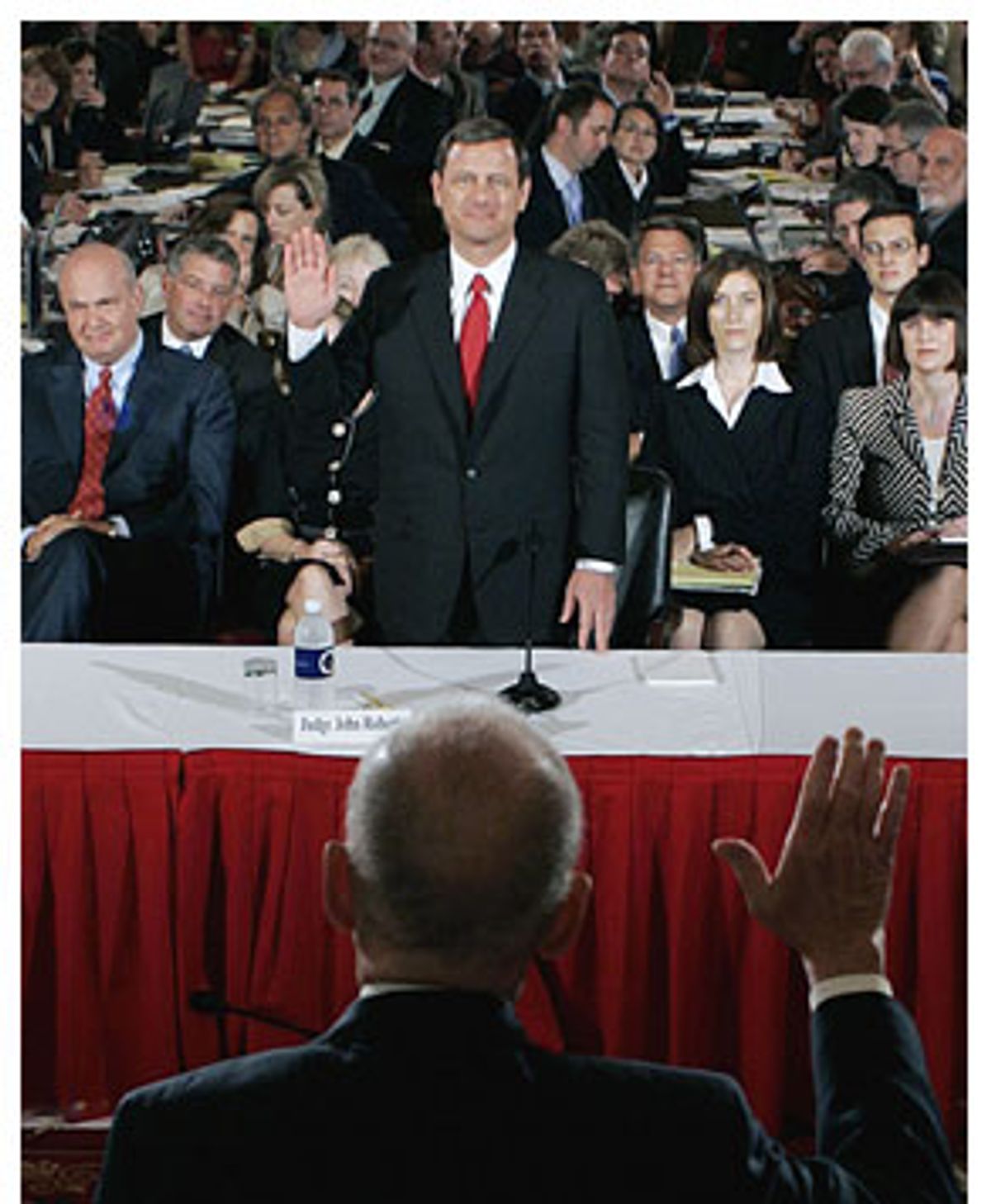
The first day of John Roberts' confirmation hearings played as expected, with senators posturing, Judge Roberts saying nothing, and a pro-life activist dressed as Betsy Ross setting off a metal detector.
At some point in August, Judge John G. Roberts Jr., President Bush’s nominee to head the U.S. Supreme Court, appears to have found time to tan. He entered the Russell Caucus Room Monday for the first day of his confirmation hearing with his face glowing in an even bronze tone, a striking feature in a room of uniformly pasty white men and women. His skin contrasted with his starched white collar, his charcoal suit and his cherry-red power tie. It made his smile gleam. “You are obviously very talented,” Sen. Russ Feingold, D-Wis., told Roberts once the hearing got under way. “And you also look healthy.”
To complete the visual package, Roberts brought with him some of the cutest kids the Senate has seen, two blond cherubs, 4-year-old Jack, who wore a gray bow tie, and 5-year old Josie, in a white headband. Then he delivered the hearing’s most memorable line, a sports simile intended to answer the large outstanding questions about his judicial temperament and ideology. “Judges are like umpires,” Roberts told the Senate Judiciary Committee, in an opening statement delivered from memory. “I will remember that it is my job to call balls and strikes, and not to pitch or bat.” Like Roberts, the line sounded good, but that was all. It provided no actual insights.
That said, the first day of Roberts’ confirmation hearing went well for the nominee, even as it proved to be a practice in platitudes, a four-hour spectacle of partisan posturing and public introductions in a marble hearing room gilded with gold and strung with chandeliers. Senators droned on, while Roberts posed for the camera. Republican and Democratic senators both praised Roberts’ sterling reputation, but that was where their agreement ended.
For Democrats the coming days and weeks of hearings are a chance to crack the handsome shell of Roberts, to find out how he thinks and what he would do to the nation’s highest court. Roberts, they warn, might lead the country backward, to a time when the courts did not protect the powerless against the will of the powerful. “In particular, we need to know his views on civil rights, voting rights and the right to privacy,” said Sen. Edward Kennedy, D-Mass., “especially on the removal of existing barriers to full and fair lives for women, minorities and the disabled.”
By contrast, Republicans argued that the coming hearings — which will start with questions tomorrow — should be an extended exercise in evasion. One by one, Republican senators cited judicial ethics rules and historical precedent to explain why the American people should not expect to hear anything of substance from Roberts before he becomes the chief justice, a position Democrats have taken in the past to protect their own nominees. “Some have said that nominees who do not spill their guts about whatever a senator wants to know are hiding something from the American people,” said Sen. Orrin Hatch, R-Utah, who called that notion “false.” “The Senate traditionally has respected the nominee’s judgment about where to draw the line.”
Committee chairman Sen. Arlen Specter, R-Pa., aptly observed that Roberts’ willingness to describe his own views over the coming days will depend less upon any constitutional duty than his own fear of rejection by the Senate. “Nominees answer about as many questions as they think they have to, to be confirmed,” Specter said in an ad lib that was not in his prepared statement. “It’s a subtle minuet.” If that rule holds true, the coming days are sure to be frustrating for Democrats. Barring an unforeseen revelation, Roberts is widely seen as a shoo-in for confirmation, creating an imbalance between the huge stakes of his nomination and the piddling suspense it has generated. As several senators observed, Roberts is only 50 years old. If confirmed as chief justice, he may place his mark on American law for 30 or 35 years.
But Democrats are not the only ones uncomfortable about the relative dearth of information on Roberts’ legal views. Away from the microphones during a recess, Sam Brownback, R-Kan., said he would prefer it if Roberts just came out and stated his opposition to Roe v. Wade, a case that Brownback blames for the death of 40 million unborn children. “It creates some unease,” Brownback said of Roberts’ unknown position on the case. “I would like to know.”
On the other side of the aisle, Sen. Dianne Feinstein, D-Calif., said she also would like to know where Roberts stands on issues concerning women’s right to choose. “It would be very difficult for me to vote to confirm someone to the Supreme Court whom I knew would overturn Roe v. Wade,” she said. “I remember — many of the young women here don’t — what it was like when abortion was illegal. I knew a woman who killed herself because she was pregnant.”
After the hearing ended, the senators walked out into hallway to spin the day’s events. The spin sounded remarkably like the hearing itself, which will continue at 9:30 a.m. Tuesday in a less resplendent room. “On the other side of the aisle, Judge Roberts was counseled to say as little as possible over and over again,” said Sen. Dick Durbin, D-Ill., in protest. Nan Aron, of the Alliance for Justice, stood nearby speaking of a new letter that Democratic senators had just sent to President Bush asking for more documents from Roberts’ tenure in the Justice Department. Asked if she thought judges should “pitch or bat” instead of just “calling strikes,” she only laughed.
Ed Gillespie, the lobbyist-turned-Republican National Committee chairman, who is guiding Roberts through the confirmation process, stood nearby, outside the men’s room. Asked how he thought the first day had gone, he offered this non sequitur. “When you see someone give an opening statement without the benefit of a single note — he had a blank pad in front of him,” Gillespie said, “it is clear that this is someone who is a very fair, even-handed, open-minded judge.”
There was also a pro-life activist in the hallway, Merrie Turner, wearing a period costume from 1776. She said she was dressed as Betsy Ross, the woman who had sewn the first American flag. When she came in the building, her corset had set off the metal detector. “I just believe that President Bush has made a good selection,” she said of Roberts, though she acknowledged she had no evidence concerning Roberts’ stand on abortion. “He is simply a good judge.”
The Transportation Security Administration, a universally loathed government agency, is facing a shortfall, despite its more than $8 billion budget. Instead of having a debate over what effective airport security might actually look like and how much should reasonably be spent on the honestly rare threat of commercial-air-travel-based terrorism, there was a debate over how best to come up with the money needed for all the radioactive naked picture machines and bomb-sniffing dogs. The Democrats suggested passing on the cost of ineffective, cumbersome and intrusive security theater to citizens, via higher fees on airfares. The Republicans, even more predictably, suggested cutting spending that directly helps poor people to ensure there is enough to spend on stopping imaginary future 9/11s.
The newspaper account of the debate in The Hill just reinforced the Republican spin, highlighting the Democrats’ decision to make people spend more money on the hated TSA and downplaying the actual existing Republican alternative to the proposal, which was not “spend less on the hated TSA” but rather “raise money for the hated TSA by slashing needed aid to states.” The Democrats won, or “won,” and now they will earn the fruits of that victory: well-deserved scorn from everyone. And Ben Nelson (D-Troll Town) voted with the Republicans. (Though surely having users pay the fees for supposedly necessary security measures is perfectly conservative, isn’t it? Am I missing something here? I mean besides the fact that the two sides in this debate weren’t actually “liberal” and “conservative” but rather “people who want to come up with a way of paying for the oppressive and useless national security state” versus “people who want there to be an oppressive national security state but hate government spending on feeding and sheltering impoverished people.”)
I don’t know of anyone not employed by the TSA or some other arm of Homeland Security that believes the TSA does a good job and deserves its massive budget, but everyone in Washington apparently feels differently (and is terrified of being blamed for “voting to cut TSA funding” if there is another terrifying and deadly underwear bomber, of course). This is why everyone hates politics and Congress and Washington. This and Iraq. And the drug war.
Alex Pareene writes about politics for Salon and is the author of "The Rude Guide to Mitt." Email him at apareene@salon.com and follow him on Twitter @pareene
More Alex Pareene.
Questioning President Obama’s birthplace is cool again among Republican office holders and seekers, despite official poo-pooing from the GOP establishment. And nowhere is it more in vogue than in Arizona, where a birther is giving the GOP’s favorite candidate an unexpected run for his money in the U.S. Senate race.
U.S. Rep. Jeff Flake has everything going for him in his bid for a promotion to the Senate: Tons of money, six high-profile terms on Capitol Hill, and the backing of many Republican leaders, including the seat’s current holder, Sen. Jon Kyl, the Senate’s No. 2 Republican, who is retiring this year. He’s also supported by Arizona favorite son John McCain.
Flake was supposed to sail through the GOP primary without lifting a finger, after which he would go on to to crush Democrat Richard Carmona, a former Navy officer and former U.S. surgeon general, in the still right-leaning state.
But a new PPP poll out yesterday may have some Republicans worried, as Flake’s Republican opponent Wil Cardon has hacked 27 points off of Flake’s lead in just three months. Flake is still comfortably ahead by 22 points, but it’s nothing compared to the nearly 50-point lead he had back in February.
In Cardon, Flake is facing a surprisingly tough challenge from not only a political neophyte who has never held public office before, but a birther. When the Arizona Republic asked Cardon whether he believes Obama has sufficiently proven his citizenship, Cardon wouldn’t say, responding only, “I think people who run for office … ought to prove that they meet those qualifications.”
The poll shows Cardon’s rise has to do with his growing name recognition in the state. And while an early round of advertising certainly helped, it’s likely nothing helped as much to raise Cardon’s profile as his birther-curious comments a month ago, which captured national headlines and introduced Cardon to many people for the first time.
And Arizona, more than any other state, has been leading the charge against Obama’s birth certificate. The state legislature has advanced a Donald Trump-backed “birther bill” everyspringsince the president took office, which would require presidential candidates to present a long-form birth certificate before they can appear on the ballot. An Arizona State University poll from earlier this month found 60 percent of Arizonans support the bill.
Gov. Jan Brewer vetoed 2011’s version, which passed the state Senate 20 to 9 and the House 40 to 16, specifically objecting to a provision asking candidates to provide “circumcision certificates,” but it was reintroduced last month thanks to its popularity.
Just last week, Arizona’s Secretary of State Ken Bennett — who is a state co-chairman of Mitt Romney’s presidential campaign — formally requested the state of Hawaii provide proof that Obama’s birth certificate is indeed valid, explaining to a local radio station,”I’m not a birther. I believe the president was born in Hawaii — or at least I hope he was.”
But perhaps no one has done as much to advance the birther cause as Maricopa County Sheriff Joe Arpaio, who, it was revealed yesterday, used taxpayer dollars to send a deputy to Hawaii to investigate Obama’s birth certificate.
While it’s tempting to look at Cardon’s rise in the paradigm of the insurgent Tea Partier against the establishment-backed GOP, Flake is a favorite of the far-right grassroots movement, securing the endorsement of kingmaker Sen. Jim DeMint (R-S.C.) and several Tea Party groups.
Nonetheless, Cardon’s surge could trouble some Republicans still smarting from back-to-back upsets in Indiana and Nebraska, where insurgents Richard Mourdock and Deb Fischer defeated candidates favored by the GOP establishment and even DeMint, respectively.
Flake, however, has been clear that he believes Obama is indeed a U.S. citizen, much to the chagrin of birthers. And while it’s difficult to say with certainty if Cardon can credit his flirtation with birtherism for his rise in the polls, there’s been a startling uptick in the number of Republicans questioning Obama’s citizenship as the 2012 elections have ramped up.
North Carolina alone has seen a handful of GOP congressional candidates railing against Obama’s “poorly reproduced forgery” of a birth certificate, while even some GOP leaders such as Rep. Cliff Stearns (R-Fla.), who has led the charge against Solyndra and Planned Parenthood, have waded into the birther myth. Meanwhile, a PPP poll from March found that more than a third of GOP primary voters in Tennessee, Georgia and Ohio do not believe Obama was born in Hawaii.
How else to read this third wave of the birther myth but that it sells among many GOP voters?
Two recent Senate primary elections produced surprise winners, both of whom are now front-runners for their seats: Deb Fischer in Nebraska, and Richard Mourdock in Indiana.
That’s not all Fischer and Mourdock have in common. Both of them, as it happens, were born in the same year. Harry Truman was president of the United States. Perry Como, Tony Bennett and Mario Lanza dominated the Hit Parade; “I Love Lucy” debuted on TV, if you had TV; and Joe DiMaggio was still playing for the Yankees. They were born in 1951. If they’re elected, they will be 61 years old when they take office.
Fischer and Mourdock were first eligible to vote for president in 1972. That year, while Richard Nixon was sweeping to a landslide victory, 29-year-old Joe Biden was winning a Senate seat in Delaware; he wouldn’t even be eligible for the office until his birthday on Nov. 20. He’s about nine years older than them, but by January he’ll have completed a four-year term as vice president … after his 36-year run in the world’s most exclusive – and rapidly aging – club.
And that, in a nutshell, is a sign of one way the United States Senate has changed over the last several decades.
It’s fairly well known, I think, that the average age of members of Congress has been growing older and older over time. While the current 112th Congress turned slightly in the younger direction, before that virtually every Congress for some time broke records for age, with the 111th Senate peaking at an average of 63.1 years.
But what’s not been reported as far as I know is that one of the big factors in the aging of the Senate is in part a consequence not of high reelection rates or delayed retirement from senators too stubborn to quit, but of changes among incoming senators. Of course, not all newly elected senators are as old as Fischer and Mourdock, and Joe Biden was hardly typical of the 1970s, but as symbols of the change, you could do worse.
Let’s go to the numbers. I looked at the three most recent classes of senators, and four famous elections from the past: the Republican Revolution of 1994; the Reagan takeover of the Senate in 1980; the Watergate babies elected in 1974; and, stretching further back, the famous class of 1958, who would reform Congress and pass civil rights and Great Society legislation. In each case, I only looked at those elected in regular November elections of those years, ignoring those elected or appointed within election cycles (many of those, after all, are just caretakers who rapidly leave the Senate).
First, the recent groups. In 2006, the Democrats took over the Senate, and 10 new senators were elected. Their average age: 54.2 years. The next cycle was also good for the Democrats. Another 10 new senators showed up, with a whopping average age of 56.6. And then Republicans stormed back in 2010; the 13 new senators from that cycle were a slightly younger 52.8. Looking at individual senators, I count 10 of those 33 senators who reached their 60th birthdays before taking the oath of office – which also means that all of them would be on the far side of 65 before their terms expired.
Things look very different if we go back only a few years. The Clinton-era class of 1995 had 11 senators who averaged 48.8 years old. The 18-strong Reagan class of 1981 was only 46.7 years old, while the 10 aptly named Watergate babies tipped the clock at just 45.5 years, over a decade less than those sworn in at the beginning of the Obama presidency. Going way back to 1959, that illustrious group of 18 was just over an average of 50, thanks to the two oldest new senators in the whole study, 69-year-old Stephen Young of Ohio and Ernest Gruening, who was one of Alaska’s first two senators. However, and while I haven’t looked any further, those two look like total flukes; they are the only two 60-year-olds that year, and there are none at all in the Watergate and Reagan groups.
And Mourdock and Fischer are just par for the course in the current election cycle, which features strong contenders David Dewhurst of Texas (he’ll be 67 in January 2013), George Allen in Virginia (60), Angus King in Maine (67) and Elizabeth Warren in Massachusetts (63). Or look at Hawaii: In the Democratic primary, Ed Case (60) and Mazie Hirono (65) are contending to take on Linda Lingle (59). And I really don’t think Tommy Thompson is going to win in Wisconsin (I doubt he’ll make it through the primary), but if he does make it he’ll be 71 years old at the beginning of his term. And those are only the candidates with very good chances of winning.
Now, I certainly don’t have anything against individual older senators. Plenty of members of Congress have been excellent legislators in their 60s and even 70s. But I do think that there’s something wrong when most new senators in 2010 were out of college (where they wrote their term papers on typewriters) before Grandmaster Flash and the Furious Five unleashed the Message; perhaps more to the point, we’re still electing lots of new senators who grew up with Vietnam and the Soviet Union in the background, and hardly any who reached college when the Cold War was history instead of current events. Especially since many senators have said that it takes a full term for them to get fully up to speed – and after a full term, many of our recent new senators are on the far side of 70.
I really don’t have an explanation for why we’re nominating and electing much older Senate candidates these days, but I think it’s an unfortunate trend that can’t make for better representation or for a more engaged and active Senate. I’d like to see more senators in their 30s (and, yes, even in their 20s, ideally). I have no idea how to get there, but if the first part of solving a problem is to identify it, I hope this helps. If young people want Washington to be more receptive to their problems — from climate to student-loan debt — one solution might be to start electing people closer to their own ages.
Ron Paul and Rand Paul (Credit: AP/Charles Dharapak)
So Ron Paul says he is going to stop actively campaigning, but his supporters will continue to rack up delegates by storming state conventions. What will he do with these delegates? That is still unclear. (Barter them for gold?) What is the point of this strategy, exactly? Also unclear, but the Daily Beast’s Ben Jacobs today says it’s part of a “sneaky maneuver” to help his son Rand out. Ron will continue to consolidate power but will not appear to be actively sabotaging the party’s nominee. Dave Weigel says the maneuver is less sneaky and barely a maneuver: He doesn’t want it to be a huge embarrassment when he loses Kentucky, the state his son represents in the Senate.
Interestingly, though perhaps not surprisingly, Paul declined to endorse Libertarian Party nominee Gary Johnson, the former New Mexico governor who endorsed Paul in 2008. Johnson was, formerly, the Republican presidential candidate all those young “liberal” college stoner Ron Paul supporters should have gone with if they’d wanted to support a candidate who believed strongly in liberty but who wasn’t a racist Alex Jonesian conspiracy-mongering goldbug loon. But Johnson had “extensive executive experience” instead of a blimp and a sweet logo, so he did not win over many Paul fanatics.
Ron Paul’s strategy seems to be a gradual takeover of the Republican Party itself, instead of attempting to build a Libertarian alternative to the GOP. I think he’ll find that he can get the party to happily sign on, at least rhetorically, to his fiscal message, as they continue to ignore his popular and populist isolationism and his eminently agreeable but politically untenable positions on criminal justice and civil liberties, forever. The party, in other words, will continue to co-opt whatever they find electorally useful about the Paul phenomenon, as the Tea Party movement stole his iconography and messaging wholesale while attaching it to the same religious-right/nativist sentiment that has driven the party’s activist base for decades.
But Paul thinks the future lies with his son Rand, who shares many of his father’s enthusiasms and beliefs while also appearing to be more acceptable to the mainstream. Various Paul allies and a few other Republicans strongly suggest that Rand is gearing up for a 2016 run; which would mean, of course, that they expect Romney to lose, but that they need to not appear to be rooting for Romney to lose.
The problem is that what makes Rand Paul more acceptable to the mainstream of the Republican Party is what makes him more repellent than his father. Take, for example, Rand Paul’s funny joke this last weekend about Barack Obama and gay marriage.
The president recently weighed in on marriage. And, you know, he said his views were evolving on marriage. Call me cynical but I wasn’t sure that his views on marriage could get any gayer. Now it did kind of bother me, though, that he used the justification for it in a biblical reference. He said the biblical Golden Rule caused him to be for gay marriage …
And I’m like: What version of the Bible is he reading? It’s not the King James version. It’s not the New American Standard. It’s not the New Revised version. I don’t know what version he is getting it from.
Haha Barack Obama is so gay, he should read a Bible for once. Libertarianism!
Nick Gillespie, of the libertarian Reason Magazine, does not get this joke. The crowd, at the Iowa Faith and Freedom Coalition, did seem to get it, or at least they appreciated it. But Rand sounds very different when he speaks to Iowa conservatives than he does when interviewed by Gillespie and Matt Welch. (His address received a nice notice from Robert Costa of the National Review, who did not mention his funny joke.)
While Rand Paul may be, as Gillespie says, the most libertarian senator, he is also not an actual libertarian, as demonstrated by his support for anti-constitutional anti-immigrant legislation and his very vocal antiabortion position. He is also a dumb lout, and I tend to think that having the Senate’s most libertarian member be a dumb lout is not actually that good for the Libertarian movement. When he makes explicitly libertarian arguments, he makes them dumbly. When he goes all anti-gay talk-radio bigot culture warrior, which he does increasingly frequently, he does so dumbly. (If he wants to be a mainstream politician and presidential contender, it was certainly dumb to appear — more than once — on the radio program of Truther/Birther/New World Orderer/every-other-conspiracy promoter Alex Jones, but for some reason he almost entirely escaped mainstream press scrutiny for these appearances.) While I don’t feel much affection for Ron Paul, he seems both significantly smarter and leagues more principled than his son the senator.
If the “electable” face of libertarianism is a fratty anti-gay, anti-choice nitwit like Rand Paul, I will stick with socialism, thank you. And I wonder if the Paul family’s plan is to promote “liberty” or to promote the Paul family.
Alex Pareene writes about politics for Salon and is the author of "The Rude Guide to Mitt." Email him at apareene@salon.com and follow him on Twitter @pareene
More Alex Pareene.
John McCain, Lindsay Graham and Joe Lieberman (Credit: AP)
When John McCain, Lindsey Graham and Joe Lieberman join forces, you can be sure of one thing: It will involve state-sponsored violence. Today, they want us to arm Syrian rebels. Though, you know, what they really wanted to call for was actually bombing the hell out of Syria, until there is freedom. They’re just taking it slow.
The Senate’s three most predictable and least credible warmongering “moderates” frequently join forces to publish joint Op-Eds or hold press conferences and the one thing they always, invariably want is for the United States to have just a little bit more war than it currently has, somewhere far away. Sure, we could draw down in Iraq … or we could listen to McCain, Lieberman and Graham and draw back up. We could draw down in Afghanistan … or we could stay the course and keep sending troops there until we win! Americans may be tired of endless war with no coherent goal, but on the other hand, “only decisive force can prevail in [whatever country John McCain, Lindsey Graham, and Joe Lieberman are talking about now].”
As the Hill recently explained in a story on how John McCain, Lindsey Graham and Joe Lieberman were pushing for a resolution basically promising to make war with Iran, “Graham, Lieberman and McCain are considered some of the top foreign policy experts in the upper chamber,” because they always, invariably support military intervention everywhere for any reason, and that is invariably considered a sign of “seriousness” in Washington. If you don’t like waging wars everywhere, forever, you are a weird kooky hippie, and everyone laughs at you. If you believe that bombs and troops have the power to magically solve all problems, you are invited on all the Sunday shows every week to offer your sober analysis of the foreign situation.
You just never know which country these three will decide needs bombing next! One time the three amigos also took a trip to Tripoli to hang out with Moammar Gadhafi. (They invited Susan Collins along, though usually their sleepover parties are strictly “no girls allowed.”) Sadly, by April of last year, they were no longer friends with Gadhafi, and the three had decided that the United States should assassinate him. (That is not really legal but, you know, “war on terror” and “serious, muscular foreign policy” or something.)
One time Lieberman and Graham tried to hang out with a different senator and they all came up with an idea that didn’t involve bombing anyone but that made McCain mad and he yelled at them. Don’t hang out with John Kerry and try to solve climate change! Hang out with me and let’s try to convince everyone to bomb Russia or something!
Sadly, Joe Lieberman will be leaving the U.S. Senate soon, which means John McCain and Lindsey Graham will need to find a new fake-Democrat best friend to add a patina of “bipartisanship” to their endless demands for explosions and shooting and death.
Alex Pareene writes about politics for Salon and is the author of "The Rude Guide to Mitt." Email him at apareene@salon.com and follow him on Twitter @pareene
More Alex Pareene.