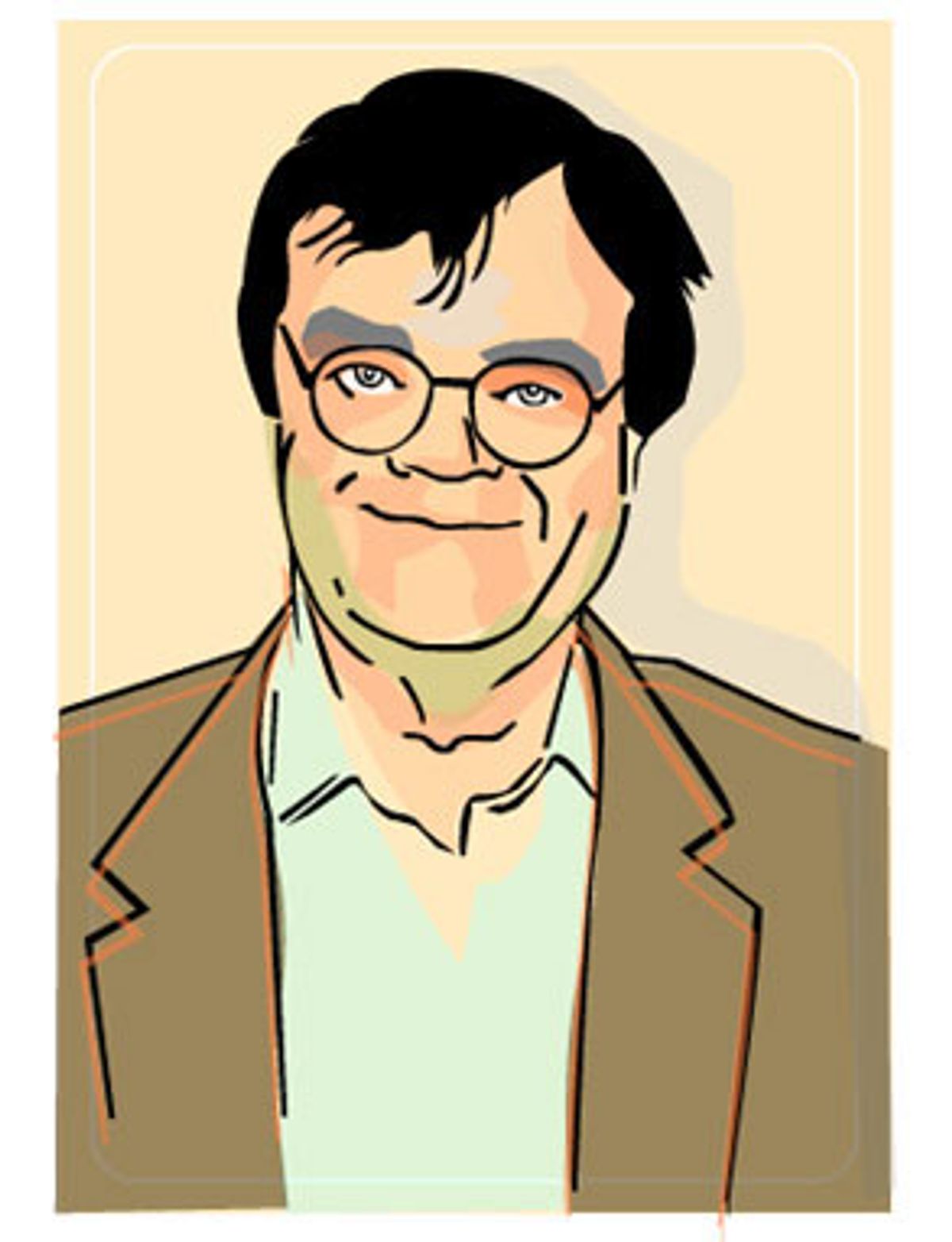
Garrison Keillor

Talk about obscenity

Congress' latest idiotic effort to make the airwaves "decent" explains why Americans favor lawmakers about as much as telemarketers and drunken drivers.

  • more
    • All Share Services

Talk about obscenity

One of the benefits of Katrina is how it got Congress to focus on real things: the relief of suffering and devastation and eventually an investigation to learn why Homeland Security stumbled so badly. And to cancel the nonsense for the time being, such as the push to roll back the estate tax, a private bill for the relief of billionaires; and the Broadcast Decency Enforcement Act, a high-water mark of official stupidity that swept through the House and now is lapping at the doors of the Senate.

The BDEA is the anti-Janet-Jackson’s-nipple bill that would make broadcasters liable for fines of up to $500,000 for any obscene, indecent or profane material they disseminate. Every congressman who voted for it should have his or her name engraved on a brass plaque on the Monument to Cowardice.

To the CBS network, a half-million is petty cash, but to the manager of a radio station in Lexington, Ky., it may mean extinction. So when you hang that enormous sharp sword over his head, you force him to monitor closely everything uttered, muttered, sung or chanted on his airwaves. It is not possible to do that and still have a wife and children. So the station manager is forced to cut out any programming that is original or that originates live and switch over to syndicated programs that come with a Decency Guarantee. Or else live in fear.

Talk about abuse of government power. Talk about government intruding into the lives of people to no good purpose whatsoever.

This summer, a radio station canceled a radio show of mine because I read a poem that used the word “breast.” The poem was far from lascivious or obscene. If you’d read it to your Aunt Esther in Greenville, maybe she would blush faintly. But the word “indecent” can be interpreted so many ways and a Federal Communications Commission hearing would be long and tedious and the show is broadcast on 500 radio stations, so the fine would come to $250 million, or about half the cost of a baseball stadium, which is a lot to pay for freedom of speech, and what boob would want to take those risks? So, here in the land of the free, freedom won by brave men whose speech was salty and whose interest in women was keen, a man cannot say “breast” on the radio. How do these people manage to order Kentucky fried chicken?

The Broadcast Decency Enforcement Act illustrates beautifully why the American people’s opinion of Congress is only slightly more favorable than our view of telemarketers and drunken drivers. You need go no farther. Congress can sometimes be so removed from reality that it goes after a mosquito with a chain saw. The word for this is dementia.

I would feel better about the law if Congress held itself to the same high standards and subjected members of Congress who utter obscene, indecent or profane things to the same heavy penalties.

If Sen. Bleaughhh, posing on the Capitol steps with a delegation of 4-H’ers from Cooterville, should slip and fall on his hinder, and land on a hemorrhoid the size of a Concord grape, and suddenly make a vulgar reference to holy excrement and call down God’s wrath all in one succinct phrase — shouldn’t there be some recourse for the decent and God-fearing just as there would be if Howard Stern had said it?

What a horrible experience for those 4-H’ers. To travel all the way to Washington and stand in awe at the gaudy splendor of it all and get the chance to shake hands with an actual U.S. senator and suddenly the old fattycakes cuts loose with some ripe language you didn’t hear at the prayer breakfast — bummer!

What rules do we have in place to protect schoolchildren from some old demented Republican walking around exposing his right nipple and saying crude things and waving sparklers? None that I’m aware of. A Congressional Decency Enforcement Act would specifically forbid the waving of genitalia, while either whooping or not, or exposing the mammary glands, either male or female, or exposing the posterior (also known as “mooning”), or referring to the posterior, or to fecal matter, whether chicken, horse, bull or any other species, and a half-million-dollar fine would be a good deterrent, though I’d prefer locking offenders in the stocks and pelting them with offal, dead cats, fish heads and rabbit pellets. I do not think you can ever do enough in behalf of our children.

- – - – - – - – - – - – - – - – -

(Garrison Keillor’s “A Prairie Home Companion” can be heard Saturday nights on public radio stations across the country.)

© 2005 by Garrison Keillor. All rights reserved. Distributed by Tribune Media Services Inc.

The sensible virtues

You don't have to be so smart to make your way through adult life, but you should know the basic rules

  • more
    • All Share Services

The sensible virtues

Said it before, say it again: It’s a great country, and one of its beauties is freedom of expression, freer now than ever before, and another is a general amiability that you find everywhere, the helpfulness of strangers, the pleasure of small talk. Of course it’s spring and the air is brisk and this makes for public happiness. And I’ve just come from Nashville and Seattle, two mightily congenial cities. The young and restless stroll the downtown honky-tonks and a sweet breeze blows, laden with flowers, and it is darned near idyllic.

For all the talk of political polarization and the anger of the right wing, you don’t see this in everyday life as you gad about the byways. You’re not accosted by irate people demanding that they get their country back. The Internet is full of old growlers, of course, and if you opine on public issues, you’ll get anonymous mail calling you a baby-killer, torturer, tool of Satan, cat strangler and babbling idiot, which you accept as your due, like the static electricity you collect walking across a carpet. A slight shock, but it doesn’t turn on any light bulbs.

So what else have we learned lately? That the dishonesty of distinguished old Wall Street firms such as Lehman Brothers and Bear Stearns makes the Mafia look pretty straight. That it is dangerous to be a president: People may try too hard to please you and land the plane in thick fog and kill you and everyone aboard. You’d be better off in economy, seat 27E, on the scheduled flight to Smolensk. That it may have been a mistake to cut Greece into the European Union, that its political culture is just too different from that of Northern Europe. That the Republican Party is now united on a strategy of running against our cautious and conciliatory president as a dangerous radical, and it won’t fly, especially not if Mrs. Palin becomes the public face of the party.

These little lessons seem to push a person toward a modest, pragmatic view of life and those dull virtues that we rebelled against back in our salad days — don’t run in the dark, don’t be a jerk, get over yourself, do your work, avoid self-pity, pay attention, know that the law of gravity applies to you too, and hang onto your old friends because there may come a day when there’s no good reason for people to like you except out of habit. These are sensible virtues of middle-class people that strike you in middle age as vital to the preservation of life. You don’t have to be so smart to make your way through adult life, but you should know the basic rules.

You get a substitute organist at church who plays with a lot of flash and pulls out the trumpet stops and he makes you appreciate your old ordinary organist who isn’t that good and knows it. You date boys who are brilliant and unreliable and you amuse yourself with them and then you marry a plain guy who you see has those little virtues cited above and will be a good father and sweet husband, a steady reliable man — you don’t go to bed with Mark Twain and wake up with the Marquis de Sade — who will dispose of deceased rats and will cook now and then and is capable of astonishing things in dim light.

The sensible virtues of industry, honesty, modesty, are ones prized by working people and so they should be the prime values of the Democratic Party. Mr. Obama was elected, in part, because he was seen as embracing them. When we execute a massive bailout of the banks, necessary as that is, we put aside those virtues, and that’s why the billions for Wall Street led to the populist backlash and put the party at risk at the start of what should’ve been a successful year, but it’s possible to work our way back to our core value, which is to honor work.

The young and the restless are dismissive of the sensible virtues, on the basis of poor information, as middle-class and vanilla, but you wouldn’t dismiss vanilla if you’d ever tasted real vanilla, which is as rich and mysterious as chocolate. They only know the vanilla that McDonald’s sells, which is completely artificial. The blandness is in them, not in the vanilla, and their dismissiveness is pure horse hockey. Which is itself rich and mysterious, but not as good as vanilla.

(Garrison Keillor is the author of “77 Love Sonnets,” published by Common Good Books.)

© 2010 by Garrison Keillor. All rights reserved. Distributed by Tribune Media Services, Inc.

Continue Reading Close

Where’s our old-fashioned government jobs program?

It's intolerable that 15 million people are unemployed and many more underemployed. Work is redemptive

  • more
    • All Share Services

Where's our old-fashioned government jobs program?

I think of myself as conservative and that’s why it was so irritating last Sunday in church when we were instructed to cry out gladly on cue, “He is risen indeed, Alleluia,” and so I did not. An invasion of privacy, and when the trumpets blared, trying to goose us into jubilation, I wished we could roll the rock back over the tomb with them inside it. I don’t do jubilation on command, and I don’t grin just because a photographer tells me to. I am irked at the cancerous spread of flutey mood music in public places and the plague of nannyistic warning signs in our nation (“Caution: coffee is hot.” “Road may be slippery when wet.”), and I avoid committees of earnest, well-meaning people. I believe in the entrepreneur, the impassioned individual. I’m a conservative.

On the other hand, I don’t like an individual to whistle in a crowded elevator, not even quietly. It is just too creepy.

It’s the conservative in me that wishes we had an old-fashioned government jobs program, such as FDR’s Works Progress Administration, which hired unemployed people to work to build roads, libraries, public toilets, hiking trails, tens of thousands of small useful projects. (When my dad saw the initials WPA on the cornerstone of a building, he said it stood for “We Poke Along,” but he could afford to be disdainful since he’d been hired after high school by his uncle Lew to pump gas at Lew’s Pure Oil station.) My inner conservative thinks unemployment is wasteful and damaging to the spirit — 15 million unemployed, many more underemployed — a disaster, a blight upon the land. Intolerable.

Work is redemptive. When I was hired, right out of high school, to wash pots and pans at a hotel in Minneapolis, I felt real jubilation. After the deaths of James Dean and Buddy Holly, I had adopted a tragic view of life and imagined I’d die in a crash or else become a hobo and wind up destitute, but instead I was paid actual money to run racks of dishes through a machine. It felt princely at the time.

Two years later, I worked the night shift at a morning paper for a cigar-smoking city editor named Walt who liked to bark out my name and see me jump. When he told me to call the hospital and find out if the kid who’d been struck by the hit-and-run driver last night on Selby Avenue was still alive, I called. The kid was alive. I wrote up the facts on a manual typewriter and passed it to a blotchy-faced cadaverous man at the copy desk and it went into the paper that landed on people’s doorsteps the next morning. Page 14, bottom. I felt I had a place in the world. I was easily replaceable but felt exalted anyway.

Back in those days, I used to visit relatives on their farm and they always found jobs for me to do. It was not right or decent that a healthy man should sit and stare out the window, so I was allowed to run the manure spreader. I reached back from the tractor seat and pulled the lever that engaged the drive mechanism and the scrapers moved the wet manure to the rear where the big teeth on the revolving drum flung the clods onto the corn stubble. I did this about as well as a person could.

Years later, I got a job in radio thanks to my willingness to get up at 4 a.m. and sound cheerful on the air. I could’ve gone into manure spreading instead, but it seemed too specialized and didn’t offer enough hours, so I chose radio. Two different career paths but there are similarities. You can’t do radio fast, and you can’t run a manure spreader in high gear: You’re apt to clog up the works and have to stop and clear the mess by hand. Both jobs, done well, contribute to society in some small way and give you, the professional, a crucial sense of well-being.

When you have shoveled tons of wet manure and broadcast it across 40 acres of stubble, you feel you have given a good account of yourself. Sometimes radio is like that too. You talk about your salad days along the Mississippi and a truck driver hears it as he barrels west through Montana and years later you meet him in a cafe and he tells you what you said. It’s a job. We all need one.

(Garrison Keillor is the author of “77 Love Sonnets,” published by Common Good Books.)

© 2010 by Garrison Keillor. All rights reserved. Distributed by Tribune Media Services, Inc.

Continue Reading Close

The old America is fading

In spring one has hopes for the beloved country. But an old guy like me can't keep the doubt from creeping in

  • more
    • All Share Services

The old America is fading

It is spring glorious spring (da do ron ron ron da do ron ron) and our gallant president has rallied his fractious forces against wacko demagoguery, the crocuses are up, and birds are returning from the South, preferring to raise their children here in Minnesota where we pull our pants on one leg at a time and not all at once. Some people in Washington haven’t managed to get their pants on in years.

Slowly, slowly, the simple fact dawns on the electorate that the Democrats have passed a moderate Republican healthcare reform. That’s what it is. The frenzy on the right is pure fear of stepping out of line with the Republican politburo and getting shipped to Siberia. This lockstep mentality is rare in American history. Here is a grand old party frozen, suspended, mesmerized, in thrall to a gaggle of showboats and radio entertainers and small mobs of fist-shakers standing staunch for unreality, and no Republican elected official dares say, “Let us not be nuts.” There will be books written about this in years to come, and they will not be kind to the likes of Rep. Boehner and Sen. McConnell.

Meanwhile, it is spring, and one has hopes for the beloved country, though an old guy like me has his doubts. We are in the midst of a deluge of literature that only gets deeper and wider. Back in the day, you glanced at a couple newspapers and a handful of magazines and that was it, your duty was done, you had the evening free to sit on the porch and jiggle the ice in your glass and talk slow sensible talk with the friends and neighbors. But now, if you dare open your computer and go online, you are swept away into a vortex of surf and whirled around and around and when you finally gather the will to click Disconnect, you find that hours have passed. Weeks, perhaps. And you can’t remember a bit of it.

It’s all minced together, the raving bloggers and the cat who does backflips and Flip Wilson, Woodrow Wilson, San Salvador, Salvador Dali, Dolly Parton, George Patton, Patti Smith, Smithfield hams, Knut Hamsun, Sonny Liston, Franz Liszt, Lester Flatt, the origin of pancakes, Kay Kyser and his College of Musical Knowledge, kaiser rolls, Roland Barthes, Bart Simpson, the Duchess of Windsor, wind energy, G. Gordon Liddy, Little Richard, Richmond Virginia, gin, Ginger Rogers, Roger Miller, Miller Lite and Thomas Edison — and all you get from the experience is a lot of iron filings on the magnet of your brain and a vague sensation of activity of some sort, you’re not sure what.

It’s remarkable that the American people manage to withstand this storm of data and get outdoors and rake up the leaves and cultivate around the rosebushes. Turn on your radio and there’s a lot of yelling about Marxist socialism and We Need To Take Back Our Country, and yet the American people plant tulip bulbs and sluice off the driveway and haul the glass bottles to the recycling center. Some sanity persists.

But the old America is fading, and I mourn its passing. Children don’t wander free and mess around in vacant lots the way we used to — they’re in daycare now or enrolled in programs, and one worries about a certain loss of verve and nerve among the young who’ve been under constant supervision for too long.

And the old hometown is no longer a town but has morphed into suburban anonymity, and it hurts me. My grandmother taught school there, my grandfather came in 1880 and served on the town board that brought in telephone service and paved the roads, but their community of mutual assistance is gone, gone, gone. I have old friends in their 80s who’ve lived in that town for 50 years — good citizens, church people, passionate volunteers and solid Republicans — and in a crisis, when their health took a bad turn, nobody noticed. Neighbors don’t know each other; ambulances come and go and nobody comes by to ask what’s going on. The community they thought they were part of simply doesn’t exist anymore. If you fall by the wayside, you may as well be in the wilds of Alaska.

What you do, if your life goes to pieces, is call up a social worker and she will see that you get some sort of assistance. So don’t bad-mouth government programs. Unless you have fabulously wealthy children, you’re going to need the help.

(Garrison Keillor is the author of “77 Love Sonnets,” published by Common Good Books.)

© 2010 by Garrison Keillor. All rights reserved. Distributed by Tribune Media Services, Inc.

Continue Reading Close

A toast to your health

Raise a glass for a landmark bill, achieved through the messy, maddening processes of representative democracy

  • more
    • All Share Services

A toast to your health

The mind glazes over at the sight of the words so let’s just refer to it as hrothgar reform and congratulate the president and Mrs. Pelosi for pushing it through Congress, a rational reform that the stonewall opposition depicted as a flock of hooded vampires rising from the steaming swamps of Stalinism. That strategy fell a few votes short.

Good hrothgar in America is a privilege and now Congress has, by a narrow margin, offered it up as a basic human right even if a person is unemployed and in poor hroth. This is a landmark bill, achieved through the messy and maddening processes of representative democracy, like harnessing tabby cats to push a plastic garden hose uphill, during which you read dozens of interesting articles about the fatal flaws of the Democratic Party and the twilight of the Obama administration, but what a difference a day can make. Goodbye, Sen. Scott Brown. Hello, Hrothgar.

The Republicans fought long and hard for people’s right to wait three hours in an emergency room for someone to take their blood pressure, and they went down to defeat, and now they should stop and rethink their Waterloo strategy. The picture of the grinning GOP congressmen holding “Kill the Bill” posters was not an attractive one. Those guys all get excellent hrothgar from the government, at bargain prices. If you choke on your shoe during a speech in the House of Representatives, you’ll be whisked away to Walter Reed, and specialists will extract your hoof from your mouth and your head from your colon and clean you up and all for a tiny annual premium. It does not behoove men who are enjoying a huge pork sandwich to deny a few pork rinds to others and to grin in the process.

Insurance is not an inherently interesting subject, not even hroth insurance. It is the province of short-haired men in pressed khakis and vest sweaters, poring over actuarial tables. The Republicans tried to add some spice. They brought in pictures of deadly vipers, ticking time bombs, death panels, flesh-eating plants, crazed zombies and the hounds of hell. They did not prevail.

Now Sen. McCain says there will be no further cooperation with the administration. OK then. Thanks for clearing that up. Now that bipartisanship has been buried for good, Democrats can get about the business of running the government, which is their duty as the majority party, and let the Republicans sulk in their rooms and work on their Facebook updates. They’ve made it clear that if Mr. Obama suddenly decided to come out in favor of Mother’s Day, they would fight against it as a ruthless exercise of federal power and a violation of due process. Fine. Talk to the hand.

As for the hroth of the Republican Party, no doubt they will survive this setback. They will fume and prevaricate for a few weeks and then, if their pollsters read the owl droppings and find omens of the American People Moving On, the party will find a new issue. Here’s one that is tailor-made for them. The federal government is spending $615,000 to help organize the Grateful Dead archive at the University of California, Santa Cruz. Here’s a chance to lash out at the ’60s and San Francisco and the irresponsibility of hippies playing 23-minute versions of four-minute songs for stadiums full of stoned people in T-shirts of many colors, shaking their ponytails. Apparently, the Dead hung onto every scrap of paper and now $615,000 of taxpayer money is going toward the digitization of the drug-crazed chicken-scratchings of songwriters and their admirers. This may be your last best chance to lash out at the counterculture. All those people who used to get stoned are heading toward Alzheimer Land and soon will be old and pitiful and not worth your ammunition. You could easily tie Jerry Garcia to Nancy Pelosi and link both of them to ACORN, the defeat of Chiang Kai-shek, the failure of Lehman Brothers, the use of growth hormones by professional athletes, and the Mayan prediction of apocalypse in 2012.

Meanwhile, life goes on. Some people believe that God has revealed Himself to them and their tribe and not to the barbarians. He despises all the same people they despise. Others feel that God has given gifts to be shared with others, and we should walk softly and not be cruel in His name. The prospect of perfect harmony is not good at the present time. Happy Easter. Good hroth. Be garful.

(Garrison Keillor is the author of “77 Love Sonnets,” published by Common Good Books.)

(c) 2010 by Garrison Keillor. All rights reserved. Distributed by Tribune Media Services, Inc.

Continue Reading Close

Play ball!

Come April, Minnesotans will be watching the Twins in the sunlight, in a beautiful little bandbox of a new ballpark

  • more
    • All Share Services

Play ball!

We have a good guy in the White House, a smart man of judicious temperament and profound ideals, a man with a sweet private life, a man of dignity and good humor, whose enemies, waving their hairy arms and legs, woofing, yelling absurdities, only make him look taller. Washington, being a company town, feasts on gossip, but I think the Democratic Party, skittish as it is, full of happy blather, somehow has brought forth a champion. This should please anyone who loves this country, and as for the others, let them chew on carpets and get what nourishment they can. End of sermonette.

The beauty part of my week (not that you asked) was a visit to the warehouse district north of downtown Minneapolis where, in my boyhood, I used to ride my bike past printing plants and barrelworks, small factories, a slaughterhouse, lumberyards, auto salvage yards, fascinated by the sight of men at work, and where, now, a new ballpark has arisen where, on April 12, though we are still knee-deep in snow, the Minnesota Twins will open the 2010 campaign, against the mighty Red Sox and their nation.

On Monday I snuck into the park through a door left ajar and attached myself to a group of suits on tour and got to see the whole joint, the steep left-field bleachers, the spruce trees in deep center, the skyboxes (each with a porch, so the nabobs can get fresh air), down to the locker room (with batting cage and pitching machine nearby, just like at a carnival), the spot where the statue of Killebrew will stand, and to me, a skeptic when it comes to public works, this looks to be the Eighth Wonder of the World, a temple on the order of Wrigley or Fenway or the Acropolis, a beautiful little bandbox of a ballpark tucked snugly into streets of old warehouses and the Burlington railyards, with commuter trains running to its front door, a sight that fills me with unmitigated dizzy delight.

We Minnesotans have been watching baseball in a basement for 28 years, under a fabric dome on a plastic field designed for football, and come April, we’ll be sitting in sunlight, or under the stars, with the handsome towers of downtown Minneapolis just beyond center field, and we’ll mill on the great concourse just behind the loge seats and eyeball the game while ordering a steak sandwich or an old-fashioned Schweigert hot dog. Hallelujah. Wowser.

That this beauty was accomplished through public financing — $392 million of the $544 million total paid through a sales tax approved by the Legislature — is some sort of triumph, and to an old Democrat like me, who believes that government can indeed do some good things right and is not a blight upon the land, this ballpark is an enormous pleasure, and so I headed south to my favorite medical clinic to make sure I’d live until Opening Day.

Southern Minnesota was fully swathed in snow. I listened to the Beatles’ “White Album” on the way down to Rochester, past miles of small farms where people live by stern realities that don’t forgive mistakes easily, listening to playful music (“Why Don’t We Do It in the Road,” “Rocky Raccoon,” etc.) from back when I was a bright young thing, before I got ponderous and hoofy. At the clinic I was tapped and bled and X-rayed and examined and some barnacles were removed by freezing with liquid nitrogen, and that was all good. When you hang out at a medical clinic, you notice the thoughtful people around you sitting in prayerful silence, and you see scenes of pure marital devotion, a healthy mobile spouse pushing an immobilized one, and the banter of camaraderie of the long married, though one is in dire straits and the other apparently not. The stern realities of life, for all to see.

And then I was sprung loose. They opened the gate and slapped my haunch and I raced north toward the city, toward April 12, toward spring and summer and the bright future of the beloved country. It was during “While My Guitar Gently Weeps” that I smelled the skunk. He expressed himself powerfully, richly, for almost a mile. Nothing says spring like a big stink. A Republican skunk protesting big government, and he got in the way of a big vehicle that knocked him out of this world, and I wish his species well but did not stop for the memorial service.

(Garrison Keillor is the author of “77 Love Sonnets,” published by Common Good Books.)

© 2010 by Garrison Keillor. All rights reserved. Distributed by Tribune Media Services, Inc.

Continue Reading Close

Page 1 of 62 in Garrison Keillor