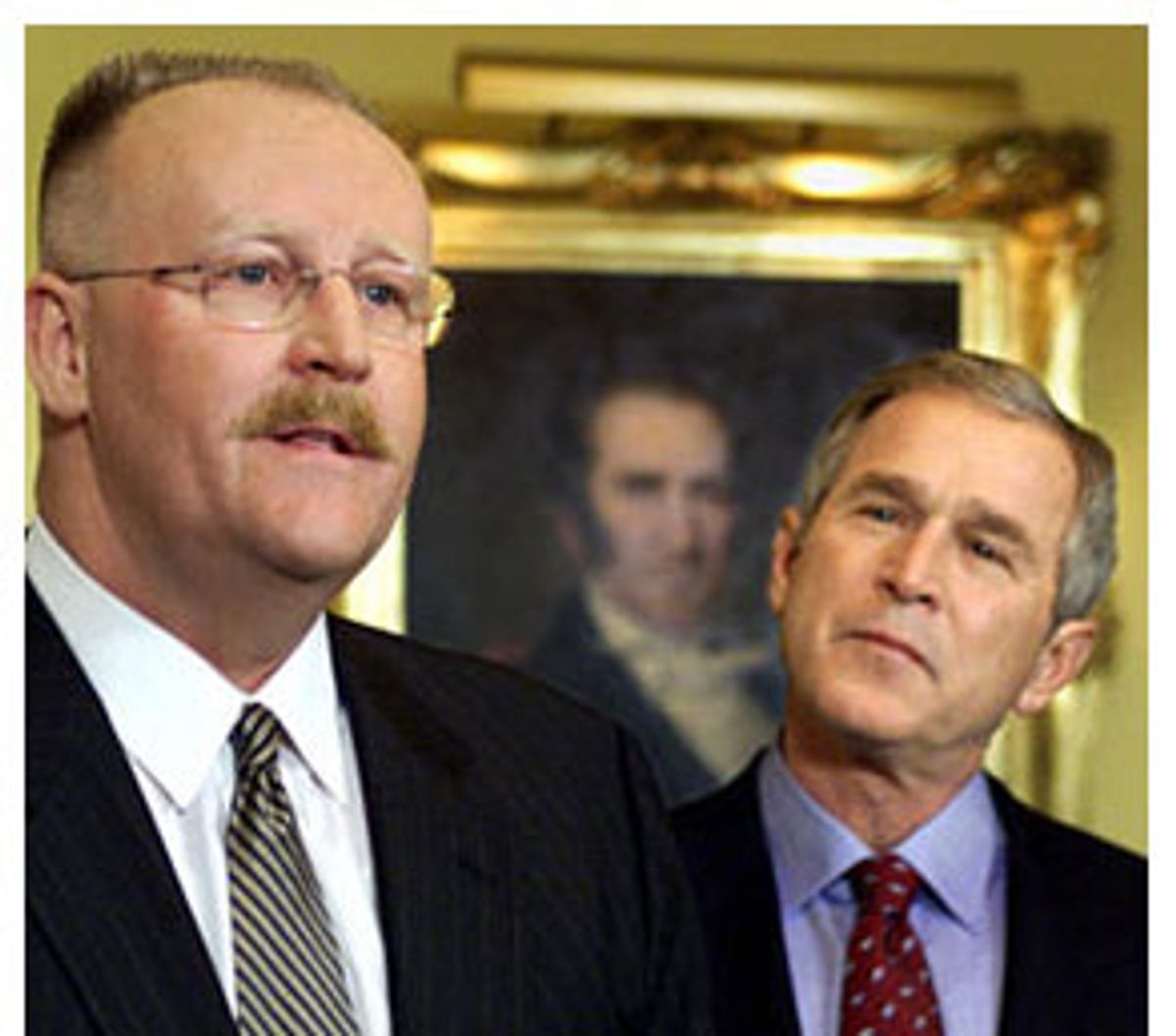
Mark Benjamin

The crony who prospered

Joe Allbaugh was George W. Bush's good ol' boy in Texas. He hired his good friend Mike Brown to run FEMA. Now Brownie's gone and Allbaugh is living large.

George W. Bush relied most heavily on three trusted staffers in his bid for the White House in 2000: political strategist Karl Rove, communications czar Karen Hughes and national campaign manager Joe Allbaugh, who had been Bush’s chief of staff in Texas, when Bush was governor. The three were dubbed the “iron triangle” of Bush’s top staff. Allbaugh was “the enforcer,” says Texan Robert Bryce, the author of “Cronies,” about Bush and the oil industry. “And he looked the part: crew-cut, cowboy boots, and just slightly smaller than a side-by-side refrigerator.”

When Bush moved into the Oval Office, Hughes took a job as counselor in a spacious White House corner office with a view of the Truman balcony. Rove moved in as senior advisor. Allbaugh, on the other hand, went down the road to C Street in southwest Washington to take over the Federal Emergency Management Agency.

FEMA?

“Everybody thought [Allbaugh] was going to be White House chief of staff,” Robert Novak said on CNN at the time. “And your initial reaction is, boy, what did he have against Allbaugh? But as I talked to politicians, they say this was a brilliant maneuver because FEMA is very important, politically, to any president dealing with disasters.”

The FEMA director has turned out to have political consequences for the president all right, but not the kind that Bush supporters could have ever envisioned. Critics say Allbaugh hastened the decline of FEMA — even before he turned the agency over to his buddy from Oklahoma, Michael D. Brown, the hapless captain when Katrina struck, whose political career appears to have been shipwrecked for good.

As for the president, a recent Washington Post-ABC News poll found that 54 percent of Americans disapprove of his response to Katrina. Allbaugh, meanwhile, has risen above the morass. He and his wife, Diane, now work as Washington lobbyists and consultants for such companies as Halliburton and Northrop Grumman, companies involved in homeland security and disaster relief that do business with the federal government.

When Allbaugh inherited FEMA in February 2001, the relief agency may have been in its best shape since its inception in 1979. It had been in the hands of James Lee Witt for the previous seven years. Witt was an experienced disaster manager who had been the director of the Arkansas Office of Emergency Services for four years before going to FEMA. Witt is credited with implementing sweeping reforms to speed disaster relief, and he was the first FEMA director to get Cabinet-level status — and crucial access — to the president. “Access to the president, I think, is critical in an agency like this,” Witt told reporters over lunch just as he was leaving FEMA.

Bush, however, did not hand the FEMA reins to Allbaugh because of any long experience in emergency services. “Look at Joe Allbaugh’s qualifications,” says Eric Holdeman, director of the King County, Wash., Office of Emergency Management, who last month penned an editorial in the Washington Post, “Destroying FEMA.” “He was campaign manager for Bush. He was a political strategist. He saw FEMA as a federal entitlement program for people. He had no interest in the mission and functions of the emergency management agency.”

However, at FEMA, Allbaugh led federal rescue efforts at Ground Zero with apparently good results, though New York City officials, notably Mayor Rudolph Giuliani, got most of the attention. Allbaugh could also move fast. In February 2001, the Nisqually earthquake in Washington state occurred at 11 a.m. By 11 p.m., Allbaugh was in the Puget Sound area, leading a $157 million response.

Following the terrorist attacks on 9/11, Allbaugh backed plans to fold FEMA into the Department of Homeland Security. “I fully support FEMA’s transfer into the new department and commit myself to ensuring its success,” Allbaugh told the Senate Environment and Public Works Committee in September 2002. “This is the right action, at the right time, for the good of the country.”

In March 2003, FEMA was folded into DHS. FEMA critic Holdeman explains that the move stripped the FEMA director of Cabinet-level status, buried the agency in red tape, and caused key talent to flee. DHS employees now rate it as one of the worst places to work in the federal government, according to a nonprofit agency’s report, “Best Places to Work in the Federal Government,” released this week. “FEMA first became ill with the appointment of Joe Allbaugh,” Holdeman says. Not only is it on the back burner of DHS priorities, he says, “it is not even on the stove.”

After FEMA’s move to DHS, Allbaugh promptly left the agency. “I have been a longtime advocate for the Department of Homeland Security, and now that it is a reality and the president has a great team in place, I feel I can move on to my next challenge,” he said in a statement. Of course, before he drove off, he appointed the now infamous Brown as team leader, whom he had brought to FEMA in 2001 as general counsel. Appearing before the Senate Governmental Affairs Committee in June 2002, Brown said: “My friend, Joe Allbaugh, whom I have known for some 25 years, has asked me to serve with him. Our friendship goes back many years.”

Allbaugh graduated from Oklahoma State University in 1975, the same year Brown moved from Southeastern Oklahoma State University to the University of Central Oklahoma. (It has been incorrectly reported that Allbaugh and Brown were college roommates. They did not attend the same college and were never college roommates.) Both were active in Oklahoma municipal or state government. Allbaugh was once the Oklahoma deputy secretary of transportation, and Brown was the staff director of the Oklahoma Senate Finance Committee from 1980 to 1982.

Patti Giglio, Allbaugh’s spokeswoman, says Allbaugh is unavailable for interviews. She says that she is not sure exactly how Allbaugh and Brown met in Oklahoma, but that Allbaugh is “absolutely” responsible for first bringing Brown to FEMA. “He hired him because he was a solid attorney with a strong ethics background,” she says.

Like Allbaugh himself, Brown was no veteran of emergency services. He worked as general counsel for Dillingham Insurance in Enid, Okla., from 1988 to 1991, and evaluated judges for the International Arabian Horse Association for the 10 years ending in 2001.

Brown’s sole piece of emergency experience before FEMA came in the 1970s, working for the city of Edmond, Okla. In the spring of 2002, Brown delivered written biographical materials to a Senate panel considering his nomination to FEMA as a political appointee. In those papers, Brown said he worked as “Assistant City Manger, Police, Fire & Emergency Response,” in Edmond from 1975 to 1978. He signed an affidavit stating that his biographical material and written answers to that Senate panel were “current, accurate and complete.”

However, Edmond city spokeswoman Claudia Deakins says city records list Brown as an “assistant to the city manager” — as opposed to “assistant city manager” — from August 1977 through September 1980. Randel Shadid was on the Edmond City Council from 1979 to 1991 and was mayor from 1991 through 1995. He says he remembers Brown and described the Edmond job as relatively low level. “My best I can recall he was an assistant to the city manager, which basically means he did certain tasks for the city manager,” he says. “He would not have been in charge of the police and fire departments. We had a fire chief and a police chief.”

Shadid says Brown may have assisted the city in preparing a response plan for a tornado or a freight train spill. “He was a nice guy, hard worker and pretty bright,” he says. “But the scope of doing anything in the city of Edmond is nowhere near the scope of trying to handle what’s going on in the gulf.”

Today, with the disgraced Brown having quit FEMA, and President Bush’s post-Katrina poll numbers sinking, Allbaugh continues to prosper. His stint at FEMA has proven to be lucrative for him and his wife Diane, who are lobbyists and consultants for the Allbaugh Co.

A review by Salon of lobbying registration records shows that seven months after Allbaugh left what was to become the Department of Homeland Security, Diane Allbaugh registered as a lobbyist with three companies to work on homeland security or disaster relief issues. Prior to that, she focused almost exclusively on energy companies and electric utility clients.

Records also show that Diane Allbaugh contacted DHS for undisclosed reasons on behalf of two of those clients. She did less than $10,000 of work for each company and all three contracts were terminated in the summer of 2004.

Washington is full of folks in power with spouses who are lobbyists. Allbaugh’s spokeswoman, Giglio, points out that Diane has her own substantial credentials as an attorney and a lobbyist. “Her work is much broader than ‘electric utility lobbyist,’ as you have described it,” Giglio says in an e-mail. “She is an experienced government affairs consultant across many industry sectors.”

Federal ethics law bars senior employees from contacting their former employers on business matters for a period of one year. But not necessarily their spouses. Scott Amey, general counsel at the Project on Government Oversight, says it is unclear if Diane violated any of a complex web of ethics laws, but there are provisions intended to prevent the use of spouses to skirt restrictions.

It is not the first time Diane’s lobbying could be perceived as cashing in on her husband’s connections. Then-governor Bush in 1996 learned from a report in the Dallas Morning News that Diane had been hired by Texas utility companies who had business before the state. Diane and Joe Allbaugh had moved to Texas from Oklahoma because Joe had become Bush’s executive assistant. The paper said Diane could get $250,000 from the companies, even though she “had no previous experience with Texas legislators.” Diane later dropped the clients to avoid the “perception of a conflict,” she wrote Bush’s general counsel.

This year, the Allbaugh Co. registered to lobby for Halliburton Co. subsidiary Kellogg Brown & Root, Northrop Grumman Corp., and Shaw Group, according to lobbying registration forms. In all three cases, the Allbaughs said they would “educate Congress” on either homeland security or disaster relief issues on the companies’ behalf.

The Washington Post reported last week that Allbaugh was in Baton Rouge, La., helping his clients get business in the wake of Katrina. Allbaugh told the Post that he guides his clients toward “entities” that might need their services but, he said, “I don’t do government contracts.”

Press reports show that Kellogg Brown & Root received a $30 million contract to rebuild Navy bases in Louisiana and Mississippi, and Shaw got a $100 million FEMA contract for housing construction and management. Giglio says Allbaugh had nothing to do with those contracts at all. “He is not in the government contracting business,” she says. “Everybody is trying to connect the dots. They just don’t connect. He did not secure these contracts for either of these companies.”

Watchdog Amey says Allbaugh clearly got the job at FEMA because he was a political operative and he appears to be cashing in on his FEMA post now. “Bush may have stacked the [FEMA] administration with people who may not have been the most qualified, and who then steer business their way afterward. Cronyism gets them into the White House. The revolving door gets them business.”

The 10 most terrifying would-be congressmen

Slide show: One may have dry-fired a gun near his ex-wife, another may have gotten away with murder

View the slide show

The thing about wave elections is that you never know until the very end who will wash ashore.

That the Republicans will gain seats — probably a lot of seats — in next week’s midterms is not in dispute. But don’t be fooled by their claims of a looming mandate: They really haven’t done anything to deserve it. The GOP is simply benefiting from the same rule of politics that boosted Democrats in 2008 and 2006: When voters are angry, they take it out on the party that runs Washington.

In House districts across the country, many voters will head to the polls next week intent on voting for the Republican candidate, even if they don’t know a thing about him or her — a perfect opportunity, in other words, for GOP candidates with checkered backgrounds to slip undetected into the halls of Congress.

We’ve looked around and identified the 10 Republican House candidates with the most bizarre, unnerving and downright alarming baggage who just might sneak through next week. So when someone expresses bafflement that, say, a guy who allegedly dry-fired a gun outside his estranged wife’s bedroom could become a member of Congress — well, don’t say you weren’t warned.

View the slide show

Continue Reading Close

“War on terror” psychologist gets giant no-bid contract

The Army has handed a $31 million deal to Dr. Martin Seligman, who once blasted academics for "forgetting 9/11"

Left: Marty Seligman. A Guantanamo detainee sits alone inside a fenced area during his daily outside period, at Guantanamo Bay U.S. Naval Base, Cuba.

The Army earlier this year steered a $31 million contract to a psychologist whose work formed the psychological underpinnings of the Bush administration’s torture program.

The Army awarded the “sole source” contract in February to the University of Pennsylvania for resilience training, or teaching soldiers to better cope with the psychological strain of multiple combat tours. The university’s Positive Psychology Center, directed by famed psychologist Martin Seligman, is conducting the resilience training.

Army contracting documents show that nobody else was allowed to bid on the resilience-training contract because “there is only one responsible source due to a unique capability provided, and no other supplies or services will satisfy agency requirements.” And yet, Salon was able to identify resilience training experts at other institutions around the country, including the University of Maryland and the Mayo Clinic. In fact, in 2008 the Marine Corps launched a project with UCLA to conduct resilience training for Marines and their families at nine military bases across the United States and in Okinawa, Japan.

Government contracting regulations allow sole-source contracts, but only under very limited conditions, such as when only one company has the ability to do the needed work, according to Trevor Brown, a contracting expert at Ohio State University.

Brown said inappropriately awarding sole-source contracts is an “endemic” problem throughout the Department of Defense.

“I am not an expert on resilience training,” he said, “but I know enough to know they could have put out a tender, and my guess is they would have gotten a number of bids. My first reaction was that there is a market for this stuff.”

Army resilience training is the pet project of Army Chief of Staff Gen. George Casey, previously the commander of U.S. forces in Iraq during the darkest days of the war there, from July 2004 through February 2007. Army sources say the director of the Army’s resilience program, Brig. Gen. Rhonda Cornum, rammed the training contract through the Army bureaucracy on Casey’s behalf.

Seligman is most famous for his work in the 1960s in which he was able to psychologically destroy caged dogs by subjecting them to repeated electric shocks with no hope of escape. The dogs broke down completely and ultimately would not attempt to escape through an open cage door when given the opportunity to avoid more pain. Seligman called the phenomenon “learned helplessness.”

Government documents say that the goal of Bush-era torture was to drive prisoners into the same psychologically devastated state through abuse. “The express goal of the CIA interrogation program was to induce a state of ‘learned helplessness,’” according to a July 2009 report by the Justice Department’s Office of Professional Responsibility.

Seligman, described as politically conservative by a psychologist who knows him well, once chastised his fellow academics for “forgetting” 9/11. “It takes a bomb in the office of some academics to make them realize that their most basic values are now threatened, and some of my good friends and colleagues on the Edge seem to have forgotten 9/11,” Seligman once wrote on the Edge Foundation website. In that post, Seligman was arguing that any science advisor to the president “needs to help direct natural science and social science toward winning our war against terrorism.”

Previous reports have explored how Seligman’s fingerprints show up on the CIA and military torture programs — including his interactions at key moments with individuals and institutions that helped set up and carry out government torture. Seligman told Salon he never intended for the government to use his ideas for torture and described the timing of the meetings as coincidental.

Understanding Seligman’s connection to torture requires a bit of background. Bush-era torture was designed by a small group of current and former military psychologists who had been training elite U.S. soldiers to resist torture, an effort that has been in existence in the military for decades in what is called the Survival, Evasion, Resistance and Escape (SERE) program.

In late 2001, both the CIA and the Pentagon first requested interrogation assistance from various SERE psychologists, according to a November 2008 report by the Senate Armed Services Committee and a 2004 CIA inspector general report. A small group of those SERE psychologists agreed to reverse-engineer their torture-resistance training tactics into brutal interrogation methods.

Seligman shows up early on. In December 2001, one of the SERE psychologists who helped establish and run the CIA torture program, James Mitchell, attended a small meeting at Seligman’s house along with Kirk Hubbard, then the CIA’s director of Behavioral Sciences Research. The New York Times has described this meeting as “the start of the program.”

In a lengthy correspondence with Salon over the previous months, Seligman described that meeting at his house as a small gathering of professors and law enforcement personnel as well as at least one “Israeli intelligence person,” to conduct an academic discussion about the so-called war on terror. “It was about isolating Jihad Islam from moderate Islam,” Seligman said of the meeting. “It did not touch on interrogation or torture or captured prisoners or possible coercive techniques — even remotely.”An interview with another attendee as well as an agenda for that meeting, obtained by Salon, support Seligman’s description of that meeting.

Seligman said he interacted with Mitchell at that meeting infrequently, but does recall the SERE psychologist “telling me that he admired my work at a coffee break.”

Another interaction between Seligman and the architects of Bush-era torture came a few months later, in the spring of 2002. Jane Mayer’s 2008 book “The Dark Side” shows that Seligman made a three-hour presentation at the Navy’s SERE school in San Diego in the spring of 2002. Mayer said Hubbard, the CIA official, was involved in arranging Seligman’s presentation. Hubbard confirmed that in an e-mail to Salon.

In e-mails to Salon, Seligman said that Hubbard, the CIA official, also attended the presentation. So did Mitchell and Mitchell’s partner in setting up government torture, another SERE psychologist named Bruce Jessen. Seligman said the audience included 50 to 100 SERE officials. “I was invited to speak about how American troops and American personnel could use what is known about learned helplessness to resist torture and evade successful interrogation by their captors,” Seligman wrote.

Seligman did allude to discussions at that time with SERE officials about interrogating al Qaida suspects, but said those talks were limited because of security clearance issues. “I was told then that since I was (and am) a civilian with no security clearance that they could not detail American methods of interrogation with me,” he wrote. “I was also told then that their methods did not use ‘violence’ or ‘brutality,’” he wrote.

Seligman’s colleagues estimate that the famous psychologist charges between $20,000 and $30,000 to present a speech. Seligman waived his fee when he presented to the SERE officials.

The Senate report says that at around the same time during that spring of 2002, Mitchell’s partner, Jessen, wrote for the military a “draft exploitation plan” for use on detainees. The Senate report says that at the same time, a number of SERE officials became involved in developing the torture program. “Beginning in the spring of 2002 and extending for the next two years (SERE officials) supported U.S. government efforts to interrogate detainees,” the Senate report says. “During that same period, senior government officials solicited (SERE) knowledge and its direct support for interrogations.”

Another related thing was going on at the same time in the spring of 2002. The CIA had also just recently taken custody of al Qaida suspect Abu Zubaydah, the first so-called “high-value” detainee subjected to CIA abuse. Mayer’s book documents how Mitchell, the SERE psychologist, led the team that tortured Zubaydah that spring of 2002. She quotes an unnamed source present at the scene who says Mitchell described his plans for Zubaydah “like an experiment, when you apply electric shocks to a caged dog, after a while, he’s so diminished, he can’t resist.”

(Mayer’s book also explores the ironic leitmotif of Bush-era torture: that SERE officials are not trained interrogators and the methods they employed were originally designed by Communists to produce forced confessions, not good intelligence.)

In his correspondence with Salon, Seligman said the CIA and military appear to have hijacked his learned helplessness work without his knowledge or consent. “I am grieved and horrified that good science, which has helped so many people overcome depression, may have been used for such dubious purposes,” he wrote in an e-mail. “Most importantly, I have never and would never provide assistance in torture. I strongly disapprove of it.”

Similarly, Seligman says he doesn’t know anything about how or why the military early this year steered the $31 million resilience-training contract to his psychology center with no other competition allowed. “I just don’t know,” Seligman wrote. “Government contracting is way above my level of knowledge or competence.”

“You will need to ask General Cornum and (Army Chief of Staff.) Gen Casey about their process,” Seligman added.

Gary Tallman, an Army spokesman, said in an e-mail that the Army steered the contract to Seligman for the benefit of soldiers. “The decision not to compete was affected by a compelling reason to execute this contract as quickly as possible, as the impact of current operations (Post-Traumatic Stress Disorder [PTSD] incidents) and a suicide rate reported to be sixty percent higher than in 2003 posed significant concern for the well-being of our Soldiers,” Tallman wrote. He said the contract also went to Seligman because the psychologist had “the only program available that demonstrated it could meet stated requirements such as ‘longitudinal efficacy in randomized clinical trials, with improvement well documented in published research.’”

Tallman said Casey and Cornum declined Salon’s interview request.

Continue Reading Close

“Everyone just wants to kill people at any cost”

What Adam Winfield, one of the U.S. soldiers accused of killing civilians in Afghanistan, told his father

Emma and Christopher Winfield hold a photograph of their son, 22-year-old U.S. Army Spc. Adam Winfield, at their home in Cape Coral, Fla., Friday, Sept. 3, 2010. Adam is accused of murdering civilians during his deployment to Afghanistan, a charge he and his family firmly refute. (AP Photo/Erik Kellar)(Credit: Erik Kellar)

One of the five U.S. soldiers accused of murdering Afghan civilians in a grisly case now unfolding in Washington state sent Facebook messages to his father early this year in which he claimed to be mortified that his fellow soldiers had purposely killed a civilian. In the messages, Spc. Adam Winfield also indicated that the murder was an open secret among the members of his platoon, and that no one seemed to think it was a big deal.

Winfield wrote his father, Chris, on Feb. 14 about his concern that two members of his platoon had the previous month murdered “some innocent guy about my age just farming.” The correspondence from that day illustrates the young soldier’s horror at the murder, and also reveals a shocking indifference about the killing among the other troops in his platoon.

“Well, it was two guys who did it actually killed the dude (sic) but the whole platoon knew about it,” Winfield wrote to his father. “Theres (sic) no one in this platoon that agrees this is wrong.”

Winfield is one of five soldiers in an Army Stryker Brigade from Joint Base Lewis-McChord, near Tacoma, that the Army has accused of being involved in the murders of at least three civilians in Afghanistan between January and May. Details have emerged about rampant drug use in Winfield’s platoon of around 30 soldiers, and of troops posing for photos with corpses. Soldiers in the unit say the alleged ringleader in the murders, Staff Sgt. Calvin Gibbs, severed and collected body parts, including teeth and fingers, apparently to make a necklace. Members of the platoon allegedly used drop weapons to cover up their crimes.

It’s too early to blame what occurred in Winfield’s platoon on soldiers’ moral compasses spinning out of control after repeated, violent tours in Iraq and Afghanistan (Gibbs was on his third combat tour). But it is easy to imagine that seemingly endless wars contributed to the moral turpitude Winfield described to his father.

“There are no more good men left here,” Winfield wrote in the Feb. 14 exchange released to Salon by Chris Winfield through his attorney, Neal Puckett. At one point, Winfield seemed to echo Sen. John Kerry’s haunting 1971 testimony about Vietnam when Kerry asked rhetorically, “How do you ask a man to be the last man to die for a mistake?”

“I started to think whether I should quit and just give up because it’s stupid to get smoked in Afghanistan,” Winfield wrote. “The Army really let me down when I thought I would come out here to do good maybe make some change in this country I find out that its all a lie (sic).”

Winfield said he raised concern about the January murder with someone there, but received a blasé response. “Well I talked to someone and they told me this stuff happens all the time and that when we get back there is always someone that spills the beans so it normally works its way out,” he wrote.

Winfield claimed he gave up his position in the platoon as a team leader because of the murder. “I stepped down I cannot be a leader in a platoon that allows this to happen,” he wrote.

In the correspondence from Feb. 14 Adam’s father, Chris, expressed shock at the indifference to the killing. “No one else thought it was wrong?” he asked his son. “No,” Adam wrote back. “Everyone just wants to kill people at any cost they don’t care the Army is full of a bunch of scumbags I realized.”

Adam Winfield also wrote that he feared for his own safety if he reported the murder, harkening back to the fragging incidents in Vietnam. “Pretty much the whole platoon knows about it,” Winfield wrote about the January killing. “It’s okay with all of them pretty much. Except me,” he added. “I want to do something about it the only problem is I don’t feel safe here telling anyone.”

Chris Winfield has said that he made multiple calls to the Army (including at least four to various offices at Fort Lewis) in an effort to report the murder his son described to him. On Friday, the Army announced that it is investigating this claim.

Winfield’s phone records, reviewed by Salon, show phone calls to those numbers taking place between 3:43 p.m. and 4:18 p.m. on Feb. 14. Mostly, Winfield says, he left messages, though he also talked to a sergeant in his son’s unit’s office. “I said my son is in [Stryker Brigade] and he told me there is a rogue sergeant over there committing murders,” Winfield told Salon. “I was pretty upset. I was frantic.”

He said nobody ever got back to him. Members of his son’s platoon allegedly committed at least two more murders in the months that followed. The Army has now implicated Adam Winfield in one of those later killings.

“The Army had the opportunity and they dropped the ball,” Chris Winfield said. “The Army has the blood on their hands on those two [later] murders. They want to sweep it under the carpet and make it disappear,” he claimed. “I’m not going to let them do that.”

The Army is not commenting on the cases.

Continue Reading Close

What Islamophobia really threatens

Two new reports shine light on the crucial role American Muslims play in stopping terrorism in the United States

A young Muslim American woman holds the U.S. flag at the Islamic Center of America in Dearborn, Michigan on March 26.

With the volume of Islamophobia on the rise in the United States, a recent report prepared for Congress and new law enforcement data are shining fresh light on the significant role American Muslims play in foiling terrorist plots, particularly those of the domestic “homegrown” variety.

The report from the Congressional Research Service, sent to Congress with little fanfare on September 20, contends that soon after 9-11, American Muslims “recognized the need to define themselves as distinctly American communities who, like all Americans, desire to help prevent another terrorist attack” and explores how federal, state and local law enforcement organizations responded by tapping into American Muslims’ language skills, contacts, information and cultural insights.

CRS is a branch of the Library of Congress that conducts research on a confidential basis for members of Congress and committees. Its report was obtained by the Federation of American Scientists and released on September 24, but a CRS spokeswoman would not say who in Congress originally requested it.

Meanwhile, the Muslim Public Affairs Council has crunched FBI data, information in government press releases, and media reports on potential al Qaida-related plots and determined that since 9-11, Muslim Americans have helped thwart 11 al Qaida-related plots, nearly one-third of all such planned attacks that threatened the United States. (A vivid example of an American Muslim warning authorities of a problem: a Muslim was the first to report to law enforcement last May the suspicious vehicle in Times Square which turned out to be a dud car bomb.)

The cooperation from American Muslims is no secret to law enforcement officials, who have established, all the way down to the local level, formal and informal connections to American Muslim communities to cultivate the flow of intelligence — like the Muslim Community Affairs unit of the Los Angeles Sheriff Department, established in August 2007. For their part, Muslim-Americans have established a litany of organizations to better understand and refute extremism, like the Muslim American Society’s “Straight Path Initiative,” which focuses on rooting out potential extremism, particular on Muslims aged 15 to 30. The CRS report on American Jihadist terrorism contains a list of examples of American Muslim organizations established to rebut extremism and an appendix listing federal, state and local authorities’ efforts to work with American Muslim communities.

Bruce Hoffman, a terrorism expert at Georgetown University, agreed that the American Muslim community has played a crucial but often overlooked role in the fight against extremism, actively reporting to law enforcement about potentially dangerous developments. “We can’t expect the intelligence community to spot these aberrations on the fringe,” Hoffman said. “That work comes from communities who are best poised to work with the authorities to prevent problems from even surfacing.”

Ironically, the American Muslim community is simultaneously facing what seems to be a swelling wave of Islamophobia, fueled, in part, by specious rhetoric that fuses terrorism and Islam.

Earlier this month, columnist and birther Frank Gaffney, Rep. Pete Hoekstra, R-Mich., the ranking Republican on the Intelligence Committee, and others held a news conference on Capitol Hill to release a report on Muslim religious law entitled “Shariah: The Threat to America.” That document alleges that Muslim adherents to Shariah law are categorically “making a determined, sustained, and well-financed effort to impose it on all Muslims and non-Muslims, alike.”

“This is laughable. This is pure prejudice and fear mongering,” is how Nihad Awad, executive directory of the Council on American-Islamic Relations, reacted to Gaffney’s report. “What they are presentingis contrary to Islamic ethics. They are just trying to scare people. This is the new McCarthyism. They are exploiting fear and public unawareness of Islam in general.”

Some American Muslims are also frustrated by grappling with anti-Muslim sentiments while simultaneously working so hard against extremism and assisting law enforcement to root out terrorists. “Ironic doesn’t even begin to explain this,” said Alejandro Beutel from the Muslim Public Affairs Council. He said Islamophobes are “failing to see who are the potential enemies and who are the potential allies.” Beutel predicted, however, that this new evidence of American Muslims’ role in thwarting attacks wouldn’t change the minds of many Islamophobes, saying, “Nothing we do is going to be good enough for them.”

Continue Reading Close

So, did Christine O’Donnell break the law?

And if she has spent campaign money illegally, will she pay any price for it?

FILE - In this Friday, Sept. 17, 2010 file photo, Delaware Republican Senate candidate Christine O'Donnell delivers remarks at Values Voter Summit in Washington. Comedian Bill Maher is digging up clips of Delaware GOP Senate candidate Christine O'Donnell's past appearances on his shows, including one in which she says she "dabbled in witchcraft." (AP Photo/Manuel Balce Ceneta, File)(Credit: Manuel Balce Ceneta)

Christine O’Donnell has been accused twice recently of violating campaign finance laws. The Tea Party-backed GOP Senate candidate in Delaware has dismissed the allegations, characterizing the complaints as unwarranted, politically motivated smears.

A review of her campaign finance records filed with the Federal Elections Commission, interviews with attorneys familiar with campaign finance law, and a review of her own public statements suggests O’Donnell has almost certainly flouted the law. The attorneys agree, but say she is likely to face little penalty from the FEC.

Earlier this month, the Delaware Republican Party filed a complaint with the FEC alleging that O’Donnell accepted illegal contributions from the Tea Party Express. On Monday, Citizens for Responsibility and Ethics in Washington filed complaints with the FEC and the U.S. attorney in Delaware alleging that O’Donnell had violated the law by using campaign contributions for personal use, paying for gas, bowling, even the rent on her house.

“I am confident that we have been ethical,” O’Donnell said this week to a scrum of reporters who had cornered her at a forum held by the First State Patriots. “I personally have not misused the campaign funds.” When a CNN reporter pressed her specifically about using campaign money to pay the rent on her house, however, O’Donnell would not answer. In fact, she ran away.

That’s probably because even under notoriously equivocal campaign finance laws, there is no gray area when it comes to using campaign money to pay the rent on your house. “Well, that is a clear violation,” said Richard Briffault, who teaches election law at Columbia Law School. Indeed, according to FEC rules, “the campaign may not pay for mortgage, rent or utilities for the personal residence of the candidate or the candidate’s family even if part of the residence is being used by the campaign.”

The Wilmington News Journal in March of this year figured out that a sheriff’ sale for O’Donnell’s Wilmington home had been set for Aug. 1, 2008, because O’Donnell was in default on her mortgage. A month before the sale, however, O’Donnell sold the house to Brent Vasher, who was also her campaign attorney and her boyfriend at the time. (O’Donnell ran for the Senate in 2008 against Joe Biden.) She then rented the house from Vasher until sometime last summer.

The FEC files of O’Donnell’s campaign committee, Friends of Christine O’Donnell, document payments of $750 to Vasher during this time period. Also, back in March, O’Donnell admitted she was using campaign money to pay that rent, “because she also uses the town home as her Senate campaign headquarters,” the News Journal reported. “I’m splitting it, legally splitting it and paying part of it,” the paper reported her saying about her rent. “This is our technical headquarters,” she said about her house.

O’Donnell’s campaign expense files do show a number of unusual expenditures, including charges at gas stations and stores like Dollar Tree, Trader Joe’s, Target and Kmart, among others. O’Donnell was also very tardy in reporting those expenses, failing to file at least two required campaign finance reports with the FEC last year that were supposed to disclose contributions and expenses from April through the end of September. Twice the FEC wrote O’Donnell letters warning her that, “failure to file … may result in civil money penalties, an audit or legal enforcement action.”

During the same time period, the FEC also learned that Friends of Christine O’Donnell’s was operating without a treasurer after the departure of Susan M. Dixon sometime after April 2009. “It is required that for any committee to conduct any business, they must have an active treasurer,” the FEC wrote O’Donnell in April and then again in October. “Failure to appoint a treasurer will result in the inability of the committee to accept contributions and make disbursements.” Campaign finance lawyers agree that the rules on this are clear.

An FEC spokeswoman would not comment on O’Donnell’s records, but said that, in general, the commission tries to negotiate with a delinquent candidate like O’Donnell to hire a treasurer and report on time. That may have occurred in this case. In January of this year, O’Donnell sent in a campaign finance report covering the missing months in 2009. In that report, O’Donnell lists herself as the treasurer of her campaign committee.

Campaign finance attorneys say it’s unusual for a candidate to serve as her own treasurer, but may not be illegal. Paul Ryan, an attorney at the Campaign Legal Center, said that rules clearly require a treasurer, though they don’t seem to rule out a candidate putting herself in that position. “I don’t read the regulation as having anything to say about who should or may serve as the treasurer,” Ryan wrote in an e-mail.

In yet another twist, the Daily Beast reported earlier this month that her campaign committee also cut checks for $3,500 to O’Donnell’s mother, Carole O’Donnell. The first payment, dated Feb. 26, 2010, lists $500 for “bookkeeping and reporting.” A second payment on July 13, 2010, for $3,000 describes Carole O’Donnell as performing “financial consulting services.” Attorneys say those payments are legal if Carole O’Donnell did real work for the money.

Blogger Judson Bennett noticed an “unusual pattern of reimbursements” on O’Donnell’s FEC forms early this year, and when he asked her about it, O’Donnell responded, “I’m not rich, I’m not working. It is perfectly legitimate for me to use campaign funds for my living expenses while campaigning — food, gasoline, etc.”

Yes and no, campaign finance lawyers say. Ryan said O’Donnell could use campaign money only for expenses that are directly related to campaigning, like a fundraising dinner. When asked if she can use campaign money to pay for her regular groceries, for example, Ryan said, “The answer is a clear ‘No.’”

Still, attorneys familiar with campaign law say that based on the FEC’s track record, O’Donnell is unlikely to face much in the way of consequences, even if she did violate the law. “Generally what they try to do is resolve it informally or have her repay her campaign funds with her own funds,” Briffault said. “It is very, very, very rare that there are criminal prosecutions.”

Continue Reading Close

Page 1 of 47 in Mark Benjamin