New Orleans
“Less weeping, more sweeping”
While the president and the press play the blame game, our band of holdouts help clean the streets of the Quarter.
I’ve learned to make flies alight on my fingertips and suck the blood from mosquitoes. Now they tell me the city may have its lights again this weekend, and I wonder if I’ll remember all I’ve learned in the dark. I’m not sure I’m ready to forget.
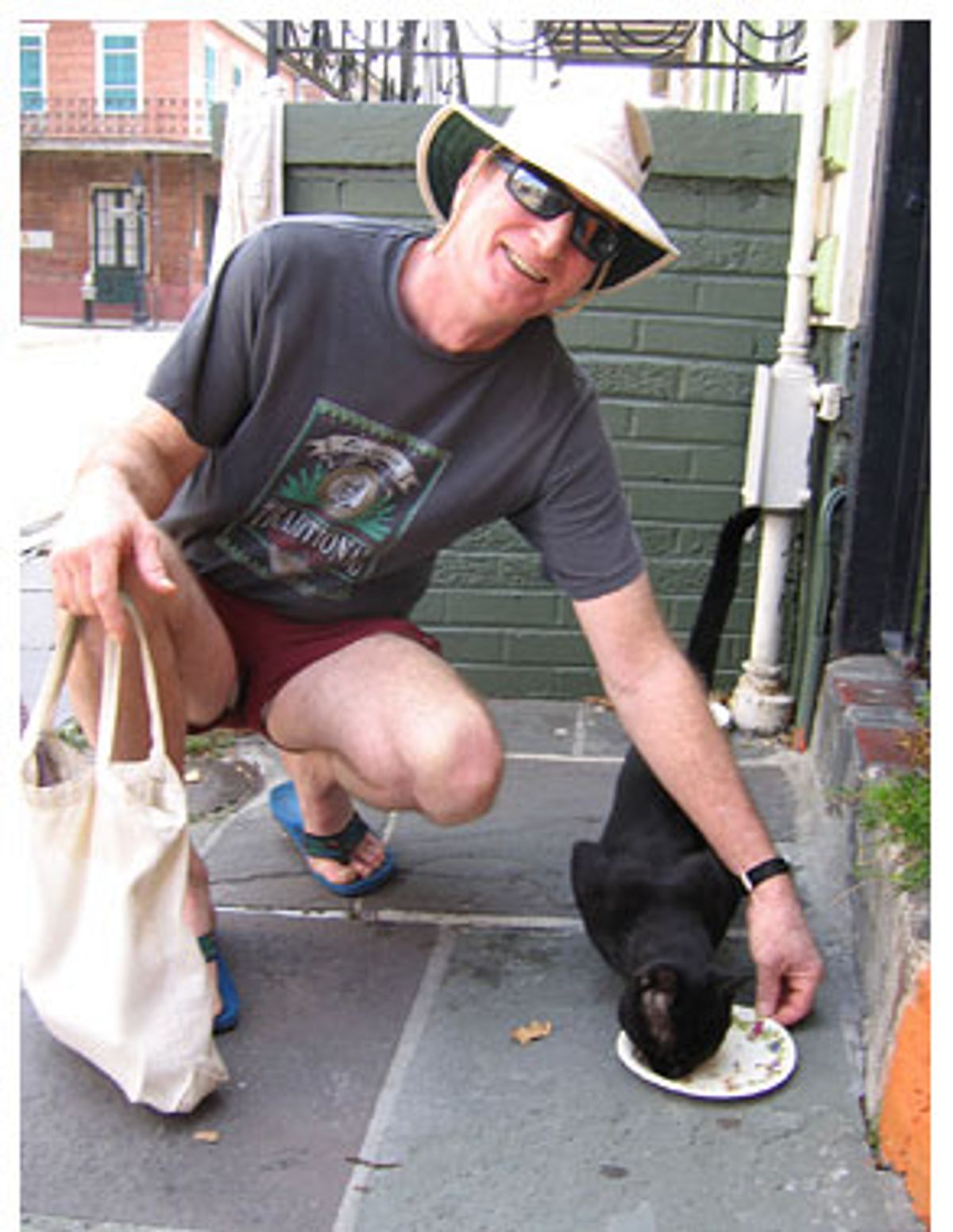
I went to rescue a friend’s cat this morning, no doubt having its own battle with the elements. After the fourth voicemail pleading and begging for her cat’s life, I got a 40-foot extension ladder from an antiques dealer who was having his morning Miller down at Johnny White’s (now officially the only New Orleans bar never to lock its doors), hauled it up Orleans Avenue, climbed on top of her garage, pulled the ladder up, climbed back down it into her garden and opened her kitchen shutter doors so Bingles could jump out of her little cat door to freedom.
This is my third such rescue. Word has it the SPCA has been overwhelmed and simply given up. Of course, there are all sorts of rumors floating through this media-blacked-out neighborhood, like a bunch of debris. I myself cannot understand people who leave town right before a Category 5 because their house may undergo massive destruction and flooding, but leave Bingles locked up in the kitchen with a can of Meow Mix and a bowl of water.
As I was walking back to the commune, a van pulled up alongside me, then screeched to a halt. A petite blond reporter poked her head out and asked if I was a resident. She told me President Bush had accepted responsibility for the mismanagement of the hurricane response and asked if I would care to respond to him. I said sure, You got him in the back seat?
I was disappointed to see only an ABC News camera crew roll out of the van and cluster around me. I mumbled stuff about how we haven’t had much time to point fingers around here. If Bush did in fact accept responsibility, it would seem to me that he’s won the so-called blame game because he’d be the first politician I’ve heard of who’s taken any responsibility for anything that’s gone wrong around here. From the “Reverend” Coco, who even now drinks from a brown bag and sleeps in a box down the street — he calls it his “Off-White House” — to the White House, far as we can tell everyone’s been pointing their fingers left, right, up, down and all around.
So we decided the buck stops here. We need progress, baby. If at this point everyone were to stop screaming and start helping, well, I hope the outcome would be obvious. Let the anger roll later. Other regions not as fortunate as our neighborhood still need plenty in the way of relief.
As for us, we’re stuck here, so we start here. Last week, the 10 of us holed up together in the commune formed an organization to start cleaning the Quarter: New Orleanians Eliminating Negative Debris (NO END). Our motto is “Less Weeping, More Sweeping.” In keeping with our motto, we constructed a sign and hung it in front of St. Anthony’s Garden behind the St. Louis Cathedral. In the center of the garden, smack-dab in the center of the French Quarter, stands a 20-foot-high statue of Jesus with his arms stretched high and wide — a city icon known lovingly as “Touchdown Jesus.” The sign, now locally (in)famous, says, “Jesus Swept.”
The plan was also to tape a broom into one of his hands. Armed only with other brooms, that plan was promptly abandoned upon encountering a couple dozen rangers from the 82nd Airborne, red berets and all, who were chopping up the massive elms that had fallen perfectly around Jesus during the storm and had only knocked one of his pinky fingers off.
Though Jesus himself has done no manual labor yet that we could verify, we hauled fallen trees and swept debris from Jackson Square last week, then cleaned our own blocks and a good portion of Bourbon Street. I even shoveled up a 40-foot-wide whole brick wall that had fallen across Burgundy Street so that cops and military and ambulances could roll through. It was just something to do.
But today clean-up crews rolled in from Atlanta, and the Navajo Scouts have polished off Jackson Square, so we’ve moved on to cat rescue.
The city is slowly regaining its footing after the pummeling Katrina gave it. Some downtown hotels and government buildings already have power restored. My girlfriend Ellen and I sat on the roof of our commune at midnight last night. The Mississippi stretched out before us, no city lights yet shivering upon its surface, the French Quarter roofs around us a mess of dark shards pointing silver into the almost full moonlight. Beyond the Quarter, the northern half of the city was erased in stars, while the southern sky was erased in the lavender haze of downtown lights.
Rumor has it that about 60 of us residents remain here in the Quarter. But our evacuated fellow citizens will soon follow the approaching electricity and lights like the moths that now flutter and drown in the wax around our candles. The nationwide diaspora of New Orleanians will collapse upon us as quickly as they feared their foundations would collapse from the storm. But the foundations, bricks and people, remain.
Larry is one of them, one of the 60 faces that have defined this neighborhood over the last two weeks. I finally got his name after he let me borrow his extension ladder to rescue Bingles this morning. He’s 81 and has lived in this neighborhood for 40 years — and, as the orange spraypaint on the street in front of his house stipulates, he is the only one left on his block.
He was sitting in a wicker chair by his doorstep, breakfasting on a cheese omelet MRE. I thanked him for the ladder.
“Don’t worry, ” he said, laughing off a rumor that the remaining residents could be forced out. “I’ll poke their eyes out with this cane if they come for me.”
Joshua Clark is the editor of Light of New Orleans Publishing. More Joshua Clark.
Hit on the head
For five years, I was haunted by a violent crime and a broken relationship. Then came a twist I never expected
The author in a red dress in a Second Line processional
through the French Quarter. (Credit: Laurence Kretchmer) When I saw the date of Charlotte’s wedding, I felt like I’d been hit on the head. What were the chances? Of all the days to get married – of all the cities to get married in – my friend had chosen the exact date that I met Nick, in the city that I met Nick.
I suspect most couples don’t know the exact date of their first encounter. But then most couples probably don’t have a police report.
It took me a few days to decide to contact Nick. I’d been wrestling with that urge for five years now. My inbox was a shame trail of gushy letters typed after midnight, impulsive notes dashed off in the afternoon. All of them had cutesy subject lines, like the titles of Raymond Carver stories, but they should have been labeled the same thing: “Do you love me again? Have you changed your mind yet?”
Continue Reading CloseSarah Hepola is an editor at Salon. More Sarah Hepola.
The homeless: Pawns in the war on OWS?
A death at Occupy NOLA leaves protesters questioning the motives behind the city's closure of a nearby tent city
A homeless man sets up a tent at Occupy Seattle on Oct. 5, 2011 (Credit: AP/Ted S. Warren) Beneath the veneer of New Orleans’ vibrant culture lies a history of tragedy. From the yellow fever outbreaks of the 19th century, the many catastrophic storms that have visited the city, the violence of the Civil War and Reconstruction, to the vast social dysfunction of contemporary New Orleans, this is a city that has known adversity throughout. It is sadly fitting, then, that Occupy NOLA is one of the few occupations to have witnessed a death at the encampment. Last week, 53-year-old Ronald Dean Howell, known as “Curly” or “Old School” to friends, was found dead in his tent. The coroner’s chief investigator, John Gagliano, stated that the cause of death was “complications from alcohol abuse.” According to other occupiers, the man was homeless, and likely relocated from another tent city at Calliope Street and the Pontchartrain Expressway, which was closed by authorities on Oct. 27.
Continue Reading CloseMatt Reichel is a writer currently living in New Orleans. Respond to him at: mereichel@gmail.com. More Matthew Reichel.
What’s the dirtiest city in America?
It's not New York, Philadelphia or L.A. ...
42nd street, New York City In its June 2011 issue, Travel + Leisure magazine has ranked America’s ten dirtiest cities. Where does your hometown — or favorite tourist destination — fall?
Here’s the list:
- New Orleans
- Philadelphia
- Los Angeles
- Memphis
- New York
- Baltimore
- Las Vegas
- Miami
- Atlanta
- Houston
The ranking is not exactly scientific — it’s based on input from the magazine’s readers, who fill out an annual “favorite cities” survey — but the results hold up fairly well next to the conclusions of other studies. T+L explains:
Continue Reading CloseEmma Mustich is a Salon contributor. Follow her on Twitter: @emustich. More Emma Mustich.
Evacuations in Cajun country after spillway opens
Louisiana reeling from historic flooding
Water diverted from the Mississippi River spills through a bay in the Morganza Spillway in Morganza, La., Saturday, May 14, 2011. Water from the inflated Mississippi River gushed through a floodgate Saturday for the first time in nearly four decades and headed toward thousands of homes and farmland in the Cajun countryside, threatening to slowly submerge the land under water up to 25 feet deep. (AP Photo/Patrick Semansky) (Credit: AP) Renee Ledoux cried when the National Guard and sheriff’s deputies showed up at her front door and warned her she needed to get out to avoid water gushing from the Mississippi River after a floodgate was opened for the first time in four decades.
But by the 5 p.m. deadline Sunday, the 44-year-old Ledoux and her boyfriend Billy Hanchett decided to ride it out one more night on air mattresses inside the empty home in Krotz Springs. They have a camper they plan to stay in on a friend’s property outside the flood zone.
Continue Reading CloseAs water creeps closer, residents warned: Get out
Louisianans flee from floodwater released by the opening of the Morganza Spillway yesterday
A member of the Louisiana National Guard stands guard as water diverted from the Mississippi River through a bay in the Morganza Spillway begins to fill a pasture in Morganza, La., Saturday, May 14, 2011. Opening the Morganza spillway diverts water away from Baton Rouge and New Orleans, and the numerous oil refineries and chemical plants along the lower reaches of the Mississippi. (AP Photo/Patrick Semansky) (Credit: AP) Deputies warned people Sunday to get out as Mississippi River water gushing from a floodgate for the first time in four decades crept ever closer to communities in Louisiana Cajun country, slowly filling a river basin like a giant bathtub.
Most residents heeded the warnings and headed for higher ground, even in places where there hasn’t been so much as a trickle, hopeful that the flooding engineered to protect New Orleans and Baton Rouge would be merciful to their way of life.
Days ago, many of the towns known for their Cajun culture and drawling dialect fluttered with activity as people filled sandbags and cleared out belongings. By Sunday, some areas were virtually empty as the water from the Mississippi River, swollen by snowmelt and heavy rains, slowly rolled across the Atchafalaya River basin. The floodwaters could reach depths of 20 feet in the coming weeks.
Continue Reading ClosePage 1 of 27 in New Orleans
