Hollywood, Florida's biggest junkyard was situated in the rubble of a half-built ghost-mall off Taft Street. Andrea's Miami airport rental car came with a GPS, but the little box hadn't ever heard of the mall; it was off the map. So she took a moment in the sweltering parking lot of her coffin hotel to call her interview subject again and get better coordinates.
"Yeah, it's 'cause they never finished building the mall, so the address hasn't been included in the USGIS maps. The open GPSes all have these better maps made by geohackers, but the rental car companies have got a real hard-on for official map-data. Morons. Hang on, lemme get my GPS out and I'll get you some decent lat-long."
His voice had a pleasant, youthful, midwestern sound, like a Canadian newscaster: friendly and enthusiastic as a puppy. His name was Perry Gibbons, and if Kettlewell was to be believed, he was the most promising prospect identified by Kodacell's talent scouts.
The ghost-mall was just one of many along Taft Street, ranging in size from little corner plazas to gigantic palaces with broken-in atria and cracked parking lots. A lot of the malls in California had crashed, but they'd been turned into flea-markets or day-cares, or, if they'd been abandoned, they hadn't been abandoned like this, left to go to ruin. This reminded her of Detroit before she'd left, whole swaths of the inner city emptied of people, neighborhoods condemned and bulldozed and, in a couple of weird cases, actually farmed by enterprising city-dwellers who planted crops, kept livestock and rode their mini tractors beneath the beam of the defunct white-elephant monorail.
The other commonality this stretch of road shared with Detroit was the obesity of the people she passed. She'd felt a little self-conscious that morning, dressing in a light short-sleeved blouse and a pair of shorts -- nothing else would do, the weather was so hot and drippy that even closed-toed shoes would have been intolerable. At 45, her legs had slight cellulite saddlebags and her tummy wasn't the washboard it had been when she was 25. But here, on this stretch of road populated by people so fat they could barely walk, so fat that they were de-sexed marshmallows with faces like inflatable toys, she felt like a toothpick.
The GPS queeped when she came up on the junkyard, a sprawling, half-built discount mall whose waist-high walls had been used to parcel out different kinds of sorted waste. The mall had been planned with indoor boulevards between the shops wide enough for two lanes of traffic, and she cruised those lanes now in the hertzmobile, looking for a human. Once she reached the center of the mall -- a dry fountain filled with dusty Christmas-tree ornaments -- she stopped and leaned on the horn.
She got out of the car and called, "Hello? Perry?" She could have phoned him but it always seemed so wasteful spending money on airtime when you were trying to talk to someone within shouting range.
"Andrea!" the voice came from her left. She shielded her eyes from the sun's glare and peered down a spoke of mall-lane and caught her first glimpse of Perry Gibbons. He was standing in the basket of a tall cherry-picker, barechested and brown. He wore a sun-visor and big work gloves, and big, baggy shorts whose pockets jangled as he shinnied down the crane's neck.
She started toward him tentatively. Not a lot of business-reporting assignments involved spending time with half-naked, sun-baked dudes in remote southern junkyards. Still, he sounded nice.
"Hello!" she called. He was young, 22 or 23, and already had squint-creases at the corners of his eyes. He had a brace on one wrist and his steel-toed boots were the mottled grey of a grease-puddle on the floor of a muffler and brake shop.
He grinned and tugged off a glove, stuck out his hand. "A pleasure. Sorry for the trouble finding this place. It's not easy to get to, but it's cheap as hell."
"I believe it." She looked around again -- the heaps of interesting trash, the fountain-dish filled with thousands of shining ornaments. The smell was a mixture of machine-oil and salt, jungle air, Florida swamp and Detroit steel. "So, this place is pretty cool. Looks like you've got pretty much everything you could imagine."
"And then some." This was spoken by another man, one who puffed heavily up from behind her. He was enormous, not just tall but fat, as big around as a barrel. His green T-shirt read IT'S FUN TO USE LEARNING FOR EVIL! in blocky, pixelated letters. He took her hand and shook it. "I love your blog," he said. "I read it all the time." He had three chins, and eyes that were nearly lost in his apple cheeks.
"Meet Lester," Perry said. "My partner."
"Sidekick," Lester said with a huge wink. "Sysadmin slash hardware hacker slash dogsbody slashdot org."
She chuckled. Nerd humor. Ar ar ar.
"Right, let's get started. You wanna see what I do, right?"
"That's right," Andrea said.
"Lead the way, Lester," Perry said and gestured with an arm, deep into the center of the junkpile. "All right, check this stuff out as we go." He stuck his hand through the unglazed window of a never-built shop and plucked out a toy in a battered box. "I love these things," he said, handing it to her.
She took it. It was a Sesame Street Elmo doll, labeled BOOGIE WOOGIE ELMO.
"That's from the great Elmo Crash of 2008," Perry said, taking back the box and expertly extracting the Elmo like he was shelling a nut. "The last and greatest generation of Elmoid technology, cast into an uncaring world that bought millions of Li'l Tagger washable graffiti kits instead after Rosie gave them two thumbs up on her Christmas shopping guide.
"Poor Elmo was an orphan, and every junkyard in the world has mountains of mint-in-package BWEs, getting rained on, waiting to start their long, half-million-year decomposition.
"But check this out." He flicked a multitool off his belt and extracted a short, sharp scalpel-blade. He slit the grinning, disco-suited Elmo open from chin to groin and shucked its furry exterior and the foam tissue that overlaid its skeleton. He inserted the blade under the plastic cover over its ass and revealed a little printed circuit board.
"That's an entire Pentium III on a chip, there," he said. "Each limb and the head have their own subcontrollers. There's a high-powered digital-to-analog rig for letting him sing and dance to new songs, and an analog-to-digital converter array for converting spoken and danced commands to motions. Basically, you dance and sing for Elmo and he'll dance and sing back for you."
Andrea nodded. She'd missed that toy, which is a pity. She had a five-year-old god-daughter in Minneapolis who would have loved a Boogie Woogie Elmo.
They had come to a giant barn, set at the edge of a story-and-a-half's worth of anchor store. "This used to be where the contractors kept their heavy equipment," Lester rumbled, aiming a car-door remote at the door, which queeped and opened.
Inside, it was cool and bright, the chugging air-conditioners efficiently blasting purified air over the many work-surfaces. The barn was a good 25 feet tall, with a loft and a catwalk circling it halfway up. It was lined with metallic shelves stacked neatly with labeled boxes of parts scrounged from the junkyard.
Perry set Elmo down on a workbench and worked a miniature USB cable into his chest cavity. The other end terminated with a PDA with a small rubberized photovoltaic cell on the front.
"This thing is running InstallParty -- it can recognize any hardware and build and install a Linux distro on it without human intervention. They used a ton of different suppliers for the BWE, so every one is a little different, depending on who was offering the cheapest parts the day it was built. InstallParty doesn't care, though: one click and away it goes." The PDA was doing all kinds of funny dances on its screen, montages of playful photoshopping of public figures matted into historical fine art.
"All done. Now, have a look -- this is a Linux computer with some of the most advanced robotics ever engineered. No sweatshop stuff, either, see this? The solder is too precise to be done by hand -- that's because it's from India. If it was from Malaysia, you'd see all kinds of wobble in the solder: that means that tiny, clever hands were used to create it, which means that somewhere in the device's karmic history, there's a sweatshop full of crippled children inhaling solder fumes until they keel over and are dumped in a ditch. This is the good stuff.
"So we have this karmically clean robot with infinitely malleable computation and a bunch of robotic capabilities. I've turned these things into wall-climbing monkeys; I've modded them for a woman from the University of Miami at the Jackson Memorial who used their capability to ape human motions in physiotherapy programs with nerve-damage cases. But the best thing I've done with them so far is the Distributed Boogie Woogie Elmo Motor Vehicle Operation Cluster. Come on," he said, and took off deeper into the barn's depths.
They came to a dusty, stripped-down Smart car, one of those tiny two-seat electric cars you could literally buy out of a vending machine in Europe. It was barely recognizable, having been reduced to its roll-cage, drive-train and control-panel. A gang of naked robot Elmos were piled into it.
"Wake up boys, time for a demo!" Perry shouted, and they sat up and made canned, tinny Elmo "oh boy" noises, climbing into position on the pedals, around the wheel, and on the gear-tree.
"I got the idea when I was teaching an Elmo to play Mario Brothers. I thought it'd amuse the Slashdorks. I could get it to speedrun all of the first level using an old paddle I'd found and rehabilitated, and I was trying to figure out what to do next. The dead mall across the way is a drive-in theater, and I was out front watching the silent movies, and one of them showed all these cute little furry animated whatevers collectively driving a car. It's a really old sight-gag, I mean, like racial memory old. I'd seen the Little Rascals do the same bit, with Alfalfa on the wheel and Buckwheat and Spanky on the brake and clutch and the doggy working the gearshift.
"And I thought, shit, I could do that with Elmos. They don't have any networking capability, but they can talk and they can parse spoken commands, so all I need is to designate one for left and one for right and one for fast and one for slow and one to be the eyes, barking orders and they should be able to do this. And it works! They even adjust their balance and centers of gravity when the car swerves to stay upright at their posts. Check it out." He turned to the car. "Driving Elmos, ten-HUT!" They snapped upright and ticked salutes off their naked plastic noggins. "In circles, DRIVE," he called. The Elmos scrambled into position and fired up the car and in short order they were doing donuts in the car's little indoor pasture.
"Elmos, HALT" Perry shouted and the car stopped silently, rocking gently. "Stand DOWN." The Elmos sat down with a series of tiny thumps.
Andrea found herself applauding. "That was amazing," she said. "Really impressive. So that's what you're going to do for Kodacell, make these things out of recycled toys?"
Lester chuckled. "Nope, not quite. That's just for starters. The Elmos are all about the universal availability of cycles and apparatus. Everywhere you look, there's devices for free that have everything you need to make anything do anything.
"But have a look at part two, c'mere." He lumbered off in another direction, and they trailed along behind him.
"This is Lester's workshop," Perry said, as they passed through a set of swinging double doors and into a cluttered wonderland. Where Perry's domain had been clean and neatly organized, Lester's area was a happy shambles. His shelves weren't orderly, but rather with looming piles of amazing junk: thrift-store wedding dresses, plaster statues of bowling monkeys, box kites, knee-high tin knights-in-armor, seashells painted with American flags, presidential action-figures, paste jewelry and antique cough-drop tins.
"You know how they say a sculptor starts with a block of marble and chips away everything that doesn't look like a statue? Like he cansee the statue in the block? I get like that with garbage: I see the pieces on the heaps and in roadside trash and I can just see how it can go together, like this."
He reached down below a work-table and hoisted up a huge triptych made out of three hinged car-doors stood on end. Carefully, he unfolded it and stood it like a screen on the cracked concrete floor.
The inside of the car-doors had been stripped clean and polished to a high metal gleam that glowed like sterling silver. Spot-welded to it were all manner of soda tins, pounded flat and cut into gears, chutes, springs and other mechanical apparatus.
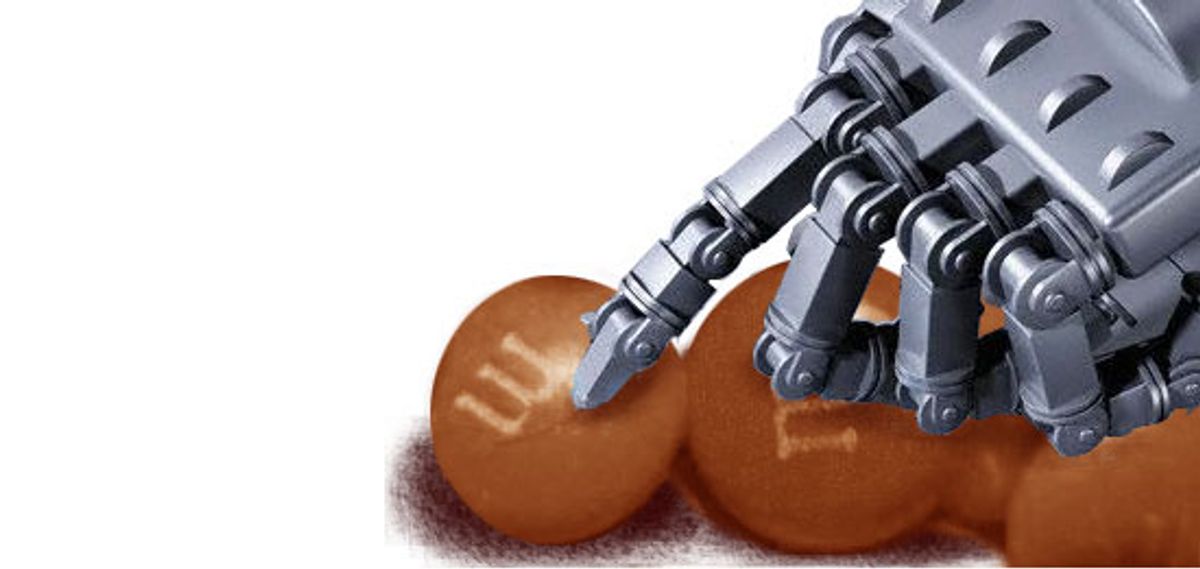
"It's a mechanical calculator," he said, proudly. "About half as powerful as Univac. I milled all the parts using a laser-cutter. What you do is, fill this hopper with GI Joe heads, and this hopper with Barbie heads. Crank this wheel and it will drop a number of M&Ms equal to the product of the two values into this hopper, here." He put three scuffed GI Joe heads in one hopper and four scrofulous Barbies in another and began to crank, slowly. A music-box beside the crank played a slow, irregular rendition of "Pop Goes the Weasel" while the hundreds of little coin-sized gears turned, flipping switches and adding and removing tension to springs. After the weasel popped a few times, twelve brown M&Ms fell into an outstretched rubber hand. He picked them out carefully and offered them to her. "It's OK. They're not from the trash," he said. "I buy them in bulk." He turned his broad back to her and heaved over a huge galvanized tin washtub full of brown M&Ms. "See, it's a bit-bucket!" he said.
Andrea giggled in spite of herself. "You guys are hilarious," she said. "This is really good, exciting nerdy stuff." The gears on the mechanical computer were really sharp and precise; they looked like you could cut yourself on them. When they ground over the polished surfaces of the car-doors, they made a sound like a box of toothpicks falling to the floor: click-click, clickclickclick, click. She turned the crank until twelve more brown M&Ms fell out.
"Who's the Van Halen fan?"
Lester beamed. "Might as well jump -- JUMP!" He mimed heavy-metal air-guitar and thrashed his shorn scalp up and down and though he were headbanging with a mighty mane of hair-band locks. "You're the first one to get the joke!" he said. "Even Perry didn't get it!"
"Get what?" Perry said, also grinning.
"Van Halen had this thing where if there were any brown M&Ms in their dressing room they'd trash it and refuse to play. When I was a kid, I used to dream about being so famous that I could act like that much of a prick. Ever since, I've afforded a great personal significance to brown M&Ms."
She laughed again. Then she frowned a little. "Look, I hate to break this party up, but I came here because Kettlebelly -- crap, Kettlewell -- said that you guys exemplified everything that he wanted to do with Kodacell. This stuff you've done is all very interesting, it's killer art, but I don't see the business-angle. So, can you help me out here?"
"That's step three," Perry said. "C'mere." He led her back to his workspace, to a platform surrounded by articulated arms terminated in webcams, like a grocery scale in the embrace of a metal spider. "Three-dee scanner," he said, producing a Barbie head from Lester's machine and dropping it on the scales. He prodded a button and a nearby screen filled with a three-dimensional model of the head, flattened on the side where it touched the surface. He turned it over and pressed the button again and now there were two digital versions of the head on the screen. He moused one over the other until they lined up, right-clicked a drop-down menu, selected an option, and then they were merged, rotating.
"Once we've got the three-dee scan, it's basically plasticine." He distorted the Barbie head, stretching it and squeezing it with the mouse. "So we can take a real object and make this kind of protean hyper-object out of it, or drop it down to a wireframe and skin it with any bitmap, like this." More fast mousing -- Barbie's head turned into a gridded mesh, fine filaments stretching off along each mussed strand of plastic hair. Then she was wrapped in a Campbell's Cream of Mushroom Soup label, wrapped around her like a stocking pulled over her head. There was something stupendously weird and simultaneously very comic about the sight, the kind of inherent comedy in a cartoon stretched out on a blob of Silly Putty.
"So we can build anything out of interesting junk, with any shape, and then we can digitize the shape. Then we can do anything we like with the shape. Then we can output the shape." He typed quickly and another machine, sealed and mammoth like an outsized photocopier, started to grunt and churn. The air filled with a smell like Saran Wrap in a microwave.
"The goop we use in this thing is epoxy-based. You wouldn't want to build a car out of it, but it makes a mean doll-house. The last stage of the output switches to inks, so you get whatever bitmap you've skinned your object with baked right in. It does about one cubic inch per minute, so this job should be almost done now."
He drummed his fingers on top of the machine for a moment and then it stopped chunking and something inside it went clunk. He lifted a lid and reached inside and plucked out the Barbie head, stretched and distorted, skinned with a Campbell's Soup label. He handed it to Andrea. She expected it to be warm, like a squashed penny from a machine on Fisherman's Wharf, but it was cool and had the seamless texture of a plastic margarine tub and the heft of a paperweight.
"So, that's the business," Lester said. "Or so we're told. We've been making cool stuff and selling it to collectors on the Web for you know, gigantic bucks. We move one or two pieces a month at about ten grand per. But Kettlebelly says he's going to industrialize us, alienate us from the product of our labor, and turn us into an assembly line."
"He didn't say any such thing," Perry said. Andrea was aware that her ears had grown points. Perry gave Lester an affectionate slug in the shoulder. "Lester's only kidding. What we need is a couple of dogsbodies and some bigger printers and we'll be able to turn out more modest devices by the hundred or possibly the thousand. We can tweak the designs really easily because nothing is coming off a mold, so there's no setup charge, so we can do limited runs of a hundred, redesign, do another hundred. We can make 'em to order. "
"And we need an MBA," Lester said. "Kodacell's sending us a business manager to help us turn junk into pesos."
"Yeah," Perry said, with a worried flick of his eyes. "Yeah, a business manager."
"So, I've known some business geeks who aren't total assholes," Lester said. "Who care about what they're doing and the people they're doing it with. Respectful and mindful. It's like lawyers -- they're not all scumbags. Some of them are totally awesome and save your ass."
Andrea took all this in, jotting notes on an old-fashioned spiral-bound shirt-pocket notebook. "When's he arriving?"
"Tomorrow," Lester said. "We've cleared him a space to work and everything. He's someone that Kettlewell's people recruited up in Ithaca and he's going to move here to work with us, sight unseen. Crazy, huh?"
"Crazy," Andrea agreed.
"Right," Perry said. "That's tomorrow, and this aft we've got some work to do, but now I'm ready for lunch. You guys ready for lunch?"
Something about food and really fat guys, it seemed like an awkward question to Andrea, like asking someone who'd been horribly disfigured by burns if he wanted to toast a marshmallow. But Lester didn't react to the question -- of course not, he had to eat, everyone had to eat.
"Yeah, let's do the IHOP." Lester trundled back to his half of the workspace, then came back with a cane in one hand. "There's like three places to eat within walking distance of here if you don't count the mobile Mexican burrito wagon, which I don't, since it's a rolling advertisement for dysentery. The IHOP is the least objectionable of those."
"We could drive somewhere," Andrea said. It was coming up on noon and the heat once they got outside into the mall's ruins was like the steam off a dishwasher. She plucked at her blouse a couple of times.
"It's the only chance to exercise we get," Perry said. "It's pretty much impossible to live or work within walking distance of anything down here. You end up living in your car."
And so they hiked along the side of the road. The sidewalk was a curious mix of old and new, the concrete unworn but still overgrown by tall sawgrass thriving in the Florida heat. It brushed up against her ankles, hard and sharp, unlike the grass back home.
They were walking parallel to a ditch filled with sluggish, brackish water and populated by singing frogs, ducks, ibises and mosquitoes in great number. Across the way were empty lots, ghost-plazas, dead filling stations. Behind one of the filling stations, a cluster of tents and shacks.
"Squatters?" she asked, pointing to the shantytown.
"Yeah," Perry said. "Lots of that down here. Some of them are the paramilitary wing of the AARP, old trailer-home retirees who've run out of money and just set up camp here. Some are bums and junkies, some are runaways. It's not as bad as it looks -- they're pretty comfy in there. We bring 'em furniture and other good pickings that show up at the junkyard. The homeless with the wherewithal to build shantytowns, they haven't gone all animal like the shopping cart people and the scary beachcombers." He waved to an old man in a pair of pressed khaki shorts and a crisp Bermuda shirt across the malarial ditch. "Hey Francis!" he called. The old man waved back. "We'll have some IHOP for you 'bout an hour!" The old man ticked a salute off his creased forehead.
"Francis is a good guy. Used to be an aerospace engineer if you can believe it. Wife had medical problems and he went bust taking care of her. When she died, he ended up here in his double-wide and never left. Kind of the unofficial mayor of this little patch."
Andrea stared after Francis. He had a bit of a gimpy leg, a limp she could spot even from here. Beside her, Lester was puffing. No one was comfortable walking in Florida, it seemed.
It took another half hour to reach the IHOP, the International House of Pancakes, which sat opposite a mini-mall with only one still-breathing store, a place that advertised 99-cent T-shirts, which struck Andrea as profoundly depressing. There was a junkie out front of 99-Cent Tees, a woman with a leathery tan and a tiny tank-top and shorts that made her look a little like a Tenderloin hooker, but not with that rat's-nest hair, not even in the 'Loin. She wobbled uncertainly across the parking lot to them.
"Excuse me," she said, with an improbable Valley Girl accent. "Excuse me? I'm hoping to get something to eat, it's for my kid, she's nursing, gotta keep my strength up." Her naked arms and legs were badly tracked out, and Andrea had a horrified realization that among the stains on her tank-top were a pair of spreading pools of breast milk, dampening old white, crusted patches over her sagging breasts. "For my baby. A dollar would help, a dollar."
There were homeless like this in San Francisco, too. In San Jose as well, she supposed, but she didn't know where they hid. But something about this woman, cracked out and tracked out, it freaked her out. She dug into her purse and got out a five dollar bill and handed it to the homeless woman. The woman smiled a snaggletoothed stumpy grin and reached for it, then, abruptly, grabbed hold of Andrea's wrist. Her grip was damp and weak.
"Don't you fucking look at me like that. You're not better than me, bitch!" Andrea tugged free and stepped back quickly. "That's right, run away! Bitch! Fuck you! Enjoy your lunch!"
She was shaking. Perry and Lester closed ranks around her. Lester moved to confront the homeless woman.
"The fuck you want lard ass? You wanna fuck with me? I got a knife, you know, cut your ears off and feed 'em to ya."
Lester cocked his head like the RCA Victor dog. He towered over the skinny junkie, and was five or six times wider than her.
"You all right?" he said. Gently.
"Oh yeah, I'm just fine," she said. "Why, you looking for a party?"
He laughed. "You're joking -- I'd crush you!"
She laughed too, a less crazy, more relaxed sound. Lester's voice was a low, soothing rumble. "I don't think my friend thinks she's any better than you. I think she just wanted to help you out."
The junkie flicked her eyes back and forth. "Listen can you spare a dollar for my baby?"
"I think she just wanted to help you. Can I get you some lunch?"
"Fuckers won't let me in -- won't let me use the toilet even. It's not humane. Don't want to go in the bushes. Not dignified to go in the bushes."
"That's true," he said. "What if I get you some take-out, you got a shady place you could eat it? Nursing's hungry work."
The junkie cocked her head. Then she laughed. "Yeah, OK, yeah. Sure -- thanks, thanks a lot!"
Lester motioned her over to the menu in the IHOP window and waited with her while she picked out a helping of caramel-apple waffles, sausage links, fried eggs, hash browns, coffee, orange juice and a chocolate malted. "Is that all?" he said, laughing, laughing, both of them laughing, all of them laughing at the incredible, outrageous meal.
They went in and waited by the podium. The greeter, a black guy with corn-rows, nodded at Lester and Perry like an old friend. "Hey Tony," Lester said. "Can you get us a go-bag with some take-out for the lady outside before we sit down?" He recited the astounding order.
Tony shook his head and ducked it. "OK, be right up," he said. "You want to sit while you're waiting?"
"We'll wait here, thanks," Lester said. "Don't want her to think we're bailing on her." He turned and waved at her.
"She's mean, you know -- be careful."
"Thanks, Tony," Lester said.
Andrea marveled at Lester's equanimity. Nothing got his goat. The doggie bag arrived. "I put some extra napkins and a couple of wet-naps in there," Tony said, handing it to him.
"Great!" Lester said. "You guys sit down, I'll be back in a second."
Perry motioned for Andrea to follow him to a booth. He laughed at her. "Lester's a good guy," he said. "The best guy I know, you know?"
"How do you know him?" she asked, taking out her notepad.
"He was the sysadmin at a company that was making three-dee printers, and I was a tech at a company that was buying them, and the products didn't work, and I spent a lot of time on the phone with him troubleshooting them. We'd get together in our off-hours and hack around with neat little workbench projects, stuff we'd come up with at work. When both companies went under, we got a bunch of their equipment at bankruptcy auctions. Lester's uncle owned the junkyard and he offered us space to set up our workshops and the rest is history."
Lester joined them again. He was laughing. "She is funny," he said. "Kept hefting the sack and saying, 'Christ what those bastards put on a plate, no wonder this country's so goddamned fat!'" Perry laughed too. Andrea chuckled nervously and looked away.
He slid into the booth next to her and put a hand on her shoulder. "It's OK. I'm a guy who weighs nearly 400 pounds. I know I'm a big, fat guy. If I was sensitive about it, I couldn't last ten minutes. I'm not proud of being as big as I am, but I'm not ashamed either. I'm OK with it."
"You wouldn't lose weight if you could?"
"Sure, why not? But I've concluded it's not an option anymore. I was always a fat kid, and so I never got good at sports, never got that habit. Now I've got this huge deficit when I sit down to exercise, because I'm lugging around all this lard. Can't run more than a few steps. Walking's about it. Couldn't join a pick-up game of baseball or get out on the tennis court. I never learned to cook, either, though I suppose I could. But mostly I eat out, and I try to order sensibly, but just look at the crap they feed us at the places we can get to -- there aren't any health food restaurants in the strip malls. Look at this menu," he said, tapping a pornographic glossy picture of a stack of glistening waffles oozing with some kind of high-fructose lube. "Caramel pancakes with whipped cream, maple syrup and canned strawberries. When I was a kid, we called that candy. These people will sell you an eight dollar, 18-ounce plate of candy with a side of sausage, eggs, biscuits, bacon and a pint of orange juice. Even if you order this stuff and eat a third of it, a quarter of it, that's probably too much, and when you've got a lot of food in front of you, it's pretty hard to know when to stop."
Andrea can't help it, she blurts out: "But will-power --"
"Sure, will-power. Will-power nothing. The thing is, when three quarters of America are obese, when half are dangerously obese, like me, years off our lives from all the fat -- that tells you that this isn't a will-power problem. We didn't get less willful in the last fifty years. Might as well say that all those people who died of the plague lacked the will-power to keep their houses free of rats. Fat isn't moral, it's epidemiological. There are a small number of people, a tiny minority, whose genes are short-circuited in a way that makes them less prone to retaining nutrients. That's a maladaptive trait through most of human history -- burning unnecessary calories when you've got to chase down an antelope to get more, that's no way to live long enough to pass on your genes! So you and Perry over here with your little skinny selves, able to pack away transfats and high-fructose corn-syrup and a pound of candy for breakfast at the IHOP, you're not doing this on will-power -- you're doing it by expressing the somatype of a recessive, counter-survival gene.
"Would I like to be thinner? Sure. But I'm not gonna let the fact that I'm genetically better suited to famine than feast get to me. Speaking of, let's eat. Tony, c'mere, buddy. I want a plate of candy!" He was smiling, and brave, and at that moment, Andrea thought that she could get a crush on this guy, this big, smart, talented, funny, lovable guy. Then reality snapped back and she saw him as he was, sexless, lumpy, almost grotesque. The overlay of his, what, his inner beauty on that exterior, it disoriented her. She looked back over her notes.
"So, you say that there's a third coming out to work with you?"
"To live with us," Perry said. "That's part of the deal. Geek houses, like in the old college days. We're going to be a power-trio: two geeks and a suit, lean and mean. The suit's name is Tjan, and he's Singaporean by way of London by way of Ithaca, where Kettlebelly found him. We've talked on the phone a couple times and he's moving down next week."
"He's moving down without ever having met you?"
"Yeah, that's the way it goes. It's like the army or something for us, once you're in you get dispatched here or there. It was in the contract. We already had a place down here with room for Tjan, so we put some fresh linen on the guest-bed and laid in an extra toothbrush."
"It's a little nervous-making," Lester said. "Perry and I get along great, but I haven't had such good luck with business-types. It's not that I'm some kind of idealist who doesn't get the need to make money, but they can be so condescending, you know?"
Andrea nodded. "That's a two-way street, you know. 'Suits' don't like being talked down to by engineers."
Lester raised a hand. "Guilty as charged."
"So what're you planning to do for the rest of the week?" It was Wednesday, and she'd counted on getting this part of the story by Saturday, but here she was going to have to wait, clearly, until this Tjan arrived.
"Same stuff as we always do. We build crazy stuff out of junk, sell it to collectors, and have fun. We could go to the Thunderbird Drive In tonight if you want, it's a real classic, flea-market by day and drive in by night, practically the last one standing."
Perry cut in. "Or we could go to South Beach and get a good meal, if that's more your speed."
"Naw," Andrea said. "Drive in sounds great, especially if it's such a dying breed. Better get a visit in while there's still time."
They tried to treat her but she wouldn't let them. She never let anyone buy her so much as a cup of coffee. It was an old journalism-school drill, and she was practically the only scribbler she knew who hewed to it -- some of the whores on the Silicon Valley papers took in free computers, trips, even spa days! -- but she had never wavered.
Shares