Fiction
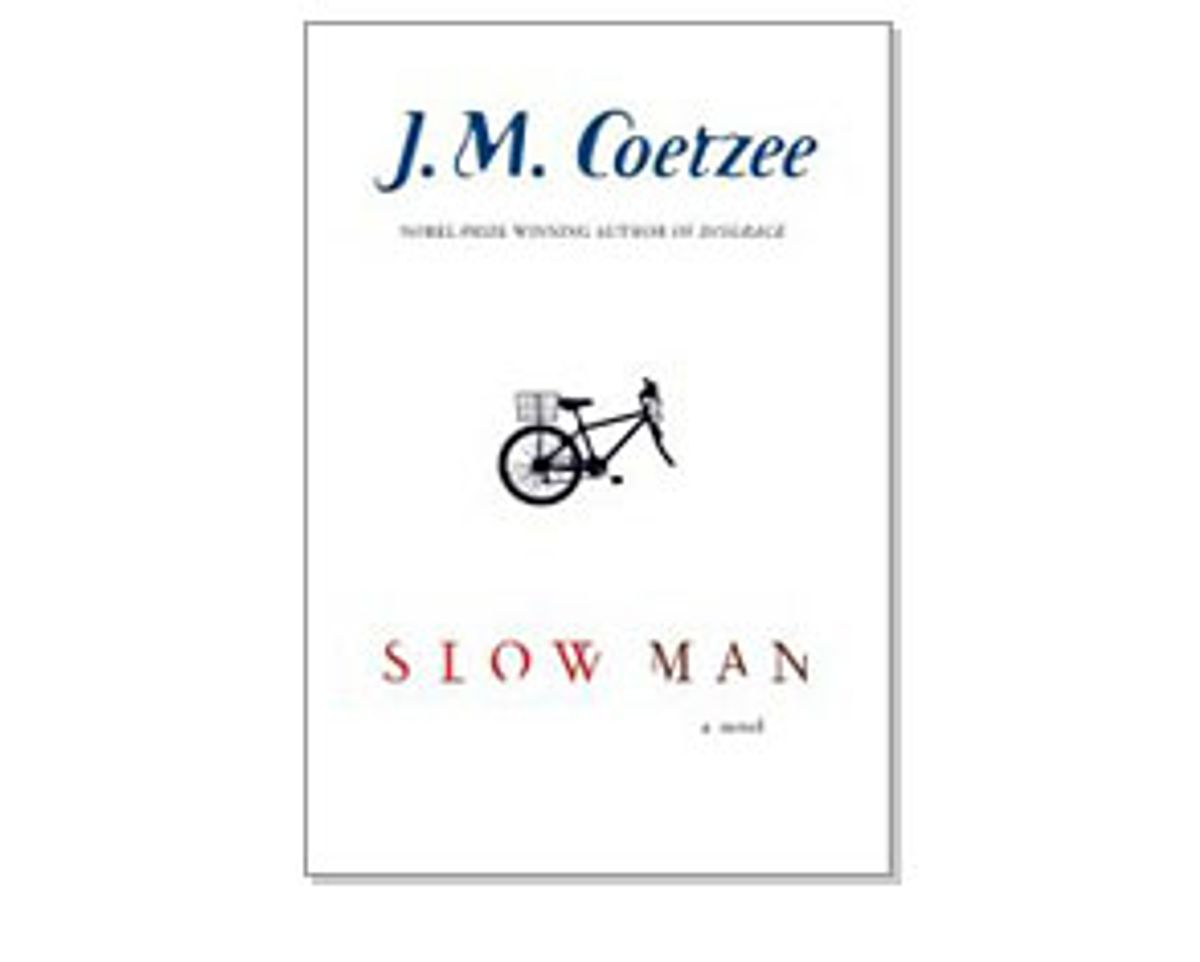
“Slow Man” by J.M. Coetzee
Nobel laureate Coetzee takes a simple plot -- an aging, injured man falls for his nurse -- and spins it into a postmodern meditation on desire and humanity.
“Slow Man,” the new novel from South African Nobel laureate J.M. Coetzee, opens on a glorious Australian morning. Sixty-year-old Paul Rayment is out on a bike ride when a young man in a car hits him, sending him flying through the air, and then smack down onto the pavement. Within the book’s first pages, Rayment is taken to the hospital, where he drifts in and out of consciousness before discovering that his leg was not only destroyed in the accident, but has been amputated just above the knee. A doctor tells him that he is lucky — it could have been much worse.
Rayment is sent home fairly quickly after his surgery, but because this is a Coetzee novel, what follows is not a tale of coming to terms, of adaptation, of a cranky, stubborn man who finds a new lease on life after nearly losing it. To be sure, Rayment is stubborn, but not in any amusing way. He steadfastly refuses to accept what has happened to him, let alone consider wearing a prosthesis and learning again to walk; he stays indoors, and grows gloomy. He hires a day-nurse, Sheena, but “he does not like any of the temps — does not like being treated like a child or an idiot, does not like the bouncy, cheerful voice they put on for him.” That is, he doesn’t like the temps until Marijana, a Croatian immigrant, arrives to nurse him.
Rayment is an unremarkable man. Divorced, with no children, he lives in a flat filled with the previous owner’s furniture. He is French, but grew up in Australia; as an adult, Rayment tried to repatriate himself to his birth country but found it unwelcoming, and returned to his adopted nation to take photos and begin collecting old images of native Australians, those families and workers who, unlike him, are rooted to a particular place. Rayment seems to have always been incapable of joy, but it’s even worse after the accident so Marijana arrives to a particularly dark situation. But when she treats him like a man — she does not talk to him as if he’s a child — respects him, dusts his books, washes his “stump,” parts of him wake up, and he falls desperately in love with his nurse.
There is no real affair between them, but “Slow Man” follows Rayment’s descent into desperation; his ardor increases for Marijana, even as she senses it and pulls away. (His efforts to keep her on, and to win her heart, mostly involve promises of money.) Only a writer like Coetzee — who doesn’t want you to care about his characters so much as observe them, take in their humanity — could make this story of a passive, aging man who desires his housekeeper interesting. Rayment’s story is sad, and reading this novel will make you feel profoundly sad — which has a lot to do with Coetzee’s ability to write in a prose so spare that the absence of embellishment inspires more despair than does the plight of Paul Rayment. There is air in each line — have I ever read such unadorned sentences? — but that air is thick, and weighs heavily.
Still, it seems that even Coetzee may have doubted whether the decidedly average Paul Rayment was enough to hang an entire novel on. To assist, about halfway into the book, Elizabeth Costello appears; she is a novelist — as well as the eponymous heroine of an earlier Coetzee book — who shows up randomly to keep the plot moving along. She imposes on Rayment, staying in his house only semi-invited, watching him and Marijana. Rayment’s passivity irks her, so she contrives various scenarios to get him to act, to behave with some agency in his own life.
Costello finagles a sexual tryst for Rayment and pushes him to confront Marijana over an issue with her son (who Rayment, childless, begins to wish were his own) — she’s like a puppetmaster. Mostly, though, she is an irritant. Rayment is constantly trying to get her out of his hair — he says, shaking his head, “I don’t know what you want,” and she responds, “Push!” Rayment suspects that she has arrived in order to study him, study all of them, and put them into her next book, and he finds notes on a desk that seem to confirm it. She claims only that “When I came knocking at your door … I came to find out what happens when a man of sixty engages his heart unsuitably.”
Throwing Elizabeth Costello into “Slow Man” is a clever move, and the kind of postmodern trick that could drive some readers mad. But for fans of Coetzee’s recent work — not just “Elizabeth Costello” but the Booker Prize-winning “Disgrace,” too — this novel is a welcome addition to a unique oeuvre. As Coetzee gets older himself and shifts focus from his homeland of South Africa and the legacy of apartheid to other things (including animal rights and, more important, aging) we have a lot to look forward to. Still, I must admit that I hope this is the end of Elizabeth Costello — she seems like a rather intrusive houseguest.
Our next pick: An ambitious novel from the author of “Bee Season” about love, life, loss — and the flu
Hillary Frey is the Books editor at Salon. More Hillary Frey.
50 shades of Shutterstock
Slide show: Everyone's favorite light-bondage bestseller illustrated by inexplicable stock photography SLIDE SHOW
This week, for roughly the millionth time, E.L. James’ romance-bondage trilogy “50 Shades” nabs the No. 1, 2 and 3 spots on the New York Times bestseller lists. We don’t get it either. Every page of that book, which famously began as “Twilight” fan fiction, elicits a sigh of confusion and weird secondary embarrassment. The question is: Who would read this? (The answer is: Apparently everyone.) It’s the same baffled, helpless feeling we get when we sort through stock photos on a daily basis. Stock photos – which have been the subject of recent outstanding Internet satire – are used by this site, and many others, to illustrate our flood of content. Many are plain and simple, but a good portion are flat-out mind-blowing. Why did anyone think that photo was a good idea? It only made sense to join these forces. And so, we present to you passages from the most head-scratching bestseller of our time, illustrated with the assistance of inexplicable stock photography.
Megaphone by Natalie Bakopoulos
Miracles happen, even in an Athens crippled by a garbage strike, to a young mother unsure of her ability to love
(Credit: iStockphoto/caracterdesign) It’s the third week of the garbage strike and Athens has begun to smell. Bright-colored trash bags fill the curbs and alleyways, and we have learned to step over the rubbish and avoid the blocks that had become unnavigable. We know which stretches are particularly foul — a stretch along Mavili Square, or the entire top end of Monastiraki. Odos Athinas is a sea of trash, and Omonia is ghastly but we don’t go there anyway. May has gone from unseasonably cool to raging hot, and the garbage seems to be melting. In front of the museum it’s like yet another installation project. When I arrive each morning I want to wretch.
Continue Reading CloseNatalie Bakopoulos's first novel, "The Green Shore," will be published by Simon & Schuster in June 2012. Her work has appeared in Tin House, Ninth Letter, Granta Online, and The O. Henry Prize Stories 2010, and she is a contributing editor for the online journal Fiction Writers Review. More Natalie Bakopoulos.
Almost by Chris Pavone
She never thought of herself as ambitious, until motherhood and career collided in one horrifying hospital ride
(Credit: iStockphoto/caracterdesign) It’s just before dawn when Isabel puts the final page down on the fat stack of paper that sits on the rumpled bedspread, next to an overflowing crystal ashtray and a crumpled soft-pack of cigarettes. She’d tried Wellbutrin and Xanax; she’d used patches and gum. In the end, the only thing that made her quit smoking was being pregnant.
But then, after everything, she couldn’t help but start up again. At first it was just a single cigarette per day, or two. Then it became a few, and within months she was back to full-throttle. Over the past couple of years, she’s tried to quit a few times, but not seriously. She anticipates — she accepts — failure. Because she doesn’t want to quit, not really. She wants instead to try, and fail.
Continue Reading CloseMemorial Day fiction: Are we there yet?
Salon exclusive: At the start of the summer fiction season, new stories from Chris Pavone and Natalie Bakopoulos
(Credit: iStockphoto/caracterdesign) “Are we there yet?”
It’s a dreaded sentence. When it’s spoken by an anxious child from the back seat, it’s enough to make stressed-out parents wish they’d never taken a family vacation in the first place. And even if it’s delivered as a sing-songy punch line, from an impatient partner or spouse on a long road trip, it’s an irritating eye-roller of a joke.
So this Memorial Day weekend — the unofficial start of the summer vacation season, and therefore the summer fiction season — we asked two novelists to reclaim the sentence in a new and adult context. For our latest fiction project, there was only one simple rule: Each story had to include the line “Are we there yet?” in a fresh and surprising way.
Continue Reading CloseDavid Daley is the senior culture editor of Salon. More David Daley.
“Frankenstein” remixed
This masterful new adaptation of Mary Shelley's classic novel may be the best interactive fiction yet
Whatever interactive fiction is (and we’re still figuring that out) it suffers from all the problems of traditional fiction and then some. The vast majority of novels and short stories aren’t much good, but when a branching fiction — along the lines of the old “Choose Your Own Adventure” children’s books — fails to engage, the first impulse is to blame the form rather than the content. Let “Frankenstein,” just released by Inkle Studios and Profile Books, serve as a reproach to that reflex. The app is a creative, subtle and sensitive adaptation of Mary Shelley’s classic novella, and it has singlehandedly renewed this critic’s hopes for interactive fiction.
Laura Miller is a senior writer for Salon. She is the author of "The Magician's Book: A Skeptic's Adventures in Narnia" and has a Web site, magiciansbook.com. More Laura Miller.
Page 1 of 130 in Fiction


