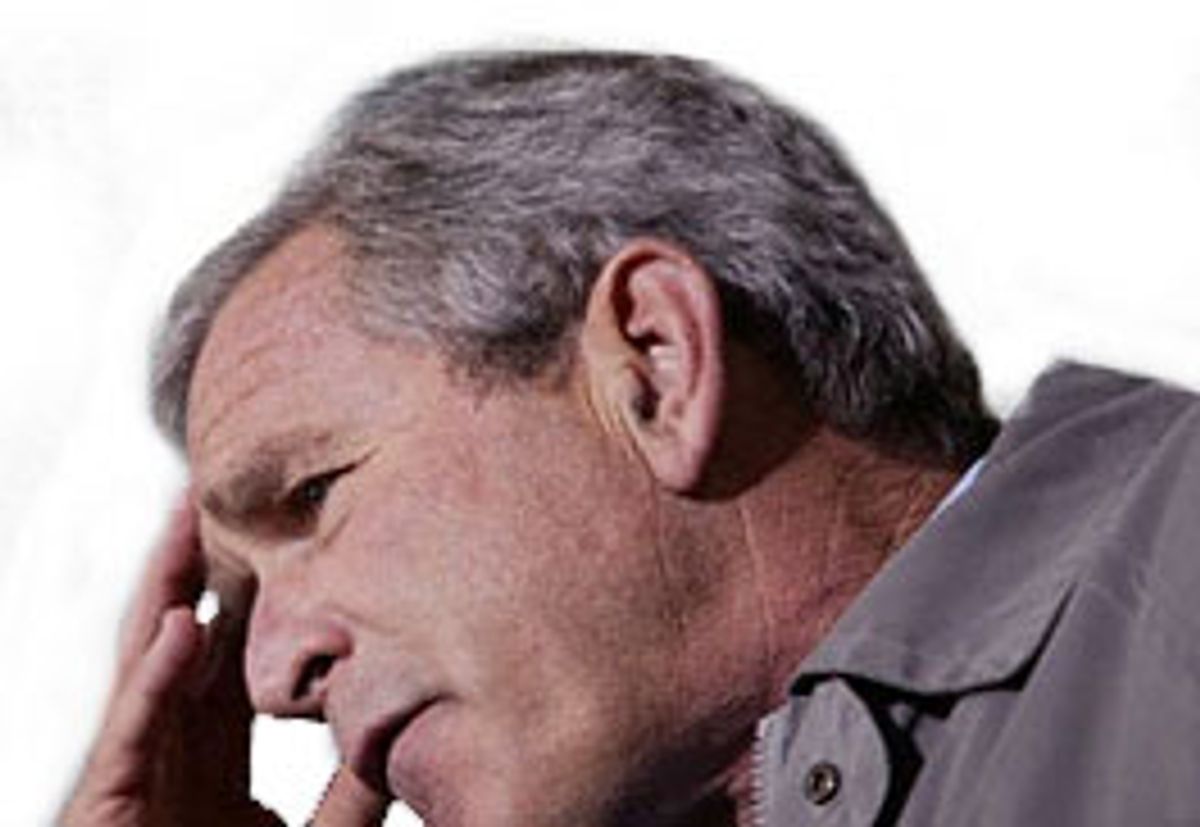
George W. Bush
Bush’s bunker strategy
A prisoner of the neocons, the president hunkers down, awaiting the outcome of the Libby indictment.
One year after his reelection President Bush governs from a bunker. “We go forward with complete confidence,” he proclaimed in his second inaugural address. He urged “our youngest citizens” to see the future “in the determined faces of our soldiers” and to choose between “evil” and “courage.” But as he listened to Bush that day, Vice President Dick Cheney knew that the election had been secured by a coverup.
“I would have wished nothing better,” declared Patrick Fitzgerald in his press conference of Oct. 28, announcing the indictment on five counts of perjury and obstruction of justice of I. Lewis “Scooter” Libby, the vice president’s chief of staff, “that, when the subpoenas were issued in August 2004, witnesses testified then, and we would have been here in October 2004 instead of October 2005. No one would have went to jail.”
The indictment of Libby documents that it was Cheney who confirmed the exact identity of covert CIA operative Valerie Plame to him. The indictment also describes a figure called “Official A,” subsequently disclosed to be Karl Rove, the president’s chief political advisor, who informed Libby that he had told conservative columnist Robert Novak of Plame’s secret status. The next day, July 12, 2003, Libby conferred with Cheney on how to handle the press on the matter. That same day, Libby revealed Plame’s identity to two reporters, Judith Miller of the New York Times and Matthew Cooper of Time magazine. Then Libby falsely testified that he had learned Plame’s name from reporters. On Sept. 30, 2003, President Bush emphatically stated that he wanted anyone in his administration with information about the Plame leak to “come forward”; if anyone inside was involved, he wanted to know; and if anyone had violated the law, “the person will be taken care of.” On June 10, 2004, he pledged that anyone on his staff who had leaked Plame’s name would be fired.
When the Libby indictment was announced, Bush and Cheney praised him as a fine public servant. Still under investigation, Rove remains in the West Wing. But Cheney knew during the presidential campaign that he had discussed with Libby how to deal with Plame. Now Bush knows that Rove had enabled Novak to publish her identity. But the president’s promise to fire officials is suddenly inoperative. It is apparently acceptable for aides to deceive the president and compromise national security so long as they further his short-term political benefit. Ever-shifting ends justify ever-shifting means.
Libby’s alleged coverup was undertaken in the spirit of neoconservative Leninism. The vanguard, which sets all policy and uses the party as its instrument, rationalizes any tactic. Libby was a deeply seeded neoconservative apparatchik, possessing long experience and great bureaucratic skill, an inside man, never seeking the spotlight for himself. He was a member of a small cadre of his caliber, not easily replenished. If he had testified truthfully in October 2004 the result would have consumed the final days of the campaign. His Leninist logic permitted him to protect the Republican cause, but he has tainted Bush’s victory in history as surely as the Supreme Court decision in Bush v. Gore did in 2000.
Bush took his 2004 win as a resounding mandate for a right-wing agenda. His second term was to be the fulfillment of conservative dreams to roll back decades of liberalism. With each right turn, however, his popularity declined. Iraq acted as an accelerator of his fall.
His nomination of his White House legal counsel Harriet Miers for the Supreme Court was an acknowledgment of his sharply narrowed political space. Bush believed he could thread the needle with her because her record was unknown. While the Republican masses supported him, the Leninist right staged a revolt. In Bush’s cronyism and opportunism, they saw his deviation. He was the disloyalist. With the prosecutor’s indictment imminent, Bush withdrew Miers and caved. Broadly unpopular, he could not suffer a split right. His new nominee, federal Judge Samuel Alito, a reliable sectarian, is a tribute to his bunker strategy.
Hostage to his failed fortune, Bush is a prisoner of the right. His administration has become its own little republic of fear. Libby’s public trial will reveal the administration’s political methods. Cheney, along with a host of others, will be called to testify. Whatever other calamities may befall Bush, their specter harries him to the right. “Disunity, dissolution and vacillation” are hallmarks of “the path of conciliation,” as Lenin wrote in “What Is to Be Done.” The vanguard on “the path of struggle,” criticized for being “an exclusive group,” must oppose any retreat proposed by the “opportunist rearguard.” “We are marching in a compact group along a precipitous and difficult path, firmly holding each other by the hand. We are surrounded on all sides by enemies, and we have to advance almost constantly under their fire.”
Sidney Blumenthal, a former assistant and senior advisor to President Clinton, writes a column for Salon and the Guardian of London. His new book is titled "How Bush Rules: Chronicles of a Radical Regime." He is a senior fellow at the New York University Center on Law and Security. More Sidney Blumenthal.
Using Bush’s playbook
"Karl Rove politics" aren't quite dead: Obama's strategy in 2012 will mirror W's in 2004
George W. Bush and Barack Obama (Credit: Reuters/Larry Downing) Barack Obama’s presidency was born from nothing so much as his repudiation of George W. Bush’s administration — its policies and politics, its style and tone. One of Obama’s most effective 2008 stump speech refrains was his promise to end the era of “Scooter Libby justice, ‘Brownie’ incompetence and Karl Rove politics.”
But the political dynamics for winning a second presidential term often differ markedly from winning the first. So don’t be surprised by many eerie parallels between Obama’s 2012 reelection bid and Bush’s 2004 campaign. The president may not rely upon “Karl Rove politics” in the strictest sense, and nobody would confuse David Axelrod with Rove. But Obama’s reelection route and rhetoric may bear more than a few Rovian hallmarks.
Continue Reading CloseThe Bushies are back
Missed the neocons? Don't worry: Mitt Romney's getting the band together again
(Credit: Reuters/Win McNamee) There was good reason for Republicans to cry foul over the Obama campaign’s advertisement highlighting the president’s killing of Osama bin Laden; the GOP has lost its decades-long edge on national security. According to a Washington Post poll, “By a margin of more than 2 to 1, Americans say the president’s handling of terrorism is a major reason to support rather than oppose his bid for reelection.”
Continue Reading CloseJordan Michael Smith writes about U.S. foreign policy for Salon. He has written for the New York Times, Boston Globe and Washington Post. More Jordan Michael Smith.
Bush aide blasts torture
Philip Zelikow tried to warn Bush on interrogations. Now he's penned an authoritative article on how he was ignored
(Credit: Reuters/Jim Young) The Bush administration hasn’t heard the last from Philip Zelikow. After the rediscovery last week of his long lost 2006 anti-torture memo, Zelikow, a former State Department official, has written arguably the most damning article yet about U.S. government’s interrogation policies from 2001 to 2009. The article, called “Codes of Conduct for a Twilight War,” will be released in a forthcoming issue of the Houston Law Journal, and was obtained exclusively by Salon. Says Zelikow in an email: “I’m not aware of other accounts that combine historical, policy and legal approaches to” the subject of the Bush administration’s interrogation methods.
Continue Reading CloseJordan Michael Smith writes about U.S. foreign policy for Salon. He has written for the New York Times, Boston Globe and Washington Post. More Jordan Michael Smith.
Thomas Kinkade, the George W. Bush of art
The rise and fall of Thomas Kinkade, the Painter of Light™ in a decade of bad faith
News of Thomas Kinkade’s death arrived on the same day I received in the mail a vintage teacup on which I had spent a ridiculous amount of money. It has a cottage painted on it. Kinkade, whose work has long exerted a morbid fascination for me (to the concern of all my friends), specialized in cottages. So some part of me understands the appeal, I guess, but, damn: Those paintings make my corneas hurt. And yet, I could barely stop looking at them.
Kinkade was only 54, and his family told the media that he died of “natural causes.” This comes after years of reports of drunken public misbehavior: cursing at people who tried to save him from falling off bar stools, heckling Siegfried & Roy, grabbing a woman’s breasts at a publicity event and, most memorably, urinating on a Winnie the Pooh statue at the Disneyland Hotel while proclaiming, “This one’s for you, Walt!” There were DUI arrests. Also, his manufacturing company declared bankruptcy two years ago, and former franchisees of the once-ubiquitous Thomas Kinkade Signature Galleries won settlements against him for fraud.
Continue Reading Close
Laura Miller is a senior writer for Salon. She is the author of "The Magician's Book: A Skeptic's Adventures in Narnia" and has a Web site, magiciansbook.com. More Laura Miller.
The memo Bush tried to destroy
A document advising the Bush administration against torture has resurfaced, despite his best efforts to hide it
George W. Bush in 2006 (Credit: AP/Ron Edmonds) In February of 2006, Philip Zelikow, counselor to Secretary of State Condoleezza Rice, authored a memo opposing the Bush administration’s torture practices (though he employed the infamous obfuscation of “enhanced interrogation techniques”). The White House tried to collect and destroy all copies of the memo, but one survived in the State Department’s bowels and was declassified yesterday in response to a Freedom of Information Act request by the National Security Archive.
Continue Reading CloseJordan Michael Smith writes about U.S. foreign policy for Salon. He has written for the New York Times, Boston Globe and Washington Post. More Jordan Michael Smith.
Page 1 of 436 in George W. Bush