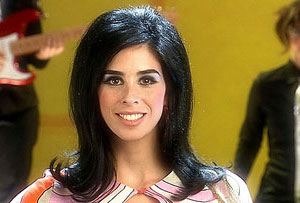

Sarah Silverman
“Sarah Silverman: Jesus Is Magic”
Silverman is as funny as ever, but do we really need to see her strolling around, decked out like "That Girl" and singing about racism?
Sarah Silverman The artistry of stand-up comic Sarah Silverman — the weirdly concrete subtlety of jokes like “Nazis are A-holes, and I’ll be the first one to say it. ‘Cos I’m edgy” — is so austere that the last thing it needs is clutter. And that’s the chief problem with “Sarah Silverman: Jesus Is Magic.” The picture consists mostly of performance footage of Silverman, which, despite the fact that it’s shot on grainy, anemic-looking digital video, is a pleasure to watch. But the performance is chopped up and intercut with musical numbers and set pieces in which Silverman shows up in crazy get-ups to sing songs that often repeat the punch lines of her jokes. The movie lures us into that forbidden garden where the funniest things are precisely the things we’re not supposed to laugh at, only to yank us out of that paradise and draw our attention to the things it desperately wants us to laugh at.
So just as we find ourselves easing into the unsettling, alluring rhythms of Silverman’s patter (about, say, the dangers of using words like “Chink” on TV even when you’re making a joke that’s implicitly, if not overtly, anti-racist), we’re whisked away from that auditorium, and away from the illusion that we’re part of that live audience, and confronted with pieced-in footage of Silverman wandering around a set, troubadour-like, in a Marlo Thomas “That Girl” dress and hairdo, singing a song about racism.
The incongruity of it all is what’s supposed to be funny. But Silverman doesn’t need to manufacture clever, faux-ironic gags to get laughs: Even without costumes, she’s a vision of incongruity, which is part of what makes her act, and her persona, so alluring. Silverman’s hair falls in a smooth, enviable Breck-girl sheet around her shoulders; her skin has a creamy glow that suggests innocence, in direct contrast to the stream of unthinkable thoughts that issue, uncensored, from her lips, the sort of things that nice girls shouldn’t think, let alone say. Part of her genius is the way she uses her girlish twang to lull us into easy complicity. When she shoots a caustic arrow of social commentary like “I think the best time to have a baby is when you’re a black teenager,” she delivers the line as if she were telling us what she bought at the mall that day.
And as with most comics, the very thing that makes Silverman so brilliant is exactly what frustrates and angers people about her. Ancient talk-show host Joe Franklin has said he’s considering suing Silverman because of the particularly transgressive routine she contributed to Paul Provenza and Penn Jillette’s marvelous documentary “The Aristocrats,” about the filthiest joke in the universe, in which she spins an obviously false tale about how Franklin raped her when she was a kid on the vaudeville circuit.
The absurdity of the story is exactly what made it so funny. (As Provenza said of Silverman’s version of the joke in a recent New Yorker article: “If the choice of who raped her was anybody but Joe Franklin, we couldn’t deal with it. But by making it Joe Franklin she spins it off into absurdity yet again. Imagine Joe Franklin being sexual. There’s an irony in that alone.”)
But the gag also makes you feel vaguely nervous, maybe a little bit queasy. You know it’s OK to laugh, but there’s still a part of you that wonders if maybe you shouldn’t. The best parts of “Jesus Is Magic” all work on that principle: Silverman’s favorite subjects are rape, racism and the Holocaust (although not particularly in that order), and her riffing often leads us into some very dark places. She talks about her late nana having been a Holocaust survivor, but assures us that she was lucky, because she was in one of the “better” camps. (She even had a vanity tattoo, Silverman says. It read “Bedazzled.”)
Even if a joke like that makes you laugh, it also leaves you wondering what earthly purpose it could serve. There is a point of view in Silverman’s humor: She despises hypocrisy, and the way people make facile, fake pronouncements about serious issues just to make it look as if they actually give a damn.
But Silverman’s humor doesn’t always have an overtly obvious purpose. As she notes at one point in “Jesus Is Magic,” she’s a serious comic who deals with serious issues. She waits a beat: “Learnmady is what I call it.” Silverman’s gags don’t come with that reassuring gleam that tells us we’re learning something even as we’re laughing. The gleam is implicit — we are learning something, even though we may not know exactly what it is. But Silverman’s great gift lies in her refusal to reassure us: This isn’t humor that allows us to congratulate ourselves on how tolerant or sensitive we are, on what lengths we’ve gone to become the thoughtful, engaged people we are. Instead, it leaves us dangling nervously, and questioning deep in our hearts, whether we’ve really gone far enough.
Stephanie Zacharek is a senior writer for Salon Arts & Entertainment. More Stephanie Zacharek.
The New York Times has female trouble
Katie Roiphe defends risque jokes at work, but then an arts story wonders if women comics are going too far
Sarah Silverman The New York Times thinks naughty ladies are just da bomb. People still say “da bomb,” right? That’s a thing? On Sunday, the Paper of Record gave Katie Roiphe free rein to gas on “in favor of dirty jokes and risqué remarks,” which, to her mind, are what those whiny girls are complaining about when they’re being sexually harassed. “Show me a smart, competent young professional woman who is utterly derailed by a verbal unwanted sexual advance or an inappropriate comment about her appearance,” she wrote, between boasts about her Princeton pedigree, “and I will show you a rare spotted owl.” Show me evidence Katie Roiphe has ever held a real job, and I will eat a rare spotted owl.
Continue Reading Close
Mary Elizabeth Williams is a staff writer for Salon and the author of "Gimme Shelter: My Three Years Searching for the American Dream." Follow her on Twitter: @embeedub. More Mary Elizabeth Williams.
Sarah Silverman meets the Serenading Unicorn
Is this melodic horned horse the best viral marketing since the Old Spice Guy? We think so
Sarah has finally moved on. The best job in the world must be being Sarah Silverman’s boyfriend. Well, unless you are Jimmy Kimmel, in which case I guess hosting your own late night show and f*cking Ben Affleck is more spiritually rewarding.
But don’t worry, Sarah, there’s a new player in town who wants to wine and dine you, and that’s the Serenading Unicorn.
Continue Reading Close
Drew Grant is a staff writer for Salon. Follow her on Twitter at @videodrew. More Drew Grant.
Inside TED
At the ultra-cool "ideas" conference, there's no recession, Sarah Silverman is tame and all we need is "mind shift"
Sarah Silverman arrives at the 61st Primetime Emmy Awards on Sunday, Sept. 20, 2009, in Los Angeles. (AP Photo/Chris Pizzello) (Credit: Chris Pizzello) A perfect breeze wafts through the outdoor plaza of the four-star Riviera Resort in Palm Springs, Calif., site of this year’s TEDActive conference, the slightly less expensive, and less exclusive, overflow conference of the annual TED conference, held in Long Beach. Friend and colleague Andy Bichlbaum and I are sitting with a crowd in an outdoor Jacuzzi, reveling in the balmy weather after having just barely escaped the blizzard on the East Coast. This being a conference devoted to “Ideas worth spreading,” we’ve been invited to give a talk here about the work of the mischief-making, left-leaning activist collective known as the Yes Men, best known for constructing elaborate pranks, impersonations and hacks of major corporations and powerful government bodies. Andy is one of the co-founders, and I’ve been working with the group on and off in various capacities for a year and change.
Continue Reading CloseJoseph Huff-Hannon is a Brooklyn-based independent writer and producer, a 2008 finalist in the Livingston Award for Young Journalists, and a recipient of a James Aronson Award for Social Justice Journalism. See more of his work at josephhuffhannon.com. More Joseph Huff-Hannon.
Women ARE funny. And foxy!
Vanity Fair spotlights Tina Fey and other female comedians, and the question isn't "Why aren't women funny?" but "Why are today's funny women all so hot?"
Back in January 2007, when Vanity Fair published Christopher Hitchens’ irritating “Why Women Aren’t Funny,” clearly written in the depths of a Bushmills bender, the funny (ha!) thing was that female comedians were actually doing better than ever: Tina Fey was starring in the best sitcom on television after a winning tenure at “Saturday Night Live,” Amy Poehler and Maya Rudolph were kicking ass on that show, Sarah Silverman had been the subject of a fawning New Yorker profile and was about to launch her own comedy show, etc. So it was puzzling why Hitch chose that moment to publicly perform his own verbal wedgie. Maybe it was a slow month.
Continue Reading CloseSarah Hepola is an editor at Salon. More Sarah Hepola.
I Like to Watch
Sarah Silverman fans, cheesy housewives and goo-covered clairvoyants agree: Disappointment awaits the already disappointed among us!
When you smile, the world smiles back at you. Likewise, when you frown or grimace or roll your eyes, the world gives you the finger and tells you to go frack yourself.
And when you use the word “frack” too often in your column, the world shoves your own geeky reference in your face by putting it into Summer’s dialogue on “The OC.” And when you insult “The OC,” the world makes “The OC” more interesting by getting rid of Mischa Barton and giving neurotic overachiever Taylor a leading role. Then, just when you’re beginning to like the new “OC,” with its fake French lovers and fake French talk shows (Je Pense!) and its careless, pregnant middle-aged moms, the world cancels “The OC” and blames it all on you for not championing it through the hard times (i.e., the last three seasons).
Continue Reading CloseHeather Havrilesky is Salon's TV critic and author of the rabbit blog. Her memoir, "Disaster Preparedness," published in 2010. More Heather Havrilesky.
Page 1 of 2 in Sarah Silverman
Silverman’s character could take a few pointers from Tina Fey on “30 Rock” (You’re watching it now, right?): an awkward, vaguely pathetic character who manages not to be unbearably smug and cloying in a way that makes you want to punch her in the face. With all of the potential here — the fantasy sequences, the extreme weirdness, the desire to offend — Silverman should manage to make us laugh more often. I’m going to give this one a 3 on the