Without a tsunami or volcanic eruption in progress, there's very little drama on your average island. Sulawesi, an X-shaped island in Indonesia, located just east of the larger island of Borneo, has its share of woes: Ethnic conflict between Christians and Muslims has been a flashpoint for years. But in the tiny region around Sulawesi's northern tip, tensions are like family dramas, invisible to casual visitors. Green dive boats rock in the swell; mantises and geckos stalk their victims; small black hens peck through the grass and wood shavings between bungalows. Waves slap the shore with an effervescent crunch, like someone rolling over in cellophane.
But if one were to speed up the clock, the crisis threatening the region would become obvious. The mangrove swamps would recede, making way for new resorts; the reefs would burst and dissolve, destroyed by dynamite fishing, coral harvesting and pollution. Swaths of tropical rain forest would vanish, giving way to erosion. Mudslides would pour though villages. Worst of all -- and invisible even in time-lapse photography -- one species after another would blink out of existence, its last member obliterated with no more concern than the accidental crushing of an ant.
It's happening everywhere, of course, but on islands the rate of species extinction is snowballing at a stunning rate. Globally, 75 percent of all recent animal extinctions have happened on islands; nearly three-quarters of all the plant and animal extinctions recorded in U.S. history have occurred in Hawaii alone. Today, Indonesia's 10,000-plus islands have more species threatened with extinction than any other nation on the planet.
Sometimes environmental pressures come from outside developers; sometimes they come from traditional practices like hunting, fishing or tree-cutting. It's hard to break such habits or show why resisting development is a good idea in the long run. That's where Seacology comes in. The nonprofit group, based in Berkeley, Calif., represents a new league of environmental groups that work directly with indigenous people to help them preserve their communities. Seacology, which focuses on islands, offers local people tangible benefits such as a new school for protecting the biodiversity of their lands. It also empowers village councils to monitor and enforce the protected areas.
On a recent morning, furious wind and intense rain hammer Manado, located in northern Sulawesi, scattering the tinny call of a mosque in all directions. I'm driving south to the village of Kawangkoan, where Seacology is renovating a primary school in exchange for 140 hectares (roughly 350 acres) of "no-take" tropical forest: a zone that will be left in pristine condition, protected from logging or hunting by villagers or the government. My guide and companion is Meity Mongdong, a short, sparky woman with features that one might mistake for Mayan. Mongdong is in her early 30s and a native of northern Sulawesi. Her father is a teacher from Minahasa and her mother a nurse from Manado Tua, a cloud-wreathed, Bali Hai-ish island to the north. In 2002, Seacology awarded Mongdong its annual environmental prize for her work in the marine sanctuary of Bunaken, where she galvanized the local community and put what had been bumbling, top-down management of the national park into the hands of local villagers, fishermen and dive operators.
We stop at a small church to pick up Janny Rotinsulu, a graphic designer and community leader who was instrumental in getting the Kawangkoan project off the ground. Rotinsulu is a young, immediately likable man with a round, clear face and an astonishing smile; he made a bundle living in Jakarta, designing ads for BMW, before moving back to his home village.
Kawangkoan, Rotinsulu explains, means "Big Land," the name given by the original inhabitants. The parcel of rain forest being protected with Seacology's support, he explains, is a beautiful tract of land with two waterfalls, giant hornbills and numerous rare mammals, including tarsiers (the world's smallest primate, a tiny monkey with Bill Keane eyes) and wild cows. I didn't even know wild cows existed. Rotinsulu nods grimly. "They can be very aggressive," he says.
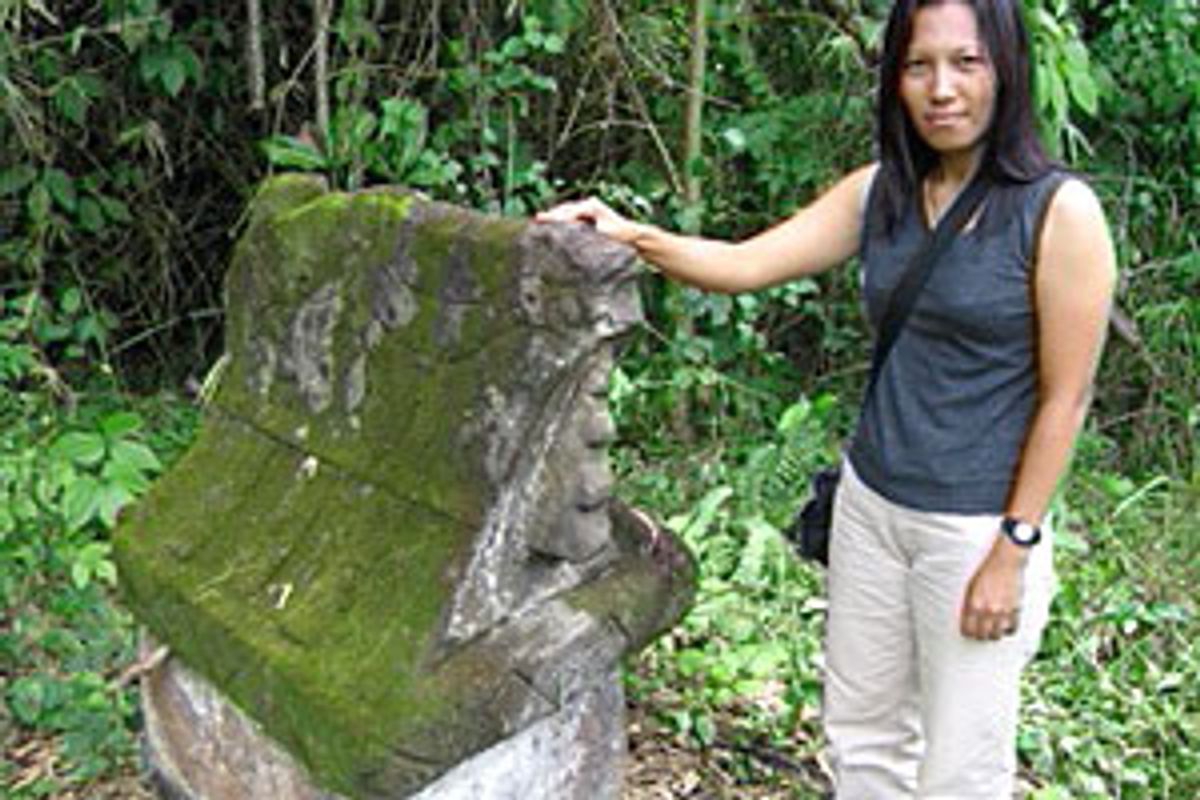
The moment we leave the outskirts of Manado, the rain forest becomes thick and heavy. As we enter Kawangkoan, signs of earlier inhabitants appear in the form of warunga: mysterious stone tombs that litter the landscape by the thousands. Little is known about them; they might be anywhere from 300 to 700 years old, and are decorated with odd, sometimes macabre, carvings. They remind me of the ghostly tombstones found in old Dutch cemeteries around Tarrytown and Hastings. This is probably not a coincidence; the Dutch controlled Indonesia for centuries, even though these northwestern reaches were also on Portuguese routes.
The forest itself is a tract owned by Kawangkoan, and the decision to create and enforce a no-take zone requires only village approval. Indonesia already has strict laws against cutting the forests, and I wonder how this newly protected area will affect people hoping to build new houses. But Mongdong and Rotinsulu agree that the lack of lumber isn't an issue; when wood is cut down, it's usually shipped off to Jakarta for wealthy people wanting to build Minahasa-style homes. The real ecological problems here are game poaching and people clearing land for farming.
We drive our Daihatsu van down a dirt road and arrive at the existing elementary school, built in 1975. "The building is awful," says headmaster Christian Wenas. "It is falling apart. Huge chunks are missing from the roof; during the rainy season, water pours in."
We stand outside one of the large classrooms beneath a plumeria tree. A cow wanders by; I eye it with some apprehension. Wenas, who has been in the local education business for 37 years, shows me the holes in the roof, the broken benches and inadequate desks. The school serves 183 students, ages 5-12, from four villages. The terms of a financial agreement with Seacology are fairly simple: Seacology will provide around $12,000 for the project, money the foundation raised from private donors. In return, the village council will sign on the dotted line, promising to leave the agreed area of the rain forest intact. Rehabilitation of the school will begin as soon as the village leaders sign the agreement. When it's all settled, Kawangkoan gets a new school, as well as a protected rain forest -- not exactly a hard bargain.
By the time we return to Manado, the island is obscured by massive gray clouds. The wind rises, and within minutes the sky opens, pelting the tin roof of Mongdong's office, peppering the sea and cleaning the dust off our van. We drive the narrow lanes slowly, passing two little girls gleefully shampooing their hair in the rain.
The following morning we drive west to several more villages in Minahasa district, where Seacology projects are well underway or complete. "I grew up here, in these coastal areas," says Mongdong, "and I loved the beaches and the reef fish. Even as a child, I could see that the coastal communities were poorer than the upland people; we depended on the marine environment, and the quality of those resources were going down. The distances fishermen had to travel for a catch were getting greater. That's why I felt that I needed to do something."
The road is as smooth and black as a graphite line drawn through the jungle. "When I was a girl," Mongdong recalls, "transportation to Kumu was by boat."
We pass the Telekom booths, traditional markets and horse-drawn carriages of Tanawangko, and drive through a town called Poopoh. "It means 'coconut,'" explains Mongdong.
Mongdong's hometown, Kumu, is a tidy village ending at the sea. There isn't a trace of litter on the streets. Motorbikes buzz up the road, driven by 12-year-old girls and fishermen with skin like fish jerky. There are churches everywhere, and the new school we've come to see -- built with Seacology's help -- is behind one of them. It's a single-level, L-shaped building with blindingly white walls and slatted wooden windows that channel the breeze into the large classrooms.
"My parents are both very socially minded," Mongdong says as we approach the school. "My mother works as a nurse for low-income families; I've seen her treat people in exchange for bananas. My father worked as a teacher. He has a strong personality, and can be difficult to get along with; he's hard-nosed, but also very honest. He helped the people in Kumu understand the impact of logging the forest and the problems it was causing; and he also helped see that every rupiah went to the project, and not into someone's pocket."
The school opened in August but already feels lived in. Classes are in session when we arrive, and I've never seen a more expressive bunch of kids. They shriek with glee as the teacher introduces us, then leap to their feet to sing an Indonesian version of "Frère Jacques" at earsplitting volume.
The teacher, a beautiful woman named Sartji Manangkoda, is seven months pregnant, and her desk is littered with flower parts: a big pink bud, broad leaves, long stems. "This is a science class," she explains. The children sit in neat rows behind shared wooden desks, dressed in white uniforms and waving their arms frantically after every one of the teacher's questions.
Two hundred fifteen families from four villages send 102 students, ages 6 to 13, to the school. During a break, all eight teachers -- four volunteers and four employees, who each earn between $100 and $150 a month -- meet me in the courtyard. They express unanimous delight with the building.
"The old school was very hot," one of them recalls. "There was no air circulation at all. During the rainy season, we had to tell the students to go home; water flooded the classrooms."
Still, the effort to build the school in exchange for protecting Manenembo-nembo -- the local stand of tropical rain forest, which borders all four villages -- met with opposition at the start, mainly from villagers who felt threatened by the idea of a no-take zone in the forest. The complaints stopped when people saw the new school, and realized that it hadn't been an empty promise.
A few hundred yards away, we meet the men charged with the conservation plan's development and enforcement. District supervisor Harry Runtualian, a rough-looking character wearing a black T-shirt, sums up the reasons the program has succeeded.
"Only about 5 percent of the villagers cut trees from the forest, but it had a big impact," he says. The river dried up because the trees were no longer holding water; a landslide covered the road; sediments washed into the sea and covered the coral reef, killing off the fish. Awareness of these problems came from the Sulawesi people, he says, not from an outside agency telling them what their problems were.
It wasn't just a matter of harvesting trees. Wild pigs and bats were being killed, and the endemic crested black macaque was hunted for food. The hunters were among the most vocal critics of the proposal. But they're not complaining anymore. When I ask why, Runtualian's answer seems both reasonable and ominous: "Face-to-face discussions."
Part of the deal included money for several thousand nantu saplings, which Runtualian and his two colleagues have been carrying, nearly two miles up into the open forest, for planting. It will take the hardwoods from five to 10 years to grow. When I ask who is charged with enforcing the no-take rule, Runtualian points to a tall man wearing a green Lacoste knockoff and a ten-gallon hat: "The Cowboy." Despite his Gary Cooper poise, Wely -- the man's real name -- doesn't look like much of a match for poachers armed with rifles or machetes. But all he has to do, I learn, is warn the culprits and report them to the local council. On a second infraction, the police and forestry rangers take over.
Impressively, conservation has quickly become a part of the local mindset. Erni Sumatow, a woman from the nearby village of Pinasungkulan, recently pushed through a Seacology project protecting the local reef, mangrove swamp and rain forest, all in exchange for a new drinking water distribution system. "People truly believed that it was their right to take everything they needed from the beach and forest, even using bombs to fish the reef," she says. "Building awareness wasn't easy; we informed people of the issues at every opportunity: at meetings, weddings, funerals, any time the villagers were together. Eventually, it worked. It was hard at the beginning -- but now people think it's a very good thing."
For all their apparent success, Seacology's projects prompt another question: If communities are being asked to protect their forests forever, what happens when the school, or water system, eventually falls apart? What's the incentive to keep Kumu or Kawangkoan from cutting down trees after 20 or 50 years?
In Manado, Meity Mongdong and I pick up a marine biologist and conservation specialist named Mark Erdmann, who has lived in the area for more than 10 years. We drive together to a rustic cafe, high in the hills overlooking the city. Mark and Meity order avocado smoothies; I wait and see if they look better than they sound.
Erdmann explains that conservation in Indonesia had typically operated in a top-down fashion. People were told that if they cut down trees or poached animals they would face stiff penalties. But the punitive approach wasn't successful. Seacology's approach to offer something in return, he says, "really grabs the interest of villagers."
Still, Erdmann says, Seacology knows it can't ask for anything in perpetuity. In general, it enacts commitments with villages that last 20 to 30 years. "But after that the school or dock will have fallen apart," Erdmann says. "At that point, we hope that the concept of conservation has sunk in enough so that people continue to respect it, and that things have progressed to a point where the villagers are not so dependent on natural resources.
"And if not, what's the worst that could happen? What if, in three years, Kumu turns around and cuts down its forest? At the very least, they got a school. It was a low-cost investment and it made a big difference in some people's lives. Compare that with what happens when huge conservations groups come in. They might spend hundreds of thousands of dollars on consultants and posters, and at the end of the day, when that project folds, the community is left with nothing."
Shares