Terrorism

A history of violence

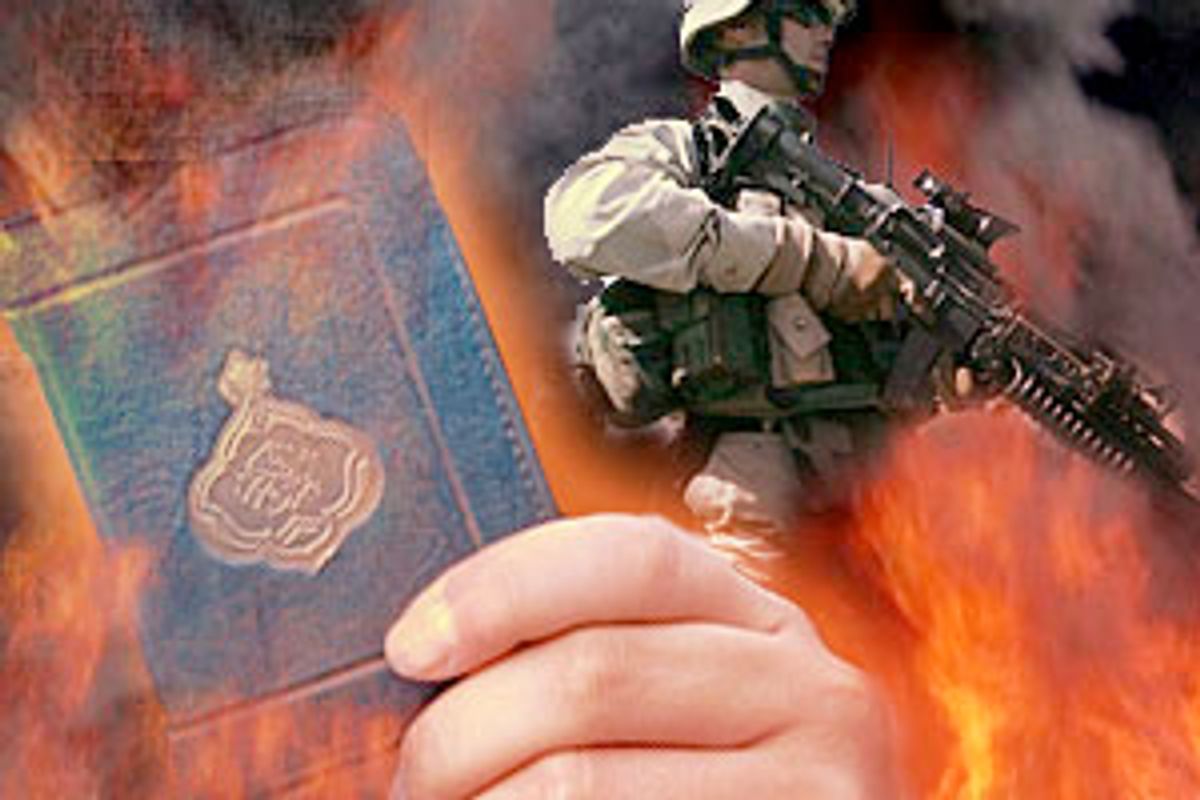
Robert Dreyfuss explains how America's meddling in the Middle East unleashed the current deadly wave of Islamic fundamentalism.

  • more
    • All Share Services

A history of violence

History can be a truly explosive force when it’s connected tightly to contemporary events. The linkage of Islam, terrorism and the war in Iraq has a deep and vivid history, with the potential to hit the American public like a roadside bomb, but it has gone largely untold, emerging only in bits and pieces — until now. “Devil’s Game: How the United States Helped Unleash Fundamentalist Islam” digs up the knotty roots of Islamist violence, exhuming the deep, dirty story behind the “war on terror.”

Part of the story has been told before, in newspaper and magazine articles that put together some of its many pieces. But with “Devil’s Game,” author Robert Dreyfuss has written what may be the most clear and engaging history of the deadly, historic partnership between Western powers and political Islam. Dreyfuss, who covers national security for Rolling Stone, delves deep into the explosive mix of shrewd realpolitik and raw, ignorant fervor that helped fuel the worldwide enterprise of radical Islam and create the extremist theocracies that hold sway today in Iran and Saudi Arabia.

The book is a chronicle of mistakes made, opportunities lost, and lessons most vividly not learned. It’s also the story of the historical error that has come to define U.S. foreign policy in the Muslim world: the Machiavellian use of political Islam as a sword and shield against communism and Arab nationalism. Contextualized by the modern-day neoconservative push for war with Iraq, “Devil’s Game” records the long and sordid history of right-wing and hard-line elements in the U.S. government finding common cause with fundamentalist groups in the Middle East.

For instance: In a chapter on the U.S. proxy war in Afghanistan, Dreyfuss describes how the United States deliberately channeled money to the “nastier, more fanatic types of mujahideen” in Afghanistan (to quote Stephen P. Cohen, a former top State Department official) in order to do the most damage to Soviet occupiers. Among the nastiest: Gulbuddin Hekmatyar, who won the confidence of his Pakistani and CIA backers in part by skinning prisoners alive and approving the practice of throwing acid in the faces of women who failed to cover themselves properly. After 9/11, Hekmatyar would resurface as an ally of the Taliban and a bitter opponent of U.S. occupiers.

Dreyfuss also reveals how Israel helped to create and empower the forerunners of Hamas as a bulwark against Palestinian nationalism (as embodied by Yasser Arafat and the PLO). The Likud-Hamas link — with both organizations thriving in unstable, warlike environments — is sure to be one of the book’s most controversial points, and it is a disturbing parallel to the “blowback” the United States suffered by backing bin Laden and his fellow “freedom fighters” in Afghanistan. Dreyfuss also uncovers how Citibank and Harvard University, among other international players, helped create the Islamic banking system that would act as the financial battery for the Energizer Bunny of violent anti-Western Islamism.

Along the way, Dreyfuss replays long-buried quotes from top American military and intelligence officials that illuminate the shadowy origins of America’s current foreign policy. When asked about the rise of the Taliban in 1996,President Carter’s national security advisor, Zbigniew Brzezinski, offers this thoughtful rejoinder:

“What is more important to the history of the world? The Taliban or the collapse of the Soviet empire? Some stirred-up Muslims or the liberation of Central Europe and the end of the cold war?”

Using the hammer blows of history and polemic, Dreyfuss suggests that “some stirred-up Muslims” may turn out to be something of a problem, after all.

“Devil’s Game” is a book likely to appeal to those who defend the purity of means despite the urgency of the ends. By feeding the monster of militant Islamism to fulfill short-term goals, Dreyfuss argues, the United States helped unleash the most challenging foreign policy crisis of the new millennium. Salon caught up with Dreyfuss recently to discuss the campaign to isolate Syria, the disastrous impact of the war in Iraq, and the pressing need to reduce the U.S. presence in the Middle East.

Tell me about the genesis of “Devil’s Game” — why this topic, and why right now?

Since 9/11, like a lot of reporters, I’ve been focusing pretty heavily on Iraq, the Middle East, Islamic fundamentalism and terrorism, and lots of intelligence issues. In this case the publisher actually called me and asked me if I had any book ideas, and I’d been thinking about this in the following terms: a lot of people saw what happened on 9/11 as some kind of blowback. There was talk about the origins of bin Laden in Afghanistan. What I know about the Middle East is that the blowback goes back much farther than just Afghanistan.

In other words, Osama bin Laden didn’t just emerge from Zeus’ brain in the middle of Saudi Arabia or Afghanistan. He sprang out of a movement of ideologues, of fundamentalists, of salafists, that goes back really into the 19th century, and if you wanted to be historical about it, you could trace it back to the 11th century or even before that.

What fed this movement? How did it move from the fringes to its current place of global influence?

Really, in the modern era, this began with the forebears of the Muslim Brotherhood who began organizing in the late 19th century. Their enemies were first and foremost the leftists and nationalists in the Muslim world, especially in the Arab world, but also in India and Turkey and elsewhere. And on a broader scale, they were fiercely anti-communist. On religious grounds, I think, first of all. Communism was atheism in their minds.

So for these two reasons, because they were anti-communist and because they were anti-nationalist, they became allies of convenience with first the colonial powers, and then later with the United States once the United States inherited primacy in the Middle East after World War II. And so here comes this big dumb giant, the United States, with literally zero background in understanding the Middle East. With no Middle East academic programs at any of its universities including the Ivy League, with no experience in the region. And the United States stumbles into this region as the chief guarantor and protector of Western interests and stability, and so we found ourselves time and time again over the decades in league with political Islam.

That’s the story I wanted to tell. That’s where the real legacy of blunders and stupidity and, in some cases, actually deliberate malfeasance is recorded.

Your book is coming into print just as Scooter Libby, who helped lead the U.S. into war, is leaving office under indictment. Iraq has become a bloody quagmire. The evidence that justified the U.S. invasion has turned out to be mostly exaggerated or falsified. Is there any evidence that the neoconservatives have been beaten into retreat?

I think since the invasion of Iraq went so awry, the neocons have suffered serious blows to their credibility and their prestige, and if I had to guess, I would think that even Donald Rumsfeld has thrown some tantrums about the stuff he was told by the neocons prior to the invasion of Iraq. On the other hand, they’re a very tight-knit fraternity, they stick together, and they’re very single-minded, so I don’t count them out. I think the fact that Bolton has been shuffled off to the U.N., and that Wolfowitz and Feith are both gone from the Pentagon, are useful signs, and certainly the Libby investigation has the potential to unravel the whole spider web.

But I never count them out. I think in a way if you look at the broader picture in the Middle East, they knocked down Saddam, and now pressure is building on both Syria and Iran — and that was really part of the original grand design for the region going back to 2001. We’re also still in control of Afghanistan, we’re building an empire in Central Asia, and Bush remains committed to this fantasy of democracy in places like Egypt and Saudi Arabia overnight, and so in that sense, I think the neoconservative project for the Middle East is moving forward until it’s dead and buried and flowers are growing on its coffin. I don’t see that we can relax.

And we’re still clearly in the midst of a rather poorly defined “war on terror,” which includes the war in Iraq. Is that fight doing anything at all to deter al-Qaida?

Al-Qaida is an ideology above all, and it recruits activists and supporters from a pool of angry and bitter people who are upset, both with their place in life and what they see as injustice. The way to fight al-Qaida, in the broadest sense, is to remove the sense of grievance.

So, in that sense, contrary to what the Bush administration would argue, the way to fight al-Qaida is to pull out of Iraq, because [the U.S. presence] is creating tremendous incentive for people to pick up arms on behalf of this mythical new caliphate [pan-Islamic religious-political empire] that they want to create. It makes sense to reduce our footprint in the Persian Gulf, and in fact the whole Middle East, and to remove this seemingly imperial presence that creates so much anger and unhappiness there.

We should also work a lot harder to solve the problems on what neoconservatives like Bernard Lewis call the “fringes” of the Muslim world — the conflicts from the Philippines to Kashmir to Chechnya to, of course, Palestine — all of those disputes need to be reduced because they create heat that keeps the pot boiling. It’s the molecules that escape from that boiling pot that are immediately snatched up by these terrorist groups in one form or another. They’re catching the angriest, most nihilistic people coming out of this simmering pot. And so we need to lower the temperature.

And then we need to start more generally getting out of the way and letting the people in the region engage in rebuilding their societies and starting on the process of what I call “religion building” — in other words, yanking big parts of the Islamic establishment into the 21st century and reconciling it with ideals of secular modern institutions where church and state are separated.

If we reduce our footprint now, if we pull out of Iraq, doesn’t the U.S. then reward and embolden the hard-line fundamentalists who will say: “We’ve won a victory, we’ve driven them out — next step, new caliphate.”

I don’t know how these lunatics are going to respond to the things we’re going to do, but we need to do what’s right: engage in policy reevaluation to come up with an approach to the region that is based on our real interests. And our real interests are not establishing an empire in the Middle East, and are certainly not a long-term occupation of Afghanistan and Iraq and other countries Bush decides to drag us into.

The victory that bin Laden is trumpeting now is the victory of confirming everything that he has been arguing for the past 20 years — and his forbears have been arguing for a century — which is the clash of civilizations. The West is out to destroy Islam and rape its people and pillage its oil and destroy the Muslim religion — that’s the victory that bin Laden is trumpeting now.

By reducing our presence in the Middle East, we confound him. And most of the smart people who think about the Middle East know that by stumbling into this Iraqi tar baby we have done precisely what bin Laden in his wildest dreams could not have hoped for. We’ve confirmed his worst predictions.

Are democracy and political Islam simply incompatible? Is it critical to ban religious parties from Middle Eastern elections?

I don’t think you can ban any sort of political party. I’m not for banning political parties, as long as they compete fairly in elections. I suppose you can point to Turkey as an example of a country that has a government basically run by an Islamist political party, and which is still maintaining both a democracy and sort of a universal approach toward people who don’t agree. It’s a very complicated question because passions are so high. People flock to these parties because they’re desperate or angry or riled up by imams in mosques and it’s so easy under current circumstances for this to spin out of control. It’s a very delicate question — I think the answer is to go slowly.

I think what happened in Iraq shows that most clearly. Here was a secular dictatorship. We destroyed it, and what emerged in its place is largely a Shiite theocracy on one side, and a Sunni movement that because of civil war conditions is itself pulled very strongly into a Sunni Islamic formation. Neither one of these Iraqi whirlpools — either the Sunni or the Shiite Islamist ones — need to be victorious. I believe there are many Shiites in Iraq who are unhappy with the theocrats, and there are many Sunnis — probably the majority in Iraq — who are nationalists and are secular. But as long as this conflict continues I believe both of those nonreligious elements in Iraq are going to increasingly lose out to the Islamist character of both the Shiite and Sunni leadership.

There’s been a lot of speculation about the actual (and concealed) agenda behind the U.S. invasion of Iraq. What’s your storyline for the administration’s push for this war?

The core of the movement to support the war was the fraternity of the neoconservatives. I believe they saw the war in Iraq as a way of decisively demonstrating American power in a region of the world that was up for grabs in which they believed the United States had to have preeminence because of the oil. Not oil for American oil companies — in fact, I’ve written articles about how American oil companies were opposed to the war in Iraq — but oil in the strategic sense that a principal battle in the 21st century would be for control of Middle East oil between the United States and Russia and China and other powers.

And they picked the Middle East because of its geopolitical and geo-economic value. Tied to that I think quite closely was the fact that so many neoconservatives identify the destruction of Iraq with the security of Israel. So by knocking off Saddam, they believed they could throw the whole Middle East off balance in a way that would lead to an enhanced security environment for Israel.

That’s why so many people have focused on the “clean break” paper that Richard Perle and Douglas Feith and [David and Meyrav Wurmser] and others delivered to Benyamin Netanyahu in 1996. It was kind of a redrawn map of the region that was supposed to be kind of a big-think picture of what Israel’s security could be based on. The core of it was the elimination of Iraq, the destabilization of Syria, and the suppression to nonexistence really of the Palestinian movement. So I think two big motivations kind of linked together were oil and Israel.

Had it not been for 9/11, there is no question in my mind that they could not have achieved either the political support or the support in Congress for going to war in Iraq. And most likely they probably couldn’t have even convinced President Bush to do so. Clearly, President Bush himself was traumatized by 9/11, and he and Karl Rove saw tremendous political value in carrying forward the idea of a war presidency and a war on terrorism. So, they capitalized on that, and they capitalized on Bush’s hatred of Iraq for having tried to kill his daddy, and on other kinds of almost Freudian motivations that the president must have had for all this.

But that starts to get into the tactics of how they accomplished their end. I think the end that they wanted to accomplish was simply the flattening of Iraq and the transformation of Iraq into some kind of pliable American neo-colony.

Is there a historically obvious way to depoliticize Islam in states such as Afghanistan and Iraq, where the U.S. wields some de facto political and economic influence?

Unless someone can create some benevolent despot who can do it by snapping his fingers, I think it’s going to be a project of many decades that has to be undertaken above all by the people who live there. You have to look at the reason why people turn to these kinds of movements. This wasn’t something that happened overnight. This is something that is the product of so many decades of fear and anger and bitterness that unless the temperature is lowered, unless people are given the chance to engage in normal kinds of political debate, there is no chance of separating religion and politics.

Any thoughts on what’s next for Syria as the investigation of the assassination of Lebanese politician Rafik Hariri unfolds?

Rather than increasing the pressure on Syria — rather than squeezing it until it pops, we need to step back and allow diplomacy to work. I think clearly important elements of the Bush administration, and especially the neoconservatives, are pushing for regime change in Syria. They want the Assad government to collapse. They’re doing it without any idea of what might come next.

There is an Ahmed Chalabi in the wings for Syria — a guy named Fareed Al-Ghadiri who lives in the United States who has already had meetings with the State Department and the CIA. They’re playing around with a coalition of Syrian exiles who are at least as unreliable as the Iraqi exiles were in 2003 —

That was going to be my next question…

– but probably even more so. And just like in Iraq where the Shiite religious movement was waiting in the wings until Saddam fell, in Syria there is a majority Sunni population, many of whom are loyal to the Muslim Brotherhood, who are just itching to start a sectarian battle against the Alawite minority elements in Syria.

So it’s a witches’ brew. Syria could explode into a vicious, Lebanon-style catastrophe if Assad were to collapse. On the other hand, intelligence people who I’ve talked to say that Syria was very helpful after 9/11 in providing intelligence to the United States about al-Qaida, that Syria has absolutely no interest in supporting Islamist terrorism, and that if we want to stabilize Iraq we should be approaching both Syria and Iran directly on some diplomatic grounds to help reduce sectarian conflict in Iraq. Instead, what the Bush administration is doing is increasing the pressure on both Syria and Iran … which is precisely the wrong thing to do if your goal is to stabilize Iraq.

I guess their theory is that the best defense is always a good offense, and astonishingly to me at a time when the American adventure in Iraq has gone completely and utterly off the track, rather than think about retreat, they’re thinking about advance.

It reminds me of a piece in the Onion a while ago, which was a satire, saying that Bush announced that we were going to pull our troops out of Iraq, and that they were going to withdraw through Syria. That was a hilarious satire, but it seems to be almost exactly what some people in the administration are thinking.

Are there any politicians on the national stage who seem to be articulating foreign policy ideas vis-à-vis Islam and violent fundamentalism that are well informed by history and the kind of mistakes you write about in “Devil’s Game”?

Not that I can see.

I think one of the lessons of my book is that for the last 60 years the United States has had a pathetically ill-informed notion of how this part of the world works. And even the people who pretend to be most informed sometimes are the most wrong-headed.

I guess the big gap is, there are professionals in the State Department and the intelligence community who have, I think, pretty clear ideas about the facts on the ground and how these societies are organized, but what I’ve found is that there’s an almost complete disconnect between their expertise and the politicians who make the decisions. And I don’t know how to solve that problem.

Is that a disconnect that you think has always been there, or has it gotten much worse since the election of Bush in 2000?

I think it’s always been there, at about the same level. The difference is that I don’t think we’ve ever launched a preventative unilateral war before. That’s the perfect case study because virtually everyone who knew anything about Iraq was against the invasion of Iraq before the war. And the Catch-22 is that, because they were against the war, by virtue of knowing something about Iraq, they were considered untrustworthy by the Bush administration’s planners. That left the planning of the war, by definition, to people who didn’t know anything about Iraq. And that’s true really in every decade of our policy toward the Middle East, to a greater or lesser degree, and really I think that’s the core lesson from my book.

Is there a politician who’s given real thoughtful consideration to this kind of stuff? Not that I can see, because, so far at least, the political consequences would be fatal. You’d have to come out against the war on terrorism, number one — at least as it’s currently conceived, and number two, you’d have to come out against America’s one-sided support for Israel. And either one of those stands politically would be dangerous but both of them together would be fatal for most politicians — or at least that’s how they see it.

- – - – - – - – - – - -

James Norton was the Middle East editor for the Christian Science Monitor during the first year of the Iraq war. His new book, “Saving General Washington,” comes out next spring.

James Norton is the co-editor of Flak Magazine (www.flakmag.com). He's also the author of the forthcoming book "Saving General Washington: Why Everything the Right Wing Tells You About Your Founders Is Wrong," due out this spring from Tarcher/Penguin.

Senate Democrats heroically fund TSA

Democrats score the dumbest political victory of 2012

  • more
    • All Share Services

Senate Democrats heroically fund TSA (Credit: Reuters/Frank Polich)

On Tuesday, a Senate Appropriations Committee vote effectively highlighted everything that is stupid about politics.

The Transportation Security Administration, a universally loathed government agency, is facing a shortfall, despite its more than $8 billion budget. Instead of having a debate over what effective airport security might actually look like and how much should reasonably be spent on the honestly rare threat of commercial-air-travel-based terrorism, there was a debate over how best to come up with the money needed for all the radioactive naked picture machines and bomb-sniffing dogs. The Democrats suggested passing on the cost of ineffective, cumbersome and intrusive security theater to citizens, via higher fees on airfares. The Republicans, even more predictably, suggested cutting spending that directly helps poor people to ensure there is enough to spend on stopping imaginary future 9/11s.

The newspaper account of the debate in The Hill just reinforced the Republican spin, highlighting the Democrats’ decision to make people spend more money on the hated TSA and downplaying the actual existing Republican alternative to the proposal, which was not “spend less on the hated TSA” but rather “raise money for the hated TSA by slashing needed aid to states.” The Democrats won, or “won,” and now they will earn the fruits of that victory: well-deserved scorn from everyone. And Ben Nelson (D-Troll Town) voted with the Republicans. (Though surely having users pay the fees for supposedly necessary security measures is perfectly conservative, isn’t it? Am I missing something here? I mean besides the fact that the two sides in this debate weren’t actually “liberal” and “conservative” but rather “people who want to come up with a way of paying for the oppressive and useless national security state” versus “people who want there to be an oppressive national security state but hate government spending on feeding and sheltering impoverished people.”)

I don’t know of anyone not employed by the TSA or some other arm of Homeland Security that believes the TSA does a good job and deserves its massive budget, but everyone in Washington apparently feels differently (and is terrified of being blamed for “voting to cut TSA funding” if there is another terrifying and deadly underwear bomber, of course). This is why everyone hates politics and Congress and Washington. This and Iraq. And the drug war.

Continue Reading Close
Alex Pareene

Alex Pareene writes about politics for Salon and is the author of "The Rude Guide to Mitt." Email him at apareene@salon.com and follow him on Twitter @pareene

Police arrest artist setting up ‘I Love NY’ work

The installation included a plastic bag with a battery inside of it, hanging from a tree

  • more
    • All Share Services

Police arrest artist setting up 'I Love NY' work (Credit: http://tmiyakawadesign.com/)

NEW YORK (AP) — An artist who was setting up an “I Love New York”-themed public art display in Brooklyn was arrested after the wired contraption was mistaken for an explosive device.

Takeshi Miyakawa, a visual artist and furniture designer, was arrested Saturday after placing the installation in two separate areas of the same New York City neighborhood. His lawyer and employer both called the arrest a misunderstanding.

The first apparatus was found Friday morning after a caller reported a suspicious package to police. It consisted of a plastic bag that contained a battery and was suspended from a metal rod attached to a tree. The bag, which had the classic “I Love New York” logo printed on it, was connected by a wire to a plastic box that contained more wires.

The area was evacuated for two hours until a bomb squad determined that the device was not dangerous.

At about 2 a.m. Saturday, a police officer discovered Miyakawa on a ladder not far from where the first contraption was found. Police said he was tying a similar “I Love New York” bag to a public lamp post.

Miyakawa was charged with two counts of first-degree reckless endangerment, two counts of placing a false bomb or hazardous substance in the first degree, two counts of placing a false bomb or hazardous substance in the second degree, two counts of second-degree reckless endangerment and two counts of second-degree criminal nuisance.

A judge ordered him held pending a psychiatric evaluation. His lawyer, Deborah J. Blum, said Monday that she is filing for emergency relief to have Miyakawa released. A court date was set for June 21 to review the results of the evaluation.

“He’s still being held,” Blum said Monday. “I believe that it was a gross misunderstanding and other than that I don’t have any other comment.”

Miyakawa, who was born in Tokyo and is about 50 years old, has worked for a New York-based architect Rafael Vinoly for the last 20 years and also has an independent design practice.

Vinoly’s firm released a statement Monday praising Miyakawa for his “extraordinary brand of professionalism” and said he has been a mentor to generations of young architects.

“Takeshi is a fabulous human being and a person of extraordinary talent,” Vinoly said. “We hope this misunderstanding is cleared up as quickly as possible.”

New York Civil Liberties Union Executive Director Donna Lieberman said in a statement that the charges sounded “like a wild overreaction.”

“It’s hard to understand why a light-up bag in a tree would be treated as an attempted terrorist act unless there’s more to the story than has been reported in the press thus far,” she said.

In 2007, an artist touched off a terror scare in Boston by placing electronic devices around the city as part of a marketing stunt for Cartoon Network. The city closed bridges, roads and public transit before authorities realized the signs were not bombs.

On an average day, the NYPD receives nearly 100 reports of a suspicious package. Last year, there were more than 4,000 such reports. The number generally rises following any word of terror threats in New York and around the world.

Continue Reading Close

Behind the underwear bomb

The latest airplane terror plot wouldn't have been foiled without airport security -- but not the kind we all know

  • more
    • All Share Services

Behind the underwear bombTravelers line up at a TSA checkpoint at Los Angeles International Airport. (Credit: Reuters/Danny Moloshok)

Another deadly plot taken down in the planning stages. This time, thanks to the work of a CIA double agent, officials were able to infiltrate a Yemen-based al-Qaida plot to destroy a U.S.-bound jetliner using a nearly undetectable underwear bomb.The moral of the story: Airport security works!Am I being facetious?  Not necessarily.  It depends on your definition of airport security.

In my mind, the key to keeping airplanes safe is, and always has been, stopping acts of sabotage while they are still in the planning stages. Here in the age of the TSA checkpoint, with its toothpaste confiscations and obsession with pointy objects, we tend not to think this way, preoccupied instead with a kind of airport Kabuki — the tedious, fanatical screening of passengers and their carry-ons. Real airport security takes place offstage, as it were. It is the job of the folks at the CIA and the FBI, working together with foreign authorities. And while TSA has an important role here too, we can do without the spectacle of airport guards rifling through innocent people’s bags in a pathological hunt for what are effectively harmless items.

The concourse checkpoint needs to be there.  Just the same, chances are good that once an adversary has made it to the airport, he or she has engineered a way to outwit the system.  And spend as we might, there will always be a way to outwit the system.  ”Even if our technology is good enough to spot it,” said California Rep. Adam Schiff, commenting on the news of the latest underwear plot, “technology is still in human hands and we are inherently fallible.”

That’s one of the smartest things I’ve heard a politician utter in some time.

Getting a handle on this takes us all the way back to Sept. 11, 2001, the day that everything, and yet really nothing, changed.  I’ve said this before, but it bears repeating: Conventional wisdom holds that the 19 hijackers exploited a weakness in airport security by smuggling box cutters onto four Boeing jetliners. But conventional wisdom is wrong. What the men actually exploited was a weakness in our mind-set — a set of presumptions based on the decades-long track record of hijackings and how they were expected to unfold. (In prior years, a hijacking meant a diversion, perhaps to Havana or Beirut, with hostage negotiations and standoffs; crews were accordingly trained in the concept of “passive resistance.”) The presence of box cutters on 9/11 was merely incidental. The men could have used almost anything — a deadly sharp can be fashioned from a broken first-class dinner plate or a ballpoint pen — particularly when coupled with the bluff of having a bomb. The success of their plan relied not on hardware but on the element of surprise. It wasn’t a failure of airport security that allowed those men to hatch their takeover scheme. It was a failure of national security — a breakdown of communication and oversight at the FBI and CIA level.

To put it succinctly: The success of the 9/11 attacks had almost nothing to do with airport security at all — a great and painful irony, of course, to any passenger forced to endure the checkpoint rigmarole in 2012.

Not that frontline guards don’t play a deterrent role.  And, in the opinions of some, the plot uncovered in Yemen underscores the value of full-body scanners — those controversial walk-through machines that allow guards to look beneath a passenger’s clothing. It’s a compelling argument, but the way in which these scanners have — and have not — been deployed is apt to make some of us cynical. For instance, the vast majority of body scanners are found at U.S. domestic airports. Overseas, where a bomb is far likelier to originate, they are rare. Is this really about safety, we wonder, or is it about billions of dollars going into the coffers of the companies contracted to build these machines?

And although the scanners are effective, where does the arms race end?  Not long ago, the idea that passengers would be marched through body scanners and photographed naked before being allowed to board an airplane, would have seemed outrageous. Yet here we are. What might be next?  The stubborn truth is, we can turn airports into fortresses if we want (in some respects we’re well along that path), yet we’ll never be entirely safe. Airport screening alone, no matter how thorough, how expensive, and how technologically advanced, will never defeat a relentless enough, resourceful enough adversary intent on downing a plane.

That isn’t capitulation, it’s reality.  And acknowledging this reality would go a long way toward warding off panic and overreaction when the next successful attack occurs.

Regrettably, too, we often forget that commercial air travel has long been a target of terrorist extremists.  The 1970s and 1980s in particular were, as I like to describe them, a Golden Age of Air Crimes, comparatively rife with bombings, hijackings and other deadly assaults against airplanes and airports. Over one five-year span between 1985 and 1989 we can count at least six high-profile terrorist attacks, including the horrific bombings of Pan Am 103 and UTA 772; the bombing of an Air India 747 over the North Atlantic that killed 329 people; and the incredible saga of TWA Flight 847.  And let’s not forget what might have been, such as the so-called “Project Bojinka,” the 1994 scheme masterminded by Ramzi Yousef (nephew of Kalid Sheikh Mohammad), in which impossible-to-detect (at the time) liquid explosives were to be used to simultaneously destroy a dozen U.S. airliners over the Pacific Ocean. Fortunately the plot unraveled and Yousef was arrested.

While we can argue, quite persuasively, that many of the current-day security measures have done little if anything to make us safer, we’ve nevertheless introduced measures that have been useful and effective, from explosives screening of checked luggage to the sorts of trans-border partnerships that broke up the most recent plot from Yemen. Whether in spite of, or because of, the attention we’ve lavished on All Things Terrorism, the past decade has seen fewer attacks against commercial air travel than any since the 1950s.What we need to remember, though, is that our success has had more to do with the security measures we don’t see than those taking place in plain view. And if our luck is to hold, we need to better rationalize and streamline our entire approach to airport security. For instance, if we’re going to have those body scanners, let’s put them where they’re needed. If this requires negotiating with foreign authorities whose airports are beyond TSA’s jurisdiction, so be it. Meanwhile, here at home, TSA’s one-size-fits-all approach, in which every single person who flies is seen as a potential threat, is simply unsustainable in a country where close to 2 million people fly daily. Things like taking snow globes from children, haggling over tiny container sizes, or confiscating a dessert fork from a uniformed, on-duty airline pilot (it happened to me) serve no useful purpose whatsoever. On the contrary, they divert valuable time and resources away from the things that could make us safer.  Let’s scale back that concourse Kabuki and retrain guards in the finer points of a more sensible, risk-based assessment of passengers and their belongings.

And lastly, if only as an aside, let’s behold for a moment the term “underwear bomb.”  That was the operative phrase in literally hundreds of articles and broadcasts over the past several days, and nowhere did it raise a snicker.  What does it say about our country, I wonder, that such a preposterous expression is instantly understood and effectively taken for granted?

Strange times indeed.

Continue Reading Close

Hiding 9/11′s last secrets

The military tribunal for Khalid Sheikh Mohammed means the American people will never know what drove him to terror

  • more
    • All Share Services

Hiding 9/11's last secrets (Credit: Reuters//Brennan Linsley)

After a Navy SEAL team killed Osama bin Laden at his Pakistan hideout a year ago this week, it flew his body to the Arabian Sea, weighted it down, and slid it silently off an aircraft carrier into the watery depths.

For many Americans, the secret raid provided a measure of revenge and catharsis for the strikes of Sept. 11, 2001. But it didn’t provide the kind of justice and official reckoning that the country needs to gain real closure. Now the government has a chance to achieve that through a full, fair and open trial of Khalid Sheikh Mohammed and four co-defendants, so the world can finally see the evidence against him as the true architect of the attacks on New York and Washington. The trial kickoff — an arraignment for the men — is scheduled for this Saturday at the U.S.-run detention facility in Guantanamo Bay, Cuba.

This should be our Nuremburg, the defining trial of the 9/11 era and a fitting coda to it.

Unfortunately, the U.S. government appears to be on the verge of squandering this opportunity, and with it, the best, and perhaps only, chance for the public to understand not only how the attacks came to be, but why Mohammed waged a relentless war against America and how we might stop the next would-be terrorist mastermind.

The problems lie within the reformed military-tribunal system that the Obama administration put in place after losing its fight for a civilian trial in New York. Political compromises have resulted in a flawed military commissions process that from outward appearances is not only rigged against the defense, but hyper-choreographed, censored and hermetically sealed.

“The process is designed to achieve a conviction, and to do it with as little revelation as humanly possible, but with the veneer of due process and justice,’’ said one participant who said restrictive gag orders prohibited him from talking publicly. “You’re talking about the most heinous crime ever, and we’re going to afford them less due process, less discovery, less of everything than we would the guy who shoplifted a pack of gum from CVS.’’

Obama administration officials say their reformed military commissions system is a vast improvement over the Bush administration’s version, which Obama moved to shut down on his first day in office in 2009.

Defense lawyers disagree, and insist they have been hamstrung in their efforts to mount the kind of aggressive defense needed to do their jobs including full and unfettered access to evidence, witnesses and even the accused themselves.

Four of the five legal teams had so few of their key players in place in recent months that they did not file the “mitigation submissions’’ that the government said it needed to decide which of the five men should face the death penalty and other key issues, such as whether to try them together or individually. They recently filed motions asking that the charges be thrown out because of fatal flaws in the system, which they say make it impossible for them to defend their clients.

“It’s window dressing,’’ Mohammed’s defense lawyer, David Nevin, said of the government’s improvements. “I am not all satisfied that it is a fair process. In fact, it is not a fair process.’’

Many of the defense lawyers have quit out of frustration or for other personal reasons stemming from the many delays in the process. Only a few have been there long enough to even begin to understand their clients’ case, not to mention the convoluted military commission process.

And they say they will be unable to effectively challenge confessions obtained when their clients were coercively interrogated in the CIA’s black site prisons, if they can broach the subject at all. This is important for the four men accused of helping Mohammed with the logistics of the plot. Several claim they have been wrongly accused, tortured into confessing, or both.

It is also important with regard to Mohammed, who confessed to dozens of plots while being waterboarded 183 times, and has said he may plead guilty even before the trial begins. Few U.S. counterterrorism officials believe all of his often boastful confessions, and it is important for the public to hear what, exactly, evidence the government has with regard to what he did and didn’t do, and whom he might have been protecting.

The team of Defense and Justice Department officials overseeing the military commission process, and the presiding judge, should quickly address the defense lawyers’ complaints, or a proceeding that some call “The Trial of the Century’’ will be delayed further by legal wrangling — and forever tainted by accusations of being unfair.

A full, fair and transparent trial, above all, will benefit the public. There is much the public doesn’t know about Mohammed, including the details of how he devised the plot, convinced bin Laden to let him do it and then orchestrated it “from A to Z,’’ to use his own words. It was Mohammed who masterminded dozens of other plots and attacks, some while staying a step ahead of the largest-ever criminal manhunt.

Mohammed, not bin Laden, was the one who traveled the world as a kind of “Johnny Appleseed’’ of terrorism, establishing alliances and creating a network of cells and lieutenants that in some cases remains today. And it was Mohammed who personally recruited young jihadist prospects much like a baseball scout, many of them Westerners, tapping into their grievances to turn them to his cause.

The U.S. government has kept the details of what Mohammed did — and how and why he did it — hidden in its most classified files since his capture in Pakistan nine years ago. The government should set the record straight on that, because there is an important lesson to be learned from the largely untold tale of Khalid Sheikh Mohammed: It isn’t some monolithic group like al-Qaida that poses a continuing threat, it’s the one intelligent and energetic person who can emerge from nowhere and orchestrate a 9/11 while the world focuses elsewhere.

To that end, the government should declassify as much evidence as possible, and explain how it obtained it. It should call numerous witnesses to testify, especially since the one who has been publicly identified, Majid Khan, claims he was tortured while in CIA custody overseas.

Instead of limiting access to a few closed-circuit TVs, it should consider televising the proceedings. It should ensure that censorship is minimized, and used only to protect intelligence sources and methods, not to save the government from embarrassment. And it should let Mohammed and the others testify at length on their behalf if they so desire.

By doing so, the Obama administration will be able to say it did its best to put on the kind of civilian trial it has wanted all along, and one with a similar outcome to that of the al Qaida members charged with blowing up two U.S. embassies in Africa in 1998.

Those of us who witnessed that trial in Manhattan in 2001 saw the defendants squirm in their chairs as prosecutors introduced mountains of evidence against them. We saw eyewitnesses point the finger at the accused, and surviving victims glare at them from the pews.

We heard from the terrorists themselves, and learned a lot about why they did it, about how terrorist networks operate and about what might be done to stop people like them. And when the jury convicted them, there was no question that justice was done.

Continue Reading Close

Josh Meyer is the author, with Terry McDermott, of the new book, "The Hunt for KSM: Inside the Pursuit and Takedown of the Real 9/11 Mastermind, Khalid Sheikh Mohammed.’’

FBI heroically locks up ridiculous anarchists on May Day

Feds stop inept radicals from carrying out a plot feds helped them conceive and carry out

  • more
    • All Share Services

FBI heroically locks up ridiculous anarchists on May DayU.S. Attorney Steven Dettelbach, left, and FBI special agent in charge Stephen Anthony walk past a map showing the location of a bridge on Ohio Rt. 82. Five men, pictured on the wall behind the map, have been arrested for conspiring to blow up the bridge. (Credit: AP/Mark Duncan)

Happy May Day, fellow travelers! If you’re not currently disrupting capitalism and/or having your wrists zip-tied for exercising your right to freely assemble, you probably read about the Federal Bureau of Investigation’s latest, not-at-all suspiciously timed terror sting. The Bureau, in an inspired bit of early-20th century nostalgia, has railroaded a bunch of dangerous anarchists. (Or “dangerous” “anarchists.”) America will not waver in the face of the Galleanist threat!

Five young men from Cleveland are now in jail, accused of plotting to “blow up a bridge in the Cleveland area,” according to the FBI’s triumphant press release/criminal complaint. As is always the case with FBI terror stings, the “sting” part involved the bureau’s informant/agent provocateur mostly inventing the plot the accused have now been arrested for. In this case, the five planned to detonate smoke bombs as a distraction as they “topple[d] financial institution signs atop high rise buildings in downtown Cleveland.” But the informant (as usual, a sketchy unnamed character with a checkered past) strongly pushed the group to seriously consider different, more extreme plots. At the end, some or all of them were going to plant C-4 on the Route 82 Brecksville-Northfield High Level Bridge over the Cuyahoga Valley National Park.

So what was initially a political action aimed at financial institutions somehow morphed into a supposed attempt to destroy or damage a piece of publicly owned infrastructure in a national park. Anarchists sure do hate bridges, and parks, I guess. (No parliament of men has the authority to designate which spaces are “national parks”! The whole world is the worker’s national park!)

The FBI’s affadavit suggests that there was never actually a serious “plot.” The gang tossed around the idea of “taking out” a bridge in order to stop people from getting to work, but they also thought maybe they could use their (pretend) C4 on a Klan rally, or a neo-Nazi organization, or an oil well, or the Federal Reserve Bank. They eventually decided to maybe sink a ship. All of their many plans were super serious and well-thought out. (“To prevent capture, he suggested getting tacks that they could throw out of the back of a car if they get in a chase.”) Eventually they settled on the bridge thing, sort of, and bought fake IEDs from the guy they already suspected was a cop.

In other words, these are a bunch of dumbasses even by the standards of amateur “black bloc” dumbasses. Do you know how I know these morons weren’t serious? They planned to download the Anarchist Cookbook and follow its notoriously awful instructions. Every experienced anarchist knows that the Feds have a mole in your group house, but these guys were mainly concerned with having someone’s “hacker friend” explain to them how bitcoins work. Without the FBI’s intervention the most damage these idiots would’ve ever caused is a broken Starbucks window. So thank god they’re off the streets, and congrats to the FBI for getting this tale of dangerous, bomb-planting anarchists onto the news broadcasts on the day of Occupy’s big May Day action.

(At least the Feds are branching out from only targeting Muslims in these ridiculous “stings.” Some day all Americans, regardless of creed or color, will have their circle of friends secretly infiltrated by a paid informant.)

Continue Reading Close
Alex Pareene

Alex Pareene writes about politics for Salon and is the author of "The Rude Guide to Mitt." Email him at apareene@salon.com and follow him on Twitter @pareene

Page 1 of 159 in Terrorism