David Pescovitz

Desktop manufacturing

Advances in 3-D printing and embedded electronics will revolutionize how everything from coffee makers to cellphones gets made.

  • more
    • All Share Services

Desktop manufacturing

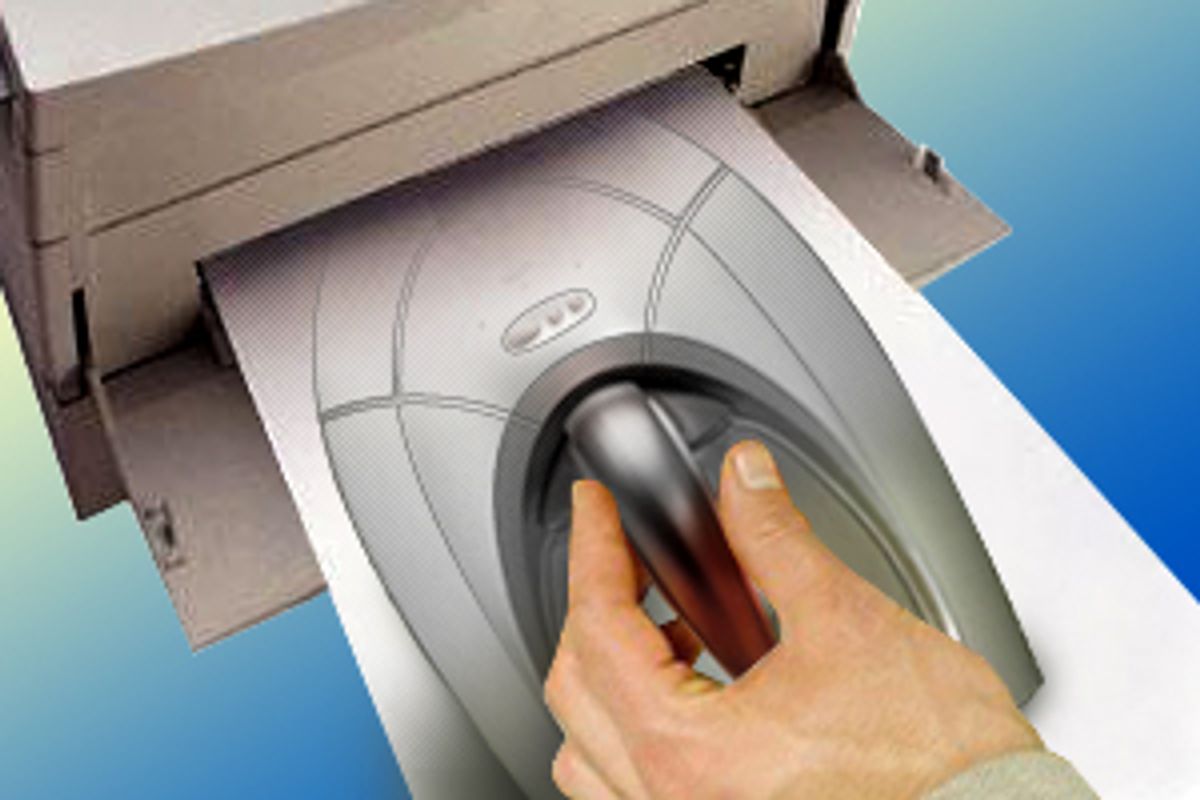
Imagine that your coffee maker breaks just before you’re about to host a brunch. You go online and click on the model you want to buy. But you don’t have to wait for it to be shipped; instead, a machine on your desk kicks into operation. Inside a glass chamber, a nozzle spits out the electronics, chassis, motor and other components, layer by layer. An hour later, you snap together a few parts and the brewing begins.

That machine would be the “Star Trek” replicator realized. Well, a beta version anyway. Already, several engineering threads are converging that may pull the replicator out of the far future and put it in our homes, or at least at Kinko’s, in the next few decades. MIT’s Neil Gershenfeld, director of the Center for Bits and Atoms, dubs the vision “personal fabrication.” John Canny, a professor at UC-Berkeley’s College of Engineering, where I’m a writer in residence, refers to the research field as “flexonics.” Whatever the buzzword, it’s not unlike desktop publishing, but for products instead of paper. Call it desktop manufacturing.

It starts with the physical object itself, the plastic chassis for the remote control that you stepped on, the body of the coffee maker. Product designers have literally been printing out objects for more than a decade. A digital design is loaded into a machine that drips out thin beads of plastic and glue, building up hair-thin layers until the whole form is complete. These kinds of three-dimensional printers are perhaps the coolest tool in the realm of rapid prototyping, technology that allows designers to quickly mock up models of new products. A designer can feel how the next-generation phone she’s working on will fit in a shirt pocket.

While these 3-D printers are improving in quality and dropping in price, the devices they produce still have one problem: They don’t actually work. That’s where printable electronics come into play. Researchers at many corporate and university laboratories are brewing inks of semiconducting nanocrystals and using cannibalized inkjet printers to pattern the nanomaterials into circuits on plastic, paper and even cloth. Printable electronics is likely to hit the mainstream first in flexible displays that can be cranked out in rolls and then as UPC bar-code-killing RFID (radio frequency identification) tags stamped right on a product package.

While printable electronics are still far from delivering the reliability and performance of traditional circuitry, the printable-electronics technology could eventually be incorporated into a 3-D printer. For example, the printer would embed layers of electronics within the housing of the device it printed. Of course, that might mean that a hairline crack in your cellphone would be fatal.

The next step is to print mechanical structures — motors and actuators, devices for controlling or moving something. At MIT, Joseph Jacobson and his students have printed microscopic linear drive motors, similar to pistons, and thermal actuators that are triggered by heat. These kinds of pinhead-size devices, called MEMS (micro-electromechanical systems), are found in everything from automobile air bags to dishwashers. To make larger mechanisms, such as the components that cause a blender’s blades to spin when it’s switched on, Canny and his Berkeley colleagues propose filling inkjet cartridges with electroactive polymers, essentially plastic that contracts when zapped with electricity. The same material generates a voltage when flexed, making it an ideal choice for buttons or switches in a printed object.

These kinds of polymers could potentially be loaded into University of Bath engineer Adrian Bowyer’s RepRap (replicating rapid prototyper). The RepRap project has just begun, but Bowyer’s aim is to build a “universal constructor” that not only can manufacture objects but can actually make copies of itself. Over the next four years of development, he plans to release the blueprints and software code for free online to accelerate progress.

Desktop manufacturing is still in its infancy. But as the baby steps get bigger, the potential impact of this technology on everything from product development to retailing becomes clearer. Canny says that in many cases, consumers might pay for plans instead of a product. Raw materials — alloy, polymer and nanoparticle inks — will be staples on a person’s grocery list. While companies now play down how crappily their products are made, those who embrace personal fabrication won’t even have to worry about it anymore. Perhaps they’ll be more willing to pay big bucks for good design if they can leave the manufacturing to us. Still, I look forward to a generation of do-it-yourself industrial designers and tinkerers who improve and customize these commercial product plans. Their work could be swapped online like so many MP3s.

The Big Idea

Robugs, biologically based software, the GeoWeb, transgenic art and other hot frontiers in technological innovation.

  • more
    • All Share Services

Robugs: Swarms of tiny robotic insects

Tomorrow’s robots may look more like spiders or flies than Rosie or Robby. While Japanese engineers wow crowds with expensive, complex humanoid bots like ASIMO and QRIO, groups of engineers are developing tiny mechatronic bots modeled on insects. Robots built in our image appeal to our emotions and might make good caretakers, but small, cheap and simple “robugs” would be better suited for activities like burrowing into the rubble of a collapsed building searching for survivors or, someday, traversing your colon looking for polyps.

In September, Dartmouth researchers demonstrated what they claim is the world’s smallest mobile robot. As wide as a human hair and about one-quarter of a millimeter long, the inchworm robot was fabricated out of silicon with processes similar to those used to manufacture computer chips. Eventually, minuscule robots might even inspect and repair integrated circuits, manipulate cells in biotechnology labs, or explore remote planets, thousands of them working in parallel like ant colonies.

Meanwhile, waiting in the wings is University of California at Berkeley professor Ronald Fearing’s Micromechanical Flying Insect. The aerodynamics of the 25mm robofly is meant to mimic the rhythmic beating of a real fly’s wings. Once it finally gets off the ground, an airborne robug outfitted with a tiny video camera would make a great “fly on the wall” for remote reconnaissance. It’s no surprise that the early robofly research was funded by the Department of Defense.

Hacking DNA: Creating life one BioBrick at a time

Biology is the nanotechnology that works. That’s the motto of Tom Knight, a computer scientist at MIT who is creating a library of genetic parts called BioBricks that could be snapped together like Tinker Toys. The BioBricks effort is part of an emerging field called synthetic biology that promises to make genetic engineering worthy of its name. Literally, the aim is to build biological systems to specs never found in nature. Imagine microbes that glow red in the presence of TNT and then digest its active ingredient, or custom-built green algae that produces hydrogen from water and sunlight for fuel cell automobiles.

The MIT crew has already hacked together synthetic genetic counters for tracking how many times a cancer cell divides, and logic gates, the building blocks of computer circuits, but in this case based on chemical inputs and outputs instead of zeros and ones.

Across the country, U.C. Berkeley scientist Jay Keasling transformed run-of-the-mill E.coli into a microbial factory that spews the raw ingredients of an anti-malaria drug, potentially cutting the cost of treatments from dollars to dimes. Further alterations to the cellular pathways could enable the bacteria to produce the anti-cancer drug Taxol. Keasling is also heading up another project to engineer a single-cell soil microbe that would swim into a pool of pesticides and mellow the nasty chemicals. Where does it end? Where life begins, it seems.

This year, J. Craig Venter, the biologist who famously led the commercial effort to sequence the Human Genome, launched a company that plans to build an entire synthetic cell from the bottom up. The first step is to determine the bare minimum genes needed for an organism to survive. Then, specific biological capabilities could be added to the minimal genome and the whole thing inserted into a single-cell bacterium stripped of its original genes. Programmed with what Venter calls “biologically based software,” this synthetic cell could then get to work producing ethanol, hydrogen, pharmaceuticals or other useful materials cleanly, efficiently and cheaply.

Location, location, location: The GeoWeb

What if you could Google the world? You might stop outside a new Chinese restaurant near the office when the smart phone in your pocket comes alive with digital graffiti posted in the wireless ether by a previous patron: “Stay away. The Thai noodle joint down the street is a better bet.” Later, you could pass a cafe where your phone buzzes with a notice that a friend on your “buddy list” is inside. The very fact that you were alerted to his location means that he’d welcome some company. Sightseeing in a new city, your phone becomes a virtual tour guide, providing you with engaging custom-tailored histories of the neighborhoods and landmarks you visit.

This is the vision of a Geospatical Web, or GeoWeb. In GeoWeb terms, cyberspace is no longer a place you go to, but rather an overlay to the physical world. The GeoWeb would link the geographic location of people, places and things with the digital information that lives on the Internet. Like the personalized ads that Tom Cruise was barraged with in “Minority Report,” you ask? That’s the worst-case scenario. Dodgeball, a location-enabled social networking service created by a New York University student and recently acquired by Google, is a better place to start. Indeed, many of the enabling technologies behind a GeoWeb are becoming common, including GPS-enabled mobile phones and urban wireless networks. And other ways for your mobile device to know where it’s at are on the way.

The path to the GeoWeb is rocky, though. Carriers often lock out developers, leading to “walled gardens” of mediocre services. And good geodata is often proprietary and pricey. Meanwhile, a dedicated cabal of independent GeoWeb enthusiasts are hammering out the standards that would guarantee interoperability and moving carefully through the mire of privacy concerns. They’re also toiling away on projects like OpenStreetMap, a distributed effort to produce free road maps of the world, and myriad Google Maps mash-ups. While wireless providers tentatively search for business models, geobloggers and map hackers are already laying claim to the future of the GeoWeb.

Maker mind-set: DIY technology

Consumer technology is built to break or, worse, to be perceived as useless or undesirable. It means that as consumers, we’re pressured to buy products repeatedly, from computers to cars. But there’s a movement emerging of people who call bullshit on planned obsolescence.

From modded TiVos to pimped-out Toyota Priuses, these individuals are boldly voiding warranties to tweak, hack and customize the products they buy. It’s a duct tape and soldering iron cultural movement that can be summed up as Martha Stewart meets 1950s-era Popular Mechanics magazines. These are tech heads who aren’t satisfied with the functionality of the standard-issue iPod so they’ve figured out how to install iPod Linux on it, thereby opening up the ubiquitous device to dozens of new features, from line-in recording of audio to playing video, long before the video-enabled iPod. They’re homebrew roboticists who transformed old computer mice into the likes of Mousey the Junkbot. They’re hardware hackers who sussed out a method to download the video off a “disposable” drugstore digital camcorder and reuse it.

And for them, the fun is in the fix. Broken gear is revived with the help of online repair guides. If there’s irreparable damage, the product is cannibalized. No user serviceable parts inside? Who says? Vintage PDAs become robot brains, the LCD display in a cheap child’s toy is reborn as a digital picture frame. MAKE:, a DIY technology magazine that I contribute to, calls this drive to tinker the “Maker Mindset.”

MAKE: has become a hub of the DIY tech movement, but it’s certainly not the only source for garage engineers. Indeed, the Web has replaced the model rocket clubs of yesteryear. Online is where you can meet the people who have launched backyard-built weather balloons to high altitudes and converted a 1970s console stereo into the world’s largest MP3 player that also digitizes old vinyl records. Makers love to share and show off their innovations. Just check out the video evidence of DIY demonstrations, like the gas-powered “Shopper Chopper” shopping cart tearing through a parking lot. As cyberpunk author William Gibson once wrote, “The street finds its own use for things.”

Biology as art: Genetic creativity

Last year, University of Buffalo professor Steven Kurtz was detained by the FBI as a bioterrorist. Kurtz’s wife had died unexpectedly in the night of heart failure. When police arrived with the paramedics that Kurtz had called, they discovered laboratory equipment and petri dishes containing benign bacteria. Kurtz, a founding member of the Critical Art Ensemble, had acquired the materials for art’s sake. His work comments on eugenics, in-vitro fertilization and genetic engineering. The FBI weren’t too up on edgy tech art, and so they launched a full-blown investigation. Surprise, surprise, no evidence of bioterrorism was found. Still, Kurtz and the former head of the genetics department at the University of Pittsburgh’s School of Public Health, who helped the artist obtain the bacteria, were later indicted for “mail and wire fraud.” The federal charge carries a possible 20-year prison sentence. Of course, Kurtz isn’t the only artist using genes as his palette or commenting on the biotechnology boom. And his work certainly isn’t the weirdest.

If there’s an elder statesman of this nascent genre, it’s Eduardo Kac. In 2000, the Chicago artist collaborated with French gene jockeys to create Alba, an albino bunny with a jellyfish gene that makes her fluoresce green. According to Kac, the incredible controversy surrounding Alba’s birth was an essential phase in the project. Kac’s most recent piece of bio art is Move 36, referring to a key move made by the computer Deep Blue before it beat Gary Kasparov at chess. The installation centers around a plant engineered with a gene that spells “Cogito ergo sum” in computer code represented by genetic bases.

While Kac continues to push the boundaries of what he calls “transgenic art,” Australian artist Stelarc, known for his nervy explorations of the relationship between the body and technology, is continuing to blur the line between the natural and artificial. He’s in the process of growing an extra ear synthesized from his own cells for eventual implantation on his arm. Extra Ear is a collaboration between Stelarc and the appropriately named Tissue Culture & Art Project at the University of Western Australia. Previously, the group created a “victimless leather” jacket by growing living tissue on a polymer scaffold acting as a dress form. Are laboratories the art galleries of tomorrow? Or vice versa?

“Whenever I start a new research project, I inevitably stumble on an artist who’s been there before, maybe even decades earlier,” says Eric Paulos, a research scientist at Intel, a company well known for supporting tech art. “I always look to artists as the forerunners exploring the social and philosophical issues around new technology.”

And now, the BIGGEST IDEA in technology…

Continue Reading Close

Counting spies

The soundtrack of surveillance is a little girl's voice, broadcast over shortwave, monotonously reciting numbers.

  • more
    • All Share Services

Twisting the dial of your shortwave radio, you come across the most “experimental” sounding station you’ve ever heard. A glockenspiel tune is followed by the voice of a little girl speaking numbers and letters in what sounds like a random order. A techno DJ’s pirate radio remix? Performance art? No, you’ve stumbled across a “numbers station,” and the message inside the madness just wasn’t meant for you. Somewhere in the world, a government spook, maybe CIA, MI6 or Mossad, is furiously scrawling down the numbers on a pad, a decoding key open at his side.

“Shortwave numbers stations are a perfect method of anonymous, one way communication — spies located anywhere in the world can be communicated to by their masters via small, locally available, and unmodified shortwave receivers,” reads the Web site of The Conet Project, an outfit that’s compiled 150 numbers stations recordings from the last three decades on a four-CD set. (The word “Conet” is the sign-off signal on one station.)

And that’s the short of it. For 30 years, intelligence organizations have allegedly broadcast one-way messages to their agents in the field via shortwave and the transmissions happen to sound weirder than any Stockhausen score or minimalist electronica you’ve ever heard — a child’s voice, or the obviously synthesized intonation on what’s known as the “Lincolnshire Poacher” station, named for the folk song accompanying the numbers.

“Alleged” is a key word here when talking about the numbers stations’ purpose, even though it seems that everyone with their ear to the airwaves is in agreement as to the stations’ spy connection. A rare mainstream media article about numbers stations published in the Daily Telegraph last year quoted a spokesman for the Department of Trade and Industry, responsible for regulating the airwaves in the U.K.: “These [numbers stations] are what you suppose they are. People shouldn’t be mystified by them. They are not for, shall we say, public consumption.”

But when I wandered into Aquarius Records in San Francisco’s Mission District, how could I not consume? While I began browsing through the improv-jazz works of John Zorn, the electro-acoustic ontology of Terre Thaemlitz and the surreal soundtracks of Ethiopian field recordings, I barely noticed the sounds emanating from the store’s stereo — a computer voice calmly rattling off digits. Likely a new release, I thought, from Robin “Scanner” Rimbaud, the British composer who injects snippets of electronically eavesdropped cellular phone calls into his mixes.

The numbers continued to flow through my brain as I shopped, though, present enough to be distracting but not repetitive enough to be annoying. Call it mutant Muzak. After 20 minutes, I found myself and the clerk in deep conversation about “The Conet Project: Recordings of Shortwave Numbers Stations,” one of the store’s “staff favorites.” Like the clerk, I was hooked on the bits of Conet lore that were spread like a cultural virus by the Aquarius employees and customers. Probably unlike him, I dropped $60 to analyze the Conet CDs in the comfort of my home.

My preferred dose? One CD of Conet before bedtime. Repeat if necessary. Be warned, though: Side effects may include grainy and nihilistic nightmares starring a grayscale spy cabal armed with an arsenal of dead media. Conet as soundtrack to a J.G. Ballard noir documentary. Indeed, Ballard’s style of (non) fiction blends seamlessly with the blurb on Conet’s stark, minimalist packaging: “The origin of these stations is in dispute. Their purpose is unclear. Some of these organizations should have been closed down after the ‘end of the cold war,’ yet they continue to transmit like clockwork.”

And therein lies the mystery that keeps headphones on hundreds of numbers listeners around the world. Most of these people aren’t the avant-audio enthusiasts who frequent Aquarius. They don’t know from musique concrete. These shortwave buffs are knob-twiddlers of a different sort. For them, the process of numbers stations is more interesting than the product. Under the mainstream radar, numbers stations Web sites, online chat rooms and e-mail lists thrive with listeners sharing frequencies, recordings, rumors, stories and speculations about the strangest sounds on the dial.

“If you tune in to the BBC World Service, you know where the studios are, who the intended audience is and where the transmitters are, but with numbers stations you don’t know any of that,” says Simon Mason, a chemistry lab supervisor in England who in 1991 penned one of the first texts detailing the numbers racket, “Secret Signals: The Euronumbers Mystery.” “It’s like a mystery novel or television show, but the difference is no one will ever come out with a solution.”

Mason was a teenager twiddling the knobs on his father’s shortwave set in the early 1970s when he was first caught in the numbers trance.

“I listened to the Voice of America and Moscow Radio and eventually came across shipping and aircraft stations,” he says. “I was able to find an explanation for those. Then I heard the strange voice — someone saying, ‘Papa November’ for five minutes while a snake charmer’s flute played in the background. And there was no explanation anywhere.”

Convinced that he was just the victim of ignorance, Mason’s interest in shortwave waned. Until the 1980s, when he tuned in again and was confronted with the same mystery he’d encountered as a child. Finally, he discovered a mention of the numbers stations in the American magazine Monitoring Times.

“That showed me that I wasn’t alone in listening to these things,” he says.

Several years of spending many hours a day tuning in and cataloging led to Mason’s “Secret Signals.” Shortly after its publication, the West Yorkshire-based ENIGMA (European Numbers Information Gathering and Monitoring Association) was established and through its esoteric ENIGMA Journal, a nascent network of seekers formed.

“Numbers station enthusiasts are usually in their late 30s, because they would have had to grow up with shortwave, which most people consider a dead media these days, but also they’re usually what we call Anoraks, obsessive nerd types into railway engines and things like that,” he says.

Chris Smolinski, for example, the 32-year-old software engineer in Baltimore who runs the Spooks Spy Numbers Station Mailing List.
With more than 300 members, Spooks is where numbers enthusiasts meet and greet online.

“With the Net, I can post that I’m hearing something and instantly find out who else around the world is hearing it,” he says.

Recently, for instance, the list was abuzz with reports of the first French language numbers broadcast. Based on format patterns, Smolinski says, it was determined that the station was most likely Russian in origin. Also good for a few online laughs are the technical gaffs common on the Cuban numbers stations.

“We have jokes about how Castro can’t do good radio,” Smolinski says. “Lots of times you’ll hear Radio Havana on top of the numbers because someone plugged in the wrong patch-cord.”

Like most numbers enthusiasts, Smolinski has a sense of humor about his hobby. “Fortunately, conspiracy nuts haven’t latched on to numbers stations and given us a bad name,” he says. After all, he and Mason have no delusions about someday cracking a numbers code — indeed, knowing what the spooks are saying would spoil the climax of this never-ending story.

Basically, this isn’t “The X-Files.”

Take the time Smolinski visited what an online associate told him was a CIA numbers station transmission tower an hour southwest of Washington. In the middle of a field, surrounded by a barbed-wire fence complete with U.S. government “no trespassing” signs, are several radio towers. Did Smolinski jump the fence?

“I certainly wouldn’t do something foolish like that,” he says, before proudly adding that he “did get a few nice photographs that I posted on my Web site. After all, the government doesn’t play any games — they pretty much acknowledge the numbers stations and what they’re used for.”

Conet, then, is a cultural artifact, an audio snapshot of a surveillance culture heard live or plucked from the airwaves and burned to CD. Not post-Cage chaotic white noise that “just sounds cool” over a kick drum, but content-rich transmissions that, quite simply, we’ll never fully understand.

Tune in.

Continue Reading Close

A computer in every hand

Adam Osborne paved the way with the Osborne 1 -- the first portable PC.

  • more
    • All Share Services

“The best way to predict the future is to invent it,” computer pioneer Alan Kay once said, but he was not the only technology trailblazer heeding that call at the dawn of the digital revolution.

“The future lies in designing and selling computers that people don’t realize are computers at all,” Adam Osborne told Time magazine at the beginning of 1983. That year the computer had knocked out all human contenders and was named “Machine of the Year.” PCs, analysts predicted, would soon be in every home. But Osborne wanted them to be in every hand. And with his Osborne 1, the first portable computer, having done $70 million in sales the previous year, he seemed to be on the right path.

Portability is subjective. A Walkman is portable because it fits in your pocket. A massive boom box is portable too, sometimes just because it has a handle. The Osborne 1, at 24 pounds, wasn’t compact, but its sewing machine-size case and, yes, handle, made it portable. It was to be an indispensable accessory for the first-generation high-tech road warrior. Rugged as a Samsonite suitcase, with a removable top that contained the keyboard, the Osborne could be stowed (theoretically) under an airline seat. Its 8-bit microprocessor crunched numbers in SuperCalc and processed words with WordStar. And at $1,795, half the price of a comparable Apple II, it sold itself with the pitch that you were paying for the software and getting the computer for free. The Osborne 1 was big and bulky, but broke the chains tying computer users to their desks. When the computer first went on sale in April 1981, mobile professionals were first in line, along with attorneys whose “briefs can be recalled on the (battery-powered) screen for a quick read” in the courtroom, Time reported.

“I liken myself to Henry Ford and the auto industry,” Osborne told the New York Times, and anyone else who would listen. “I give you 90 percent of what most people need.”

- – - – - – - – - – - – - – - – - – - -
-

Adam Osborne wasn’t bred a businessman. Born in 1939 in Thailand to British parents — his father taught Eastern religion and philosophy — Osborne moved to the U.K. as an adolescent and eventually got a bachelor’s degree in chemical engineering from Birmingham University. After relocating to the United States, he completed a Ph.D. in chemical engineering at the University of Delaware and quickly landed a job with California-based Shell Oil. Like many creative minds, Osborne didn’t settle well into life as a small cog in a vast corporate culture. His strong-mindedness — what Osborne himself has described as brashness — simply didn’t sit well at Shell.

So he took the computer skills he developed while mathematically modeling chemical reactions for Shell and became a full-fledged programmer. For six months, Osborne searched for work while the industry-wide recession was literally driving jobless programmers to suicide. Yearning to be in the computer business, and having observed firsthand the sub-par quality of most technical manuals, Osborne established himself as a technical writer while continuing to program on the side. Encouraged by the lack of competition at the time, Osborne also penned “An Introduction to Microcomputers,” which he published himself, hawking it at user-group meetings. In 1975, IMSAI, an established computer company, happened upon the text and started to throw in a copy with every computer sold. Osborne Books was born, and its founder began writing the critically acclaimed industry-analyst column “From the Fountainhead” for Interface Age and later for InfoWorld. In 1979, McGraw-Hill bought the successful book company, and with $250,000 in his pocket, Osborne decided to try his hand at solving some of the usability and affordability hurdles he’d been slinging ink about.

As the legend goes, the idea for the Osborne 1 was actually hatched at the Xerox Palo Alto Research Center, iconic birthplace of the laser printer and other milestones in computer evolution. According to the story, Osborne visited Xerox PARC in 1980 and was dazzled by the Notetaker, a computer with a small screen and a modem port that was designed to be toted between home and work. Around that time, Apple founder Steve Jobs also visited the center and left with what would become the Macintosh’s groundbreaking graphical user interface (and Bill Gates’ Windows).

“Everyone was very open at PARC, and he [Osborne] saw all the drawings and asked a few questions and left not saying anything,” Gwen Bell, curator of the Computer Museum History Center, has said. “And the result was, a year or so later, you saw the plans for the Osborne 1, and it was very much like [the Notetaker].”

Osborne brought his Osborne 1 to the drawing board in the spring of 1980. At the West Coast Computer Fair, he met with Lee Felsenstein, an engineer who had occasionally consulted for Osborne Books. Osborne presented Felsenstein with his idea for a hardware company that would bundle software with its computers. The plan was to lure shoppers with a one-stop solution for all their computing needs. Under Osborne’s direction, Felsenstein went to work on a portable computer. Faced with numerous limitations because of the size requirements, Felsenstein made ingenious innovations in computer design — for example, since the screen was so small, a full page of text was kept in memory and the user scrolled across the display using arrow keys.

Introduced one year later at the same computer fair, the Osborne was met with critical acclaim and more than a few jokes. At the time, Tandy and Apple were the top dogs of the nascent PC market, with IBM and Xerox set to throw their hats into the ring a few months later. Even with the Osborne’s “first-ever” portable form factor, Silicon Valley cynics sourly dubbed it a “luggable” rather than a “portable” and commented that owning one also developed the user’s biceps, at least on one arm. Still, “it (was) quite a little box,” International Data Corporation analyst Aaron Goldberg told the New York Times. “A lot of people are attracted by the price.” The Osborne 1 was the Volkswagen Beetle of computers — the company was shipping 120 machines a day six months after its launch. Osborne called this runaway success “hypergrowth,” a business state that ironically contributed to the company’s demise.

Osborne built the portable market, and competitors followed. At the mammoth National Computer Conference in Houston in the summer of 1982, more than a dozen hardware companies, from Kaypro to Otrona, were pushing portable computers. The Kaypro II was almost identical to the Osborne, while the Otrona Attachi was a step forward in sleek design, but at double the price of its competitors. Meanwhile, the IBM PC had claimed its title as the benchmark in PC design, and the Osborne was not compatible with Big Blue’s box.

But the real crash came when word of the much-improved second-generation Osborne computer, the Executive, hit the streets long before the product was ready to ship. In anticipation of a new machine, computer dealers simply stopped ordering the Osborne 1. No sales meant no capital, and in September 1983, Osborne Computer Corp. filed for bankruptcy.

In 1984, Osborne went back to his publishing roots. The plan for his new venture, Paperback Software International Ltd., was to sell inexpensive software bound in paperback books to the new mass market of computer users. Paperback Software was a success for several years, both in the United States and the U.K., but was mortally wounded in a legal battle with the Lotus Development Corporation that began in 1987. Lotus charged that Paperback’s VP Planner spreadsheet program infringed on its Lotus 1-2-3 copyright. Customers feared that Paperback had no chance against the mighty Lotus, and quarterly sales dropped from $1.5 million in 1986 to $300,000 in 1989. In March 1990, a month after the case went to court, Osborne resigned from Paperback Software. VP Planner was eventually pulled from shelves.

The following year, Osborne headed back into the computer industry ring for what might have been his final public swing. Allied with an India-based computer company, he founded Noetics Software in 1992 to commercialize advances in fuzzy logic and neural network systems. Apparently, the plan never came to fruition and Osborne, whose legacy, ultimately, is the laptop computer, vanished from the media’s radar, a lost blip in the computer revolution.

- – - – - – - – - – - – - – - – - – - – -

One year after Adam Osborne helped introduce the world to the idea of ubiquitous computing with the Osborne 1, and a decade before the living legend vanished from the industry he helped create, he was asked why he believed people will come to embrace computer technology when so many resist it. His answer? “It’s going to be a combination of evolution and necessity. On the one hand, we will make these devices easier to use; on the other, the economic imperative of using one will help us. After a while, executives will discover they can’t avoid using these devices — they’ll just have to do it.”

Adam Osborne, or someone who looks like him, was last seen on the streets of Bangladesh muttering to himself while wirelessly surfing the Web on a Palm VII.

Continue Reading Close