Brouhahas about maternal vs. professional priorities come and go like fashion: Remember when hollering about Sylvia Ann Hewlett was all the rage?
This season's vogue is for debate over women leaving the workforce to raise children full-time. It heated up in 2003 with Lisa Belkin's New York Times piece "The Opt-Out Revolution," which earned criticism for focusing on a small group of wealthy women and for Belkin's questionable data. This fall, the Times ran an equally controversial piece by Louise Story about how some Ivy League undergrads already claim to know they want to stay home full-time. In October, Times tornado Maureen Dowd blew through with a book excerpt alleging that post-feminist women were moving in reverse -- toward husbands and housewifery -- with such alacrity that we would soon have a population of Ativan-popping suburban mommies. In November Linda Hirshman wrote a searing piece in the American Prospect in which she dissed Belkin, Story and Dowd, but asserted that much of what they've proclaimed may actually be true. Then on Friday, the Times backpedaled, publishing a piece on research that suggests that maybe women aren't opting out at all.
Welcome to the fray the premiere issue of Total 180!, a magazine for working women who have chosen to stay at home full-time, with a tag line that reads "From briefcase to diaper bag..."
Total 180! was founded by three California women who left their careers -- one in publishing, one in real estate marketing, and one in dentistry -- to raise kids, only to find that there was a dearth of magazines addressing their specific situation. They threw their money together to create the Girlfriend Media Group, which publishes Total 180! The initial subscription base is 25,000, and they work for a few flexible hours a day. Their aim is to publish six times a year.
I should confess that I picked up Total 180! expecting to read a pious and self-congratulatory ode to the virtues of child rearing. What I found was perhaps more disquieting.
Whatever studies tell us about whether privileged women are or aren't opting out, this magazine, produced by women who have, suggests that some stay-at-home moms are in a dark, dark place. As a woman who is neither married nor a mother, but who someday hopes to have children with a partner, I was left petrified by Total 180! and its vivid depiction of the inequities of domestic life that I -- apparently naively -- had assumed were a thing of the past in a post-feminist world.
An editor's letter by Erika Kotite kicks off by describing pizza joints where groups of "stay-at-home moms 'let out' by their husbands" huddle "for a once-weekly session of lamenting, venting, laughing and girding for the next week of chaos." Let out? Yikes.
There's also a message from Total 180! founders Debbie Klett, Kirstie Zamboanga and Andrea Bandle, who write, "We hear what you're screaming because we're screaming it, too!" Can you hear them, Clarice?
A contributor's note explains that writer Kelly Pollard used to be an after-school-program teacher until she elected "the more rewarding, exasperating, and challenging job of CHO [Chief Household Officer]." A Total 180! ad tells readers that "being an at-home mom is the absolute hardest and most important job there is..." Is it? Is it harder than being a Middle East peace negotiator or a janitor at a sports stadium? Is it more important than being an environmental preservationist or a bus driver? It's possible to rightly assert that stay-at-home mothers work hard at an extremely important job without testing the limits of credulity or coming off as defensive or judgmental. But maybe the Total 180! people are just desperate for a ray of positivity in what sounds like their hellish daily lives.
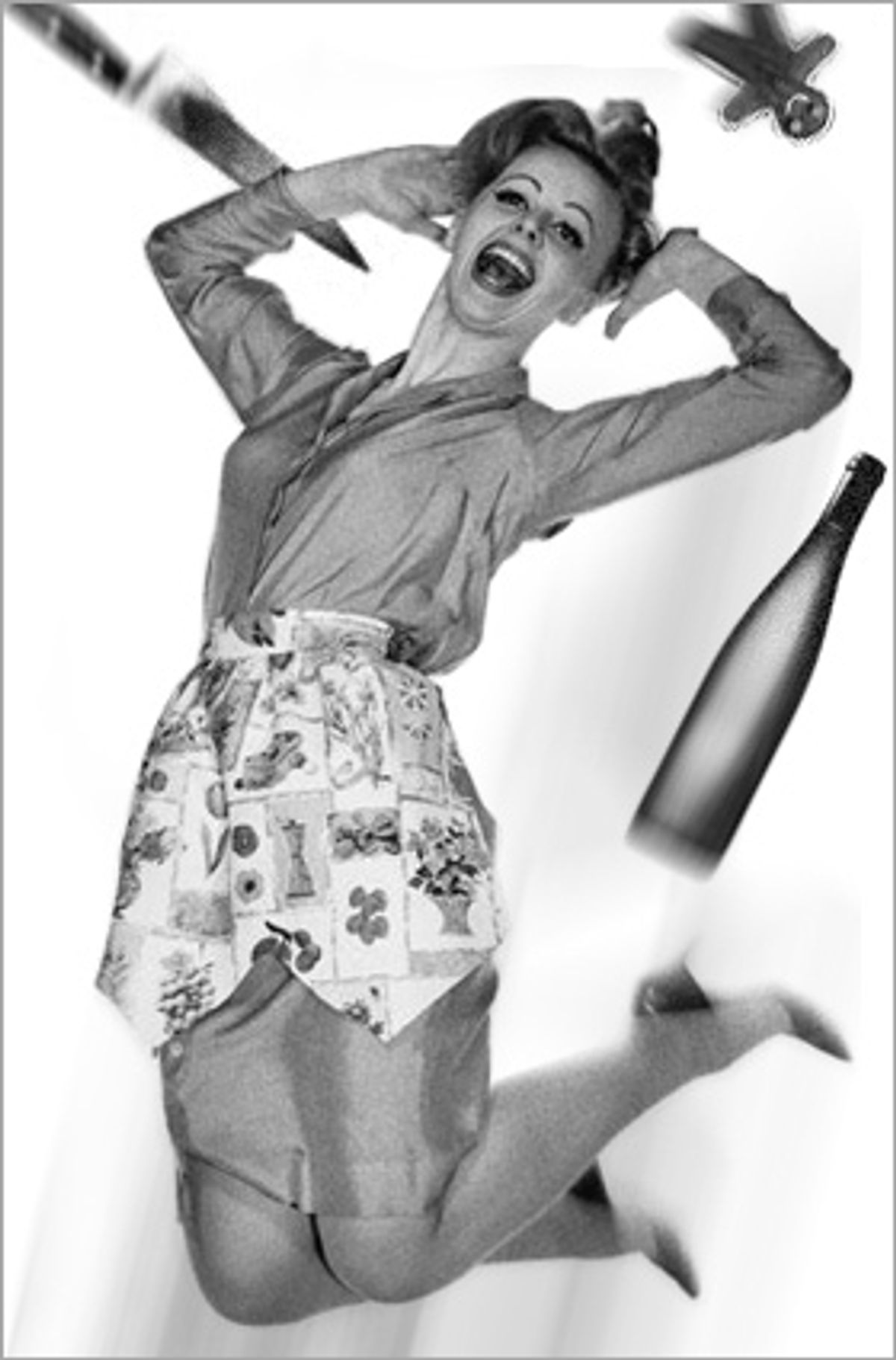
The first item in a section about goods "that no stay-at-home mom should do without" is a big bottle of Rodney Strong Chardonnay. A photograph illustrating a piece called "Martha Doesn't Live Here" depicts a crazy-eyed woman wielding a turkey-carving knife. The "Sex Scorecard" feature is about women who tally up their husbands' daily good deeds and sins and allow his score to determine whether "he is -- or ISN'T -- 'getting any.'" What about whether she is or isn't getting any?
One chart called "Coulda, Shoulda, Woulda" compares, "just for fun," what CHOs are obligated to do during the holidays vs. what they would actually like to do. Among the required tasks? "Do all the shopping for my entire family and my husband's relatives," "Buy a new dress for my husband's company party," "Cook endless batches of cookies" and "Put the decorations away and clean the house on New Year's Day." Among the things that CHOs would like to do are "Sit in front of a cozy fire drinking wine," "Buy a whole new winter wardrobe" and "Send my husband to the bakery." Another table listing "20 ways to amuse yourself on a bad day" includes suggestions like making "pancakes in the shape of those really nice Jimmy Choos you used to wear before you had kids," and affixing "a smiley face sticker to your forehead, because frankly, it's the only smile that's been on your face all day."
Isn't the new "staying at home" about empowerment of sorts? Isn't it supposed to be about exercising choices made possible by feminism? Why are these women doing all the baking and cleaning and schlepping to husbands' office parties? In a feature called "Gettin' CHOey," the Total 180! ladies write that "We needed to validate, support and reassure one another. Lord knows our husbands can't do that for us, and we shouldn't expect them to -- that's what girlfriends are for." Why is there no expectation of validation, support or reassurance from the husbands whose dinners they're cooking? Did they all marry the Great Santini?
Reading Total 180! made me want to introduce the CHOs to an incisive little volume titled "The Feminine Mystique." In it, they would find a description, in Paragraph 1, of a suburban wife who, as she "made the beds, shopped for groceries, matched slipcover material, ate peanut butter sandwiches with her children, chauffeured Cub Scouts and Brownies, lay beside her husband at night ... [was] afraid to ask even of herself the silent question -- 'Is this all?'"
I called Total 180! co-founder Debbie Klett to ask her directly about these questions. Klett, 38, spent seven years in sales at International Data Group before deciding to stay at home full-time more than two years ago. She lives in Rocklin, Calif., with her husband (who wrote the male perspective on the "Sex Scorecard" in which he wondered "why [wives] can't remember that we're giving 'it' to you too?"] and 3-and-a-half-year-old twin daughters.
Do you find a contradiction in publishing a magazine about stay-at-home mothers when you yourself have gone back to work?
We feel that we're reinventing ourselves. We're still putting our families first. And if I'm on the phone for business and my kids need me then I can say, "I've got to call you back." It's not really opting back into the workforce, it's reinventing a way to stay involved and hoping society will play along. Imagine if companies put families first and tried to work with women! Imagine if they were better about hours and on-site day care and job sharing and flexible shifts.
That would be great. But that's different from full-time motherhood, which is what the magazine is about, right?
Well, by no means do we want to frown upon moms that need to work. We are not telling working moms you need to stay home; we do not want to do that at all. I have a friend who needs to work. If she were home with her kids all day she wouldn't be able to mentally take it; everybody's different. But there is a trend in society; women in their 30s have been able to have the success of having a career, and then they have their children and they say what I want to do is be there for all those firsts and be here for my children.
The New York Times recently interviewed women at elite colleges who said they planned to stay home to raise their kids. I think that's great. I am biased, of course, but I think that if you focus on your family and you're there for your children and they're not coming home to an empty house then that is going to create a positive wave of change across society.
What about women who need to work not for psychological reasons but for financial ones? Does privilege play a part in staying at home?
Absolutely. I can say personally that we as a family made personal sacrifices to enable me to stay home: We moved to a community where we were able to afford a home and a lifestyle that could be supported by one income. That's one of the reasons we put the feature about the 10 best cities [in which to be a CHO] in the issue, because we realize that sometimes families have to move for a woman, or a man, to be able to stay home.
Right. But a huge number of families can't even afford to own a house, much less move. I'm talking about poorer women for whom staying at home is simply not an option.
Oh, absolutely. When you get into different economic levels of society there is no option to make a choice and my heart goes out to those women, because maybe they do want to be staying home and they just can't.
What kind of positive wave of change were you referring to above?
Well, I don't know how to say it without slamming anybody, but I do believe if you put your family first and are there for your children and make them feel loved and supported, they're not going to go out looking for love and support in places that might not be good for them. If society, including corporate America, put family first, imagine what kinds of positive changes would happen across all levels.
The main reason why kids get involved in gangs is because they need to feel accepted in a circle of people who understand who they are. If your kids feel they are loved and accepted at home and they have a strong home base, even if Mommy and Daddy work, they're going to be more self-confident individuals who may not need to feel like they have to go somewhere else to feel accepted. But by no means do I want to slam anyone who has to work. This is a very rocky ridge to walk.
Because people are inevitably defensive about the choices that they have made?
Oh yeah. You know we have a story in the first issue called "I'm Sooo Pissed...!" [in which a CHO responds to the question "What do you do all day?"]. When women leave the workforce, you feel like you've lost your identity. So when people ask what you do and you say, "I stay at home with my kids," you say, "I used to be in the publishing world," so that you can have something important you used to do. We are trying to start a wave of change so that people understand that being a mother is one of the most important jobs in the world. The rewards are unmeasurable.
Well, it's good to hear you talk about the rewards, because to be honest, as someone who hasn't had kids yet, your magazine scared me to death. When I opened it I assumed it would be a complete celebration of domestic life, but it actually made it sound pretty bad.
Well, that's good for us to hear for feedback. What did you think was scary?
Well, when you wrote about being "let out" once a week by your husbands, it made it sound like you were caged.
When you are a mom you have what I call a hypothetical pager, and your pager is on 24/7; you never get to turn it off. Getting "let out" means that your husband has said, "Go out for the night, I'll take care of things," and you are able to completely release yourself from responsibility.
You know reality TV? Well this is a reality magazine. We've received maybe one comment that our features were a bit long. That's the only comment that was in any way negative. The reality of staying home is sometimes "What the heck am I doing? I want to pull every hair out of my head!" and the next minute your child comes up and gives you a hug and tells you they love you and it's the best thing. But we don't want to sugarcoat things and say everything is a celebration.
I was also alarmed by the "Coulda, Woulda, Shoulda" chart because it seemed like moms were depriving themselves of so much. I wanted to scream, "Buy something for yourself! Let your husband get his own dinner!" Is it really that bad?
Oh no, it's just that we always joke around; we say, "When I turn 40, I'm going to be able to talk about what I want to do!" "Coulda, Woulda, Shoulda" is a humorous thing, because we all want to go on that trip to take the kids to cut down the Christmas tree, right? But then you're getting the kids in the car and cutting it down and it's cold and you're thinking "Oh my gosh, let me just buy a fake tree and be done!" It's designed to be funny.
Yes, but I agree -- buy a fake tree!
I hope you got this sentiment, that we are all very grateful at the end of the day. Going from the workforce to staying home is a transition and a challenge but it is totally worth it. The moments with your kids are priceless and when you put your head on your pillow every night you know you are there for your kids and you know you're doing the right thing. It just feels right.
Are you conscious that statements like that -- about how you know you're doing the right thing -- will make many working mothers feel angry and guilty?
I am totally conscious of that and that is a personal statement based on my own choice. Everyone has to do what they feel is right for themselves. I know by putting my family first I'm doing the right thing for me, for my children and my family unit. But everyone has to do what they feel is right. If a mom is going to stay home and not be happy about it and be in a bad mood all day because she resents it, then that's not going to be good for the family unit.
What about the Sex Scorecard article, where sex is something women withhold from their husbands. Don't moms like sex too?
I live on a street [on which] all of the houses ... are stay-at-home moms and we sit and talk about the idea of the Sex Scorecard, like, "Man, why can I not get in the mood? I am always tired, and he ticked me off doing this." But if you get to the end of the Sex Scorecard you'll see that it says that by withholding sex you're punishing yourself too and mothers need to make it more of a priority. It may get better as kids get older, but in that initial stage with bottles and laundry and getting used to the fact that you have a baby, unfortunately it's what happens.
But wouldn't all the bottles and laundry also impact husbands' libidos? Do they lose the drive?
Oh, no. What happens is that the wife's attention is mostly on the kids, but the husband hasn't changed, hasn't gone through any type of hormonal things and he's still got needs and for him it's like, "Hey, what's going on?" Hopefully they are understanding about it but I don't think that their [sex drive] is affected anywhere near the way the woman's is.
But aren't modern men supposed to be sharing in the experience of parenthood? It doesn't make sense to me that a man's life and habits wouldn't be changed at all by becoming a father.
Ha, well you know one of the feature stories for the next issue is called "My Husband Is a Single Man Who Happens to Have a Family." I mean, I'm sure you found from reading the magazine that we're trying to be humorous. I don't know how to put it, but men, as we know, maybe even biologically are able to focus on one thing at a time. Women juggle. The fact that I stay home and watch my kids gives my husband the freedom to not wear that pager because he knows I've got it covered. When we're both home we share. But we had to have that discussion many times, about having shared duty. It's the same thing women talk about all the time, that their husband doesn't clean the house or doesn't do this or that. A man will step over the bag of garbage to get to the beer in the fridge, and a woman will pick up the bag of garbage as soon as she walks into the kitchen.
But 40 years after feminism, aren't those patterns that should have changed? Don't you think that men can be better than that?
I really, really hope so. I do have a neighbor who, when her husband comes home from work, he takes care of the kids. They totally share everything. I do think it's something that can change, but there has to be conscious effort from both sides to make it work.
What do you think about feminism, which tried to free women from some of these binds by fighting for them to have an equal place in the workplace and at home?
I think that what we're talking about is a reworking of feminism in the sense that we are opting to stay home and at the same time we are yelling from the treetops that this should not be something that makes us any less of a person in society. That's the part that upsets us the most. Have you ever read that book "The Mists of Avalon" [Marion Zimmer Bradley's gyno-centric reimagining of Arthurian legend]?
Yes, a long time ago.
Well, at some point the women were the powerful ones; we had all the power and the glory. Then it shifted and it was the men on top. And feminism tried to move us forward again, to get the same pay and the same promotions, and that's great and all, but sometimes ... feminism says, "OK, get that job," and "You can do just as good as the men," so we think, "OK, I've got to get that job and do just as good as the men but when I come home I've also got to be on duty." And doing it all is just not always possible.
There is a maternal instinct and I believe it is a biological thing. If you're going to try to work 60 hours a week and be a mother, you cannot do it all equally well. You have to make the choice as to what you want and what your priority is. It's a reworking of feminism because if stay-at-home moms had respect like they do in the workplace it wouldn't be so much of an issue. That's why we came up with the title CHO for chief household officer. Because when you lose your paycheck and lose your title, somehow you lose respect. And we are trying to explain why that should not be the case. When you tell people you're staying home, they should say "Congratulations! What a great choice!"
But have people who answer that they work made a bad choice?
No, but workplaces should have on-site day care and let you work flexible hours. Can you imagine? We need this reinvention. Look what's happened by not putting the family first.
What's happened?
It seems like there's a lot more weird stuff going on in society than there used to be.
Are you blaming the weird stuff on the feminist movement?
No, not really. But you've got a lot of moms who tried to have it all and you're seeing the results of that in that children were not getting as much dedicated attention as they were before when you had June Cleavers. I heard on TV recently that kids in grade school were giving oral sex to people for a dollar. I don't know if that went on in the 1950s but I sure didn't hear about it. I wasn't around in the '50s but you know what I mean. Why is that happening now?
It sounds like you're idealizing the 1950s, which is pretty controversial. The 1950s was a stifling decade for women. Do you want to go back to the '50s?
No, I think that somewhere between the 1950s and now, that's the happy medium we're trying to get to now. If we could have the liberation but still put family first.
What would be interesting is to see if you took finances completely out of the picture what women's choice would be. Is the need for dual incomes the main reason they're not staying home? Or are they not staying home because they'd rather work?
Well, why did you choose to start this magazine?
We realized that there was no magazine that spoke to women in the voice that we as professional women turned stay-at-home moms wanted to read. Most other magazines are very advice- and tip-driven: trim down your abs, et cetera. Just reading the cover you [get the message that you're] not good enough the way you are. When you go out with your girlfriend, she tells you, "Oh, you're going through this difficult time, I understand." That's the voice we wanted to capture.
So you didn't choose to found the magazine for financial reasons, but because you were passionate about it.
Absolutely. And that's part of our thinking. That if women decided to be at home, they might get involved in [projects they're passionate about]. I am very, very thankful my husband goes out and gets his paycheck and keeps the house afloat. I am very, very thankful that I have the opportunity to do something I really care about. It's a way to keep the adult side of yourself as passionate and alive as the side of you that's playing Barbies. You're having the best of both worlds and your brain is not turning to mush.
I remember my husband getting home one night and suggesting we get pizza. And I took down the phone book and started counting the places we could order from: "One, two, three, four, five ..." and he said, "You don't have to count like that to me." So you don't want to stay like that all the time, because, yeah, you would go crazy.
Is there one moment when you remember knowing for sure that you did the right thing by staying home?
When one of my daughters was starting to walk, I was right there and I didn't have to hear about it from a day-care person. It was like, "Here it is, the first time, and I'm sitting right here and I'm never going to forget this." Stay-at-home moms cry on a regular basis, because we are filled with joy and frustration. And when you become a stay-at-home mom, you really join a community of women.
It's not scary, really.
Shares