Football

The year in sports

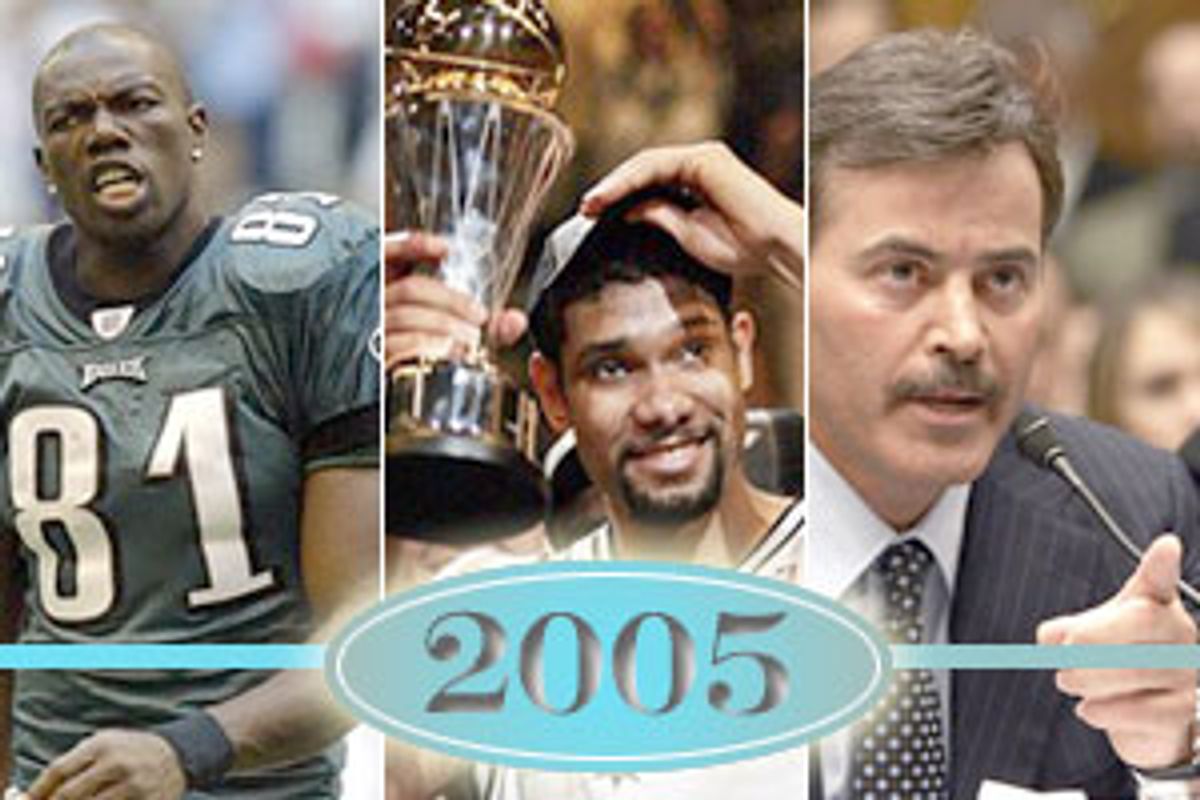
In a no-nonsense 2005, Terrell Owens and BALCO fizzled, while the hard-working Pats, Spurs, White Sox and Colts sizzled.

  • more
    • All Share Services

The year in sports

What a sober year it was, this year in sports. An upstanding law-and-order year, a do-the-right-thing year. It was a year of new rules and regulations, stiffer penalties, the bad guys getting theirs. Humble lunch pail brigades took home championships this year while flash and self-glorification were sent into exile.

Except for Reggie Bush. The Heisman Trophy-winning tailback from USC was so spectacular that even this hat-in-hand, nose-to-the-grindstone annum couldn’t dim his luster.

Maybe the sports world was chastened by the Brawl of Palace Hills in November 2004, the consequences of which were felt well into ’05.

Maybe it was the prospect of playing games in the face of a wave of worldwide disasters, of tsunami aftermath and earthquake, war and, especially, Hurricane Katrina, that injected a note of humility to the proceedings and had athletes, coaches and the commentariat talking again and again about “perspective.”

Maybe it was just one of those years, and with one or two things breaking differently — high-flying Dwyane Wade staying healthy and leading his glamorous Miami Heat into the NBA Finals, say, or the New York Yankees going on one of their October runs — this theme wouldn’t fly at all.

Thank heavens for small favors.

The year began, as sports years tend to do, with college bowl games, and a massacre at the Orange Bowl. But the lasting memory from that National Championship Game wasn’t Southern Cal toying with Oklahoma on the way to a 55-19 smithereening. It was Ashlee Simpson getting booed off the stage at halftime.

It was as if sports fans were serving notice that this was a new day. Keep in mind this was the Orange Bowl, which is to impossibly cheesy halftime entertainment what Siberia is to ice. The assembled crowd had only moments earlier had no problem with Kelly Clarkson, a minimally talented, manufactured product of the instant-celebrity hype machinery.

And now they rose up as one to say no — they pronounced it “Boo!” — to the amateurish keening of Simpson, who isn’t even a minimally talented, manufactured product of the instant-celebrity hype machinery. She’s the untalented sister of one. “That’s where we draw the line,” the people declared: “Boo!”

What does this have to do with sports? Everything. It was a harbinger, a signal that 2005 would be a year of no nonsense. A few weeks later, that no-nonsensiest of football teams, the New England Patriots, won the Super Bowl for the second straight time — and with nary a costume malfunction during the forgettable halftime show.

The Patriots have won three of the last four Super Bowls without benefit of a superstar other than quarterback Tom Brady, a good-looking but unassuming fellow who is not going to make the popular culture forget Joe Namath. Or even Dan Marino. This blue-collar year saw a TV ad campaign make Brady’s offensive linemen almost as famous as he is.

In between those two championship football games, Minnesota Vikings wide receiver Randy Moss elicited outrage when he pretended to moon the crowd in Green Bay after scoring a touchdown and pitcher Randy Johnson, then the newest New York Yankee, was filmed acting imperiously and roughly with a TV news cameraman.

Those served as opening acts. By the fall the outrageous behavior of an NFL wide receiver and the assault of a cameraman by a major league pitcher would be two of the biggest sports stories of the year, but Moss, traded to the Oakland Raiders over the summer, and Johnson, who couldn’t fix the Yankees’ pitching problems, weren’t involved.

It was that other brilliant but temperamental receiver, Terrell Owens, who overshadowed Moss in 2005. He began the year by heroically returning from a broken ankle in time to play well in the Philadelphia Eagles’ Super Bowl loss to the Patriots, completely scuttling his reputation as an egotistical, team-poisoning jerk.

By August, he’d gotten himself thrown out of training camp for whining about his year-old contract and bad-mouthing teammates, particularly popular, good-guy quarterback Donovan McNabb. 2005 was not a year for taking on the good guy. In November Owens was suspended for the maximum four games and deactivated for the remainder of the season following his latest round of carping.

By that time, the Indianapolis Colts had taken over the NFL, winning their first 13 games and clinching home-field advantage throughout the playoffs before finally losing a game without stakes for them to the San Diego Chargers on Dec. 18.

The Colts launched their assault upon the Miami Dolphins’ 33-year-old record of being the NFL’s only unbeaten, untied champions behind an unabashedly spectacular offense — but one led by their own aw-shucks quarterback, Peyton Manning, and by receiver Marvin Harrison, as brilliant as he is unflashy, a sort of anti-Terrell.

But the Colts have had offensive firepower for years. They finally turned themselves from pretenders tormented by the Patriots to contenders streaking toward a title the old-fashioned way: with a tough, bruising defense. Only fitting for a team coached by Tony Dungy, who is, of course — this being 2005 and all — a no-nonsense, defense-minded boss.

Sadly, the Colts’ glorious year was marred by tragedy just before Christmas, when Dungy’s 18-year-old son, James, was found dead of an apparent suicide.

The pitcher who went one better than Randy Johnson was Kenny Rogers of the Texas Rangers. Johnson at least had the excuse, however lame, that he’d been accosted by a camera on a city street. Rogers was in uniform, on the field before a game, and the local news cameraman he attacked had as much right as Rogers did to be where he was.

Rogers became a pariah, booed at the All-Star Game and savaged in the press, which makes sense, one of its own having been attacked. But when a celebrity can’t get the people on his side in a beef with the intrusive media, something’s afoot.

Another important thing happened in that busy month of January, between those two championship football games: Major League Baseball announced a new steroid testing plan with stiffer punishments for offenders. It was the start of baseball’s Year of the Steroid.

In February, Jose Canseco confessed to — or bragged about — having been the Johnny Appleseed of steroids in the late ’80s and early ’90s. In his book, “Juiced: Wild Times, Rampant ‘Roids, Smash Hits, and How Baseball Got Big,” he wrote of teaching teammates such as Mark McGwire and Rafael Palmeiro all about performance-enhancing drugs, and even about shooting up some teammates with hypodermic needles in bathroom stalls.

At the time, Canseco was largely dismissed as a bitter attention whore telling tall tales. Within a few months, he was starting to look like the only honest man in the room.

The new program yielded suspensions for steroid use for the first time. Journeyman outfielder Alex Sanchez of the Tampa Bay Devil Rays was the first to get dinged for 10 days. Every few weeks another no-namer’s name would be announced, he’d issue a wan denial — must have been something mixed up in the stuff I got at the GNC — and then he’d serve his 10 days. It looked for a while like the program would only catch small fish.

But only for a while.

In March, not long after Yankee Jason Giambi, whose steroid use was made public in a December 2004 leak of grand jury testimony from the case against suspected steroid lab BALCO, issued a heartfelt apology to fans, teammates and the rest of the world without mentioning what it was he was apologizing for (it was his steroid use — Shhhh!), a group of current and former players, including Canseco, appeared before a congressional committee that was grandstanding about steroids.

At the hearing, McGwire, the retired, Bunyonesque slugger who had done a lot to help baseball recover from a devastating strike by breaking Roger Maris’ single-season home run record in 1998, refused to answer questions about whether he’d used steroids. “I’m not here to talk about the past,” he kept repeating.

In a matter of minutes, McGwire’s reputation as an American hero was destroyed. A few months later, McGwire, who’d worn a Cardinals uniform when he broke Maris’ record, was booed in St. Louis. No former Cardinals get booed in St. Louis. That fans there booed McGwire, who a few years earlier had had a section of interstate highway in town renamed for him, showed how badly he’d crashed.

But among the men sitting shoulder to shoulder in that congressional hearing room on that March day, McGwire got off easy compared to Rafael Palmeiro. The Baltimore Orioles star pointed his finger at the committee and said, “I have never used steroids. Period.” On Aug. 1, baseball announced that Palmeiro had tested positive for steroids.

He was suspended for 10 days like the others, but he was no Alex Sanchez. Earlier in the year — after his positive test but before his appeals were exhausted and the results announced, timing that some found fishy — Palmeiro had reached the 3,000-hit mark, which combined with his 500 home runs all but assured him of a spot in the Hall of Fame.

Now that enshrinement appears unlikely. Booed at home and on the road, Palmeiro was eventually sent home for the rest of the season by the Orioles, ostensibly to nurse a sore leg.

In September, Major League Baseball and the players union were again renegotiating the steroid testing plan, in hopes of avoiding threatened congressional imposition of a tougher standard. While this was going on, Barry Bonds returned from a knee injury that had sidelined him for the entire season.

Bonds had been a key figure in the BALCO case. He was a client of the lab and one of the defendants had been his personal trainer. His steroid use also came out in the leaked testimony, though he’d denied knowingly using. Now, 41 years old and with the sports world waiting for him to prove his doubters right, to show that he couldn’t do anything without steroids, he hit five home runs in 14 games, leaving him six shy of Babe Ruth’s career total.

Did that performance mean his astonishing hitting prowess of this century hadn’t been steroid fueled after all? Or merely that whatever he was juicing with wasn’t detectable by the current tests?

Or maybe he was just in that same period Palmeiro had been in when he’d hit his 500th home run, the time before his first positive test. The reality of the year of the steroid, of the whole steroid era, is that we just don’t know.

In November, the players and owners agreed on yet another, stiffer testing program, with a 50-game suspension for a first offense and a possible lifetime ban for a third. Congress backed off. Law and order had won the day.

In the meantime, getting back to the lunch pail side of our thesis, the Chicago White Sox won the World Series. This scrappy, superstar-free bunch — Paul Konerko hardly transcends the sport in Derek Jeter- or Johnny Damon-like fashion — brought the hard-working, blue-collar South Side its first championship since 1917.

And the Sox did so by beating the Houston Astros, who’d beaten the more glamorous Cardinals and Atlanta Braves to win the National League. The Braves, in turn, won the National League East only after the surprising, underdog Washington Nationals had spent much of the summer in first place. It was a stylish way for baseball to make its return to the capital, where it had been missing for 33 seasons.

Style was something that was missing from the NBA Finals in June. The fundamentally sound, defense-first San Antonio Spurs beat the fundamentally sound, defense-first Detroit Pistons for their second championship in three years and third in seven. Nose to the grindstone stuff, hard work and playing the right way paying off.

TV viewers stopped complaining about the lack of fundamentals in the modern NBA long enough to stay away in droves.

The only diva in sight for those dozens who tuned in was Pistons coach Larry Brown, who spent the team’s playoff run flirting with other clubs and ended up taking the head coaching job with the Knicks. In other words he was sent into a sort of exile, to a place far from the mainstream in this humble, down-to-earth year: New York.

The NBA had limped into 2005 stinging from a disastrous public-relations year highlighted by Kobe Bryant’s rape trial in Colorado — charges were dismissed in September — and the infamous November brawl between the Indiana Pacers and Detroit Pistons that spread into the stands.

Commissioner David Stern, who’d slapped instigator Ron Artest with a full-season suspension, scuttling the Pacers’ hope for a championship, pushed through two image-polishing initiatives in 2005. As part of the new union contract, the NBA now has a minimum age of 19 for players — Stern had been hoping for 20.

The new rule was supposed to encourage kids to stay in school for at least another year and reach the league with that much more seasoning and maturity. Of course it won’t hurt that they’ll arrive with a year’s worth of free NCAA publicity behind them too, but that’s surely nothing more than a happy side effect of doing the right thing by our nation’s youth.

Stern’s other innovation, a new business-casual dress code for players when on league business, such as traveling to games, got some laughable criticism from the millionaire players — Denver’s Marcus Camby said he wanted a clothing allowance — and, like almost everything that happens in the NBA, led to an interesting conversation about the role of race in a league of mostly black players that’s overwhelmingly run by and played for whites.

A group of elderly former players who had been NBA pioneers in the 1950s pushed hard during the labor negotiations to be included in the NBA’s pension plan, from which they’d been excluded since its formation in 1965.

Though NBA players and teams sent tens of millions of dollars to disaster relief during the year, they declined to shake loose the few hundred thousand that would have taken care of the 80 or so men, some in desperate financial straits, who had helped create the league’s wealth. Doing the right thing wasn’t universal in 2005.

Prospects for a more glamorous 2005-06 increased a little with Brown bringing some star power to New York’s long-dormant squad and the return of Phil Jackson to the Los Angeles Lakers’ bench, though neither team figured to still be around in June.

It might have been a perfect four-sport parlay of lunch pail-toting champions if some grinding, checking, superstar-free team had won the Stanley Cup, but the Stanley Cup wasn’t awarded. The NHL, in a lockout since September 2004, in February became the first North American sport to lose a season to labor trouble when it announced the 2004-05 campaign wouldn’t be saved.

The players eventually capitulated to the owners, agreeing to the salary cap they’d earlier refused to negotiate about. It was a total loss for the players, who got a worse deal than they could have without losing a year off their careers.

A positive side effect of this embarrassing disaster, the loss of a season because a group of a few hundred people couldn’t figure out how to divide up $2 billion, was that the NHL felt the need to win fans back by fixing the on-ice game, a move that was about a decade overdue. Liberalized rules led to an increase in scoring of about a goal a game in the early going of the new season. No longer was a two-goal lead insurmountable. Real progress.

“Disaster” is obviously a relative term. Poor decision-making in a contract negotiation is nothing compared to real-world disaster, and the sports world didn’t escape the effects of Hurricane Katrina.

The Superdome, home of the New Orleans Saints, the Sugar Bowl and numerous Super Bowls, was a briefly notorious relief shelter. Teams, leagues and players donated money, goods and time to disaster relief. Two major pro teams, the Saints and the NBA’s New Orleans Hornets, were forced to relocate.

The Saints moved their headquarters to San Antonio, playing home games there and in Baton Rouge. Already a struggling franchise, they may never return to New Orleans. The Hornets moved temporarily to Oklahoma City, a town that hopes to use the team’s presence to showcase its readiness for a franchise without appearing to capitalize on a tragedy.

And many college sports programs throughout the Gulf Coast region were affected. In New Orleans, Tulane “suspended” eight sports as a cost-cutting measure as it tries to recover. But Tulane was also responsible for a first, small flowering of good news: On Dec. 18, the Green Wave beat Central Connecticut State in women’s basketball. It was the first sporting event, college or pro, in the city since the hurricane.

As always, there were stars and heroes outside the four major North American sports. Lance Armstrong, chief among them, won his seventh straight — and, he says, last — Tour de France, though he remains under a cloud of doping accusations, charges he insists are false and motivated by European antipathy toward him. He remains a lavishly admired figure at home.

Tennessee’s Pat Summitt became the winningest college basketball coach ever, and Baylor won the women’s NCAA Tournament, a surprise that finally brought good basketball news to a campus that two years earlier had been home to one of the most sickening scandals in the history of college sports.

North Carolina survived a dazzling, thrilling Elite Eight round and beat Illinois — which had been undefeated before losing to Ohio State in its last regular-season game — for the men’s championship. Then the Tar Heels had four players taken in the first 14 picks of the NBA draft. Andrew Bogut of Utah, a slick-passing Australian center, was the top pick in the draft and began his pro career playing well for the Milwaukee Bucks.

In college football, while USC and Texas were No. 1 and No. 2 wire to wire and will play for the national championship in the Rose Bowl, Notre Dame and Penn State made headlines with huge comeback years.

Joe Paterno, the subject of “How do we get Joe to retire?” talk as he coached Penn State to a 26-33 record from 2000 through 2004, opened up the offense at long last and led his Nittany Lions to a 10-1 record and a Big Ten championship, the only loss coming at Michigan.

He was named Associated Press Coach of the Year the day before his 79th birthday. Ranked third in the nation, Penn State will play in a Bowl Championship Series game for the first time in the BCS’s 8-year history, meeting Florida State in the Orange Bowl Jan. 3.

In South Bend, former Patriots assistant Charlie Weis took over a program that had had only two winning seasons in the last six and immediately energized it. The Irish went 9-2, losing only a pair of thrillers at home, to Michigan State and, in the game of the year, Southern Cal. Notre Dame will play Ohio State in the Fiesta Bowl Jan. 2.

Speaking of comebacks, a 50-1 shot came from way off the pace to win the Kentucky Derby. Of course. In what other year should the little-known Giacomo roar down the stretch and win, rather than the much-hyped Afleet Alex, with his ready-made, heartwarming back story involving a brave little girl who died of cancer?

Afleet Alex overcame a trip at the start to win the Preakness, then took the Belmont Stakes too. Of course, because 2005 was all about doing the right thing, and who better to win two Triple Crown races than a horse donating a chunk of his winnings to pediatric cancer research?

Danica Patrick became the first woman to lead a lap at the Indianapolis 500, and more importantly returned that race, possibly temporarily, to the A list of American sports events, though NASCAR, whose Nextel Cup was won by former bad boy Tony Stewart, continued to dominate the world of speed.

It’s too late for such a figure to return the sad sport of boxing to the front pages. Here’s an example of how far the sweet science has fallen: On Dec. 17, a 7-foot Russian won the WBA heavyweight championship on a disputed decision over John Ruiz in Germany.

This whole thing, a freakishly huge Russian winning a questionable decision in a heavyweight title fight, barely made the papers in the U.S. If you can summon the name of the giant who now holds a share of what was, during this not-yet-old writer’s lifetime, the most important title in sports, you are in a tiny minority. It’s Nikolay Valuev.

And there was more crime and punishment as well. Temple basketball coach John Cheney suspended himself after he ordered a player to commit hard fouls against St. Joe’s in response to officials not calling moving screens, and that player broke an opponent’s arm, ending his career.

The BALCO case, the eye of the steroid hurricane for most of 2004 and ’05, fizzled, with founder Victor Conte and two others copping pleas and getting short jail sentences or probation.

The Minnesota Vikings, off to a terrible start in a season in which they’d been picked by many to win their division, made headlines with a bye-week bacchanal on a pair of Lake Minnetonka charter yachts that was cut short after the crew complained of players and their guests engaging in public sex and aggressive behavior.

Four Vikings players, including quarterback Daunte Culpepper, who was injured in a game shortly after the party, were charged with misdemeanors.

Unfortunately for the thesis of this piece, all of this was followed by the Vikings turning their season around, winning six straight games to launch themselves into the thick of the playoff picture, though they were eliminated from contention Sunday night with their second straight loss.

And the sports story from 2005 that will have the longest-lasting and farthest-reaching consequences for the most people had nothing to do with good or bad, right or wrong, humble or egocentric. It simply was what it was, a business story with no heroes or villains. But it meant the end of an era.

In April, the NFL announced two new television deals: “Monday Night Football,” the cultural icon that had brought the NFL to prime time in 1970, was moving from ABC to cable in 2006, to corporate partner ESPN, where one out of five American households wouldn’t be able to see it.

NBC would take over the Sunday night game, which the Peacock says will become the big prime-time game of the week. Disney, which owns ABC and ESPN, begs to differ, but there’s no denying that that little slice of Americana created by Howard Cosell and Don Meredith was in its last days as the year ended.

A sober, serious year. A nose-to-the-grindstone year. One with no place for Dandy Don serenading us, however appropriate the sentiment would have been, with “Turn out the lights, the party’s over.”

This story has been corrected since publication.

King Kaufman is a senior writer for Salon. You can e-mail him at king at salon dot com. Facebook / Twitter / Tumblr

Can Tebow find salvation?

Updated: After losing his job in Denver, evangelicals' favorite jock faces an uncertain future in New York.

  • more
    • All Share Services

Can Tebow find salvation?Tim Tebow (Credit: Reuters/Rick WIlking)

[UPDATED BELOW]

You don’t need to be an evangelical Christian to care about the future of Tim Tebow. I’m a lapsed atheist myself. But with the resurrection of quarterback Peyton Manning in Denver, I wonder most about the future of the spiritual scrambler, who led the Broncos to the playoffs last year.

The Broncos signing Manning to replace Tebow is a no-brainer. He may be diminished by age and injury, but he is also the best quarterback of our time, not because he is a brilliant coach’s puppet (Tom Brady) or an on-field, off-field brute (Ben Roethlisberger) but by virtue of a fierce work ethic and a concentrated intelligence that is contagious and inspirational. Whatever is left at age 35 of him will make the Broncos better.

Through 14 years and two Super Bowls with the Indianapolis Colts, there was something reassuringly manly about Manning, his cool leadership, his laconic but friendly demeanor, his thoughtful professionalism, that evoked my role models on the Encore Westerns channel like Marshal Dillon and Wagonmaster Flint. (Something went out of American life when the legend of the western hero was replaced by the myth of the sports idol.)

Tebow also evoked the TV cowboy for me, those boyish enthusiasts, Rowdy Yates and Deputy Johnny McKay, still learning but eager to make things happen. Tebow, in his second year at Denver last season, was rough edges and a wonk’s nightmare – his various quarterback ratings and statistics were low – but he did make things happen, as a team leader and a fearless runner when he couldn’t pass, which was often. He became a fan favorite because he tried so hard, often succeeding in the clutch toward the end of games, and a cultural phenomenon for bringing extreme praying to the mainstream tent. He was always ready to take a knee for God.

“Tebowing” became a something of a joke, which was unfair. He wasn’t cool about his Christianity, like so many athletes, including Jeremy Lin. He lived it. But his retrograde beliefs grated on most sports commentators, who tend to find it easier to understand the more traditional jock outlets of driving drunk and assaulting women.

Tebow was a quarterback whose arm, accuracy and game smarts were not considered elite — yet he somehow won anyway. God forbid it was the confidence he got from his faith. But isn’t sports about teaching kids that you can make it if you try hard enough?

Assuming that Tebow will not be kept on in Denver to make Manning even better (as running back or tight end, for example), it figures that he will soon be dealt off. The Miami Dolphins would be a good fit. Tebow’s success at the University of Florida makes him a local hero, and the large Jewish population might give him the chance to refine his other controversial skill, performing circumcisions. He needs to sharpen the technique he practiced at his father’s evangelical ministry in the Philippines.

In Miami, Tebow can mix a little profane with his sacred, hanging out with the Heat basketball star LeBron James, dubbed by author Scott Raab as “The Whore of Akron” for leaving Cleveland to take his talents to South Beach, an American Sodom that could use a missionary like Tebow.

A more serious issue for the NFL is what to do about the defensive unit of the New Orleans Sinners, who, under the supervision of a seasoned, respected coach, instituted cash bounties for knocking opponents out of the game. A good, hard hit that put a rival player on a stretcher might be worth $1,000. As it turned out, this was not aberrant behavior in the National Football League, although it was against the rules, and, I thought, against the spirit of the game.

It may also turn out that the neck injury that kept Manning out of football last season was originally suffered in a game against New Orleans. Could he have been a targeted hit? How much to sack him, to knock him out of the game, to end his career? Just for money, a victory and bragging rights? Doesn’t seem very manly. Football is supposed to have the madcap gallantry of a World War I cavalry charge, not the mean cowardice of a drone attack.

The best we can hope for is that the thuggish Saints coach and the wimps who didn’t have the moral courage to stand up to him are suspended for the season, one less concern as Manning revives his exemplary career in Denver and Tebow, wherever in God’s name he ends up, finds spiritual satisfaction.

UPDATE: So Tebow is going not to the Miami Dolphins but the New York Jets. New York will still give him a large circumcision roster for his shaky arm and a Sodom for his faith-healing, but it will also test him cruelly. It might seem that New York fans would mock his kneeling ways and his anti-abortion stand, but they will also forgive anyone who wins. Will the temptations of the Big Apple be Tebow’s downfall? I hope not. Lord knows the Jets need that mindless confidence that only faith supplies.

And as to the New Orleans Saints: the League stood tall, suspending not only the defensive coach, but the head coach, and penalizing the franchise. There may be further penalties for the players involved. One should not have expected less, of course, as football faces lawsuits and moral indictments for its long failure to deal with head traumas.

Continue Reading Close

Robert Lipsyte is a former New York Times sports columnist. His new memoir, "An Accidental Sportswriter," has just been published.

The Super Bowl is not a job creator

Despite what civic boosters say, hosting the big game provides few long-term benefits

  • more
    • All Share Services

The Super Bowl is not a job creator (Credit: AP/Michael Conroy)

Roger Goodell, the commissioner of the National Football League, argued on “60 Minutes” last Sunday that the NFL is one professional organization designed to appeal to the economic interests of the little guy: Its revenue-sharing model, he said, gives a fighting chance to squads from Green Bay and Buffalo as well as to those from large media markets like New York, Los Angeles and Boston.

On the eve of the Super Bowl, Goodell was touting the familiar idea that the sport’s biggest game is a boon to economic development. But with the cost of a ticket now averaging  $3,982 and 30-second television spots selling for $3.5 million, the Super Bowl can appear to be more an occasion for ostentatious excess than an engine of development.

This year’s Indianapolis Super Bowl Host Committee, which has a budget of $25 million, predicts the game will inject anywhere from $150 million to $400 million into the local economy, according to Dianne Boyce, communications director for the host committee.

Amid the continued economic uncertainty, this may sound like a lot of money. But for a major metropolitan city, the impact will likely be  short-term only.

Consider last year’s game at Cowboys Stadium in Arlington, Texas. The North Texas Host Committee’s executive summary from April 7, 2011, summed up its belief that the game was an unprecedented economic catalyst for the region, declaring grandly:

“North Texas will forever celebrate Super Bowl XLV, the most impactful event in the region’s history and the most important sports event in the world in 2011.”

But  the Dallas News reported last February that the “Super Bowl was not a rising tide that lifted all boats … Hotels and restaurants that were part of official NFL activities, or apt to attract A-listers, reported full rooms and brisk business. Other food sellers and hoteliers said great expectations faded as the week wore on and the hoped-for masses failed to materialize.”

According to Bureau of Labor Statistics data for Dallas-Fort Worth-Arlington, a small portion of steady job growth in the 10 months that followed could be attributed to the game. The  Dallas Business Journal reported last week that unemployment in Dallas has dipped from 8.5 percent last January to 7.1 percent. But Bill Lively, the president and CEO of the 2011 North Texas Super Bowl, conceded in an interview the 2 million-plus population of Dallas made it unlikely that the game would be responsible for extended increases in employment.

To Lively, the game served an important community function: unifying three important regions of Texas. The cooperation between Fort Worth, Dallas and Arlington was a “real triumph” that catapulted a city to greatness. He hopes that the Super Bowl will return to the area soon.

Duane Dankesreiter, the vice president of the Dallas Regional Chamber of Commerce, also stressed the secondary benefits of hosting the big game. “The global exposure of an event of that size is tremendous. It gave us an opportunity to introduce North Texas to millions of people and to spread the word about what a great place DFW is to live and work,”  he said.

But the Super Bowl did not figure in the city’s long-term economic planning, says Daniel Oney, who works in the Dallas Office of Economic Development. He told me that his office did not  engage in broader strategic thinking about hosting it.

“I’m not aware of anything we did to support or hinder the Super Bowl,” he said.

Dennis Coates, a professor of economics at University of Maryland with a specialty in sports, said that all evidence from “benefits, employment, tax revenue generation and so on … indicates that proponents wildly exaggerate the impact of the Super Bowl.”

Mark Rosentraub, a professor of sports management at the University of Michigan, urges the public to “resist trying to make the argument that there are any meaningful or long-term economic effects” from hosting a Super Bowl.

The Dallas Host Committee did boast of a $7.15 million surplus from last year’s game. Texas journalist Scott Nishimura reported in the Fort Worth Star-Telegram that the windfall was redirected toward charity and a new Super Bowl bid, rather than broader economic development. According to the committee, the funds supported:

the NFL Youth Education Town (YET) center for at-risk youths, which is being built in Arlington as the league’s “legacy” project for the area; the North Texas Food Bank; the Tarrant Area Food Bank; and the NFL’s Slant 45 service projects in North Texas. The YET center, scheduled to open early next year, will receive half the surplus beyond the $2 million reserve; the food banks will get 20 percent each; and Slant 45 will get 10 percent.

Like Dallas, Indianapolis is relying on the hope that the secondary perks of the game will translate into future business. Boyce has told me and other journalists that the “NFL estimates that over 60 percent of those people are corporate decision makers, so those are key people who, if they come to Indianapolis and have a positive experience, will come back.”

For Indianapolis restaurateurs and business owners, the hope is that the economic surge crosses class lines this year. That forecast is more plausible in Indianapolis, where the events are centralized in the city, whereas the commerce generated by last year’s game was spread across three localities of metropolitan Dallas. But in Indianapolis, Boyce said that there is no comprehensive economic strategy for channeling the short-term economic gains into the long-term development of  the city.

The economic benefits of this year’s Super Bowl will not be tallied until after the Lombardi Trophy is awarded on Sunday. But don’t be surprised if they are modest.

Continue Reading Close

Alexander Heffner is a freelance journalist whose writing has appeared in the New York Times, Washington Post, and Boston Globe.

Political lessons from this year’s Super Bowl

From jobs to health care, football's big game illustrates the factors that will dominate the 2012 election

  • more
    • All Share Services

Political lessons from this year's Super Bowl New England Patriots quarterback Tom Brady (Credit: AP Photo/Elise Amendola)
This originally appeared on TomDispatch.

Most Americans won’t need a justification to watch Sunday’s game, but if you’re a Salon reader you might think, even in passing, that celebrating the holiest day of violence, consumerism and class warfare on your couch is a betrayal of your values or a waste of your time. You might even imagine that it would be better to take a hike, read a book or meditate.

Not this Sunday, buster. It’s an election season. You need to watch this game to fully understand how jobs, religion, leadership and healthcare dominate every American contest.

1. Joe Hill will be playing: Where else will be you be able to watch more than 100 young men, most of them African-American, working for high wages in a totally unionized shop? True, their jobs are dangerous (more on that later) and relatively short-term (typically three or four years), but they are also high profile. They can lead to TV gigs, even political office. Buffalo Bills quarterback Jack Kemp became a Republican congressman and vice-presidential candidate. The former New England Patriots running back and ESPN analyst Craig James is currently running for the Republican nomination for Senator from Texas, although to less than universal acclaim.

Fans tend to fixate on the money and glamour of the football job, so that when this past season was threatened by labor-management strife, it was easy for National Football League lackeys to frame the confrontation as “millionaires versus billionaires” so the rest of us thousandaires wouldn’t stand with the workers against the bosses.

Even with a progressive attitude, watching the Super Bowl, which seems to float on rivers of oil — think car ads — and beer, is not exactly like holding a OWS-style general assembly in the red zone. Nevertheless, it’s a terrific visual of the American class divide. In their skyboxes, usually in jacket and tie, eating, drinking and high-fiving — or scowling — are the one-percenters who own the team, which is usually not their only source of income.

Below them, on the field, are their employees (many of them temporary one-percenters, given the median league salary of at least $560,000), using up the capital of their bodies. If you want to root for the Patriots or the Giants, fine. I’ll be rooting for the working class.

2. Tim Tebow will not be playing: Thank God. The season’s most hyped player — the NFL published its first magazine last month with Tebow on the cover — has the looks, personality and backstory of the clean-living, principled, athletic role model we’ve been told we need to help raise our children. Born in the Philippines to Baptist missionaries who refused to abort him despite his mother’s illness, Tebow led the University of Florida to two national championships and became the first sophomore to win the Heisman Trophy, college football’s top individual prize. He also refused to be considered for Playboy’s annual all-American team because the magazine’s values conflicted with his Christian beliefs.

Tebow was a star attraction of the 2010 Super Bowl — in which he didn’t play.  (He was still in college.)  He appeared in a commercial for Focus on the Family in which he tackled his mother.  The ad generated intense controversy because of the group’s stand against abortion and same sex marriage. Neither issue was explicitly mentioned in the commercial, which marked the first time CBS had broken its rule against ads from advocacy groups.

This past season, as a Denver Bronco rookie quarterback, Tebow carried his team to the division playoffs despite his shortcomings as a passer and field tactician. As the saying goes, all he could do was win. He was tough, determined, inspirational and a fine runner. Although he was careful to note that God did not care who won, he prayed publicly so incessantly it was celebrated and mocked as Tebowing.

While his aggressive evangelism turned off some people, no one could deny his confidence and fierce competitiveness on the field, and his humility and niceness off it. Also, he was white (as are most fans, coaches and team executives) in a predominately black sport, a declared virgin in a world where the macho, and sometimes felonious, “playas” get an inordinate amount of attention and criticism. So why was there so much gasbagging about his evangelical faith?  Why was he called “polarizing”?

Tebow is too true to be good. His religious principles may eventually even get in the way of money-making. Playing for a higher team, he is a threat to owners who can’t buy him off (although he has plenty of commercial endorsements, thank you — and Republican presidential contenders are lining up).

He may also disrupt the fantasies of fans.

Dan Levy, writing in Bleacherrport.com, put it well: “Because his faith is so prevalent and because his beliefs have become so much of who he is on and off the field, it’s nearly impossible to separate the two. Can you blindly root for Tim Tebow on the football field without, in turn, tacitly rooting for him in life? And does rooting for him in life — even if that simply means rooting for the underdog to succeed — include implicit approval of his beliefs? Are Broncos fans able to parse the player from the man, the quarterback from the evangelist?”

If he were playing Sunday, it undoubtedly wouldn’t be the Super Bowl, but the Tebowl.

3. JoePa will be there: Once held up as the gold standard of college football coaching, now as the hero of a classical tragedy, the late Joe Paterno will be represented on Sunday by three players and his successor as head coach at Penn State. They will be reminders of what Paterno really represented beneath the iconic image.

The three players, almost a thousand pounds worth of them, are Jimmy Kennedy, a 302-pound defensive tackle, and Kareem McKenzie, a 330-pound tackle — both Giants — and Rich Ohrenberger, a 300-pound guard for the Patriots, who is on injured reserve. Boston College with six players in the Super Bowl and Rutgers with five lead this year’s honors list of colleges that serve as NFL minor league feeder teams, but Penn State has been a perennial supplier of meat on the hoof. No wonder the school has been dubbed Linebacker U.

Paterno became head coach in 1966, the year before the first Super Bowl. At least one player he coached has been in every one of the 46 Super Bowls.  He produced several hundred pro players. At the start of this past season, there were 36 Nittany Lions on NFL rosters.

In other words, Penn State was a football factory as well as a research university, which made Paterno the Geppetto of those over-sized puppets, even while he was touted as a classics scholar (he identified with Aeneas) and a philanthropist — he donated $4 million to Penn State. (How does a coach get that kind of dough?)

His successor will be Bill O’Brien, the current Patriots offensive coordinator. Though he graduated from Brown, as did Paterno, O’Brien has no connection to the Penn State program, which has angered some people, reassured others. A number of former players have threatened to sever their ties with the university because the school went “outside the family” for a new coach, an act seen as a total repudiation of the Paterno era. Others felt that a rigorous cleansing was necessary. After all, Paterno had apparently known for almost 10 years that Jerry Sandusky, once his main assistant and presumed heir, was an alleged child molester. Paterno tossed the matter upstairs and continued to devote his attention to Aeneas and linebackers, while Sandusky allegedly raped more little boys.

Paterno’s powers of concentration or expedience or denial were extraordinary enough, it seems, to qualify for presidential nomination. In his last interview, he implied that he probably couldn’t fully process the tale he was told about Sandusky sexually assaulting a young boy in the football team’s shower-room because he knew nothing about male-on-male rape.

4. You can occupy the Super Bowl: One of the Penn State trustees who voted to fire Paterno, Kenneth C. Frazier, said this:  “[E]very adult has a responsibility for every other child in our community. We have a responsibility for ensuring that we can take every effort that’s within our power not only to prevent further harm to that child but to every other child.”

Frazier, of course, was referring to the lack of leadership — the lack of humanity — at Penn State that allowed fealty to an institution and the power it offers to trump individual responsibility. It was an it-takes-a-village-to-raise-a-child sort of statement.  It’s worth keeping in mind as you watch the Super Bowl, because the subject Frazier raised goes far beyond the charges against Sandusky or the lack of leadership Paterno and others exhibited in the case. It includes our neglect, denial and often encouragement of all the blows to the head that every football player — from peewee to pro — routinely suffers.

Watching those hits, hearing them lauded, feeling them vicariously is the guilty pleasure of football, as marketed by the NFL. Players who can deliver such hits and those who can absorb them, shake them off and play on are extolled as true warriors, as gladiators, as real men. More and more of those “real men” are now being diagnosed with dementia and other conditions caused by the traumas first suffered by Peewee brains.

The “concussion discussion” started with retired NFL players pleading with the league and the players’ union for financial help with their medical bills. It has since trickled down to college, high school and youth football as it becomes ever clearer that all those little insults to the brain that begin so early add up to catastrophe in middle age.

So if you believe in taking responsibility for “every other kid,” go organize in your community against helmet-wearing tackle football — at the very least until high-school age. (If you let your own kid play peewee football, you should be charged with child abuse.) It’s hard to go up against Jock Culture, which you’ll be watching in its full power and glory on Sunday.  Then again, it’s hard to go up against the banks and the war machine, too.  It’s time, in other words, to occupy football.

And if you need a pep talk before you get started, here’s one from Tim Tebow, who marked his eye-black with the numbers of biblical quotations until it was banned by the NCAA last year. (The NFL also bans unapproved logos.) I approve one of Tebow’s – Hebrews 12:1-2. “Let us run with patience the race that is set before us.”

To stay on top of important articles like these, sign up to receive the latest updates from TomDispatch.com here.

Continue Reading Close

Robert Lipsyte is a former New York Times sports columnist. His new memoir, "An Accidental Sportswriter," has just been published.

Enjoy the game? For the true fan, it’s all about agony

The New York Giants are in the Super Bowl. But for one obsessive, the question is what time to take the Ativan

  • more
    • All Share Services

Enjoy the game? For the true fan, it's all about agony Ohio State football fans (Credit: AP)

“The truth is,” Nick Hornby wrote in “Fever Pitch,” his book about his obsession with Arsenal and British football, “for alarmingly large chunks of an average day, I am a moron.”

That’s a wonderful sentence by one of my favorite writers, but if Hornby is only a moron for only large chunks of the average day, he is doing a lot better than I am. I can honestly report that for the last few months I have been an absolute idiot for all but very small portions of the day.

Some football (American football) fans mistakenly assume that the season goes in a straight line, starting in August with pre-season games (wherein five of your team’s 10 best players will suffer season-ending injuries) and ending in February with the Super Bowl. But the true fan, the addicted and obsessive, the kind friends and spouses ought to be worried sick about, knows that the season doesn’t end. There is no start, there is no finish. It just is, and, like life, it ends when you do. This is why, when the New York Giants beat the Green Bay Packers in the divisional playoff a few weeks ago in the Frozen Tundra of Lambeau Field (it was colder in my Manhattan apartment that day than it was in Green Bay, Wis.) and qualified for the NFC Championship game (which they won … no, let me put that a better way: WHICH THEY WON!!!) my wife looked at me and said, “Hey, you can relax now. They won the game.”

But I could not relax. I never can. There is never any respite.

The second the game ended and the Giants won, I had to begin worrying about the NEXT game. (I bet even the team’s offensive and defensive coordinators gave themselves a few hours before they started contemplating schemes for the following Sunday.) And, as soon as the Giants finished off the 49ers in San Francisco the following week, I began worrying about the next game, Super Bowl MLCCDIXXIV or whatever number it is, next Sunday against the New England Patriots.

I don’t know what it is like for most football fans, but for me a season isn’t about exultation or grief — it’s about anxiety.  The anxiety soars right before kickoff, lasts throughout the game, subsides a bit after the game, but then begins to climb the following morning. It’s like an airplane taking off, experiencing hours of gut-churning turbulence, and never quite landing.

The Giants-49ers game went into overtime. The game had a 6:30 p.m. time (well, that’s a Network TV 6:30 p.m. — you have to tack on an additional 15 minutes for the National Anthem and plane flyover and Bud Lite commercials). I almost always take half an Ambien on Sundays, especially winter/football Sundays, but with my favorite team fighting for their lives, I knew I would need a whole one. Not knowing the game was going into overtime, I mistimed the whole drug-dropping and wound up doing dishes at 1 in the morning. And already I was worrying. There was no time to celebrate. I worried about Bill Belichick, football’s own Dr. Strangelove, and Tom Brady and how to stop both Bob Gronkowski and Wes Welker; I worried about Gisele Bundchen and the fact that, since the Giants had experienced a spectacular season that was completely unforeseen, they were going to end up with an abysmally low first-round draft pick.  Yes, they had won but there was more work to be done.

And that’s what I mean about the season never ending. A team plays its first games in September and, if they’re good and if they’re lucky, is still playing in January and February. But it doesn’t stop there. Just when you think you can exhale and knock off for a few months, you have to worry about the draft, about players being re-signed or getting traded or quitting or shooting themselves in the leg at 5 in the morning at some disco that’s less than a mile away from your house that you never even knew existed.  You worry about your quarterback going skiing and tearing his Achilles’ tendon or about Victor Cruz, the Giants exciting new wide receiver, destroying his ACL salsa-ing on “Dancing With the Stars.” Being a fan means nonstop, all-year, around-the-clock worrying — it means worrying when you’re watching baseball in July. ESPN, even in the off-season (ha! Like there is an off-season), airs a show about the NFL every weekday and somehow, when nothing is happening, when there is no news to report, somehow manages to fill an hour. In February comes the NFL Scouting Combine, where fresh-out-of-college football players gather to get weighed, measured, taped, have their intelligence tested, get grilled about their dreams, hopes, fears and drug use and sexual preferences. In April comes the NFL Draft — I will watch a lot it — where teams pick their stars, pleasant surprises and disappointments of the future. Then come the mini-camps and pre-season, and then the teams make their cuts, whittle themselves of their veterans who can no longer do it and of their kids who never would. And then the real season begins. And on and on and on.

It brings to mind Joni Mitchell singing that we’re captive on the carousel of time. But Joni Mitchell is Canadian and probably likes hockey. Football is a roller-coaster ride that never ends, the kind that you think will fly off the rails and land you into the face of a mountain.

The day after the Giants beat the 49ers, I woke up and my very first thoughts were about the Giants, about the game they’d played in rain-soaked San Francisco, and about how they’d beaten the Packers in Green Bay the week before and the Falcons in Atlanta the week before that.  As the day wore on, the Giants weren’t off my mind for a minute. As a matter of fact I think I can say that lately the average minute of mine can be broken down this way:

15 seconds: being happy the Giants won and are in the Super Bowl

40 seconds: worrying about the Super Bowl, about the 2012/2013 season and beyond

5 seconds: other shit

The last time the Giants were in the Super Bowl was in 2008. My wife was very pregnant at the time but she and I had a deal, a deal we’d worked out in advance of even conceiving: She could not go into labor during the Super Bowl. If she did so, she would have to go to the hospital with one of her sisters … or maybe the taxi driver could help her along. Well, she and the fetus agreed to this and the Giants won. Even then, right after the game, she asked me what was wrong. I believe I said something like, “I don’t think they’re going to be able to repeat next year and I’m still not a Tom Coughlin fan.” (Our baby came along a few weeks later — my wife was late and had to be induced — and I somehow resisted the impulse to name our daughter Eli or Plaxico.)

So there is little joy in the Mudville of the true football fan. For every minute of exultation, if you are lucky enough to be able to exult, there comes about two hours of dread.

If you, the reader, do not believe me then I ask you to do this: Go to a sports bar in Pittsburgh when the Steelers are playing, or to one in Boston when the Patriots are playing, or in Philly when the Iggles are playing. If the home team loses, look at the players on the field congratulating the winning team, patting their helmets and shaking hands. Quite often, players on the losing team will be … smiling. That’s right.  Smiling.  They just lost a game and they’re already over it. Now look at the fans in the bar and tell me how many smiles you see.

I’m convinced that fans take the game more seriously than the players do, and it might be because of this: The players are paid with money but the wages of fandom is fear. Money you save or squander, but anxiety is forever.

At my Super Bowl party this year, the choice of wings will be: mild, spicy, five-alarm and Ativan. Guess which ones I’m going for.

Continue Reading Close

Ted Heller's latest novel, "Pocket Kings," will be published in March. He is also the author of the novels "Slab Rat" and "Funnymen."

Small blunders kill Super Bowl dreams

For fans of the 49ers and Ravens, the road to the big game is paved with pain

  • more
    • All Share Services

Small blunders kill Super Bowl dreams Kyle Williams loses it

Just when it looked like the NFC and AFC championship games were going to last until the Super Bowl, two fatal blunders brought them to an abrupt close. The stunning conclusions to two of the most tense, evenly matched conference championship games in recent memory were a painful reminder that although football is a team game, one miscue by a single player can wipe out thousands of hours of collective blood, sweat and tears.

It will be a sad and lonely night for Baltimore Ravens’ kicker Billy Cundiff, whose shanked chip-shot 32-yarder gave the AFC championship to the New England Patriots. Kickers must have strong mental constitutions: in a sport where bonds between teammates are cemented in blood and pain, they are not always regarded as full-fledged comrades to begin with, and so when they screw up, it’s even harder for them to deal with. The mantra “short memory,” which defensive backs are constantly shouting at each other, applies in spades to kickers.  Cundiff could use a tall glass of Milk of Amnesia.

It must have been an especially bitter defeat for the Ravens because they had played the Patriots to a standstill. In fact, they would have won the game had receiver Lee Evans been able to hold onto a pass in the end zone for another split-second, before New England backup defensive back Sterling Moore poked it out. On a night when Tom Brady had a subpar game – “I sucked pretty bad today,” he said – Baltimore had a golden opportunity to make it to the Super Bowl. The opportunity, for aging legends like Ray Lewis and Ed Reed, may never come again.

But the biggest goat horns belonged to San Francisco 49er return man Kyle Williams, who made not one but two critical mistakes that basically cost the 49ers the game. His first miscue took place midway through the fourth quarter, with the 49ers leading the New York Giants 14-10 and about to get the ball back. It was not only a game-changing play, it was one of the weirder instant replays I’ve ever seen.

As a Steve Weatherford punt landed in front of him and began bouncing toward him, Williams was torn between trying to field it, saving valuable yards of field position, and playing it safe by getting away from it. His indecision only lasted half a second, but it cost him and his team dearly. The ball ticked almost imperceptibly off his knee, and the Giants recovered it as he froze, desperately trying to look like he just happened to be walking by the bank when the vault exploded and a large wad of banknotes flew into his unwilling hands. The officiating crew on the field ruled that it was 49ers ball; the Giants challenged the call. The slow-motion replays were inconclusive, leading 49er fans like me to briefly hope that a saving cloud of epistemological murk had descended, a Nietzschean universe in which there were no facts, only interpretations. But then perspectivism was refuted: A regular-speed replay from a different angle clearly showed the ball touching his knee.

That was odd enough – normally the full-speed shots are more ambiguous, not less — but the really odd thing was Williams’ reaction. If he knew that the ball had touched him – which he may not have – did he really think he could get away with feigning innocence? The all-seeing eye of Sauron was going to find him out and shoot him down. His nothing-to-see-here, keep-moving reaction was understandable, but it somehow seemed like trying to hide under the bed when a drone has launched a missile at you.

That mishandled punt led to a Giants touchdown. And then, in overtime, Williams fumbled while returning another punt. The Giants recovered and kicked the winning field goal.

Williams’ 49er teammates all told him to keep his head up, that he hadn’t lost the game. Quarterback Alex Smith said that the real reason the 49ers lost was that they couldn’t convert on thirddown: They were an abysmal one for 13, and that one was a meaningless quasi-Hail Mary at the end of the first half that the Giants conceded. The solidarity Williams’ teammates showed was admirable, and in the great scheme of things they’re right that one player doesn’t lose a game. If the 49ers’ mediocre wide receivers had ever gotten open, if the 49ers’ coaches had stayed with what had been an effective rushing attack toward the end of the game instead of inexplicably deciding to pass on every down, if they had overcome their aversion to calling screens and swing passes, Williams’ boo-boos might not have mattered.

But those flaws are integral to the 49ers. All year long, they struggled to convert thirddowns and score in the red zone. Alex Smith has taken most of the blame for these failings, and he deserves some of it. But so do his receivers. And so do the 49er coaches, who have devised a highly creative running game but whose passing schemes are strikingly ineffective.

The 49ers lived all year on great defense – this year’s version is right up there with the great defenses in the glory years led by Ronnie Lott – and above all by not making mistakes. They tied an all-time NFL record for the lowest number of turnovers, with 10. But this means they have no margin for error. Until they put some electricity in their passing game, they have to play flawless football to beat a first-rate, well-rounded team like the Giants. And that isn’t going to happen every time.

I was bummed that Alex Smith’s redemption story did not have a Hollywood ending. Although he didn’t have a great game – the fact that his 97.6 quarterback rating was higher than Eli Manning’s 82.3 shows how little those ratings can mean – he played well enough this year to have convinced all but the most obdurate that he is not the 49ers’ problem.

Still, even taking into account how bad the 49ers’ receivers are compared to the Giants’ lethal trio of wideouts, the contrast between Manning and Smith in this game was striking.

Manning simply played at a higher level. Under heavy pressure in the second half, he managed to find open receivers time and again, whether on outlet patterns or downfield. His accuracy was remarkable for a game played in terrible weather. And even when he was being smashed to the ground, he kept his poise. No quarterback in the league is playing better than he is right now.

All four teams were remarkably closely matched; both games could have gone either way. But in the end the two best teams from each conference are going to the Super Bowl. And just as the matchup between the Giants and the 49ers became more intriguing after Alex Smith won last week’s legendary shoot-out with Drew Brees, so the matchup between the Patriots and the Giants has become a lot more interesting after the Patriots showed they could actually play defense against the Ravens. Defensive tackle Vince Wilfork had a monster game, and the Patriots’ secondary managed to hang in there against Anquan Boldin and Torrey Smith. Also, Brady is not going to lay an egg two games in a row.

It’s a case of the team with the mojo going against the team with the maestro. With considerable hesitation, I’m going with the maestro. Patriots 24, Giants 21.

A personal postmortem, now that my team has been eliminated. Defeat is bitter wormwood. I’d forgotten how bitter.

It has been many years since I’d really felt anything, good or bad, about the 49ers. The team sucked and I got used to being disappointed. The glory days felt like they took place in another lifetime – and in a way they did. I shut my expectations down. And my emotions.

Then this amazing season reawakened something. And when the 49ers pulled off that victory for the ages last week against the Saints, it all came back. I felt the delirious joy I, and the city, felt the first time, and every time, the 49ers won the Super Bowl. I remembered the shouts of joy echoing across rooftops on Nob Hill, and the old black man on the corner of Broadway and Columbus doing a funny little dance and saying to everyone who went by, “Who said Joe ain’t bad?” Like a woman who can only remember the joy of giving birth and has blocked out the excruciating pangs of labor, I conveniently forgot the agony of all the losses – Billy “White Shoes” Johnson’s last-second catch in Atlanta, the Don Beebe dagger, Roger Craig’s fumble against the Giants, the phantom pass-interference call against Eric Wright against the Redskins.

But when the 49ers walked off the field Sunday with their heads down, in front of a sad, silent crowd, 30 years’ worth of bad old memories came rushing back. As I drove through the empty streets, the city’s collective sorrow seemed almost tangible, like the weeping sky. It, and I, had gone from ecstasy to misery in one week. I wondered for a moment if it was worth it.

But I only wondered that for a moment. This had been a wondrous season, a gift. Yes, it ended in heartbreak. But I would rather feel heartbreak than nothing. In sports, as in life, it’s better to have loved and lost than never to have loved at all.

Continue Reading Close

Gary Kamiya is a Salon contributing writer.

Page 1 of 52 in Football