In the minds of America's opinion leaders, Africa is always in crisis, and the crisis -- whether over disease, hunger, war or natural disaster -- is invariably placed in a frame that Americans, and the wider world, can easily understand. When it comes to wars between people in Africa, the frame of preference is genocide, the systematic slaughter of one group by another.
Genocide is killing on a vast scale -- killing so large and terrible as to seemingly render explanations irrelevant. Genocide appears to stand outside of history, of place, of rationality. The term simplifies the complicated problem of African communal violence into a story of one "tribe's" relentless drive to erase the presence of another.
Yet by imposing the frame of genocide on African conflicts, do we obscure more than we explain? To do more than mourn Africa's dead, shouldn't we understand the actual sources of African conflict? Explanations of civil war are crucial, not only to settling African wars, but for imagining a better future for the world's poorest and most troubled region.
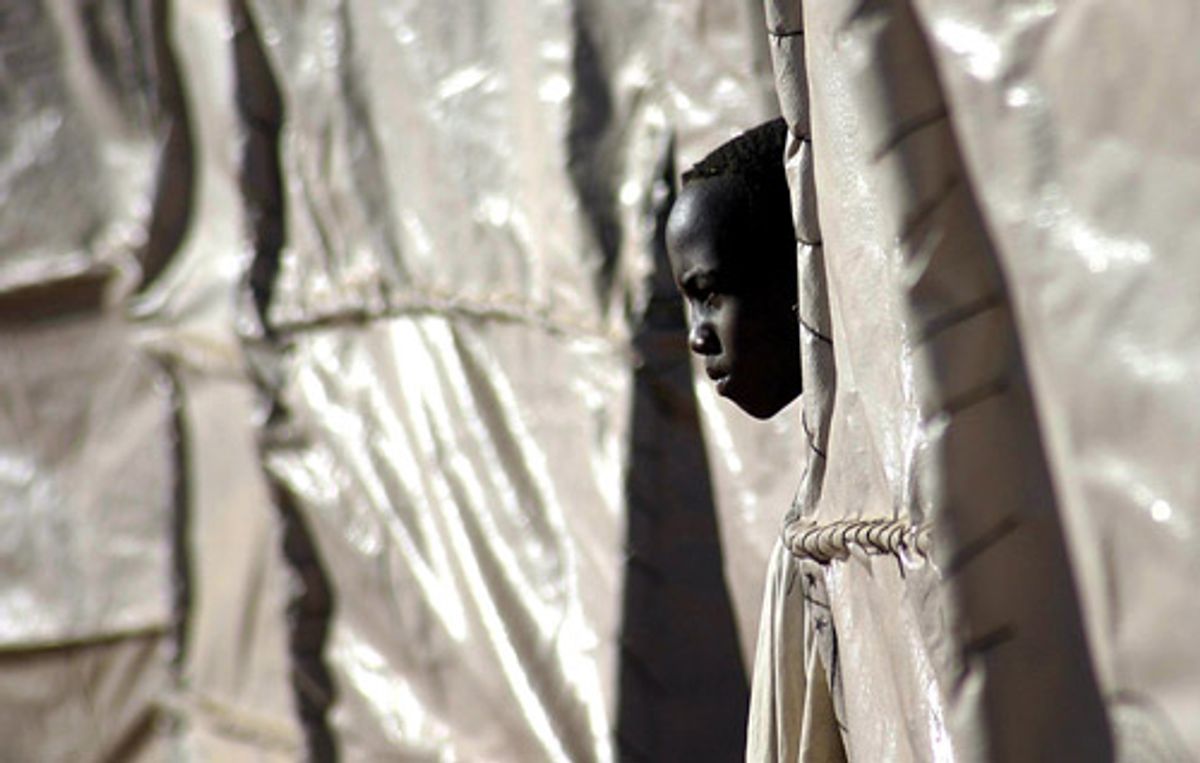
The wider importance of "deconstructing" African genocide is well illustrated by the continent's most vexing civil war, which is taking place in the Darfur region of western Sudan (an area roughly the size of France). Human-rights experts have declared that a new African genocide is underway there; and on the surface, the case for genocide is strong. The conflict pits light-skinned Muslim "Arabs" against black-skinned Muslim "Africans." Arab attackers, so-called janjiweed militias, murder black Africans with impunity and, evidence has shown, at the direction of the government, with the aim of eradicating Darfur's substantial black population. So persuasive is this evidence that the United Nations in June of 2004 agreed that Darfur's Africans indeed qualified as victims of genocide. No matter what language is applied, the bare facts are depressing enough: as many as 300,000 dead and perhaps 2 million people displaced. Even those living in refugee camps remain subject to the violent whims of the janjiweed.
Given American fascination with genocides past, present and future, the next 10 years will likely bring a steady stream of literary and analytical works about the killing fields of Darfur, which Nicholas Kristof, from his influential perch as a New York Times columnist, has called "the first genocide of the 21st century."
But does the conflict in Darfur, however bloody, qualify as genocide? Or does the application of the word "genocide" to Darfur make it harder to understand this conflict in its awful peculiarity? Is it possible that applying a generic label to Darfurian violence makes the task of stopping it harder? Or is questioning the label simply insensitive, implying that whatever has happened in Darfur isn't horrible enough to justify a claim on the world's conscience, and thus invite inaction or even the dismissal of Darfur altogether?
These questions -- and the paradoxical nature of the G-word -- lie at the heart of a much-needed new book by Gerard Prunier, a scholar of African affairs. In "Darfur: The Ambiguous Genocide," Prunier, a professor at the University of Paris, casts aside labels and lays bare the anatomy of the Darfur crisis, drawing on a mixture of history and journalism to produce the most important book of the year on any African subject. Clearly and concisely, he describes a complex civil war, where "Arabs" and "Africans" are often indistinguishable from one another to outsiders. Members of both groups can be dark-skinned, Muslim, poor and neglected. Indeed, this last characteristic of Darfurians, the extent of their neglect by Sudan's central government, may be the most significant for understanding the roots of today's conflict. (Although racism cannot be discounted; racial bias exists in Sudan with some people demonizing blacks and holding them as slaves.) Prunier emphasizes the legacy of Darfur's isolation, which began under Britain, colonial ruler of Sudan until its independence in 1955. In 1916, the British incorporated Darfur, which had been an independent country for centuries, into colonial Sudan and then pathetically left it to crumble (as late as the 1930s there was not a single high school student in Darfur, and only four primary schools for younger kids).
Rule by an independent Sudanese government changed little. In the 1960s, and through the decades following, Darfur remained woefully ignored, a poor stepchild to the clique of Arabized Africans who ran Sudan. Yet, according to Prunier, while Darfur's marginalization was systematic and relentless, it did not prefigure genocide. "The social and economic marginalization of Darfur was regional, not racial or cultural," Prunier writes.
In 1984, a terrible famine struck Darfur, breaking the delicate balance between nomadic herders and pastoral peoples. Ever since, Darfurians have lived, Prunier observes with his characteristic pith and understatement, in "a state of endemic insecurity." The ambitions of Muammar Gaddafi in the 1980s to create a mini-empire in the northern part of sub-Saharan Africa led Libya to invade, occupy and "Islamicize" Darfur for many years, with the quiet complicity of Sudan's central government. Neighboring Chad also used Darfur's "barren" territory to play out some of its own strange internal conflicts. When a motley collection of pastoral peoples (the "Africans") staged a quixotic armed uprising in 2003 and 2004, the government mounted a brutal counterattack, training its rage on unarmed civilians and making the situation in Darfur, in Prunier's blunt words, "much closer to a genuine civil war."
This Article
"Darfur: The Ambiguous Geocide"
By Gerard Prunier
Cornell University Press
312 pages
Nonfiction

"Darfur: A Short History of a Long War"
By Julie Flint and Alex de Waal
Zed Books
176 pages
Nonfiction

While Prunier is critical of using the word "genocide" too loosely, he is careful to document the Sudanese government's efforts to target specific population groups for decimation. Sudan's government has organized the worst forms of violence against unarmed civilians: rapes of women, murders of children, the killings of husbands and fathers in front of their own families. These actions cannot be excused. However, they are not explained either by ignoring the precarious hold that Sudan's government has over some of its territory and the extent to which Darfur's "African" groups are militarized. Indeed, the surge in violence against blacks in Darfur occurred after an armed movement began mounting attacks against the government. Given the weakness of the Sudanese state, Prunier writes, "any armed movement initiated by the non-Arab tribes of Darfur was like a red rag waved before the eyes of an excited bull."
He explains: "the parallel with Rwanda [where in 1994 the Hutu ethnic group organized the mass slaughter of minority Tutsis in 1994] is striking. When Tutsi rebels entered Rwanda in October 1990 they probably did not realize the degree of danger they were creating for the other Tutsi living inside the country. In an atmosphere charged with racism an armed rebellion by the 'inferior' group is fraught with enormous danger for the civilians of that group. Counter-insurgency in Darfur could perhaps only have gone wrong. This was not 'counter-insurgency' organized by a government trying to restore law and order; it was the answer with arms by a racially and culturally dominant group to the insurrection of a racially and culturally subject group. The hope that repression could be limited to combatants was completely unrealistic."
In laying bare the roots of Darfur's crisis, Prunier provides a fresh way of thinking not only about a remote patch of Africa but about the most vexing African problem of our times: What can effectively be done to halt government-sponsored violence, whether it carries the genocide label or not. As Prunier rightly concludes, "There are no big political, economic or security stakes for the developed world" in African conflicts. This means that calls for intervention -- or even aid -- are usually based on international law or basic moral and humanitarian grounds, not the sorts of realistic, pragmatic concerns that motivated, say, U.S. intervention in Haiti, Afghanistan and Iraq. Absent finding a self-interested reason (even a false one) for American military intervention in another country's affairs, the surest way to pry open a closed killing field to concerned outsiders is to utter the G-word. But Prunier bravely complains that making legalistic distinctions about the murder of African innocents often undercuts both effective responses and sympathetic understanding.
"Unfortunately, whether the 'big-G word' is used or not seems to make such a difference," Prunier writes. "It is in fact a measure of the jaded cynicism of our times that we seem to think that the killing of 250,000 people in a genocide is more serious, a greater tragedy and more deserving of our attention than that of 250,000 people in non-genocidal massacres. The reason seems to be the overriding role of the media coupled with the mass-consumption need for brands and labels. Things are not seen in their reality but in their capacity to create brand images, to warrant a 'big story', to mobilize TV time high in rhetoric. 'Genocide' is big because it carries the Nazi label, which sells well. 'Ethnic cleansing' is next best (though far behind) because it goes with Bosnia, which is the last big-story European massacre. But simple killing is boring, especially in Africa."
Prunier's formulation is daring in its critique of the orthodox view of how to draw attention to -- and make sense of -- African conflicts. He offers a pragmatic way of understanding them, not as iconic -- even mythic in their connection with universal horrors such as the Jewish Holocaust -- but as singular horrors that must be parsed and analyzed on their own terms. To be sure, understanding the peculiarities of an African conflict does not guarantee that the conflict can be ended.
Prunier is himself rather circumspect about how to fix the many failures of Sudan's 50-year period of independence. The two British authors of "Darfur: A Short History of a Long War" are less restrained. Julie Flint, a journalist and documentary-film producer, has reported on Sudan since 1992. Alex De Waal, a fellow at Harvard University's Global Equity Initiative and director of London-based Justice Africa, visited Darfur often in the 1980s for a book on the 1984 famine in the region, "Famine That Kills." He remains a trenchant observer of Sudan's ethnic politics, regionalism and fragmentation. Flint and De Waal label the leaders of Sudan's government "war criminals" and they imply (though don't explicitly state) that the goal of concerned outsiders should be the removal of these leaders, starting with Sudan's President Omar al-Beshir. "For Beshir," they write, "peace is subjugation." That's not a healthy starting point for people in power to begin a process of reconciliation with aggrieved minorities.
Indeed, there can be no durable peace in Sudan under the current political leadership, argue De Waal and Flint. Sudan's leaders are too implicated in atrocities against civilians, not only in Darfur, but in southern Sudan, where black Christians, notably members of the Nubian group, suffered grossly in government terror campaigns during the 1990s. Southerners, as part of their peace deal struck earlier this year with Sudan's government, won the right to get a vote on splitting from Sudan, as early as 2011. The Beshir government has pledged to abide by the vote, and allow its oil-rich southern provinces to depart, but many worry the government won't allow this to happen without another war. Even now in Darfur, the inability of two different rebel groups to forge a common cause has provided Beshir with another excuse to make only "cosmetic" changes in the government's behavior.
De Waal and Flint detail the failures of international intervention to halt the war in Darfur. The U.S. placed great hopes on the ability of the African Union, an association of African countries, to establish order there, but De Waal and Flint demolish this idea, and argue that the African Union lacks the resources, expertise and political will to impose a solution. The African Union might redeem itself, if the U.S. Congress agrees to fund a large military operation by the African Union in Sudan. But with Congress dithering on approving money, despite personal appeals by Condoleezza Rice, the African Union is likely to live up to De Waal and Flint's dour assessment. What's necessary, the authors insist, is "regime change" in Sudan -- the Beshir government is simply irredeemable. While they don't try to tie an evil ideology to Beshir, they argue that he is wedded to committing "atrocity by force of habit." Once an advocate of an Islamic state, Beshir and his gang now "seek power for its own sake," and "people they perceive to be challenging that power count for nothing," De Waal and Flint write. "They can be subjugated, shot or starved without compunction ... Mass killing has become so routine that it no longer needs conspiracy or deliberation. It is simply how the security elite does business."
No wonder that Human Rights Watch, in a report released last month, allege that Beshir and 12 other top Sudanese government officials are responsible for much of the violence in Darfur. While merely pretending to negotiate a settlement to the Darfur conflict, "the Sudanese leadership continues to implement policies that permit continuing attacks on civilians, and perpetuate a climate of fear and intimidation through structural and institutional abuse," Human Rights Watch said.
The renewed killing in Darfur, and the failure of the outside world to impose a peace, has raised fresh calls for the U.S., the United Nations or both to send armed forces into Sudan in order to "save" Darfurians and end the "genocide." Calls for humanitarian intervention persist because, as Samantha Power wrote recently in the New Yorker, Darfur remains overrun with violence and banditry. Power, a professor at Harvard University's Carr Center for Human Rights Policy, predicts that the African Union will ultimately withdraw from Sudan, leaving the U.S., Europe and the U.N. no choice but to send in their own troops. Both of these books, however, should give pause to Power and other advocates of such intervention.
This Article
"Darfur: The Ambiguous Geocide"
By Gerard Prunier
Cornell University Press
312 pages
Nonfiction

"Darfur: A Short History of a Long War"
By Julie Flint and Alex de Waal
Zed Books
176 pages
Nonfiction

To be sure, regime change is needed in Sudan and foreign military intervention may stop killing for a short time. But at what price? As we have seen in Iraq, military intervention will not end a conflict whose underlying causes go unaddressed. Those causes spring from a history of inequity between regions and peoples in Sudan. American, European and U.N. troops are unlikely to remain in Sudan for the five to 10 years required to bring about a radical reworking of power relations between these regions and peoples.
Yet only a radical power shift -- perhaps one that actually splits Sudan into two or more countries, or, at a minimum, results in an authentic federal system where political power is widely dispersed -- is likely to ensure lasting peace in Sudan. Proponents of military intervention clearly have good intentions -- and who would not wish to stop the violence in Darfur? -- but they must be honest about the consequences of what would inevitably become a foreign occupation of Sudan. Overthrowing the Beshir regime, however justified, will unleash a bloody civil war and a long post-conflict period in which foreign troops will be needed to maintain order. Sudan would become another Muslim country occupied by Westerners, and perhaps even a breeding ground for terrorists (this is a country, after all, that once harbored bin Laden himself). Given the cost of such an intervention and its risks, a more sensible approach to Darfur would draw on the lessons of history and highlight the crucial importance of a negotiated settlement that the Sudanese themselves could carry out.
Shares