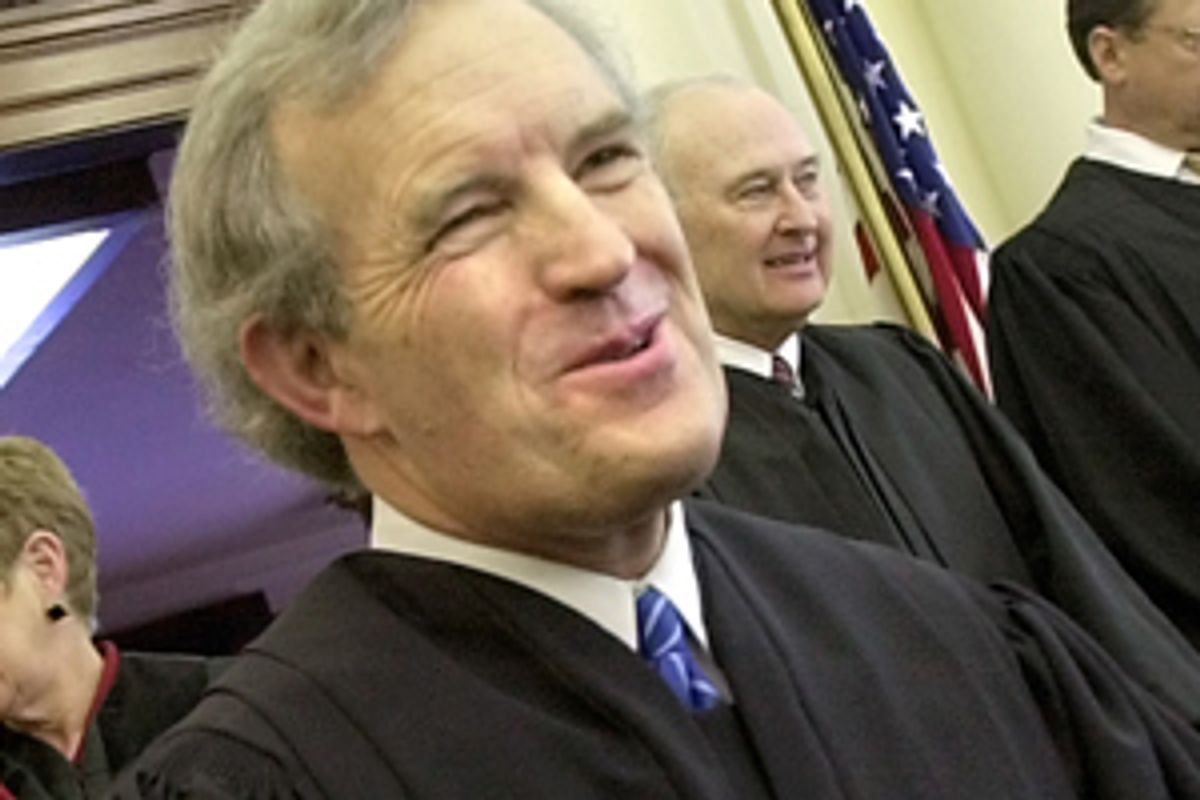
A judge nominated by President Bush to one of the highest courts in the nation apparently violated federal law repeatedly while serving on the federal bench. Judge James H. Payne, 64, who was nominated by Bush in late September to join the 10th U.S. Circuit Court of Appeals, based in Denver, issued more than 100 orders in at least 18 cases that involved corporations in which he owned stock, a review of court and financial records shows.
Federal law and the official Code of Conduct for U.S. judges explicitly prohibit judges from sitting on cases involving companies in which they own stock — no matter how small their holdings — in order to uphold the integrity of the judicial system. (Judges’ financial filings typically don’t differentiate ownership between the judge and immediate family members.) The clear-cut, objective standard aims to prevent even the appearance that a judge may be taking into consideration his or her personal financial interests.
Payne’s financial filings show holdings of up to $100,000 in SBC Communications stock, up to $50,000 in Wal-Mart stock and up to $15,000 in Pfizer stock, among others, while he presided over lawsuits involving the companies or their subsidiaries. In fact, it appears that since he was appointed by Bush in 2001 as a federal district judge in Oklahoma, Payne has been sitting inappropriately on at least one case at any given moment for nearly his entire federal judgeship.
Last fall, Payne’s nomination to the 10th Circuit got little public attention while the media focused on the president’s Supreme Court nominations. But Chief Justice John Roberts and current nominee Samuel Alito have tripped over the conflict of interest issue as well. Roberts, who holds an array of blue chip stocks and has unprecedented corporate ties for a sitting Supreme Court justice, has already recused himself from numerous cases and admitted a mistake in not recusing himself earlier from another. Alito was grilled in Senate hearings this month about why in one instance he didn’t follow through on a pledge to recuse himself from any case involving the mutual fund company Vanguard, in which he held investments.
Payne refused to answer repeated requests by Salon for comment regarding conflicts of interest in the cases over which he presided. When reached by phone for comment on Dec. 20, Payne said, “I do not have time … I can’t do it,” before abruptly hanging up. He did not respond to a subsequent call, or to a follow-up letter delivered to his office on Dec. 22, detailing the problematic cases and asking for an explanation.
Praised for his integrity by a number of Oklahoma lawyers, Payne did eventually recuse himself in some cases and kept himself off others from the start. In the cases in which he didn’t recuse himself, most of his actions were routine and procedural. Most of the cases were settled, rather than going to trial.
But informed of Payne’s reported stock holdings, plaintiffs in some of the cases say that the judge may well have been swayed by those holdings. Whether he was or not, legal experts say he should have never presided over the lawsuits.
“If I was suing Wal-Mart and I knew the judge held stock in Wal-Mart, I’d be concerned about that,” said professor Leslie W. Abramson, a legal ethics expert at the University of Louisville’s law school, after reviewing Payne’s cases. While there is no proof of malfeasance on Payne’s part, Abramson says, the letter of the law is clear on judicial conflict of interest — and Payne’s conduct, he says, leaves the impression that Payne has run his court in a “sloppy” fashion. “He took an oath to follow the law. The judge is supposed to recognize these things himself. If he owned the stock, he shouldn’t have been sitting on the case. That to me is a clear call,” Abramson said. “I think it speaks to whether a judge has been doing his job responsibly and is likely to do his job responsibly in the future.”
“There’s no wriggle room here,” says professor Stephen Gillers, a scholar of legal ethics at the New York University School of Law. “It’s not just an ethics rule, it’s a congressional statute — a law.” Even if he doesn’t make any orders during the proceedings, he can’t be the judge on such a case, Gillers says. “He’s disqualified, period.”
Linda Chambers, a resident of Muskogee, Okla., says she certainly wouldn’t have wanted to go before a judge who owned stock in Pfizer when she sued the pharmaceutical giant for the death of her mother. Chambers’ case was one of thousands of lawsuits provoked by the diabetes drug Rezulin, which was withdrawn from the market after being linked to liver damage and deaths. Chambers’ mother, Margaret Owens, died at age 65 after liver and kidney failure while taking Rezulin. Chambers’ case happened to go before Payne in 2002 and again in 2003, when he reported holdings of up to $15,000 in Pfizer stock. The lawsuit later moved to another court, bundled with similar suits, and was settled. Chambers’ attorney, Tony Edwards, said Payne made no significant decisions in the case — but Chambers said she would have asked for a different judge if she had known of his conflict of interest at the time.
“Sounds like the judge is deciding this case on his best interest also,” said Chambers. “I wanted a judge that was impartial. That’s what I thought the judges are supposed to be.”
Payne’s track record illuminates how conflict-ridden cases can slide through the cracks of a system that relies primarily on judges to regulate themselves. The financial disclosure forms that Payne signs and submits each year show a consistent core group of stocks year after year, including those in his most recent filing last September. Since 1999 (as far back as his filings are publicly available), court records show Payne participated in cases involving SBC, Tricon Global Restaurants, Pfizer, Williams Cos. and Wal-Mart while reporting stock holdings in those companies. Some of the lawsuits explicitly name the corporations, while others name subsidiaries, like Taco Bell and KFC (owned by Tricon) or Williams Oil Gathering (owned by the Williams natural-gas giant).
In the wake of the Watergate scandal, Congress passed a law in 1974 during an era of reform that made the rule for recusals unequivocal: Judges should monitor their finances and must disqualify themselves if they, their spouses or their children have a financial interest in the case — “however small.”
Enforcing the law is another matter.
Payne, for example, apparently broke the rules several times in 1999 as a magistrate judge — yet the Senate confirmed Payne unanimously to become a district judge in 2001, without any mention of the issue.
Judges must fill out financial disclosure reports every year, identifying potential conflicts like stocks. But the filings are kept in an administrative office of the court system in Washington, and if anyone wants to see them, the judge is notified exactly who is asking. This requirement could intimidate lawyers who don’t want a judge to find out they are snooping.
Tulsa lawyer Jeff Martin sued Tricon Global Restaurants on behalf of a former KFC restaurant manager who claimed he was owed disability benefits, a case that went before Payne in 2002. Martin says the judge didn’t play a significant role in the case, which ended up being settled. But Martin had no idea that Payne’s reported stock holdings included up to $50,000 in Tricon (now called Yum Brands). Martin says that if he had known, he would have informed his client — but probably wouldn’t have challenged the judge over it. “I’m not a greatly experienced, big-time lawyer where I think I can push judges around,” he said. “I probably would have left it at [Payne's] discretion.”
In December 2005 the American Bar Association gave Payne a unanimous “well qualified” rating, its highest mark. The ABA rating committee evaluates a nominee’s integrity and reputation, but its guidelines don’t say whether it reviews a judge’s cases for conflicts of interest. The committee chair declined to comment further.
Payne’s Senate confirmation hearing has not yet been scheduled. He currently presides as chief of the U.S. District Court in Muskogee, Okla.; if confirmed to the 10th Circuit, Payne would serve on the court of last resort (except for those relatively few cases that make it to the Supreme Court) in a region covering Colorado, Kansas, New Mexico, Oklahoma, Utah and Wyoming.
Senate Judiciary Committee staffers perform a thorough screening of judicial nominees, but don’t always review every case a nominee ever sat on, according to Tracy Schmaler, a spokesperson for the ranking committee Democrat, Sen. Patrick Leahy. Finding possible conflicts among hundreds of lawsuits can require a lengthy, exhaustive comparison of a judge’s financial interests to all of his cases.
Most district courts now have computer programs that can monitor a judge’s caseload for conflicts. But it’s up to the judge whether to plug in financial information and use the system. A few federal courts have pioneered reforms: The Northern District of Iowa went so far as to disclose judges’ financial interests on the Internet and to require parties in a lawsuit to file a list of all related financial interests. The clerk’s office then looks over a judge’s cases, and if it identifies a conflict, it automatically reassigns the case before the judge even sees it.
But neither of the clerk’s offices in the Northern or Eastern District of Oklahoma, where Payne presides, gets involved with monitoring a judge’s conflicts.
University of Louisville’s Abramson argues that all judges should be required to use the computer system, and that every clerk of the court should reassign cases with conflicts before they reach the judge’s chambers. “The integrity of the process is on the line,” he said, pointing out a “systemic failure” that goes beyond Payne. “The U.S. Supreme Court has said that the appearance of impartiality is as important as the fact itself of impartiality.”
And yet, in Oklahoma, some lawyers don’t see it that way.
Harold Witcher, now retired from practice, helped bring a case against Southwestern Bell Telephone, among others, while Payne reported stock holdings in parent company SBC (now renamed AT&T). Payne issued a couple dozen orders over five months before recusing himself in March 2002. Moreover, Southwestern Bell and other defendants were represented by fellow members of Payne’s church, where Payne sits on the board.
Though federal statute requires a judge to recuse himself when “his impartiality might reasonably be questioned,” the circumstances surrounding Payne in that case didn’t trouble Witcher. “That Judge Payne, I tell you — he calls it like he sees it. He doesn’t care who’s sitting where.”
One of Witcher’s clients, however, said she didn’t think Payne should have presided.
“If he is invested in SBC, he’s going to rule in favor of SBC and not the ordinary people,” said Kathy Lamon, 52, who sued the company and others because of high phone bills charged to families of prison inmates. “I would think it would be a conflict of his interest to be seated on a case like that.”
Witcher said he vaguely remembered that Payne mentioned the stock conflict — and then proceeded with the case because the attorneys didn’t object. Oklahoma City lawyer Carrie Hoisington, who was involved in a separate case over which Payne presided, recounted a similar scenario in which Payne may have raised the issue and the case proceeded nonetheless.
Professor Steven Lubet, a legal ethics authority at the Northwestern University School of Law, argues that Payne is guilty only of careless mistakes that are not particularly meaningful “in terms of assessing someone’s career or someone’s integrity.”
Other experts say Payne is clearly in the wrong, regardless of intention. “It doesn’t matter whether his rulings were mundane or major, and it doesn’t matter that the attorneys agree — this is a conflict that’s not waiveable,” said Gillers of NYU. “Maybe the judge just didn’t realize that. But he’s the judge — he should read the statutes.”
The law does not include a specific penalty for violations, but judges can be censured by a committee of colleagues or, in extreme circumstances, impeached and removed from the judiciary by Congress.
Curiously, Payne recused himself from many cases that intersected with his reported stock holdings, only to later sit on cases concerning the same companies. In March 2002, for example, he suddenly jumped off several lawsuits involving SBC and its subsidiaries after issuing numerous orders. Court records show he cited his SBC stock ownership as the reason in one case; the suit against Cingular Wireless also named SBC, which owns roughly 60 percent of Cingular. But in 2004, Payne presided over another case against Cingular — and received yet another Cingular case last spring. After being contacted for this story, and without the prompting of attorneys working on the case, Payne recused himself Jan. 3.
“I have absolute complete faith in him as a judge,” said David Blades, an attorney who brought the recent case against Cingular. “If he had come and said to me, ‘I own stock in Cingular,’ I would say, ‘So what?’”
But Abramson warns against participating in even the most routine procedures, because it’s impossible to predict the twists and turns of a case. In Payne’s situation, the various settlement conferences over which he presided could’ve been particularly problematic: Judges can act as “some of the greatest arm-twisters in the world” in these conferences, Abramson said, actively pushing for resolution of the case rather than having it go to trial.
As a nominee for the federal bench in both 2001 and 2005, Payne did in fact pledge to the U.S. Senate to adhere to conflict-of-interest rules. “In general, I plan to comply with Canon 3 Code of Judicial Conduct and the provisions of 28 U.S.C. 455 concerning disqualification of United States District Judge or United States Magistrate Judge,” he wrote in a 2001 questionnaire.
But apparently his willingness to follow through on recusing himself was a different matter. “If it happened routinely,” said Gillers of NYU, “then that shows a lack of awareness of his professional responsibilities that I think warrants an explanation.”
The most important revelation in Jeffrey Toobin’s 10,000-word New Yorker piece on Chief Justice John Roberts’ takedown of campaign finance laws in the Citizens United case is the extent to which modern conservatism is trying to restore the Gilded Age. That was a time when corporations had more rights than individuals, when a conservative Supreme Court did its best to protect those corporate rights, and wealth and corruption ran unchecked. Of course, we live in a neo-Gilded Age, when income inequality is more pronounced than at any time since the Great Depression, and the Roberts court’s decisions in the Citizens United case helps bring us all the way back to those bad old days.
Much is being made of Toobin’s revelations about the dramatic internal political divisions and infighting within the court triggered by the CU decision (more on that later). But what I think is most politically significant in Toobin’s piece is that it shows the dramatic rightward – and backward — march of Republicanism over the last 30 years. In January 1982, Ronald Reagan famously wrote in his diary, “The press is trying to paint me as trying to undo the New Deal … I’m trying to undo the Great Society.” Reagan was anxious to unravel the anti-poverty programs Lyndon Johnson pushed into place (though not Medicare), but he collaborated with House Speaker Tip O’Neill to pass payroll tax increases to stabilize Social Security for the next 50 to 60 years.
Today’s Tea Party, of course, is going after what’s left of the Great Society and the New Deal too, trying to privatize Medicare and Social Security and undo the labor protections passed by Congress and many states in the wake of the Great Depression. But the Roberts court wants to go back even further, to the Progressive Era, when some politicians in both parties recognized that the omnipotence of Gilded Age robber barons had to be curbed – and that campaign finance regulation was a good place to start.
Back then a conservative Supreme Court majority also disagreed with that Progressive reform push. In an 1886 tax case it first held that the 14th Amendment’s equal protection laws applied to corporations. In its 1905 Lochner ruling, striking down a New York law limiting bakery workers to a six-day 60-hour week, it declared such regulations a breach of contract rights, an “unreasonable, unnecessary and arbitrary interference with the right of the individual to his personal liberty or to enter into those contracts in relation to labor which may seem to him appropriate or necessary for the support of himself and his family.” As Toobin observes, “In simple terms, the majority in Lochner turned the Fourteenth Amendment, which was enacted to protect the rights of newly freed slaves, into a mechanism to advance the interest of business owners.”
Progressive era reform also included campaign finance regulation, starting with the 1907 Tillman Act, which prevented corporations from directly contributing to campaigns. The Court let the act stand, but over the years a series of rulings by conservative majorities have managed to establish that money is “speech,” and though contributions could be regulated, expenditures – speech – could not.
Toobin shows decisively that the court could have kept its decision on Citizens United quite narrow. Attorney Theodore Olson wasn’t seeking to strike down McCain-Feingold, but to clarify that it applied to television commercials, not to 90-minute political “documentaries” such as “Hillary: The Movie” (a shriekingly negative “documentary” on the woman who was expected to be the 2008 Democratic presidential nominee). But in oral arguments the conservative justices sought to broaden their purview, and Roberts helped them along. “As the Chief Justice chose how broadly to change the law in this area, the real question for him, it seems, was how much he wanted to help the Republican Party,” Toobin writes. “Roberts’s choice was: a lot.”
After taking a shot at drafting the CU ruling himself, he later assigned it to “swing vote” Anthony Kennedy, whose views on campaign finance regulation reliably put him with the conservative majority. Assigned to write the dissent, outgoing Justice David Souter accused Roberts “of violating the Court’s own procedures to engineer the result he wanted,” Toobin says. That’s when Roberts took the extraordinary step of asking that CU be re-argued – though with five justices already committed to a sweeping attack on McCain-Feingold, the outcome of those re-arguments were never really in doubt.
And indeed, Kennedy again wound up writing the majority opinion, which found that “The Court has recognized that First Amendment protection extends to corporations” since 1886, and that in McCain-Feingold “the Government has muffled the voices that best represent the most significant segments of the economy.” It’s unclear from the context whether Kennedy is saying what he seems to be – that corporations “best represent the most significant segments of the economy.”
Justice John Paul Stevens, a moderate Republican once on the court’s more conservative end, wrote in his dissenting opinion, “Five Justices were unhappy with the limited nature of the case before us, so they changed the case to give themselves an opportunity to change the law.” Stevens’s dissent continued for a record 90 pages.
At bottom, the Court’s opinion is thus a rejection of the common sense of the American people, who have recognized a need to prevent corporations from undermining self-government since the founding, and who have fought against the distinctive corrupting potential of corporate electioneering since the days of Theodore Roosevelt. It is a strange time to repudiate that common sense. While American democracy is imperfect, few outside the majority of this Court would have thought its flaws included a dearth of corporate money in politics.
Toobin’s conclusion is no less scathing: “The Roberts Court, it appears, will guarantee moneyed interests the freedom to raise and spend any amount, from any source, at any time, in order to win elections.”
It’s worth noting that the most spirited opposition to Citizens United is coming from Montana, where the ties between Gilded Age corporate abuse and campaign finance regulation are perhaps the most explicit. Copper mining interests essentially owned the state in the late 19th and early 20th century, but Montana Progressives pushed a tough campaign finance law as a way of clawing back control of their state from the “copper kings,” who Mark Twain wrote “bought judges and legislatures as other men buy food and raiment.” Montana’s state Supreme Court upheld that 1912 “Corrupt Practices Act” in January, putting the state on a collision course with SCOTUS. Gov. Brian Schweitzer has been one of the most articulate voices against Citizens United, and supports a state ballot initiative that would ban corporate money in politics and make it state policy that corporations are not people.
“Montana’s going first, but we have before,” Schweitzer told the Huffington Post earlier this month. “It was Montana in 1912 that banned corporate money from our elections. We don’t mind leading and we believe it has to start somewhere. This business of allowing corporations to bribe their way into government has got to stop.”
But in a world where the Citizens United decision is precedent, it’s hard to imagine that ballot measure surviving a legal challenge. Toobin’s piece makes clear the stakes in the 2012 presidential race as vividly as anything else does: American democracy can’t survive the appointment of more justices like Roberts, Sam Alito and Antonin Scalia, who mainly serve the interests of corporate America. Mitt “Corporations are people, too, my friend” Romney can be expected to give them company in the years to come if he wins the White House.
Continue Reading
Close
Ruth Marcus is unsettled. Maybe even queasy. There is probably some light nausea. What has her worried for the future of the nation, today? President Obama’s shameful, horrific, vicious attacks on those nice people in the Supreme Court.
Obama said that the court overturning Congress’ healthcare reform law would be a textbook example of “judicial activism” as “conservative commentators” define it: “that an unelected group of people would somehow overturn a duly constituted and passed law.” And hey, that seems like an eminently defensible and not particularly unsettling point! Conservatives made “judicial activism” into a talking point and rallying cry and defined it vaguely enough to encompass judges striking down basically any law or statute.
Marcus, though, is stopped cold.
And yet, Obama’s assault on “an unelected group of people” stopped me cold. Because, as the former constitutional law professor certainly understands, it is the essence of our governmental system to vest in the court the ultimate power to decide the meaning of the constitution. Even if, as the president said, it means overturning “a duly constituted and passed law.”
Judicial review, as a former constitutional law professor certainly understands, is not in the Constitution — an unelected activist judge made it up! — and the founders themselves disagreed on the wisdom of the principle. (They tended, in fact, to decide whether or not they liked judicial review based on whether or not the judges ruled in a way that they approved of.) The history of the Supreme Court is replete with nakedly political and mostly conservative rulings until very recently, when we had a brief period of liberal-leaning rulings from a marginally more diverse group followed by a return to status quo conservatism.
As long as the Supreme Court has been making awful and indefensible rulings based on ideology or racism, presidents and politicians have been criticizing the court. Abraham Lincoln attacked the Supreme Court in his first inaugural address, in a passage that conservatives love to quote when they’re attacking “activist judges.”
At the same time the candid citizen must confess that if the policy of the government, upon vital questions, affecting the whole people, is to be irrevocably fixed by decisions of the Supreme Court, the instant they are made, in ordinary litigation between parties, in personal actions, the people will have ceased, to be their own rulers, having, to that extent, practically resigned their government, into the hands of that eminent tribunal.
I am stopped cold and unsettled!
Marcus, hilariously enough, supports the healthcare law and the mandate — she is the world’s most sensitive milquetoast moderate liberal newspaper columnist, after all — which theoretically means she thinks it’s constitutional, which would mean that declaring it unconstitutional should maybe upset her more than criticizing the court for being political, but on the other hand those judges seem very smart and our entire system of government could collapse if we aren’t all super polite to one another and constantly deferential to authority.
I would lament a ruling striking down the individual mandate, but I would not denounce it as conservative justices run amok. Listening to the arguments and reading the transcript, the justices struck me as a group wrestling with a legitimate, even difficult, constitutional question. For the president to imply that the only explanation for a constitutional conclusion contrary to his own would be out-of-control conservative justices does the court a disservice.
Yes, I could tell they were very seriously wrestling with a difficult constitutional question when Scalia began joking around about broccoli mandates and the legendary “Cornhusker Kickback.”
I’m not sure what more the Supreme Court could do before moderates like Ruth Marcus finally acknowledged that it’s a partisan body with a right-wing majority. If Bush v. Gore didn’t do it, maybe nothing could. But as a partisan body it is open to partisan attacks, and our fragile democracy will not descend into anarchy if people think as poorly of the Court as they currently do of Congress.
Of course, the Republican talking point is that the president is attempting to bully the Court into ruling the way he wants. (Because if they strike down the law, he’ll … yell at them during the State of the Union again? No one seriously predicts an arrest warrant for Chief Justice Roberts here.) Mitch McConnell: “This president’s attempt to intimidate the Supreme Court falls well beyond distasteful politics; it demonstrates a fundamental lack of respect for our system of checks and balances.” Lamar Smith: “What is unprecedented is for the president of the United States trying to intimidate the Supreme Court.” Mike Johanns: “”What President Obama is doing here isn’t right. It is threatening, it is intimidating.” (Did you notice how everyone used the word “intimidate”? That’s because they got their language from a memo.)
The only time, besides Lincoln’s suspension of habeas corpus, that any president has seriously threatened the independence of the Supreme Court was when Franklin Roosevelt tried to amend the law to give the president the power to appoint more justices. And Roosevelt, frankly, was right on the merits of his proposal. The court is completely unaccountable and ridiculously powerful, it always has been, and pointing that out does not a constitutional crisis provoke.
Continue Reading
Close
On Monday, we had another example of the Supreme Court’s ideological division: a 5-4 ruling, along partisan lines, giving police the right to conduct strip searches for any offense. This came on the heels of last week’s oral arguments before the Supreme Court about the constitutionality of the individual mandate provision of the Affordable Care Act, which led many observers to predict that the nation’s highest judicial body will strike down part or all of the controversial healthcare reform package. But the hearings were instructive in other ways. They showed once again that political partisanship is closely correlated to a justice’s view of the law. And they proved that the Supreme Court once again is functioning, not as a court, but as a third house of the federal legislature.
The U.S. Constitution, like many state constitutions, really is two constitutions in one. There is the black-letter constitution, which consists of rules about which there is little or no dispute. Most of these have to do with qualifications for representatives, like Article I, Section 3, Clause 1, as amended: “The Senate of the United States shall be composed of two Senators from each State, for six Years; and each Senator shall have one Vote.” Not a whole lot of room for interpretation there.
The other constitution, embedded in the same document, is the Blank Constitution. It is not so much a limit on power as an assignment of the power to fill in blanks left in the text, like the Eighth Amendment’s prohibition of “cruel and unusual punishment.” The need to fill in the blank is admitted even by champions of the “original intent theory,” who must dig up historical evidence of what the drafters and ratifiers might have thought was cruel and unusual punishment at the time of the Constitution’s adoption. The answer is not contained in the text.
Even the basic definitions of powers assigned to different branches of government are blanks that must be filled in. The basic issue in the case of the Affordable Care Act is whether Congress had the power to compel individuals to purchase private health insurance, under the Commerce Clause and the Necessary and Proper Clause of the Constitution. Article I, Section 8, Clause 3 of the Constitution gives Congress the power “to regulate Commerce with foreign Nations, and among the several States, and with the Indian Tribes.” Article I, Section 8, Clause 18 gives Congress the power “to make all Laws which shall be necessary and proper for carrying into Execution the foregoing Powers, and all other Powers vested by this Constitution in the Government of the United States, or in any Department or Officer thereof.”
Is the power to prescribe an individual health insurance purchase mandate included in these powers granted by the Constitution to Congress? The Constitution does not specifically say. If the Constitution were easy to amend, like some state constitutions, then it could be more specific — at the cost of having hundreds of amendments, like an imaginary Amendment Number 873: “Congress shall have power to impose an individual mandate to purchase health insurance.” But the federal constitution, for better or worse, was designed to be difficult to amend.
There is therefore no escaping acts of interpretation that are really acts of legislation: filling in the blanks in the text of the Constitution. The only real question, therefore, is how much latitude the federal judiciary should give Congress when Congress fills in the blanks by passing laws.
The Whig Party between the 1830s and the 1860s thought that the federal judiciary should defer to Congress. The Whigs favored a strong, competent federal government and opposed restrictions on federal power in the name of the states. Opposed to the administration of Andrew Jackson, the Whig Party also wanted the powers of the presidency strictly limited. In the Whig view, the federal judiciary should defend congressional power against encroachments by the states and the executive branch, while deferring to the decisions of Congress on matters of federal legislation.
The Whig theory of the Constitution strikes me as a pretty good one. But it rules out judicial activism, which has been embraced at different times by different factions in American politics. Between the Civil War and the New Deal, a pro-business federal judiciary persecuted unions and struck down federal, state and local restraints on corporations. In the civil rights era, liberal federal judges went beyond striking down racist laws to discovering a “right to privacy” in the Constitution that has been used to eliminate or restrict laws against abortion and homosexuality. Whatever you think about the outcomes of these cases, it is clear that the courts in all of them were just making things up.
In the case of the “right to privacy” they weren’t even filling in a blank in the Constitution, because the term does not exist in the text. In Griswold v. Connecticut, the 1965 case on which all subsequent federal law involving sex and reproductive rights including Roe v. Wade has been built, Justice William O. Douglas wrote that while the Constitution said nothing about contraceptives the “specific guarantees in the Bill of Rights have penumbras, formed by emanations from those guarantees that help give them life and substance.” The right to privacy is a penumbra from an emanation — in other words, it is whatever a majority of the Supreme Court says it is at any given moment.
Liberals applaud the federal judiciary when it pretends to find constitutional restrictions on the ability of states to ban abortion or gay sex, and conservatives and libertarians applaud the federal judiciary when it pretends to find constitutional restrictions on the ability of Congress to regulate the national economy. The left and the right endorse judicial activism when it works in their favor and denounce it when it produces what they think are the wrong results.
For my part, I think the Whigs with their theory of judicial deference to Congress got it right. The states have usually been a greater threat to personal liberty and economic growth than the federal government. Yes, the federal government interned Japanese-Americans during World War II and has abused civil liberties in other ways, and before the Civil War some Northern states were more protective of freedom than the slaveholder-dominated federal government. But throughout American history national majorities, acting through the federal government, have more often checked the illiberalism of local majorities.
Economic policy, too, is best carried out at the federal level in a nation with a continental market. The Balkanization of the U.S. economy into 50 separate state economies by state regulations — even good regulations — is something that should be avoided. And as corrupt and partisan as it is, Congress is better equipped to make public policy than judges.
But wouldn’t judicial deference toward Congress and a broad interpretation of congressional power run the risk of majoritarian tyranny over minorities at the national level? The historical record suggests otherwise. The Supreme Court has almost never been ahead of the political branches when it comes to minority rights or individual freedom. The Court intervened in Brown v. Board only when the civil rights revolution was well underway in the streets and in legislatures, and it intervened in Roe v. Wade and recent gay rights cases only when waves of reform were making progress in federal, state and local legislatures. The federal judiciary has often run out with its surfboard to ride a wave of liberation, but it has never caused the wave. Indeed, in the last half-century the same reforms — anti-racism, the liberalization of abortion laws and the rise of gay rights — have taken place at roughly the same time in all advanced industrial democracies, including Britain, which has no written constitution at all.
When they try to fill in the blanks in the Constitution themselves, instead of letting Congress do the job, federal judges cease to be judges and start acting as legislators — incompetent legislators, like the Supreme Court justices who wrestled with issues like adverse selection in insurance policies in last week’s hearings. A number of state constitutions provide for the direct election of state Supreme Court justices by the people. Perhaps the federal Constitution should be amended along similar lines. Why not? If our laws are to be made by a tricameral federal legislature with three branches of the legislature — the House, the Senate and the Supreme Court — we the people might as well be empowered to elect the lawmakers in all three.
Continue Reading
Close
This originally appeared on Cedar Burnett's
Open Salon blog. It was written in a response to
a call for essays about people's personal experiences with the Affordable Care Act. Have an Obamacare story of your own? Blog about it on
Open Salon.
Dear healthy people,
It’s great that you’re deriving intellectual pleasure from debating Obamacare. I love that this theoretical dance you’re engaged in has no repercussions to you, a healthy individual. I would love to join you some evening for a spirited discussion on the pros and cons of healthcare reform. Maybe over a glass of wine? Heck — over two or three glasses of wine. I’d love to lean forward, my arched brows furrowed, my full lips purple with the stain of a good Zinfandel, and throw out statistics and well-crafted one-liners about the plight of the uninsured, the underinsured, the sick. Those poor, poor sick.
But I can’t.
I can’t because it isn’t theoretical. I am sick. I’m so sick I can’t drink. I can’t drink and I can’t eat half the things a normal person eats and when I hear the word “Obamacare” hissed in snide derision I want to put a golf club through the windshield of the nearest Mercedes-Benz.
I’m 33 years old. I was diagnosed with an autoimmune disease called ulcerative colitis when I was 26.
Ulcerative colitis isn’t a disease people like to discuss. Most of what we experience is so embarrassing that many of us don’t tell people what we’re going through. We might tell you we’re “sick,” or “under the weather,” but we won’t tell you how bad it is. We won’t tell you we’ve had constant diarrhea for days, weeks, months on end, that we’ve been throwing up stomach acid, that we can’t eat anything but bagels, and that our joints ache so badly it’s hard to sleep. We won’t tell you how we’re wearing adult diapers under our clothes. We won’t tell you that getting in the car and driving three blocks away is the only activity we can do in an entire day.
But you know what we will tell you? We have to have insurance. We need healthcare and support because ulcerative colitis is a lifetime sentence. You know what else it is? A preexisting condition. Since receiving my diagnosis I have lived in fear of losing my insurance because if I let my insurance lapse, and Obamacare fails, I won’t be able to get it again. Ulcerative colitis and her sister, Crohn’s disease, are up there in the echelons of Scary Diseases Insurance Doesn’t Like to Cover.
I get it, I do. Some of our drugs cost a ton. It’s likely we’ll be hospitalized here and there. And many of us can look forward to bowel resection surgery or colon cancer. We’re expensive and we stay expensive for our entire lives. That’s the sticking point with chronic illness like Crohn’s and colitis: We’re sick but we just keep on living. We just don’t die fast enough.
If the health mandate stays, then the preexisting condition clause goes away. Insurance companies have to take everyone — even me. Lose the mandate and I’m right back to worrying about my care.
In truth, I think Obamacare doesn’t go far enough. My family is still coughing up $900 a month to insure the three of us, since my husband and I are self-employed. That’s pretty unsustainable. But at least the current plan includes a provision that insurance companies have to take me. I may have to pay ridiculous sums to keep my insurance, but I’m not going to live in fear of being dropped.
The last thing a sick person should have to worry about is how to pay for their care. The last thing the parent of a sick child or the child of a sick parent should have to worry about is how to pay for care. People should not have to choose between food and medicine, losing their house or losing their loved one. Let’s hold onto Obamacare as a stopgap, but let’s also work toward the goal of universal coverage.
For those of you who think of the healthcare reform debate in theoretical terms, I warn you: Your day is coming. Sure, you and your family are healthy now, but you might not be tomorrow. Sickness can come out of nowhere and knock your world upside down.
You’d better hope you have decent coverage. You’d better hope you’ve won the genetic lottery and you’ll never find yourself sitting in a flimsy hospital gown on a sheet of wax paper, staring down at your unshaven legs while a doctor tells you you have a golf ball-size tumor in your head or ulcers lining your intestines. You’d better hope Obamacare covers your theoretical ass.
Continue Reading
Close
Writing in Salon, Natasha Lennard proposes that with the warm weather we can again expect the Occupy movement to shoot up. Arab Spring, American Spring. She’s right about one thing: Like in the decades before the Arab Spring, it has been a long, cold, American winter. In the 30 years since coming to power here, Republicans have used their initial ascent to power to seal themselves into office as tightly as the pharaohs. Smart commentators have noted how lawless the conservatives are in making substantive decisions, but that’s not the worst of it. The worst of it is how they use their tenure to make it increasingly impossible to oust them.
With this week’s Supreme Court hearings — which will end, liberals worry, with the justices overturning healthcare reform — we are nearing the apotheosis of conservative power. Let us recount how we got here: In 2000, a mob of conservative thugs stopped the vote recount in Florida. And that was before the court got involved, the five conservative justices seizing the election and handing the White House to George W. Bush. Secure in the tenure of their undemocratically selected president, the two older conservative justices, William Rehnquist and Sandra Day O’Connor, retired from the bench. Bush replaced them with two young conservatives, destined, by constitutional design and the miracles of modern medicine, to dominate the court into the foreseeable future. At the Supreme Court, it’s always winter (and never Christmas).
The stunningly inept performance by the Bush administration unforeseeably produced the first Democratic federal government since 1994. Immediately thereafter, the conservative Supreme Court majority ruled that the GOP’s wealthy sponsors could spend an unlimited amount of the money putting conservatives in office. Now, the conservative majority on the Supreme Court, appointed, in part, by the conservative president they put in the White House, is preparing to wipe from the statute books the only piece of meaningful progressive legislation in the last half century, passed during the brief Indian summer of a two-year Democratic majority.
And it’s not just the federal government. In 2010, fueled, in part, by the money the conservative justices unleashed, the conservatives took over state legislatures across the country. In power, they enacted a series of measures that should make Hosni Mubarak blush. They redrew the legislative maps to guarantee that they would hold a majority of the legislatures, state and federal, regardless of whether they failed to gain a majority of actual votes. (The design of the Senate, favoring sparsely populated rural states, already way overrepresents the Republicans.) Using a panoply of legislative strategies, they made it infinitely harder for the Democrats to register their supporters and for the Democratic voters, even if registered, to vote. Voters must be reported within 24 hours of being registered or penalties will be levied on the laggard registrars. Would-be voters must produce a fistful of identity documents, notoriously more common among old white (Republican) voters than the youthful and nonwhite Americans likely to support the Democrats. If they run the registration gauntlet, they must again verify their identity on Election Day, with the same culturally skewed set of papers. In the swing state of Florida, the New York Times reports, the activists have given up registering new voters: Too perilous.
True, the Democrats have not been models of political virtue. Cowardly when confronted by their powerful adversaries, confused about the moral grounding of their political vision, faithless to their allies, racketing from one trendy policy initiative to another, without anything resembling long-term planning — with enemies like the Democrats, who needs friends? But blaming the victim is way too easy. Democrats made the mistake of behaving as if the American rules of representative government still applied. Confronted with the lawless conservative Republicans, their fate was sealed.
Continue Reading
Close