England

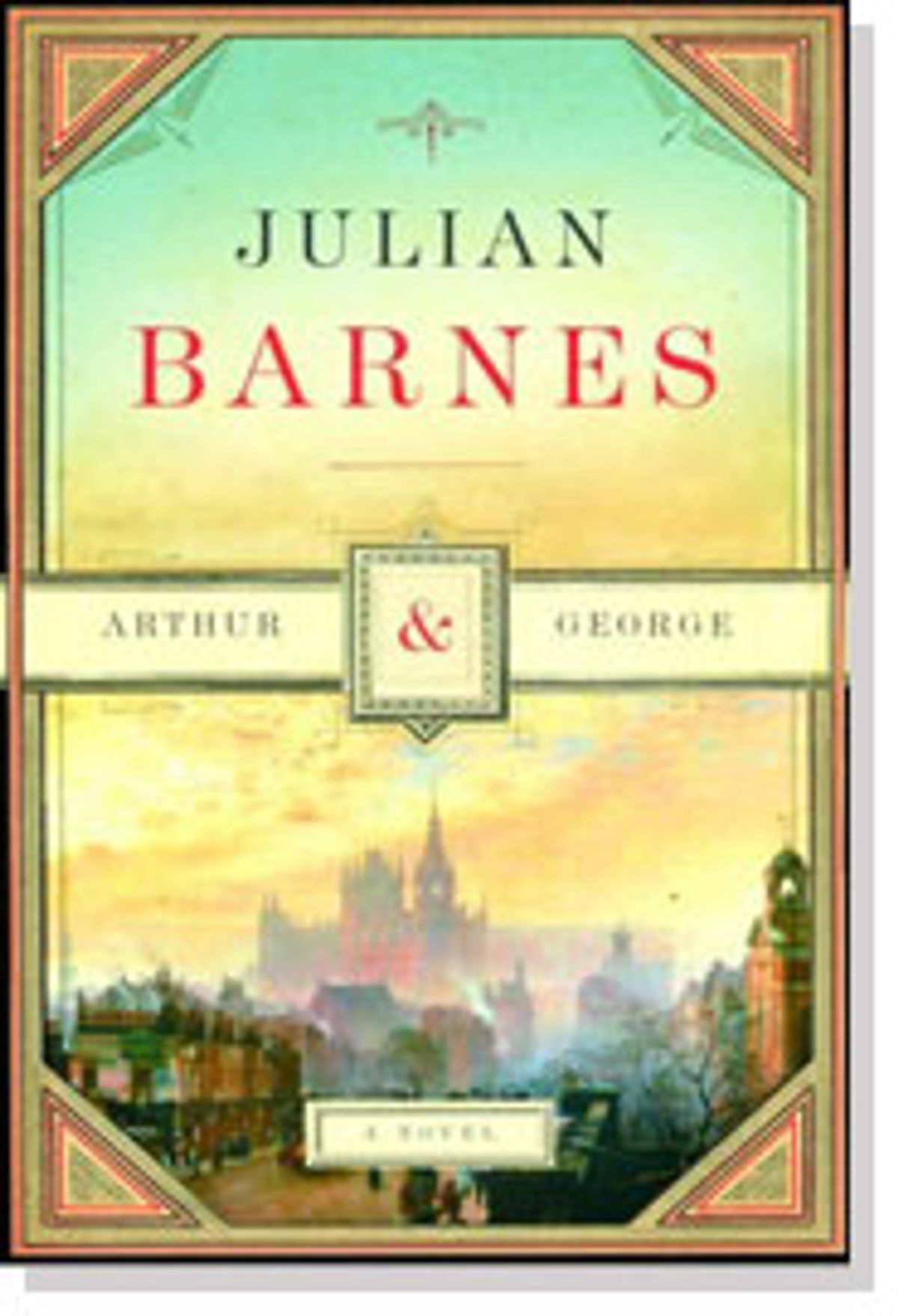
“Arthur & George”

Drawing on a true story about Sherlock Holmes' creator and disemboweled farm animals, Julian Barnes delivers his most substantial novel.

  • more
    • All Share Services

For years, Julian Barnes wrote as two authors. Under his own name, he published literary novels, the most popular of which, including “Flaubert’s Parrot” and “A History of the World in 10 1/2 Chapters,” were breezy, postmodern meditations on French culture, romantic love and the ironic injustices of history. (Some respectable experiments and some pretty tedious relationship novels appeared under his real name as well.) Barnes’ other authorial self, under the name of Dan Kavanaugh, wrote crime fiction. Barnes’ latest novel, the rousing and elegant “Arthur & George,” is like a protracted negotiation between Barnes and Kavanaugh, and the mingling of a little detection into the literary author’s work has produced his most substantial novel yet.

“Arthur & George” is based on a real incident, the intervention of Sir Arthur Conan Doyle, creator of Sherlock Holmes, in the case of one George Edalji, a solicitor from Staffordshire. Edalji, the son of a Scottish woman and an Indian-born Anglican vicar assigned to a rural parish, was falsely convicted of a series of nocturnal livestock mutilations and sentenced to seven years in prison. (He was released after serving three.) Doyle was only the most famous of a group of notable Britons who campaigned to have Edalji’s case reconsidered by the Home Office and his reputation cleared in order that he could once again practice law.

Barnes’ novel lays the lives of the two men side by side and considers which is more the outsider. Edalji might seem the most logical choice, but as portrayed by Barnes, George is a man whose faith in the English way of life is well nigh unshakable. George is indifferent to his Parsee roots, while Arthur revels in his Scottish blood. George lives a life of eminent respectability, while Arthur falls in love with another woman as his wife slowly dies of tuberculosis. George believes in reason, justice and above all the law, while Arthur becomes more and more enmeshed in the spiritualist movement and its theories about the persistence of the soul after death. Arthur is sick of his most famous literary creation, while George, author of a manual titled “Railway Law for the ‘Man in the Train’: Chiefly Intended as a Guide for the Travelling Public on All Points Likely to Arise in Connection with the Railways” (a volume that, I’m delighted to say, actually exists), hopes to be remembered for this useful work.

Arthur is the name attraction in this story, but George is Barnes’ greater creation. Arthur’s tortuous romantic life, pursued in accordance with the most scrupulous notions of chivalric honor, has the slightly tedious quality of so many of the love affairs in Barnes’ fiction, in which everyone behaves a little too decently to be very interesting. George’s dogged pursuit of the most unexceptional, orderly and modest English life seems, paradoxically, both more heroic and slightly, if touchingly, deranged.

Then there’s the novel’s animating mystery: Who disemboweled several horses and other farm animals in the vicinity of Great Wyrley, Staffordshire, at the turn of the century, and was it the same party or parties who had been sending nasty anonymous letters to the Edalji family for years? Why would George perpetrate both outrages, as the authorities insisted he did? Did the police tamper with or misrepresent the physical evidence to implicate George in the crimes? To everyone but George and the local chief constable — who tells Doyle “when the blood is mixed, that is where the trouble starts” — the targeting of George seems a blatant case of “race prejudice.”

Barnes enjoys teasing out the many minor ironies in the case: George, suspected by the police of “barbarous and ritual practices” as well as senselessly self-incriminating acts, is so punctiliously rational he keeps misjudging his own case. He expected the law to function like a perfect machine. Arthur, creator of the most supremely logical character in literature, is by contrast a master of the kind of emotional manipulation needed to sway public opinion and win George a pardon. The stupidly racist chief constable proves himself a shrewd analyst of Arthur’s illogical beliefs. He also inadvertently hits the writer’s most vulnerable spot when he suggests that George, like any “normal, healthy man … continually deprived of sexual fulfillment for whatever reason” might “end up worshipping strange gods, and performing strange rites.”

Arthur’s detecting, aided by a loyal personal secretary who “had always had a deal of sympathy for the character of Dr. Watson,” is historically accurate, impressive and good fun. But it’s really George who sticks with you, a man who for all his oddity has done a better job than Arthur of handling the inevitability of disappointment — in the world, in life, in one’s self. There’s something almost autistic about George, but except for his tenacious insistence that he is no different from any other Englishman, he sees things more clearly. On the other hand, Arthur’s generosity, imagination and energy — all blessings — arise from his refusal to face what George sees. The novel’s final, enigmatic scene suggests the possibility of a second and deeper convergence of these two endearing men, but whether that possibility was ever realized is, of course, a mystery not even you-know-who could solve.

Laura Miller

Laura Miller is a senior writer for Salon. She is the author of "The Magician's Book: A Skeptic's Adventures in Narnia" and has a Web site, magiciansbook.com.

Murdoch’s empire strikes back

The media mogul and his family have turned the tables on the British government in the News Corp. scandal

  • more
    • All Share Services

Murdoch's empire strikes backNews Corp. CEO Rupert Murdoch (Credit: AP Photo/Noah Berger)
This article originally appeared on GlobalPost.

LONDON — Last year, Rupert Murdoch struck a contrite note to U.K. lawmakers over the phone-hacking scandal involving his newspapers. He told them it was his “most humble” day.

Global Post

The scandal cost him one of his most lucrative titles — the tabloid News of the World — and resulted in possible criminal charges for his trusted lieutenant Rebekah Brooks and the arrest of a dozen reporters on his beloved Sun newspaper.

Now, Murdoch appears to be fighting back.

He and his son James were in the U.K. this week to face the Leveson inquiry, a judicial investigation into press standards, begun last year in the wake of revelations that journalists at Murdoch’s U.K. titles illegally hacked the voice mails of prominent public figures.

This time, he and his family appear to have turned on the British establishment, pressuring Prime Minister David Cameron and putting a key minister in the spotlight over a controversial business deal.

In his evidence on Tuesday, James Murdoch released documents that appeared to show that Jeremy Hunt, a media minister charged with examining a $13.4 billion bid by Murdoch’s News Corp. for full control of British Sky Broadcasting, had secretly helped to progress the deal.

The revelations sent Cameron’s government into a tailspin. Cameron pledged to stand by Hunt — who is overseeing the 2012 Olympics — while Hunt himself was forced to defend his actions to Parliament, denying claims he gave News Corp. a “back channel” of influence over the bid.

In an attempt to limit the damage, Hunt’s advisor Adam Smith — a key link in communications with James Murdoch — tendered his resignation at the same time that a relaxed-looking Murdoch senior was taking the stand to deny he held any sway over Britain’s politicians.

News Corp.’s bid to buy BSkyB was ruled out last year in the wake of the phone-hacking scandal, an outcome that soured the once-cordial relations between Murdoch and Cameron. This breakdown appears to have set the tone for Murdoch’s reappearance.

Even before giving evidence at the Leveson inquiry, Rupert Murdoch appeared to be on the offensive against the government. Last month he took to Twitter to complain about “old toffs and right wingers” — a likely dig at the British establishment.

More followed when he arrived in London last weekend. In one tweet he criticizes the economic policies of Cameron’s government. “Govt sending IMF another ten bn to he euro. Must be mad,” he wrote.

Murdoch’s offensive and the question mark over Hunt couldn’t come at a worse time for Cameron. His government is already under fire for provoking a recent fuel crisis and for a financial budget that was derided in Parliament as an “omnishambles.”

A recent poll showed the ruling Conservatives have lost their command over the main opposition Labour Party, largely as a consequence of the budget.

To make matters worse for Cameron, it was announced on Wednesday that Britain had slumped back into recession despite forecasts of economic recovery.

But, despite his tweets, Murdoch insists he hasn’t been gunning for the government. Asked by Leveson counsel Richard Jay if “rumors” were true that he had not forgiven Cameron, he said they were not. He added: “Don’t take my tweets too seriously.”

Speculation had been rife that Murdoch would use his Leveson appearance to launch a “slash and burn” offensive, as one commentator put it. Some speculated his revelations could take direct aim at Cameron, possibly making the prime minister’s position untenable.

Continue Reading Close

America’s Christian hypocrisy

The Bible preaches tolerance and liberal economics. So why do its proponents embrace right-wing politics?

  • more
    • All Share Services

America's Christian hypocrisy (Credit: maigivia Shutterstock)

Here’s a newspaper headline that might induce a disbelieving double take: “Christians ‘More Likely to Be Leftwing’ and Have Liberal Views on Immigration and Equality.” Sounds too hard to believe, right? Well, it’s true — only not here in America, but in the United Kingdom.

That headline, from London’s Daily Mail, summed up the two-tiered conclusion of a new report from the British think tank Demos, which found that in England 1) “religious people are more active citizens (who) volunteer more, donate more to charity and are more likely to campaign on political issues,” and 2) “religious people are more likely to be politically progressive (people who) put a greater value on equality than the non-religious, are more likely to be welcoming of immigrants as neighbors (and) more likely to put themselves on the left of the political spectrum.”

These findings are important to America for two reasons.

First, they tell us that, contrary to evidence in the United States, the intersection of religion and politics doesn’t have to be fraught with hypocrisy. Britain is a Christian-dominated country, and the Christian Bible is filled with liberal economic sentiment. It makes perfect sense, then, that the more devoutly loyal to that Bible one is, the more progressive one would be on economics.

That highlights the second reason this data is significant: The findings underscore an obvious contradiction in our own religious politics.

Here in the United States, those who self-identify as religious tend to be exactly the opposite of their British counterparts when it comes to politics. As the Pew Research Center recently discovered, “Most people who agree with the religious right also support the Tea Party” and its ultra-conservative economic agenda. Summing up the situation, scholar Gregory Paul wrote in the Washington Post that many religious Christians in America simply ignore the Word and “proudly proclaim that the creator of the universe favors free wheeling, deregulated union busting, minimal taxes, especially for wealthy investors, and plutocrat-boosting capitalism as the ideal earthly scheme for his human creations.”

The good news is that this may be starting to change. In recent years, for instance, Pew has found that younger evangelicals are less devoutly committed to the Republican Party and its Tea Party-inspired agenda than older evangelicals. Additionally, surveys show a near majority of evangelicals agree with liberals that the tax system is unfair and that the wealthy aren’t paying their fair share. Meanwhile, the organization Faith in Public LIfe has highlighted new academic research showing that even in America there is growing “correlation between increased Bible reading and support for progressive views, including abolishing the death penalty, seeking economic justice, and reducing material consumption.”

Of course, many Americans who cite Christianity to justify their economic conservatism may not have actually read the Bible. In that sense, religion has become more of a superficial brand than a distinct catechism, and brands can be easily manipulated by self-serving partisans and demagogues. To know that is to read the Sermon on the Mount and then marvel at how anyone still justifies right-wing beliefs by invoking Jesus.

No doubt, only a few generations ago, such a conflation of religion and right-wing economics would never fly in America. Whether William Jennings Bryan’s “Cross of Gold” crusade or the Rev. Martin Luther King Jr.’s poor people’s campaign, religion and political activism used to meet squarely on the left — where they naturally should.

Thus, the findings from Britain, a country similar to the United States, evoke our own history and potential. They remind us that such a congruent convergence of theology and political ideology is not some far-fetched fantasy: It is still possible right here at home

Continue Reading Close
David Sirota

David Sirota is a best-selling author of the new book "Back to Our Future: How the 1980s Explain the World We Live In Now." He hosts the morning show on AM760 in Colorado. E-mail him at ds@davidsirota.com, follow him on Twitter @davidsirota or visit his website at www.davidsirota.com.

David Cameron’s fun American vacation marred by more phone-hacking arrests

As the prime minister enjoys America, his good friends the Brookses are arrested back home

  • more
    • All Share Services

David Cameron's fun American vacation marred by more phone-hacking arrestsDavid Cameron and Rebekah Brooks (Credit: Reuters)

Insecure countries are known to lock up unsavory elements when international guests are expected, so it should not have been a terrible shock to see that the U.K.’s Metropolitan Police had arrested former News Corp. executive Rebekah Brooks and her horse-training husband, Charlie, yesterday, a few short months before the opening ceremonies of the London Olympic Games. The Brookses are now, apparently, back on the streets, having made bail.

The Brookses were arrested, along with four others, “on suspicion of conspiracy to pervert the course of justice.” This was the second time Rebekah Brooks, the former editor of the Sun and the now-shuttered News of the World, had been arrested — the last time it was for conspiring to intercept communications, or “phone hacking” — and this arrest suggests that News International’s extensive efforts to cover up their unethical practices may end up damaging the company just as much as the unethical practices did.

Brooks’ newspapers gathered a great deal of news by illicitly listening to the voice-mail messages of celebrities and members of the royal family and murder victims. They also had a private investigator on contract to do other law-violating things, and they had a bribery budget that would make most American newspaper publishers jealous. Once Murdoch’s British newspaper empire faced civil, criminal and Parliamentary inquiries, they went on an email-destroying binge. They have since become much more cooperative, but deleting half a terabyte worth of emails to and from executives and destroying computers used by journalists under investigation is really not a sound legal strategy.

James Murdoch, still the News Corp. heir apparent, has written a note of apology to members of Parliament. He owes them an apology because the recoverable emails among the deleted cache strongly indicate that he lied to Parliament about his awareness of the extent of phone hacking. James has also essentially fled the country, having resigned from his father’s British newspapers company and taken a job at his American-based international pay television company.

Meanwhile, British Prime Minister David Cameron is in the middle of his well-publicized state visit to the United States. Barack Obama has taken him to a “basketball match,” which Cameron found “hard to follow.” The right-leaning U.K. papers have been extremely overexcited in their coverage of the PM’s visit, because, again, national insecurity.

Cameron was surely thrilled to be out of the country when the Brookses got collared. They’re neighbors and close personal friends. Charlie Brooks and Cameron go way back — they attended Eton together, and as equally ridiculous posh stereotypes they got along famously — and earlier this month it was revealed that Cameron had ridden a retired police horse that the Met had for some reason given to Rebekah Brooks. (The only way the ensuing scandal could’ve been more British is if it had involved a Tory MP and a dominatrix.)

Speaking of horses, Charlie Brooks has one running in a race today. As the Guardian noted, he had a column published the day he was arrested in which he said, tragically, that “the happiest moment of my year is about three hours before the first race at Cheltenham on Tuesday.”

As for old Rupert himself, he hasn’t tweeted anything since Saturday. But he assured employees at the Sun that they’re in the clear, and he’s headed to London to perform damage control. His British newspapers hold a special place in his heart, making it a bit poignant — or hilarious, depending on your perspective — that that tiny arm of his vast international empire is the one that is currently destroying everything he’s spent a lifetime building.

Continue Reading Close
Alex Pareene

Alex Pareene writes about politics for Salon and is the author of "The Rude Guide to Mitt." Email him at apareene@salon.com and follow him on Twitter @pareene

Piers Morgan plays dumb in UK media inquiry

The CNN host and former tabloid editor still doesn't admit to phone-hacking, though there's a lot he doesn't recall

  • more
    • All Share Services

Piers Morgan plays dumb in UK media inquiryPiers Morgan (Credit: Phil Mccarten / Reuters)

Minor British media personality host Piers Morgan was called to give evidence to the Leveson Inquiry, the British government’s ongoing inquiry into the occasionally criminal newsgathering practices of the British tabloid press. Morgan appeared via satellite from the United States, where he is inexplicably employed as a talk show host by CNN.

Morgan edited the Daily Mirror, a competitor to Rupert Murdoch’s News of the World and the Sun, from 1995-2004, when he was sacked for printing fake photographs and a hoax story on the front page of the paper. No one alleges that phone-hacking was as widespread at Morgan’s Mirror as it was at the News Corp. papers, but Morgan has written of listening to a voice-mail message left by Paul McCartney on his ex-wife Heather Mills’ phone, and said, in past statements, that basically “everyone” in the British press listened to celebrity voice mails.

The Guardian helpfully liveblogged Morgan’s entire appearance. Asked why the Mirror employed private detectives, Morgan played dumb:

I don’t know. Because I was never directly involved, this was dealt with through the news desk or features desk … Certainly all journalists knew they had to act within the confines of the law.

Questioned about the legality of using “rubbish” thrown out by private citizens as material for stories, Morgan said he thought it legal but “on the cusp of the unethical.”

Asked about a diary entry in which he explained how “phone-hacking” works, Morgan again played dumb, claiming not to remember who explained it to him. Morgan was questioned about a man “who went to the Daily Mirror more than 10 years ago with a story about mobile phone voicemail security being compromised.” Morgan said he doesn’t remember ever hearing about the man, and said the story would’ve been too boring to print, but the man was paid 100 pounds for the tip.

From the Guardian liveblog:

Morgan says he has “studied this man’s testimony”. “He seems to me one sandwich short of a picnic,” he adds.

He continues: “This was a complete non-event, it never got supressed for the reason he’s trying to …”

Sherborne asks why Nott was paid £100 for the story.

Morgan says “loads” of people get paid £100 for stories that are not used.

Nice work if you can get it.

And that was about it. The inquiry was never going to “nail” Morgan on anything other than generally being simultaneously amoral and sanctimonious. While he engaged in loads of completely unethical behavior, and almost certainly skirted the law, it’s clear that the Mirror wasn’t acting in blatant violation of the law as often or as brazenly as the Sun and News of the World.

Morgan finished off with a defensive and petulant closing statement, complaining that the inquiry lawyers only asked him about the bad stuff he did in his years in British tabloids. “It’s like a rock star having an album coming out with all his worst-ever hits,” Morgan said.

Continue Reading Close
Alex Pareene

Alex Pareene writes about politics for Salon and is the author of "The Rude Guide to Mitt." Email him at apareene@salon.com and follow him on Twitter @pareene

News Corp may face American class action suit

The Justice Department is also investigating Rupert Murdoch's beleaguered media company

  • more
    • All Share Services

News Corp may face American class action suitRupert Murdoch(Credit: Reuters/Paul Hackett)

The News Corp phone-hacking scandal is still generating headlines in the UK. (It is widely referred to as the “phone-hacking scandal,” though it may more accurately be described as a “police bribery, voicemail-listening, privacy-invading, and lying-to-Parliament scandal.”) The Guardian says today that it may soon spread to America. The lawyer representing the family of one of the murder victims whose voicemail was listened to by News of the World reporters is looking to launch a class action suit against Rupert and James Murdoch in the US.

News Corp is negotiating a settlement with the family of murdered teenager Milly Dowler which will likely cost News Corp and Rupert Murdoch millions of pounds. Even if the class action suit doesn’t materialize, News Corp also has the Justice Department to worry about:

Separately, it emerged that this week US prosecutors at the Department of Justice have written to Murdoch’s News Corporation requesting information on alleged payments made to the British police by the News of the World. The DoJ is looking into whether the company may have violated the Foreign Corrupt Practices Act (FCPA).

Under FCPA laws, American companies are banned from paying representatives of a foreign government to gain a commercial advantage.

There has been a lot of bad news for the Murdoch’s this month. News Corp is also facing a shareholder lawsuit. The House of Commons culture, media and sport select committee has recalled James Murdoch. News of the World’s former legal manager basically accused James Murdoch of lying in his last appearance before the committee.

Continue Reading Close
Alex Pareene

Alex Pareene writes about politics for Salon and is the author of "The Rude Guide to Mitt." Email him at apareene@salon.com and follow him on Twitter @pareene

Page 1 of 30 in England