Iraq

America’s unlikely savior

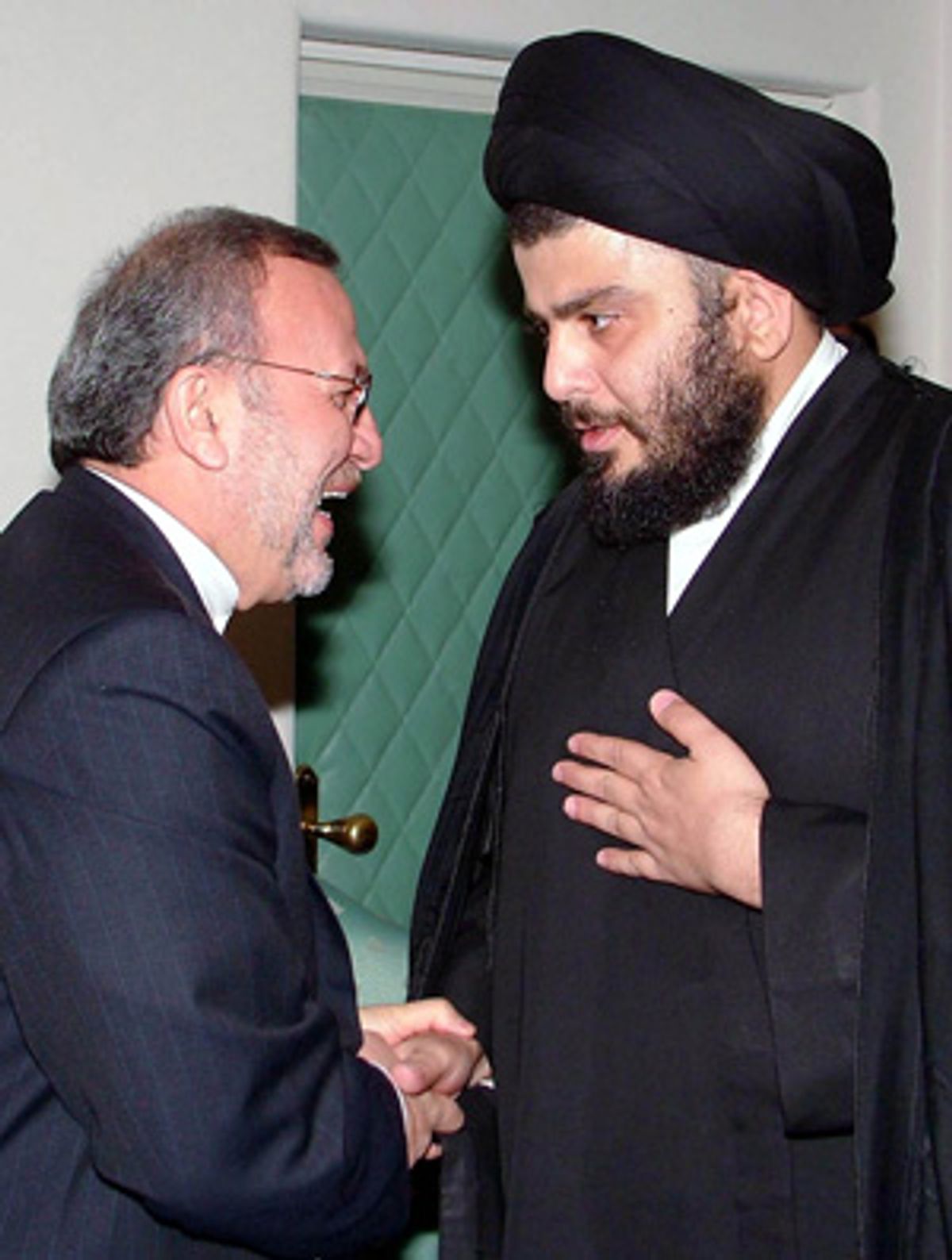
Recently, the U.S. was calling for Muqtada al-Sadr's head. Now, the fiery cleric may be the only man who can defuse Iraq's Sunni-Shiite conflict.

  • more
    • All Share Services

America's unlikely savior

In the spring and summer of 2004, the radical young Shiite cleric Muqtada al-Sadr led an armed uprising against the U.S. occupiers. His militia, the Mahdi army, fought several bloody battles against American forces. Muqtada’s intifada, along with the Sunni insurgency that broke out in Fallujah at the same time, spelled doom for the neocon fantasy that the U.S. occupation would be a cakewalk. High-ranking U.S. officials called for Muqtada to be captured or killed. But the fiery cleric not only survived, but flourished — and in the last two years he has turned his enormous street credibility into political power. In the December elections his slate earned potentially 30 seats in Parliament, making him an equal partner with two other Shiite groups in the largest Shiite coalition, the United Iraqi Alliance.

But what sets Muqtada apart from the other Shiite leaders — and makes him a potentially crucial, if supremely unlikely, ally for the United States — is his close ties to the Sunni insurgents. With sectarian tensions in Iraq and the region increasing, Muqtada may be the only Shiite leader in Iraq who can reach out to Sunnis, who see him as “the good Shia.” His Mahdi army fought the American occupiers, establishing street cred with the Sunni resistance. Much of Muqtada’s appeal is his fervent nationalism. Unlike the leadership of Dawa or the Supreme Council for the Islamic Revolution in Iraq (SCIRI), Muqtada was not in exile and, like his father, has condemned foreign-born clerics based in Iraq.

On the crucial issues that divide Shiite and Sunni, Muqtada sides with the Sunnis. He opposes federalism, which he believes will lead to the breakup of Iraq, and supports amending the constitution. SCIRI and the other main Shiite party, Dawa, support federalism and refuse to amend the constitution. For Sunnis, federalism means the loss not just of the old Iraq, which they dominated, but also of oil revenue, and they are determined to resist it. Muqtada is their only Shiite ally. Inexperienced in foreign affairs and barely experienced in politics, Muqtada may nonetheless be the only figure capable of halting Iraq’s steady descent into a civil war that could ignite the entire region.

Juan Cole, a professor at the University of Michigan who is an expert on Iraq’s Shiites, says, “Muqtada is indeed now in a position to form a link between fundamentalist Sunnis and hard line Shias, to the extent that they do have some goals in common. [American ambassador to Iraq Zalmay] Khalilzad is now supporting a better deal for the Sunni Arabs and is pushing for a national unity government into which the Shias incorporate them, so he is a de facto potential ally of Muqtada, though neither he nor Muqtada will admit it.”

Muqtada is an unlikely ally for the United States. Before joining the Shiite coalition, Muqtada insisted that other Iraqi politicians agree to his “Code of Honor,” which sets a timetable for U.S. withdrawal, legitimizes resistance if the U.S. stays, and rejects any relationship with Israel. Muqtada also refused to work with more secular former Baathist parties, calling the participation of U.S. favorite Ayad Allawi in particular a red line that would force him to back out. Allawi and his party were hated by Muqtada’s men both for having former Baathists in their ranks and for Allawi’s asking the Americans to battle Muqtada in the spring and summer of 2004.

In recent weeks, Muqtada burnished his credentials with both the Sunni and Shiite establishments when he visited first Saudi Arabia, then Iran — where he warned the United States that if it attacked Iran, he would send his forces into the field. His meeting with Saudi Arabia’s King Abullah proved he is the only Shiite leader in Iraq that Sunnis can tolerate; his trip to Iran cemented his ties with the Shiite clerical elite and boosted his regional stature as an ideological foe of the United States and Israel.

Muqtada’s legislative triumph makes him legitimate, no longer an outsider. Crucially, his presence gives Sunnis hope that he will succeed in defying SCIRI by blocking federalism and modifying the constitution. It also complicates SCIRI’s coalition with the Kurds. The hypernationalist Muqtada and his followers are fierce enemies of the Kurds, condemning their autonomy and clashing with them in the north, where many Shiite Turkmens are aligned with Muqtada.

Muqtada is far from impressive in person. His unpolished speech and youth (it has been widely speculated that he is younger than his putative age of about 32) have led American officials to consistently underestimate him. But Muqtada has drawn on his impeccable family pedigree and his fiery anti-Americanism to build vast popular support — and he has proved much more clever than his enemies expected.

I first met Muqtada in May 2003 in his barani, or office, in a Najaf alley, across a shop where his and his father’s sermons were sold on CD and one could buy watches with the Sadr family members depicted on the face. Unlike other clerics in Najaf, who speak classical Arabic, Muqtada speaks in a strong colloquial slang. He seemed cocky. He disparaged Shiite exile leaders who had been based in Iran and had not suffered with the Iraqis, singling out the SCIRI for particular disdain. Muqtada expressed only contempt for the Americans who had so recently rid his people of Saddam, and resentment of Iran, which had done nothing to help Iraq’s Shiites. “I am not afraid,” he said, “I wish to be a martyr and I don’t fear death.” I was struck by how awkward Muqtada looked and how ill-experienced he was for a man so popular that throughout Shiite neighborhoods he was known only by his first name, a tribute no other Iraqi leader received. I wondered, as I do to this day, if there was some other brain behind his operation. His young, unctuous associates seemed too smug, as if they already knew Iraq was theirs.

Muqtada al-Sadr derives his power from his family connections. He is the scion of the revolutionary Sadr family, one of the most illustrious religious names in Iraq. His great-uncle, Muhammad Bakr Sadr, was the most important Shiite theologian of the 20th century, writing about economics, politics and philosophy as well. Bakr Sadr led the Dawa Party, an underground movement whose members were decimated by the Baath Party. In 1980, after Bakr Sadr declared Baath Party membership forbidden, he was arrested with his sister, forced to watch her raped and executed, and then executed himself by having nails driven into his head. He became known as the First Martyr.

Bakr Sadr’s nephew (and Muqtada’s father), Ayatollah Muhamad Sadiq Sadr, envisioned himself as the wali al am, or general leader, of the clergy, a position above all others, including the top clerics in Iran. He aspired to lead world Shiism and head an Islamic government in Iraq. In 1998, when Saddam Hussein relaxed restrictions on the Friday khutba, or sermon, Sadiq Sadr began preaching at the Kufa mosque outside Najaf. His 47 very influential sermons reached all Iraqi Shiites. He was particularly obsessed with the coming of the Mahdi, or Shiite messiah, the 12th leader of the Shiite community who disappeared into an occult realm and whose return is eagerly awaited by Shiites.

Muhamad Sadiq Sadr may have looked like an avuncular Santa Claus, but he regularly damned as infidels those who disagreed with him, and hung up lists of the damned in his office. (Many on the lists were accused of homosexuality.) Sadr outraged the Shiite establishment in Najaf’s hawza, or seminary, by denouncing the other leading ayatollahs who were not of Iraqi origin. Saddam’s regime promoted Sadr as a homegrown alternative to non-Iraqi clerics, especially those originating from Iran. In 1999 Muhamad Sadiq Sadr became the Second Martyr after he and two of his sons were killed when their car was riddled with bullets. Although Shiites blamed it on the regime, it is likely that rival clerics in the hawza were responsible for the assassination.

Muqtada moved quickly to establish his power base after Saddam fell. Posters of the First and Second Sadr martyrs appeared throughout Iraq’s Shiite areas, symbolizing the new order. The downtrodden masses of Iraq, the Shiite “mustad’afeen,” as the Ayatollah Khomeini of Iraq had called them, were in power for the first time since the 7th century, when the Sunnis had begun ruling over them. Muqtada’s father, the Second Martyr, had built an impressive network of mosques and social services around the country, controlled by his former students, and Muqtada capitalized on this network, dispatching young clerics around the country to seize mosques, hospitals, clinics, and looted goods, and to provide security and social services. His men soon gained control of the Baghdad slums known as Saddam City, where up to 3 million Shiites lived. Built in the ’50s to house Shiite migrants from the south, it was originally called Madinat Athawra, or Revolution City, and was a bastion of the Iraq Communist Party. Signs and graffiti proclaimed Saddam City’s new name: Sadr City. (Part of the reason for Muqtada’s support for a centralized Iraq may be because he has so much support in Baghdad.)

There was a nearly messianic euphoria among Iraq’s Shiites, many of whom viewed the Mahdi’s arrival as imminent. Among Muqtada Sadr’s followers it was common to hear the view that the U.S. Army had come to kill the Mahdi, but that the Mahdi would kill all the Americans — and all the Jews too, for good measure.

The Shiite leadership followed the Grand Ayatollah Sistani, who counseled the faithful to bide their time and not resist the American occupation. But Muqtada remained defiant. Rejected for a post in the Iraqi Governing Council established by American proconsul Paul Bremer, he seized the role of spoiler, condemning the occupation and the IGC and establishing his Mahdi army, allegedly to protect Shiites. Muqtada became a rallying point for Iraqi nationalism. In August 2003, when an American helicopter tried to remove a Shiite flag in Sadr City, enraged followers of Muqtada rioted, convinced that America was the enemy of Iraq and Islam.

From the start, Muqtada has supported the Sunni-led Iraqi insurgency, with the exception of the foreign Arab-dominated Zarqawi movement that finds Shiites anathema. As the insurgency spread, Muqtada established a close working relationship with radical Sunni movements, especially the Association of Muslim Scholars (AMS), a neo-Baathist movement of Sunni clerics. The AMS controlled one of Iraq’s most important indigenous resistance groups, the 1920 Revolution Battalions, named for the rebellion against the British occupation, and AMS scholars routinely sermonized in support of the resistance. Muqtada’s clerics held joint prayer sessions with them, and in the fateful spring of 2004, when Fallujah rose up against the Americans, followed by an uprising of Shiites in the south, Shiite followers of Muqtada helped their Sunni brethren and benefited from aid and arms sent at the behest of the AMS.

Muqtada fought the Americans once more in the summer of 2004. Though American forces swore to arrest or kill him, Muqtada survived and even indirectly fielded candidates in the January 2005 elections. They won seats in both the national and provincial governments and even had two ministers in the Cabinet.

These battles were invaluable in establishing Muqtada’s militant and patriotic credibility, particularly among Sunnis. Muqtada’s followers boast that “the two intifadas” they have fought against the Americans prove that they are true Iraqi nationalists who refuse to accept occupation, unlike the two other leading Shiite movements, SCIRI and Dawa. In addition, Muqtada’s movement has drawn many former Baathists into its ranks, as well as Shiites who served in Saddam’s dreaded security and intelligence services. And he has been a fierce critic of Iran, warning of Iranian interference in Iraqi affairs. All these factors make Muqtada acceptable to Sunnis who fear and hate the rest of the Shiite establishment.

Sunnis increasingly view all Shiites as Iranians or Persians, refusing to recognize that Shiites are the majority or that Shiites had been singled out for persecution under Saddam. Sunnis are the primary victims of American military aggression, and they view Shiites as collaborators with the occupation.

And Sunni antagonism towards Shiites has been fed by an increasingly violent series of targeted killings of insurgent leaders. In the fall, Sunni leaders accused SCIRI’s Badr militia of infiltrating the Ministry of Interior and sending out uniformed death squads to assassinate former Baathists and Sunni clerics. (In fact, Muqtada’s militia, the Mahdi army, also sends out death squads to assassinate Sunnis it deems deserving of death, but this fact is not widely known.) The existence of secret prisons revealed that the SCIRI-dominated Ministry of Interior had learned well from America’s prisons in Guantánamo Bay and Abu Ghraib.

For their part, Shiites tend to view Sunnis as Baathists or Wahhabis, but until last year — despite suffering an endless onslaught of terror attacks meant to provoke a civil war — they showed restraint. But last year the situation grew more ominous. Politics became increasingly sectarian — and bloody. Tit-for-tat killings began: After a Shiite cleric was assassinated, a Sunni cleric would turn up dead the following morning. Threats and bombings drove Shiites from Sunni neighborhoods.

The Sunni-Shiite discord unleashed by the U.S. invasion is not confined to Iraq. Muqtada’s trip to Saudi Arabia took place against a backdrop of rising sectarian tensions throughout the region. Sunnis make up the majority in every Arab state except Iraq, Bahrain and Lebanon; in Jordan and Saudi Arabia, in particular, they feel threatened by the Shiite renaissance in Iraq. In December 2004, Jordan’s King Abdullah warned of a “Shiite crescent” from Lebanon to Iraq to Iran that would destabilize the entire region. Iraq’s Shiites have demonstrated against Jordan in the past, condemning the country for its steady trickle of suicide bombers who cross into Iraq and commit atrocities against Shiite civilians.

These tensions have spilled over into acrimony between Iraqi and Saudi officials. In September, Saudi Foreign Minister Saud al-Faisal warned that a civil war in Iraq would destabilize the entire region and complained that the Americans had handed Iraq over to Iran for no reason. In response Bayan Jabr, Iraq’s interior minister — and the former commander of the Badr Corps, SCIRI’s militia — called the Saudi foreign minister a “Bedouin riding a camel” and described Saudi Arabia as a one-family dictatorship.

In Saudi Arabia, home of Wahabi Islam, Shiites are known as “rafida,” which means “rejectionists.” A highly pejorative term, it implies that Shiites are outside Islam, and to Shiites it is the equivalent of being called “nigger.” This is the same word that Abu Musab al-Zarqawi, al-Qaida’s leader in Iraq, uses to describe Shiites, as do Sunni radicals in the region. The ascension of King Abdullah, who has taken a more moderate stance on the Shiites, is a positive development. But Saudi Arabia’s 2 million Shiites have been persecuted, prevented from celebrating their festivals and occasionally threatened with extermination. Saudi Arabia is also the main exporter of foreign fighters to the Iraqi jihad to fight both the Americans and the Shiite “rafida” collaborators.

In this context, Muqtada’s trip to Saudi Arabia was at least a small step in building a regional bridge between Sunnis and Shiites.

As Iraqis try to form a government, it is not yet clear whether Muqtada will succeed in persuading his fellow Shiites to compromise on key issues like federalism and the constitution. Iraq’s Shiites are triumphant, knowing that Iraq is now theirs and cannot be taken away from them except by the Americans. There is no threat of Sunnis retaking the country, because they had never taken it before; they had been given it — first by the Ottomans and then by the British. SCIRI sees no need for compromise. It plans to forcefully impose a new order on Iraq, one that directly clashes with Sunni aspirations and reinforces all their fears.

The one figure opposing SCIRI’s maximalist demands is Muqtada. Should he win out over SCIRI in a battle for influence, we might see a majority in the Assembly calling for an American withdrawal from Iraq, and we would also see support for a stricter imposition of Islamic law as well as increased tension with the Kurds. The Americans who had once called for his arrest or death would be forced to deal with their former enemy, though he too would now be restrained by his own political participation.

It is a priceless irony that Muqtada Sadr — the poorly educated, inarticulate, thuggish and violently anti-American young cleric — may be the one man who can allow America to get out of Iraq without the roof caving in after them.

Continue Reading Close

Nir Rosen is a freelance writer in Iraq.

Our real Iraq losses

We left their nation in turmoil and our own country entangled in an endless "national security" nightmare

  • more
    • All Share Services

Our real Iraq lossesA man, left, inspects his destroyed vehicle at the scene of a car bomb attack in Ramadi, 70 miles (115 kilometers) west of Baghdad, Iraq, Tuesday, March 20, 2012. Officials say attacks across Iraq have killed and wounded scores of people in a spate of violence that was dreaded in the days before Baghdad hosts the Arab world's top leaders. (AP Photo) (Credit: AP)
This originally appeared on TomDispatch.

People ask the question in various ways, sometimes hesitantly, often via a long digression, but my answer is always the same: no regrets.

In some 24 years of government service, I experienced my share of dissonance when it came to what was said in public and what the government did behind the public’s back. In most cases, the gap was filled with scared little men and women, and what was left unsaid just hid the mistakes and flaws of those anonymous functionaries.

What I saw while serving the State Department at a forward operating base in Iraq was, however, different. There, the space between what we were doing (the eye-watering waste and mismanagement), and what we were saying (the endless claims of success and progress), was filled with numb soldiers and devastated Iraqis, not scaredy-cat bureaucrats.

That was too much for even a well-seasoned cubicle warrior like me to ignore and so I wrote a book about it, “We Meant Well: How I Helped Lose the War for the Hearts and Minds of the Iraqi People.” I was on the spot to see it all happen, leading two Provincial Reconstruction Teams (PRTs) in rural Iraq while taking part up close and personal in what the U.S. government was doing to, not for, Iraqis. Originally, I imagined that my book’s subtitle would be “Lessons for Afghanistan,” since I was hoping the same mistakes would not be endlessly repeated there. Sometimes being right doesn’t solve a damn thing.

By the time I arrived in Iraq in 2009, I hardly expected to be welcomed as a liberator or greeted — as the officials who launched the invasion of that country expected back in 2003 — with a parade and flowers. But I never imagined Iraq for quite the American disaster it was either. Nor did I expect to be welcomed back by my employer, the State Department, as a hero in return for my book of loony stories and poignant moments that summed up how the United States wasted more than $44 billion in the reconstruction/deconstruction of Iraq. But I never imagined that State would retaliate against me.

In return for my book, a truthful account of my year in Iraq, my security clearance was taken away, I was sent home to sit on my hands for months, then temporarily allowed to return only as a disenfranchised teleworker and, as I write this, am drifting through the final steps toward termination.

What We Left Behind in Iraq

Sadly enough, in the almost two years since I left Iraq, little has happened that challenges my belief that we failed in the reconstruction and, through that failure, lost the war.

The Iraq of today is an extension of the Iraq I saw and described. The recent Arab League summit in Baghdad, hailed by some as a watershed event, was little more than a stage-managed wrinkle in that timeline, a lot like all those purple-fingered elections the U.S. sponsored in Iraq throughout the Occupation. If you deploy enough police and soldiers — for the summit, Baghdad was shut down for a week, the cell phone network turned off, and a “public holiday” proclaimed to keep the streets free of humanity — you can temporarily tame any place, at least within camera view. More than $500 million was spent, in part planting flowers along the route dignitaries took in and out of the heavily fortified International Zone at the heart of the capital (known in my day as the Green Zone). Somebody in Iraq must have googled “Potemkin Village.”

Beyond the temporary showmanship, the Iraq we created via our war is a mean place, unsafe and unstable. Of course, life goes on there (with the usual lack of electricity and potable water), but as the news shows, to an angry symphony of suicide bombers and targeted killings. While the American public may have changed the channel to more exciting shows in Libya, now Syria, or maybe just to “American Idol,” the Iraqi people are trapped in amber, replaying the scenes I saw in 2009-2010, living reminders of all the good we failed to do.

Ties between Iraq and Iran continue to strengthen, however, with Baghdad serving as a money-laundering stopover for a Tehran facing tightening U.S. and European sanctions, even as it sells electricity to Iraq. (That failed reconstruction program again!) Indeed, with Iran now able to meddle in Iraq in ways it couldn’t have when Saddam Hussein was in power, that country will be more capable of contesting U.S. hegemony in the region.

Given what we left behind in Iraq, it remains beyond anyone, even the nasty men who started the war in 2003, to claim victory or accomplishment or achievement there, and except for the odd pundit seeking to rile his audience, none do.

What We Left Behind at Home

The other story that played out over the months since I returned from Iraq is my own. Though the State Department officially cleared “We Meant Well” for publication in October 2010, it began an investigation of me a month before the book hit store shelves. That investigation was completed way back in December 2011, though State took no action at that time to terminate me.

I filed a complaint as a whistleblower with the Office of the Special Counsel (OSC) in January 2012. It was only after that complaint — alleging retaliation — was filed, and just days before the OSC was to deliver its document discovery request to State, that my long-time employer finally moved to fire me. Timing is everything in love, war, and bureaucracy.

The charges it leveled are ridiculous (including “lack of candor,” as if perhaps too much candor was not the root problem here). State was evidently using my case to show off its authority over its employees by creating a parody of justice, and then enforcing it to demonstrate that, well, when it comes to stomping on dissent, anything goes.

My case also illustrates the crude use of “national security” as a tool within government to silence dissent. State’s Diplomatic Security office, its internal Stasi, monitored my home email and web usage for months, used computer forensics to spelunk for something naughty in my online world, placed me on a Secret Service Threat Watch list, examined my finances, and used hacker tools to vacuum up my droppings around the web — all, by the way, at an unknown cost to the taxpayers. Diplomatic Security even sent an agent around to interview my neighbors, fishing for something to use against me in a full-spectrum deep dive into my life, using the new tools and power available to government not to stop terrorists, but to stop me.

As our government accumulates ever more of what it thinks the American people have no right to know about, there will only be increasing persecutions as prosecutions. Many of the illegal things President Richard Nixon did to the famous Pentagon Papers whistleblower Daniel Ellsberg are now both legal (under the Patriot Act) and far easier to accomplish with new technologies. There is no need, for instance, to break into my psychiatrist’s office looking for dirt, as happened to Ellsberg; after all, the National Security Agency can break into my doctor’s electronic records as easily as you can read this page.

With its aggressive and sadly careless use of the draconian Espionage Act to imprison whistleblowers, the Obama administration has, in many cases, moved beyond harassment and intimidation into actually wielding the beautiful tools of justice in a perverse way to silence dissent. More benign in practice, in theory this is little different than the Soviets executing dissidents as spies after show trials or the Chinese using their courts to legally confine thinkers they disapprove of in mental institutions. They are all just following regulations. Turn the volume up from six to ten and you’ve jumped from vengeance to totalitarianism. We’re becoming East Germany.

What I Left Behind

There has been a personal price to pay for my free speech. In my old office, after my book was published in September 2011, some snarky coworkers set up a pool to guess when I would be fired — before or after that November. I put $20 down on the long end. After all, if I couldn’t be optimistic about keeping my job, who could?

One day in October, security hustled me out of that office, and though I wasn’t fired by that November and so won the bet, I was never able to collect. Most of those in the betting pool now shun me, fearful for their own fragile careers at State.

I’ve ended up talking, usually at night, with a few of the soldiers I worked with in Iraq. Some are at the end of a long Skype connection in Afghanistan, others have left the military or are stationed stateside. Most of them share my anger and bitterness, generally feeling used and unwanted now that they need a job rather than rote praise and the promise of a parade.

“We Meant Well” is, I think, pretty funny in parts. I recall writing it as an almost out-of-body experience as I tried to approach the sadness and absurdity of what was happening in Iraq with a sense of irony and black humor. That’s long gone, and if I were to write the story today, the saddest thing is that it would undoubtedly come out angry and bitter, too.

A Member of a Club That Would Have Me

Having left behind friends I turned out not to have, a career that dissolved beneath me, and a sense of humor I’d like to rediscover, I find myself a member of a new club I don’t even remember applying for: The Whistleblowers. I’ve now met with several of the whistleblowers I’ve written about with admiration: Tom Drake, Mo Davis, John Kiriakou and Robert MacLean, among others.

As ex- or soon-to-be-ex-government employees all, when we meet, we make small talk about retirement, annuities and the like. No one speaks of revolution or anarchy, the image of us the government often surreptitiously pushes to the media. After all, until we blew those whistles, we were all in our own ways believers in the American system. That, in fact, is why we did what we did.

My new club-mates represent hundreds of years of service — a couple of them had had long military careers before joining the civilian side of government — and we cover a remarkably broad swath of the American political spectrum. What we really have in common is that, in the course of just doing our jobs, we stumbled into colossal government wrongdoing (systematized torture, warrantless wiretapping, fraud and waste), stood up for what is right in the American spirit, and found ourselves paying surprising personal prices for acts that seemed obvious and necessary. We are guilty of naiveté, not treason.

Each of us initially thought that the agencies we worked for would be concerned about what we had stumbled upon or uncovered and would want to work with us to resolve it. If most of us are now disillusioned, we weren’t at the outset. Only by the force of events did we become transformed into opponents of an out-of-control government with no tolerance for those who would expose the truth necessary to create Thomas Jefferson’s informed citizenry. In meeting my club-mates, I learned that whistleblowers are not born, but created by a government with much to hide and an unquenchable need to hide it.

One of those whistleblowers, Jesselyn Radack, wrote a book about her experiences called “Traitor: The Whistleblower and the American Taliban.” At the dawn of the War on Terror, Radack, an attorney at the Department of Justice (DOJ), wrote a memo stating that John Walker Lindh, the “American Taliban” captured in Afghanistan, had rights and could not be interrogated without the benefit of counsel.

The FBI went ahead and questioned him anyway, and then DOJ tried to disappear Radack’s emails documenting this Constitutional violation. Ignoring her advice, the government tossed away the rights of one of its own citizens. Radack herself was subsequently forced out the DOJ, harassed, and had to fight simply to keep her law license.

As proof that God does indeed enjoy irony, Radack today helps represent most of the current crop of government whistleblowers (including me) in their struggles against the government she once served. Radack and I are now working with Academy Award-nominated filmmaker James Spione on a documentary about whistleblowers.

What Will Be Left Behind

So what’s left for me in my final days as a grounded State Department worker assigned to timeout in my own home? Given my situation, there is, of course, no desk to clean out; there are no knickknacks collected abroad over my 24 years to package up. All that’s left is one last test to see if the system, especially the First Amendment guaranteeing us the right to free speech, still has a heartbeat in 2012.

Though I could be terminated by State within a few weeks, I am otherwise only months away from a semi-voluntary retirement. Since I’m obviously out the door anyway, State’s decision to employ its internal security tools and expensive, taxpayer-paid legal maneuvers at this late date can’t really be about shortening my tenure by a meager four months. Instead, it’s clearly about mounting my head on a pike inside the lobby of State’s Foggy Bottom headquarters as a warning to its other employees not to dissent, or mention wrongdoing they might stumble across. Better, so the message goes, to sip the Kool Aid and keep one’s head down, while praising the courage of Chinese dissidents and Egyptian bloggers. The State Department is all about wanting its words, not its actions, to speak loudest.

Running parallel to the State Department termination process is an investigation by the Office of the Special Counsel into my claim of retaliation, which State is seeking to circumvent by tossing me out the door ahead of its conclusion. State wants to use my fate to send a message to its already cowed staff. However, if the Special Counsel concludes that the State Department did retaliate against me, then the message delivered will be quite a different one. It just might indicate that the First Amendment still does reach ever so slightly into the halls of government, and maybe the next responsible Foreign Service Officer will carry that forward a bit further, which would be good for our democracy.

One way or another, sometime soon the door will smack me in the backside on my way out. But whether the echo left behind inside the State Department will be one of justice or bureaucratic revenge remains undecided. My book is written and my career is over either way. However, what is left behind matters not just for me, but for all of us.

[Disclaimer: The views expressed here are solely those of the author in his private capacity and do not in any way represent the views of the Department of State, or any other entity of the U.S. Government. It should be quite obvious that the Department of State has not approved, endorsed, embraced, friended, liked, tweeted or authorized this post.]

To stay on top of important articles like these, sign up to receive the latest updates from TomDispatch.com here.

Continue Reading Close

Peter Van Buren spent a year in Iraq as a State Department Foreign Service Officer serving as Team Leader for two Provincial Reconstruction Teams (PRTs). Now in Washington, he writes about Iraq and the Middle East at his blog, We Meant Well. His book, We Meant Well: How I Helped Lose the Battle for the Hearts and Minds of the Iraqi People (The American Empire Project, Metropolitan Books), will be published this September.

Shaima Alawadi’s murder: Hate crime or honor killing?

The murder of an Iraqi immigrant in California has stirred rumors of both a hate crime and an honor killing

  • more
    • All Share Services

Shaima Alawadi's murder: Hate crime or honor killing?Fatima Alhimidi weeps over her mother Shaima Alawadi's coffin as it arrives in Najaf, Iraq. (Credit: AP/Alaa al-Marjani)

EL CAJON, Calif. – On March 21, an unknown assailant shattered Shaima Alawadi’s skull with a tire-iron-like weapon in the living room of her home. An Iraqi immigrant and mother of five, Alawadi was found by her 17-year-old daughter, Fatima, who said she was “drowned in her own blood.” Alawadi was rushed to the hospital, still alive, but she was soon taken off life support and died March 24. It was, by all accounts, a heinous crime. But was it a hate crime?

After her mother’s death, Fatima said she found “a letter next to her head saying, ‘Go back to your country, you terrorist.’” The accusation sparked outrage and brought national media attention to the murder. And yet, within days, publicity-craving Islamophobes Pamela Geller and Robert Spencer were pushing an alternative motive: that Alawadi’s death was, in fact, an “honor killing.” Geller crowed, “I surmised that the murder of Shaima Alawadi appeared to be Islamic, rooted in Islamic teachings and culture …”

I journeyed to Alawadi’s adopted hometown of El Cajon in Southern California to find out more about her death. El Cajon is a microcosm of Iraq, but an Iraq that no longer exists. More than 40,000 Iraqis are struggling to build a new life there, having fled persecution in their homeland. One local described to me a community where “There’s Chaldeans, Yazidis, Mandaeans. There’s Shi’a, Sunni, Kurds. There’s Assyrian and Armenian.”

The first wave of immigration came in the late 1970s on the eve of the devastating Iran-Iraq War. Others, including Alawadi and her family, fled after the 1991 Persian Gulf War, mainly Shi’a who unsuccessfully tried to overthrow a wounded Saddam Hussein at the urging of the senior Bush administration. The third wave was courtesy of the junior Bush’s 2003 invasion, which spawned Islamist militias that have decimated Iraq’s Chaldean Christians, Mandaeans (followers of John the Baptist) and Yazidis (a 4,000-year-old syncretic religion). Out of the millions of Iraqi refugees from the most recent U.S. war, 59,000 have landed on American soil.

Many have found their way to El Cajon. They tell of harrowing escapes from kidnappings, bombings and death squads, years in refugee camps and life savings spent to hopscotch from country to country. Recent arrivals come bearing deep traumas and have landed in a depressed economy where they often sink into joblessness, squalor and depression. They have also discovered not everyone is welcoming.

“There is a hate crime problem in El Cajon,” says Basma Coda, an Iraqi-American who works at the Chaldean-Middle Eastern Social Services. “We have documented six physical attacks since 2007 in which Iraqi refugees were beat up and had broken bones. All had to go the hospital. They were all over 50, and one was a 75-year-old man with Parkinson’s disease.” (The El Cajon police department did not return calls about the alleged crimes.)

“There are a lot of anti-Islamic groups and know-nothings here,” says California State University professor Brian Levin, director of the Center for the Study of Hate and Extremism in San Bernardino. Nonetheless, he and other hate-crime monitors are skeptical of some of the alleged details of Alawadi’s death. “Why are the police so quick to say it is an isolated incident? That suggests to me they are looking at other motives. There is the possibility this could be some sort of personal attack or revenge attack.” Mark Potok, senior fellow at the Southern Poverty Law Center, which monitors hate groups nationwide, says that when he first heard about the threatening notes, “I raised an eyebrow. It’s too perfect. It’s highly unusual to have notes that spell out the motive on paper.” As for the crime itself, Potok says, “It is quite unusual to invade someone’s home, especially a woman, and violently beat her to death in the dining room.”

Indeed, in the days after her death several revelations called the hate-crime allegation into question. On April 4, an affidavit for a search warrant about the murder was “accidentally released,” according to the New York Times. The San Diego Union-Tribune, which first received the document, claimed it shows a “family in turmoil and cast doubt on the likelihood that her slaying was a hate crime.” Alawadi was said to be planning on leaving her husband, based on blank divorce papers found in her vehicle. Last November, police investigating reports of two people possibly having sex in a car found Fatima with a 21-year-old man. After her mother was called to pick her up, Fatima allegedly jumped out of the moving car at 35 mph. While being treated at a hospital for her injuries the court records state, “Police were informed by paramedics and hospital staff that Fatima Alhimidi said she was being forced to marry her cousin and did not want to do so she jumped out of the vehicle.”

The document also mentions “a neighbor reported seeing a skinny dark-skinned male running west from the area of Alawadi’s house” on the morning of the murder. According to the affidavit, as of March 27, the police had not confirmed the whereabouts of Kassim Alhimidi, Alawadi’s husband, at the time of the murder. And curiously, “a handwritten note was located at the scene that the family denied seeing before.”

Yet some in the community are still skeptical because there is no suspect, motive or murder weapon. Hanif Mohebi, director of the San Diego chapter of the Council on American-Islamic Relations, says, “There are definitely questions that are brought up by the article, but we should not jump to a conclusion unless there is a real fact provided. Our community is not immune to these issues.”

Some observers worry that the new information in the Alawadi case will be misused. Hanif Mohebi says, “From the beginning we were very cautious about the murder because we are all human beings, and this could go any way. The Islamophobes will exploit this. If there is something that advances their agenda, they will most definitely use it.” Right on cue, Geller and Spencer began their postulations about “honor killings.”

Potok also stresses that, whoever murdered Alawadi, the rise in Islamophobia is genuine. The Southern Poverty Law Center has tracked a 200 percent increase in anti-Muslim hate groups nationwide from 10 such groups in 2010 to 30 in 2011. Potok attributes the spread to “the so-called Ground Zero Mosque controversy in 2010 that was really ginned up by opportunistic activists and politicians … This is a classic case of words having consequences.”

The rumors of notes, in particular, have unsettled Iraqi immigrants to El Cajon. The notes have hurled them back to wartime horrors they seem unable to escape. After the United States occupied Iraq, a favored tactic of extremist militias was to deliver a note to intended victims warning them to leave or be killed. Families would receive letters because a child or husband was collaborating with U.S. forces, or perhaps they were the wrong ethnicity or religion in the wrong part of town. Religious minorities were sometimes given the “option” of converting to Islam.

Basma Coda says, “We have threatening notes in our office that people brought from Iraq.” The notes say things like, “You are an infidel. You are a sinner. You deserve to die. If you don’t leave by a certain time, you and children will die.” Often they would be given a specific day or time to leave. Coda says, “The Iraqi refugees in El Cajon every day they live their fear. They live their trauma. The future is unknown for these refugees.” She says her social service organization is trying to help them, “but one incident like Alawadi’s murder takes them back to the trauma they experienced.”

On March 30, I attended an outdoor prayer service and candlelight vigil for Alawadi. I met one of her neighbors from Iraq. Abbas Almeali, 42, clad in traditional Iraqi garb and headdress, said he knew Shaima and her family from Samawa, the closest city in southern Iraq to the Saudi Arabian border. He fled in March 1991 after the revolt failed, but “was proud to be part of the uprising.” He said Alawadi’s father was tortured by Saddam Hussein’s regime and her uncle was hung during the uprising. “She was a nice girl, she had no problems with anyone,” Almaeli said.

Kamyar Hedayat, a medical doctor of Iranian heritage, spoke at the vigil. Hedayat said as he has practiced critical care for children, “I’ve watched children die, and I know how death affects families.” Hedayat said, “It is ironic that a woman who escaped the murderous regime of Saddam Hussein and the bombs of George Bush, Sr., lost her life in San Diego seeking safety and civility.”

Michelle Fawcett contributed to this report.

Continue Reading Close

Arun Gupta, a New York writer and co-founder of Occupy the Wall Street Journal, covers the Occupy movement for Salon.

In Iraq and on “The Wire,” it’s all acting for Benjamin Busch

In a lyrical memoir, a novelist's son discusses his strange path into war -- and David Simon's TV masterpiece

  • more
    • All Share Services

In Iraq and on Benjamin Busch

Benjamin Busch’s “Dust to Dust” is a remarkable book — part military memoir, part childhood reminiscence, and also an effort to explain his relationship with his father, the celebrated novelist Frederick Busch.

And yet it is also more than all of those things. Busch is filled with complicated and fascinating contradictions. Yes, he’s the son of a famously introspective and domestic writer, who grew up in rural New York obsessed with toy guns and building massive military forts. But he studied visual arts at Vassar, where he confused everyone by joining the Marine reserves — especially his commanders, when he accidentally announced himself in a roll call as part of the “Vassar infantry.”

A man consumed with war, words and images, Busch served two combat tours in Iraq. He proved himself both exceptionally thoughtful and also terribly overconfident. In his first tour, beginning in April 2003, he was the commanding officer of a light armored reconnaissance unit, in a village near Iran. In his second tour, in an exploding Ramadi in 2005, Busch had the impossible job of trying to rebuild a town — and gain its trust — while insurgents and sniper fire added to the general lawlessness and lack of any power structure.

Oh, and in between those two tours, Busch returned home to play Sgt. Anthony Colicchio on “The Wire.” The military man who emphasized listening to Iraqis and learning what he didn’t know played a fictional Baltimore police officer of the exact opposite variety. The over-aggressive Colicchio loved nothing more than making arrests to show toughness and to pump up the Western District’s stats. He’s not interested in getting to know the streets he patrols, and he’s disgusted by covert efforts to legalize the drug trade in a part of Baltimore dubbed “Hamsterdam.”

In an interview this week, Busch said real-life frustrations in Iraq fueled Colicchio’s rage. But the challenge in Iraq, he says, was making sure those frustrations never, ever revealed themselves when working with Iraqis. Both roles, he said, were essentially acting jobs. We also talked about Robert Bales and how soldiers handle pressure, where the war plans went wrong and whether the Marines need more Vassar alums.

You were a student at Vassar during the first Gulf War, the 100-hour action that pushed Iraq out of Kuwait. You write about feeling disappointed that it was over so quickly – that this looked like your generation’s shot at war. You very much wanted to go to war.

I thought that. I pushed the extremes throughout my youth, as you can see from some of the small stories even as a child. I was always venturing into what I either considered unexplored territory or what I considered unwise territory to explore.  And war was certainly one of those things. Its mere existence is entirely an environment of threat. Although, as you learn in war, with the randomness of death, preparation is only partially useful. Looking forward to it, you think that you could develop skills which would make you impervious. I painted myself in that idea, that I had survived the poor wisdom of my youth, and it must be because I had certain endurance. I wanted to believe that that could be extended into an environment as ferocious as war. I covered myself in a certain invulnerability in my first tour as a commander, mostly because my Marines expected it.

There’s a vivid scene in the book where your helicopter is going down, and you see the side of a cliff rushing toward you, the small details of land getting clearer and clearer. But you have Marines in the back of the helicopter facing the other direction who don’t know what is happening. So you just calmly smiled at them.

What else can you do in the face of death but smile.

Some people might scream. 

I’m not a screamer. There’s a certain calm that comes with both a belief that you are invulnerable and a belief that you’re doomed.  It leads to a lack of anxiety: One you can’t affect, and the other you can’t be affected.

And that’s the change you describe during your two tours in Iraq. The first time, there’s an eerie confidence. But the second time, death is omnipresent.

Yes, between the two tours that became very pronounced. My first tour I was wearing it for show; I created my own myth and believed in it. My second tour I was wounded almost immediately and we were taking incredible casualties and Ramadi was just a caustic environment in 2005. It was entirely random; every day you expected that it was going to be your day. We almost had this fatalistic humor about it all. We’d walk out the door and say, “Oh, I’m probably going to be killed today, so you can have my uniforms.” People weren’t surviving.

This is post-insurgency, and in the capital of the Sunni province of Anbar. It was a very bloody time, and you suggest our presence didn’t help, which in some ways is a startling admission from a Marine.

It was teeming not just with insurgents — actual Sunnis which were fighting for their own destiny — but it was also overrun with Syrians who were real pure jihadists. They came across the border to fight and die – they came there for us. Many of them were funded by Saudis. So there was a strange triangle of danger created all around our mere presence. And what we would look at was the families. There were children living there and parents who wanted what everyone wants – a secure day, food on the table. And not to fear that something collateral will happen to them, either by insurgents or by us. It was hard to watch that every day, knowing that they were under threat because we were under threat. And that our job was to protect them and we really couldn’t.

Let me back up for a moment. Your memoir has nine chapters, structured among elements like water, metal, stone and blood. You recount stories involving those materials from your youth, and then connect those materials to your war stories. So how did your childhood prepare you for what you saw when you weren’t playing games?

Endless fascination. I think it was endless fascination that prepared me for everything in my life. I was always paying attention. I was put here to observe and build upon my fascinations.

You make it sound simple. But there’s another scene in the book where you are called to mediate an emergency council meeting in Jassan. Water had been diverted to Saddam Hussein’s family. The town wanted a pipe sealed so their water flow would improve. The people did not know what to do, and insurgents were threatening the village’s leaders and sent a message during the meeting that they would also kill you. How does a young American in that situation know what to do?

It’s my Lawrence of Arabia moment.

It’s also a moment where you teach the meaning of democracy. You empower them to put the matter to a vote, and then act. You see people hungry to solve problems together, and excited to find the power within themselves to do that. That’s in some ways what we said we would do there — and exactly what didn’t happen often enough.

It was my place not to impose that, but to let that native urge be successful. I just felt very early that they wanted direction, and the worst thing that I could do would be to give it, because that would make me in charge. That would make me the ruling class. What had been removed was any sense of structure – the Baath party had been dissolved at that point, and had not been replaced with anything. There was a huge vacuum and all that had been put into it was us. And I knew that our mistakes would be made by creating a dependency upon a new state order that was perhaps not sustainable. I had nothing to offer except advice and bullets. That’s what I had. We couldn’t even get our mail at the time. What I wanted to do was find native solutions to native problems that I could only reinforce their answers to their problems, in some ways.  And that was a big moment I wish I could have celebrated in some ways because it was their choice and it was just that brief moment where they felt like they were in charge of their destiny – they felt like they had done something. They had the power to achieve justice, and they did it against all the odds. We had to replace rule of law in a place that is entirely lawless.

So you pay attention. I just followed my fascinations. Why is the water not running? Where does the water come from? Let’s follow that. And we did. You begin to reverse engineer everything just by seeing what’s wrong at the end. I wouldn’t say that I was good at anything.

Good questions. Too bad we didn’t ask them more often.

We could have saved a lot of time and a lot of loss if we had done so. What I feel the most regret about is that I left those people. We had that place almost stabilized in some ways, and though it was not in any way efficient or in any way without corruption, there was a possibility of being quietly transformative in some of those communities.

How do you see what went wrong?

We tried to define them. It’s what we do. We’re Americans. We find ourselves in a position that’s generally comfortable and our vision can only extend so far as us, and who wouldn’t want to be like us. So, if we just offer this, then it will be accepted and embraced. We don’t have a lot of respect for cultural traditions because we barely have any.

And honestly, our own history, if you watch how we achieved our great comfort, it’s pretty ugly. We’d like to criticize everyone for their stages toward democracy but if you look at ours – we didn’t let women vote, we didn’t let blacks vote, we had slaves. We had issues. We eradicated an entire native population almost.  I went into the place knowing that I was the one with the least information, and so it was my job to spend as much time listening and not talking as I could. I wanted to make sure I kept track of the details, the names. I was rebuilding family trees because the environment was built out of family trees.

Unless you’re going to come in there like the British empire and establish infrastructure and reform an entire place in its image, then you’re going to be wholly ineffective. We are definitely not the British empire in the way that we do business. We went in there awkwardly, we built mistakes upon mistakes. And after a while, you know, we wore ourselves down being wrong about things. It just took a little perspective, and some specialists. The people in the State Department knew all about Iraq. I would have liked to have had them in my vehicle.

All that failure, all that pressure, the consecutive tours. Not everybody handles pressure the way you were able to. What do you think happens when a soldier snaps, like Sgt. Robert Bales in Afghanistan, and allegedly goes on a shooting rampage and kills 17 people.

I can’t diagnose him. We have people that do horrible things all the time. Everyone deals with stress in their own way. There were ideologues over there. There were people who were on crusades. You just name it – look at everyone’s background.

Is this the right way to put a military together? When you look at the background you had, and the very different way you approached problem-solving and building relationships with people, those don’t necessarily seem to be the skills most valued by the military right now. You were a visual artist from Vassar. You probably had many cultural issues to overcome. But would a more diverse military be beneficial? Even some sort of mandated public service of some sort

What I found intriguing was that I met America in the Marines. At Vassar, I met a certain intellectual group. Vassar doesn’t teach you how to do anything. Literally. You come out of Vassar with no skill other than that if you find yourself in any situation you’ll be able to think your way out of it. It’s a critical thinking environment. To constantly question, to constantly try to resolve, and to resolve by not talking over the problem but by engaging in it. Collectively in some ways.  The military obviously has a very hierarchical system, but I didn’t see them any differently. I took the discipline of critical thinking, much to the chagrin of certain people, and I employed it.

Now that led to its own kind of hubris in your second tour, when you thought what had been effective among the Shia might also work with the Sunni. It didn’t.

I said, well, I don’t understand anything that’s happening here, which should tell me something. Shut up and find out. I deluded myself into thinking that because I had been effective in that area, which was very rural, Shia, on the Iranian border, with completely different feelings, that when I went for my second tour in Ramadi, the opposite side of the country, Sunni, I thought I could apply these great collective, cooperative ideas of building a city to a place that was a shooting gallery. And I was exposed for being the most wrong person, ever. It was just one step short of delusional that I could take these ideas and apply them effectively to a place, thinking, Well, this has been effective in a small scale, on a small range, with almost no money. We repaired buildings, we established critical infrastructure, we fixed water lines. We did an awful lot of stuff in a small place and they liked it.

With the irony, of course, that we fixed what we blew up.

Right. I thought that if you give something to someone that they realize is of great value to them, then they will defend it and, in doing so, they will embrace some of the stability that comes with preserving things instead of destroying them. We knew very well what the Taliban did and what the insurgents could do, which was destroy things. They didn’t build things for people; they blew them up. Our message was, “We didn’t do that.” And of course, in order to fight them, we blew things up. So our message was lost in our own struggle, and we never could achieve the support of the locals because we could prove nothing. We couldn’t give them the one thing that was needed for all these things to be effective, which was security, peace. We couldn’t do it. And because they knew we couldn’t do it, they were forced to side with those who would use extreme measures.

“Hopelessness” is certainly a word that comes to mind. I mean, we fought the city every day, as one captain said when we were there. You don’t fight the Battle of Ramadi, you fight Ramadi every day.

An impossible bureaucracy, corrupt institutions, intractable problems — it’s almost like a David Simon TV show.  And in between tours in Iraq, you established an acting career, and played a Baltimore policeman on “The Wire.” How did one experience affect the other?

Sgt. Colicchio fed off that second tour of Iraq where I was so frustrated. Colicchio is the opposite, he has a very black-and-white sense of justice. There is no gray for him, and of course, Iraq was entirely gray. So I got to air all the things I had to bury while I was there.

What was the timeline like on the acting roles, and your military service?

Interestingly, I had just come back from my first tour when I got the role of Colicchio. And for a year, 2004, I did Season 3. Immediately at the end of the filming schedule, I went to Ramadi. For 2005, I came back just in time for the beginning of Season 4 and rushed to grow out some hair on my face. It was literally at the end of one experience and the beginning of a very different one.

How do you handle that psychologically — to go from a real war zone into playing a police officer?

It was all an acting of a certain kind. When you play a role, there is some of you in it, and the rest is what you’re burying yourself in to create a character. I did that in Iraq. I didn’t think I could be killed. I had to prove that by acting that way. And I did the same thing with Colicchio; Colicchio  was airing a lot of frustration I truly felt, that I kept to myself, and he gave it a voice. So it’s interesting that I think the war informed Colicchio in some ways, and then going back, I was once again placed in that environment where I had to create a certain person who was both real and partially imagined to deal with that environment. I couldn’t actively and visually be frustrated with Iraqis, because that was insulting. Even if they were saying the most outrageous stuff imaginable. It’s an area of conversation, most of which is a lie. Asking questions about the lie, you begin to get pieces of the truth, and eventually, you create something close to what’s really going on.

Continue Reading Close

David Daley is the senior culture editor of Salon.

Iraq war booster urges Syria intervention

Kanan Mikaya insists we must save a besieged people, but that's what he said about Iraq in 2003. Should we listen?

  • more
    • All Share Services

Iraq war booster urges Syria interventionKanan Makiya (Credit: AP/Manish Swarup)

Outside of the fraudulent Ahmed Chalabi, Kanan Makiya was the Iraqi exile most influential in driving America to war with Iraq in 2003. His 1989 book “Republic of Fear” was arguably the greatest effort to chronicle and categorize the horror of Saddam Hussein’s Iraq. His 1993 work “Cruelty and Silence” was a devastating broadside aimed at the Arab intelligentsia’s refusal to admit the horrors of Saddam. Makiya’s unique credibility and eloquence (he is now a professor at Brandeis University) made him a singularly powerful voice among those who believed it was a moral imperative to overthrow Saddam and democratize Iraq. He met with President George W. Bush and spoke at the right-wing American Enterprise Institute to make his case, promising that American troops would be greeted as liberators. Peter Beinart, in his final column as editor of the New Republic, wrote in regret that he supported the war primarily “because Kanan Makiya did.”

Makiya was no academic advocate, however. He returned to Iraq to set up an NGO, and was an advisor to the Iraq interim governing council. He oversaw the drafting of a prototype Iraqi constitution, which called for a secular, democratic state. He argued with Chalabi about pushing Iraq into a civil war. He has been back to Iraq “many times” since the 2003 invasion, he says.

Now Makiya is back as a pundit, talking about Iraq’s neighbor to the west, Syria, a country increasingly engulfed in civil war. All efforts to reached negotiated solution have failed and the government’s attacks on its opponents, armed and unarmed, have widened. An estimated 8,000 civilians have been killed in the past year. In challenging President Bashar al-Assad’s entrenched dictatorship, the Arab Spring has suffered its most violent repression.

Makiya has written a powerful article  for the New Republic, calling international intervention in Syria a “moral and human imperative.” “There is a moral and a human imperative to act that is larger than any nation’s interests and larger than any strategic calculation,” he writes. “That is so obvious it is an embarrassment to have to say it. This is how I thought about intervention in Iraq 20 years ago and it is how I think about what needs to be done in Syria today.”

But, of course, the disaster of the Iraq war that Makiya supported causes many to draw the opposite conclusion: that America should avoid intervening in the Middle East militarily, at least unless it is directly attacked. For Makiya the mistake came not in 2003, but 1991, the year that hundreds of thousands of Iraqis were slaughtered after they rose up to overthrow Saddam Hussein, while President George H.W. Bush and his Allied Coalition sat by, despite having urged the uprising. Many Iraqis understandably felt betrayed. But the first President Bush, unlike his son, had few illusions about America’s ability to govern Iraq after getting rid of Saddam.

Makiya spoke to Salon about these ideas in a recent phone conversation. He wrote the TNR piece, he says, because he has a “sense of déjà vu” that the world is making the same mistakes that it did in 1991. In 1991, the case for intervention was “much, much greater,” Makiya says. The population had risen in opposition, the Iraqi army was devastated, and help was nearby. No help was given.

“The result was, not only did you have an immediate crushing of the uprising, but in the two to four months following that, as the regime retaliated, the result was some 200,000 dead,” he says.

The single biggest problem in Iraq is the devastation that resulted from the failure of the state following the 1991 uprising, Makiya says. “A state that I described as semi-totalitarian in ‘Republic of Fear’ turned into a criminal state. Sanctions took a huge toll, and institutions crumbled. They were totalitarian institutions, to be sure, but they had functioning health and education systems. The infrastructure for all that collapsed.” By the time the Americans did invade, in 2003, “the institutions are a shell of their former selves, and the entire thing collapsed like a house of cards,” he says. That is the lesson Makiya believes we should learn from Iraq. “It’s not a case of intervening too much or too little,” he argues, “but when it happens that matters.”

Makiya says that “what we are looking at in Syria is very similar.” Aside from the failures of the Arab Spring, the cost will be not just victims who have already been killed. The cost of keeping Syrian leader Basher al-Assad, he says, will be “hundreds of thousands dead,” as the regime retaliates over the long term. Not letting that happen is Makiya’s imperative, he says.

His plan relies on the leadership not of the United States, but of Turkey. A safe haven for the Syrian opposition should be established that would be policed by Turkish troops and funded by Arab countries. “Establish a place where the Syrians can be safe from the bombardment and killing machine of Assad, No. 1. No. 2, give them a chance to organize their future.” America uses its political capital, not its military capital, to establish a safe haven protected by the Turks. “It just requires political will, but that is the crucial first step before we can talk about arming the Syrian opposition and finding out who the opposition is. That’s where I would start.”

The solution may not be so simple. The rebels are determined to bring Assad down. Will those protecting them prevent the government’s overthrow? With much of the country targeted, a no-kill zone will have to engulf much of the country. At that point, the Assad government may simply make war on the Turks, lest the government lose control of a majority of the populace. Why the Turks would sign on to such an open-ended venture is unclear.

Hanging over all this is the specter of Iraq. How one evaluates that war often determines how one views the prospect of further involvement in Syria. Makiya still believes the war was worth it; indeed, he wishes it came in 1991.

“2003 didn’t come out of nowhere. It directly follows the tragic outcome of 1991, which only looked on paper like a victory because Saddam Hussein was kicked out of Kuwait.” For the Iraqis who faced retaliation and 13 years of crippling sanctions, it was not a victory at all. “From an Iraqi point of view, containment didn’t work.” For all the horrors of the war and the many mistakes America made,  Makiya says, “Iraqis have a future. They have elections, they are starting to learn politics because their institutions were destroyed by 30 years of Saddam Hussein, and there is hope.”

Many Iraqis disagree with that argument. According to November 2011 polling conducted by Zogby, a full one-half of Iraqi Shiites and Sunnis say they are “worse off” as a result of the war. Eighty-eight percent and 81 percent of Sunni and Shia Arabs, respectively, say “personal safety and security” has worsened. Those figures, of course, do not include the feelings of the many Iraqis dead from the war, nor of the more than 5 million refugees that resulted from the conflict.

Moreover, the war was an unmitigated disaster for the United States. Whatever benefits were accrued from the removal of Saddam Hussein were outweighed by the deaths of 4,486 American troops, the expenditure of at least $1 trillion, the erosion of U.S. credibility and international support, and the bolstering of Iranian power.

Nonetheless, Syria is not Iraq, which was at worst a potential threat to the United States. Syria is undoubtedly a humanitarian crisis. But Makiya concedes Syria is like Iraq in another way: We don’t know much about it.

“It turns out we don’t know an awful lot about what happens after 30 years of a totalitarian regime. We didn’t really understand the legacy of pain and brutalization that this kind of situation in Iraq and, perhaps to a lesser extent, in Syria, have gone through,” he admits.

Trying to replace a dictatorship is something the United States should avoid, given its disastrous history in the region. Only the people of Syria can do that and the world community may have to protect them in order to avoid an even great massacre and a wider war. Makiya’s plan hinges on Turkey taking a leading role. It’s difficult to see how it would work but such a scheme may be the only hope Syria has left.

Continue Reading Close

Jordan Michael Smith writes about U.S. foreign policy for Salon. He has written for the New York Times, Boston Globe and Washington Post.

Iraq vets on the road to recovery

Sometimes the best treatment for war wounds is a long bike ride

  • more
    • All Share Services

Iraq vets on the road to recovery On the road to recovery

Last September, I was in the saddle of my bicycle somewhere in the middle of Pennsylvania. Dark green farms materialized from the mist as one hill rolled into another. Somewhere out here, United Airlines Flight 93 crashed.

In about a day, I would be at the exact place where the plane went down, by the sides of dozens of troops who were injured in the wars in Afghanistan and Iraq. I was chronicling a solemn moment on the 10thanniversary of the 9/11 attacks for “Recovering,” the documentary film I’m directing about troops who have turned to an unlikely recreation, bicycling, to heal from wounds such as post-traumatic stress disorder and lost limbs.

But Shanksville was far away. It was raining and cold and I kept pedaling. I was wet, breathing hard, my ass hurt and heart felt like it could burst. I wanted to stop. But that was out of the question. I wasn’t going to let the other cyclists down.

I looked down at the Garmin mileage tracker on the handlebars of my road cycle. It read: “790.”

In just 121 miles, it would hit “911.” Then the champagne would flow.

In my 12 years as a journalist this moment ranks high in terms of unusual situations that I’ve been in. Here I was, supposedly reporting and the battery for the tiny HD camera attached to my bike had run out. Walkie-talkie contact with my director of photography, “Blood Diamonds” author Greg Campbell, was long lost.

Alone with my thoughts and too tired to talk or do anything constructive for the film, I kept spinning my legs. I wondered if I ought to be on the back of a motorcycle, armed with a camera and helping Greg. Or maybe I should be in a van, waving my arms and squinting at horizons, sipping a perpetual cup of lukewarm coffee and looking like a film director.

It was a moment of doubt. I wondered, “Was I still making a difference to this film?”

It was also a moment of pain with pain. I was, as cyclists say, bonking, or hitting a proverbial wall of fatigue after riding hundreds of miles, including several days with a small group of cyclists through Tropical Storm Lee. The proverbial wall became a real one: this damn hill. On any other ride, I may have quit.

But today, most of the cyclists around me were hurting just as bad. As Dexter Durante, an Army master sergeant who was blinded when a small bit of C-4 explosive detonated in his face during a training accident, told me, cycling is like a bad relationship – the kind so bad that it’s good for you, if that makes sense. “You know, she hurts so bad,” he says in his poetic way. “Yet still, she’s addictive, you know. I can’t stop loving her. I’m all into her, even when I’m climbing up them hills.”

For years I’ve reported on the toll of the wars in Iraq and Afghanistan, including here at Salon. In two investigations, reporter Mark Benjamin and I revealed that troops with severe psychological trauma had been mistreated by commanders when they returned from brutal war deployments. Some were drummed out of the Army without adequate access to benefits, like help for their PTSD, at a time when suicides were hitting record highs.

Now, I was pulling a new thread in this story that has sweeping ramifications for not just a generation of American troops, but also their communities. Troops are fighting to recover from their wounds. If there are enough of them, they may alter the stereotype that many returning veterans are hardcore substance abusers who can become violent and dangerous.

I met young privates, hard-nosed sergeants, fresh-faced officers, Navy SEALs, Army Rangers and Special Forces officers. They were all joining cycling rides  – whether they were wounded warriors or not. Neither rank nor branch of service matters. When former Army Chief of Staff George W. Casey, a retired four-star general, joined the trek in September, he told everyone to call him “George.”

Vietnam vets I met along the way were almost jealous of this – in a melancholy sort of way. More than one told me they wished there was something like this for them when they returned from war back in the 1960s and 1970s. One told me he was so inspired by the young riders that he was now, after all these years, starting to address long-lingering psychological issues, including simmering, vague anger, head-on. Everyone I met, it seemed, was having nightmares. And everyone was finding a way to talk about them.

This is what John Wordin, a former pro cyclist and executive director of the Ride2Recovery nonprofit, wanted. Hundreds of troops, clad not in camo and boots, but superhero-like Lycra and clicky shoes, all riding together, helping one another by literally lending a hand by placing their palm on the back of the rider next to them (or on the push-bar of a hand cycle or recumbent). This makes hills easier. Moreover, they could talk about their problems with people who understand.

As I pedaled for hundreds of miles last summer and fall through several East Coast states and Normandy, France, I received a few pushes myself. I returned the favor and began to push others. Somewhere in there, riders began to trust us and tell their stories on camera.

In the film, troops talk about how their post-traumatic stress disorder evolved. Wives share what they thought when their husbands lost their legs. Riders speak about the darker places in their souls. Suicide was a subject that came up.

Then we’d ride some more. Then came laughter.

Besides the obvious benefits of cardio exercise, weight loss and muscle gain, bicycling creates a “runner’s high,” a rush of endorphins and a sense of euphoric bliss. As Tony Dragovich, a doctor at the pain clinic for Fort Bragg, North Carolina, tells me, “You relieve your own pain by doing this. So it becomes a self-fulfilling pain treatment.” The activity can be so powerful, he says, that riders with severe pain have kicked their dependence on prescription pills.

For some riders, there’s a new addiction: speed. After a grueling climb comes the reward of a fast descent in which bicycles can hit speeds of up to 60 mph. My mini bike computer has told me I’ve hit speeds in the high 50s many times and I can only say that it is seriously fun and scary all at once.

There are crashes. I saw one unfold before my eyes. As a small group of riders zoomed down a hill in Pennsylvania as part of a ride to meet up with a larger contingent of riders at ground zero in New York on Sept. 10 last year, three riders tumbled on the road when a stick got caught in someone’s spokes. One rider, Dick Brock, a gray-haired man who just rides because he loves being around veterans, needed a hip replacement.

That event was on my mind as we closed in on mile 911 in the suburbs outside the Pentagon in late September. I was also thinking about Army Sgt. 1st Class Justin Minyard, a 9/11 first responder and rider who came up with the idea of the 911-mile journey to honor the victims of 9/11. He couldn’t make it because of a medical issue and not being there was something he said he’d probably regret for a long time.

When we hit 911, champagne was everywhere, all over everyone. I’ve never poured champagne over anyone for a story. This was not any old story.

Several of the soldiers and Marines I rode with now call Greg and me friends. We made friends. As one sergeant wrote to me, “For a bunch of wounded guys and gals to accept and let you into our circle may not seem like a lot but it is. We are very protective of whom we tell and how we tell it. We created a special bond that I know that I will never forget.”

That’s the kind of solidarity that I want every average American to know is out there for them if they take the time to care. There are a lot of positives to having a military where men and women voluntarily agree to serve, but the system has also led to a divide. Many families seem blissfully unaware of the challenges faced by military families, including their tragic losses.

Whether you were for or against the wars, I’m here to tell you times are changing and war is winding down. The troops are coming home in droves and many have experienced horrific moments. Soldiers and their loved ones often tell me they are somehow different than when they left, changed in a sad sort of way, like the excitement of life is gone and can’t be recaptured. They are seeking their old selves – their true selves. They are looking for the persons they were before they went into combat. I am honored that I was there to catch a glimpse of the spark returning to their eyes.

To see the trailer for the film “Recovering,” click here.


Continue Reading Close

Michael de Yoanna is a journalist and documentary filmmaker who won an Edward R. Murrow award for investigative radio journalism in 2011. You can view his past work at Salon here, visit his personal website here, and follow him on Twitter @mdy1.

Page 1 of 255 in Iraq