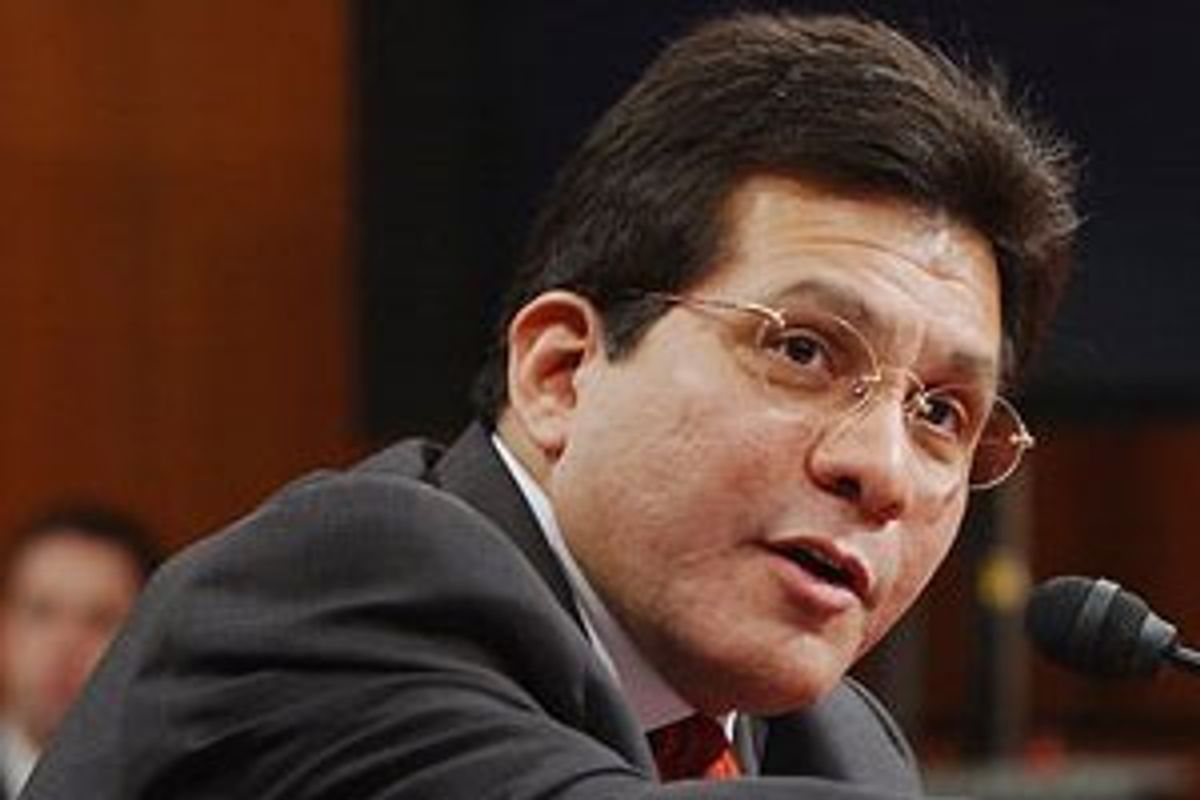
The congressional inquiry into President Bush's authorizing the National Security Agency to wiretap Americans without warrants has now been locked away behind closed-door briefings. But if the public Judiciary Committee hearing earlier this week is any guide, the Senate and House intelligence committees can expect to get no help from Attorney General Alberto Gonzales. He avoided far more questions than he answered in Monday's hearing. In one sense, Gonzales did a masterly job of defending Bush's position, by never acknowledging what he knows that position to be: an extraordinary claim to unchecked executive power.
When asked about facts, Gonzales declined to answer, saying that he could not discuss the operational details of the program. (Except, of course, where selectively disclosing details made the program appear narrow and reasonable, in which case he disclosed them.) And when asked about the law, he repeatedly refused to answer any questions about the consequences of the administration's legal theory by insisting that the questions were hypothetical and did not concern "this program." It was the perfect Catch-22: The senators couldn't ask him about the facts or the law. An exasperated Sen. Patrick Leahy, the committee's ranking Democrat, had it right when he remarked after yet another Gonzales dodge: "Of course, I'm sorry, Mr. Attorney General, I forgot you can't answer any question that might be relevant to this."
Most revealing was the attorney general's persistent refusal to address recurring questions on one essential point: Given Bush's brazen assertion of power, how far does his inherent authority as commander in chief extend? Sen. Dianne Feinstein asked whether this slippery slope would authorize the president to violate the prohibition on covert illegal propagandizing within the United States. The attorney general declined to answer. Sen. Lindsay Graham asked whether the president could override the ban on cruel, inhuman and degrading treatment, which Congress recently reaffirmed in the McCain Amendment. The attorney general again refused to answer. Sen. Edward Kennedy asked whether the president could open domestic first-class mail; Sen. Charles Schumer asked whether Bush could order warrantless searches of Americans' homes; and several senators asked about the wiretapping of wholly domestic calls. Each inquiry met with the same essential response: "It's hard to answer a hypothetical question."
Of course, as every lawyer knows, being a lawyer means always asking -- and answering -- hypothetical questions. The only way to assess whether a legal theory makes sense is to test how it would govern a variety of hypothetical scenarios. That is the premise of the Socratic method, employed in every law school in the country. And that is how legal arguments in court are conducted every day. Surely the attorney general, the nation's top lawyer, knows that "It's hypothetical" is not a sufficient answer to a legal question.
The reason Gonzales spent so much time dodging and weaving is not that he was unable to answer, but that he knows that a candid answer would have been politically unacceptable to the senators and to the American people. His honest answer to all of the foregoing questions would have been the same: Yes, the president could order warrantless searches of Americans' homes, the opening of mail, domestic wiretaps and torture -- because there are no limits on the president's powers as commander in chief to engage the enemy.
That answer is not hypothetical -- it is found buried in the footnotes of a detailed 42-paged single-spaced legal memorandum provided to Congress in January. In that memo, which sought to defend the legality of the NSA surveillance program, the Justice Department argues that Congress may not in any way impede the president's executive authority to choose the "means and methods of engaging the enemy."
That theory knows few if any limits. The Justice Department argues that since electronic surveillance is a "means and method of engaging the enemy," Congress cannot restrict it, even when it comes to spying on Americans without judicial approval, and even though Congress made such conduct a crime in the Foreign Intelligence Surveillance Act (FISA).
In an infamous August 2002 memo on torture, the Justice Department advanced the same theory to argue that the president could order torture despite the existence of a criminal law and a ratified international treaty flatly prohibiting torture under all circumstances. The memo was withdrawn when it became public and jeopardized Gonzales' confirmation as attorney general, but the new memo that replaced it pointedly did not reject the presidential power asserted in the August 2002 memo.
And President Bush claimed the same power, albeit in arch legalese, when he attached a signing statement to the McCain Amendment in December, stating that he would enforce the law "in a manner consistent with the constitutional authority of the president ... as Commander in Chief" -- or, in other words, consistent with the president's authority to violate the law whenever he chooses to do so.
Bush has long sought to cast himself as a disciple of Ronald Reagan -- but apparently his true guide is Richard Nixon. In defense of the warrantless surveillance of Americans involved in the antiwar movement of the 1970s, Nixon infamously claimed, "If the president does it, that means that it is not illegal." Gonzales surely knows that to directly claim Bush can pick and choose which laws to follow and which to violate would resonate disturbingly with Nixon's statement -- so Gonzales avoided doing so by repeatedly contending that, in this instance, the president was acting within existing statutes, not in contravention of them. That argument not only "defies logic and plain English," as Republican Sen. Arlen Specter of Pennsylvania concluded Monday, but it ultimately rests on an assertion of uncheckable executive authority to violate any law deemed by the commander in chief to be in his way.
The argument that the president's actions are consistent with the law turns on the theory that Congress authorized the unlimited warrantless wiretapping of Americans when it authorized the use of military force against al-Qaida in September 2001. Congress' authorization to use force, however, says not one word about the wiretapping of Americans, while another statute, titled "Authorization During Time of War," addresses the issue specifically. This statute dictates that the president may engage in warrantless wiretapping "for a period not to exceed fifteen calendar days following a declaration of war by the Congress." The legislative history explains that if the president needs more extended authority, he should come to Congress during that 15-day period to request that the law be amended. If Congress was willing to grant the president only 15 days of warrantless wiretapping when it declared war, surely one cannot interpret a mere authorization to use military force -- which is far less severe than a declaration of war, and which is entirely silent on the subject of wiretapping -- to authorize unlimited warrantless wiretapping.
Attorney General Gonzales argued that the Supreme Court's decision in Hamdi v. Rumsfeld, involving the detention of an American citizen captured in Afghanistan as an enemy combatant, supports his reading of Congress' authorization to use military force. There, the court interpreted the authorization as providing sufficient statutory authority to detain American citizens as enemy combatants, even though the authorization did not specifically address detention. The court reasoned that detention is a fundamental incident of war, and therefore one could assume that it was part of the authorization. But the difference is that on wiretapping, unlike detention, Congress had already specifically addressed the scope of the authority it would give the president during wartime. Had there been a statute on the books saying that American citizens could be detained only for the first 15 days of a war, and that any further detention would require specific congressional approval, there is no way that in the Hamdi case the Supreme Court would have interpreted the authorization to use military force as giving the president unlimited authority to detain.
Every time Gonzales was challenged on the implausibility of his reading of the authorization to use military force, however, he retreated, characteristically enough, to the doctrine of "constitutional avoidance." He said that as long as the administration's interpretation of the statute was fairly possible, it must be adopted to avoid the serious constitutional question that would be raised if one read the statutes' "plain English" as prohibiting the president's action. But that claim ultimately returns Gonzales to the question he repeatedly sought to duck: namely, does the president have the authority to violate a criminal statute barring him from conducting warrantless electronic surveillance on Americans within the United States?
In the end, Gonzales's argument is circular: You need not reach the constitutional question of executive authority to violate the law, because the president acted consistently with the law. But you must find that the president acted consistently with the law because otherwise the law would be an unconstitutional infringement on the president's powers. At the center of this circle is an astounding assertion of presidential power -- the power to choose the "means and methods of engaging the enemy" without being subject to any legal limits imposed by Congress, whether they be limits on cruel, inhuman and degrading treatment, torture, or spying on Americans.
What the NSA spying debate is ultimately about is this: Do we want to live in a country where the president, like the rest of us, is bound by law, or do we want to live in a country where the president, by invoking the magic words "commander in chief," can order that criminal laws be violated in secret? One thing is certain: The Bush administration will never want a hearing on that question.
This story has been corrected since it was originally published.
Shares