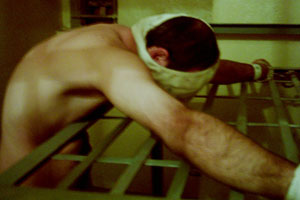

Salon has obtained files and other electronic documents from an internal Army investigation into the Abu Ghraib prisoner-abuse scandal. The material, which includes more than 1,000 photographs, videos and supporting documents from the Army’s probe, may represent all of the photographic and video evidence that pertains to that investigation.
The files, from the Army’s Criminal Investigation Command (CID), include hundreds of images that have never been publicly released. Along with the unpublished material, the material obtained by Salon also appears to include all of the famous photographs published after the Abu Ghraib scandal broke in April 2004, as well as the photographs and videos published Wednesday by the Australian television news show “Dateline.”
The source who gave the CID material to Salon is someone who spent time at Abu Ghraib as a uniformed member of the military and is familiar with the CID investigation.
The DVD containing the material includes a June 6, 2004, CID investigation report written by Special Agent James E. Seigmund. That report includes the following summary of the material included: “A review of all the computer media submitted to this office revealed a total of 1,325 images of suspected detainee abuse, 93 video files of suspected detainee abuse, 660 images of adult pornography, 546 images of suspected dead Iraqi detainees, 29 images of soldiers in simulated sexual acts, 20 images of a soldier with a Swastika drawn between his eyes, 37 images of Military Working dogs being used in abuse of detainees and 125 images of questionable acts.”
The photographs we are showing in the accompanying gallery represent a small fraction of these visual materials. None, as far as we know, have been published elsewhere. They include: a naked, handcuffed prisoner in a contorted position; a dead prisoner who had been severely beaten; a prisoner apparently sodomizing himself with an object; and a naked, hooded prisoner standing next to an American officer who is blandly writing a report against a wall. Other photographs depict a bloody cell.
The DVD also includes photographs of guards threatening Iraqi prisoners with dogs, homemade videotapes depicting hooded prisoners being forced to masturbate, and a video showing a mentally disturbed prisoner smashing his head against a door. Oddly, the material also includes numerous photographs of slaughtered animals and mundane images of soldiers traveling around Iraq.
Accompanying texts from the CID investigation provide fairly detailed explanations for many of the photographs, including dates and times and the identities of both Iraqis and Americans. Based on time signatures of the digital cameras used, all the photographs and videos were taken between Oct. 18, 2003, and Dec. 30, 2003.
It is noteworthy that some of the CID documents refer to CIA personnel as interrogators of prisoners at Abu Ghraib. But no CIA officers have been prosecuted for any crimes that occurred within the prison, despite the death of at least one Iraqi during a CIA interrogation there.
Human-rights and civil-liberties groups have been locked in a legal battle with the Department of Defense since mid-2004, demanding that it release the remaining visual documents from Abu Ghraib in its possession. It is not clear whether the material obtained by Salon is identical to that sought by these groups, although it seems highly likely that it is.
Barbara Olshansky, deputy legal director at the Center for Constitutional Rights, said, “We brought the lawsuit because we wanted to make sure the public knew what the government was doing, particularly at these detention facilities,” and, “It is the public’s right to know.”
Based on a verbal description of the files and images, Olshansky said she believes that the material obtained by Salon represents all of the Abu Ghraib images and video the Pentagon has been fighting to keep confidential. “I’m guessing that what you have is a pretty rare and complete set,” she said.
The Pentagon initially argued in federal court that release of more Abu Ghraib images would violate the privacy rights of the Iraqi prisoners. Later, government lawyers argued that public release of the records might “endanger” soldiers in Iraq because publication of the pictures could incite further violence.
The government’s argument was rejected by a federal district court last September. Judge Alvin Hellerstein said in his ruling, “Terrorists do not need pretexts for their barbarism.” Release of the photographs in the suit has been delayed as the government appeals Hellerstein’s decision.
Meanwhile, military trials of the soldiers who served at Abu Ghraib continue. Next month, two more enlisted men, both dog handlers, will face a military court at Fort Meade in Maryland. No high-ranking officer or official has yet been charged in the abuse scandal that blackened America’s reputation across the world.
Additional reporting by Mark Follman, Page Rockwell and Michael Scherer.
The Bush administration hasn’t heard the last from Philip Zelikow. After the rediscovery last week of his long lost 2006 anti-torture memo, Zelikow, a former State Department official, has written arguably the most damning article yet about U.S. government’s interrogation policies from 2001 to 2009. The article, called “Codes of Conduct for a Twilight War,” will be released in a forthcoming issue of the Houston Law Journal, and was obtained exclusively by Salon. Says Zelikow in an email: “I’m not aware of other accounts that combine historical, policy and legal approaches to” the subject of the Bush administration’s interrogation methods.
Based on published histories and his firsthand observations, and adapted from a lecture delivered in November, the article calls the administration’s rationale for its use of torture — which he nonetheless insists only on calling “extreme interrogation” and “coercive methods” — “radical,” “an amazing contention,” “untenable and extreme,” “unsustainable,” “an unprecedented program of coolly calculated dehumanizing abuse and physical torment,” and, finally, simply a “mistake.” He concludes: “This was a collective failure of American public leadership, in which a number of officials and members of Congress (and staffers) of both parties played a part, endorsing a CIA program of physical coercion without any precedent in U.S. history.” In fact, “The only defense against criminal prosecution would be that officials acted in good faith reliance on the advice of their government lawyers.”
Part of what makes Zelikow’s analysis so damning and definitive is its judiciousness. The article is deeply empathetic of the uniquely fearful situation under which the Bush administration was initially operating. Zelikow calls the Sept. 11 attacks a “collective trauma” and a “shoc[k] to mass beliefs.” He notes that Bush and others spent time in burn units, morgues and with survivors of the attacks. One traumatic experienced often overlooked — overlooked because it appeared in Stephen Hayes’ stenographic biography of Dick Cheney — was that the vice-president’s daughter was (falsely, it turns out) told that her house with her children in it had tested positive for anthrax. Similarly, Cheney and National Security Advisor Condoleezza Rice were told that they and others had been exposed to an extremely lethal toxin in a particular area of the White House — and might soon die as a result. “The alarms did not stop and they too were not abstract … The pressure on Bush and his senior advisers was so direct because so much of the response had to be invented and improvised,” the article reads.
An additional factor in the power of the article is Zelikow’s credibility and history. Before entering government, he was a civil rights lawyer in Texas battling the Ku Klux Klan and then a highly esteemed Harvard historian specializing in U.S. foreign policy — he co-authored one book with Rice. He then served on the National Security Council under President George H.W. Bush and directed the 9/11 Commission before becoming counselor to Rice at the State Department from 2005 to 2007. He currently volunteers part-time on the President’s Intelligence Advisory Board under President Obama.
Such bipartisan, establishment credentials render the breakdown and conclusion of this article all the more damning. He believes that what should have been a political and moral question — should the United States torture captives? — became strictly a legal matter left up to government lawyers, few of whom had any experience with these issues, and who had to take the necessity of extreme measures as a given. “These lawyers then became secular priests, granting absolution to the supplicant policymakers,” Zelikow writes.
The problems began when the Office of the Vice President and the CIA took central roles in policymaking. Cheney felt himself above the rest of the National Security Council, bypassing Rice and other traditional channels of national security policymaking. Ad-hoc decision-making and improvisation became “a habit of thought,” which seemed initially to pay off in the security of the nation, as well as in Bush’s political standing and self-confidence.
With Cheney and CIA head George Tenet “the key entrepreneurs in setting codes of conduct for the War on Terror,” it was essentially left to their obsequious lawyers to decide, in secret, on the interrogation methods America should employ. Bush even told the Senate’s Intelligence Committee chairman that “the vice president should be your point of contact … [He] has the portfolio for intelligence activities.” Decisions were made to jettison international treaties. By December 2001, the CIA was already interested in reverse-engineering methods “heretofore used only to treat Americans to resist enemy torture.” When a senior al-Qaida member was captured in March 2002, the prototype for the administration’s torture policies was already developed. “So, for the first time in American history, leaders of the U.S. government carefully devised ways and means to torment enemy captives.”
Zelikow notes that “None of the policy or moral issues connected with these choices appear to have been analyzed in any noticeable way.” Perhaps worst of all, no serious consideration was given to weighing the costs of benefits of the torture program, with reference to relevant historical precedents and/or examinations of the respective French, British and Israeli experiences in dealing with captured terrorists. “Bush and Rice should have insisted on this,” Zelikow writes.
The 52-page article observes the successes of Obama’s counterterrorism policies after repudiating the use of torture. On the basis of the empirical evidence then, “[t]here is no evident correlations between intelligence success and the available of extreme interrogation methods,” no matter what Bush and Cheney claim. Finally, “The program’s costs — which include the high-level effort expended in order to establish, maintain, and defense the program — appear on the evidence so far to have well outweighed any unique value the program might have had as a method of counterterrorism intelligence collection.” This is apart from the damage to America’s international standing and corrosion of its traditional values.
Zelikow concludes his analysis by arguing that, although the Obama administration has the right to wage war and use extralegal methods to defeat al-Qaida, its claim of that authority to defeat “associated forces” is unwarranted. “The U.S. government should publish and explain any overarching policy and legal documents that guide and confine the conduct of deadly operation against its foreign enemies … the executive branch of the U.S. government has a duty to articulate the scope of its warfare to the Congress and the public.” The Bush administration’s unprecedented elevation of torture to national policy may be history, but the job to get U.S. foreign policy in line with its constitutional and moral obligations is far from over.
Jordan Michael Smith writes about U.S. foreign policy for Salon. He has written for the New York Times, Boston Globe and Washington Post.
More Jordan Michael Smith.
In February of 2006, Philip Zelikow, counselor to Secretary of State Condoleezza Rice, authored a memo opposing the Bush administration’s torture practices (though he employed the infamous obfuscation of “enhanced interrogation techniques”). The White House tried to collect and destroy all copies of the memo, but one survived in the State Department’s bowels and was declassified yesterday in response to a Freedom of Information Act request by the National Security Archive.
The memo argues that the Convention Against Torture, and the Constitution’s prohibitions against cruel and unusual punishment, do indeed apply to the CIA’s use of “waterboard[ing], walling, dousing, stress positions, and cramped confinement.” Zelikow further wrote in the memo that “we are unaware of any precedent in World War II, the Korean War, the Vietnam War, or any subsequent conflict for authorized, systematic interrogation practices similar to those in question here, even when the prisoners were presumed to be unlawful combatants.” According to the memo, the techniques are legally prohibited, even if there is a compelling state interest to justify them, since they should be considered cruel and unusual punishment and “shock the conscience.”
Chillingly, the memo notes that “corrective techniques, such as slaps,” may be legally sustained, as might be “[C]ontrol conditions, such as nudity, sleep deprivation, and liquid diets…depending on the circumstances and details of how these techniques are used.” However much distress Zelikow’s memo caused the White House, it was not an ACLU briefing paper.
“I’m pleased the memo is now part of the historical record and available for study,” Zelikow wrote Salon in an email. The White House had determined that the memo — which was not binding since Zelikow’s was a bureaucratic position without legal authority — was too dangerous to exist. “I later heard the memo was not considered appropriate for further discussion and that copies of my memo should be collected and destroyed,” he said in a May 2009 congressional hearing.
At that hearing, before the Senate Committee on the Judiciary, Subcommittee on Administrative Oversight and the Courts, Zelikow said he had “no view on whether former officials should be prosecuted,” a decision he thinks should be left to “institutions.” However, he did call for a thorough inquiry and a public report examining how the U.S. came to employ torture.
Of course, no such inquiry was ever launched. The Obama administration declined to revisit the U.S. employment of torture, with the president saying he didn’t want to “look back.” Zelikow believes this was a mistake. “I still believe an inquiry would be useful, though less so as time passes and more information becomes available, especially after the 9/11 trials conclude, hopefully this year,” he says in an email.
During his congressional testimony, Zelikow declined to say whether Department of Justice lawyers acted improperly or immorally, conceding only that their opinions were “unsound, even unreasonable.” But in a 2007 lecture in Houston, he had no problem saying “the cool, carefully considered, methodical, prolonged, and repeated subjection of captives to physical torment, and the accompanying psychological terror, is immoral.”
The importance of the memo lies in its revelation that there was real, serious debate inside the Bush administration about how to interrogate captured terrorist suspects. The members of the White House declined to enter that debate — indeed, they did their best to squash it. The destruction of Zelikow’s carefully reasoned memo suggests the White House did not want any record of alternative views even existing, lest they be considered reasonable or people get the idea that the torture policies were thought controversial even by members of the administration.
Jordan Michael Smith writes about U.S. foreign policy for Salon. He has written for the New York Times, Boston Globe and Washington Post.
More Jordan Michael Smith.
A lawsuit between two aviation companies concerning a couple hundred thousand dollars in unpaid expenses has inadvertently led to the publicizing of a great deal of information about the CIA’s extraordinary rendition program. (The program involved the illegal transport of thousands of terrorism suspects to secret CIA prisons in foreign nations and then to countries where suspects could be tortured. It is basically “kidnapping” followed by “torture” but the CIA did it so no one went to jail for it.)
The records from this lawsuit between two sub-contractors involved in the renditions will eventually be taught in an undergrad history course titled “America: Where It All Went Wrong.” Detainees were transported by the same companies that fly billionaires on private jets to their resort vacations. (The CIA doesn’t have an air force, so they relied on massive government contractor DynCorp, which… just rented some private planes.)
We learn that the CIA provided the flights with letters from a fictional State Department official (the State Department was almost certainly not involved in the rendition program) providing diplomatic cover.
We learn that one the planes used to transport a suspect (Abu Omar, captured in Italy and tortured in Egypt) was owned by the co-owner of the Boston Red Sox. The plane sported a Red Sox logo on the tail. I mean a Yankees plane might’ve been more poetically apt but either way it seems like such a pat symbol of America’s behavior in the wretched first decade of the 21st century that I’d roll my eyes at it if it turned up in a piece of fiction. An executive’s private plane, sporting the logo of a rich baseball team and carrying an Imam captured overseas by the CIA, touches down in Egypt, a nation led by an American-backed strongman, where the Imam is to be tortured. What preachy liberal hack dreamed up that one? (The executive also owns part of Liverpool FC, because we can’t forget Great Britain’s help in all this.)
Then the hedge funds took an interest in privatized torture:
DynCorp was purchased in 2003 by Computer Sciences Corp., another leading federal contractor, in a $940 million merger. Computer Sciences Corp. then took on a supervising role in the rendition flights through 2006, according to invoices and emails in the court files. CSC sold three DynCorp units in 2005 to Veritas Capital Fund, a private equity firm, for $850 million, but retained ownership of other parts of the old company. Veritas in turn sold the restructured DynCorp — now known as DynCorp International — for about $1 billion in 2010 to Cerebrus Capital Management, another private equity fund.
So at least a couple rich people got even richer off of our national shame. There’s an upside to everything.
Alex Pareene writes about politics for Salon and is the author of "The Rude Guide to Mitt." Email him at apareene@salon.com and follow him on Twitter @pareene
More Alex Pareene.
The official government narrative, as defended by Donald Rumsfeld, is that no prisoners were waterboarded at Guantanamo Bay; the CIA did use waterboarding as an interrogation technique, but only at so-called “black sites”; and only three prisoners were subjected to this treatment.
However, new evidence is emerging to the contrary, largely in anecdotal form. As Truthout reported this week, a number of stories have come out about forced water choking and other uses of water for torture at sites including Gitmo.
Investigative reporter Jeremy Scahill discussed the issue with Keith Olbermann Thursday. He recalled an incident he had investigated (which would not be classified as waterboarding) of a former Guantanamo detainee having a high pressure water hose fixed up a nostril. Water would be forced up his head until suffocation.
Scahill noted President Obama’s “extremely poor record” at holding people accountable for torturous acts and expressed concern that little has changed at Guantanamo.
Rumsfeld currently faces a lawsuit over the alleged use of torture, bought by a former military translator held in Iraq for nine months, but Scahill emphasized that the U.S. administration always tends to get its people off the hook.
Natasha Lennard covers the Occupy movement for Salon. A British-born, Brooklyn-based journalist, she has been covering Occupy Wall Street since before the first sleeping bag was unrolled in Zuccotti Park. One of the first journalists arrested at an Occupy action, she has managed to enrage Andrew Breitbart, Rush Limbaugh and Glenn Beck. You can follow her on Twitter (@natashalennard), and email her any Occupy updates/videos/ideas to natasha.lennard@gmail.com
More Natasha Lennard.
Remember Marc Thiessen, the former Bush speechwriter whose black heart loves nothing in this world besides the torturing of America’s many enemies and people who have been mistaken for our enemies? You know, the guy who has a Washington Post column, for some reason? He wrote a lie, at the Washington Post, this week! (Because he is a liar. In addition to being morally reprehensible, he also lies.) Via Adam Serwer, here’s what Thiessen said in a blog post about how Obama likes to “catch and release” terrorists, like little baby fishes:
The United States’ top special operations commander told Congress that because the United States has no place to hold captured terrorists we have simply been letting them go.
That is a lie. Even leaving aside the fact that it was written in support of an argument in favor of lawless, endless, indefinite detention forever, it’s not true.
Vice Adm. William McRaven said releasing people if they can’t be tried or send to a third-party nation “is an option.” He never said it had been done, let alone that it was the Obama administration’s standard operating procedure.
If you want the rest of the story of how Thiessen is misrepresenting the Obama administration’s anti-terrorism activities, go back to Serwer’s post. I just want to point out, once more, that Thiessen lied, in the Post, and I would like to ask if anyone at the Post cares about that.
Fred Hiatt, the Post’s editorial page editor, did specifically hire Thiessen after Thiessen wrote his book about how much he loves torture and how wonderful it is to torture people, so “staggering moral depravity” obviously does not disqualify you from a columnist gig at that fine newspaper. But I’d think lying to the readers would be frowned upon!
Not that George Will has ever gotten in trouble for repeatedly, purposefully and maliciously lying about climate change, but climate change involves “science” and editors and reporters and ombudsmen don’t understand “science”; they just understand that reasonable people disagree about it. This, on the other hand, is a very simple lie about someone’s testimony to Congress, which is very easy to find and check.
It is also a pretty minor offense, compared to repeatedly and misleadingly defending torture, but I’ve found newspaper types tend to feel like they’re on safer “objective” ground going after someone for a factual error than for a horrible, fascistic worldview.
Alex Pareene writes about politics for Salon and is the author of "The Rude Guide to Mitt." Email him at apareene@salon.com and follow him on Twitter @pareene
More Alex Pareene.