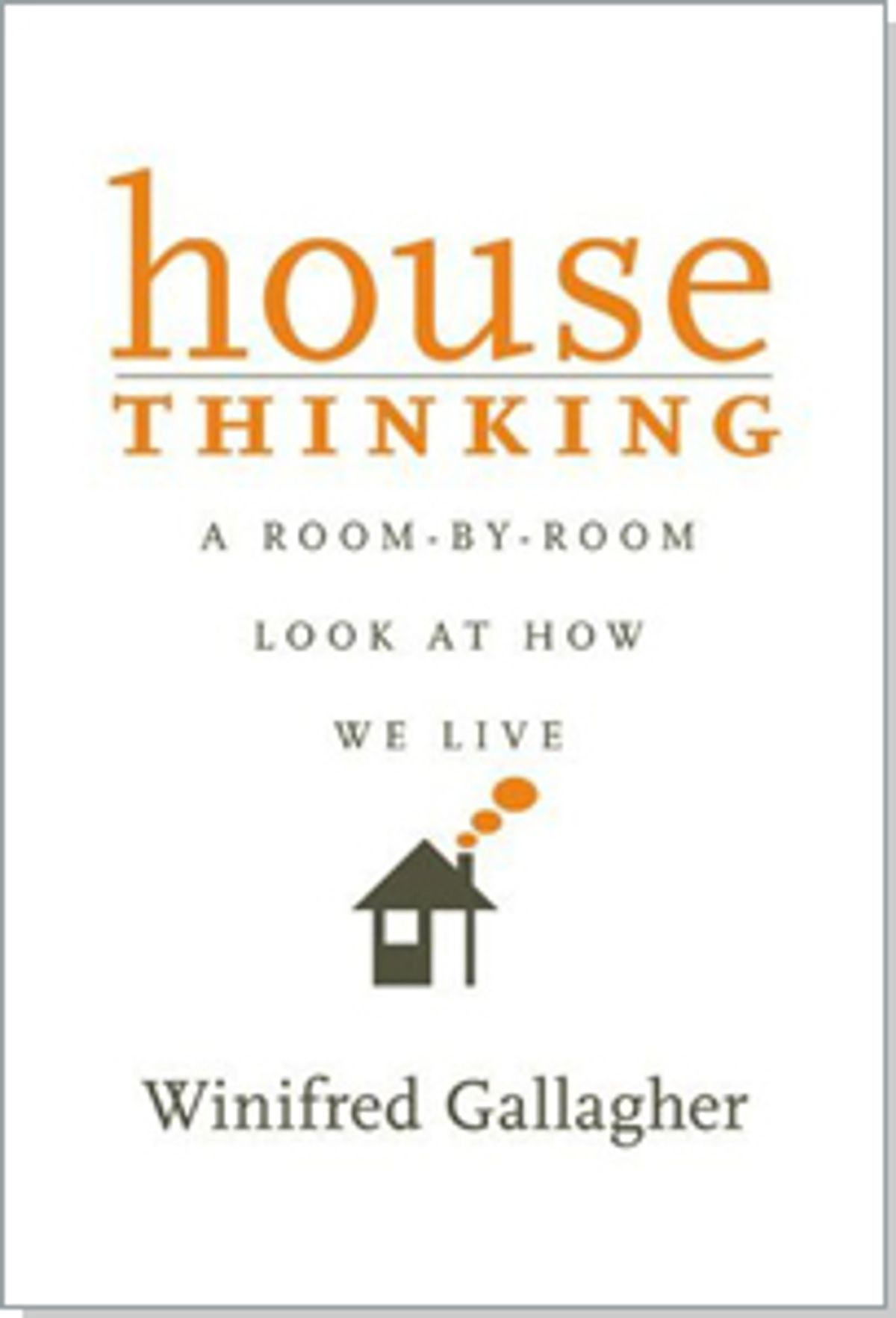
Wini Gallagher has a beautiful home. It's the kind of home that makes you want to take your shoes off upon entry, not out of obligation, but because you want to curl up in every chair, light every white candle on the dining room table, even use the fancy toilet. Gallagher's is the kind of home that makes you cringe when thinking of your own dining room table covered with tax returns, your bedroom floor moonlighting as a closet and the substance growing on your bathroom wall that you've left ignored for too many days. What is abundantly clear, both from touring her house and reading her new book, "House Thinking: A Room-by-Room Look at How We Live," is that Gallagher has put a lot of thought into her home -- an act she insists is all that stands between most of us and the domestic sanctuaries of our dreams.
"House Thinking" is neither a how-to book nor a treatise in behavioral science, but instead tells the story of the American home through historical anecdotes, personal narrative and sociological studies. In it Gallagher, 59, draws from the expanding field of environmental psychology to explore how home design can bring out our "best selves." Devoting a chapter to each room of the house, Gallagher explains, for example, that the bedroom is a place for sleep and sex, not a storage closet (though, she admits, when she started the work, that's what hers was fast becoming).
"House Thinking" is also a sequel to Gallagher's first book, "The Power of Place," which looked at the ways that environments affect our behavior by examining everything from the impact of seasons on the Alaska population to the kinds of places that induce drug abuse. While it may be tempting to dismiss environmental psychology as yet another New Age way for high-income families to spend their money, Gallagher's work is grounded in the belief that significant changes can be made at little cost, no matter how humble or luxurious your home. Indeed, on the tour of her own house, Gallagher did not neglect to point out the myriad inexpensive changes she had made -- choices as simple as moving the television from the living room's center to a corner and placing a yard sale couch in the dining room to provide a place to relax after a meal.
I spoke with Gallagher in the living room of her prewar townhouse on Manhattan's Upper West Side about America's ever-expanding suburbs, the birth of vanity, and Eastern versus Western toilet etiquette.
What got you thinking about "House Thinking"?
When I was working on "The Power of Place" there was an enormous concentration -- which there still is -- on how our internal neurochemistry can affect our behavior. And that seemed to me to be very lopsided. I believe that the environment, and not just the social environment but also the physical environment, has a big impact on behavior. And science up until the turn of the 20th century thought that too -- it was so-called geographical medicine. Doctors would tell patients afflicted with melancholy (which we call depression) to go to a sunny place to feel better. It actually works.
Our culture doesn't look at the effects of the environment on behavior. We talk about social relationships and neurochemistry. But it's not just my opinion that environment affects behavior. There's real solid research from environmental psychology, from psychiatry, from design, architecture, cultural history. A Roman doctor in the second century said, "Melancholics are to be laid in the sunshine, for their disease is gloom." The American Psychiatric Association didn't recognize seasonal affective disorder until the '80s, but the ancients recognized it and knew how to treat it. We can actually do much more to improve the quality of our lives for little or no money.
In many low-income communities aren't serious afflictions like asthma and lead poisoning brought on or exacerbated by the environment?
That's something very rarely mentioned when we talk about the consequences of poverty. One of five American kids grows up in poverty, and those children face enormous environmental as well as social and nutritional deficits. There are kids in America who don't have a single nook, much less a room, of their own. Maybe they have one drawer or maybe not even that. They have no place to go to study. There are huge numbers of people living in small places because they can't afford better housing, so everyone's activities have to go on in the same tiny little space. Those are the kinds of situations that really would drive middle-class people crazy. And yet there's an enormous number of kids growing up like this.
Are there environmental "prescriptions" for people living in those situations?
There are things that can be done. For example, in railroad-flat apartments that are common in tenement buildings, there is great potential for creating private nooks and crannies. So a kid could have maybe have one little corner of one of those rooms, a place that's his or her own for a specific period of time. There are lots of simple things like that that don't really cost very much, but we don't think about them, so we don't do them.
But isn't that the sort of thing that requires a family discussion to figure out -- to say, this corner is going to be Junior's and this is Mom's? And it's not possible to have those conversations in every family.
Absolutely. Certainly in New York City there are plenty of middle-class families where kids share a room, and there's nothing wrong with that. It's ideal to have your own room because it gives you more privacy and more control -- things that are very important for the development of the self. But other interesting things can be done. I've been to houses where people put up shower curtains dividing the room down the middle so that if somebody wants to read in bed and somebody wants to go to sleep, they can. There are lots of simple, easy things you can do -- but you can't do them unless you go back to the principle that your environment really does affect your behavior and your behavior means your thoughts, your feelings and your actions.
You talk about how important it is to have a room of one's own, but you also admit that the American obsession with privacy and individualism can get in the way of our sense of neighborhood and community.
Americans have always moved more than other societies, but in the last 20 or 30 years, things have really started to pick up. Around 20 percent of us move every five years, and some very mobile young professionals move every year. And there are corporate families that just move from one giant subdivision of McMansions to the next. This is very different from the way America started, which was as an agrarian, small-town culture where people really knew each other and where there was a lot of community support. When I grew up in the Philadelphia suburbs, literally every relative in my family lived a half an hour away. So when a grandparent got sick there were six people to visit the hospital and to take care of things; when a new baby came there were four aunts.
That doesn't exist anymore for most people. In my own family, I have a son in Seattle, I have a daughter who just moved back to New York from Wyoming, and we have another kid right now up in Boston. We have two at home, but they'll soon be gone. That is now considered the norm and a good thing -- and in some ways it is fun and exciting -- but you also lose the whole extended family network and the neighborly network.
Is there anything you think can help counter that trend?
It's hard, because I think that a lot of people have never known anything else, so they don't know what they're missing. Certainly my younger kids really never experienced block parties, neighbors who would have a key to your place and take care of it when you're away. We had nannies and babysitters -- we paid people to create the sort of social network that used to be a very easy thing to have. I think, especially in big suburbs that are very car-oriented -- and most Americans live in suburbs or exurbs -- you literally get up in the morning, you get into your car in the garage, you click a button, you drive out of your garage, you go to an industrial office park, you drive to another big mall to do your shopping, and drive home. You never have to set foot in your neighborhood.
So what attracts people to that lifestyle?
I did some reporting for the book at Mount Vernon, George Washington's home. I think you can make a good case that Mount Vernon is the archetypal American home, a dream home. It was the Washington family farmhouse, a modest one and a half story farmhouse that he turned into a prototypical McMansion. He glorified it and gussied it up so that it looked fancy but was basically a farmhouse -- which studies show is still America's favorite type of home.
If you ask Americans about their dream home, they want a single-family detached home in a pastoral setting. And that's what our suburbs are all about. They're not as big as Mount Vernon, but that is the type. And even some of the elements like white columns and the shutters and the bricks, the whole look of the place, those things are cultural icons that keep popping up. Why was the farmhouse so important back then? Because a lot of the people coming here were used to an oppressive European class system where to have your own farm was to be independent. It's all very tied up with our idea of what it is to be a free person, what it is to be independent. I just came back from Wyoming, and you really see it writ large out West that your land is your fiefdom. I'm not trying to bash suburbs -- I grew up in suburbs largely -- and there are real advantages, behavioral advantages, to suburbs.
Like what?
The main reason people like suburbs is that they give you the most control over your environment for the least amount of annoyance. You would presumably have total control over your environment if you lived on a farm in complete isolation, but that's inconvenient. People sacrifice a lot to live in the suburbs because they are putting distance between them and annoyance, which gives them a feeling of control. I like urban life, but if my neighbor is playing rap music and I can't sleep at night because it's coming through the walls, that's extremely annoying.
Are suburbs and McMansions particularly American phenomena?
I know in Europe it's much more regulated. I'm always impressed when I go to France because it seems to me that the French have a very good way of incorporating the new while still preserving what's best about the old. It's really a pleasure to drive around to old French towns and see how they have maintained the old agrarian model, where people live in the town and farm out in the field, so that you don't have everything all messed up together. I think here, again as part of our independence -- we think, well, if I have the money I can buy this property and do anything I damn well please on it. It's part of that "live free or die" spirit that just makes it difficult for some people to cooperate for the greater good. And it's really spectacular if you look at it in terms of child rearing -- American babies not only have their own cribs, a lot of them have their own rooms! In much of the world that would be considered bizarre. I mean right from the get-go we are raised to be independent and to value a lot of privacy and space around us.
Why are you attracted to living in the city?
Well, I think because of temperament, probably, I have this house, but then I also have a home that is almost the extreme opposite -- a one-room schoolhouse in a very remote corner of northwest Sullivan County near the Delaware River. Out there it's all dirt roads and there's hundreds of acres of woods around us. My temperament, my nature, is just to want to be connected and busy and have a lot of things to do but then to go where I can really shut that off. I can be very happy up there for days and days and days without seeing a soul. But I'm just an example. Everyone should be thinking about their homes in terms of their temperament.
One of my favorite chapters in your book is the bathroom chapter. I found it especially interesting that you pay particular attention to the bidet, even though it's an oddity in most American homes.
You know, in India where I've traveled a lot, beside the toilet -- which might be a squatter -- there is a faucet. So, in that culture toilet paper is considered gross. I read somewhere that Salman Rushdie, while talking about dividing his life between the East and West, said that he was for both toilet paper and water -- and I'm kind of with him there. But I went to the penthouse apartment in the Trump Towers over by the U.N., and they had an open house, and they had gold-plumbing faucets and huge million-foot ceilings with views to the Catskill Mountains, but the bathroom had no bidet.
For myself, from a behavioral view, I'm in favor of comforting, sheltering, low-technology bathrooms. So, after working on the book, I removed the bathroom scale from mine because every time I looked at it I would say, "Oh, that reminds me: I have to go on a diet" -- which is just a negative message because I'm not going to go on a diet anyway. So I got rid of the scale, and now it's a very simple kind of low-key pleasant bathroom. I put a plant in it because the bathroom is all about water, and water is nature, so it's actually a very nice place to make a natural part of your home.
So we don't need to rush out and get Jacuzzi jets in order to relax?
No! Well, maybe you do. If that's what makes you happy in your bathroom, fine. What I question is, Do you really need to have the giant mirrors that magnify every flaw? Do you really need to have a doctor's scale so you can say, "Oh God, I'm four ounces more than I was yesterday! I can't have lunch."
I think it's fascinating that until the Industrial Revolution a mirror was something that only very, very, very rich people had. They were real rarities. When they could be produced cheaply, then people started looking at themselves, but for most of history -- we're talking until barely a hundred years ago -- most people didn't have that much of a sense of what they looked like from day to day, much less hour to hour. So they just didn't brood about it the way that we do.
You also discuss how some of the obsessive attitudes we have about our bodies -- like anorexia nervosa and bulimia -- have developed alongside the changes in the technology of the home.
Yes. Well, until after World War II most people did not have scales in their homes. You went to the doctor and you got weighed, or maybe there was a health day at your school and everybody lined up and got weighed, but it was not this thing where people were obsessed with it. So there is a big technological component to our neurosis. I think of the bathroom as neurosis central, because it's the place where people who have a disorder like obsessive tendencies do a lot of their ritual cleaning and cleansing. And we have all these anti-germ products now that don't do any good, but people buy them anyway. With binging and purging, the purging is done in the bathroom. So I just really think it is place we should think about carefully. We need to ask ourselves, "Is my bathroom helping me feel good about myself and sending me positive messages, or is it making me feel that there's something wrong with me every time I go in there?"
If the bathroom is the site of such anxiety, what is the place in your home or where do you feel most at ease?
You know, I think most people would reply to that question with what they thought was the prettiest room in their home, but I'm not concerned so much about attractiveness. I mean, I am, but it's a matter of "Does this space support what I need to do there and what my life is like?" So which room do I think is the prettiest room in my house? Probably the living room. But I love my home office upstairs because that's my life, that's my nerve center. And the dining room is a very important place, because our family makes a big effort to eat at least five dinners together every week. And we entertain a lot; we like to have friends for dinner. So that's a very important social place for me.
America is a diverse place with many different kinds of homes and families -- but do you think there are some things that we all want from our houses?
That's an excellent question. There are really two things that all homes should do, whether it's a studio apartment or a mansion, and that is they should support the inhabitant's private life. Whatever you want to call it, they should be a refuge, a shelter -- a place that separates you and buffers you from the mad world outside. But they should also allow you to be as sociable as you want to be.
Those two impulses are really universal. They're what Frank Lloyd Wright called "nesting and perching," and they're what Grant Hildebrandt, an architect in my book, calls "prospect and refuge." A brilliant psychiatrist I once interviewed said, "The whole problem of being human, the whole challenge of being human, is to find the balance between our autonomy and independence and our need for other people and our interactions with other people." And the home is the place where we do both.
Shares