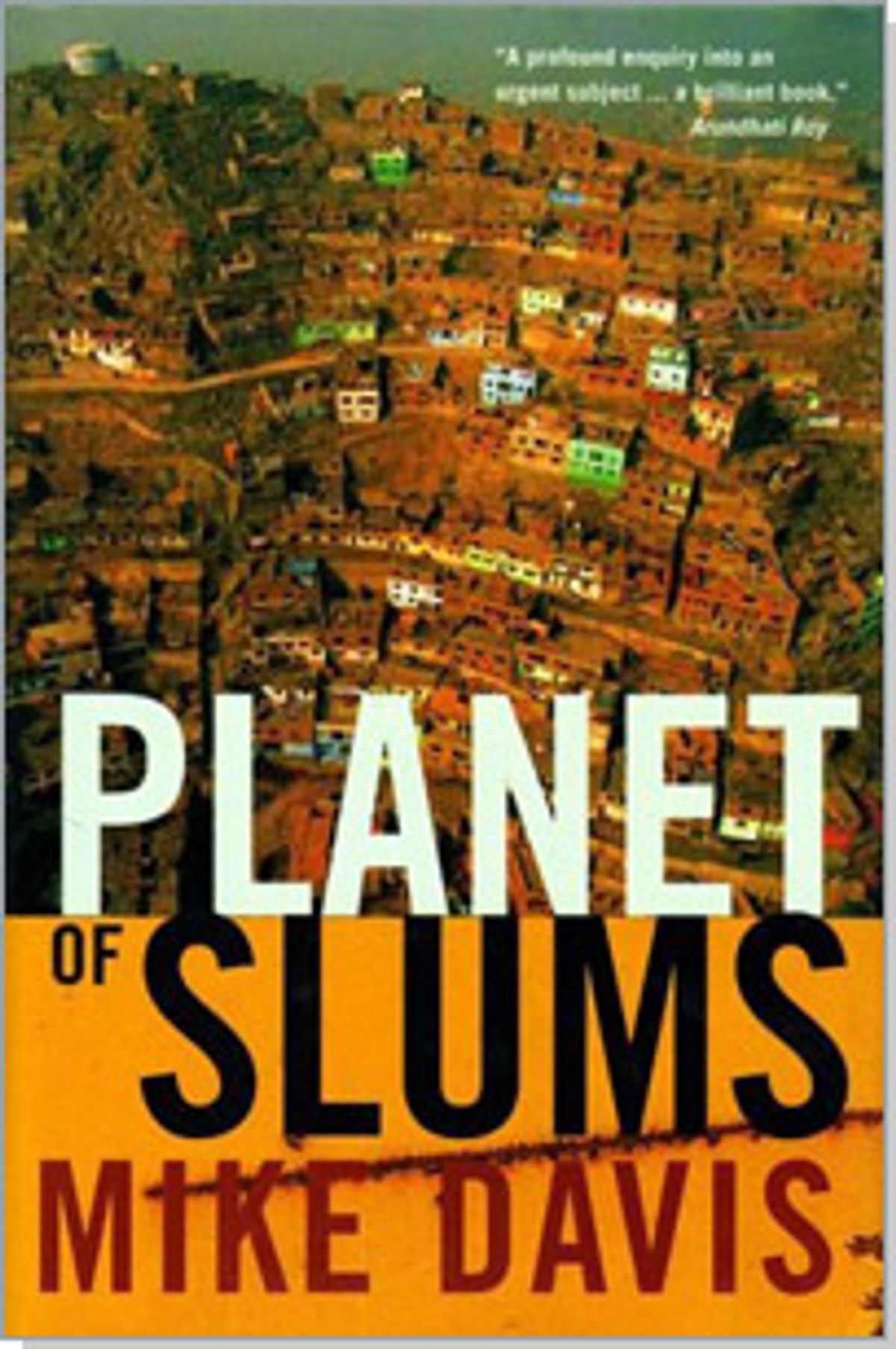
In case global warming, avian influenza, AIDS, terrorism, nuclear proliferation, Chinese nationalism, epidemic obesity and the state of the Knicks don't have you worried enough, Mike Davis has a new reason to panic: Planet Earth is turning into a giant slum. For the first time in human history, the world's urban population now equals its rural population, and the balance tilts further toward the cities with each passing year. The overwhelming majority of this growth is occurring in shantytowns and tenements stretching from Karachi, Pakistan, to Lima, Peru, where people live crowded together in densities that sometime dwarf those of such notorious 19th century human anthills as New York's Mulberry Bend. As of 2005, a billion people were living in slums, and the number is rising by 25 million per year.
The proliferation of slums is an ironic rebuke to the modernist vision of the city of tomorrow, which prevailed until a few decades ago. "The cities of the future," writes Davis, "rather than being made out of glass and steel as envisioned by earlier generations of urbanists, are instead largely constructed out of crude brick, straw, recycled plastic, cement blocks, and scrap wood." The high modernist dream has been pronounced dead before, beginning in the 1970s, when Jane Jacobs first attacked skyscrapers and freeways in favor of the organic, variegated human-scale neighborhoods such mega-projects often bulldozed. But the slums that hold 39 percent of China's urban population, 55 percent of India's, and an incredible 99 percent of Ethiopia's (according to U.N. figures) make a mockery of Jacobs' "urban ballet." In Davis' words, "Instead of cities of light soaring toward heaven, much of the twenty-first-century urban world squats in squalor, surrounded by pollution, excrement, and decay."
It's not surprising to hear such apocalyptic rhetoric from Mike Davis, who has spent his literary career taking on one disaster after another. His classic "City of Quartz" critiqued the chaotic urban history of Los Angeles. "Late Victorian Holocausts" recounted the devastating famines afflicting British colonies in the late 1800s. And "The Monster at Our Door," published just last fall, sounded the klaxon over avian influenza's threat to mutate into a massive human pandemic. It is hard to dismiss Davis as a serial Chicken Little; his books are simply too well researched. For "Planet of Slums," he has digested acres of reports by U.N. agencies, governments, academics and nongovernmental organizations, along with obscure architectural papers bearing titles like "The Incidence and Causes of Slope Failure in the Barrios of Caracas."
Yet Davis' relentless dourness does tend to make his conclusions less trustworthy. He has a penchant for arguing against all sides of an issue. In Chapter 3 of "Planet of Slums," "The Treason of the State," Davis excoriates neoliberal governments that fail to build housing for the poor -- and criticizes those that do, like China and Thailand, because their high-rises are too far from poor people's jobs, or lack the community feeling of the old slums. In Chapter 4, "Illusions of Self-Help," the reader learns that granting squatters legal title to their land is a false solution that only enriches speculators -- and that not granting squatters land titles leaves them at the mercy of gangs and police who demand payment for squatting rights. Reading Davis can be a bit like sitting down at a bar next to a guy who starts out lambasting the president and then proceeds to ridicule the opposition, leaving one with the impression that he doesn't actually vote.
Well, one might say, what do you expect? It's a book about slums. What's to like? But, in fact, many urban thinkers have had positive things to say about slums. For example, Davis in several places cites papers published as part of a 2002 conference on African urban issues titled Under Siege, held in Lagos, Nigeria. I was at that conference, and the tone, while sometimes apocalyptic, was a lot more enthusiastic than one would expect from reading Davis.
The conference's most illustrious presenter was the Dutch superstar architect Rem Koolhaas, who had just finished a four-year study of Lagos conducted with his students at the Harvard Graduate School of Design. Koolhaas is an inveterate contrarian, the kind of guy who can find humanism in a concrete access ramp, and his take on Lagos was typical. He said his initial impression of the city, driving in along the freeways that stretch over its lagoon and seeing only the indistinct forms of shanties through masses of rising smoke, was as a sort of modernist hell. Gradually, however, he realized that what he was seeing was Ebute-Metta, Lagos' partially waterborne sawmill district, where giant rafts of logs floated down from the country's surviving rain forests are hacked up by hundreds of small lumber companies. What at first appeared as pure negative chaos was in fact a complex, unstable and highly creative informal economy.
Koolhaas and his students came to realize that all of Lagos was like this. The book they published, "The Lagos Project," presents dozens of examples of the city's mash-up economy: the world's largest markets for used electronics and auto parts; unfinished public housing taken over semi-legally, the units rebuilt in jury-rigged expansions by the residents; a never-completed butterfly highway access ramp converted into a cantilevered village by informal colonists, complete with market stalls and a church. Koolhaas coined the term "flexscape" to denote large indeterminate structures, like highway overpasses or abandoned freighters, which can be creatively reappropriated and made to serve changing local needs. He came to see the city not as a dystopian nightmare or ruin, but as a giant hive of recombinant, sometimes cannibalistic creative energy. Lagos is often termed "unlivable" by Westerners and even by its own inhabitants; but as Koolhaas pointed out, 12 million people live in this unlivable city, and somehow, on their own terms, they make it work.
Davis does acknowledge the views of such slum enthusiasts. In the 1970s, in particular, social scientists in Latin America wrote of "slums of hope," where families staked an informal claim on open land and built a shanty in the expectation of gradually working their way up the income ladder, into the middle class. But he invokes these optimistic progressive visions of the slum in order to dismiss them. Davis argues, rather trenchantly, that the rising inequality associated with globalization and the neoliberal economic policies of the Washington Consensus have sawed through that income ladder. The very fact that slums are growing much faster than the urban population overall is proof that the "slums of hope" are mostly hoping in vain.
One of Davis' most original observations is that the explosive growth of modern third-world cities stands the model of Europe's Industrial Revolution on its head: It is not generally driven by economic growth. In East and parts of South Asia, the new jobs are there, but not in Latin America and certainly not in Africa, where countries have been losing industrial jobs since the 1980s even as their cities ballooned. Today's migrants are not lured to the city by the promise of prosperity, but are driven from the countryside by ever direr poverty, population growth, environmental damage, war and the increasing global domination of high-tech agribusiness. "'Overurbanization,' in other words," Davis writes, "is driven by the reproduction of poverty, not by the supply of jobs." In the cities, they survive not by finding formal employment, which scarcely exists, but by scrabbling together an existence as petty traders, artisans or day laborers -- entering the so-called informal sector, which Davis argues generally subdivides the existing economic pie into ever-smaller pieces. The starkest example is Kinshasa, a city that continues to grow even as the Congo it supposedly governs has fallen off the map of the world economy.
Davis goes on to sketch the proliferation of hysterical witchcraft accusations against Kinshasa's unfortunate children. He then tops off his "Oliver Twist" meets "Blade Runner" vision of the global urban present with a chapter on the only U.S. government agency he thinks really "gets" the transformations underway in the Third World today: the Defense Department, whose planning for anti-insurgent guerrilla warfare in urban environments has gained fresh impetus from the conflict in Iraq. Davis sketches Baghdad as a kind of blueprint for the future of the planetary city, the world of the "war on terror" as a magnified New Los Angeles, with the police helicopters of the first world's gated communities perpetually hovering over the permanent low-grade conflict of the Third World's smoldering slums.
It would certainly make a great movie. And it's a brilliant paradigm for thinking about global inequity: "Planet of Slums" is the first book I've read to consider globalization through the frame of the urban landscape. But again, Davis sometimes strays too far to the noir side of his cinematic imagination. In my own experience of some of the slums Davis describes, I haven't found them as bleak as he does. He cites an Organization for Economic Co-operation and Development study hypothesizing the West African coast from Lagos to Accra, Ghana, as a single vast urban poverty zone by 2020; it's possible, but today much of this coast still consists of tiny raffia-hut villages under palm trees, or uninhabited scrub. And Davis utterly fails to capture the organic vibrancy and thriving street life that can make slums attractive: the elbow-to-elbow throngs of Lagos' Idumota market, where Igbo teenagers hand-spool videotape for local shot-on-video feature film studios, choking in the exhaust of thousands of tiny electric generators; the alleyways and gray tile roofs of Beijing's packed old hutongs, where barbers trim hair on the sidewalk in front of mirrors hung from tree trunks; the sunny, grassy shantytowns of Capetown, South Africa's Khayelitsha.
A romance of picturesque poverty? Sure. It's easy to be charmed by Khayelitsha when you live in Tamboerskloof. But like Davis' Bangkok residents who preferred their old slums to the new public housing projects, at least some slum dwellers enjoy aspects of their neighborhoods -- many of which they themselves have created. What Davis' book misses is any acknowledgment of positive agency on the part of the millions of people who move into slums each year. More important, it lacks any acknowledgement that some of the negative outcomes he describes from housing policy toward the poor are the result of inevitable tradeoffs. Davis scathingly depicts the miseries of slum life in one chapter and the miseries inflicted by slum clearance in the next, without ever suggesting what other choices might be possible. "Planet of Slums" is a brilliant book, but it might have benefited from a calmer analytic tone, more like the one taken by Jared Diamond in last year's "Collapse" -- an acceptance that even catastrophic social developments result from bargaining and competition between different groups with different outlooks and interests, and that perfectly bad solutions are as rare as perfect ones. It's gratifying to see that Davis is now at work on a book about what agents of change might lead to positive improvements in the situation of the global poor. Davis is extraordinary at staring into the abyss; it'd be nice if he started telling us where the handholds are.
Shares