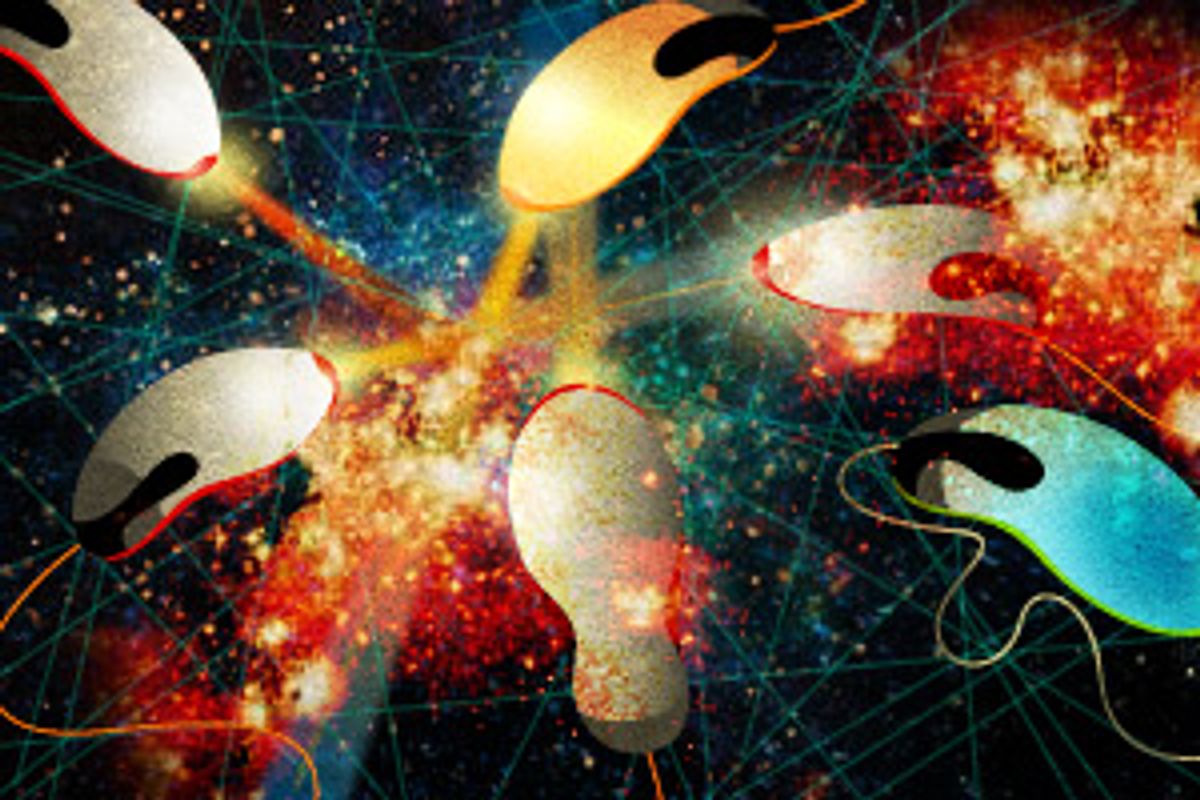
New books by Instapundit and Kos present dueling visions of the future -- as libertarian paradise or populist battleground.
Do bloggers lean left or right? Does the blogosphere have an ideological tilt? Such questions once engaged mainstream reporters and pundits struggling to understand an upstart online movement. During the post-9/11, pre-Iraq explosion of “warbloggers,” we were told that blogs gave voice to red-state anger and conservative values. Then, during the heyday of Howard Dean’s outsider campaign, we heard that they instead embodied a new progressive populism.
Now, the pointlessness of these questions seems plain. You might as well ask, “Do writers lean left or right?” — or, “Does the world have an ideological tilt?” As millions of blogs reflect the passions of millions of people, statements that “Bloggers are [blank]” become indicators of ignorance. The only generalizations that have a prayer of holding up are those that zero in on particular blogging subcultures — discrete continents on the face of the blogosphere, like the realms of open-source software developers or indie-music lovers, foodie bloggers or “mommy” bloggers.
If you look closely, Blogistan Left and Blogistan Right do have distinct tones, behavior patterns and community structures. These differences are on view in two new books by leading bloggers from opposite sides of the political spectrum — “An Army of Davids,” by Glenn Reynolds (Instapundit), and “Crashing the Gate,” by Markos Moulitsas Zuniga (founder of Daily Kos) and Jerome Armstrong (of MyDD).
Instapundit launched before 9/11, but it only emerged as a central hub of the conservative blog universe in the wake of the al-Qaida attacks. Reynolds — a law professor at the University of Tennessee who also dabbles in music, science fiction and a variety of other geekly enthusiasms — is a classic instance of the species Malcolm Gladwell identified in his best-selling analysis of idea-propagation, “The Tipping Point,” as “connectors.” Tirelessly posting dozens, sometimes hundreds of brief links and snippets a day, Reynolds helped a new wave of bellicose bloggers find its group identity.
But he did it alone. Instapundit is a sole proprietorship; in that, it is an old-school blog, true to the form’s earliest incarnation as a platform for self-publishing, self-expression and self-entertainment. Reynolds doesn’t even allow blog visitors to post comments. The blogging “conversation” happens cross-blog, in links that follow the back-and-forth exchanges between the Instapundit site and its peers. This is all in keeping with the libertarian cast of Reynolds’ brand of conservatism: The individual is the irreducible atomic force in the libertarian universe.
But there are other ways to blog. Moulitsas was a child of ethnically Greek emigres from El Salvador who spent four years in the Army before landing in Silicon Valley during the dot-com bubble. He started Daily Kos in 2002 at a time when liberals, alarmed at the apparent rightward tilt of the blogosphere (or at least the part of it that was snagging media attention), began streaming onto the Internet in force. He always allowed his readers to add their own comments, and in the heady days of 2003, as the left found its voice in opposition to the Iraq war, he discovered — just as the Howard Dean campaign was learning — that the humble “post your comment” field could serve as a potent catalyst for online networking.
In October 2003, Moulitsas switched Daily Kos over to the open-source Scoop software platform, transforming the blog from a soapbox-with-comments to a community hub. In a vivid demonstration of Mitch Kapor’s aphorism, “Architecture is politics,” the choice of this site-building tool shaped a new set of possibilities for the site — and accelerated its evolution from solo performance to cast-of-thousands drama.
“An Army of Davids: How Markets and Technology Empower Ordinary People to Beat Big Media, Big Government, and Other Goliaths”
By Glenn Reynolds
Nelson Current
272 pages
Nonfiction
“Crashing the Gate: Netroots, Grassroots, and the Rise of People-Powered Politics”
By Jerome Armstrong and Markos Moulitsas Zuniga
Chelsea Green
240 pages
Nonfiction
It’s a little too pat to look at this history and say, Aha! Right-wing bloggers are individualists, left-wingers are collectivists. The conservative Web has its venerable communities, and the progressive Web has its comment-free one-man bands. The different approaches to blogging that Reynolds and Moulitsas exemplify reflect not only their ideologies but also their different aims. The Instapundit remains a pundit, an armchair observer of the passing scene, dipping into the roaring flood of blog postings to fish out and chew on choice morsels. By contrast, Kos wants to move the needle of events; he is an activist first and foremost, who discovered that the Web is, as they say in the military, a “force multiplier.”
This divergence of goals shapes the two volumes these blog luminaries have produced. Reynolds’ book — the full title is “An Army of Davids: How Markets and Technology Empower Ordinary People to Beat Big Media, Big Government and Other Goliaths” — is a casual ramble through the landscape of Internet-driven changes in politics and culture. If you’ve been offline since, say, George W. Bush took office, you might find it a useful refresher; but there isn’t a lot new here for readers who have been paying any attention at all to the online world over the last decade.
Reynolds starts off promisingly, with a pungent folksy anecdote comparing blogging and other do-it-yourself media with home brewing. Just as the beer you make yourself is less predictable and has more character than the stale, homogenized mass-market product, he says, bloggers’ fizz is tastier than flat Big Media journalism. (I think this casts Salon and similar independent online publishers as microbreweries — an analogy I’ll happily embrace.)
Alas, “An Army of Davids” itself isn’t exactly a strong ale. There’s a blandness to Reynolds’ prognostications about the rise of garage-band home recording, telecommuting and the Starbucks-based office, distributed amateur newsgathering and other phenomena that Reynolds says “empowers individuals.” Reynolds sees the rise of the blogosphere as a harbinger of a global shift away from the 20th century’s mass market and back to the 18th century’s coffeehouse culture.
These changes are inevitable, Reynolds’ tone implies, and he will enjoy them, leaning back on the couch at his neighborhood Barnes and Noble, sipping his coffee and posting from his laptop. I’m not suggesting this is an unattractive picture — I like my espresso, too — but it doesn’t impel you to keep reading Reynolds’ prose. In the event that you do, you will find that in the second half of “An Army of Davids” he dons a futurist’s hat and wanders down a number of well-trod side roads to survey nanotechnology, life extension, the private exploration of space and the coming “singularity.” When the themes about “empowering ordinary people” and “small is the new big” grow faint, Reynolds drags them back into the discussion via unpersuasive last-paragraph summations.
“An Army of Davids” has all the virtues and failings that you’d expect in a blogger’s book: You get a personable introduction to the author and his obsessions, but the whole is less than the sum of its parts. “Crashing the Gate: Netroots, Grassroots and the Rise of People-Powered Politics” couldn’t be more different: You learn almost nothing about the authors as people, except for one offhand mention that they’re both vegetarians. But the book is fueled by an urgent, grab-your lapels hunger for political victory.
It turns out that Armstrong and Moulitsas aren’t interested in writing about blogging at all. As their introduction states, “Many people wanted us to write a book about blogging, but that seemed too self-indulgent for our tastes.” Instead, they decided to produce a field handbook for insurgent Democrats to seize control, first of their party and eventually of the government.
In broad strokes, “Crashing the Gate” traces a history of the rise of the American right and its subgroupings (“corporate cons,” “paleocons,” “neocons”) and the ossification of the Democratic Party in the face of the right’s success. Democrats, the authors maintain, need to stop relying on single-issue supporters and go back to a big-tent coalition that tolerates differences on some controversies in order to achieve the paramount goal of electoral triumph.
The tactics recommended by “Crashing the Gates” are smart; Armstrong and Moulitsas rail at Democrats for their infighting, their policy wonkishness and their reliance on expensive consultants with antiquated playbooks. (They are particularly eager to end the career of Kerry campaign advisor Bob Shrum.)
But the more you read, the more the recommendations in “Crashing the Gate” start to contradict one another. Moulitsas and Armstrong tell Democrats they should stand together and swallow their differences in order to win. They also castigate the old-line party establishment for giving in to the right, and say Democrats should fight Republicans everywhere. Their winning-is-everything pragmatism crosses wires with their “Democratic wing of the Democratic Party” purity. That conflict makes it hard to apply the book’s recommendations to everyday political choices.
Take Sen. Russ Feingold’s recent proposal to censure the president over his illegal domestic wiretapping: Should we support it because it represents core Democratic principles? Or should we reject it because it could divide the party and give swing-state Republicans a chance to knock Democrats as radicals? Postings at Daily Kos have, predictably, run heavily in favor of Feingold, but the reader of “Crashing the Gate” can’t tell where its authors would come down on the issue: fire in the belly, or compromise to win.
I think Armstrong and Moulitsas get into this trouble because they keep dancing around the problematic void at the heart of their argument. “The Democrats’ New Deal coalition is long dead,” they write. “It’s not coming back. Neither will Democrats ever replace the Republicans by trying to move to the center and becoming the part of business interests. Democrats have to stand for something different, providing a stark alternative to the pro-corporatist, antigovernment agenda of the Republican Party … The Democratic Party stands for everything, yet stands for nothing. It’s a gaggle of special and narrow interests, often in conflict with each other, rarely working in concert to advance their common cause.”
“An Army of Davids: How Markets and Technology Empower Ordinary People to Beat Big Media, Big Government, and Other Goliaths”
By Glenn Reynolds
Nelson Current
272 pages
Nonfiction
“Crashing the Gate: Netroots, Grassroots, and the Rise of People-Powered Politics”
By Jerome Armstrong and Markos Moulitsas Zuniga
Chelsea Green
240 pages
Nonfiction
So what should Democrats stand for? What’s the banner under which the disparate elements can unite? That’s a complicated question, but in addressing it, “Crashing the Gates” never gets past clearing its throat. There’s a lot of repetition of terms like “people-powered” and “progressive.” There are love letters to a handful of candidates, like Montana Gov. Brian Schweitzer and former Virginia Gov. Mark Warner (whose presidential campaign Armstrong is now advising). There’s talk of Democratic reformation, and cleaning house, and generational change.
But “Hooray for our side” isn’t enough to build a political movement. You have to appeal to people’s interests and inspire them with a vision of change. Moulitsas and Armstrong know that, but they seem remarkably uninterested in hashing out the details. The only real beef they seem to have with the old-guard Democrats is that they’re losers. Ideas? We’ll turn the crank on new Democratic think tanks, developed to match the right’s successful model, and they’ll come pouring out. The content of those proposals? Whatever. “You give us the ideas,” they seem to say, “and we’ll give you the White House.”
And maybe they can, and will. The political savvy in “Crashing the Gate” is considerable. Anyone responsible for building a Web site as popular and loyalty-commanding as Daily Kos is clearly capable of inspiring people — and organizing them. But for inspiration, I won’t reread “Crashing the Gate”; I’ll look to what I find on Daily Kos itself — the continued ferment of ideas and conversation, of quick-hit updates and long-term thinking in post-by-post bursts of anger and triumph and head-scratching.
I’m not sure what gate it is that Moulitsas and Armstrong think they need to crash: With their Web sites, they’ve already got the keys to the future.
The beautiful banality of high school
A John Hughes-esque book details the failed romance of a "jocky" boy and an "arty" girl
This novel, the fourth that Daniel Handler, better known for the novels he wrote under the name Lemony Snicket, which rival those written by a woman named Rowling in copies sold, has written under his own name, is arguably his first explicitly targeted toward older teens. Though the first two Handler novels featured high school and college-age protagonists, their subject matter (homicide and incest) made them more the province of literary adults.
The subject of “Why We Broke Up” — the unlikely romance between a “jocky” boy and a girl he insists, despite her protests, on calling “arty” — would sit comfortably next to any classic John Hughes movie. But the execution is a master class in the things books do best: It’s loaded with sly, beautifully produced illustrations by Maira Kalman and Handler’s exquisitely wrought sentences, brimming with charm and surprise, whether describing invented plots to classic films, clothes coming off a dry-cleaning rack, or the gorgeous banality, beauty and terror of high school life.
The novel begins at the end: 16-year-old Min — “call me La Desperada” — is making a pilgrimage in a borrowed truck to dump off a cardboard box containing the “prizes and the debris of this relationship, like the glitter in the gutter when the parade has passed.” The intended recipient is her ex-boyfriend, Ed, the co-captain of the basketball team, whom she met when he waltzed into her friend’s Bitter Sixteen party — featuring dandelion green pesto and an inedible 89 percent cacao cake in the shape of a black heart — looking exactly opposite its theme, “strong and showered” and “enormous as a shout.”
Ed is “like some movie everyone sees growing up”: “the jocky hero, handsome in the student newspaper and star of a million strands of gossip,” who always “has a girl on him in the hall, like they came free with a backpack.” She likes jazz, he likes mainstream rock “as bold and dull as a giant potato”; she wants to be a film director, he wants to be “winner of state finals.”
At first, she can’t believe a boy like him would be interested in a girl like her and struggles to put together “the print and the negative, the boyfriend and the celebrity shadow.” But he is utterly smitten; to him, she is “different,” like a “spicy food” from “Whatever-stan.” Though we know from the beginning — heck, from the title — to expect a bad end, Handler unfolds the odd-couple love story in a way that resists, rather than reinforces, clichés — of boys and girls; jocks and freaks — while evoking the universal adolescent experience of falling in, then right back out of, love.
More tips for literary lovers
Is it truly better to love and lose than not to love at all? Further book-themed advice for Valentine's Day
Authors Jack Murnighan and Maura Kelly.
Dear Maura and Jack,
I’ll keep this as short as I can, because the situation is quite simple really. After many years of keeping in touch across long distances (from occasional emails and phone calls to sleeping together if we happened to be in the same city), I finally live in the same city as a man I have been infatuated with, in love with and everything in between. Now that I’m here, he has become evasive, flaky and sometimes a flat-out jerk. I’m accustomed to being pursued and wooed and made a priority. Now I am bending over backward to try to see someone who changes plans, doesn’t make an effort to make time for me and doesn’t put any effort into our plans when we do get together. I have never been treated worse in my life. I have never been treated like this by a man — and yet I keep going back for more. I hate the way it makes me feel, but for some reason I can’t stop.
Hit me with the canon. I need it.
Maura writes:
Dear Girl Doesn’t Get Boy:
Jane Austen and I feel your pain. In “Sense and Sensibility,” her character Marianne Dashwood has a very similar experience. She and a charming young guy named Willoughby are thick as thieves, as my grandmother might say; he seems to be just as besotted by her as she is by him. But then he moves away unexpectedly, to London. When she shows up there, for an unannounced visit, he gives her the cold shoulder so hard that all of us readers shiver, and pull the couch blankets up around our necks. He is — like your man — evasive, flaky and flat-out jerky. Marianne later figures out why Willoughby is blowing her off: He’s gotten engaged to another (much wealthier) woman.
But my guess is that your guy isn’t a player as much as a commitment-phobe. He was perfectly into you when he didn’t have to take the relationship seriously; now that he does, he can’t be counted on for anything. Commitment-phobes abound in literature, and run the gamut from unremitting scalawags, like Lucas Burch in Faulkner’s “Light in August,” to people so obsessed with ambition that they just can’t be seriously involved in relationships, like the main man in “The Aeneid,” to more deeply conflicted characters, like Esther Greenwood in “The Bell Jar,” who fears getting too close to anyone will only set her up for a great emotional disturbance, like the one she experienced when her father died in her childhood.
I don’t know why your guy is acting like he is — whether it’s because he’s a plain old scalawag, someone who’s scared of loss, or because, like Aeneas, he believes he’s destined for great things. But one thing is for sure: He’s not treating you right. Trying to change him is likely to be a losing battle. (Just ask Pip Pirrip, of “Great Expectations,” who spent the better part of a lifetime trying to get the girl he loved to pay attention to him.) But you can change yourself. Detach yourself from this ball of confusion. Get out there and see what your new city has to offer.
– – — – — – — – — – — – — – –
Dear Jack and Maura,
I am absolutely, head over heels in love with my man of two years. I think about him constantly, and we each dream of the future and have joked once or twice about what our wedding would be like. That is not the problem. This is a fairy-tale love and we are perfect for each other. Except … There’s a time limit of three years. He’s enlisted in the U.S. military and will be reassigned (likely far away) in one year. Great, I could marry him and move with him, you say? Everyone says that to me, but no. I’m a single parent and can’t see myself moving out of state — I don’t want to take my child away from his father. So I go on and enjoy each day that I have him, knowing that as this charges ahead my heart will eventually break — harder than if I ended it today. I go on, and I love him more and more every day because it’s better to have love and lost than never to have loved, right?
Jack writes:
It’s a sad fact that there are great loves that aren’t destined to last, but, for my money, I’d much rather love hard and lose than not love at all. And, yes, he’s going to be reassigned, but who knows what will come of things after that. If you can keep your connection strong, he might be able to arrange to come back to you in time.
To me, the beauty and wonder of real romance is worth a lot of risk and sacrifice — and even a lot of heartache. If you were to walk away now, you’d always wonder what you might have had, and, over time, that could end up more frustrating than taking it all the way and seeing what happens. I say go for it!
As for books to read, I’d go for the subtle love story of “The Odyssey.” Odysseus is forced to leave his beloved wife, Penelope, to go and attack Troy with a slew of Greek ships, and it takes him 20 years to get home (granted, a few too many of those are spent in the caresses of Circe, but forget about that part …). When he finally does get home, his love for Penelope is as strong as ever — and my, what quick work he makes of all the other guys trying to get her hand. It’s an excellent parable of the endurance of real love.
Literature for your love woes
Never been in love? Obsessed with someone who lives far away? Our guest columnists have classic books for you
Authors Jack Murnighan and Maura Kelly.
Dear Jack and Maura,
I’m a 23-year-old straight male, and I’ve never been in a relationship. In fact, I’ve never even been on a second date before (and only a couple of first dates, for that matter). I’ve only ever kissed two girls, and that’s the extent of my sexual experience. I feel like I’ve missed out on so much over the years, and it’s made me wonder if there might be something horribly wrong with me. I’m seriously on the brink of giving up on dating (and everything that goes with it) altogether.
Moreover, I don’t think I’ve ever met anyone who is as much of a romantic “blank slate” as I am. Because I’ve never been in a relationship, I don’t have a reference point; I have no idea what kind of partner I’d be for a woman (whether I’d be clingy, whether I’d be open to the possibility of commitment, etc.). So not only do I think I’ve missed out on a wealth of experiences, but I’ve also missed out on the self-discovery (or whatever Disney cliché you want to use) that goes along with those experiences.
If you have any literature to recommend me, I’d greatly appreciate it.
Maura writes:
Dear Never Been in Love:
You haven’t missed out all! Very few people who are 23 truly know what they’d be like in a relationship. These are the years — your 20′s and 30′s — for figuring this stuff out. I know it’s hard to remember in our hyper-sexualized age, but you still have plenty of time for all sorts of experiences and self-discoveries — even if you may need to push yourself out of your comfort zone a bit to have them.
Read a book like “Jane Eyre,” and you’ll meet a main character a bit like yourself, even though she’s female. She lives a very lonely and solitary life — and surely has no idea what she‘d be like in a relationship — until she meets a true kindred spirit in her employer, a man named Edward Rochester. You might, however, feel more affinity with Margaret Schlegel, the heroine of “Howards End.” A thirty-something spinster, she’s pretty sure she won’t ever fall in love — until the day when an older male friend unexpectedly makes it clear that he’s deeply enamored of her by asking her to become his wife. His love for her is so strong that her own love grows out of it — and they go on to build a remarkable marriage.
But there are also male characters who think they’ll never find love, only to discover it unexpectedly — like Karim, a computer programmer who gets into a sweet relationship with his office mate, in the novel “Kapitoil,” by my friend Teddy Wayne. Or Raskolnikov, the murderer from “Crime and Punishment,” who is redeemed by the love of a good woman (who happens to be a prostitute). Although, come to think of it, maybe it’s not Raskolnikov who thought he’d never find love, but I who thought no one could ever love an over-educated, self-important jerk like him.
So please, Mr. Never Been, have faith! Remember how much opportunity and possibility there is out there — and how young you are. Life is yours for the living, friend.
– – — – — – — – — – — – — – –
Dear Jack and Maura,
Two years ago I met a very sweet guy from out of town at a friend’s party. We kept in touch primarily via letters and saw each other once or twice a year. Since I met him I have been irrationally in love with him, but he always seemed a little cold to me (even though he supposedly cared for me). We didn’t declare our mutual love for one another (and he didn’t explain why he had been so paralyzed by his feelings for me) until after I had already moved a continent away. We’ve since decided to try being friends (leaving a romantic relationship to the unforeseeable), and I have a great new French boyfriend, but I don’t know how to let go of this guy back in the States. Help!
Jack writes:
My guess is that what you call “irrationally in love” is really just honest-to-goodness infatuation; you guys have only seen each other a few times, and each visit got to be a reunion. That doesn’t add up to the reality that long-term relationships have to go through.
As a result, it’s pretty likely that your man back home is really more of an idealization than the one that got away. I’d advise you to put your energies into the fantastic French boyfriend, knowing that one way or another, you have the American as a backup. But don’t compare the two: the American is still a dreamy soap bubble that could easily burst the first time you spend real time together. Fantasy is fun, but don’t let it make you discontent with reality.
A good literary example of this is Hans Castorp in Thomas Mann’s “The Magic Mountain.” He convinces himself he’s in love with Claudia Chauchat, another patient at the sanitarium he is staying in, but he’s barely exchanged introductions with her. Seeing how far he can go down the road of “love” without having real information is a warning to us all.
– – — – — – — – — – — – — – –
Dear Maura and Jack,
My plight is simple: my beloved husband died in 2008 after a several-year struggle with cancer. While he was not my first husband or love, he was the best. Also the one I had a daughter with (she’s now away in college). I guess the woe is this: I’m 58, look OK, have a good job (though always precarious) and live in a metro-New York family town chock-full of younger Park Slope émigrés. I’m interested in finding someone, but know how hard it is, and I’m weary at the prospect. No one on Match.com who’s also interested in me seems interesting. I listen to live music, read and write a lot; I’m a little cynical; I’m a lot of fun. I do seek out books and movies that I can relate to, but somehow my life isn’t turning into “Shirley Valentine.” I’m not Olive Kittredge, or some 70-plus widow either. Find my literature that balms my soul! Or gives me hope that even one such as I will serendipitously find love again.
Maura writes:
Dear Aging Cynically:
When I was 33, I had a tearful heart-to-heart with a friend of mine that ended with me saying, “I just feel too old to find love — like if my love juice hasn’t been activated yet by now, it’s probably expired.” He said, “Maura, sweetheart, you realize you’ve been saying that kind of thing since you were about 25, don’t you?” This is a long way of saying age might be a matter of perception more than anything else.
What’s more, I know of plenty of people who have found love unexpectedly much later in life — like my friends Donna and Ari, who found each other online when she was in her 50s and he was in his 60s. They’re like two newlyweds whenever I see them: always affectionate, holding hands, and kissing. If Match.com isn’t working out for you, why not try another site, like OkCupid? Or Alikewise, which caters especially to bibliophiles?
Or you could take a cue from “Love in the Time of Cholera.” The two main characters in that get together, finally, for the first time, when they are quite old … though the man, Florentino, has held a candle for the woman, Fermina, since they were kids. Do you happen to have any high school reunions coming up? Maybe you should go!
Another great — if far more bawdy — novel about love in older age is Philip Roth’s “Sabbath’s Theater.” The main character lives in a little Massachusetts town that might be a little like your New York town — and he and the town’s innkeeper fall into a passionate love affair when she’s in her late 50s, he in his 70s. It’s far from a conventional relationship, but it brings them both new zest for life, inspiring in them deeper feelings (and lust) than they’d imagined they could feel. So perhaps it’s worth attending a few Chamber of Commerce meetings … or getting involved in local politics … or maybe just treating yourself to a drink at the little hotel in town, where that charming older bartender works.
“The Fault in Our Stars” and “There Is No Dog”: Not kids’ stuff
Two new young adult novels are smarter, better-written and more emotionally complex than most adult fiction
Why should you, an adult, bother with a novel intended for an audience aged 14 to 18? If you’re among the ever-growing adult readership for YA (young adult) fiction, you’re probably not even asking that question anymore. And no doubt John Green, whose most recent YA novel, “The Fault in Our Stars,” became a bestseller on Amazon even before he finished writing it (pre-orders were enabled when he settled on a title), doesn’t especially need readers with the legal right to vote. But if you were to skip “The Fault in Our Stars” — or another new novel, by YA luminary Meg Rosoff, “There Is No Dog” — because you assume that such books are less intelligent, well-written or emotionally complex than their adult counterparts, you would be most miserably mistaken.
Both of these novels ask questions as difficult as those posed by any serious writer: Why do we suffer, why must we die, and what meaning can be found in any of it? More important, they are not afraid to respond to these questions unflinchingly. These books are often — very often — funny, but they aren’t frivolous. I can think of a dozen acclaimed contemporary adult novelists who blunder through this territory, wallowing in sinkholes of sentiment, tangling their narratives in thickets of saccharine fabulism. It makes no sense that the maudlin goo that is “Extremely Loud and Incredibly Close” should be classified as a work for adults, when “The Fault in Our Stars,” a far more mature rumination on the same themes, is regarded as a children’s book. Likewise, why should grown-ups be subjected to the cutesy “The Life of Pi” while teenagers get to revel in an astringent fable like “There Is No Dog”?
“The Fault in Our Stars” is told in the first person, with the sort of fresh, irreverent voice that inevitably gets compared to Salinger’s Holden Caulfield. This story, however, comes from a character infinitely more appealing than Holden. Her name is Hazel Lancaster, and she is dying. The thyroid cancer that will eventually kill her is being held in abeyance by an experimental drug, but she still needs an oxygen tank, and she spends a lot of time worrying that she’s an emotional “grenade” for her parents. “There is only one thing shittier than biting it from cancer when you’re 16,” she observes, “and that’s having a kid who bites it from cancer.” She’d prefer to limit the damage.
And yet, who could help but love her? Certainly not Augustus Waters, a survivor of osteosarcoma with a replacement leg he calls Old Prosty. The two meet at a support group, where they are suitably skeptical about the inspirational mottoes and the covert competition to end up among the 20 percent who’ll still be alive in five years. A tender, bookish, wisecracking romance ensues, fueled in part by the couple’s shared enthusiasm for a novel, “An Imperial Affliction,” Hazel’s favorite, yet something she mostly “can’t tell people about, one of those books so special and rare and yours that advertising your affection feels like a betrayal.”
“An Imperial Affliction” ends in the middle of a sentence, and while Hazel thinks she knows why, she still wishes she could find out what happens to its characters. The author, who has written nothing else, lives reclusively in Amsterdam. The two young people hatch a plan to visit him and extract the answers to Hazel’s questions. It’s a quest complicated by the difficulty of traveling with oxygen tanks and prosthetics, but enabled by the sort of favors Hazel sardonically refers to as “cancer perks.” There will be grenades, but not in the places where you expect them.
The sparkling, satirical “There Is No Dog” extrapolates from a clever premise: If this world — “not just full of suffering” but “full of perversity, of things that go horribly wrong more or less at random. For the hell of it” — has a creator, the only deity messed up enough to have made it must be a teenage boy. His name is Bob, and he’s petulant, self-absorbed and hormone-addled. Most of the actual work gets done by the middle-aged Mr. B, a put-upon administrative second banana who spends his time frantically trying to limit the damage caused by Bob’s moods and negligence.
Bob got punted this job (“miles off the beaten track in a lonely and somewhat run-down part of the universe”) by his feckless mother, Mona, who won it in a celestial poker game. His initial efforts at creating light consisted of “fireworks, sparklers and neon tubes that circled the globe like weird tangled rainbows,” all of which Bob regarded as “very cool” even though they didn’t work. (The functional aspects of the solar system were executed by Mr. B while Bob napped.) Creating humanity in his own image (“one big fat recipe for disaster”) is this creator’s crowning misdeed and results in a long history of Bob falling in love with mortal women, an emotion whose agonizing ups and downs trigger bizarre weather and other natural disasters. “There is No Dog” begins just as a lovely assistant zookeeper named Lucy comes to Bob’s amorous and catastrophic attention.
Rosoff gets an impressive amount of mileage out of what might otherwise seem like a joke. This is largely due to a lively extended cast of characters who include Lucy’s mother, the dispirited vicar who pines for her, Mona’s terrifying poker buddy and his thoughtful daughter, Estelle. There’s also Bob’s neglected pet (“I don’t ignore him! Just last night I made him bring me some food!”) the Eck, an endearingly hapless “penguiny” creature, the last of his kind, in danger of being eaten by Estelle’s father.
It’s debatable whether Rosoff’s shrewd, trim prose might not occasionally fly just over the heads of teen readers. (Lucy’s mother is memorably described as “having the air of an expensive pony — sturdy, alert and well-groomed.”) But it’s rather thrilling to know that stylists of her caliber have dedicated themselves to writing for young readers, and that it doesn’t even seem to occur to her to pander to them. Not much in today’s culture inspires hope for the future — or at least not credibly so — but I count the knowledge that so many teenagers read and love books like “The Fault in Our Stars” and “There Is No Dog” as one of the bright spots.
Salman Rushdie fears nothing
The famed author opens up to Salon about new threats, his just-finished memoir and his forthcoming TV show
Writer Salman Rushdie attends an event in the Joan Fuster state library in Barcelona, March 31, 2009. (Credit: ©Gustau Nacarino / Reuters)
Plates and glasses are cleared away, and a hush descends on the packed private dining room of a fancy Manhattan Indian restaurant; a distinguished writer — the star of the evening’s event — is about to give a reading. The iPad in his hands bathes his familiar features in a soft, electric glow that complements the muted lights and blinking candles spaced around the room.
As Salman Rushdie intones his own elegant prose in a rich, musical British accent, a soundtrack plays softly but distinctly in the background. If the music seems particularly well-selected — if its rhythms subtly match the story’s turning points — that’s because it was commissioned expressly for the purpose.
Though the story is short, Rushdie stops several times to ask the audience if he should continue. At each juncture, rapt listeners beg him to go on. After the performance is over, guests murmur words like “mesmerizing” and “transporting” as they turn back to their tablemates — and I’m one of them.
The event is a glitzy dinner organized by Booktrack, a company that publishes e-books with “synchronized soundtracks”; the occasion is the launch of the e-publisher’s first short story — Rushdie’s “In the South” — with accompanying music composed by John Psathas. (“In the South” is available for download now from Booktrack’s website.)
How do we dignify storytelling’s grand traditions in the Internet age? How can we use new technologies to enhance texts, while staying true to the most essential elements of the reading experience? Come to think of it, does that experience even need enhancing to begin with?
These questions preoccupy the contemporary e-book industry, and all who follow it. But after the reading, as I pull myself back to real life, I don’t need to wonder what exactly has been so special about the night’s performance. It wasn’t the tailor-made music — although that was beautiful — but rather the chance to hear an author’s tale quite literally in his own words.
In fact, the whole evening is something of a treat. I’ve been following Booktrack ever since the Rushdie project was announced, hoping to speak to the author about these musically “illustrated” texts. When I enter the dining room to check the seating arrangement, I’ve been seated at a table of reporters — next to the great man himself.
First, what does Rushdie — who has embraced social media wholeheartedly over the past several months — think of the Booktrack project?
“I had to be convinced that this was a good thing,” he says. “But actually, when I heard the music, I thought it really went very well.” Although Rushdie’s own instinct is to read without music, Booktrack’s presentation of his story eventually “won [him] over.”
“I always yield to [my younger son] in these decisions,” he notes graciously. “He said, ‘It’s super cool, dad.’ If he thinks it’s super cool, he’s right. What do I know?”
How does it compare to other settings of his work to music — such as the eccentric 12-tone opera version of “Haroun and the Sea of Stories,” which played in New York in 2005? (I’ve learned the hard way that twelve-tone opera is an acquired taste.) “[Booktrack] is different because it’s not dramatized,” Rushdie says. “In the case of Haroun, that was a whole opera. In this case, basically the reading is still something you do quietly by yourself.”
Rushdie explains that he was offered several chances to weigh in on the music as it was composed, but largely kept out of the creative process, since he found nothing objectionable in the draft material he was sent. “I just liked it. The composer was over in New Zealand, and he would email me clips of the music, and ask me what I thought — so I guess if I thought that something was really wrong, I could have said so. But as it happens, I didn’t think that. He was very generous; he was totally up for me saying whatever I wanted to say.”
“What I didn’t want it to sound like too much was special effects. I didn’t want it to sound like too literal a soundtrack — you know, with bangs and crashes in the right places.”
Close followers of the Booker Prize-winning author — or just readers of the New York Post — will know that he’s been making lots of brave forays into the world of new media. He joined Twitter last year, and his 140-character contributions to the social network’s endless conversation span the full range of literary culture (and much else besides) — from “Literary Smackdowns” to Kardashian-themed limericks. As much fun as he’s been having, though, he tells me that the move might not be permanent.
“I’m not even sure that I’m going to stay [on Twitter] forever. I thought I’d try it out, and it’s been what, four months, five months now. … I started doing it at a point where I was just coming to the end of a major piece of work, my memoir, and now I’m just beginning to think about the next major piece of work, which is this TV series I’ve got to write.” It might be harder to stay engaged with Twitter when he’s fully immersed in a project, he says. “But in between, I’m interested.”
What’s his Twitter philosophy? “You have to have a kind of an idea of how you use it. One of the things I didn’t want to do is to use it for personal trivia. I use it for stuff that’s in my head, or books that you’re reading, or some political thing that’s going on that you want to comment on — then I think it can be very effective. But you do have to have a sort of strategy of it.”
I point out that his strategy seems to be working — he has more than 205,000 followers — and that he’s known for being outgoing in the offline world, as well. Does he think of himself as a socialite?
“I don’t know about ‘socialite’ — I think I’m more sociable. I think a lot of writers are very private people. I’ve always found that, at the end of my day’s work, it helps me to get out of my head, and be amongst people, and do something else. I go back to my work the next day feeling fresher because of it. That’s a temperamental thing. I know lots of writers who, when they’re working certainly, sequester themselves, because that’s what works for them. Everybody finds out what works. At this point in my life, I’m pretty clear what works for me.”
Of course, Rushdie isn’t totally at liberty to travel as he pleases. Just weeks ago, perceived security threats forced the author to skip the Jaipur Literary Festival (protestors later even blocked his planned appearance by video-link). To many, it was a sign that the fatwa issued against the writer in 1989 might still pose real dangers. I ask if Rushdie feels any trepidation about socializing publicly here in New York. “No,” he says firmly. “It has really been over a decade since there was any real security issue,” he adds, downplaying even the threats from Jaipur. “I’m glad to be at this point, because it was serious for a long time. It was always less problematic in America, actually. Even in the bad old days, it was less of an issue here.”
The project he’s focusing on at the moment — since he’s finished his memoir and the screenplay for “Midnight’s Children” (now “deeply in post-production”) — is the pilot for a new Showtime series called “The Next People.” And though he’s achieved his greatest success as a novelist, he seems thrilled with the prospect of writing for a new medium.
“Once you’ve written feature films, [writing for TV] is not so different,” he explains. “You know, writing is writing — finding a way to tell a story. I just think what’s happening and succeeding in television drama in America right now is very exciting. … Because you’ve got cable, you have enormous creative freedom. All sorts of things that on the networks would be restricted, like language, violence, sexuality — none of that is an issue on cable. It means you can really write as freely as you want. And you have 12 hours, so you have an almost novelistic length of time to develop character, reveal narrative slowly, deceive people and then reveal things. It’s very much a writer’s medium, the drama series.”
When it comes to nominating favorite recent TV series, “Homeland” occurs to him immediately — as do other “obvious ones” like “Mad Men,” “Breaking Bad,” and “The Wire.”
As Rushdie gets up to read his story aloud, and the evening draws to a close, I know one thing for sure — I’m looking forward to reading his memoir (though it’ll clearly be too long to have a soundtrack itself; “it’s a brick,” he laughs). Perhaps I’m particularly excited because, in the midst of a discussion about Cambridge University — where we both did our undergraduate degrees in History — he offers a tantalizing teaser. “I taught [E. M.] Forster how to play croquet on the day that Evelyn Waugh died,” he exclaims, adding playfully: “Just showing my age.”
Page 1 of 968 in Books
A match made on Craigslist adult services
Can’t see the forest for the wood
The things I carry
When I lost the ability to type
Pop art, the beaded edition
The beautiful banality of high school
The unemployed meet MacArthur’s tanks
Demi’s last night out
One day you’re in
Pitch and catch 

