Tom Delay

Sinners in the hands of an angry GOP

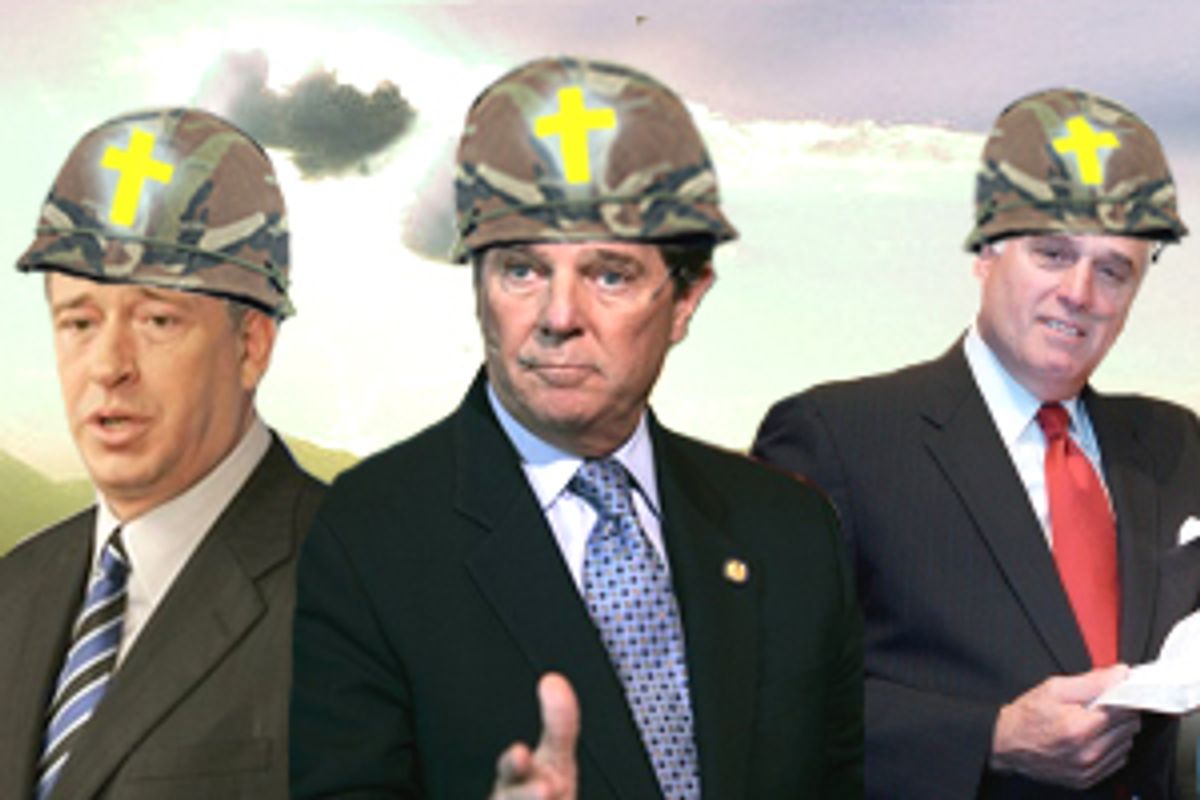
At a messianic "War on Christians" conference, Tom DeLay warned that "the future of man hangs in the balance" as other righteous souls demanded that gay sex be explicitly described to restore "shame."

  • more
    • All Share Services

Sinners in the hands of an angry GOP

Introducing Rep. Tom DeLay at the War on Christians and the Values Voter in 2006 conference in Washington Tuesday, master of ceremonies Rick Scarborough described him as “the man God has appointed in this last day.” The conference began on Monday and was saturated with millennial anxiety. A succession of preachers, talk-radio hosts, religious right operatives and, significantly, major Republican politicians took to the stage at the posh Omni Shoreham hotel to rally the troops for an epic battle between the forces of national renewal and those of vice and enervating perversion. So it wasn’t surprising to hear Scarborough, a Baptist preacher who has made it his mission to organize “patriot pastors” for political action, talk about DeLay’s legal troubles as part of a culminating war between heaven and hell.

“I believe the most damaging thing Tom DeLay has done in his life is take his faith seriously in the public office, which made him a target of all those who despise the goals of Christ,” said Scarborough, a former college football player and longtime DeLay ally. Taking the stage before the 200 or so adoring activists in the banquet hall, DeLay ran with the end-times theme. “We have been chosen to live as Christians at a time when our culture is being poisoned and our world is being threatened, at a time when sides are being chosen and the future of man hangs in the balance,” he said. “The enemies of virtue may be on the march, but they have not won, and if we put our trust in Christ, they never will.”

A strange mix of dejection and ecstatic expectation pervaded the War on Christians conference. It was organized by Scarborough’s group, Vision America, the same outfit that put together last year’s Confronting the Judicial War on Faith gathering. At a time when the foot soldiers of the right feel weary and betrayed by the administration they helped put in office, it was meant to rally the base for 2006 by presenting the election in eschatological terms. The energy in the room sometimes felt sluggish, and people were clearly worried about November, forcing their leaders to work all the harder to motivate them for the political crusade.

“Bush has hurt his own troops very badly with what he’s done on immigration,” Phyllis Schlafly told me in a room outside the hall. “I think he’s really destroying his base with his views on bringing in more guest workers.” Others complained about Bush’s failure to push a constitutional amendment banning gay marriage. People were shocked that the government America midwifed in Afghanistan seemed close to executing Christian convert Abdul Rahman. In the face of lassitude, speakers repeatedly cautioned against giving in to disillusionment and apathy. They reminded the audience that they are one judge away from overturning Roe v. Wade. They warned that Christianity is on the verge of being criminalized in America, and they harped on the manifold dangers of the “homosexual agenda.”

Perhaps worrying that anti-gay rhetoric hasn’t been sufficiently inflammatory lately, some speakers urged listeners to start using more scatological and stigmatizing language. Peter LaBarbera, who heads the Illinois Family Institute and is known for his obsession with gay men’s most outri sexual practices, told the audience, “My greatest frustration has been our side’s inability to make homosexual behavior an issue in the public’s mind.” In order to inspire the kind of revulsion he wants to see more of, he read from a posting on a gay message board: “Hey guys, I know this is kind of gross and all, but I was wondering if I’m the only one. I’m usually the bottom in my relationship with my boyfriend. After having been the receptive partner in anal sex it’s only a few hours before I start to experience diarrhea … it really stinks, because I really like sex, duh, but it takes the fun out of it when I know I’ll be tied to the bathroom for the next day.”

“I don’t think so-called GLBT teens are told anything like this” by their school counselors, LaBarbera said. “We need to find ways to bring shame back to those who are practicing and advocating homosexual behavior.”

These issues are nothing new on the religious right, of course — anti-gay and antiabortion politics have been central to the movement for decades. But the sense of crisis among the speakers was especially acute, and the calls to go on the offensive seemed urgent. Many proclaimed that America’s very survival is at stake. Some suggested that if the country doesn’t purify itself soon, it might not deserve to survive at all.

Laurence White, a bearded Lutheran pastor in a clerical collar who followed DeLay, repeated a quote that he, like many before him, erroneously ascribed to Alexis DeTocqueville: “America is great because America is good, and if America ever ceases to be good, America will also cease to be great.”

“My friends,” White said in a stentorian voice like burnished oak, “America is no longer good. Unrighteousness, evil, corruption, perversion and death are now standard operating procedure in the United States of America. If we do not put an end to it now, in this moment of divine destiny, then God will and God should judge America.”

This was remarkable language to hear at a political forum. Imagine if Democratic leader Nancy Pelosi gave a conference address that was followed by a furious condemnation of her country. She would have to scramble to distance herself from it and would be excoriated in the press regardless. But it’s not unusual to encounter this kind of thing at one of Scarborough’s events because they manage to bring together congressmen — this one featured Sen. John Cornyn and Republican Reps. Todd Akin and Louis Gohmert — with some of the most radical elements of what was once the right-wing fringe. (Sen. Sam Brownback was supposed to speak as well, but he couldn’t make it because he was needed for a vote).

At one point, speaker Herb Titus held up a copy of Kevin Phillips’ “American Theocracy,” offering it as evidence of the putative war on Christians. It was an audacious move, given that Sara Diamond, the preeminent scholar of the Christian right, reported in a 1998 book that Titus was forced to resign his post as dean of the law school at Pat Robertson’s Regent University because he refused to renounce Christian Reconstructionism. Christian Reconstructionism is a theocratic sect that advocates the replacement of civil law with biblical law, including the execution of homosexuals, apostates and women who are unchaste before marriage. Christian Reconstructionists used to be politically radioactive, but a new generation of religious right leaders like Scarborough have embraced them, and some members of today’s GOP apparently see no problem associating with them. This does not mean that America is on the verge of theocracy, but it signals an important shift. The language of religious authoritarianism has become at least somewhat politically acceptable.

Consider Rod Parsley, Pentecostal pastor of the World Harvest megachurch in Columbus, Ohio, a broad-shouldered, suntanned man who, like Scarborough, is emerging as one of the new generation of leaders of the religious right. He was a major force behind the mobilization for the anti-gay marriage amendment in Ohio, which in turn helped get out the evangelical vote that put Bush over the top in that state.

Parsley’s church is nearly half African-American, and he has a talent for mixing the soaring civil rights rhetoric and rousing call-and-response rhythms of traditional black preachers with classic populist demagoguery and exhortations to ostensibly metaphorical violence. When he speaks and shouts, his words building to alliterative climaxes as his arms wave in the air, sparks seem to fly off him.

“A spiritual invasion is taking place,” Parsley roared to the packed banquet hall on Tuesday morning, drawing out the “a” in invasion. “The secular media never likes it when I say this, so let me say it twice. Man your battle stations! Ready your weapons!” He paused to take a preemptive jab at his critics, his voice going soft and scolding: “They say, ‘his rhetoric is so inciting.’” Then he nearly screamed, “I came to incite a riot! Man your battle stations! Ready your weapons! Lock and load!”

Parsley preached for a half hour, dabbing at his sweating face with a navy blue handkerchief as his excitement grew. Near the end, he promised, “A great and noble and righteous nation can resurrect itself out of the smoldering ash heap of moral decline that we find ourselves in today.”

Continue Reading Close

Michelle Goldberg is a frequent contributor to Salon and the author of "Kingdom Coming: The Rise of Christian Nationalism" (WW Norton).

John Edwards’ creepy mug shot

The disgraced senator flashes an unnerving grin -- just like Tom DeLay

  • more
    • All Share Services

John Edwards' creepy mug shotEdwards sports a cold, dead smile in his mugshot

If the pictures of Anthony Weiner and (allegedly) a sunbathing Newt Gingrich weren’t too much for you, here’s another unsettling image: CNN’s Ed Hornick has posted John Edwards’ mug shot. Edwards, who faces felony charges for allegedly using over $1 million of campaign cash to hide his extramarital affair and child, went for the unnerving smile with accompanying cold, dead eyes for his photo:

The image is reminiscent of Tom DeLay from the Republican former House majority leader’s mug shot. (DeLay was ultimately convicted on conspiracy and money-laundering charges.)

We wonder whether the smiles here are meant to convey confidence or an image of innocence. If so, neither man succeeded.

Natasha Lennard covers the Occupy movement for Salon. A British-born, Brooklyn-based journalist, she has been covering Occupy Wall Street since before the first sleeping bag was unrolled in Zuccotti Park. One of the first journalists arrested at an Occupy action, she has managed to enrage Andrew Breitbart, Rush Limbaugh and Glenn Beck. You can follow her on Twitter (@natashalennard), and email her any Occupy updates/videos/ideas to natasha.lennard@gmail.com

Meet Patrick McHenry, the rudest, most shameless College Republican in Congress

Of course he was unfair to Elizabeth Warren: He was trained by the most cutthroat political organization around

  • more
    • All Share Services

Meet Patrick McHenry, the rudest, most shameless College Republican in CongressPatrick McHenry

Rep. Patrick McHenry (R-Countrywide) called Elizabeth Warren a liar at the conclusion of a House Oversight subcommittee hearing that had already consisted mainly of Republican members of Congress getting very basic information about Warren’s Consumer Financial Protection Bureau completely wrong.

McHenry has been one of the most completely shameless of House Republicans since his arrival in Congress, in 2005, when he immediately and publicly endorsed Tom DeLay’s brilliant plan to exempt himself from ethics rules as his connections to Jack Abramoff began to end his career. But he was born to be cheerfully corrupt: He’s a product of the College Republicans, an organization that trains little Lee Atwaters, Karl Roves and Grover Norquists in the arts of scorched-earth campaigning and wholly irresponsible “governing” on behalf of the monied interests that bought you your job. The ethos is win by any means necessary, legal or quasi-legal (or worse, as long as you never get caught), and McHenry was very good at that, according to Benjamin Wallace-Wells’ memorable profile of the then-freshman in the Washington Monthly.

After the College Republicans, and a failed state legislature race, McHenry moved on to truly insidious conservative astroturfing/push-polling/communications firm DCI, then worked for Rove, then took a political appointment in the Bush administration, then moved to the district he now represents, where he started a real estate company that did not actually buy or sell any real estate, so that he could run for Congress as “a small businessman.”

Once in the United States House of Representatives, McHenry personally intervened in a wild and bloody College Republican National Committee chair election, on behalf of a personal friend of his who’d become slightly toxic after he sent fundraising letters attempting to trick “elderly people with dementia” into donating to the CRNC. And he was successful! The horrible kid won, against all odds:

In other phone calls, McHenry was more blunt: “He told me, and several of my friends that we were done in politics if we didn’t support him,” another College Republican chapter president told me. (McHenry has admitted that he and Deans made the calls but denied that they threatened anyone’s career). Over the course of two weeks, after a couple of a dozen calls, McHenry prevailed upon those in the North Carolina delegation to change their votes, removing three votes from Davidson’s column and putting them in Gourley’s. Gourley ended up winning by six votes; had North Carolina voted the other way, Davidson might have won.

Another of McHenry’s first acts in Congress, Wallace-Wells writes, was to champion a bill that was specifically written to rip off a large portion of his constituents, by making it “much harder for government to regulate or block the conversion of credit unions into banks …” He is a close ally of major consumer financial institutions with a plum assignment to the Committee on Financial Services, which is great for raising money.

It’s only natural that Elizabeth Warren, whose mission is to protect consumers from unethical and predatory practices by these institutions, is Patrick McHenry’s enemy. You can complain on his Facebook wall all you like, but the Republican from North Carolina is incapable of feeling embarrassment.

And his treatment of Warren will only make him a bigger conservative hero and an even more attractive investment opportunity for major banks.

Continue Reading Close
Alex Pareene

Alex Pareene writes about politics for Salon and is the author of "The Rude Guide to Mitt." Email him at apareene@salon.com and follow him on Twitter @pareene

The end of Tom DeLay

And why he'll probably never spend a day in prison

  • more
    • All Share Services

The end of Tom DeLayTom Delay

On Monday, Tom DeLay was sentenced to three years in prison on two felony charges, conspiracy and money laundering, in a campaign finance corruption case that had dragged on for years.

The sentencing of DeLay, once one of the most powerful Republicans in Washington and the majority leader of the House of Representatives, was largely ignored because of the aftermath of the mass shooting in Arizona.

But it’s an extraordinary story — and one that’s not quite over. When he was indicted in Texas in 2005, DeLay’s political career sustained a fatal blow. He was forced to step down from his House leadership position and, in 2006, he resigned from Congress. 

The charges arose after DeLay set up a PAC to funnel corporate money, which is barred in Texas elections, to candidates for the state legislature. The group raised $190,000 and funneled it through the national Republican Party, which then distributed the money to several state-level candidates in Texas.

To learn more about the case that brought DeLay down, I spoke with Lou Dubose, who co-authored “The Hammer,” a biography of DeLay. The former editor of the Texas Observer and the current editor of the Washington Spectator newsletter, Dubose covered the trial gavel to gavel in Austin. He was in the courtroom on Monday when DeLay gave a lengthy presentencing speech accusing prosecutors of having political motivations and claiming he had $10 million in legal bills. 

I asked Dubose whether DeLay, who is planning an appeal, will ever see the inside of a jail cell, and whether the former majority leader appears humbled by the ordeal of the trial.  The conversation has been edited for length and clarity.

Did you ever think that you would see this happen?

I really didn’t. This was a working class jury, and I think that made a huge difference.

What was the dynamic with the jury — why did that make a difference?

Gary Cobb, the assistant DA who tried the case, really dragged out the $50,000 checks and the flights on corporate jets with the same persons who had written the checks to DeLay’s PAC. The sort of life that Tom DeLay lived at the expense of the corporate lobby — I think that really made an impact. By their clothes and what we know about them, it was a real working-class jury.

Oddly enough, Tom DeLay spent the entire duration of the three-week trial in a motor home rather than the Four Seasons. He drove his motor coach over here and checked into a motor home park in south Austin, a long way from where he was playing golf at Saint Andrews in Scotland. Then there was also the fact of the way the DeLays dressed, the fact that Reverend Rick Scarborough was sitting behind them. There was a lot of bling there that these people on the jury didn’t have.

Was it possible to tell where the $190,000 ended up? Did it just go to the state GOP?

The money came back, and it went to the candidates in Texas for whom it was designated. The backstory, of course, is that the Republicans controlled everything in Texas but the statehouse. Therefore they could not control redistricting. So DeLay set this organization up in 2001 for the 2002 election and they had to win a majority in the house. They moved this $190,000 up to D.C. because they were specifically raising corporate money, which was easier to raise. They sent it to Washington with specific instructions to send it back to these designated candidates. The candidates got the checks in the exact amount of $190,000.

And DeLay personally raised the money?

Well, that was the question. He stayed in the background but the state proved that he was aware that that transaction had happened. He was probably involved in directing it, although they didn’t have direct testimony on that. They put the three men who did the money-laundering in a room together in Sugar Land, Texas, in DeLay’s district, before the transaction was made.

Remarkably, at one point in the trial, DeLay went out and talked to Laylan Copelin of the Austin American-Statesman, who is a really terrific reporter. And Laylan asked him if he could have stopped the transaction. And DeLay said, “I could have stopped it, but why would I?”

And that was used in the trial?

In the middle of the trial, the state called Laylan Copelin as a witness — really bizarre. He’d been sitting there most of the trial; two weeks into the trial they call him as a witness because of what DeLay had said. His story ran, and two days later he was on the stand testifying as to what he had been told.

So I think DeLay proved to be a terrible client for a storied criminal defense attorney, Dick DeGuerin. That said, the state did an incredible job putting on a case that had to be by nature largely circumstantial.

Do you think he will ever spend a day in jail?

No. Simply because the Court of Criminal Appeals is an elected court, it’s all Republican, it’s highly political. It’s known as a prosecutors’ court, but in this case I would bet that they’re going to rule for the defendant. The Third Court of Appeals, where the appeal will start, is also a Republican court.

What are the issues in the appeal?

These courts are going to have to find a creative way of setting Tom DeLay free. One argument that they once made that they might try to revive is that money-laundering didn’t apply to checks, it applied to cash. This involved checks. The problem with that at the appellate level is that there have been a number of convictions based on money laundering with checks. So are you going to overturn all these prior convictions in order to save Tom DeLay?

What is DeLay doing these days?

You know, nothing. He is struggling to remain relevant. DeLay was always the star at CPAC, the annual conservative conference in Washington. But he hasn’t been allowed to speak there. Two years ago at CPAC, he was trolling for interviews. At the last CPAC convention, he was shunned.

He’s become a pariah to the Republican Party, and I don’t quite understand why. The true believers hold him responsible, rightly, for the Bush Medicare prescription drug bill, which DeLay pushed through. But he’s of no use to them anymore, and he’s not wanted. So most of what he does is struggle to remain relevant, and he’s not. Dick DeGuerin, in his closing argument, said “This prosecution has rendered my client unemployable.” And to my knowledge, he’s not employed.

His media statements have been defiant, but has he changed?

I don’t think so. That’s what’s remarkable. This is the same Tom DeLay that I saw every day for a year and a half when I followed him in Washington. It seemed to me that it never occurred to him that he no longer had the power that he once exercised. He had no regrets — he’s the same guy, except that he’s driving in a motor home instead of sleeping in the Four Seasons.

Continue Reading Close
Justin Elliott

Justin Elliott is a reporter for ProPublica. You can follow him on Twitter @ElliottJustin

Tom DeLay sentenced to 3 years in prison

Former U.S. House majority leader was convicted of money laundering and conspiracy

  • more
    • All Share Services

Tom DeLay sentenced to 3 years in prisonFILE - In this Oct. 26, 2010 file photo, former House Majority Leader Tom DeLay arrives at the Travis County courthouse in Austin, Texas, for jury selection in his corruption trial. Delay will be back in court on Monday, Jan. 10. 2011, for the sentencing phase of his trial after his Nov. 24 conviction on charges of money laundering and conspiracy to commit money laundering in a scheme to illegally funnel corporate money to Texas candidates in 2002. (AP Photo/Jack Plunkett, File)(Credit: AP)

A judge has ordered U.S. House Majority Leader Tom DeLay to serve three years in prison for his role in a scheme to illegally funnel corporate money to Texas candidates in 2002.

The sentence comes after a jury in November convicted DeLay on charges of money laundering and conspiracy to commit money laundering. DeLay was once one of the most powerful men in U.S. politics, ascending to the No. 2 job in the House of Representatives.

The former Houston-area congressman had faced up to life in prison. His attorneys asked for probation.

Senior Judge Pat Priest issued his ruling after a brief sentencing hearing on Monday in which former U.S. House Speaker Dennis Hastert testified on DeLay’s behalf.

Priest declined to hear testimony from the state’s only witness.

THIS IS A BREAKING NEWS UPDATE. Check back soon for further information. AP’s earlier story is below.

Jury convicts Tom DeLay in money-laundering trial

DeLay maintains his innocence and plans to appeal the verdict it took 19 hours to reach

  • more
    • All Share Services

Former U.S. House Majority Leader Tom DeLay — once one of the most powerful and feared Republicans in Congress — was convicted Wednesday on charges he illegally funneled corporate money to Texas candidates in 2002.

Jurors deliberated for 19 hours before returning guilty verdicts against DeLay on charges of money laundering and conspiracy to commit money laundering. He faces up to life in prison on the money laundering charge.

After the verdicts were read, DeLay hugged his daughter, Danielle, and his wife, Christine. His lead attorney, Dick DeGuerin, said they planned to appeal the verdict.

“This is an abuse of power. It’s a miscarriage of justice, and I still maintain that I am innocent. The criminalization of politics undermines our very system and I’m very disappointed in the outcome,” DeLay told reporters outside the courtroom. He remains free on bond, and his sentencing was tentatively set to begin on Dec. 20.

Prosecutors said DeLay, who once held the No. 2 job in the House of Representatives and whose heavy-handed style earned him the nickname “the Hammer,” used his political action committee to illegally channel $190,000 in corporate donations into 2002 Texas legislative races through a money swap.

DeLay and his attorneys maintained the former Houston-area congressman did nothing wrong as no corporate funds went to Texas candidates and the money swap was legal.

The verdict came after a three-week trial in which prosecutors presented more than 30 witnesses and volumes of e-mails and other documents. DeLay’s attorneys presented five witnesses.

Prosecutors said DeLay conspired with two associates, John Colyandro and Jim Ellis, to use his Texas-based PAC to send $190,000 in corporate money to an arm of the Washington-based Republican National Committee, or RNC. The RNC then sent the same amount to seven Texas House candidates. Under Texas law, corporate money can’t go directly to political campaigns.

Prosecutors claim the money helped Republicans take control of the Texas House. That enabled the GOP majority to push through a Delay-engineered congressional redistricting plan that sent more Texas Republicans to Congress in 2004 — and strengthened DeLay’s political power.

DeLay’s attorneys argued the money swap resulted in the seven candidates getting donations from individuals, which they could legally use in Texas.

They also said DeLay only lent his name to the PAC and had little involvement in how it was run. Prosecutors, who presented mostly circumstantial evidence, didn’t prove he committed a crime, they said.

DeLay has chosen to have Senior Judge Pat Priest sentence him. He faces five years to life in prison on the money laundering charge and two to 20 years on the conspiracy charge. He also would be eligible for probation.

The 2005 criminal charges in Texas, as well as a separate federal investigation of DeLay’s ties to disgraced former lobbyist Jack Abramoff, ended his 22-year political career representing suburban Houston. The Justice Department probe into DeLay’s ties to Abramoff ended without any charges filed against DeLay.

Ellis and Colyandro, who face lesser charges, will be tried later.

Except for a 2009 appearance on ABC’s hit television show “Dancing With the Stars,” DeLay has been out of the spotlight since resigning from Congress in 2006. He now runs a consulting firm based in the Houston suburb of Sugar Land.

Continue Reading Close

Page 1 of 35 in Tom Delay