New York City

The wily coyotes of New York

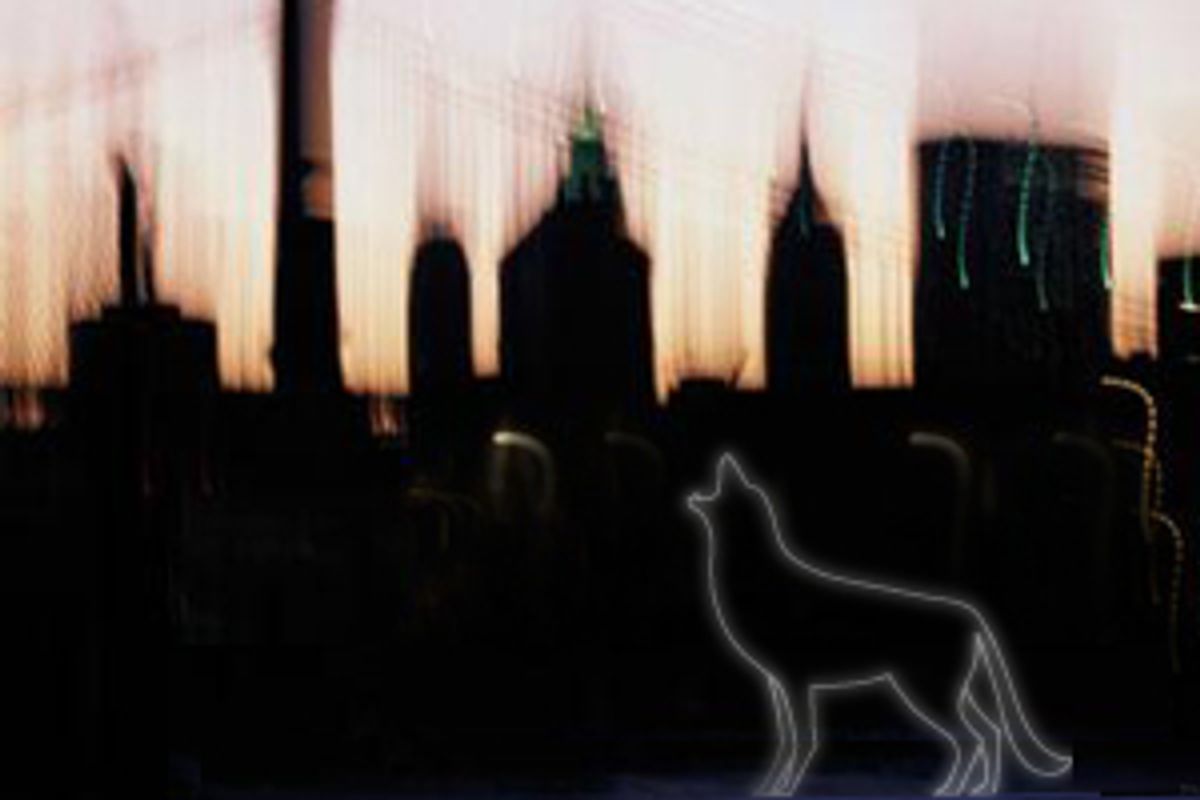
The coyote that led cops on a wild chase through Central Park last week illustrates how this supremely adaptive wild dog can live anywhere -- including in the heart of a big city.

  • more
    • All Share Services

The wily coyotes of New York

Last night the coyotes called by the covered bridge … ‘We are here,’ they say; ‘we’ll eat your apples, your voles, your cats, the afterbirth of your calves; we’re here, we set your dogs to barking, we intend to multiply.’ The coyote: evolving, getting better all the time, under heavy pressure. — Robert Michael Pyle, “Wintergreen: Listening to the Land’s Heart”

American Indians referred to the coyote as Trickster: the sneak, the fooler of fools. This explains events in Manhattan last week when a coyote from the city’s northern greenswards led cops, photographers, reporters, tourists and helicopters on a two-day chase across Central Park before finally succumbing to a tranquilizer dart.

The canid himself was no anomaly, no confused wanderer. He was a colonist, looking for new terrain, probing the limits of his range. At one point, cops cornered him near a duck pond but he dove in the water, swam to shore and was gone. Nicknamed “Hal” by park workers, he was not the first coyote to visit Manhattan this year. Six weeks earlier, on Super Bowl Sunday, a coyote was found smashed up by the side of a road on the Upper West Side. In January 2004, a coyote was seen bounding among the ice floes on frozen Rockaway Inlet, in Queens, near the piney dunes of Breezy Point, 23 miles south of Central Park.

In the Bronx, New York’s greenest borough, coyotes are now established New Yorkers, living in sprawling parks, edging through the trees that line golf courses and baseball diamonds, where the garbage and mice and raccoons are plentiful. It was assumed that last week’s coyote had made his way south from the Bronx beachhead, a young male dispersing in the springtime to find new and better land.

The rise of a northeastern coyote is an unprecedented biological event on the American continent. When white men settled the coasts of the Atlantic, there were no coyotes anywhere on the seaboard. The lonesome Canis latrans, the “barking dog,” ranged only on the prairies of the high plains and deserts of the West, hemmed in by dominant wolf packs in old growth forests.

But the reach of industrial Homo sapiens transformed the coyote’s habitat. By the early 20th century, the forests that fed the wolf had been felled, and the wolf (along with the cougar) was soon decimated, vast swaths of land were subordinated to agriculture, and in this kinder environment, the deer population, freed of top predators, began an inexorable climb to its current saturation point.

The coyote, ingeniously plastic, always adapting, saw opportunity. He pushed east and north and south, assuming the niche of top dog, and today his numbers nationwide are more than twice what they were in 1850. The coyote, says wildlife ecologist Justina Ray, “is the most successful colonizing mammal in recent history.”

The rate of expansion was astonishing. According to Ray, who works with the Wildlife Conservation Society, the coyote’s march during the 20th century covered thousands of miles, even reaching isolated regions in the Atlantic provinces of Canada, including Nova Scotia and Cape Breton Island, arriving in Newfoundland on sea ice as early as 1987.

Today, coyotes live in or near every major American city. They are reported in Atlanta, Toronto, Portland, Maine, running across a schoolyard in Philadelphia, hiding under a taxi in Chicago, and everywhere in the metro west, including Denver, Phoenix, Los Angeles and Las Vegas. A landmark study from Ohio State University, to be published this spring, tracked coyote behavior in urban Chicago for six years, concluding that the Windy City’s coyote population was vastly larger — at least 2,000 and growing — and more successful than ever expected. Urban coyotes, the study found, live longer than their country cousins, their range per pack is more compact (much like urban humans), and they hunt more often at night (also like urban humans). The study also found that the creatures likely do not pose a threat to people.

Their acculturation serves as a lesson in the rigors of urban survival. Coyotes have learned to negotiate traffic, listen for voices, watch for lights. They’ve become ever more nocturnal, remote, secretive. They learn that uncollected garbage, weedy lots and abandoned buildings are their friends. They eat primarily everything: garbage, grass, frogs, chipmunks, shoes, dragonflies, air. They follow human trails. They use our roads, our riverbanks, our bike and hiking paths, our railways and backyards. In Boston, biologists who radio-collared a female coyote during 2004 reported that the dog traveled freely across the towns of Revere, Medford, Somerville and Cambridge, at one point crossing into Boston itself via a railroad line at 3 a.m. before bedding down in an abandoned rail yard north of the Charles River. The coyote, nicknamed Fog, had “little more than shrubs for her to sleep in.”

Fog was technically an eastern coyote, as distinguished from the western coyote. Scientists believe there is considerable genetic difference between the two animals, enough that the eastern coyote, now expanding fully in our midst, may represent an entirely new subspecies of canid — a larger, smarter, more versatile creature. Coyotes, as they foraged east and north over the past 100 years, have grown to twice the maximum weight of their Western ancestors, with the biggest males topping out at over 50 pounds. The slimmer western coyote hunts alone, but the big eastern coyote has learned cooperation, pack-hunting, a wolf behavior. Some biologists argue that the eastern coyote developed through commingling with the Wisconsin timber wolf, a subspecies of the gray wolf that, rather than face extinction, perpetuated at least a portion of its gene pool by joining the migrant coyote flood (thus the coyote’s boost in size). Other scientists say that natural selection in the face of bigger game, higher snows, and colder weather catalyzed the coyote’s physical flowering.

Whatever it is, big dog or little wolf, the eastern coyote has met and deftly answered the speed of ecological change wrought by man. This is what fascinates: his tenacious adaptation, his vastly accelerated evolution.

Hal’s adventure in Central Park last week was a repeat performance of seven years ago when, on April Fool’s Day 1999, a similarly tricky coyote named Lucky Pierre led cops, photographers, reporters, tourists and helicopters in a chase across the park before, yes, finally succumbing to a tranquilizer dart. Whence do the coyotes come?

At least 20,000 now live in New York state, and an unknown number in New York City. The dogs first appeared out of Canada, in 1925. Some 70 years later, they arrived in the Bronx. A Bronx woman in 2002 claimed she watched a coyote quietly “saunter” across her backyard. There were sightings that same year of a mother and two pups in Van Cortlandt Park. At least one coyote a year is road-killed along Bronx expressways.

Each spring, coyotes disperse from the pack to find new proving grounds, a space of their own in which to hunt and dominate and attract a mate, with whom they will remain for life. A few days before he made his madcap debut on April Fool’s Day, Lucky Pierre, a classic spring disperser, was sighted at Riverside Park near 149th Street. Maybe he crossed the George Washington Bridge 30 blocks north (New Jersey hosts at least 3,000 coyotes). More likely, he traversed the Henry Hudson Bridge at Manhattan Island’s northernmost tip, or followed the Metro North line south through Riverdale, using the weedy rail span to cross the Harlem River. Or maybe he swam the river. From there, it would be easy going along the green cliffs of Inwood and the Cloisters, with the gem light of the water of the Hudson below him and rats in their burrows wherever he looked.

Lucky Pierre, so named because he was holed up in a cave across from 5th Avenue’s Pierre Hotel, was rechristened Otis and brought to the Queens Zoo, where he resides today. He paces a lot, though he enjoys an expensive diet of strawberries, blueberries, yams, kale and fish. His seven-year-itch brother of last week met with a kinder fate. Hal was handed over to a Long Island couple, Bobby and Rebecca Horvath, who are rehabilitating him before releasing him into the wilderness.

Bobby Horvath is a firefighter, Rebecca a cop. During their off-time, mostly out-of-pocket, with their suburban home as menagerie, they run a teeming nonprofit called Wildlife in Need of Rescue and Rehabilitation. In their backyard, in big cages, they have two barred owls from Connecticut, four red-tailed hawks from New York City, a bald eagle from Alaska, and a 40-pound bobcat, Tasha, rescued from a fur farm. Inside their house, they keep two white-faced capuchin monkeys, a one-legged German shepherd, four fat cats, and a parrot that ululates wildly but doesn’t speak. Among other animals, they’ve treated foxes, raccoons, opossums, seals, sea birds such as cormorants, herons and egrets, cats like Tasha who never made it to the factory shears, and primates such as squirrel monkeys, marmosets, or their own capuchins.

And now, for the first time, they have coyotes. Hal is the second in two months. The first was the coyote nearly road-killed on Super Bowl Sunday. He was a yearling, about 32 pounds, in healthy condition. His eyes were clear, his teeth were pearly, he had few ticks, no internal parasites. “He was spectacular,” said Rebecca Horvath. From the accident, however, he suffered a laceration on his back leg that needed suturing, head trauma, and one of his back teeth was cracked and had to be pulled out. He was dewormed, deticked and treated with steroids to reduce the swelling behind his eyes and in his brain. He was 38 pounds when the Horvaths freed him, 25 miles north of the New York City limits, in Westchester, on the large wild acreage of a friend’s property.

At the Horvaths’ house, Hal was curled in a dog cage that Bobby had placed in the humid dark of the basement to approximate a den. Hal, who was runtish for an eastern coyote, about 30 pounds, just bones and fur, lay in a far corner of the cage, his eyes pooled black but flashing green and gold and orange in our lamps. He shifted a little among the blankets, looking worried. Bobby reached in and touched him and the animal allowed the caress. His fur was coarse as Brillo and shaded tawny with black ticking. “Hey, guy,” Bobby softly told the coyote. “They’re not after you anymore.”

Bobby turned to me. “Can you imagine being chased around by a mob of people for two days and then being shot with drugs?” Bobby shook his head in shame. He said he counseled the Parks Department to set out a cage with a trap door and wait. No, they had to make a spectacle of things. The coyote might be dangerous. Someone might get hurt.

“Look at this guy, he’s not a killer. He wants nothing to do with us,” Bobby said. “People react with ignorance. Fear. But we’re gonna need to learn to live with them. Because they’re not going away.”

A few days later, Rebecca handed Hal into the custody of the New York State Department of Environmental Conservation, whose biologists were to release him in a state forest 40 miles north of the city. “He wanted to leave. I could see it,” Rebecca said. “He watched out the windows of his cage. He seemed excited to see the outdoors.” On Friday morning, March 31, a warm spring day in the Northeast, good weather for finding a mate, the Horvaths received word that Hal had died just as he was about to be released. A spokesman for the DEC said the cause was unknown. He simply stopped breathing.

Continue Reading Close

In the Middle: Episode 1 – Happily Ever After

Henriette and Kevin have been married for 27 years. Kevin recently moved down the street because he says he's gay

  • more
    • All Share Services

Jon Huntsman for New York City mayor?

Yes, please. It would be very funny to see him lose

  • more
    • All Share Services

Jon Huntsman for New York City mayor?

Yes, Jon Huntsman should definitely run for mayor of New York, because I never tire of watching Jon Huntsman get rejected by voters. The best part of a Jon Huntsman campaign is when his well-heeled supporters very sincerely and tragically argue that the fact that no one wants to vote for Jon Huntsman is a sign that the Republic itself is in peril. They would get so sad and melodramatic when he got 10 percent of the vote.

Now, there is no evidence that Jon Huntsman is planning for run for mayor of New York City, but one of his annoying daughters tossed this one out there last night:

Why not? I mean sure he has never lived in New York and has no connection to the city, but why not?

Of course, now that this idea is floating around, very rich and well-connected morons just might set about trying very hard to make it a reality. Jon Huntsman is a creature of the sort of oblivious center-right rich folk who bankrolled the hilarious failed New York campaigns of Harold Ford Jr. and Reshma Saujani. They would like very much to see another one of their class be the mayor of their city, after Bloomberg ends his term (if he ends his term). The Republicans have essentially no candidate. (I still wouldn’t put it past Police Commissioner and professional harasser-of-minorities Ray Kelly to mount a run, but at the moment he’s sounding disinclined to.) And Jon Huntsman is the sort of nationally prominent “independent” candidate all three major New York newspapers would love (the Daily News would love him the most, obviously, but the Post would love him because he is secretly not actually that moderate).

Jon Huntsman — whose tax plan called for the complete elimination of taxes on capital gains and dividends, as well as the elimination of the Earned Income Tax Credit, the Reagan-era tax benefit for poor people that used to be the sole form of welfare that conservatives supported, and who also wholeheartedly supported the Paul Ryan plan to fix the deficit by eliminating Medicare and not making rich people pay taxes — was of course beloved by the press and labeled a reasonable moderate when he ran for the 2012 Republican presidential nomination. He was mistaken for a political moderate primarily because he does not believe that God created cavemen and dinosaurs at the same time, roughly 4,000 years ago. Huntsman, who supports the complete repeal of Dodd-Frank and is strictly antiabortion and anti-gay marriage and anti-healthcare reform and pro-gun, is now essentially a symbol of the dignity and sagacity of the “radical center,” even though he is a conservative Republican.

So obviously New Yorkers would be thrilled to vote for this guy. I endorse this.

Continue Reading Close
Alex Pareene

Alex Pareene writes about politics for Salon and is the author of "The Rude Guide to Mitt." Email him at apareene@salon.com and follow him on Twitter @pareene

Michael Bloomberg plays the endorsement game again

The billionaire mayor meets with Mitt Romney as both campaigns practically beg him for his support

  • more
    • All Share Services

Michael Bloomberg plays the endorsement game againMitt Romney, Michael Bloomberg and Barack Obama (Credit: AP)

Mitt Romney yesterday had a “private” (well-publicized) meeting with New York City Mayor Michael Bloomberg that was a pretty obvious attempt by Romney to win the for-some-reason “coveted” Bloomberg endorsement. Mayor Bloomberg is not actually the hugely popular and universally respected national figure that anti-partisanship zealot pundits think he is — only around 20 percent of Americans viewed him favorably in 2010, and a 2011 poll says he’d get a mere 10 percent of the vote in a three-way presidential race — but those anti-partisanship zealots represent an important constituency of “rich people who run the media,” so a Bloomberg endorsement would be a strong signal that Romney is moderate and wise and prudent and so on.

The Obama administration would also like the Bloomberg endorsement, and both campaigns are trying very hard to win the mayor’s support, as Michael Barbaro writes in the New York Times today.

But as his mayoral term winds down, he has told advisers that he is willing to back a candidate this time around, touching off an intense competition for his support in the general election.

“I’ll see down the road,” the mayor said coyly on Tuesday when asked about an endorsement. Describing his impressions of Mr. Romney and Mr. Obama, he made clear that he sees a wide gap between them. “They’re very different, and they give the public a real choice,” he said. “It’s hard to argue that you can’t tell the difference, if you will. They run the spectrum on lots of different issues.”

I would be surprised if Bloomberg ended up endorsing anyone. He loves the attention he receives as a potential endorser, but he cherishes his “non-partisan independent” label much more, and an endorsement of a major-party presidential candidate would sully his carefully maintained brand. He is leading both campaigns on, just as he did in 2008.

In 2007 and 2008, Obama tirelessly wooed Mayor Bloomberg, meeting with him multiple times and showering him with public praise, and he never received an endorsement. McCain also tried to win the mayor’s support to no avail. There was even (dumb) speculation about each campaign considering offering Bloomberg the running mate gig. Since Obama took office, he has continued attempting to win the mayor over, inviting him to golf and lunch at the White House and so on. When Bloomberg was running for his third term, in 2009, Obama did no campaigning for his Democratic opponent, Bill Thompson. (Though then-press secretary Robert Gibbs did allow, in a cagy response to a direct question, that the president “would support the Democratic nominee” in his position as “leader of the Democratic party.”) The mayor has returned the favor by repeatedly, quietly undermining Obama, dismissing him as arrogant to his good pal Rupert Murdoch and trashing Obama’s deficit reduction proposals as, you guessed it, class warfare.

The absurd thing is that there is, policy-wise, practically no daylight between Obama and Bloomberg. The president is a moderate Democrat who believes in the importance of deficit reduction and comprehensive tax reform. The mayor is a liberal Republican who believes the exact same thing. Both of them are “education reformers,” both want immigration reform, both support carbon emissions reduction, both are pro-choice, and the list goes on. They don’t agree on everything, of course. Bloomberg is more strictly anti-gun than the president, and openly supports gay marriage. You know, just like Mitt Romney.

The only reason Bloomberg would have, from a policy perspective, to back Romney over Obama would be over Dodd-Frank, which Bloomberg opposed, and Obama’s plan for a millionaire’s tax bracket, which Bloomberg thinks is a “silly” idea. But the mayor’s stated position is that all the Bush tax cuts should be allowed to expire, which is the opposite of the Republican position. His other disagreements with the president are solely about rhetoric — the mayor finds any whiff of economic populism or Democratic partisanship distasteful — and personality. Not that Mayor Bloomberg, the wise technocrat who always carefully weighs the evidence before making his rational decisions, would support a candidate whose entire platform is wildly at odds with Bloomberg’s stated positions, simply because the candidate is nicer to billionaires like Mayor Bloomberg. That would be absurd!

The White House’s attempts to win Bloomberg over seem to me perpetually doomed to failure, though I imagine they’ll continue to embarrass themselves seeking his support, as he continues flirting with Romney.

Continue Reading Close
Alex Pareene

Alex Pareene writes about politics for Salon and is the author of "The Rude Guide to Mitt." Email him at apareene@salon.com and follow him on Twitter @pareene

New York’s dying signs

A Brooklyn designer dedicated to saving local lettering talks about what we lose when corporate logos take over SLIDE SHOW

  • more
    • All Share Services

New York's dying signs (Credit: Molly Woodward/Vernacular Typography)

View the slide show

This originally appeared on Jeremiah Moss's blog, Jeremiah's Vanishing New York.

Vernacular Typography is the creation of graphic designer and Brooklyn native Molly Woodward, who has spent the past decade taking photos of the city’s “found lettering.” All over the city, and the world, local signage is disappearing and being replaced with mass-produced signs and the brands of global corporations. Molly is trying to preserve it–and she has a Kickstarter campaign to help do that.

I asked her a few questions about “endangered local signage.”

How are you defining “Vernacular Typography”?

I guess it should technically be Vernacular “Lettering,” but I define Vernacular Typography as the found lettering that exists in the built environment and surrounds us everyday. It doesn’t have to be pretty or use an existing typeface, it’s just any visual representation of language.

How do you think New York City’s vernacular typography differs from other cities around the country and the world?

New York’s vernacular typography is unmatched in terms of intensity and variety of signage. On any given block, you can see the city’s forgotten history through the layers of still-visible signage in basically any medium. The typescape is also much denser than in other places because the city evolves so rapidly and retail turnover is so high.

Which New York City typefaces are your current favorites?

I’m partial to the type and signs I grew up seeing every day, most of which have disappeared (Gertel’s Bakery) or whose surfaces seem to be slowly melting away (Ideal Hosiery).

I love any type that somehow still clings to life or relates directly to a time and place (Horn & Hardart Automat).

And of course, you can never go wrong with beautiful neon (Montero’s).

What do we lose when the vernacular typography of the city streets vanishes from sight?

A sense of the city’s history, and also a precious visual resource. Typography can you tell you a lot about local culture and urban communication and when we don’t see it, our sense of the city is diminished.

What do you think might be the psychological impact of living in a city where the native typography is replaced by homogeneous corporate signage?

I think there’s less of a personal connection to a specific place. With standardized corporate advertising, signs are no longer representative of a group of people or a neighborhood, just a business that could be anywhere in the world.

For natives, connections to the past are lost, so a sense of home or a memory of a place is devalued. And for visitors, there’s less of the unique experience you get from traveling someplace new.

Vernacular typography is such an incredible marker of regional identity, spatial orientation and even personal history. If we lose it altogether, we not only lose that individual and cultural connection, but also a physical map of the city, which is why documentation and preservation are so important.

View the slide show

Continue Reading Close

Jeremiah Moss is the pseudonymous author of the blog Jeremiah’s Vanishing New York. He has also written about the city for The New York Times.

NYPD must spy on all Muslims to protect us from Iranian photographers

New York City's own constitutionally iffy intelligence agency justifies itself with fear-mongering

  • more
    • All Share Services

NYPD must spy on all Muslims to protect us from Iranian photographersRay Kelly (Credit: Reuters/Brendan McDermid)

The NYPD is less a “police department” than a secretive and unaccountable international intelligence-gathering organization with a large minority-frisking division and the firepower of a mid-sized army. Lately they have been facing a bit of criticism for their style of intelligence-gathering, which seems to be done with more gusto than concern for civil liberties or… accuracy. Sometimes the NYPD’s muscular-but-stupid approach to spying gets them in trouble with the FBI. And when the organization that fights terror by recruiting shady weirdos to try to trick random Muslims into saying “jihad” into tape recorders says your practices are counterproductive and out of line, they are probably pretty counterproductive and out of line.

But the NYPD’s “covertly follow every single Muslim in the tri-state area” approach to counter-terrorism has its defenders. Like Mayor Michael Bloomberg, who believes Americans Muslims have the right to worship wherever they see fit so long as they don’t pay any attention to the unmarked vans parked across the street.

And the department argues that it is allowed to carry out surveillance wherever it chooses, because there’s no law against just going around looking at things and taking some pictures, right? No, of course not, unless you look sort of Middle Eastern.

The NYPD earlier this week announced that they had totally caught some people who were almost definitely probably Iranian spies. These spies were caught red-handed spying all over the place!

Authorities have interviewed at least 13 people since 2005 with ties to Iran’s government who were seen taking pictures of New York City landmarks, a senior New York Police Department official said Wednesday.

The NYPD’s Mitchell Silber told Congress that Hezbollah and Iran definitely want to blow up New York, and the proof is three incidents of people “associated with the Iranian government” getting caught photographing things, in New York. (I am not much of a terrorist, but if you want pictures of New York City landmarks in order to figure out how best to blow them up why not try Flickr? There are hundreds of thousands of photos of every landmark in the city already online!)

While other so-called intelligence experts say ” there are no known or specific threats indicating Iranian plans to attack inside the U.S.,” Long Island-based Islamaphobe Republican Congressman Peter King and documented supporter of terrorism wants us all to be on high alert, because Hezbollah is everywhere:

Opening the hearing, King said, “We have a duty to prepare for the worst,” warning there may be hundreds of Hezbollah operatives in the United States, including 84 Iranian diplomats at the United Nations and in Washington who, “it must be presumed, are intelligence officers.”

Stop telling the NYPD not to spy on all the Muslims, everywhere! If they don’t keep tabs on all of them, the Iranians will get us!

Continue Reading Close
Alex Pareene

Alex Pareene writes about politics for Salon and is the author of "The Rude Guide to Mitt." Email him at apareene@salon.com and follow him on Twitter @pareene

Page 1 of 42 in New York City