David Mitchell's first three novels --"Ghostwritten," "Number9Dream" and "Cloud Atlas -- have been literary Sudoku, intricate puzzles that appeal to the kind of reader who likes to study dense works for half-hidden clues and correspondences. You can be sure, however, that if you're reasonably bright and moderately observant, you will eventually plumb all the secrets of Mitchell's books. In the end, none of his meanings will elude you, and so his novels have had more in common with high entertainment, like the TV series "Lost," than with eternal and idiosyncratic enigmas like "Gravity's Rainbow," or even "Twin Peaks."
In fact, the one persistent puzzle in Mitchell's books has been what the author sounds like when he's not assuming the voices and motifs of other writers. In "Cloud Atlas," his most successful novel, he writes each chapter in a different style: Defoe, Isherwood, any generic thriller writer, Amis, Philip K. Dick and Russell Hoban (specifically Hoban's great 1980 novel "Riddley Walker"). The sections, set in time periods ranging from the 19th century to the post-apocalyptic future, are split in half and arranged in an arresting chronological V. What it all finally adds up to is a rather weightless rumination on the cycles of life and history, but the experience of reading "Cloud Atlas" was flawlessly diverting.
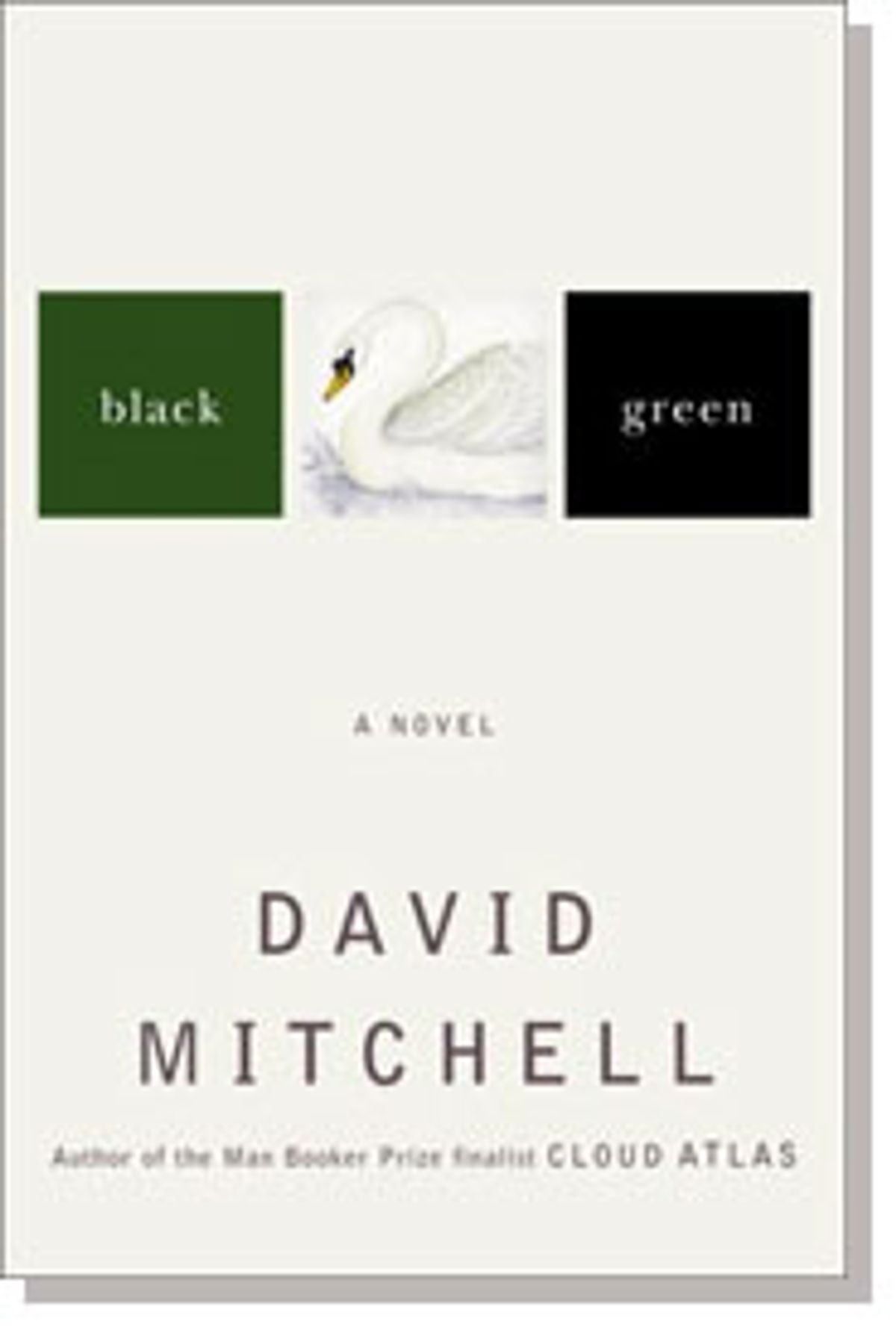
Mitchell's fourth novel, "Black Swan Green," is poised to capitalize on the readership that discovered him with "Cloud Atlas," but it might frustrate them. The structure and material are entirely conventional -- in fact, "Black Swan Green" almost seems like an explanation for why Mitchell usually writes novels like "Cloud Atlas" instead of the intimate, autobiographical fiction that other readers prefer. It describes the 13th year in the life of one Jason Taylor, a middle-class boy growing up in Black Swan Green, a village in Worcestershire, England, during the early 1980s. Jason's day-to-day existence consists of casual brutality mixed with crushing banality, an experience that Mitchell seems to be exorcising with this book. Of course, the autobiographical tone of "Black Swan Green" could be false, another one of Mitchell's uncanny impressions, but it writhes with a loathing that would be mighty hard to fake.
Here at last, it seems, is Mitchell's own voice, albeit an immature version of it. Jason's narration is an unstable blend of literary panache and schoolboy slang: "Graveyards're sardined with rotting bodies, so of course they're scary places. A bit. But few things're only one thing if you think about them long enough." Two implacable forces dominate his life: his distracted parents and the ruthless social hierarchy of his comprehensive school. (Comprehensive schools were introduced in Britain in the 1960s in order to end a prior system of class segregation and teach children from all backgrounds together.)
Among his classmates, Jason suffers from three liabilities: His family are "townies," he's not nearly as tough as the local louts, and he stammers. "It's all ranks, being a boy, like the army," he explains, and throughout most of the novel he strives, largely in vain, to improve his status. This is not a boyhood idyll in the fashion of "Tom Sawyer," but a deadly earnest struggle in which a boy's fate might hang on any detail. "Games and sports aren't about taking part or even about winning," Jason observes. "Games and sports're really about humiliating your enemy."
A goodly portion of "Black Swan Green" details Jason's own humiliation, which reaches its nadir when, after a brief moment of upward mobility, he becomes the main butt of the head bully's attentions. Meanwhile, he valiantly tries to avoid realizing that his parents' marriage is disintegrating. Occasionally the outside world sends a ripple through this kid's miserable world: A local youth is killed in the Falklands War, outraged homeowners mount a protest against a nearby gypsy settlement, Thatcher takes a notch or two (or three) out of everyone's financial security.
It's in Mitchell's sketches of adult cowardice, superficiality and mendacity, though, that "Black Swan Green" really blazes. In one early scene, a family dinner, Jason's father and uncle engage in a faux-jovial jousting match, each man boasting about his own success by pretending concern over his brother-in-law's fortunes in the current economic climate: "No, no, it's you shopfolk that my heart goes out to. This recession'll bleed the high street dry before it's finished. Quote me on that." An encounter with his father's arrogant boss on a seaside boardwalk only serves to inform Jason that the pecking orders among businessmen work much the same as those among boys.
The women don't come off any better; Jason is always being buttonholed by mean-spirited, gossipy ladies who affect gracious attitudes and "posh" accents while twisting the knife. Mitchell has their voices down pat, and some of their conversations resemble a fiercer version of Monty Python parodies: "She didn't know a dickie bird until she went through his bank statements. What a way to learn your own home is in hock! Can you imagine how duped you'd feel? How betrayed?" Even Jason's own mother seems most intent on translating her grievances against his father into new kitchen tiles and a backyard "rockery" with a "water element."
There are a few leavening elements in Jason's year: an adventure or two, an elderly foreigner (a character from "Cloud Atlas") who encourages his artistic side and some sympathetic teachers. But these interludes have a stock quality (there's even a scene where Jason, hiding in a tree, spies on a young couple having sex), and if they hint at another better life further down the road, it's not for long. An extracurricular encounter with real literature leads inexorably to judgments like, "getting creepstained as a model student in a subject as girly as French'd sink what's left of my middle-ranking status."
All this amounts to a damning portrait of the pettiness of British middle-class life and an excellent argument for why a sensitive, aesthetically inclined young man might run off to Japan (as Mitchell did). Though it's less playful and complex than his earlier books, it also feels more emotionally rooted -- even if the emotion it's rooted in is a still-raw disgust. "Black Swan Green" gives us at last a glimpse of who David Mitchell really is by showing us what he absolutely, positively never wanted to become.
Shares