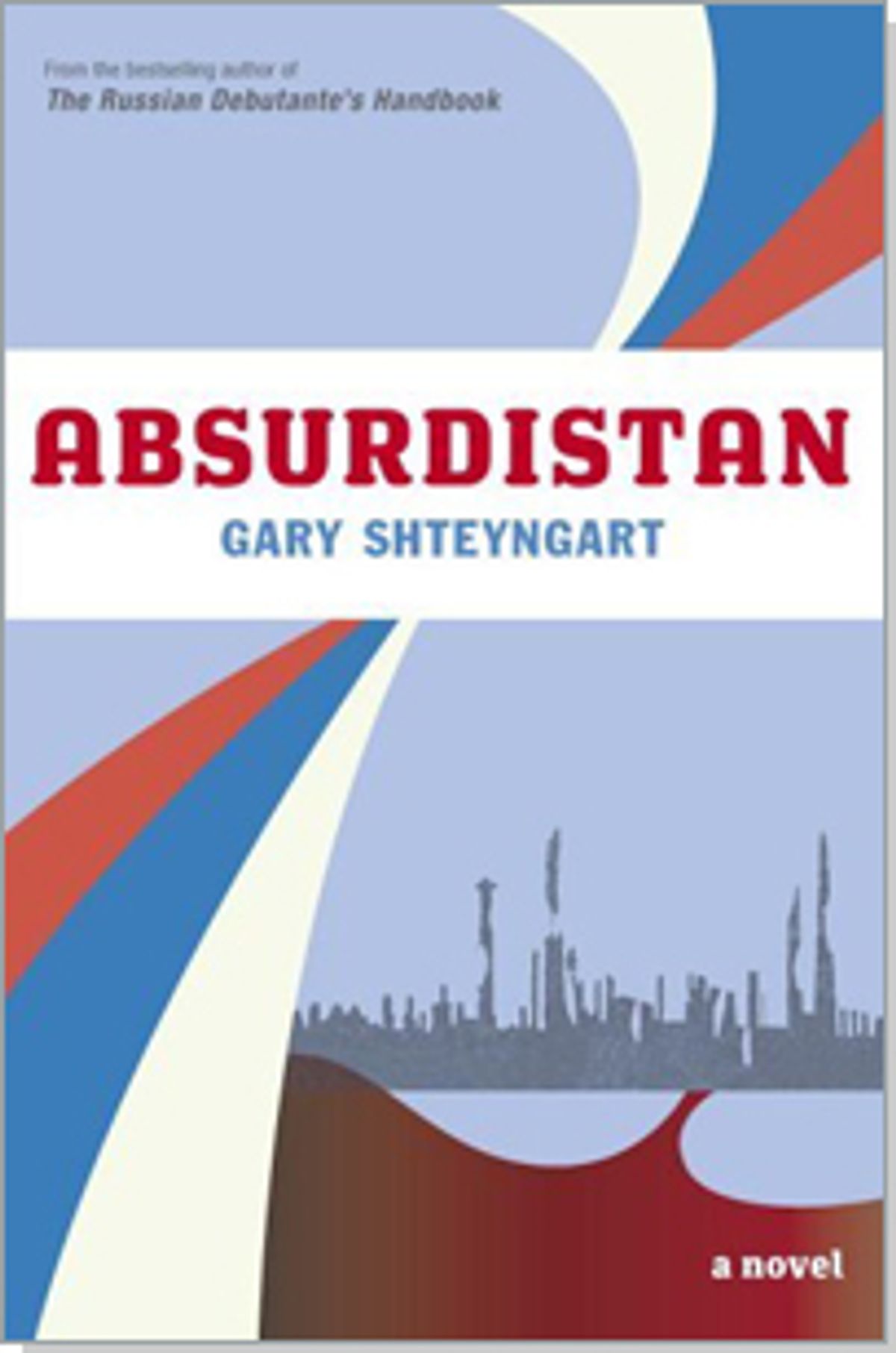
Post-Soviet life may not need its own Joseph Heller -- and chances are it couldn't sit still long enough to read his books even if it did -- but it has him all the same in Gary Shteyngart. Shteyngart's first novel, "The Russian Debutante's Handbook," described the adventures of Vladimir Girshkin, a Russian Jew who was unhappily transplanted to the U.S. in his childhood, as he seeks his fortune (and hides out from mobsters) in the frantically Westernizing Eastern Europe of the 1990s. In Shteyngart's latest, the hilarious, caustic "Absurdistan," another homesick Russian Jew, an obese innocent named Misha Vainberg, pines for a lost paradise. In Misha's case, Eden is the South Bronx, where he once gorged on junk food and canoodled on the stoop with his beloved Rouenna, a homegirl he hooked up with in a titty bar.
When we meet Misha, however, he's stuck in St. Petersburg, penning this book, ostensibly his "love letter to the generals in charge of the Immigration and Naturalization Service." He can't get back into the States because his father, the 1,238th richest man in Russia, has shot and killed an Oklahoma businessman "over a 10 percent stake in a nutria farm" and unlike the freewheeling Russians, the American authorities don't take kindly to the sons of murderers. Thanks to Beloved Papa's wealth -- acquired through assorted dubious enterprises, including VainBergAir, "an airline without any airplanes but with plenty of stewardesses" -- Misha lives pretty high on the hog. But he longs for New York and Rouenna, especially when he learns that his girlfriend has taken up with the detestable imigri Jerry Shteynfarb, author of a crap novel called "The Russian Arriviste's Hand Job."
After Beloved Papa is assassinated by another kingpin, Misha's quest to get back to New York leads him on a circuitous, Ativan- and whiskey-soaked journey to the obscure nation of Absurdistan, a former Soviet satellite on the Caspian Sea. There he gets caught up in the rising tensions between the Svani and Sevo, two Sneetchlike local groups whose primary difference seems to be which way they think "Christ's footrest" should tilt on the Orthodox cross. Ensconced in the Hyatt, where prostitutes roam the hallways, shrieking "Golly Burton!" every time they think they've spotted an employee of a certain well-connected American service-contracting firm, Misha forlornly e-mails Rouenna. Eventually, after civil war breaks out in Absurdistan, he takes up the Sevo cause, praying that for once he's on the side of right.
The plot of "Absurdistan," however, is really just a pretext to bedazzle the reader with a series of rowdy and blisteringly satirical vignettes of life in contemporary Russia, the boondocks of Central Asia and, every so often, the Never-Neverland of America itself. Courtesy of Beloved Papa, Misha obtained a useless degree in multicultural studies at "Accidental College," a private (very) liberal arts college in the Midwest, from which "a surprising number of graduates went on to raise organic asparagus along the Oregonian coast." This education leaves our hero utterly unprepared for the new Russia, where he listens to a hired thug (Ruslan the Enforcer) complain that a rival (Ruslan the Punisher) has stolen the url for his nickname "Why can't my website be called www.ruslan-the-enforcer.com? ... I am the Enforcer. I know Ruslan the Punisher. He lives with his mother by the Avtovo metro station. He is a nothing man. Now people will think that I am him. They won't hire me to do the bloody work. I will be humiliated." Not that Misha doesn't have a certain kind of expertise. He arouses an Absurdistani girlfriend, an NYU student on break and equally enamored of the Big Apple, by reciting Zagat Guide entries for Manhattan restaurants. To local leaders hoping that the West will intervene in their conflict, he explains the grim truth: "No one knows where your country is or who you are. You don't have a familiar ethnic cuisine; your diaspora, from what I understand, is mostly in Southern California, three time zones removed from the national media in New York; and you don't have a recognizable, long-simmering conflict like the one between the Israelis and the Palestinians, where people in the richer nations can take sides and argue over the dinner table. The best you can do is get the United Nations involved, as in East Timor. Maybe they'll send troops."
The Sevo appoint Misha to the post of Minister of Multicultural Affairs (even though they don't know -- or care -- what "multicultural" means) and he begins writing grant proposals to set up a Holocaust museum in the capital (a bit of a stretch considering that the Nazis never got as far east as Absurdistan, but the Absurdis think Misha can help them win the favor of Israel and, thereby, the Americans). Somehow, everyone Misha meets seems to know everything about him -- that he is a "melancholic and a sophisticate," and that he slept with his stepmother a few weeks after his father's funeral -- and finally he will learn that everyone in Absurdistan knows something about the civil war that he doesn't.
In Absurdistan, almost everyone is working some kind of angle or wearing some kind of disguise, mostly intended to manipulate the prejudices and ignorance of romantic, patronizing, uniformed Americans. The hotel manager, an Armenian-American born and raised in Glendale, Calif., sends out notes in semi-literate English to the guests, trying to pass himself off as "a wily local instead of some middle-class brat from the San Fernando Valley." A Mossad agent posing as a Texan describes the extensive market research his agency has done on "how genocides are perceived by the American electorate ... We give these American schmendricks a map of the world and say, 'Point to the general area where you think Congo is located.' Nineteen percent point to the continent of Africa. Another 23 percent point to either India, or South America. We count those as correct answers, because Africa, India, and South America all start out wide and then taper off at the bottom. So, for our purposes, 42 percent of respondents sort of know where Congo is."
Savage, but pretty damn close to the truth. No doubt Shteyngart's portrait of life in Russia and "the 'stans" is equally acute, not matter how exaggerated it seems. Like Heller's "Catch-22," "Absurdistan" has the feel of a book whose outrageous caricatures will soon become shorthand for real-life situations. We're all Absurdistanis, or will be soon, and can sympathize with the beleaguered manager of the Park Hyatt Svani City, when he asks, "Why did all this history have to happen to me?"
Shares