When people talk about "mainstream fiction," what they mean is fiction that doesn't belong to any particular genre niche -- romances or mysteries or westerns, say. When people talk about "mainstream comics," what they mean is exactly the opposite. Mainstream comics belong, with very few exceptions, to one huge genre: stories about superheroes and the worlds they live in. Most of them are published as pamphlets, and then some are collected into books, by the same two companies that have dominated the market for 40 years, Marvel and DC. Sometimes the American comics mainstream seems exploitative and exhausting to keep track of; sometimes it seems as if it's on the verge of a major aesthetic breakthrough. And this week will do a lot to shape where it's going next.
Superhero stories supplanted the rest of the mass-culture comics business for historical and economic reasons I won't get into here. But what keeps DC's and Marvel's readers coming back to them is that they've each built an enormous, proprietary version of the world as a setting for their stories. Each one has its own (more or less) consistent history, physics and even theology. The major characters who appear in them all have some kind of metaphorical significance, and their adventures can be read as allegories about the ideas those characters represent. The individual comic books that belong to the "DC Universe" and the "Marvel Universe" (if you want to sound even geekier, you can call the latter the "616 Universe") are facets of huge, flawed jewels, episodes in two much bigger, nonlinear stories, created by hundreds of writers and artists over decades. Some of their contributions are brilliant, some are inept, most are toward the lower end of the scale, but there's a real pleasure in investigating the immensity of those fictional worlds.
In the last couple of years, both of the Big Two have started plotting everything around heavily hyped crossovers that affect their entire lines -- every Wednesday, the day that new issues arrive at comics stores, there are incidents that advance the overall plot of these larger stories, scattered through a handful of titles. It's hard to pull off successful crossovers, because they have to do two contradictory things at once. They have to seem earth-shatteringly important -- as if their outcome will change everything in the shared universe forever. (A lot of them seem to involve killing or crippling supporting characters, a trend that's getting very old very quickly.) But crossovers also have to not actually change things so radically that the fictional world's long-established settings and the established meanings of its characters no longer apply.
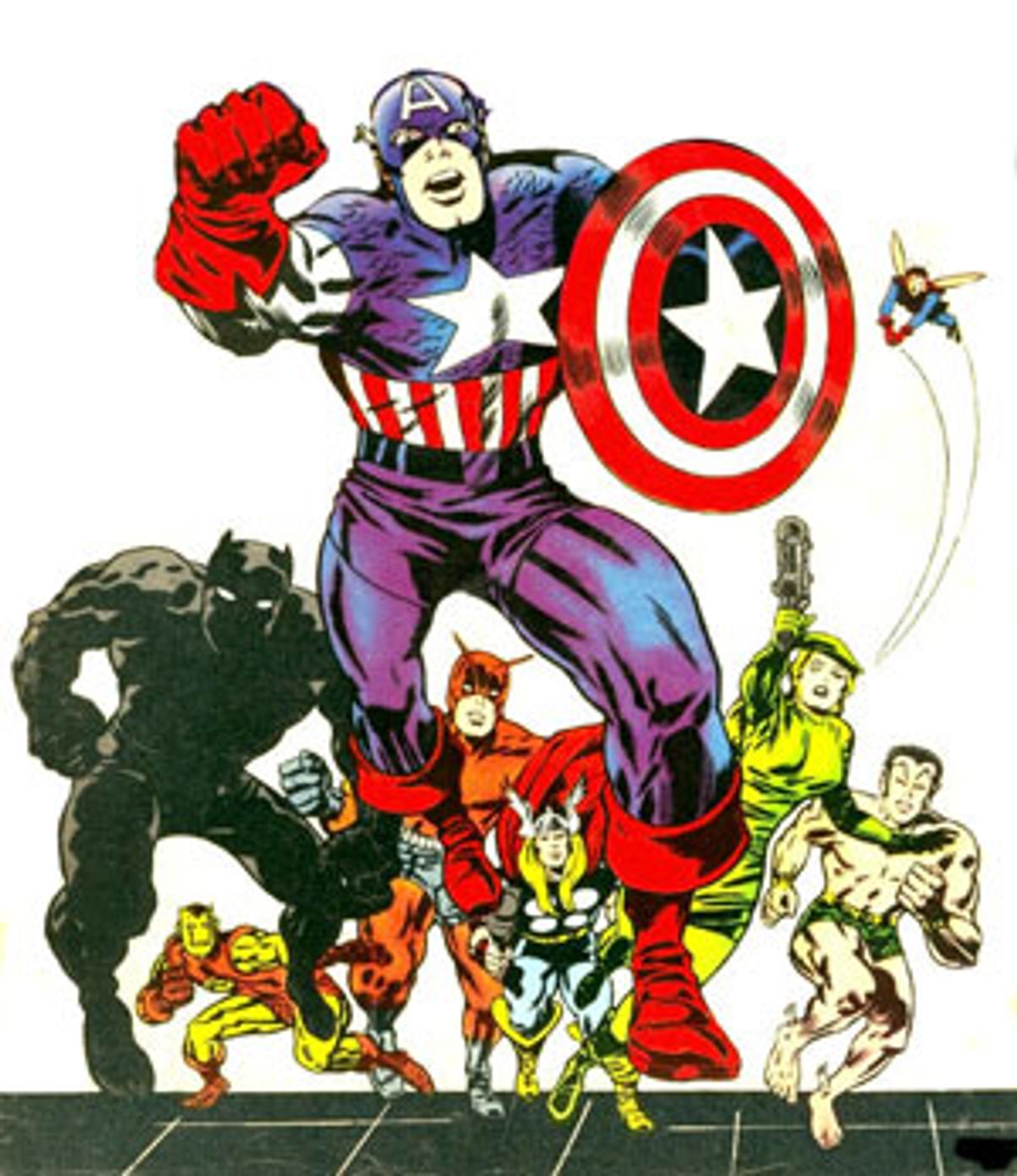
Marvel's big 2006 summer event, which officially kicked off May 3, is a clever if flawed attempt to devise a crossover with a real-world political subtext. It's built around a seven-issue miniseries, "Civil War," written by Mark Millar and drawn by Steve McNiven. The first issue (the only one available for advance review) is the setup: A third-rate superhero team, being filmed for a reality TV show, gets in a fight with a couple of villains that ends in disaster, with a chunk of Stamford, Conn., blown up and hundreds of schoolchildren killed. Subsequently, there's a public backlash against costumed vigilantes and widespread public support for forcing superheroes to work directly for the U.S. government. A schism develops between the heroes who want to go along with that plan and those who refuse. The former are led by Iron Man, a futurist and pragmatist who believes that cooperating now will spare everyone trouble in the future; the latter are led by Captain America, an ideologue who believes that to give in would be a betrayal of principle. As the title suggests, the conflict is apparently going to erupt into wholesale war within the superhero community; over the summer, there will be dozens of tie-ins in other Marvel series, and a second miniseries about what's happening on the war's "front lines."
The figurative significance of "Civil War" is easy to see: It's supposed to address the question of trading privacy and liberty for security. That's not exactly new to mainstream comics, though. The "government makes superheroes unmask/register or quit" plot was used in the '80s in both Alan Moore and Dave Gibbons' "Watchmen" and James Robinson and Paul Smith's "The Golden Age," and a few years ago in Brian Michael Bendis and Michael Avon Oeming's "Powers." Millar's great at writing action scenes and delving into his characters' ideologies, but a few seconds' thought reveals that his metaphor for America's security mania is actually pretty deeply flawed. It's hard to imagine either "army" of familiar characters countenancing any kind of civilian casualties, or voluntarily deciding to get in step with the government -- if superpowers are outlawed, only outlaws will have superpowers, as they say. And despite all of Marvel's "No, really, nothing will ever be the same again, you can't miss this, really" publicity, it's inconceivable that a major change in the status of Spider-Man or Captain America or the X-Men could last more than a few months -- as we've seen in every other crossover, the company's got too much riding on its icons staying pretty much the same forever.
At least "Civil War" is fairly self-explanatory. The same can't be said for DC's mammoth crossover "Infinite Crisis," written by Geoff Johns and drawn by a posse headed by Phil Jimenez; its final installment also appeared May 3. If you are not already deeply immersed in the last 30 years' worth of DC Comics, it might be possible -- but not easy -- to enjoy "Infinite Crisis" as an enormous show of sound and fury, crammed to bursting with incidents and explosions and carnage and hundreds upon hundreds of characters whose presence Johns rarely bothers to explain. The impossibly convoluted plot, foreshadowed for years before it began, has spilled over into four other miniseries, a slew of one-shots and innumerable crossovers in ongoing series, and still feels breathless, dense and desperately unclear.
The miniseries' theme, though, chomps right on its own tail: "Infinite Crisis" is a superhero comic book about superhero comics as a genre and what's going on with them right now. As the title suggests, it's a sequel to Marv Wolfman and George Pérez's mid-1980s crossover "Crisis on Infinite Earths," a well-intentioned miniseries that, in an attempt to clean up the confusing elements of its fictional corporate universe, wiped out one of its most resonant concepts: that there were multiple, parallel Earths, whose histories weren't quite the same, occupying the same space and time, and that they could sometimes bleed into each other. Johns' story teases readers with the return of the parallel-Earths gimmick, but concludes that there's really only one world.
The implication Johns all but spells out is that something has been terribly wrong with the tone of comics for decades, but that it can be fixed by strong, centralized control; that if the pre-1985 ideal of superhero stories as innocent, uncomplicated fun doesn't work anymore (this concept is represented by an alternate version of Superboy going on a murderous rampage -- don't ask), then neither does the darkening moral fog of the post-"Watchmen," post-"Dark Knight," post-"Crisis on Infinite Earths" mainstream; that the only solution is to return, somehow, to these characters' points of origin, and let history repeat itself with slight variations, for an audience of (some of) the same people who bought it the first time.
At the same time as "Infinite Crisis," there has been another, much more self-contained DC crossover going on: writer Grant Morrison's brilliant "Seven Soldiers" project, which wraps up in late June -- the first two paperback collections (of four) are out already. It's made up of seven four-issue miniseries, drawn by seven art teams, reinventing seven bottom-of-the-barrel, virtually unknown DC characters -- Klarion the Witch Boy, the Shining Knight and so on. (You won't miss anything if you've never seen any of them before.) The seven protagonists never meet one another, but their individual narratives collectively form an eighth, tightly choreographed story about maturity and cultural evolution: Morrison suggests that "superhero" is just another word for someone who has attained the next stage of enlightenment beyond his or her culture. (A fan makes a convincing argument here that the overall arc of "Seven Soldiers" is meant to echo Ken Wilber's "spiral dynamics" model of human consciousness.) And for all the project's conceptual complexity, Morrison still manages to pull off over-the-top nuttiness. Best caption: "All in a day's work ... for FRANKENSTEIN!"
Both Morrison and Johns are part of the four-writer team directing "52," another massive DC project, beginning May 10. (The other two are Mark Waid, a comics-history encyclopedia with a knack for pacing and flow, and Greg Rucka, who specializes in gritty spy stories like Oni Press's "Queen and Country"; he also worked on the cult favorite police-procedural "Gotham Central," whose best character, lesbian ex-cop Renée Montoya, is one of "52"'s protagonists.) It's a 52-issue, weekly miniseries that will progress in real time. The background: As of the comic books published in March, the time frame of most of DC's ongoing series jumped ahead a year, during which Superman, Batman and Wonder Woman -- three characters whose metaphorical significance is the concept of human perfectibility -- had all been missing. "52" follows what happened during the lost year from the overlapping perspectives of six characters trying to find their way in a world whose anchor has just disappeared.
The conceptual resemblance to "24" isn't an accident: The new wave of television drama -- not just "24" but the likes of "Lost" and "Six Feet Under" -- seems to have provided the model for the way "52" progresses, too. The pace is swift enough that it takes careful rereading to catch everything; multiple subplots gallop along in tandem. But the writing team knows that superhero comics can also get away with abrupt changes in setting and scale. In the course of the first month's worth of issues, "52" encompasses space opera, hard-boiled detective fiction, psychological suspense, light comedy, Grand Guignol violence, medical drama and straight-up good-guys-vs.-bad-guys action, all butting up against one another. (Keith Giffen, who's doing layouts for the whole series, gives it a consistent look, with slightly overlapping images and perspective that moves gracefully from panel to panel.) It's clear that all the plots will eventually come together, if not how.
The cast of "52" is once again gigantic, but the story is much gentler to non-obsessives than "Infinite Crisis" -- the writers don't mind throwing in a little subtle exposition, and every issue after the first will include a backup feature explaining a bit of the DC world's history or a character's background. The tone of the series is less world-making than world-mapping (at a panel discussion in February, writer Rucka noted that he and his colleagues are thinking of Google Earth as a reference point): It's not about changing everything in this fictional cosmology, it's about showing readers how 65 years' worth of collaborative invention fits together.
The biggest challenge mainstream comics face right now, though, is roping in new readers, who have gradually been trickling away as the economy of the comics industry shifts to squarebound collections and manga, and racks of comics at newsstands become a fading memory. One particularly nice form of customer outreach is happening May 6: Free Comic Book Day, a now 5-year-old tradition in which several thousand American comics stores offer a choice of about 30 different special giveaway comics, many meant for kids, to anyone who comes in.
Unfortunately, a lot of this year's mainstream freebies --Marvel's "X-Men/Runaways," DC's "Superman/Batman," independent companies' "Star Wars" and "Transformers" and "G.I. Joe" comics -- are somewhere between uninspired and horrid. If you're visiting a comics store this Saturday with a young child, grab Andy Runton's adorable "Owly: Breakin' the Ice" (Top Shelf) or the surprisingly charming "Donald Duck" giveaway (Gemstone/Disney). If you're by yourself and of legal drinking age, go for Bryan Lee O'Malley's "Free Scott Pilgrim" (Oni Press), a trailer for his loopy video game/manga-influenced graphic novel series, or French cartoonists Phillipe Dupuy and Charles Berberian's slice-of-life comedy "Mr. Jean" (Drawn & Quarterly), or Joel Priddy's daffy, minimalist one-shot "The Preposterous Voyages of IronHide Tom" (AdHouse Books).
As usual, the most pointed critiques of the comics world come from within, and one story in another Free Comic Book Day title, "Bongo Comics Free-for-All!" sums up the question of the moment. As it begins, the Comic Book Guy in "The Simpsons" is delighting in an issue of "Archie Disassembled" (a riff on Marvel's big 2004 crossover "Avengers Disassembled"): "Big Ethel kills Moose to get Jughead's attention? Oh, Brian Michael Bendis, you've done it again!" When C.B. Guy is bonked on the head by a box of "Radioactive Man" comics, though, his personality changes. He kicks his customers out and shuts down the store: "Why would you want to read this? It's overpriced, vapid, and juvenile, packed with enough grammar mistakes to make a third-grade child blush!"
Well, he's right, sometimes. God knows there's plenty of cynical, awful superhero products packing comics stores' clearance bins, and some of the worst offenders are "event" comics and crossovers. So why do people keep buying them? Because when they're good, their charge of fantastic invention is like nothing else -- a well-executed crossover offers a sense not only of experiencing a crucial moment in a huge, fictional history but of being able to understand the meaning of that moment by seeing it through multiple artists' (or characters') eyes. And, at their best, they give even the terrible comics that came before them meaning and value, as unreliable but irreplaceable documents of a world whose wonders are only more colorful versions of our own world's.
Shares