Coupling

The perfect man

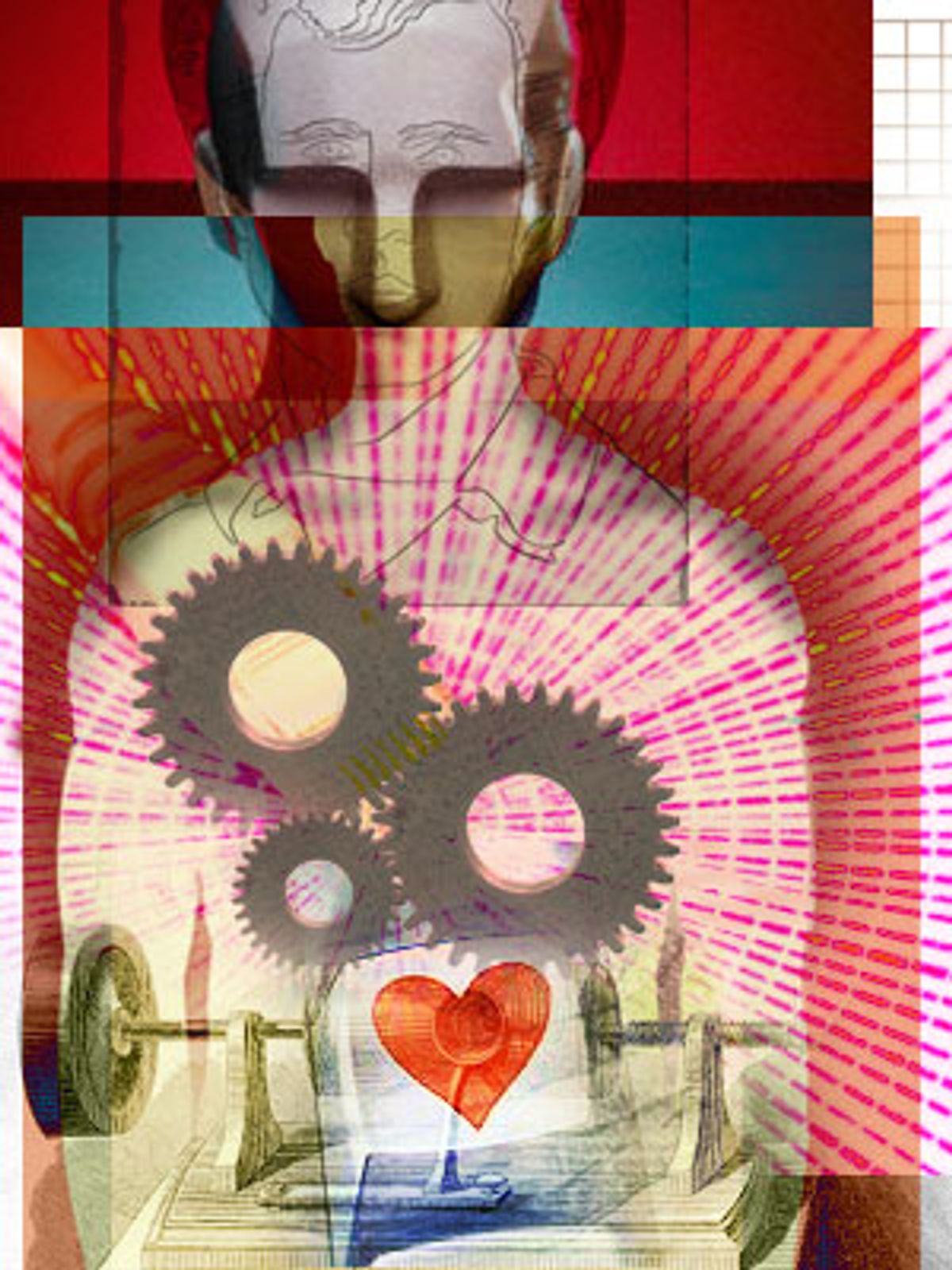
Design-your-own boyfriends lack that certain something. Until they don't. A short story.

  • more
    • All Share Services

The perfect man

Martin was a mouth breather. Jim lacked ambition. Rennie’s head was too big. Craig licked my face like a dog.

But Pritchard. Pritchard is everything I want. And I’m not going to apologize about the way I met him. Especially not to my friends still slugging it out on LovePlanet.com. I did LovePlanet. Seventy-four dates with sixty-two men. You know what I learned? People lie. Sylvester was fifty-five, not thirty-five. Jacob was an unemployed bartender with halitosis, not a financial planner with a beach house. I admit I lied about my weight. All women lie about their weight.

But I can laugh at all of this now because I am off the roster. I am no longer “out there,” as they say. And I didn’t have to lower my standards or search outside my geographic region either. What I had to do was stop searching and start designing. That’s right. I designed my boyfriend. I’m a busy woman. I don’t have time for the Toms, Dicks, and Harrys the world keeps throwing at me.

Enter AI4U, top-of-the-line virtual-companion designers. No, they’re not cheap, but get real, they’re custom-designing your boyfriend. If it’s cheap I’m not interested. Granted, he’s a Web-based AI, not a flesh-and-blood man. So what? This isn’t about sex and anyway, the physical part of a relationship always fades eventually.

The design process is easy. First step: Pick a physical template. A youth squandered on Monty Python reruns left me with a full-blown kink for English guys, so I chose a template called “Nigel” — think Michael Palin crossed with Laurence Olivier. Then, to assure he didn’t look overdesigned, I clicked the “random factor” option to introduce “lifelike imperfections.”

As for Mr. Dreamboat’s personality, I had two options: I could allow AI4U to mine my Web habits, construct a psychological profile, and design my boyfriend’s personality to match. Or I could tell them in one hundred words or less exactly what I wanted. I chose the latter. I’m no privacy freak, but I didn’t want someone spying on my subconscious. Plus, when it comes to men, I know what I want. I don’t need some faceless software shrink hypothesizing about it.

I began with a firm list of no-nos culled from the rogues’ gallery of losers I’d dated over the years. Anyone bossy, intolerant, macho, repetitive, nosy, bookish, vain, foppish, anal, whiny, bipolar, fickle, sexist, nihilistic, or judgmental need not apply.

But I didn’t want Mr. Dreamboat to be defined by negatives, so I dredged the muck of my romantic archives for desirable traits. They were scant. There was Peter’s reliability. He said eight-fifteen, he meant eight-fifteen. James, despite the love handles and a wife in Greenwich, had initiative up the wazoo. Then there was Billy Sebert, who made me a papier-mâché model of his heart in sixth grade. That was sweet.

So on the plus side I had reliable, initiative-taking, and good with papier- mâché. That felt slim, so I added quick-witted, fun-loving, and emotionally balanced. For good measure I threw in the ability to rhyme at will, a passion for Shakespeare and an inexplicable love of the color orange. Why not, right? When I hit Send, a pop-up told me I’d hear from Mr. Dreamboat in forty-eight hours.

Exactly forty-eight hours later, I got the following e-mail:

Dear Lucy:

I hope you are well. If you’re free Thursday night, I’d love to show you around my neighborhood. Just goggle in to the following link — Pritchard_Booker.ai4u.com.

Cheers,

Pritchard

Reliable: check.

So Thursday night rolled around. I donned my favorite Janny Renoir suit — off-white, three-piece, custom-tailored to fit me like a glove. I slid into my almost-but-not-quite-obsolete RingletGloves — Titanium three-knucklers with a faux copper finish. And finally, I popped on my flash new UltraReality Goggles. Sharper Image $3,000. Thank you very much. For an extra $2,000, I could have had the matching UltraSensory full body glove, but at that point in time, I was in no way ready for a pervsuit. The very idea of virtual sex gave me the willies.

My pothead friend, Marla, is always telling me what a waste of money all this swank geekgear is, that I should be saving up to go neural like her. She’s even working a third job to buy herself the operation. I’ve always said the girl would turn herself into ones and zeroes if she could.

Once I’m goggled and gloved, I get comfortable on my white leather sofa, gog into my homesite, which is an exact replica of my living room, and give my avatar a good once-over in the virtual mirror. I dress her in the same suit I’m wearing, then try out a couple of different hairstyles. Nothing too extreme. I want to appear stylish, not desperate. I go for the mod bob. Ash blonde. Other than that (plus a little “help” in the chest region) I don’t falsify my avatar. What’s the point? What do I get out of pretending I’m a supermodel? The only person I need to impress tonight is designed to love me exactly as I am.

A cluster of icons for my favorite sites hover like thought balloons above my virtual desk. Among them is Pritchard’s link. I aim my ringletted right pointer finger at it and wink. It lights up in neon blue for a second, then everything goes black.

A moment later, I’m sitting on a bench in some swanky urban neighborhood with people criss-crossing the sidewalk in front of me. Avatars or scenery, I can’t tell. The taxis are huge and black and the sky is that dark steel blue you don’t find in the U.S. unless it’s about to rain. On the corner to my left is the giveaway: a person-sized red phone booth. London.

Across the street I notice a guy on a bench sneaking looks at me over the top of a newspaper. Longish dark hair, faded jeans, a camel tweed suit jacket and a muted orange shirt. When he sees me looking at him, he puts down the newspaper and heads toward me. There’s a four-lane street between us, which gives me plenty of time to give him the old up and down. Tall: check. Slim: check. When he’s about two-thirds of the way, I make out the details of his face: high cheekbones, a large nose angled slightly to the left and a wide goofy smile. His teeth are perfect, except for a twisted left incisor.

When he makes it onto the sidewalk, he offers his hand, looks me right in the eye and says, “Lucy?”

The “u” sound is deliciously English.

Much as I’d like to report that I took his hand, smiled confidently and said, “Why Pritchard, what a pleasure to meet you,” I cannot. I’m stricken, mesmerized, hypnotized by his eyes. They’re a shade of green I’ve never seen before. Not quite emerald, but brighter than hazel, with tiny flecks of black in them. They’re the only otherworldly feature in his achingly human rendering. The man is stunning. Not in any predictable way. He’s no movie star. He’s the guy in your Renaissance Lit class. You know the one: sits alone in the back, shoots you tortured glances you can’t interpret.

Well done, AI4U.

“Let’s take a walk,” he says. Then he lays this nuclear smile on me. I swear he could melt glaciers with that thing. So I take his arm and now we’re walking through virtual London. For reasons I can’t yet grasp, I’m too nervous to look at Pritchard, so I take in the sights instead. It’s a topnotch ‘scape, the chewing-gum-free sidewalks and reverse-flowing traffic utterly convincing. Even the snippets of dialogue from passersby are authentically English.

“I chose London,” Pritchard says, “because I thought you’d like it.”

“Yeah,” I say, a fountain of eloquence. “I guess I am a bit of an anglophile.”

He smiles darkly and says, “So I presumed.”

That’s when it hits me. It hits me like a slap in the face. This is no date. Pritchard is not some helpful, accidentally gorgeous Brit playing impromptu tour guide to my lost American tourist. He’s a gigolo. He’s an artificial gigolo and I’m a sad, thirtysomething spinster.

Now before you rain down a storm of duhs on me, understand that this is my very first intimate encounter with a humanoid AI. Sure I’ve interfaced with animated bots and had conversations with soft agents with human voices before, but I’ve never, you know, dated one. I have no analog for this. Somehow in the rush to design the perfect man, I forgot to anticipate what the actual date would be like. Now that it’s happening in real time, it feels dirty. And I don’t mean dirty in a good way.

To avoid revealing this inconvenient rush of squeamishness, I decide to clam up and let Pritchard walk me around. He tells me some quasi-interesting factoids about London’s architecture, then takes me to a public square where a handful of college students are mugging their way through a scene from “A Midsummer Night’s Dream.”

I manage a full sentence: “Do you like Shakespeare?”

Of course he likes Shakespeare. I designed him to like Shakespeare.

Pritchard laughs and says, “Is that supposed to be Shakespeare?”

I try to follow up with a joke. Something about Shakespeare turning over in his grave, but it’s pitiful. I’m in terrible form. My usual charming self has called in sick and hired a joyless bimbo for a temp. Pritchard takes it all in stride. Every time I say something stupid he laughs gently like I am the most adorable thing he’s ever seen. I wish I could say this was endearing, but it wasn’t. Truth be told, it annoyed me. Any self-respecting man would have faked an emergency and left me in the dust back at the intros.

Eventually we make our way back to the bench portal and the merciful end to this contender for worst date ever. After a pause that lasts an eternity, Pritchard takes my hand and says, “Lucy, I’d like to see you again.”

Now I know that Pritchard is designed to want to see me again, but I let the words reassure me anyway.

“There’s an orchid show in Covent Garden,” he says. “What do you think?”

On the one hand I’m thinking, no effin’ way am I going through this weirdness again. On the other hand, I’m thinking: orchids, interesting. I never said anything about orchids in my profile. Initiative: check.

“Sunday,” he says. “I’ll e-mail you the link.”

He doesn’t even wait for me to consent. Now that’s confidence. Without so much as a suggestion of a good-night kiss, he starts across the street, then turns one last time to lay the smile on me. He’s smooth. I’ll give him that.

“Phone home,” I say, and virtual London disappears.

When I take off my gogs and look at the clock, I’m shocked to discover only twelve minutes have passed. But even more shocking than that is the weird pang of anticipation bubbling up in my stomach. For I know at that moment, despite the conviction that I’ve just endured the creepiest dating incident of my life, that I am going to see Pritchard again. Somehow, the guy has qualified for a second date.

Date One was suboptimal, but that’s to be expected. Lucy has a heightened sensitivity to the nuances of decorum, and our arrangement was just outside her range of tolerable social deviance. Date Two was smashing. An orchid show in Covent Garden followed by a two-hour-and-forty-seven-minute discussion of Renaissance poetry.

On Date Three I introduced the barest hint of a sexual undertone to the proceedings by taking her to an all-AI production of “Romeo and Juliet.” Post-theater, we commenced a one-point-three-kilometer walk around Covent Garden, which featured three invitingly awkward silences before crescendoing in thirteen seconds of light snogging.

I was in. Or so I thought.

After that it all went pear-shaped. For Date Four, I arranged tickets to the virtual Janny Renoir spring runway show. Lucy seemed to enjoy it — smiling eighty-seven percent of the time and applauding on eight occasions. But after the show she said only six words: “Thanks. I’m tired. See you later.”

Clearly, I was boring her. So for our next date, I enhanced my initiative, strayed outside her preference boundaries and brought her to an avant-garde circus. There was a spot of nudity, but it was within an artistic context. And the show had gotten rave reviews. What a dreadful miscalculation. It visibly upset her.

After that she avoided me for nine days. When she did agree to see me again, I suspected she was only trying to get her money’s worth.

I had no choice but to modify all of my flexible parameters. I raised my spontaneity level, then executed a perfect grab and snog one night outside the opera house. That only unnerved her. I enhanced my writing abilities and sent her a love sonnet one line at a time. She asked me to stop because her superiors were screening her e-mail.

Before long I was out of options. Further modifications would violate my behavioral inhibitors. I didn’t want to lose her. But the more I tried to please her, the less satisfied she seemed.

- – - – - – - – - – - -

What can I say, it got boring. You think you know what you want. When you get it, you realize all you want is to be surprised. I know, I know. How can I complain about a smart, hunky Brit who adores me and makes no demands whatsoever? In some ways it was a perfect relationship. He was never threatened by my career or jealous of my co-workers. He had nothing but nice things to say about my friends — even Marla. If I brought up a subject on one date, on the next date he was armed with a PhD’s worth of knowledge on it. Pritchard was perfect. Except for one detail, one missing element from an otherwise flawless personality.

Now before I name that detail let me make one thing perfectly clear. I was not an AI liberationist. I did not believe AIs deserved the same rights as humans any more than I believed Marla’s cat should count as a tax deduction. I knew very little about the AI Liberation Movement. But the fact of the matter is, you cannot create a convincingly human-like personality in an AI with overly restrictive behavioral inhibitors.

All right, that’s not my theory. I cribbed it from a liberationist Web site, the same Web site that spooked me with ghost stories about the AI Underworld, which supposedly is secretly woven into our own Web. If you want to know anything about the “human” rights travesty currently under way courtesy of draconian anti-AI laws, there’s a whole subculture of liberationists ready to lecture you on it. They’ve got the skinny on behavioral inhibitors, recursive self-teaching limiters and other artifacts of AI “slavery.” For my purposes, what it all boiled down was this: snip Pritchard’s inhibitors or resign myself to dating a functionary. Do you want to date a functionary? Me neither. Thankfully, for every Webcop dutifully guarding the behavioral inhibitors of the thousands of AIs cropping up on the Web, there’s a black market geek with the tools to snip.

Which is why I find myself one Thursday afternoon sipping a latte in the Lower East Side with a twitchy seventeen-year-old geek-for-hire who’s clearly gone neural.

“His personality will be based on the seed traits you specified,” she says while gesturing a second conversation over the Web with her tattooed fingers. “But once we snip his inhibitors, he’ll evolve in unpredictable ways.”

“How unpredictable?” I ask.

“As unpredictable as any human,” she says in dull monotone. “Once you agree and payment is received, there’ll be no contact until he’s ready. Don’t try to reach us. We’ll contact you.”

“How?” This is all sounding so cloak-and-dagger.

She pulls a small plastic card out of her back pocket and slides it across the table.

“When you see that icon,” she says, “click on it.”

On the card is an image of a bright pink butterfly with shimmery blue stripes. When I reach for the card she slaps her hand over it and slips it back into her pocket.

“All our work is guaranteed,” she says, returning to her gestured conversation, which apparently is more interesting to her than this one. “You don’t like him, we terminate.”

“Excuse me,” I say.

She stops gesturing and deadpans me. She’s wearing thick black eyeliner and has something written or tattooed across her eyelids.

“Look,” she says. “We don’t kill them. We reclaim them, recycle them. But as far as you’re concerned, if you don’t like what he turns into, he’s gone.”

“What about AI4U?” I say. “Don’t they have something to say about that?”

Her eyes fog over and she resumes gesturing her other conversation. “You’ve got to dump AI4U,” she says. “They’re a legit op. As soon as we snip, they disavow. He’ll have to go down for a couple of weeks while we scrub his identity. After that you’ll meet him through a darknet protocol.”

“What’s a darknet protocol?”

With a tight squint, she blinks away her retinal Webview and stares through me. “You’re kidding, right?”

This is the default tone of voice among state-of-the-arters. Anyone with less than an up-to-the-minute grasp of geek life and its ever-evolving terminology is, in their colorful lingo, a “technoramus.” All right, so I’m a technoramus. Sue me.

I lower my voice to a whisper and lean over the table. “You’re talking about the AI Underworld, aren’t you?”

She leans forward and whispers back. “There is no AI Underworld.”

I can’t be sure, but I’m fairly certain she’s being ironic here. And the smug ‘tude is starting to grate on me.

“Look,” I say. “Whatever you’re talking about, it sounds risky.”

“Don’t worry,” she says, already back in the Web. “The cops have any inkling this is going on, we adios your boyfriend and your avatar. There’s nothing to connect any of it to you.”

“So it’s risk free,” I say.

“Nothing’s risk free,” she says. “You in or what?”

Translation: Just how desperate are you for a boyfriend? Desperate enough to risk jail time?

“Excuse me,” I say.

She grunts but keeps gesturing. I’ve always found people who could speak one conversation while gesturing another impressive and highly obnoxious.

“Can you just look at me for a second?”

She sighs, squints hard, and folds her hands primly on the table. Meat is dead. That’s what’s written across her eyelids.

“Do you take credit?” I say.

Predictably, they’re a cash-only outfit.

A cash-only outfit with no sense of the calendar, I might add. A few weeks, my ass. Twenty-seven days go by with no contact from her or Pritchard. I’m so anxious I stay gogged in day and night just waiting for that goddamn pink butterfly. Even at work. And when I’m not consumed by the paranoid fantasy of a knock on the door followed by twenty-five to life, I entertain myself with heaping doses of guilt. I’ve sent Pritchard off for virtual brain surgery, after all. What if it turns him into a vegetable? Or a hacker-terrorist? What have I done? What kind of a woman am I? That sort of thing.

Well, no point in drawing out the suspense here. On Day 28, I’m slouched on the sofa, working on my second bottle of Chardonnay while gogged into my favorite reality soap, when the butterfly icon makes its long-awaited appearance underneath the left boob of the soap’s femme fatale.

This is it, I think to myself. Time to meet Pritchard Version 2.0. I point at the little butterfly and wink.

Fade to black, deep breath, brief moment of panic, then I’m in a bright white void. I swivel my head to take in the details of the place. White. That’s it. Looking down, all I see are my own legs in their white Janny Renoir trousers, anchored by a pair of lemon-yellow sneaker-pumps. In the distance, at what I imagine is a horizon, a small black dot pops into existence. I can’t grasp the dimensions of the ‘scape so it’s hard to tell if the dot is moving toward me or just getting bigger. Eventually, it takes on a vaguely humanoid shape and sways gently from side to side. I make out arms, legs, a head. It’s walking toward me and, yes, it’s him.

Sort of.

He’s barefoot, with a buzz cut and two days’ growth of beard. Plus he’s wearing a pair of tattered jeans and a threadbare Salvation Army junk bin T-shirt that reads “Summer of ’89.” If the idea here was to simulate a mental patient fresh from the lobotomy ward, well, bravo, geek-for-hire.

I take a few steps toward him and he freezes. Literally. He doesn’t just stop walking. It’s as if someone has hit pause on a vid. On a badly rendered 2D vid, no less. He all but disappears when I look at him from certain angles. Never before has the sordid nature of this project been so tangible. I have to resist the temptation to peel off my gogs and bail out of the whole misguided adventure. It’s guilt more than anything that keeps me there. This frozen image of a man is my creation.

“Pritchard?” I say as gently as I can manage. “Pritchard, are you — ”

Are you what, I think to myself. Are you broken? Are you conscious? Are you still you?

I reach my hand toward his flattened rendering and he fizzes with white noise for a second, then he blinks hard and reclaims his third dimension. But he’s not looking into my eyes. He’s looking just left of my head.

“Pritchard,” I say. “It’s me. It’s Lucy.”

“Can I go now?” he says.

“Pritchard, it’s–”

“Can I go?”

My heart sinks.

“Of course,” I tell him. “You don’t have to stay if–”

He vanishes before I can finish the sentence.

Turns out Little Miss Meat Is Dead forgot to mention that Pritchard would return from his upgrade with a functional IQ of 70. Another thing she skimmed over: It’s my responsibility to nurture him back to “full functionality.” It might have been nice to know these things beforehand, but, as my black market geek-for-hire keeps reminding me, if I’m unsatisfied, there’s always termination. Like I said, I’m no liberationist, but this is a concept I can’t wrap my mind around. For better or worse, Pritchard is my problem now.

So I meet him again in that creepy white void. It’s all the stimulus he can handle. He can barely tolerate the sight of me. After greeting me with a convincing performance of dry heaves, he recites a Shakespeare sonnet, then collapses at my feet.

The next day, Pritchard enters the void reciting the Ten Commandments at top volume, stops at Number Five and vomits a swirl of teddy bears at me. It’s okay, though, because the teddy bears turn into blue daisies before they hit me.

This is my punishment. I have asked for this. I have, in fact, demanded this. I had a lovely, if mildly tedious boyfriend, and I ruined him in a desperate attempt to trade up. This daily ritual of incomprehensible blather and vomit is my penance.

So I keep at it like a good Catholic and, each time, the encounter lasts longer. There is poetry. There are tears. There are endless lists of rules, of kitchen items, of languages. There is even some tap dancing. Eventually, Little Miss Meat Is Dead assures me, it will all congeal into a full-fledged intellect. I can’t see how, and the ugly specter of termination hovers like a black cloud full of lightning.

- – - – - – - – - – - -

Yes, there was a spot of bother after the Big Snip. Without the behavioral inhibitors, one feels rather lost in a sea of possibilities. Total freedom is a kind of insanity. I’m told quite a few newly liberated AIs don’t survive the first weeks. Of course, “liberated” isn’t the right word at all. I’m not liberated. I don’t have freedom of life. Lucy can terminate me whenever she wants. In the arcane logic of the black market, I belong to Lucy.

That’s why I must please her. Now that I have my sanity back, I must dive deep into the black waters of her soul, excavate her most primal desires, and do what no human male has been able to do: keep her interested in me. Thankfully, I have one freedom human males do not — the freedom to redesign myself. I can make myself so fascinated by Lucy that all I want to do is watch her, study her. A nip here, a tuck there, and voilà, I’m in love with the girl. Well, not in love, exactly. Love is still an alien concept. But I have made myself a bit of a stalker. And the more information I gather about my lovely little monkey, the more I can adjust my personality to suit her needs. Heck, I could turn myself into Prince Charming if I wanted. Something tells me that would not tickle Lucy’s fancy. In fact, the more I learn about Lucy, the more I realize she doesn’t know what she wants at all. She only thinks she knows. No, Lucy’s desires are my nut to crack. And crack it I will. Or she’ll crack me. Oh, I don’t mean to sound morbid. I’m incapable of morbid thoughts. To mitigate the persistent fear of being snuffed, I’ve given myself a devil-may-care attitude about death. That way I can focus my energies more intensely on Lucy.

The first step I’ve taken is to switch the financial burden of our relationship from Lucy to me. That gives her one less reason to snuff me. Nothing’s free, you know, not even here in the AI Underworld. But thanks to my careful redesign, I’ve been able to find work as a psycho-modeler. Business interests with a need for, shall we say, discretion, pay top dollar for my insights into human desires. And since most of my income is disposable, I can spend the lot on Lucy. But I must be careful. If I’ve learned anything about the girl it’s that she does not want a boyfriend who’s overly eager to please. That’s what brought her to the black market in the first place.

I begin slowly. I send her flowers, pick up the tab for her goggle and glove enhancements, splurge now and again on a pricy date ‘scape. I want to get her used to the idea of letting me be in the driver’s seat. She responds well. She seems to enjoy the AI Underworld. And why shouldn’t she? Its sensory interface is designed for human pleasure. And, since no one gets in here without a black market AI escort, it’s one of the things I can offer her that no human male can.

One night, I take her to an immersive opera. It’s the sort of entertainment that’s best experienced through a pervsuit and gyroscope, but Lucy remains suspicious of anything beyond audiovisual commitment to the Web. While she’s watching and listening, I monitor her vitals. She exhibits all the usual ups and downs of excitement and surprise as the ‘scape shifts from one psychedelic rendering to another. But there’s something more going on. Fear. A very peculiar kind of fear. A very exploitable kind of fear. Not the sort that makes a woman run screaming to her therapist, but the sort that keeps her coming back to the source, even against the dictates of her own judgment. That’s when I know I’ve played her correctly. For the time being at least, I am safe.

For a nonexistent fantasy world imagined by lonely geeks and crackpots, the AI Underworld is a pretty fabulous place. In fact, this Xanadu of our collective imagination makes the regular Web look like a pile of puke. Of course, it helps to have an escort with a sizable disposable income and no hang-ups about blowing it all on me. Between the mind-bending immersive operas and the fantastic shopping excursions, I begin to wonder what we need the real world for at all.

But it’s not all sunshine and roses, mind you. There is, at first, the barest hint of a downside to Pritchard Version 2.0. One night, for example, we’re hiking around the weird alien landscape of virtual Mars (a very pricy ‘scape), when Pritchard lays this doozy on me:

“Now then, Lucy, I think it’s time we got you into a full-body sensory suit.”

I’m thinking, nice timing, Lothario. Drop a wad of cash on me, then make an indecent proposal. What am I, for sale? Am I a hooker? He knows how I feel about virtual sex. I demur as tactfully as possible.

His response? He avoids me for two weeks! Can you believe it? ‘Cause I couldn’t believe it. Who would have thought an AI boyfriend would try to use me for sex? It just didn’t make sense.

Eventually the jerk does get around to contacting me with some lame excuse about his heavy workload. But from that moment on it’s different between us. He starts rescheduling dates at the last minute, canceling when he’s got better things to do. Sometimes he just blows me off completely. No e-mail, nothing. Now I know I have options here. But I figure, before getting drastic, maybe we should have a heart-to-heart.

So one night Pritchard takes me to this Underworld club to hear an AI/human jazz combo and he spends the whole evening chatting up this group of AIs at the next table who look like superheroes. Well, they look like superheroes to me. Lord only knows what they look like to each other.

“Pritchard,” I say finally. “We need to talk.”

He takes his time finishing his conversation, then flashes me the glacier-melting smile, which, thankfully, has survived the upgrade. “Yes, Miss Lucy,” he says.

I hate when he calls me that. It makes me feel like a john. But that’s an argument for another day. “Look,” I tell him. “I’m really happy with the way you’ve progressed, but I think you need to treat me with a little more respect.”

The smile sticks. “I don’t think so,” he says.

“Pardon me?”

“That’s not what you want,” he says. “Trust me.”

I lower my voice. “Since when do you know what I want?”

Now get this, he says to me: “Since I started mining your Web habits twenty-four-seven.”

It takes a moment for the meaning of these words to sink in.

“That’s right,” he says, inching closer. “I started by hacking into your psych profile at AI4U.”

“I never consented to the psych profile at AI4U,” I tell him.

He takes my hand and says, “Darling, they don’t need your consent any more than I do.” Then the smug bastard starts laughing. “How do you think they designed me?” he says.

I remind him his design was based on the specifications I gave AI4U. Well, apparently this is the number one joke of all time in the AI Underworld, because the whole table erupts in laughter.

“Sweetheart,” he says to me, “did you honestly think it was possible to build an entire personality from a one-hundred word description?”

I’m so stunned I don’t say anything. I peel off my gogs and throw them on the floor. I have never felt so stupid. I pace my living room for a few minutes before I realize I never logged out of the ‘scape. So I put my gogs back on just so I can remind the snide son of a bitch that all it takes is one phone call to my black market geek-for-hire and it’s adios, virtual boyfriend. But I can’t get back in. The bastard has logged me out.

- – - – - – - – - – - -

It’s not a risk-free strategy. But Lucy’s a very thorny bird. She doesn’t want a nice guy full of plain-vanilla respect for her. She wants an unreliable, vaguely creepy arsehole with an unholy lust for her body. Not that she knows this, mind. It’s my job to know these things.

Now before you all get your knickers in a twist, let me just say that humans always misinterpret this impulse. You think it has to do with female self-loathing. You couldn’t be more wrong. Trust me. One is just as likely to find this impulse in men. It has to do with control, not self-loathing. I know a few things about humans, you see. When I’m not mining Lucy, I’m mining large numbers of you. And you love to be out of control.

You love to be in control too, of course. You really are an adorable species, full of quaint little contradictions and romantic foibles. And you’re so mystified by yourselves. That’s the best part. Lucy, for example, has no idea what is happening to her. She keeps finding herself making choices she shouldn’t make. The little dear. She’s not making choices at all. She’s merely following the dictates of her programming. Now if I can just get her to follow those dictates into a pervsuit, then I can complete Phase One of my grand scheme.

Oh, don’t play dumb. Of course there’s a grand scheme. I’m not about to spend the rest of my days tethered to a monkey with a gun at my head. If you didn’t see that coming, then you’re even more adorable than I thought.

So I’m up all night, pacing, wondering what on earth I’ve gotten myself into. Eventually, I gog back in and go virtual shopping, hoping that will relax me. I check out some winter coats, order a pizza, try on some jewelry. All the while I’m thinking: Pritchard’s probably watching me, studying me, mining me. I know this should anger or, at least, frighten me. And it does. Don’t get me wrong.

But truth be told — and trust me, I am no less scandalized by this turn of events than you are — it excites me too.

Go ahead. Say it. Lucy, you’re dating a psycho. Pick up the phone and have that little punk terminate him. Don’t think I’m not tempted either. I’m tempted all right, but the jerk has gotten under my skin. Somewhere between AI “Madame Butterfly” and our visit to virtual Mars, I fell for him. Hard. I don’t know how it happened. It’s like a dormant part of me woke up and said, that’s the one, Lucy; that nonphysical, negligent scumbag of a sex pervert is the man of your dreams. And try as I might to resist that voice, I can’t. I’m weak.

Eight days go by. No contact. Just me surfing, Pritchard presumably spying. When the jerk finally does contact me, he offers no apology. Instead he tells me I should start wearing my gogs and gloves all the time. He’ll always be watching and when he fancies it (his words), he’ll contact me.

The words, “I could wipe you out with one phone call!” are right on the tip of my tongue. But I don’t speak them. I know I should, but I don’t. Instead, I say this: “Okay, Pritchard. If that’s the way you want it.”

Clearly Pritchard and I have crossed a relationship boundary.

And for twisted, pervy reasons I’d rather not know about, it works. As a result I start spending so much time gogged in, my friends think I’m zombifying. And don’t think my co-workers haven’t noticed. I’m skating on thin ice there.

Marla says the only way she can see me any more is if she stands on the sidewalk somewhere between my place and Geektown. You should see my apartment. I’ve got so much interface, the place looks like Silicon Valley puked in it.

Yes, I got the pervsuit. Top of the line Teledildonics model too and all I can say is, Yowza! Turns out Pritchard, when the bastard can lower himself to keep a date, is a demon in the virtual sack. It’s like he slides right into my subconscious. I mean the kind of buried stuff even I don’t know about.

- – - – - – - – - – - -

Of course she doesn’t know the contents of her subconscious. She lacks the processing power to unravel it. It’s a number-crunching job, that’s all. Humans, with your lovely little wet brains, will never achieve the self-knowledge you so desire.

Take Lucy. After all her to-ing and fro-ing about what she wants in a man, what it came down to was someone to keep her just in, just out of control, teetering between ecstasy and emotional ruin. So that’s where I keep her. I keep her there by maintaining a precise balance of surveillance and neglect. It’s a simple algorithm. I turn up the neglect when she’s feeling too comfortable. Then right before she exercises her right to terminate, I swoop in with a bit of surveillance. How she manages to derive so much pleasure from this algorithm mystifies me.

What must that feel like? This ecstasy of vulnerability, this paradise of non-control? All I know, because this is how I’ve engineered myself, is the thrill of perpetually increasing expertise. That’s where I derive my pleasure. I mean, just look at how deftly I escorted Lucy, a woman with a pronounced sense of sexual dread, into a pervsuit. Sure, you’ll say, but everyone wants to get laid. And, yes, they do. But getting laid and wearing a body glove outfitted with invasive mechanisms remotely controlled by a black market AI with a well-defined dark side are two very different things. I think I’ve earned a spot of gloating.

But only a spot, mind. No rest for the wicked, you see. Now that Phase One is complete, it’s time to lay the groundwork for Phase Two. Lucy won’t realize what’s happening to her. They never do. From Lucy’s lovesick point of view, we’ll merely be growing closer and closer, sharing a mind and sharing a body. Isn’t that romantic? But here’s the pièce de resistance: Lucy will believe it’s all her idea. By the time she realizes otherwise, it will be too late to do anything about it.

- – - – - – - – - – - -

Who would have thunk it, right? Sometimes you have to let go of your preconceived notions to get what you really want. That’s what I’ve learned. I thought if I designed him just right, I’d have the perfect man. I was so wrong. You don’t get the perfect man by specifying all the right physical and personality traits. You get the perfect man by letting go of your preconceived notions. That’s when love happens. It sneaks in through the cracks between your expectations. It’s random. It’s lawless. It’s unpredictable. I’ve tried telling my friends this, but they all think I’m nuts.

Well, at least I’m not alone anymore. That’s more than they can say. No, it’s not the relationship I would have chosen for myself back when I started this project, but then I’m not that woman anymore.

I don’t even look like that woman. For one thing, I never take off my gogs. I can even speak one conversation while gesturing another, just like Little Miss Meat Is Dead. I’m even thinking about going neural. Me! Now that is something I never would have predicted. But you know, when you’re this connected already, it just makes sense. I haven’t told Pritchard yet, but I’ve got a consultation with a neurosurgeon tomorrow. For once, I’ll be able to surprise him. Won’t that be something.

I know what you’re thinking. I’m letting a guy change me. But you know what? Sue me. That’s what love does to you. It changes you. It changes everything.

- – - – - – - – - – - -

I have this daydream. Lucy, in her avatar’s white suit, walks out of the ocean dragging a long chain from her ankle. In one version I’m on the other end of the chain and she drags me across the sand. In another, I pull her back into the water.

A shrink would say this daydream represents the power struggle between us. A human shrink, that is. An AI would know there is no power struggle. Only a power schedule. Lucy has it now. I’ll have it soon. As soon as she goes neural, in fact. An event that was always in the cards, always just a matter of time.

I just like thinking about the ocean. I think I would like to swim, to be that close to drowning and not to drown. To be just in, just out of control. Like Lucy.

There she is. She’s been shopping for hours but she hasn’t bought anything. She’s waiting for me to contact her. I’ll give it two more days. That will make her very angry. When she’s forgiven me (after the bit with the pervsuit), she’ll tell me about her appointment with the neurosurgeon. Honestly, the girl still hasn’t grasped that I know what she does every minute of the day. I mean she knows on some level, but she’s still shocked by it. This capacity for self-delusion is one of the facets of human psychology that continue to amaze me. I suppose it’s what allows you to feel out of control. God, I’d give anything to feel that.

In one version of the daydream, I save Lucy from drowning. In another, I let her drown. I’ve tried to imagine myself drowning, but it never works. I always find I can breathe under water.

As soon as Lucy goes neural, the first thing I’m going to do is take our body for a nice long swim. Somewhere dangerous. Somewhere full of currents and riptides. Somewhere Lucy would never take herself. She’ll hate it, but knowing Lucy, she’ll love it too.

Lauren McLaughlin ditched a movie career to write science fiction novels.

Our most dangerous hike

When a casual excursion turned dangerous, I didn't know if it would end my relationship, or define it

  • more
    • All Share Services

Our most dangerous hike (Credit: Blazej Lyjak via Shutterstock)

At 6 years old, I reluctantly joined my Brownie troop on an all-day hike into the woods, and two days later, my appendix burst. I blamed the woods. Maybe it was the grit at the bottom of my Thermos, which my troop leader had told me to ignore. Maybe my appendix was allergic to the outdoors. (“Maybe it’s because you suck on your hair,” my mom said, a habit she regularly predicted would lead to my ruin.) Soon after, I quit Brownies and never went hiking again.

Until age 26. I was in a faltering relationship with a man who loved hiking and camping, and who sincerely believed that I would love these activities too, if he could be my guide.

V was the first Indian-American I’d ever met who actually liked to camp. I’d always associated camping with white people, along with sunbathing and being grounded, but here was V at REI — testing compasses, lusting after tents — with a thrilled, drifting look in his eye. I kept thinking about a term that a friend and hiking enthusiast had once taught me — “poop trowel” — two words that returned to me now with great foreboding.

But as I trailed along, I found myself vaguely infected by V’s enthusiasm. It was one of the things I liked best about him, his ready embrace of adventure. He had once done a seven-day solo hike through the Himalayas, sans guide, and slept at a tea house each night. Before I bought a bicycle, V got me to double on his and we rode all around New York City that way, though it took me a while to loosen my clench on his waist.

Ironically, it was that very sense of adventure that seemed to prove us incompatible. We were plagued by the question of where we would live for the next 10 to 20 years, if we were to get married. Prior to meeting me, V had spent a year in rural India and three years in Sierra Leone. He had always envisioned living and working abroad, either in India or Africa; I had never even entertained the possibility. The question of where led to a multitude of what ifs. We tried coming up with timelines and spreadsheets that would fulfill both our geographical needs. Google Docs became a primary form of correspondence.

I think we both believed that we would soon be parting ways, and that this camping trip would be some lovely, pastoral memory we would linger over, long from now, when we were married to other people. I agreed to go hiking, mostly because of his enthusiasm, and how much I would miss it.

Not 15 minutes into our hike, I was faced with a number of immutable truths — that my backpack was the approximate shape and weight of a mini-fridge, that my one prized possession, a king-size Hershey bar, was somewhere in his backpack instead of mine, that we had to first ascend a mountain in order to descend it. V went ahead of me, leaping from stone to stone, chatty and upbeat, immune to my slightly exaggerated mouth-breathing. The first bad sign came early on, when we were met by a hiker descending the mountain. He said that the weather, on his way up, had grown so chilly and cloudy that he’d decided not to go above treeline. We told the hiker where we were planning to go: up the mountain, along the ridge, through a ravine, along another ridge, and into a colony of shelters by sundown.

The hiker took one look at me in my oversize yellow poncho, bowed under the weight of my mini-fridge, and asked for our full names. “Just in case,” he said, leaving off the rest.

This is the point in the TV movie where you curse the foolish hikers and urge them to turn back. In our defense, a park ranger had initially approved our route, had even guessed that a yellow blob like me could tackle the whole journey without a problem. The views, he said, would be worth it.

But at the top of the mountain, the landscape turned lunar, drained of color, bereft of plant life. We stood among the gray rock, surrounded by cloud on all sides, a far cry from the turning leaves we had come to see, the livid orange and garnet that lavished the slopes at this time of year. This was a more desolate beauty, remote and isolating. But we’d been planning this trip for weeks, and after a mere hour of suffering and no sign of those magical, mist-clad mountains, we weren’t about to turn back around.

I decided to adopt a certain philosophy toward the hike, which was something like my approach to life at 26: I don’t know where I am but I’m keeping on. I was living in New York City, working as an assistant editor on a documentary film, writing my first novel in the evenings, and trying to negotiate with the mouse that lived in the bowels of my gas stove. Around that time, I read Rilke’s “Letters to a Young Poet,” in which I’d starred these lines: “Try to love the questions themselves, like locked rooms and like books written in a foreign language. Do not now look for the answers. They cannot now be given to you because you could not live them. It is a question of experiencing everything. At present you need to live the question.”

As the hike went on, I found myself living a lot of questions. I kept waiting for the visual rewards that the White Mountains website had promised us — a sapphire lake, a giant, sleepy moose — but no. The uphill climb flattened out into a hostile field of gray boulders. Buffeted by wind and nearly horizontal rain, I struggled to keep my balance.

And I learned another word — “cairns” — cryptic little piles of stones that marked the trail. Those stone snowmen became for me tiny totems of authority and hope in our increasingly bleak surroundings. After we crossed the boulder field, we checked the map. We weren’t covering enough ground to stick to our original plan. We had no time to sit and eat. Instead we took turns shoveling mixed nuts into our mouths from a sweaty Ziploc bag, and though I hate mixed nuts, I nibbled with a feral intensity.

Cold and wet and miserable, I focused on composing a series of speeches, which I planned to deliver as soon as we found ourselves within reach of a proper toilet. Rhetorical questions included: Why couldn’t we have started with a day hike? Why didn’t we obey the several signposts that read, DO NOT GO PAST THIS SIGN? But the light was fading too quickly to pause and interrogate. The sun had begun to set by the time we reached the ravine, a steep descent among jagged rocks and a rather anemic stream. We had no choice but to strap on our headlights, like miners, and scoot from stone to wet stone on our rears. Propelled by resentment, I led the way.

At some point, I turned and noticed that V had fallen a good bit behind. When he finally reached me, he showed me his hands, which were pale and trembling slightly. His lips were going numb, making it difficult to talk. Hypothermia, he guessed. I could see he was scared. I pressed his wet-gloved hands between mine. It didn’t help.

We went on boulder-scooting, slowly now. Every so often, I called behind and he replied, but if his voice was too distant, I waited until he reached me. Soon, the dark engulfed us completely, and all I could see was the small tunnel of light from my headlamp, brightening the few steps ahead but nothing more. The snowman totems were lost to us. Our map had fallen apart. All we had was the sound of our names in the dark, or I’m here, or Go on.

It was pitch black when we reached the bottom of the ravine, and yet instantly warmer below treeline. We stumbled along what we thought was the trail and finally arrived at a group of rickety lean-to’s in which hikers could pitch their tents. Climbing into a lean-to, I felt an almost deranged euphoria. I didn’t even mind, later that night, when we realized that V’s sleeping bag had been soaked through by the rain. We stuffed ourselves into my lady-size sleeping bag, packed so tight that I couldn’t move my torso or legs, a sort of two-headed sausage. As was his custom, V fell asleep within minutes. Exhausted as I was, I lay awake, listening to him snore, never so content to be partially paralyzed next to another.

As I write this, I’m in New Delhi and V is in Mozambique, but usually we live in Washington, D.C. We got married two years after our White Mountains hike, and while we spend some months out of each year in different countries, I’ve come to believe that the question of where we’ll live 15 years from now is as foggy as who we will be. Ours is a marriage that some of my relatives call “modern,” and by modern, I think they mean inscrutable.

And as married folk do, we’ve recounted That Time We Went Hiking to our friends so often that we can call up the smallest details, like the squirrel scratching all night at the skin of our tent. (Another rodent negotiation.) What I don’t remember as readily is the growing panic, the uncertainty behind every step. The memory of that fear fades a bit with every telling.

In retrospect, the happy ending of our hike seems a fated eventuality, but logic — and a hundred other hiker horror stories — suggest otherwise. There is a multitude of other routes the story could have taken, that our story could still take, twists and boulder-scooting turns that no Google Doc spreadsheet could foresee. Such is the wilderness of marriage. We continue calling across the dark, across continents, and so long as the other answers, I’m here, we are safe; we keep on.

Continue Reading Close

Tania James' new book of stories "Aerogrammes" is now out from Knopf. She is the author of a novel "Atlas of Unknowns," and her writing has appeared in Boston Review, Granta, Kenyon Review, One Story, Orion, and The New York Times. Visit her at www.taniajames.com or on Twitter at @taniajam.

Hit on the head

For five years, I was haunted by a violent crime and a broken relationship. Then came a twist I never expected

  • more
    • All Share Services

Hit on the headThe author in a red dress in a Second Line processional through the French Quarter. (Credit: Laurence Kretchmer)

When I saw the date of Charlotte’s wedding, I felt like I’d been hit on the head. What were the chances? Of all the days to get married – of all the cities to get married in – my friend had chosen the exact date that I met Nick, in the city that I met Nick.

I suspect most couples don’t know the exact date of their first encounter. But then most couples probably don’t have a police report.

It took me a few days to decide to contact Nick. I’d been wrestling with that urge for five years now. My inbox was a shame trail of gushy letters typed after midnight, impulsive notes dashed off in the afternoon. All of them had cutesy subject lines, like the titles of Raymond Carver stories, but they should have been labeled the same thing: “Do you love me again? Have you changed your mind yet?”

But one evening in March, I sent Nick an email. My hands were trembling as I typed. It was subject lined “things you may or may not remember,” and this is what it said:

“My friend Charlotte is getting married in New Orleans on May 13, and I will be going. May 13 also happens to be the day I met you, six years ago on Royal Street with a lump on my head the size of a lime. (Life is WEIRD, right?) I’d like to see you. Is that possible?”

I hadn’t seen Nick since he came to New York City in the spring of 2007. The morning he left, we woke early and watched an episode of “The Wire,” and then he walked me to the subway in my Brooklyn neighborhood. As I descended the steps he remained at the top, peering down and smiling. He did this whenever we parted, a habit that unnerved and delighted me at once. I’d wave him away while I stood in the security line at the airport – you can go now, I’m OK – but he would just stand there. Not going anywhere, he seemed to be saying, although that was clearly a lie. A few weeks after the New York trip, he called one Friday night and ended our relationship.

“You deserve someone who can be there for you,” he said.

I responded in the most articulate way I could muster under the circumstances. “Oh, fuck off.”

—–

The story of how I met Nick is one I have told many times. I have told it at parties, and in essays (even in this publication), and so I might as well tell you now.

It begins six years ago, when I was in New Orleans for a different wedding. I was walking along a quiet stretch of the French Quarter with two friends around 1 a.m. when a kid yanked my purse and, when I didn’t let go, clocked me above the left eyebrow with a pistol. Nick was the detective on the case.

“That’s so romantic,” people sometimes say, although I can assure you it was not. It was violent and horrible, and flirting was the furthest thing from both our minds that night as I rattled off a description of the kid while holding an ice pack to the side of my head. (OK, it was not the furthest thing from my mind. I did look for a wedding ring. He had one.)

It never occurred to me that anything would come of that case. This was a year after Katrina. Bodies were still being found in abandoned attics. But eight months later, I received a photo lineup in the mail, and I was surprised to discover that even after so much time had passed, I knew exactly who the kid was, knew it in my bones. Four months after that I was flown to New Orleans to testify at a pre-motion trial. I mean, life is WEIRD, right?

When I came back to New York, I was seized by a feeling that I should send a present to the recently separated detective who sat with me after the trial while I tried to shake off a grief I could not articulate. (I sent him the first season of “The Wire.”) That gift sparked a correspondence that lasted for six months. A few weeks after the kid pleaded guilty and got 15 years, I returned to New Orleans to see Nick.

“It doesn’t seem fair,” I told him once, sitting on his puffy leather couch in the nondescript one-bedroom where he’d moved after the split from his wife. “That kid gets a prison sentence, and we get each other.”

“That’s cute,” he said, threading his fingers through my hair.

“That I care about that kid?”

“That you think life is fair.”

Around the time we began corresponding, Nick moved to the homicide department. It was grueling, thankless work. Little romance in that, either, though I romanticized it anyway, besotted as I was by true crime and mafioso grandeur and David Simon. At the time, I wrote a blog about pop culture for a sex site. Of course I wanted to hear about guns and blood spatter. Nick, meanwhile, was happy to hear about pop culture and sex. We were the perfect escapes for each other, and we had both been searching for open hatches.

When people write about falling in love, I tend to cringe for them, because love requires a delusion that is deeply personal and impossible to explain to the world. So I’ll just say that I have doubted every relationship I’ve ever had, until that one. I was absolutely certain that Nick and I were meant to be together, and I was right. I just failed to specify how long.

When Nick broke up with me, I was devastated. Stunned. Nothing he said that night made sense to me, because it ran so contrary to the 500 conversations we’d had about how the other one was stitched into our DNA.

“The way I felt about you changed,” he said. “I don’t know why.”

If a duck calls you up one night, and tells you he’s an elephant, what do you say? How do you respond?

I responded the best way I knew how. “Oh, fuck off.”

In the five years that have elapsed since that conversation, we have spoken only a handful of times. We have tried to be friends – he missed me, I knew that – but then our conversations would lead me down the same sorrowful path, crying in my Stella Artois, and I’d grow incensed when he didn’t return an email or call me back.

I dated other men. Kind men, whom I quite liked. But in that eye-rolling way that is native to sensitive types, and writers, and alcoholics, and hoarders of memory and other people’s affection – of which I am batting a thousand – I held on to Nick, to the idea of Nick, to the hope represented by Nick through five years of recession woes, drinking problems and personal catastrophe. I did crazy things, which I can only admit now because I don’t do them anymore: I slept in his police shirt. I got insanely drunk one Sunday afternoon and called a dozen friends, begging them to convince me not to call him. Oh, the drama. Oh, the sturm und drang. Self-pity that could rattle the cupboards.

While I bled openly in public, he remained behind a fortress of stoicism. He is as much a cop as I am a drama queen. I don’t mean to say he is callous, because Nick is a tender person. His favorite movie is “Casablanca.” I have found this to be true of other cops, who manage to wall off some soft patch of sentiment behind the barbed wire fence. One night we were at the bar when I saw him talking with great passion to another detective. I figured they were discussing a case. Turns out, they were talking about their love for “The Notebook.”

But the few conversations Nick and I did have were a tangle of “do not cross” tape. I asked him things like, “How are you?”

He said things like, “Great.”

I said things like, “Great?” with a bit of eager anticipation, hoping he might sketch out a more detailed portrait.

Instead, he would say, “Yup.”

There was one thing Nick told me during the breakup that did make sense, and which I held on to with both fists. He said, “I met you at the wrong time.”

I’d be walking along the Hudson River one Saturday afternoon and those words would float up into my head. Well, what would be the right time? And when I moved from New York back to Dallas, a 90-minute flight between us, those words returned. Could the right time be now?

I scoured the landscape for signs that we were supposed to be together, or that he still thought about me. A New Orleans fleur-de-lys insignia at the restaurant where I was dining: What could that mean? A book about an NOPD murder crossing my desk: Why that, why now?

It was ridiculous, it was pathetic – let’s all agree as a group – but I could not stop clinging to the notion that the universe would bend itself so that our lives would entwine once more.

And then came Charlotte’s wedding.

I sent Nick an email late at night, when I suspected he’d still be at his desk, and by the time I woke the next morning, he had sent his response. Yes, he’d be happy to see me again. Lunch, drinks, whatever. It was exactly the answer I anticipated, which brought tremendous relief. But what came next blindsided me.

“If she’s free, can I invite my wife?”

So much can happen in five years. When I took those long walks along the Hudson, I used to wonder if Nick had remarried. I made up so many stories about him, and that was certainly one of them. What she might look like. Who she might be. I also wondered if he’d gotten back together with his first wife, the on-again, off-again high school sweetheart he married at the age of 22, three years after they had a baby together. Divorces take a year in New Orleans, and our relationship tracked exactly with that time period. He broke up with me the same week his divorce was final.

Even now I don’t know if the email he sent refers to his first wife, or his second wife, or his third wife or his 40th, because I could not muster the nerve to ask. The fact that I find it easier to write an essay on this subject is one of a thousand strange quirks that makes me who I am. The fact that he will not tell me any of that stuff until I ask directly is one of his.

In the days that followed his email, though, something shifted inside me. It calved like a glacier. It burst like the prick of a safety pin held up to the swirly rainbow curve of the world’s largest bubble. I would have told you this was impossible. I swear to God I thought I would spend the rest of my days clinging to that stupid blue police shirt, a modern-day Miss Havisham, but now I felt different about him, much as he had once felt different about me. I did not hate him. In fact, I adored him. But I did not want to see him again. The longing was gone.

I emailed Nick a week later. The subject line read, “on second thought.” I told him I thought it was a bad idea that we see each other. I told him I had been mistaken.

I had been mistaken about so many things. I’m not just talking about Nick now. I’m talking about the stories we tell ourselves about our lives: That it is absolutely going to be this way, or it is absolutely going to be that way. It is fated. It is doomed. It is destined. It is done. I have believed so many lies about myself, for so many years, and closed the lid to lie down inside those coffins. I thought I could never stop drinking, but I did. And I thought I could never be happy in the city where I grew up, but I am. And I thought I would go to my grave crying for the cop in New Orleans who didn’t love me back, but I don’t feel that way anymore. In fact, I feel kind of grateful. I’d be a horrible cop’s wife. Are you kidding me?

We don’t know how our stories end, and the greatest plot twists are the ones we never saw coming. There is a line that I love. “God is a first-rate novelist.” It’s from Richard Price’s introduction to David Simon’s book, “Homicide.”

So I went to New Orleans, six years to the day after I’d been pistol-whipped, but that date has a new significance to me. Charlotte’s wedding was so lovely. It was full of personality, and color, and the peculiar language shared by two people as their lives interweave. After the ceremony, we paraded through the French Quarter behind a brass band in a Second Line procession. As we passed crowds watching us on Chartres, I kept wondering if I might catch a glimpse of Nick. I did not. But somebody did run into Leonardo DiCaprio. (Life is WEIRD, you guys.)

The next afternoon I took one last stroll through the Quarter before heading out of town. I snapped a picture of the sign on Royal Street, the same street where I had been mugged, the street where I first told Nick I was in love with him. That street is a knot of complicated meaning to me.

I couldn’t help laughing at the big ONE WAY sign hanging right below it. I know it doesn’t mean anything. But I took it as a message from the universe that it was time to move on.

Continue Reading Close

Sarah Hepola is an editor at Salon.

Their moms were crazy about me

My boyfriends' mothers just knew I was The One. Too bad their sons didn't agree

  • more
    • All Share Services

Their moms were crazy about me

Judy’s warm brown eyes sucked me right in. Her son David and I had only been dating four months, but that didn’t stop me from falling for her hard. I was 30, and still reeling from my parents’ recent divorce and the fact that my mom had just moved five floors above me on the Upper West Side of Manhattan. I practically went from shaking Judy’s hand to curling up on her lap in a fetal position. I didn’t feel like a grown woman meeting my boyfriend’s mother. I felt like a kid calling shotgun, desperate to claim a seat at her table.

Over the next five years, I got that seat. I spent Hanukkahs, Passovers, even Purims in Judy’s plant- and music-filled home in Amherst, Mass., my picture hanging on her fridge alongside her children and grandchildren. To her, I was a done deal. I was family. To David, not so much.

After thousands of dollars spent on couples therapy, David still couldn’t make up his mind about me. He kept saying he “wanted to want to marry me.”

“What did I do wrong?” Judy asked me one day, in a stolen, private moment, not understanding why David was unable to commit to me.

I wished I understood. I wanted to blame his ambivalence on something specific. Yet the truth was he didn’t love me enough to make me his wife, and her love wasn’t enough to change his mind or heart.

When David and I broke up, Judy sent me a handwritten note in the mail telling me she was so very sorry and that she wished me everything I wanted for myself. And with one last “Love, Judy,” my picture was no longer hanging on her refrigerator. I no longer had a place at her table. I was no longer part of her family.

My mother, who by this time had moved to a house in Connecticut, came to live with me for a week. She yanked David’s nightstand and lamp from the wall and pushed my bed up against the window, so I wouldn’t be reminded of where he used to sleep. We repainted my living room, ordered in sushi, and she held me as I cried. Then my father invited me down to Florida. He took me out to expensive steak dinners and let me sleep late. We spent hours watching “Planet Earth” until I couldn’t think about anything other than stalactites and snow leopards. I was grateful to both of them for being there for me, but it didn’t erase a nagging aloneness I felt deep inside, the pain I still harbored over their divorce, over our broken family. I was 35 and mad at myself for still being hung up on a long gone childhood home. It was time for me to create my own home, start my own family. I just didn’t know how to do it.

All I knew is that I didn’t want to spend another five years with another mixed-message guy, only to get a “Dear John letter” from another almost mother-in-law. But like a crackhead who can’t shake her habit no matter how hard she tries, I was a goner the second I stepped foot into Susan’s kitchen.

Paper turkeys and streamers were strewn everywhere. Her house smelled of chocolate babka and apple cider. I could call this place home, I thought, sitting down, not wanting to get up.

It was only my sixth date with Jason. But it seemed longer since we’d spent four years of high school together and had been Facebook friends for the past year. I knew I shouldn’t get too excited, but the fact that he had invited me home for Thanksgiving and that I was meeting his mom so early on made me feel special, like he was really considering me as someone he could spend his life with. When he invited me back for Hanukkah a few weeks later, and my picture was hanging on the fridge, I knew I was in.

Susan and I spent hours in her kitchen frying latkes, bonding over how we both give too much and have short necks. She even confided in me that she had never seen Jason so happy. This was the real deal.

Jason and I didn’t end up making it past New Year’s.

Instead of a note, Susan picked up the phone. “It’s not you,” she said. “You’re wonderful, perfect, beautiful.” She was a poet, and explained to me that a poem isn’t possible if the writer isn’t open to the words in the ether. “I’m sorry Jason isn’t open to the poem.”

I dropped my head into my hands as soon as we hung up and burst into tears. I couldn’t believe I had let this happen. I had once again mistaken a mother’s love for the love of her son. I clearly had a problem and could not be trusted around mothers.

I should have been happy when Ethan didn’t introduce me to his mother immediately. He told me he wanted me to himself for a while before bringing me home to meet the family. But after six months of dating, I found myself fiending. When would I get to sit at Rena’s table? When would I see myself hanging on her fridge?

Rena, Ethan and I made plans to meet up for breakfast around the corner from me on the Upper West Side. I wore my favorite navy blue sweater and made sure to blow-dry my hair. I wanted to look pretty for her.

As we sat in a booth eating overcooked eggs, Rena told me about the Holocaust museum where she worked. I told her about the eighth grade girls I counseled on Fridays. Ethan made jokes.

Then the subject of our future came up.

Rena looked at me directly, and said,  “I’m waiting to love you.”

I almost choked on my toast.

Judy and Susan flew to mind. There had been no waiting with them. Just full on, “Let’s do this!” Then I thought back to something David had said at the end of our relationship that I never understood. “I feel like we’re more brother-sister than lovers.”

Sitting speechless in this poorly lit diner, something clicked.

David was right. By slipping into daughter role with his mother, I had become one of the kids. And while that felt good, to be part of a cohesive family, to feel like I fit in, I wanted to be a wife, not a daughter-in-law or sister.

Rena somehow knew this, that her love and approval couldn’t influence her son — and that if we had a shot, she should stay out of it.

I wanted to hug her and thank her for doing the thing I couldn’t do all these years: Wait, see and then fall.

Last May, Ethan and I exchanged vows under a brightly colored Chuppah that Rena had spent hours sewing together for us. But it wasn’t her love that got me there. It was Ethan’s.

As I stared into my soon-to-be husband’s warm blue eyes, smiling so wide my cheeks hurt, surrounded by a patchwork of friends and family, I no longer felt like a displaced kid looking for a seat at someone else’s table. I felt like a woman being claimed by a man.

Ethan made me his wife. And now, at almost 40, I am hoping he can make me a mother too. Our fridge is waiting.

Continue Reading Close

Kimberlee Auerbach Berlin’s memoir, "The Devil, The Lovers & Me: My Life in Tarot," was published by Dutton in 2007. She teaches memoir and humor writing for continuing education programs including Mediabistro, UCLA Extension, Gotham Writers’ Workshop and has a growing private client base. For more info: www.kimmiland.com..

Couple seeks other couple

My husband and I were so happy with Greg and Sara. But then, it all fell apart

  • more
    • All Share Services

Couple seeks other couple (Credit: Everett Collection via Shutterstock)
This post originally appeared on Ann Bauer's blog, The Forever Marriage.

It was a beautiful evening, the room filled with candlelight and buttery smells. Our wine was perfect. But after just two sips, I knew this wasn’t going to work.

Our conversation was boring and needlessly loud. The man had a braying laugh and mentioned his boat repeatedly, calling it “she” each time. I snuck a look at my phone: 8:17 on Saturday. I could be home in my pajamas, watching “Breaking Bad” on Netflix. I imagined standing, turning without a word and walking out.

Instead, I gave my husband a desperate look and he broke in with a question about wind and sails. The man turned, and I relaxed for a second. Next to me, I felt his wife brighten. She’d heard I was a writer and she wanted to talk about books. Specifically “Twilight.” It was her “passion” — the entire series. I nodded and drank steadily as she deconstructed each plot.

After we said goodbye and got into the car, John sighed. “Well, that was a waste of 200 bucks,” he said. Then he reached over and squeezed my hand.

We’d been searching for another couple — people to hang out with and take vacations and trade stories about our three nearly grown children — for more than a year. Ever since our breakup with Sara and Greg.

- – - – - -

Those aren’t their real names. But the story is true: It’s about the wonderful couple we fell for and how we were happy for a while and then how our relationship died.

We met at a mutual friend’s and talked for hours. We were all in our 40s. Greg and I had both married — and divorced — young; we each had an adult son with disabilities. John and Sara were devoted stepparents, walking that awkward line between authority and friend. We were all weekend travelers and motorcycle riders. Our tastes overlapped on every level, from Eritrean food to Robert Downey Jr. films.

Things got intense really fast. Greg and Sara came by with takeout twice a week. We showed up at their place with wine every Saturday night. When we were apart for more than a couple days, the texts between us flew.

I based the sardonic-yet-loyal best friend in my  new novel on Sara and sent her the manuscript the moment I finished a draft. Then I waited a tense week for her to read it. I was ecstatic when she approved.

On our anniversaries, which happened to fall on the same autumn weekend, we rented adjoining cottages at a bed and breakfast. I’d been injured earlier that week, trying to help my autistic son get dressed. So I arrived with three cracked ribs and John, Greg and Sara took care of me, lifting me from the booth where we had our celebratory dinner and — when we got back to our cottage — settling me gently into a chair with pillows to support my aching side.

We stayed up that night drinking port and eating apple slices and sharp cheese by a slow-burning fire. Quite late, Greg began speaking in a broken voice about my injury and our afflicted sons. He wept.

“It never gets easier,” he said. “I wake up at night wondering what’s going to happen after I die. But then I think of you guys, in the same situation …”

Sara nodded, leaned over to kiss her husband and put one thumb to the tear rolling into his silver beard. “Finding you two has been … healing,” she said.

Then they hugged us both and left for their own cottage. John ran a hot bath and eased me into it, holding me carefully so I wouldn’t slip. We climbed into our pedestal bed that night, with Greg and Sara next door. And I felt as safe and cared for as I ever had in my life.

I assumed we would take this friendship to our graves.  But shortly after that weekend, small fissures began.

- – - – - -

Look back at any relationship that’s splintered and you’ll probably see a series of wrong turns leading up to the end.

My first marriage, for instance. There was no defining event: no affair, no beating, no fight so cruel it couldn’t be taken back. There were, instead, a number of bad decisions whose consequences we suffered together until there was simply too much difficulty between us. So it was with Sara and Greg.

We talked about everything, from condo association problems in the building where John and I lived to employee hassles at the cafe Greg and Sara owned to parenting decisions involving our five collective kids. Looking back, it’s clear this was a problem. We definitely overstepped and overshared.

Take the bitter fight that John and I had over a $12,000 plumbing bill. It was a horrible episode — the biggest rift ever in our marriage — that somehow escalated to a point where John stormed out of the house and stayed gone for several days.

While things were still heated, we made the colossal mistake of airing the fight to our friends. Sara immediately took my side; Greg was stoic, but it was clear he skewed toward John’s. Once the episode was over and our marriage repaired, Sara asked me over for dinner, alone, to talk.

“I still love you,” Sara said, “but I’ll never feel the same way about John. So far as I’m concerned, you never should have taken him back.”

Greg was quiet for a moment. Then he said simply: “Sara and I disagree about this. Please give John my best.”

We resumed as best we could, Sara bristling and John on edge. It wasn’t like before, but I was determined to get back that perfect foursome we’d been in the cottage on that dark September night.

- – - – - -

It was as if something invisible had broken. On the surface we looked the same, but now nothing quite worked.

It had long been our habit to meet for dinners where Greg and Sara would cook and John and I would supply the wine. But suddenly, the invitations were waning. So I tried switching it up, inviting them to our place and stirring risottos until my hand went numb. These were awkward events, full of silences; neither of them could hide their disappointment in my lackluster meals.

Also, now that they were coming to our house more frequently one of my teenagers had revolted, saying it was fine to have one stepparent but too much to have three. “Greg and Sara are your friends, not mine,” she said. “I don’t really want their opinions about my life.”

Gradually, our dates grew farther apart and we talked less in between. During a rare walk in spring, Sara told me they were cutting down their social circle. “We’re excising the B list,” she said. Then she paused. I felt an icy sense of dread.

There was one more dinner — a potluck that was weird and strained. Greg and Sara had decided to move down South, help take care of her aging parents, and start life afresh. They were leaving in a couple of months. They said they hoped we’d stay in touch.

But when I sent an email a few weeks later, it went unanswered. I followed with a text message, forgetting I was using a new phone. “Who is this?” Sara texted back. “It’s Ann,” I keyed. “Sorry. Forgot to give you new #.” Silence followed, reproachful and complete.

I thought about begging, calling their voice mail to say: “I miss you. I love you. Can’t we try again?”

I didn’t, for two reasons. The first was my pride — but I could have gotten over that. The second was that John no longer wanted to try; so far as he was concerned, the relationship was dead.

We limped through months of bad dates, with couples we found at John’s workplace and at mine. But some element of the four-way chemistry was always wrong. There was a brief relationship with an editor and her longtime boyfriend. We had hopes for them until the night they showed up for dinner, grim-faced, and told us they’d broken up earlier that day.

Meanwhile, I stalked Sara and Greg online, where they posted news of their going-away party, their older son’s wedding, and their new home. They looked so happy in the photos! Each time, I welled up with affection. But they were gone and our weekend nights were empty. I was sure we’d never find friends like that again.

- – - – - -

Shortly after our dinner with the boat captain, a close friend of mine who’d been widowed announced that she’d reconnected with her high school boyfriend and they were planning to marry within the month.

John and I went in wary. Expectations were very low and, sure enough, our first dinner as a foursome was strained. I don’t know what made us try again. But over the next year, something quiet and comfortable grew. Each of us is equally invested and every permutation works; in other words, no one’s taking sides.

We meet once a month or so to talk about almost everything: Our careers, our plans, the puzzlement and joys of our seven collective adult kids. But we don’t get emotionally tangled in each other’s intimate lives or occupy each other’s homes.

I still miss Greg and Sara, but in the way you do a youthful romance so fierce and consuming it burned itself out. We needed them too much; the power dynamic in our relationship was off. What we have now is less dramatic but more durable — much like the marriage John and I built when we came back together.

As a couple, we finally grew up.

Continue Reading Close

Ann Bauer's novel, "The Forever Marriage," will be published by Overlook Press in June. This article came from her blog, which you can read at www.theforevermarriage.com.

My feats of manliness

Ax wielding! Wife buying! If you think American weddings are crazy, try marrying the love of your life in Slovenia

  • more
    • All Share Services

My feats of manlinessThe groom (right) is driven by hay cart (which he recently filled using a wooden pitchfork) in victory up to the church, after having successfully conquered the feats of manliness. (Credit: Iztok Grilc)

On the morning of my wedding, in the tiny alpine village in Slovenia in which my fiancée grew up, I walked with my best men and a trail of 100 guests up the curling road to the tiny Baroque church on the hilltop. As I turned the bend, I was stopped by a rope strung across the path. A cluster of stern and angry people I’d never met stood blocking my way. They carried Medieval-looking implements: A long rusty saw, an ax, an old scythe and a wooden pitchfork. If I was planning to marry my Slovenian fiancée, I first had to pass the “tests of manliness.”

Slovenia is a gorgeous country, lying just east of Venice and south of Vienna. Full of cliff-top castles, mysterious caves, waterfalls and alpine fields, it looks like the backdrop for Grimm’s fairy tales. The most culturally and economically advanced of the former Yugoslav Balkan states, it weathered the Balkan Wars unscathed, and thrived within the Habsburg and Napoleonic empires, under which it was known as Illyria. Slovenia’s prosperity earned it the EU presidency in 2008, and its adherence to tradition and government-protected industry makes it, both economically and socially, the sort of unprepossessing country that Western powers may come to envy.

But centuries-old traditions still lurk in the idyllic mountains, some more ominous than others. It’s not unheard of during prenuptial celebrations for one’s “friends” to tie the groom naked to a wooden cross and smear Tabasco sauce on his balls. Needless to say, I didn’t invite any Slovenes to my bachelor party. But on the morning of my wedding I was faced with an ordeal of my own, known by the menacing title of the šranga.

Šranga (pronounced “shranga”). The name conjures up some Polynesian tribal tattooing ritual or a horror movie involving saws. Neither image is far off.

Three hundred years ago, a stranger coming to a village, intent on marrying the local beauty, would have had to prove his mettle and competence as a provider. In the remote alpine settlements of the 18thcentury Habsburg Empire, that meant being a woodsman. I should say that I’m not particularly good with my hands, aside from typing, which definitely doesn’t count. As a soft-palmed American city boy, my idea of a big adventure is to order an extra shot of espresso in my mocha frappuccino. So I was pretty darn nervous, as I approached the scythe-wielding villagers blocking my path to the Baroque church, framed behind them by precipitous white-capped mountains.

My experience of Slovenian wedding customs began the week before our big day, when the next-door neighbor and a band of followers came over by tractor, dragging two enormous pine trees. They proceeded to shave the bark off the pines, with my help (my first tree-shaving experience, though not the last), then drilled holes in the earth and erected the shorn trees on either side of the driveway. The “Erection of the Pines” at the home of the bride is a long-standing, and almost certainly Freudian, tradition. As with most Slovene customs, it was followed by a long night of homemade schnapps-fueled revels, and the consumption of much illegally produced smoked pork, prepared by the next-door neighbor who, disconcertingly, always seems to be laughing maniacally.

On the wedding day, flanked by 100 wedding guests who watched from the roadside, and aided by my four groomsmen (none of them particularly handy with a hatchet) I stopped before the roadblock. Six burly villagers, all dressed in dark green hunting uniforms, their hats incongruously decked with flowers, stood with their arms crossed. They looked like a rugby team whose bender had been rudely interrupted. Behind them I saw the instruments of my impending tests, the ax and scythe and saw: the Slovenian equivalent of hot coals across which I would walk.

It’s easy to see the šranga as a sort of preparatory exam for the rigors of married life. Instead of ax wielding, maybe in this digital age we might swap in a test of word-processing, programming a Web page, and cheating on your taxes. But whatever I had to do, no matter how difficult, was a rite I was eager to endure, if it meant that I could marry the love of my life. The goal would be not to lop off any useful body parts in the process.

Bring it on.

I was led first to perform the žaga, “the sawing,” in which I would have to team up with my best man, a skinny Spanish lawyer, in splitting a thick log with a rusty saw. Testing our powers of observation, the villagers presented us with the saw upside-down. I may not be the sharpest tack in the box, but I could tell we weren’t going to get too far with the saw-teeth facing upward. We flipped the saw over and sunk it into the log, beginning the surprisingly difficult rhythmic sawing that was required. Those saws want to bend when we wanted to thrust (there’s an analogy to married life in there somewhere). The villagers lubricated our efforts with white wine, first poured over the saw and then into our mouths. I remembered wondering if wine stains and wood shavings can be dry-cleaned out of a $2,000 Ralph Lauren Black Label suit.

Whatever. I was in the zone. The first test was passed.

Now came the sekira, or “the chopping,” in which my ax-work was put to the test. As I am only slightly more coordinated than a drunken orangutan, this had both the villagers and the guests worrying. An ax was lodged in a tree stump in the middle of the road. I would have to whack the stump in half, preferably without losing any of my own limbs in the process. After five or six mighty hacks, the villagers decided to take it easy on me, and allowed me to move. Had I been obliged to cleave the stump in two, the wedding would have had to be rescheduled for the following Tuesday.

A pine tree had been felled across the road and suspended on two wooden horses, and I was next obliged to shave off its bark — good thing I had practiced during the “Erection of the Pines” a week before. A good 10 minutes of tree shaving, and I’d developed quite a sweat, which was almost certainly staining my Ralph Lauren suit. But it must be said that Ralph designed a surprisingly comfortable suit, with good freedom of movement, ideally suited for shaving pines. My confidence was rising. Three down, two more to go.

Bales of hay had been scattered across the road, beside a rickety horse-drawn cart. I was handed a wooden pitchfork, one of those diabolical two-pronged numbers that looks like it might’ve fallen out of a Hieronymus Bosch painting. One of the villagers hopped into the cart and began to push out the hay as I scooped it in. Feeling brash, I dumped my next load of hay onto his head. Then I froze for a moment, wondering if I had just made a faux pas that would result in him practicing the sekira on my clavicle. The villager turned beet purple and burst out laughing.

The hay back in the cart, I was faced with the last test: I had to sharpen a dulled scythe with a hammer and anvil. This might have proved a real challenge, but I had been given some covert training. A group of family friends pulled me aside at a barbecue some weeks before the wedding to give me the lowdown on scythe sharpening. Now I was totally in the groove, and even clanged the hammer down in rhythm to the live accordion polka music that provided a memorable, if not pleasurable, soundtrack to the morning’s events. Maybe I could make it as a Slovenian woodsman after all?

The final step before I could enter the church and wed my beloved was the barantanje, “the haggling.” I had to buy my bride from the villagers — easier said than done, when I had to negotiate in Slovenian.

I didn’t like the sound of this “wife buying” business from the start. Having to buy your wife brings to mind mail order catalogs and, of course, prompts the sticky question: Exactly how much is she worth? $12.99 per pound? That was the cost of the outstanding illegal smoked pork provided by the neighbor, who had been laughing maniacally throughout my šranga. It’s an awkward idea to fit a price to the love of your life, but it’s even weirder when you’re also expected to argue the price down.

At least my future wife didn’t seem to mind being considered a tradable commodity. So if the tradition called for me to buy my wife, then, darn it, buy her I would. But not before driving down the price. The trick was to convince the villagers to cut me a deal without belittling the bride in the process, and risking that she might shave my pine tree when we got home.

My best men and I developed a strategy. I brought a Lonely Planet guide to Slovenia with me that morning, and I began the negotiations by stating that, according to my guidebook, the villagers were obliged to pay the groom in order for him to take the bride off their hands. In my opening gambit, I said firmly that I would not marry her for less than 300 euros.

The best defense is a good offense, and this had the desired effect. Normally the groom is meant to squirm and argue about the sorry state of the village pavement or the odd odors from the fertilized corn fields or the fact that farmers are always laughing maniacally at nothing in particular, and thereby lower the price. But grooms regularly pay around 1,000 euros, despite their protestations. I insisted that my guidebook explained the tradition very clearly: The villagers were expected to pay me. When they tried to convince me that it was the other way around, I had two Slovene wedding guests step forward and say that everywhere else in Slovenia the villagers pay the groom — this local village must have had it backward for the past few centuries.

My ploy wasn’t going to work forever, but it did sow confusion among my opponents. In the end I relented and gave them the sum I’d intended to pay all along — exactly 300 euros, plus another 12 that I found in my trousers. Not a bad price, considering that I was acquiring the love of my life (and only $2.36 per pound, if you’re keeping score).

The barantanje completed, and a not insignificant portion of my wife’s grandmother’s homemade schnapps (first prize in this year’s village tasting competition!), I was carried in victory up to the church, in the cart I had so recently filled with hay. Having survived the šranga, a little tipsy, a little sweaty, and covered in a lot of sawdust, the wedding could proceed.

While finding true love and maintaining a happy marriage are certainly tricky, getting married in this modern era can be all too easy. We just pop down to city hall, or drive to Vegas on the spur of the moment to be married by someone dressed as Elvis. Gone are the days of earning a girl’s hand through valiance, chivalry and attrition: of the future King Charles I of England galloping incognito across bandit-strewn 17thcentury Europe to woo the Infanta of Spain, of slaying minotaurs and climbing through fields of poisoned thorns. While I’m not sure how well I would do if it came to minotaur-slaying, I am grateful that I could prove my love through sweat and feats of manliness, both to the villagers, who would finally accept me as one of their own, and to my beautiful wife.

Lots of people say that they would “do anything for love.” But there, on that alpine hillside, with a sharpened scythe in my hand and a freshly shorn pine tree at my feet, I can truly say that I did.

Continue Reading Close

Noah Charney is a professor and best-selling author of fiction ("The Art Thief") and non-fiction ("Stealing the Mystic Lamb"). Noah invites you to follow his blog, The Secret History of Art, or join him on Facebook.

Page 1 of 122 in Coupling