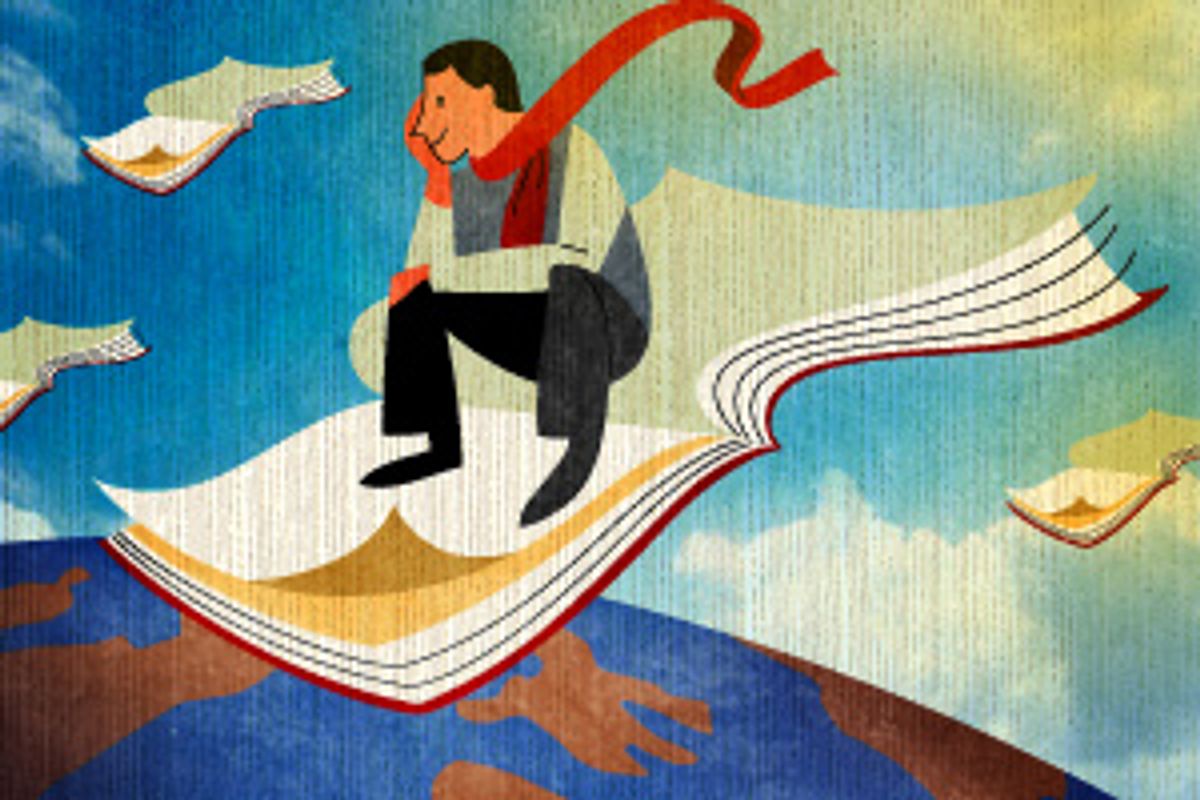
The Literary Guide to the World
What is the Literary Guide to the World?
Looking for the best novel about Zimbabwe? Or just want to take a virtual trip to Martha's Vineyard? On this literary journey, everything is first-class.
A few years ago, I went to Delhi to visit a friend. On the long flight to India, I worked my way through the American magazines I was bringing as a gift, and Ian McEwan’s “Enduring Love” (very good airplane reading). Once I had settled in my friend’s white-tiled apartment in the quaint Nizamuddin district, I wanted to take in something that seemed better suited to my destination. Not a travel guide — those I had already read and dog-eared. Rather, a book that could thrill and educate me all at once, a book that would enhance my visit rather than distract me from it.
My friend handed me a beat-up paperback edition of “City of Djinns: A Year in Delhi” by the British writer William Dalrymple. The taxiwallahs, the shrines, the Khan market immediately came to life in a whole different way. Dalrymple, whose book I toted all over Delhi, became my traveling companion — pointing out the sites, teaching me Delhi’s complicated and storied history, cracking jokes that were much funnier in India than at home. Dalrymple, even more than Mr. Vijay, who ran our very necessary car service, showed me the city. His book was indispensable — and a delight.
After that trip, I started thinking: Wouldn’t it be cool if there was a travel guide devoted not to restaurants, hotels and museums, but to the literature of a place? Yes, it would. So here it is: Salon’s Literary Guide to the World. It’s a grand name, to be sure, but one that suits. From Turkey to Togo, D.C. to L.A., Rio to Russia and beyond, the Guide promises to recommend the best books — fiction, history, memoir or otherwise — to take with you on your travels. And if there’s a place that you’ve always dreamed of seeing, but won’t visit in the foreseeable future, the Literary Guide will point you to the books that offer the best virtual tours around.
Our writers know their stuff: The first group of eight includes Booker Prize-winning Irish novelist John Banville on his homeland; New York Times bestselling author Alexandra Fuller on her childhood home of Zimbabwe (formerly Rhodesia); frequent Salon contributor — and once-Togo resident — Matt Steinglass on the small West African nation he used to call home; and the lauded young novelist Tony D’Souza on Havana, where he had a very good time.
Throughout the summer, the Literary Guide will feature two new locations a week; in autumn we’ll continue with one a week. There’s much to look forward to, including pieces from National Book Award winner William Vollmann (Norway), Salon favorite Garrison Keillor (Minnesota) and “Divine Secrets of the Ya-Ya Sisterhood” author Rebecca Wells (Louisiana). We’ll take you as far as Papua New Guinea and South Africa, but we’ve also got the books to read if you’re staying closer to home — in Martha’s Vineyard, say, or the Jersey Shore. And you can make your own suggestions, too. We hope you’ll use Salon’s letters feature to comment on our writers’ choices, and to make some suggestions of your own.
Welcome to the Literary Guide to the World — we hope you have a great trip!
Hillary Frey is the Books editor at Salon. More Hillary Frey.
I’m addicted to Harry Potter fan fiction!
Every moment I'm alone, I'm secretly reading the stories, the forums, the recommendations. I can't stop!
Dear Cary,
I am in my 30s, finished my Ph.D. dissertation recently, teaching classes at universities, applying for jobs, and have two kids under 10 years old with my husband. In fact, I should be too busy to be writing to you.
The problem is that I’m addicted to fan fiction. Especially a small fraction of online fan fiction, with which you may or may not be familiar, but has a fanatical group of followers. Yes, I’m an HP fan-fiction groupie. I know that there are various fan-fiction communities online, but I’ve been addicted with the Harry Potter fandom ever since I couldn’t wait for Book 5 to come out and started searching for any news about it on the Internet.
Continue Reading Close
Cary Tennis writes Salon's advice column, leads writing workshops and creative getaways, publishes books, writes an occasional newsletter and tweets as @carytennis.
- Send me a letter! Ask for advice! Letter writers please note: By sending a letter to advice@salon.com, you are giving Salon permission to publish it. Once you submit it, it may not be possible to rescind it. So be sure.
- Make a comment to Cary Tennis not for publication.
- Send a letter to Salon's editors not for publication.
More Cary Tennis.
Destination: Brazil
After Carnival, soccer and samba, go deeper into this South American nation via its seductive novels and gritty true-life stories.
Where do you start with Brazil, that massive, sprawling swath of South America, a republic founded in 1889 on the principle — or fantasy — of “order and progress,” but forever caught between crashes and calamities, coups and dictatorships? (In 1961, Time magazine wrote that Brazil’s mercurial new president, Janio Quadros, had “burst on the world like Brazil itself — temperamental, bristling with independence, bursting with ambition, haunted by poverty, fighting to learn, greedy for greatness.”) What to make of the national “myth of racial democracy,” the poverty and favelas, the prison riots, the burning Amazon, the new world rising in Brasilia, the population exploding in São Paulo? And what about samba, Tropicália, Cariocas, Carnival and soccer? Yes, soccer: the “beautiful game,” the uniquely Brazilian ballet that gave the world Pelé, Garrincha, Zico, Socrates, Romario and Ronaldinho? And what about Lula, the Landless Movement, Chico Mendes, Sonia Braga and Rio’s dreaded City of God?
Continue Reading CloseAnderson Tepper has written for the New York Times Book Review, Time Out New York and Paper magazine. More Anderson Tepper.
Destination: Colombia
There's more than magical realism in the literature of this beautiful and still very dangerous country.
Pedestrians in Colombia are warned to look both ways before crossing a one-way street. The advice encapsulates not just this fragile country’s lawlessness and disorder, but the slapstick, deeply ironic and often resigned dark humor of a people both tormented and exceptionally resilient. A second saying in Colombia holds, “Como nacimos en cueros, todo lo demás es ganancia,” which translates roughly to “Since we were born buck naked, everything else is the takings.”
Continue Reading CloseDestination: Gypsy Europe
Despite their historical distrust of the written word, Europe's Gypsies have a growing -- and captivating -- literary tradition.
The boy sat near the bridge, at the edge of the Gypsy camp, rolling a cigarette. The bridge was an elegant garbage heap. It was put together with planks, aluminum siding, rope, tree trunks, sodden cardboard, tires. The boy himself looked part of the bridge as he sat, cross-legged, carefully sprinkling the tobacco onto the paper. He had torn a page from a book in order to roll the cigarette. When he lit it, the paper flared a moment, and he smoked the tobacco in quick sharp bursts. When he was finished, he tore the remaining pages from the book and stuffed them in the pocket of his jeans. He threw down the cover and it landed at the foot of the bridge. The cover was too stiff for rolling tobacco.
Continue Reading CloseDestination: The Netherlands
Delve into Lowlands literature and discover there's much more to this prosperous nation than wooden clogs, tulips and -- of course -- weed.
For a country that was once the global capital of the publishing industry, it’s extraordinary how little the Netherlands has influenced world literature. Most of the canonical writers of Dutch fiction are unknown outside Holland; many are untranslated. From a traveler’s point of view, this is wonderful. Nothing could be more tedious than arriving in a new country with a suitcase full of preconceptions about its culture, drawn from world-famous novels already reduced to clichi by generations of English-language critics.
Continue Reading CloseMatt Steinglass writes for the Boston Globe and other publications, and for the children's television show "Arthur." He lives in Hanoi, Vietnam. More Matt Steinglass.
Page 1 of 8 in The Literary Guide to the World