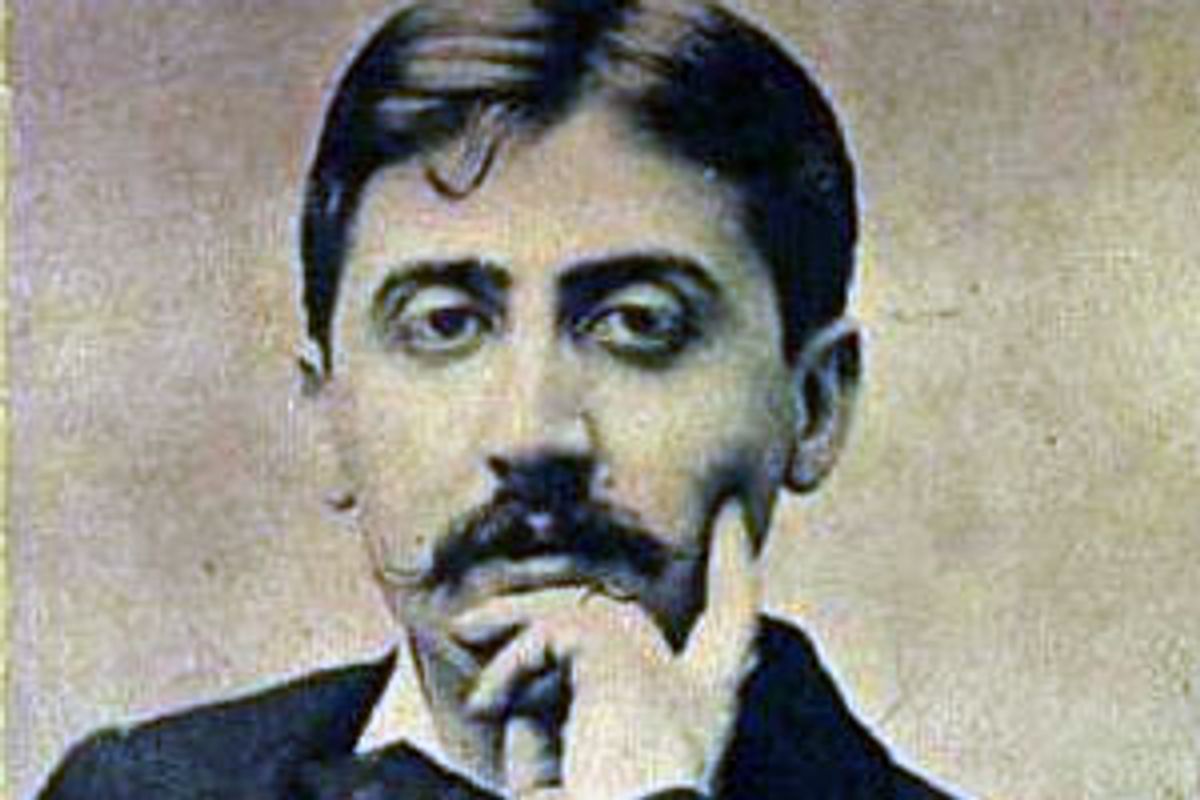
"Proust? Couldn't get into it. Seemed to be all dukes and duchesses." I can't begin to count the times I've heard this, and usually from someone rather clever, of taste and sensibility. Though it's no great secret that Marcel Proust liked to hobnob with the nobility, if all he'd ever been were a name-dropping, social-mountaineering snob, then "Remembrance of Things Past" (I prefer the elegiac, Shakespearean title to the more prosaic if precise "In Search of Lost Time") would be nothing more than a belle epoque version of "Hello!"
Mind, I have nothing against dukes and duchesses; it's the kiss-ups I have a problem with. Proust was no kiss-up; for all his snobbery, he knew his worth and, what's more, knew from experience that "great names debase rather than exalt those who cannot live up to them." He also knew what he was after in his early climbing days, those very noble names, in various guises, coming in handy as leitmotifs on the voyage of self-discovery undertaken by Marcel, the narrator of "Remembrance of Things Past." Marcel soon enough learns that savoir-vivre is a spiritually depleting bondage of the mind; that the social impulse achieves only mediocrity; that "if love were judged by most of its visible effects, it would look more like hatred than friendship"; that given the vicissitudes of time, we can be certain of nothing; that the true paradises are the paradises that we've lost; that all is vanity. Only the creation of an enduring work of art can give meaning to his wasted life and exist outside of time.
It takes Marcel two generations (and us 3,700 mostly sumptuous pages) to attain this world-weary wisdom, and yet by the time you polish off the sixth and final volume you can't wait to start again. You'd do nothing else but read Proust if you could, soak in the warm depths of "Remembrance" as you might soak in a warm bath on a chilly evening. You see his larger-than-life, Olympian characters everywhere, or at least aspects of them, tics and gestures, in your friends and family, in your acquaintances, in public figures.
You get caught up in the events of the book, the myriad story lines that miraculously cohere like elaborate patterns in a rich tapestry; marvel at his magnificent sweep of history, his piquant digressions on society, identity, sexuality, aesthetics, on just about everything under the sun in fact. You relish the rapier wit, the lethal irony, the mind's eye that spares no one its penetrating yet strangely merciful gaze; his is the bedside manner of a skilled physician (his father and brother's profession) who quickly checks his patient's fingernails for symptoms of disease. He is the ultimate psychologist -- and moralist -- owing nothing to Freud and everything to the reflective, Gallic glories of Montaigne, La Rochefoucauld, La Bruyère, Saint-Simon, Stendhal and Flaubert. You tell the world he's a cracking good read, endeavor to make "Remembrance of Things Past" "accessible," short of dumbing it down, to would-be, should-be Proustians.
Proust can change your life -- if that's what you're after; otherwise, enjoy. But perhaps the main reason you revere Proust is because he puts down in black and white and every shade of gray thoughts and intuitions you've always had but could never quite express, as if he's read your mind and searched your heart.
One sure test of determining the worthiness of a biography or study is whether it sends you back to its subject's works. On that count Richard Davenport-Hines' "Proust at the Majestic: The Last Days of the Author Whose Book Changed Paris," succeeds admirably, since you'll want to return to Proust in relief. For Davenport-Hines, Proust is little more than dukes and duchesses, or demimondaines rather, despite his stabs at themes such as class, identity and sexuality. This is prêt-à-porter Proust for those who can't be bothered to read him but want to sound as if they have. It's stuffed with anecdotes and tittle-tattle everyone has heard before, leftovers from far better books reheated and served up as pheasant under glass for the unsuspecting. Its gushy tone will put off would-be, should-be Proustians, confirming their suspicions that Proust was just a social butterfly -- "Proust of the Ritz" as he was called by those in the know who did not know.
Much as Davenport-Hines wishes it were so, Proust's book didn't change Paris; it merely took into account changes that were well underway before the First World War. That a few Faubourg hostesses and Kensington flibbertigibbets affected to read Proust (and never got beyond the first volume, if the first 50 pages) and took on fatalistic fin de siècle airs, wearing aigrettes à la Duchesse de Guermantes in their hair, doesn't a societal change make. That's being au courant, not engagé; Davenport-Hines doesn't seem to know the difference. He is, to be fair, in his element chronicling phenomena such as the rise of popular culture and the relaxation of mores and manners, and excels above all on the novelty of cocaine and opium usage among artists and socialites. (Davenport-Hines is apparently an expert on recreational drugs.)
Davenport-Hines would have been on even more promising territory had he stuck to the lively account he gives in the opening chapter of the great modernist dinner the arts patrons, the Schiffs, gave at the Majestic Hotel in May 1922, the famous one at which Proust met James Joyce. Depending on whose story you believe, these two 20th century titans talked of their ailments or, more likely, talked past each other, having little in common and other things on their minds. Joyce had dismissively skimmed Proust and Proust had never read, much less heard of, Joyce. To his credit, Davenport-Hines gives equal billing to the other honorees that evening, a veritable roll call of giants: Picasso, Diaghilev and Stravinsky. (The dinner came after the premiere of Stravinsky's short ballet, "Le Renard," with Bronislava Nijinska, Vaslav's sister, as the Fox.) Nevertheless, Proust was at the peak of his career, his book all the rage with tout Paris, the center of the universe. Six months later he was dead.
All too fleetingly Davenport-Hines touches on the élan vital of modernism that came as a cathartic release, a liberation of the spirit, after the carnage of the First World War. I could have done with more on how the Ballets Russes revolutionized dance; on le Boeuf sur le Toit, the nightclub made famous by Jean Cocteau and his circle, who came to worship at the side of sometime resident pianist Erik Satie; on Picasso's discovery (with Braque) of cubism. One doesn't even mind Davenport-Hines' heavy-handed attempts to praise Proust at the expense of Joyce, so infectious is his enthusiasm, but he doesn't quit when he's ahead and loses the plot when he strays away from this movable feast.
The rest of the book is padded-out, cafe-society scholarship. Davenport-Hines has a lighter-than-thou, Anglican understanding of Proust's mixed Jewish-Catholic background. On the former he gets it mostly right, emphasizing how the Dreyfus Affair forced Proust to show his true colors. Regardless of his lack of belief, much less his familiarity with his mother's faith, Proust never denied his ethnicity and was contemptuous of those who did or tried to "pass"; he stood up to be counted, dueled with bigots, started up petitions. Surprisingly, his outspokenness didn't cost him his newly acquired social status; if anything, it was enhanced.
The significance of Proust's Roman Catholicism is downplayed if not disparaged. If ethnically (as well as ethically) Proust was Jewish, culturally he was Catholic. Though Richard Wagner's influence on "Remembrance of Things Past" has been much noted by commentators, less so has been its debt to the symbolism and ethos of medieval art and philosophy; Proust was, after all, a disciple of John Ruskin, and translated him into French. That melancholy Roman reminder embodied in so much of the Gothic, memento mori (Remember you must die), was never very far from his mind, moreover, afflicted as he was with severe asthma. Ecclesiastical affinities aside, Proust rejected church dogma, not out of any strongly held conviction but because it wasn't the done thing to appear too devout.
As lingered over at length by Davenport-Hines, Proust's views on homosexuality were similarly paradoxical. Though his homosexuality was an open secret, he was touchy about innuendo and punished malicious gossip with pistols and foils. Though flamboyant, he hated effeminacy. His demureness had much to do with the Oscar Wilde scandal (they met, a farce straight out of Eugène Marin Labiche), and later with the notorious Eulenberg case, a same-sex scandal that shook the German military establishment; if not a crime in France, sexual inversion was definitely beyond the pale. The irony, as Proust boldly addressed in "Sodom and Gomorrah," is that its inhabitants are so commonplace; "we're everywhere," as the slogan goes.
That said, in recent years Proust has been unfairly and misleadingly depicted as self-hating by agenda-driven writers. (Cynthia Ozick and Edmund White come to mind.) Charlus and Bloch are usually singled out as gross caricatures, proof of their author's poor self-image. (Bloch is pretty ridiculous.) This is a facile, loaded reading; you'd have to be blind not to see that Proust is never purely vindictive or laudatory; his characters' virtues and vices are all there to see; everybody has their reasons. The one character to whom this might not apply is the uniquely poisonous Mme. Verdurin, whom Davenport-Hines typically condemns for being middle class; even Morel, an opportunistic little shit, has the saving grace of musical talent.
Charlus and Swann give the lie to Proust's accusers, resoundingly. Davenport-Hines correctly posits the Baron de Charlus, proud as Lucifer, sorrowful as Satan in "Paradise Lost," as the colossal, dark hero of "Remembrance of Things Past." For all his scarlet sins, Charlus is redeemed by that greatest -- and rarest -- of virtues, charity. In him this might naturally take the form of aristocratic magnanimity, but it's more than that; underneath it all, he is genuinely kind and forgiving. Charlus also has an artist's sensitivity, and when his imagination and soul are fired by passionate love -- for Morel, who cravenly abandons him at the Verdurins' connivance -- his generosity and fellow feeling know no bounds. His downfall is swift and terrible, with all the tragic, wintry grandeur of Lear.
Swann, Proust's other hero, the man about town who nearly lost his mind over a woman who wasn't even his type, the art connoisseur, the Jockey Club habitué in spite of his ancestry, is the most loyal of friends, and the bravest of men in the face of impending death. His final scene, at the end of "The Guermantes Way," is one of the most poignant, and tellingly ironic, in the whole of "Remembrance of Things Past." Charlus and Swann are two sides of the same brilliant coin.
Little of this comes across in "Proust at the Majestic." Maybe that wasn't Davenport-Hines' intention; question is, what was his intention? To amuse some soigné set, a precious "little clan"? To cut a dash in the dingy drinking dens of Soho? Perhaps as a passionate Proustian, I'm too demanding, too protective. It wouldn't bother me if this were a totally superfluous book, but it isn't; it's just twee. Proust may have been a pill at times but he certainly wasn't twee.
This isn't to write off "Proust at the Majestic" as a total loss. The egregious, smarmy acknowledgments section in the back is a right good laugh, worth the price of admission alone for its unintended comedy. Funniest is where Davenport-Hines recalls his "Is that a Proust in your pocket, or are you just happy to see me?" life-changing moment, "when, as a borderline candidate for university entrance, I went for an interview at Selwyn College, Cambridge in 1971. I was interviewed by Harry Porter, a historian of Tudor Cambridge and of Puritanism, the treasurer of Cambridge Footlights theatre-club and an ardent Proustian. In those happier days it was still permissible for dons and undergraduates to flirt during interviews. 'Mmmm,' he said as he handed me a glass of sherry, 'what have you got in your pocket?', and deftly plucked out a little volume of Proust in its merry blue-and-white jacket. Harry, as many husbands and grandfathers will remember with gratitude, was adept at getting his hands into the pockets of other men's trousers." And there it is in a nutshell: Proust as a fashion accessory, which is exactly what this book is.
Shares