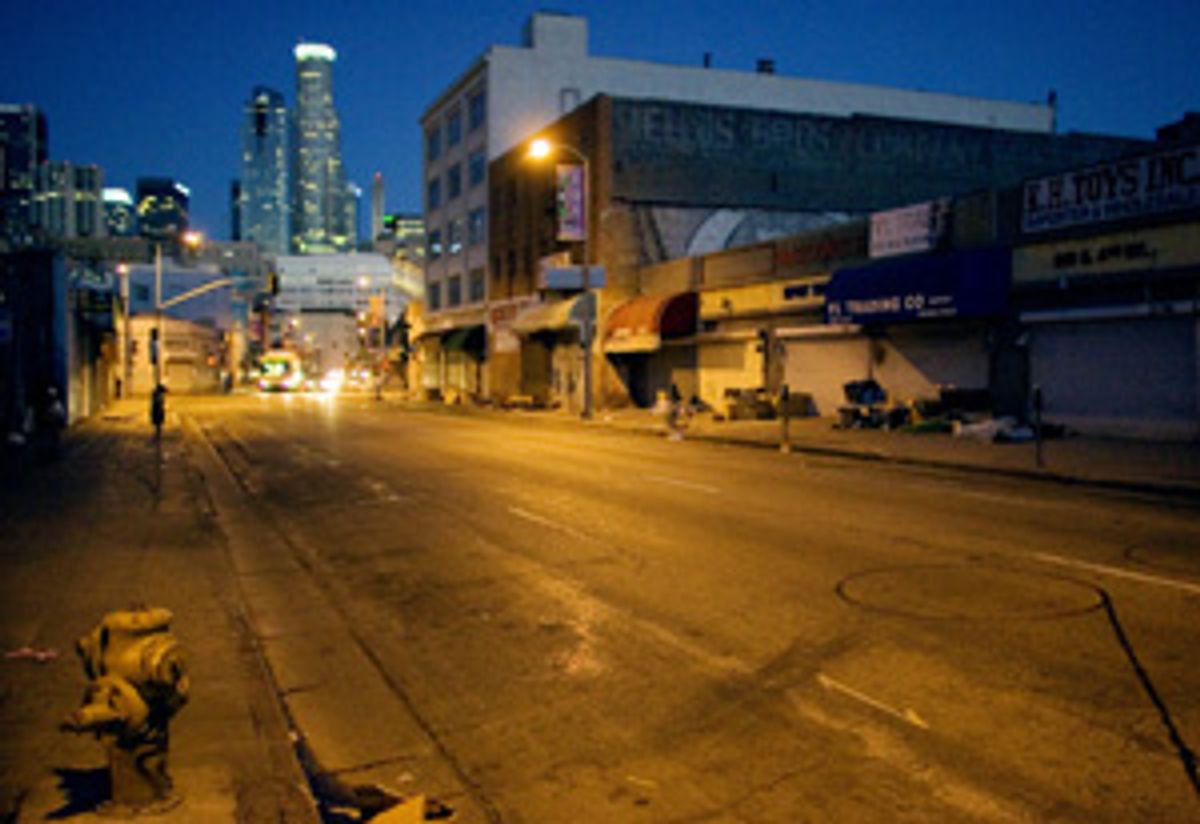
To see the old skid row of the down and out and the new skid row of the well-to-do, look no farther than the Frontier Hotel.
Smack in the heart of the nation's biggest poor neighborhood, the hotel rents to both the poor and the wealthy, albeit through separate entrances.
The Frontier's poor people's entrance, on Fifth Street, has iron gates, burly guards who ask you your business and a long, dark foyer with a clerk behind thick glass. The Main Street entrance, for urban pioneers renting new lofts on the hotel's upper floors, has a gleaming white lobby, potted palms and marble floors.
The Fifth Street renters, who pay about $100 a week, have no access to the Main Street side. And loft dwellers, who pay from about $1,100 a month to $3,900 a month, have no reason to venture to the Fifth Street side, where the hotel is still known as a rundown flophouse, one step up from the streets.
Skid row's new Frontier makes poor people and their advocates shudder. It's not just the hotel, which the owner intends to fully convert to market-rate lofts, that puts them on edge. It's everything, they say, that suggests that the grand plans for the nation's largest skid row -- 50 square blocks of prime real estate in the largest city in the country after New York -- are leaving out the poor, mostly black people who live there now:
Banners hanging from formerly vacant office buildings that advertise high-priced lofts for rent; bulldozers digging foundations for skyscraper condominiums; uniformed Business Improvement District security guards who patrol skid row like police, routinely rousting sleepers; even the Port-A-Potties in downtown's largest park, Pershing Square, which are reserved for people who use the park's underground garage.
For decades, L.A.'s skid row was the repository of every hard-luck story in the book. Everyone from evictees to parolees to runaways with Hollywood dreams ended up in this quarter of downtown, eventually creating the largest encampment of homelessness in the nation.
Now, prodded by developers that they attracted with tax breaks, city officials are trying to remake the area. The catch is what to do with the homeless people. The number of homeless people in Los Angeles, at more than 48,000, keeps rising, while plans to find housing for those who need it most remain just that -- plans, with no guarantees that they will materialize.
To Los Angeles Mayor Antonio Villaraigosa, the decades-old policy in the city and county of concentrating services for the poor on skid row is a failure, proved by the row's crime, misery and encampments the size of small villages. In April, he and the county Board of Supervisors unveiled a 10-year plan to end homelessness in Los Angeles that included five "stabilization centers" across the county to provide temporary shelter and social services for those who need it.
But to advocates of poor people, what's going on in and around skid row is not only potentially the largest displacement of poor people in the country, but also the starkest example of gentrification: a mean about-face where poor people who were dumped onto skid row for generations are now, when it is poised for a rebirth, being pushed away.
They point out that with all the dazzling new development planned -- more than 150 ambitious projects -- less than 5 percent of it includes affordable housing, and even that will be above the reach of the current skid row residents.
Pete White, the founder and co-director of one of skid row's most vocal advocacy groups for the poor, the Los Angeles Community Action Network (or LACAN), say the city has a moral obligation to make sure that longtime residents of the row are served.
"Downtown residents who have been left here to suffer for decades damn well have a right to benefit from this renaissance," he said, perched in his office directly across the street from the loft side of the Frontier Hotel.
For many years SROs, or single-room occupancy hotels, like the Frontier were the destination for people with nowhere else to go. In the early '80s, when mental institutions were vacated, their former residents were sent to skid row. When parolees were released, they were sent to skid row. Until recently, hospitals in Los Angeles County have been known to discharge indigent patients onto skid row. In March, police video cameras mounted outside the Union Rescue Mission caught a van from Kaiser Permanente's Bellflower Hospital discharging an elderly woman in her hospital gown and slippers onto a busy street, where she wandered, disoriented for several minutes.
Most of the poor in skid row lucky enough to have a roof --- about 10,000 people-- are housed in 240 residential hotels. But in recent years, more than 1,200 residential hotel rooms have been lost to market-rate development. Another 2,000 were slated for conversion when the City Council in May put a hold on the conversion of low-rent residential hotel rooms for one year. What happens next remains unclear.
L.A.'s downtown boom is a dizzying phenomenon. Seemingly every month or so brings more groundbreakings, new announcements of high-priced, high-income projects. In mid-June, the city unveiled plans for a $750 million, 1,000-room hotel complex, with a four-star Marriott and a five-star Ritz-Carlton, next to downtown's Convention Center. Meanwhile, a few blocks away, in "The Bottoms" -- the most infamous blocks of skid row -- members of LACAN were videotaping city cleanup crews sweeping up homeless people's blankets and clothes.
"The Bottoms," the area of skid row where the missions and the street dwellers are concentrated, is a stunning slice of third-world poverty, a village of souls lost to the bottle and the needle, a depressing testament to human frailties, physical and mental.
This part of skid row, the center of the district's crime and the obvious focus of news stories, is chockablock with men, but a startling number of women squat here too, including ones with gray buns and shawls. People lay themselves along the iron fences of the row's little parks, sit in heaps of clothes and other belongings, hobble around with crutches, walkers and canes. Hard to look at, the streets are harder to smell. The worst blocks have the choking stench of human waste.
The bane of advocacy groups for the poor are five Business Improvement Districts, or associations advocating for businesses, in and around skid row. Each BID performs street cleanups and employs people who act as security guards, calling in what they see as trouble, complaining to the city when encampments block the sidewalks.
What groups like LACAN don't like, they say, is the air of intimidation and harassment the uniformed security guards from some of these associations create. The other day, in The Bottoms, two men in red shirts on bikes from the Central City East Association were talking to a homeless woman in a tent. They had their cellphones in hand, as if they were about to make calls, but when three outreach workers from LACAN approached to ask what they were doing, they took off.
Two weeks ago, LACAN, the Catholic Workers and other skid row advocacy groups launched a protest when a cleaning crew from the Central City East Association asked homeless people to move out of their way so that they could steam-clean their streets. While police said the advocacy groups were hindering progress ("Why would anyone not want the streets cleaned?" said police Capt. Andrew Smith), Pete White said that the street cleaners were routinely dumping the meager possessions of those with nowhere else to go. LACAN, he said, had filed 20 property claims in six weeks on behalf of homeless people whose possessions were swept away.
"We've been told by police that they're supposed to take away so-called items of comfort, like pillows and blankets," White said. (But Smith, when asked, said there is no policy to remove such possessions and that police do not do so in any case.)
No one disputes that skid row has long needed drastic help. On any given night, according to advocacy groups for homeless people, 4,000 people are literally on the streets, in tents, tarps, blankets and cardboard boxes; another 3,300 are barely better, in transitional or temporary housing.
Police Chief William J. Bratton, who made his name in the mid-'90s with his "quality of life" initiatives as head of the New York City police department under Rudolph Giuliani, lobbied for the top job here by promising an approach to cleaning up skid row that had worked in cleaning up Times Square.
But that approach, which advocates for homeless people across the country criticized as callous, has stalled in Los Angeles. In April, a Federal appeals court panel ruled that arresting homeless people for sleeping on the streets when they had nowhere else to go constituted cruel and unusual punishment. (Bratton urged the city to appeal the ruling. He has also defended a policing theory he embraced, the "broken windows" theory, which posits that cracking down on so-called quality of life crimes like graffiti or panhandling can stem larger ones. Prominent social scientists have concluded the "broken windows" approach does not work.)
But Smith, the commanding officer of the LAPD's Central Division, which includes skid row, said his officers are focused on hardcore crime.
"We're not here to pick on homeless people," he said. The officers who patrol skid row, all of whom ask for the skid row beat out of "compassion" and "a desire to make things better, made only 56 arrests between Jan. 1 and April 1 for sleeping on the streets, he added. Rather, the officers focus on felons. "We have 3,800 parolees in the 50 square blocks of skid row," Smith said, "and something like 350 registered sex offenders. Where else do you have that kind of concentration?"
Plans for cracking down on skid row criminals include a legislative proposal that would add up to two years to the usual state sentence for selling drugs if the person convicted was caught on certain blocks of skid row. LACAN and other groups are lobbying hard to kill the bill, which they see as blatant discrimination against skid row residents who have drug addictions or are in other desperate circumstances that force them to sell drugs to survive.
The mayor and other city officials have also put a halt to more counseling and support services on skid row. Instead, the county recently set aside $100 million to spread services across the county.
Permanent housing for the homeless is a goal, but it appears a ways off. The 10-year plan to end homelessness comprises more than 200 recommendations, including building 50,000 units of affordable housing.
Also, in July, the City Council unanimously approved placing a staggering $1 billion affordable housing bond on the Nov. 7 ballot. If approved, it would create a $750 million grant and loan program for developers and a $250 million loan program to help working people buy houses. But the measure, which Villaraigosa has pledged to campaign hard for, faces a battle. It would raise property taxes on a ballot that has several other measures requiring tax hikes.
The chronically homeless in "The Bottoms" of skid row have learned to live on the streets in such a way that officials sometimes accuse them of preferring to stay outside. The other day, Smith said, there were empty shelter beds in missions while hundreds of people slept right outside them.
But Al Sabo, who passed up a shelter bed when he became homeless for the first time three years ago, says he knows why some people shun the missions.
"What people don't want is to be treated like children," said Sabo, a 61-year-old former newspaper editor who became homeless after a six-month coma and a yearlong hospital stay. He lived on the streets for two months.
Sabo said that some people, including himself, pass up beds in the well-meaning missions because they require that "you line up at such and such a time in the afternoon, get there by 8, leave by 6 in the morning, do this, do that, don't do this, don't do that."
For the last three years, as he has tried to piece his life back together, Sabo has lived in the old Frontier Hotel. He started on the 10th floor, was moved to the seventh to make way for lofts, then to the fifth.
The Frontier once had 400 SRO rooms and now has about 190. Sabo said that most of those have been emptied as the owner of the property, Zuma Corp., readies the building for renovation.
Sabo, who shares a floor that holds more than 40 rooms with a handful of other tenants, said he has no way of getting to the loft side of the hotel and doesn't care to, anyway. He has not been asked to move lately, so he reserves his energy for protesting the policies of nearby Pershing Square Park. Police tape prevents people from sitting on benches and the park is often closed for private events.
The other day, having just left the park, Sabo was still fuming. The police had told him, he said, that the benches were banded by tape so that people wouldn't sleep on them. From experience, Sabo said, he knew that homeless people often stay up all night to ward off predators, then try to find a place to sleep during the day.
"Why couldn't the city reserve a few of the empty buildings it's been practically giving away, for homeless people to live?" he said. "Now that would be a plan, wouldn't it?"
Shares