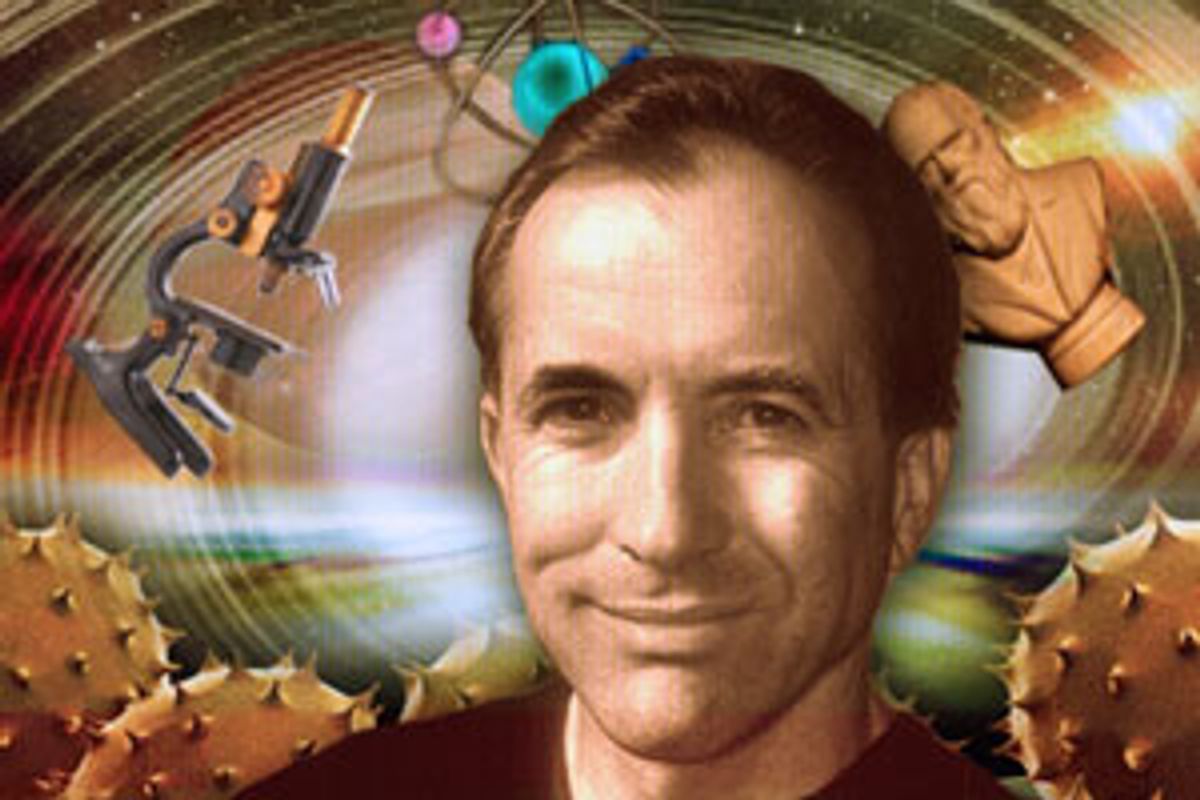
Michael Shermer has done a fine job in his new book of letting the air out of intelligent design’s tires. As you recall, the so-called scientific movement, which says that nifty things in the universe, like human eyes, are so perfect they couldn’t possibly have been created by the crude steps of evolution, was rolling along quite nicely through school districts last year, kicking up a chorus of hallelujahs from creationists. Some of Shermer’s ivory towerish science pals, like Richard Dawkins and the late Stephen Jay Gould, told him not to bother with the I.D. boosters, that acknowledging them meant going along for their political ride, where the integrity of science was being run into the ground.
But true to his genial nature, Shermer ignored his friends’ advice and penned “Why Darwin Matters.” With admirable patience and humility, he spells out each of the fancy I.D. tenets, like “design inference,” in which only a higher intelligence could have come up with something as cool and ingenious as DNA. Shermer shows how imperfect evolution, and not intelligent design, has been, for generations, the only quantifiable driver behind nature’s wonders.
In one way, he didn’t have to write the book. You could get the rundown on I.D. by reading Judge John E. Jones’ decision in the infamous trial in Dover, Penn., last year, which pitted the local school board, who supported teaching I.D., against evolution experts. The Republican judge spanked the I.D. proponents hard, calling their bedrock assumptions “utterly false,” and concluded with a swipe at the “breathtaking inanity” of the Dover School Board. Yet there’s no doubt that Shermer’s book is a nice ally for science teachers in the perpetual battle against the creationists.
When I met him, I didn’t want to get bogged down in the details of his defense. Shermer, 51, is executive director of the Skeptics Society, bold debunkers of all things supernatural; a columnist for Scientific American; and author of a bunch of readable books about why people flock to God or astrology. So while we delved into the real agenda of intelligent design advocates (like techno-guru George Gilder) we also talked about psychics, atheism, why one famous molecular biologist believes in God, and Shermer’s halcyon days as a Jesus freak.
The Skeptics Society is situated in a warm little house in Altadena, a tree-shaded town, north of Los Angeles, in the shadow of the San Gabriel Mountains, home to Mt. Wilson Observatory, one of the world’s pioneering astronomy centers. We chatted around the dining room table, stacked with issues of the latest Skeptic magazine, all about religion.
Why does Darwin matter?
Because we live in the age of science. And the Darwinian worldview is the preeminent and best supported theory for the explanation of the natural and biological world. Marx is gone. Freud is gone. History and data have not supported their theories. But Darwin was right. You have to know evolution to understand the natural world. And that cannot be a threat to people of faith. There’s a serious problem if you are forced by your faith to reject the most well supported theory in all of science.
Why do you say evolution shouldn’t be a threat?
If you believe God created the world, it’s reasonable to ask, How did he do it? What were the forces and mechanisms he used? Why not look to science and see that he started with the big bang, the force of gravity, inflationary cosmology, quarks and natural selection. Those were his tools. To that extent, science is not a threat, it’s your best friend. It’s the best tool you have for illuminating the grandeur of creation. A Hubble Space Telescope photograph of the universe evokes far more awe for creation than light streaming through a stained glass window in a cathedral. I mean, come on, that photo is an actual representation of the reality that God created, if that’s what you believe. So why not embrace science rather than fear it?
Why do people fear it?
They’ve been sold a bill of goods by people who like the warfare model of science and religion, particularly fundamentalists and militant atheists. Both sides want to force a choice and debunk the other side. But it need not be so. It’s an incorrect interpretation promoted by extremists. The tendency is for liberals to embrace science and conservatives to mistrust it. Conservatives like technology but tend to be leery about science because it threatens their religions. They fear the Darwinian worldview is the liberal worldview, which says that if there is no God, there is no absolute right and wrong. And without an Archimedean point outside of ourselves that says this is right or wrong, then anything goes, there’s no basis for morality. Therefore America will go to hell in a moral handbasket.
What do you say to them?
I say you don’t need religion, or political ideology, to understand human nature. Science reveals that human nature is greedy and selfish, altruistic and helpful. Conservatives can find family values in nature. We are pair-bonded. We practice serial monogamy. Human infants are helpless for such a long time that it’s better to have two parents rather than one to raise them. That’s what Darwin gives us. He showed us how we evolved to be cooperative and altruistic within our groups, and competitive and avaricious between them. Within groups, amity; between groups, enmity. That explains a lot about the good and evil in our nature. I’m saying to conservatives, you’re right. If you want to use the metaphors of God and Satan, fine, but let’s ground them in science.
Why do we reach so hard for a divine force to explain life?
The natural inclination in all humans is to posit a force, a spirit, outside of us. That tendency toward superstitious magical thinking is just built into our nature. What’s more, it doesn’t cost anything to have a false positive, to assume there’s a force behind the lightning or a spirit in the rock. In the ancestral environment, when we evolved, we might think spinning around three times is going to bring rain. Well, once in a while it works and makes everybody happy. And it doesn’t cost much to keep doing it. It doesn’t take you out of the gene pool.
You sound so benign. Yet your day job is debunking pseudo sciences like rain dances and astrology. There’s no harm, then, in me thinking that because I’m a Libra I just might get what I wish for today?
[Laughs] No, for most people astrology is just light entertainment. But the problem with taking it seriously is it can lead to other irrational beliefs. And presumably in an educated democracy we want to have a certain level of education, as Jefferson says, so we can have a serious national discussion about problems. I mean, people who believe in astrology tend to believe all kinds of goofy things. All the pseudo sciences — astrology, Tarot cards, psychics, mystic healing — use the exact same principle. They work because we have a selective memory and a confirmation bias. We look forward to finding evidence for what we already believe and forget the rest. In an hour reading, a psychic will make 200 or 300 statements. If a person walks away with half a dozen things the psychic got right, he’s ecstatic. It’s like Skinner with the rats. You don’t have to reinforce them every time. In fact, they’ll press the bar even faster if you give them intermittent reinforcement. It’s the same with slot machines. You just have to pay off every once in a while and it will keep us pulling the levers.
Do you think the impulse to believe in God is the same as believing in astrology?
Yes, it’s a similar foundation of magical superstitious thinking. And our need to be spiritual takes all forms. Given that traits vary in populations, it’s natural that some people will gravitate toward New Age spiritualism and others toward conservative Christianity. Even secularists believe in all kinds of transcendent things, such as “mind.” This is the Deepak Chopra school. He says, I don’t believe that Christian conservative stuff, but the universe is intelligent, it’s alive, it knows we’re here. What? You’re goofier than the Christians!
At the same time, I don’t think, as a lot of materialist atheists do, there’s something wrong with the brain or genes, and if we could just fix them, we could get rid of all the silly religion. That’s not going to happen. Besides, people believe in economic and political ideologies just as fervently as they believe in religious doctrines. Most political, economic, racial — and racist — ideologies have no basis in reality at all. They’re articles of faith. And the best tool we have for discerning truth from all those false patterns is science.
Do you call yourself an atheist?
I prefer not to use the term. Although I guess I am an atheist. I just don’t believe in God. I’ve always liked Thomas Huxley’s term, “agnostic,” by which he meant it’s an unknowable, insoluble problem from a scientific point of view. By my personality, I’m comfortable with not having the answer to everything. I’m perfectly happy going through my day, thinking, I really wish I knew the answer to that but I don’t. I have a very high tolerance for ambiguity. Most people get cognitively dissonant about having uncertainties and need to close that loop and have an answer.
What would you like to have the answer to?
What was here before time? What came before the big bang? Those questions cause people to posit that either God created the universe or some natural forces or some combination. I’m perfectly happy going the natural route. In fact, to answer what came before the big bang, people like Stephen Hawking are playing around with inflationary cosmology and how all of a sudden you get a new bubble universe. They don’t have any evidence, but mathematically it’s possible.
But when science hits a question mark, that’s OK with me. Ultimately, theologians hit the same question mark. We just have to push them one more step when they say God did it. They respond that God is He who need not be created. Well, can’t the universe be that which needs not be created? No, they say, it’s a thing and has to be created. So isn’t God a thing if He is part of the universe? These are old arguments, but at some point a thoughtful theologian has to say, You’re right, we don’t know. So we make a metaphysical assumption and define God into existence.
Francis Collins, director of the National Human Genome Research Institute, recently told Salon that he believes in God, the virgin birth and the resurrection of Jesus. “If you believe in God,” Collins said, “and if God is more than nature, then there’s no reason that God could not stage an invasion into the natural world, which — to our limited perspective — would appear to be a miracle.”
What does he mean by miracle? If God is intervening into our world, he must be doing so in some measurable way. That’s what we do with science. We measure. OK, Francis, where’s your data? There was just a big study done on prayer and healing. If praying to God is supposed to heal people, this was the best, most rigorous study ever done, conducted by a world-class scientist who believed he would find a positive result of praying. Here’s what he found: zip, nada, nothing.
So, OK, Francis, what else have you got? The virgin birth? I mean, come on. The resurrection? Now we’re talking about mythic events, we’re not talking about science. What he’s doing is rehashing old theological arguments that have been hashed out by evangelicals for a long time. The bit [from C.S. Lewis] that Jesus can’t have been a liar or a lunatic and so therefore he’s the Lord? That’s not science, that’s creating straw men you can knock down to leave the one standing you already believe in. It’s an example of the hindsight bias we’re all susceptible to. We’ve already made a decision and then we go back and justify it. Scientists like Collins are just particularly good at it.
What’s your best answer for why there is no God?
It’s not why there is no God, it’s why there’s not compelling evidence to believe in God. That’s a better way to put it. And from my perspective, it’s just not there for me. With training in science, I have high standards of evidence. If you said God is real, and you sent your evidence to the journals Science or Nature for publication, you’d be laughed out of the room; you wouldn’t get past the first reviewer.
On the other side, the best evidence that there probably isn’t a God is that belief in God is so deeply culturally embedded. When you study world religions, it’s obvious that, throughout time, all of these different people are making up their own stories about God. If you lived 1,000 years ago, hardly anybody would be a Christian. If you were born in India, you’d likely be a Hindu. What does that tell you? From a Christian perspective, it means we need to get more missionaries over there to tell them the truth! From an anthropological perspective, it’s another case. Christians today might say, I don’t believe in Zeus, that was a silly superstition. Yet for many people that was a real god.
So it turns out there are 10,000 gods and yet only one right one. That means we’re all atheists on 9,999 gods. The only difference between me and the believers is I’m an atheist on one more god.
So you’re comfortable that humans are just products of physics and chemistry?
The electric meat — that’s us! I don’t mind that at all. If anything, it’s even more awe-inspiring to think that out of physics and chemistry we’re able to get consciousness and thought, and you and I can sit here and have a conversation about electric meat and chemistry. That itself is miraculous.
Earlier this summer, George Gilder, the supply-side economist and guiding light to the techno-libertarian crowd, wrote an essay in National Review. He’s a senior fellow at the Discovery Institute, the foundation, as you know, that promotes intelligent design. In the essay, “Evolution and Me,” he argues that physics and chemistry will never yield insight into the origins of life or consciousness. He says complex life results from a preceding intelligence. He’s pretty hard on you Darwinists. He writes, “As an all-purpose tool of reductionism that said whatever survives is, in some way, normative, Darwinism could inspire almost any modern movement, from the eugenic furies of Nazism to the feminist crusades of Margaret Sanger and Planned Parenthood.”
That’s completely absurd. He’s listing all the liberal issues and wants us to see them as fascism. That’s the typical right-wing response. What a political or ideological or racist movement does with a scientific theory is quite independent of the scientists. It’s hardly fair to blame Gutenberg for the printing press that allowed “Mein Kampf” to be distributed. Science is just a tool, a way of understanding the natural world. We’ve got to get past this idea that science is a thing. It isn’t a thing like religion is a thing or a political party is a thing. It’s true that scientists have clubs. They have banners and meetings and they drink beer together. But science is just a method, a way of answering questions. It’s a verb not a noun.
Gilder claims “intelligent design is merely a way of asserting a hierarchical cosmos.” He says there’s a higher form of information than physical compounds, like DNA, and that higher information is “independent of its physical embodiment or carrier.”
Yeah, so there’s ultimately a God. That’s what he’s arguing. God creates information and then the whole thing gets started. But even without God, that’s a too simplistic view of the origins of life and information. What came first, life or information? In a way, it doesn’t matter because the beginnings of information in life are not going to be one big step but millions of incremental steps. They both came first, they’re interactive. In other words, the whole system is auto-catalytic, self-driving, so the information gives rise to a little more complex life, and more complex life gives rise to more information, and they feedback on one another, and it just drives itself.
The best example of that is, in fact, DNA, and the increasing complexity of genomes. This is what [University of Massachusetts biologist and author] Lynn Margulis has shown us. In the past 35 years, she has definitely shown that we are the product of this simple cellular world that spontaneously and naturally got more complex just by putting energy into the system, and a type of symbiogenesis, cooperation among cells, led to more complex cells. Besides, information cannot exist without a storage medium. What would that be? Your soul? What is the medium of storage for the soul when your body is gone? What carries it on into the far future? The soul discussion stops right there. Without a medium of transference of data, why would the information exist on its own?
Intelligent design boosters say that if life only develops by random chance, as Darwinists say, then we’re living meaningless lives.
Right, that’s the moral meme. But they’re confusing human meaning with natural meaning. There is no natural meaning in the universe. Nobody, Christian or otherwise, would look at a star and go, What’s the meaning of that? It doesn’t mean anything. It’s a bunch of atoms. Believers and non-believers alike are comfortable saying human life has meaning because we make it so. That goes for Rick Warren and Dr. Phil. They say, hey, look, man, you got to go out there and do it yourself. You got to volunteer and help the poor. We give our life meaning by being helpful and sociable.
Well, that’s Darwinian. We evolved as a social primate species in which we had to cooperate to get along. It’s not random, there are parameters defined by our own human nature. If these guys want to say, well, that’s how God did it, OK, that’s fine. But let’s keep studying it scientifically to understand why that would have come about through natural forces.
In the end, you don’t need a top-down entity to give life meaning. If anything, if nobody is out there, it is much more important to find meaning ourselves. Instead of this world being a mere staging for the next world of eternity — meaning it doesn’t really matter what we do now — it’s better to realize there is no eternity, that this is it. In that case, we better be careful what we do, make our choices consciously, treat people kindly and be moral because this life is what really counts.
Stephen Meyer, one of the vice presidents of the Discovery Institute, says, “Contrary to media reports, intelligent design is not a religious-based idea but instead an evidence-based scientific theory.” You write in “Why Darwin Matters” that the “veneer of science in ID theory is there purposefully to cover up the religious agenda.” How do you know that?
Because I asked them and they told me. I know these guys. I have debated Meyer at conferences and gone out to beers with William Dembski, another major I.D. theorist. They’re all evangelical born-again Christians. They all believe in Christ as their savior. They believed it before they got into all this stuff. I’ve asked them that if the main tenets of intelligent design turned out to be false, would they then give up their belief in Christ? No, they say. And that’s because they believe in Christ for reasons that have nothing to do with their theory.
They fit the science to match their beliefs?
Yes, in my opinion, that’s all they’re doing.
So what’s the real agenda of I.D.?
They want the Judeo-Christian worldview accepted into American public life as policy. But the First Amendment says you’re not supposed to do that. America is based on a diversity of beliefs and was founded on the principle of religious freedom. The conservatives want to blend public life with private life. But religion is private. It’s nobody’s business. Politicians have to announce they believe in God, and God bless America. But religion as public policy leads to a reduction of liberty and freedom for those who don’t believe. It makes it harder for us to express our own beliefs without fear of condemnation.
Let’s say that we passed legislation that requires the teaching of one dominant religion in public schools, which right now is Judeo-Christian. Hooray! Everybody’s happy. Now let’s say that Islam is the dominant religion 500 years from now. It most likely will be Europe. You still want that law on the books? Girls in public schools will have to wear burqas and, in fact, there will be no education for them after sixth grade. You still want the dominant religion legalized in America? No way!
Are you trying to talk people out of their faith by showing them the science?
No, just the opposite. First of all, I don’t think you can talk people out of their faith. It’s an utter waste of time. I learned that from Darwin himself. He said he learned early in life to stay out of those kinds of public debates. The only thing you can do is promote good science.
Why do you think scientists who have studied anthropology and science believe in God?
Because they believe for non-smart reasons. Smart people believe weird things because they’re better at rationalizing the beliefs they arrived at for emotional, psychological or personal reasons. The No. 1 predictors of anybody’s religious, political or social attitudes are those of their parents and the home where they were raised.
That doesn’t seem to be true for you. You confess in “Why Darwin Matters,” “I became a creationist shortly after I became a born-again evangelical Christian in high school in 1971 and I argued the creationist case through graduate school in 1977.” Were your parents religious?
They were neither religious nor non-religious. They were neutral on the subject. It never came up at home. I was in high school when one of my best friends talked me into being born again. So I just went along with it, and it seemed to work for me, although my stepbrothers and -sisters always gave me a hard time about being a Jesus freak.
Still, I felt that if I’m going to take this seriously, I should be proactive about it. That includes challenging people and speaking out. I even went door-to-door in Malibu. Although it was anxiety-producing to walk up to strangers’ houses and say, “Hi, I’m here to tell you about Jesus.” You were also supposed to tell people that you loved them. I remember telling that to a girl who actually liked me. And she took that the wrong way. I had to correct her. No, I don’t mean it that way, I mean it in the agape way, the kind of love that C.S. Lewis talks about, the love for your fellow humans. I can’t believe I did that. Although I guess in a way I’m doing the same thing, only now I do it through public lectures and books: “Hi, I’m here to tell you about Darwin.”
What caused you to see the light about evolution?
Taking a class in it by Bayard Brattstrom at Cal State Fullerton, where I got a master’s degree in experimental psychology. He was an evangelical evolutionist and his class met Tuesday nights and then adjourned to the local pub and continued until closing time. He would just hold forth, like Socrates, sitting around with beer and ale, and talking about God, religion, the big bang and cosmology. He was a dynamic speaker. It was great stuff. I was just sitting there stunned, like, Oh my God, this stuff is real. I had no idea. I didn’t really know anything about science.
Like most creationists, you just know what you read in creationist books. When you read them, it makes the theory of evolution sound completely idiotic. What moron could believe in this theory? When you actually take a class in the science of it, it’s a completely different picture. That’s also when I realized I enjoyed the company of scientists and science people much more than religious people and theologians. It was this exciting, open-ended, participatory process that I could be involved in. We’re all in this search together, and there’s an actual method to do it, and a community of people who practice it, and a way of determining whether something is true or not. I fell in love with that.
How did you feel when you first stopped believing in God?
The process came about pretty slowly. A girlfriend gave me a silver ichthus, the Christian symbol of the fish, and I wore it on a chain around my neck. This is when guys used to wear chains. It was so obnoxious but everybody did it. I remember at one point, after Bayard’s evolution class, looking at the ichthus in the mirror and going, You know, that’s kind of hypocritical, I don’t really believe in this stuff anymore and I don’t think I should be wearing this. So I took it off. That was a defining moment. It was liberating to be intellectually honest about what I felt. I didn’t feel hypocritical anymore. Now, as I’ve gotten older, I try not to define myself by what I don’t believe. I think that’s a fruitless enterprise. We should define ourselves by what we do believe in.
What do you believe in?
I believe in the indomitable human spirit and the amazing capacity we have for understanding the world; for love, joy and happiness. Science not only does not take away any of those things, it adds to the sum of human knowledge. When I look through my little telescope in my backyard at the planets, moon or Andromeda galaxy that is 2.9 million light-years away, I can enjoy the beauty of the night sky and appreciate it on an emotional level. Then I can think that the photons of light that are landing on my retina left 2.9 million years ago, when we were just barely bipedal hominids in Africa, and are just now arriving tonight. Boy, that’s just awe-inspiring.
To me, that’s what it means to be spiritual — what makes your spine tingle. It’s what gives you a sense of awe and wonder and transcendence. It doesn’t matter to me if you call it God or the cosmos. We’re all talking about the same thing, whether it’s religious people or New Age spiritual people or Buddhists or scientists. We’re all talking about having a sense of awe and wonder at something grander than ourselves.
This article originally appeared on
AlterNet.
Why would any organization or social change movement want to ally itself with a community that’s energetic, excited about activism, highly motivated, increasingly visible, good at fundraising, good at getting into the news, increasingly populated by young people, and with a proven track record of mobilizing online in massive numbers on a moment’s notice?
If you need to ask that — maybe you shouldn’t be in political activism.
And if you don’t need to ask that — if reading that paragraph is making you clutch your chest and drool like a baby — maybe you should be paying attention to the atheist movement.
The so-called “new atheist” movement is definitely not so new. Atheists have been around for decades, and they’ve been organizing for decades. But something new, something big, has been happening in atheism in the last few years — atheism has become much more visible, more vocal, more activist, better organized, and more readily mobilized — especially online, but increasingly in the flesh as well. The recent Reason Rally in Washington, DC brought an estimated 20,000 attendees to the National Mall on March 24 — and that was in the rain. Twenty thousand atheists trucked in from around the country, indeed from around the world, and stood in the rain, all day: to mingle, network, listen to speakers and musicians and comedians, check out organizations, schmooze, celebrate, and show the world the face of happy, diverse, energetic, organized atheism.
Atheists are becoming a force to be reckoned with. Atheists are gaining clout. Atheists are becoming a powerful ally when we’re inspired to take action — and a powerful opponent when we get treated like dirt.
Case Study Number One, “Powerful Ally” Division: The million dollars currently being raised — and the goodness knows how many people being mobilized — for the Leukemia & Lymphoma Society’s “Light the Night Walks,” by the non-theistic Foundation Beyond Beliefand the Todd Stiefel family.
The Stiefel Family and the Foundation Beyond Belief have wanted to make a large atheist contribution to the fight against cancer for some time. Like many people, Todd Stiefel has had many people in his life afflicted with cancer. His family has the resources to make a large financial donation to the fight against it. And as the largest non-theistic charitable organization in the world, the Foundation Beyond Belief was the perfect organization to channel and structure the Stiefel family’s matching offer — and to round up supporters for it.
But it was distressingly difficult to give this money away. If this whole “atheists donating pots of money to the fight against cancer” story seems familiar… you may be remembering theAmerican Cancer Society controversy, in which the ACS initially accepted a $250,000 matching offer from the Stiefel family and the Foundation Beyond Belief to participate as a national team in the ACS’s Relay for Life — and then, suddenly and mysteriously, turned it down. (And were then deluged with angry protests — and withdrawals of donations — when the story hit the Internet. More on that in a tic.)
That isn’t happening this time around. The Stiefel family and the Foundation Beyond Belief have found an organization that’s more than happy to partner with them in the fight against cancer. When Stiefel reached out to the Leukemia and Lymphoma Society, they cheerfully accepted his offer — a half million dollars in matching funds, as a “Special Friend” team partner in the LL&S’s “Light the Night” Walks, with the goal of uniting the freethought movement around the world to raise a million dollars for the fight against cancer. Andrea Greif, Director of Public Relations for the Leukemia & Lymphoma Society, says, “LLS is appreciative that Foundation Beyond Belief has set such a generous goal to help us beat blood cancer and we look forward to having their teams join LLS’s Light the Night Walk.” And Stiefel describes the Leukemia and Lymphoma Society as “enthusiastic at the prospect of working with us.” He went on to say, “We LOVE working with the Leukemia and Lymphoma Society. They have been very kind, supportive and helpful. They have made it very clear that cancer doesn’t discriminate and neither do they. LLS just wants to put the mission of fighting cancer first.”
This could easily have been a controversial effort. For one thing, the Honored Hero for the FBB in this year’s Light the Night Walk is the recently deceased Christopher Hitchens — a hero to many in the atheist movement, but a very controversial figure to many outside of it (and indeed, even to many atheists). But Hitchens’ status as the FBB’s Honored Hero is apparently not an issue. The Leukemia and Lymphoma Society is accepting FBB’s partnership and generosity with open arms. And these efforts have been extremely effective. As of this writing, the Foundation Beyond Belief has already hit 50 LLS local teams — halfway to the 100 team minimum goal. (By the way: If you were ticked off about the American Cancer Society thing, and you want to translate that anger into action? Participating in the FBB’s Light the Night Walks in your area — or starting an FBB LTN team in your area– would be a great way to do that.)
And this isn’t an isolated incident. In recent months, the atheist community has proven to be extraordinarily good at raising money, visibility, and support for people and causes that capture their imagination. And they have exceptional skills when it comes to fundraising and hell-raising on the Internet.
When high school atheist Jessica Ahlquist was being harassed, bullied and threatened by her schoolmates and community for asking her public school to enforce the state/church separation laws and take down a prayer banner from the school auditorium, the atheist community rose to her aid, with an outpouring of love, admiration, and emotional support… and a college fund totaling over $62,000. When high school atheist Damon Fowler was being harassed, bullied, and threatened by his schoolmates and community for standing up against prayer at his public high school graduation — and was kicked out of his home by his parents — the atheist community rose to his aid, with an outpouring of sympathy and support… and a college fund totaling over $31,000. When Camp Quest, the summer camp for children of non-theist families, was engaged in a major fundraising drive last year, several atheist bloggers (conflict of interest alert — including me) teamed up in a fundraising contest involving a series of grandiose and increasingly ridiculous dares and forfeits, ultimately raising $30,074.80 for the cause.
Atheists aren’t just raising money for their own, either. On Kiva — the microlending organization working to alleviate poverty and empower people in need around the world — theAtheists, Agnostics, Skeptics, Freethinkers, Secular Humanists and Non-Religious team is the #1 all-time leader in amount of money loaned… not just among religious affiliation teams, but among all the teams on Kiva. The Reddit atheist community raised over $200,000 for Doctors Without Borders last November, in a fundraising drive that came close to crashing Reddit with the traffic. The Foundation Beyond Belief has been supporting charitable and human rights projects for over two years — well before the Leukemia and Lymphoma Society project began — and to date has raised over a quarter of a million dollars to support human rights, the environment, education, child welfare, anti-poverty efforts, public health, and more.
And the power of atheist organizing extends beyond simple fundraising. To give just two recent examples: When preacher Sean Harris was caught on tape exhorting parents to beat their gay kids, the local atheist communities in the area immediately began sounding the alarm — and rounded up activists to protest at the church the following Sunday. According to Priscilla Parker, President of Military Atheists & Secular Humanists, 27 of the Sean Harris protestors last Sunday were from secular/atheist groups. That may not sound like much — but when you realize that there were a total of about 70 protestors at the event, the atheist presence suddenly looks a lot more significant. (Especially for an event in a highly religious, largely conservative town — and especially for an event that was organized on extremely short notice.) And when American Airlines was planning to air an anti-vaccination ad on their planes’ video systems and in their in-flight magazines, the atheist and skeptical communities dove into action: publicizing the Change.org petition against the Australian Vaccination Network’s ad, and slamming the decision all around the Internet. The story went viral, in large part because of the Internet power of atheists and skeptics — and the joint effort between heathens and other activists ultimately pressured the airline into rejecting the ad.
When a cause catches their hearts, the atheist community can be a powerful ally.
And when a cause catches their hearts in a different way, they can be a powerful opponent.
The American Cancer Society snafu is probably the most obvious example of this. When the ACS turned down the Foundation Beyond Belief’s offer to participate as a national team in the Relay for Life, they apparently didn’t expect much pushback. But when the story broke, it went viral — and made misery for the ACS. For weeks, the ACS was deluged with emails, letters, phone calls, and posts to their Facebook wall. For weeks, their Facebook wall was taken up almost entirely with angry posts about the story. Importantly, while the chief instigators of the rage-fest were atheists, they were quickly followed by a crowd of religious believers, who were just as outraged at the anti-atheist bigotry — and at the rejection of perfectly good money — as the heathens. And very importantly, a flood of people halted their donations to the ACS… including many people who had been regular donators for years.
But there are plenty of other examples as well. The abovementioned American Airlines anti-vaccination ad. The abovementioned Sean Harris protest. The sublimely ridiculousGelatogate, in which a local gelato merchant in Springfield, Missouri posted a sign in his store window reading, “Skepticon [a skeptical/ atheist conference] is NOT Welcomed To My Christian Business”… and then got a faceful of Internet fury when a photo of the sign was Facebooked, Tweeted, G-plussed, texted, blogged, emailed, and generally spread through the atheosphere like wildfire… and then backpedaled as fast as it is possible for a human being to backpedal. Like many social change movements, organizing atheists is like herding cats, and it’s not easy to predict which issues will catch their imaginations — but when it happens, the combination of passionate motivation and Internet savvy turns them into a powerhouse.
And very importantly, the atheist movement is increasingly becoming a youth movement. The Secular Student Alliance – an umbrella organization of non-theistic college and high school groups around the United States and the world — is growing at an astonishing rate. In 2009, they had 143 affiliates: in 2012, they had 351. Impressively, their high school rates are climbing at an even faster clip. In 2010, the organization had only four high school affiliates: this year, that number has climbed to 37. And as anyone knows who understands politics getting young people inspired and on board is enormously important for the long-term future of any social change movement. What’s more, many of these student groups are active in service projects and social change activism outside of atheism… and are eager to partner with other groups to get the job done. If you’re in any doubt about the power of atheism to help move political mountains, now and in the coming years — pay attention to those SSA affiliate numbers. And pay attention to how they keep growing… and growing… and growing.
So what’s the take-home message?
Atheists are your friend. Or they can be. And they can be a very powerful friend indeed.
Progressive and social-change organizers and organizations are having a hard time seeing the atheist movement as… well, as anything, really. Except maybe as a pain in the neck. Many progressives are undoubtedly aware of the existence of atheists: the atheist community’s efforts at visibility have been paying off, and atheism is being discussed in progressive circles as widely as it is everywhere else. But somehow, while the existence of atheists has become undeniable, the existence of atheism as a social change movement is still largely being ignored. To give just one example: In over 100 panels, training sessions, and other presentations at the upcoming 2012 Netroots Nation conference for online progressive activists, not one is about atheists or atheism. (Conflict of interest alert: I was one of the proposed panelists on a proposed atheism panel for Netroots Nation 2012.)
It’s hard to tell what this is about. Do social change organizations see atheists as toxic — too controversial, too likely to draw negative attention, more trouble than we’re worth? Or are these organizations simply unaware that atheists have formed into a serious social change movement — and are growing this movement at a rapid pace?
If it’s the former… then shame on you. In the early days of the LGBT movement, queers were far more controversial than they are now, and associating with queers was considered by many to be toxic. It was still the right thing to do. (Not to mention the smart thing to do.)
If it’s the latter… then sit up. Pay attention. Atheists are here. In just a few short years, the movement has gone from zero to sixty, in both visibility and mobilization. And the atheist movement is largely comprised of people who are passionate, compassionate, courageous, Internet savvy, skilled at seeing through bullshit, willing to defy the status quo, excited about activism… and dedicated to changing the world. After all, as far as they’re concerned, it’s the only world they’ve got.
You want these people on your side.
Continue Reading
Close
This article originally appeared on
AlterNet.
Progressives often marvel at how focused, coordinated and aggressive our conservative opposition is. They seem to fall into lockstep and march, building large organizations and executing complex strategies with an astonishing rate of success. We may be smarter, better educated and more reality-based — but they seem to have a cohesion and a discipline that eludes us. What’s going on here?
There are a lot of answers to that question. But I’d suggest that some intriguing answers might come from a close study of conservative religious paradigms, which play an essential role in giving conservatives a unique kind of emotional and social durability.
Conservative faiths — particularly evangelical Protestantism, but orthodox Catholicism and Judaism also include similar teachings – inculcate a worldview that equips people with extra tools to work with in face of large-scale change. The same qualities that lead non-believers to deride faith as a crutch also give believers very real psychological support in turbulent times — the kind of sure footing that makes organizing for political and social change easier, more effective, and more gratifying for those who are operating off this sturdy base.
What follows are just a few examples of advantages followers of conservative religions may enjoy when facing transformative change. I offer them not as an argument for belief — that’s not an option for many of us, and not even most religious liberals would agree with the theology at work in these systems — but rather in the hope that if we study these advantages closely, we might find authentic ways to cultivate similar strengths that are firmly rooted in our own worldview. There are lessons to be learned here.
Knowing you are on the side of right
The soul-deep certainty that God is on your side, and that you are fighting on the side of Eternal Truth, may be the biggest political and cultural confidence-builder there is. Conservatives know, beyond the shadow of doubt, that they are on the side of the angels, and this profound sense of spiritual assurance reduces hesitation, spurs action, and increases their willingness to take big risks for the sake of the ultimate victory they know in their bones is coming. They shake off defeat more easily, too, because they know it’s only a temporary setback on their way to that promised victory. After all, the Bible asks: if God is for us, who can be against us?
Progressives operate from a far more open-ended place. We’re suspicious of that kind of deep spiritual certainty, because we know how often it’s led people and nations into moral catastrophe. Instead, we prefer to operate out of our heads. We’re always questioning, taking in new data, re-analyzing, and re-deciding what we’ve already decided, triangulating and re-triangulating against our own moral lines. In our minds, the final outcome is never preordained; and what’s “right” is an ever-shifting target that we constantly need reorient ourselves toward. Chris Mooney documented these tendencies in his recent book, “The Republican Brain: The Science of Why They Deny Science — And Reality.” He notes that this hyperflexibility can make it devilishly hard for liberals to settle on a plan of action — let alone actually act effectively together with confidence when the time comes.
Also: because we’re not buttressed by the reassuring conviction that the CEO of the Universe has our backs, we feel more acutely alone in the battle, and often doubt that our ultimate victory is anything but assured. Because of this, it’s much easier for us to feel overwhelmed, discouraged and burned out. When religious conservatives feel this way, they can resort to sanctuaries of prayer, fellowship and reconnection with their sense of larger purpose. Most secular progressives don’t have any kind of built-in weekly restoration-and-regeneration process — and the lack of safe healing space does take its toll.
I’d gently suggest that there are authentically progressive, non-theistic ways of tapping into that deep spiritual conviction, raising our own sense of trust in the righteousness of our vision, and finding regular sources of sanctuary and restoration. And that it would be good for us to start exploring ways to do this.
We might, for example, make telling pieces of our own glorious history a regular feature of all of our gatherings. We could make a bigger ritual out of invoking the achievements of our progressive forebears, the noble example of the lives they lived, and the ways in which they altered the course of American history. These stories ground us in our own progressive identity, forge us into a community, reaffirm our shared vision, and rouse our courage. We are capable of everything Mother Jones and Martin Luther King Jr. were. Our enemies are no more dangerous or implacable now than the segregationists, the robber barons, the slaveowners, or the royalists were back then. We don’t know for sure if God is for us or against us, but we do know, with certainty, that “the moral arc of the universe is long, and it bends toward justice.” And we are the ones in our generation who have been entrusted with the sacred task of bending it a little further. History, at least, is on our side.
Being accountable to God, and nobody else
Which brings us to another, closely related item: Religious conservatives are highly motivated by the sense that, today and every day until the end of time, they’re ultimately accountable to God for how things on earth turn out. The fear of failing the test before St. Peter — and again on Judgment Day — gives their temporal efforts a sense of urgency and commitment to the cause that we progressives sometimes have a very hard time mustering.
At the same time — perhaps paradoxically — believing that the only consequence that matters will be deferred until after death makes it easier to let go of the day-to-day ebb and flow of one’s fortunes here on earth. Conservative Christians believe that they are in this world, but not of it; and therefore, it’s a sin to worry too much about what goes on here. And they certainly don’t care much about what people outside their own tribe think about them. (Inside the tribe, they care very much.) God’s judgment is the only one that matters in the end; here on earth, persecution is just the clearest possible sign that you’re doing the right thing. This ability to disengage can be a profound source of peace and courage.
Progressives, on the other hand, worry a lot about this world. We have to: we believe that we are directly accountable to history and our grandkids for what happens on our watch. There is no mercy, no grace, no forgiveness or born-again do-overs if we screw it up. And that, frankly, makes us a little tense. We think we should control everything, and take it out on each other when we can’t. They know they can’t, and let God handle the rest. And that ability to let go of what they can’t control very often makes them easier to be around, and far less likely to take out their frustrations on each other.
Recognizing your special destiny in the eternal human story
All three major monotheisms have a linear view of human history as an ever-progressing struggle between the forces of Good and Evil. This narrative gives every succeeding generation an ever-more-important role on the front lines of the Ultimate Cosmic Battle (the final scene of which is always viewed as possibly happening Any Day Now).
Seeing your personal struggles as part of an eternal battle between Good and Evil locates you in time, and gives an epic quality to your very existence. No matter how ordinary your existence is, the notion that God Has A Plan For Your Life — and every life — lends a vivid sense that your everyday actions have tremendous potential to affect the ultimate fate of humanity. How you manage your family and raise your kids matters. How you allocate your resources, devote your talents, and spend your time matters. What your church congregation does matters. The entire world is fraught with meaning, because your existence is exquisitely precious in the sight of God. You matter.
Again, this sense of being a chosen warrior in a heroic and eternal struggle is a tremendous psychological confidence-booster. It encourages people to dream big — and to take concrete steps toward fulfilling those dreams. It justifies all kinds of risks. It stirs feelings of deep love and respect toward one’s fellow warriors, which in turn creates strong movement cohesion. It gives people a vast mental space in which to regain their perspective following setbacks.
And perhaps most importantly: it confers the long view required for high-quality foresight, and the ability and inspiration to make bold plans that span decades and even generations. If your sense of time takes in all of history, from the Creation to the Apocalypse, then it doesn’t really matter whether or not you’ll live to see the changes you’re working for. The battle is forever; your job is to fight it as well as you can while you can, while also raising the next generation to take over for you when their time comes. And the most important work isn’t about getting big wins today; rather, it’s the work that builds enduring institutions that will enforce the conservative worldview long after your generation is gone.
Progressives need to bear in mind that we have a long history, too. We are today’s heirs to the Enlightenment, the latest in a series of generations that have been upholding America’s founding values and worldview since before the nation began. The progressive argument for justice and freedom is a conversation that will not end in our lifetimes. We don’t have to win all the battles, but we were born to this fight, and must also write our own chapter in its history before handing it over to the next generation.
And, most importantly: we need to cultivate that same long foresight that leads conservatives to protect their existing institutions like they were prized forts on a battlefield (which they are), and seed new ones constantly to expand their capacity to dominate the future. Our progressive legacy includes the vast array of public and private amenities — universities, parks, transit systems, social organizations, hospitals, libraries, public programs, on and on — that were created by our forebears for the same purpose, and continue to add to the dignity, opportunity and enlightenment of every American. Protecting this inheritance is the first duty of every progressive. Expanding it to serve future generations is the way we pay the gift forward.
I once was lost, but now am found
Another huge strength of the conservative side is the Christian redemption narrative. We make fun of the way the right-wing’s fallen angels do penance and are accepted readily (often far too readily, in our view) back into respectability. Make the obligatory confession, do your ablutions, and you’re back in good graces in time for Sunday dinner. And the rest of the movement will have your back the whole way. They may hate the sin, but they do walk their talk when it comes to continuing to love the sinner.
Our way of handling disgrace is demonstrably much more damaging, both to our own fallen angels and to the movement as a whole. If someone on our side is tarred — even if we all know the smear is completely unjust and undeserved — we will not defend the accused. Instead, we’ll close ranks and jettison them before anybody else has a chance to. And over and over, we lose incredibly valuable and talented people this way — people we’ve invested a lot of capital in raising up to leadership, and whose future contributions to the movement are forever lost to us when this happens.
As long as we’re so willing to off our own disgraced members, the right wing will always have an edge on us. They can take shots at our leaders and organizations (ACORN? Van Jones? Anthony Weiner?), and consistently score fatal hits, because we will reliably join them in putting their targets out of our misery. But because they have a theology that enjoins them to protect and forgive their own, they get to redeem their own disgraced people (David Vitter? Newt Gingrich?), and keep their talent in circulation. On their side, these hits are seldom fatal. They don’t lose their stars very often.
We could do with our own universally accepted rituals of repentance and redemption — a known, established path that lets our good people make their amends and put their mistakes behind them, and enables us to acknowledge both flaws and growth in each other with grace and mercy. If someone has done their penance, there will be room again for them in our circle. And our refusal to turn on each other will also do wonders for our overall level of community trust.
A mistake should not be the end of the world — or even people’s otherwise brilliant careers. And it won’t be if we find our way back to a belief in the power of redemption.
Coming together for love and community, not just work
Religion is a potent social technology — and its greatest strength is not about theology, but rather in its ability to knit people together in tight, close communities of trust, commitment, care and meaning. And regular observance of shared rituals is central to this power. Religious conservatives attend services at least once a week (in some churches, they go twice) to affirm their commitment to their shared values, celebrate and mourn the passages of life, and connect with each other not as workers and warriors, but as human beings.
Those rituals are social superglue. They build trust that extends outward into everything else these communities do. They inspire and engage people’s hearts, minds, bodies, and spirits, offer incredible healing and solace when things go wrong, and provide a ready-made outlet for celebration and re-commitment to doing even more when things go right.
The rituals that make community are simple, powerful, essentially human, and independent of any theology. Sitting down together to share a good meal. (In my long experience, there’s far more likely to be large quantities of good food at a conservative gathering than a progressive one. Eating together is vastly big mojo, and we often shortchange this.) Raising voices together in song, poetry, or a shared creed. Being present with each other to mark the passages of life — birth, marriage, parenthood, retirement, and loss. Gatherings that are about joy, play, sensual pleasure, and relaxation. Other gatherings that give us safe places to struggle among trusted friends with the things that are hardest and darkest within ourselves.
Secular progressives might even consider keeping a Sabbath. How much more effective would we be if we set aside a day of personal downtime every week? Shut off the phone, turn off the computer, and re-focus on life’s deep essentials:, home, self, health, family, community, and our own sanity. It might be a day to make a real meal, have friends over, create something beautiful, linger in a hot bath with a book, take a long bike ride, watch old movies, or make a picnic with your kids. You don’t have to be a person of faith to appreciate and savor the gift of simply being human. And such days are a potent reminder of why we’re doing this work in the first place, and what this life is for.
Conservatives may think and believe differently than we do. But their sheer political durability is due to some specific strengths in their communities and characters — strengths that aren’t out of reach for us, even if we arrive at them by different routes. We may not believe in God; but we have every bit as deep a need to believe in our cause, our future, our prospects, ourselves, and each other. And anything we can do to deepen our confidence in those things makes our movement more effective going forward.
Continue Reading
Close
If history is told by the winners, then Joel Osteen — the relentlessly upbeat spiritual caretaker of the national attitude — is history’s designated chaplain. In a marathon Sunday faith rally in the heart of the nation’s capital, Osteen, who presides over America’s largest megachurch congregation, the nondenominational Lakewood Church in Houston, exhorted the tens of thousands of believers amassed in Nationals Stadium to “live in victory,” to seize their “destiny moments,” and to fulfill God’s plan for their personal, financial and emotional success.
The Washington rally — billed as “America’s Night of Hope” — had gone a bit afoul of its own victory plan, however. It had originally been scheduled the night before, but as a persistent afternoon drizzle gave way to some spirited cloudbursts, the event’s organizers rescheduled it for the following afternoon. As I approached the centerfield box office outside Nationals Park on Saturday, the marquee overhead bore what had to be the glummest rainout announcement of the young 2012 baseball season: “Night of Hope postponed until 4 p.m. Sunday.” And since the Osteen message involves a lot of merchandising, the imposing tables hawking T-shirts and other commemorative swag seemed suddenly off-kilter. One prominent Night of Hope T-shirt was emblazoned with the inspirational divine message “I can do all things” — all things, that is, but summon the faithful to stand out in the rain.
But the Osteens were not about to let the intervention of the elements become any sort of setback. As the megachurch pastor — turned out in a blue suit and a beatific grin, looking for all the world like a fitter Tim Allen, fresh out of rehab — took his spot at the second-base perimeter of the infield, before the bank of TV cameras set up on the pitchers mound, he called out, “Isn’t it great to be here? It’s another great day the Lord has made!” He paused to note that, yes, “we had some rain last night,” but that the event’s reshuffled schedule could well mean that some people who couldn’t have made the evening version of the prayer gathering might well have turned up serendipitously today. In any event, Osteen declared his certitude that “God put the right people here right now.”
That confident assertion of — and indeed, identification with — the divine will is one of the calling cards of the Osteen faith. Amid all the spirited self-affirmations and folksy homilies that stud an Osteen sermon, it’s easy to miss the oddly deterministic invocations of divine prerogative summoned up by the preacher, who belongs to the “Word Faith” tradition of Pentecostal belief. Osteen’s serene depictions of God’s eternally uptending designs for the fates of individual believers are a sort of inverted Calvinism. Where the Puritan forebears of today’s Protestant scene beheld a terrible, impersonal Creator whose rigid system of eternal reward and punishment dispatched many an infant and solemn believer to the pit of damnation, Osteen’s God is an intensely personal presence, guiding believers out of pitfalls into inevitable glory and joy — not so much a raging Patriarch as a genial cruise director. “God’s dream for our own life is so much bigger than our own,” went one frequent refrain at the D.C. rally. “Let’s not put any limits on God.” Osteen characterized the Deity as a “running-over” and “abundant” God. “Have you ever been to a fast-food restaurant, and they ask you if you want to supersize this? Well, God is a supersizing God,” who is determined, Osteen assured the crowd, to “supersize your joy.”
It stands to reason, in this arrangement of cosmic fate, that the stubborn human weakness for anxious introspection and downbeat self-doubt is something of an affront to the author of being. “When you are criticizing yourself,” Osteen announced, “you are criticizing God’s creation. The next time you think something negative, turn that around, and say, ‘I am God’s masterpiece.’”
The talismanic faith in positive utterance is another key article of belief in the Word Faith tradition. Some Word Faith devotees are devout believers in faith-healing, and one of the key episodes Osteen cites in his own account of his faith journey is the miraculous recovery of his mother from an apparently terminal case of liver cancer in 1981. Faced with the prospect of losing his mother, the young Osteen — then a communications student at Oral Roberts University with no ministerial ambitions — turned to prayer, saying to God, as he now recounts, “I know you can do what doctors can’t do, what medical science can’t do.” Sure enough, Osteen’s mother, Dodie, went on to be cancer-free, and took to the podium on Sunday after her son’s testimonial. She reprised the story of how she fought off the specter of death by seeking out the “most healing” passages of scripture, which she assembled into a digest she still consults regularly: “Like American Express, I don’t leave home without it,” she said. Then she issued a disclaimer for her listeners contending with severe illness: “I don’t advise you not to seek treatment — get treatment any way you can.” Such cautions sounded a bit rushed and legalistic next to her own account of her recovery: When she and her preacher-husband both sensed the end was near, she recalled, “We lay on our faces … He said, ‘I need you, the church needs you, the children need you … And now, almost 31 years later, I won the battle and so will you!” God, after all, “delights in answering the prayers of his children,” and “loves everybody the same, but he can do for you what he did for me.”
The Word Faith image of the wonder-working, healing God is discomfiting to ponder, and not just because he might tempt desperately sick believers to go rogue beyond the dictates of medical science. The constant recitation of God’s transcendent goodness and the deference paid to his ironclad ability to lift believers magically out of suffering and woe both subtly downgrade the divine presence into a glorified lifestyle concierge. This God has no real way of accounting for the age-old paradoxes of theology, such as the tolerance of personal and historic evil, or the deeper ironies and unintended consequences of the believing life. Even less does the Osteen family’s success gospel encompass a sustained social ethic — even though the D.C. event featured an appeal on behalf of the World Vision ministries to adopt a needy child in the developing world. The believer’s chief task is to ratify the preexisting divine script of success in his or her individual life — and then to bear testimony to that joyous transformation in a community of like-minded success believers.
It’s a curiously childlike vision of faith — a point driven home in a homily offered up by Joel’s wife, Victoria, who serves as a kind of co-pastor of the separate domestic sphere at the couple’s revival meetings. When she finds herself assailed by cares, anxieties and negative thoughts, Victoria reported, “I visualize a bouquet of helium balloons in my hands, and I literally hold those balloons out and release them to the heavens … And as I release those balloons to Him, I say, ‘I may not have the power to change my circumstances, but God has that power to change our circumstances.’” In a later homily on the properties of unconditional love and forgiveness, Victoria delivered an extended gloss on what was apparently one of the few remotely traumatic moments in her suburban Texas upbringing — a time when, as a freshly licensed driver, she had taken out her dad’s car and negligently instructed a friend to roll down a passenger-side window that was malfunctioning, thereby breaking it once and for all. When she finally summoned the nerve to fess up to her dad, she found him to be disappointed but gloriously forgiving; he “didn’t judge my future from that one mistake” — and neither will the indulgent dad of the Osteen heavens. “You may not have been shown unconditional love in your life,” Victoria announced, “but God loves you unconditionally.” The problem, of course, is that even those of us who did survive unhappy childhoods are no longer 16 — and as a result, we need a God who can meet the challenges of the new responsibilities we’ve taken on as we’ve matured, not a figure of undifferentiated sentiment, handing our forgiveness and love like lottery tickets.
The other childlike quality of the Lakewood account of divine grace has to do with the past — which, together with negative thinking, represents the closest thing to evil in the Osteen’s scheme of salvation. The past is bad because it mires believers in remembered hurts and slights, and thereby obstructs God’s grander design for their lives. “When we hold on to the past, when we don’t go to God, that just puts more baggage in our suitcases,” Victoria exhorted, in a not-altogether-wieldy metaphor.
This spiritual hostility to the past was an all too frequent refrain in the event’s musical selections — a monotonous offering of anthemic, bombastic Christian rock, all composed without the benefit of a single minor chord or any discernible melody. “I’m moving forward,” went the lyrics to one of these intra-sermon studies in Journey-esque hymnody. “I’m not going back / I’m moving ahead / I’m here to declare to you that the past is over.” An American idol contestant named Danny Gokey also offered testimony about how the Osteens had helped him conquer his depression in the wake of the untimely passing of his wife. Gokey then performed a Christian rock number of his own, “My Best Days Are Ahead of Me,” which seemed to make short work of his once-debilitating grief: “I don’t get lost in the past or get stuck in some sad memories,” he sang, rather creepily; the song’s bridge announced that “Age isn’t nothing but a number,” and then resolved on a Successories-style upgrade of a well-known Army recruiting slogan: “If I keep getting better / I can be anything I want to be.”
There’s a term from the psychiatric clinics that neatly captures the outlook of someone possessed of grandiose fantasies about the imperial reach of the self, and a principled refusal to acknowledge anything poised to diminish such fantasies — such as the passage of time. That term is “narcissistic personality disorder,” and it does nothing to detract from the positive features of the Osteen gospel — the injunctions to persevere in the face of adversity, or the appeals for donations to World Vision — to note that this is a system of faith tailor-made to sustain narcissistic delusion. To grasp the overweening self-absorption of the Osteen faith, one need look no further than the frequent recourse Osteen makes to his own success story in sealing the case for God’s providential plan for the believer’s own life. Now, unlike other well-known evangelists, Osteen can’t lay much claim to a hardscrabble Horatio Alger-style life story. His 1920s forebear in Pentecostal media preaching, Aimee Semple McPherson, was a single-mother missionary before coming into fame and fortune as an evangelical celebrity in the Radio Age; Billy Graham was the son of a poor North Carolina dairy farmer. Osteen, by contrast, was a second-generation evangelical leader, who’d been working as a TV producer for his father John Osteen’s growing ministry before he succeeded to the elder Osteen’s pulpit after his father’s death. His personal biography tracks closer to fellow Pentecostal TV preacher Pat Robertson’s background: Robertson was the son of a U.S. senator before finding his own adult spiritual calling.
Nonetheless, Osteen repeatedly cites his own success presiding over the spiritual flock he inherited as the prime exhibit of God’s ready transposition of divine grace into worldly success. When he first acceded to the pulpit, he recalled from his riser above second base, he felt no special aptitude for ministering; he’d heard that Lakewood church leaders were raising doubts about his vocation, and the church needed to move into a bigger, upgraded new facility. “At one point,” Osteen preached, “it seemed like everything was coming against me. The enemy was fighting me not from where I was coming, but from where I was going … He didn’t want Lakewood to be in the Compaq Center” — the former home arena for the Houston Rockets, and now home to the Lakewood congregation of nearly 50,000 souls. The Compaq Center deal is a frequent touchstone in Osteen’s faith reminiscence; it occupies a good stretch of his blockbuster best-selling self-improvement tract, “Become a Better You,” which also finds evidence of divine favor in a home-flipping deal Joel and Victoria struck at the height of the housing bubble, as well as in such mundane votes of divine confidence as setting the pastor up with a premium parking space. Indeed, the steady parade of testimonials from the wider Osteen clan on the Night of Hope risers bespeaks a family-wide penchant for casting one’s commonplace personal biography as a sort of infomercial version of the Christian faith. (In addition to mother Dodie and wife Victoria, Osteen’s brother Paul, who runs a medical charity in Africa, took to the stage Sunday to relate a more responsible story of healing, in which due medical diligence properly preceded the broader appeal to faith; Joel’s two children, Alexandra and Jonathan, are respectively a vocalist and guitarist in the ministry’s Christian rock ensemble.)
Now, it may very well be that in a certain kind of conviction of grace, believers feel themselves suffused with the divine presence, and find their most quotidian activities reflect celestial favor; the 14th-century Saint Julian of Norwich recorded a vision in which she beheld the entirety of creation in an object no larger than a hazelnut, cupped in her hand. Perhaps, in this view of things, a converted sports arena or excellent parking spot is no great stretch when it comes to testifying on behalf of a God for whom all things are possible.
Still, the claustral feel of Osteen’s success gospel paradoxically works exactly the same effect that he warns believers to resist: It imposes limits on God, by largely confining his workings to the dominant American culture of success. If the Osteen-coached believer does not reap abundant and large reward in career, family life or creative pursuits, they are not necessarily going to curse their God, as Job’s comforters had counseled him to do amid his notorious personal setbacks. But neither are they going to make the key connections that earlier Protestant divines have preached, going back to Jonathan Edwards and John Calvin: that the divinity does not, in fact, have your own personal happiness occupying pride of place on his exhaustive to-do list. The universe is ultimately about a larger set of concerns, and faith concerns a much vaster striving toward justice than believers are wont to see in their personal affairs, their social conquests or their annual paychecks. This is why Edwards, for all of his better-known hell-and-brimstone sermons, urged onto believers a stoic “consent to being in general” — not a plan for individual life advancement.
This disjuncture between Protestantism’s more humbling counsel and the feel-good Word Faith gospel became most painfully evident during one of Osteen’s closing perorations. In chilling detail, he recounted the story of a young Tutsi Christian woman who’d hid out in the bathroom of her church pastor’s office at the height of the 1994 Rwandan genocide. The machete-wielding Hutu killers who pursued her returned to the pastor’s office every day for 91 days, usually calling out for her by name. At one point, Osteen said, a Hutu militia man was poised to turn the knob on the door to the tiny bathroom where the woman was quartered alongside six other Tutsi believers — but at the last moment, he became distracted and walked away. Finally, when the genocide had been contained, the woman was free, and has been traveling with ministers ever since to testify to the amazing story of her survival. “Nearly 1 million Rwandans were killed in this genocide,” Osteen said as he wound up to the story’s larger moral. “It was very sad.”
Well, no. The Rwandan genocide was something far more than sad — it was a colossal failure of moral and political agency, going back to the German and Belgian colonial partition of the country that set up artificial power conflicts between the nation’s two main tribes. This horror also most certainly came about thanks to the wretched failures of the Clinton administration and other Western powers to arrest a well-documented string of massacres, even as senior U.N. officials such as Lt. Gen Romeo Dallaire, the leader of the agency’s Rwandan peacekeeping mission, implored them to.
For Osteen, of course, the story of this woman’s survival was a divine miracle. But if this one survivor was enjoying the loving favor of an omnipotent God, what are we to conclude that this same God thought of the more than 800,000 Rwandans murdered in the genocide? Was their faith wanting? Was God planning unparalleled new successes and joys for their surviving family members? Are these the people Osteen has in mind when he exhorts his listeners not to be victims, but victors?
It’s something of an obscenity even to frame such questions. Yet they are the inevitable outcome of a theology-free success gospel, pitched exclusively to tales of individual triumph. Osteen’s sermons all begin with a self-empowering chant from believers. “This is my Bible,” it goes in part; “I am what it says I am. I have what it says I have.” But there are legions of dead — now confined by definition, it’s true, in the hated past — who come bearing the testimony that the Bible is not actually about you.
Continue Reading
Close
When North Carolina voters head to the polls on May 8, they will be asked to decide on a constitutional amendment – known as “Amendment One” – that prohibits marriages between same-sex couples. Same-sex marriage is already illegal by statute, but N.C. is the only state left in the Southeast without a constitutional ban.
So this is quite a showdown. There’s much talk of liberty, lifestyle and family — and a whole lot of talk about God. As opponents and supporters target churches all the way from Appalachia to the Outer Banks, religious leaders are flooding the airwaves to share their views on a hot button issue that throws core values into stark relief.
Growing up, I attended a church in Raleigh that is deeply involved in the current debate. And I can tell you that the fault lines are deep – and often surprising – to folks in other parts of the country.
A Tale of Two Churches
The Upper Room Church of God in Christ, located in south Raleigh, is presided over by the Rev. Patrick Wooden, who describes homosexuality a “deathstyle” and presents himself as a zealous defender of traditional marriage. Rev. Wooden, an African American, launched his ministry career with a tent revival in a small rural town. Bringing a message infused with miracles and warnings of the devil’s influence, the pastor came to Raleigh to lead the Upper Room in 1987, where his congregation, by the reckoning of the church website, today numbers 3,000. Proudly describing himself as a businessman and his church as one of the largest employers of blacks in Raleigh, Rev. Wooden’s teachings carry a whiff of prosperity gospel that appeals to those striving for economic salvation as well as spiritual. And he champions social views that have made him a rising right-wing media star, complete with spots on “The O’Reilly Factor.”
A passage in Genesis forms the basis for Rev. Wooden’s view that God’s definition of marriage is strictly a male-and-female union. He rattled it off in a recent TV appearance: “Therefore shall a man leave his father and his mother, and shall cleave unto his wife: and they shall be one flesh.”
Rev. Wooden is particularly incensed with those who equate the battle for gay rights with the struggle for civil rights. His comments on homosexuality, sometimes graphic, push the notion that gays are aberrant both culturally and physically. Who, he demands, could support a practice that forces men “to wear a diaper or a butt plug just to be able to contain their bowels?” For him, comparing gays to blacks is denigrating.
Just a few miles away from Rev. Wooden’s church, just at the edge of the North Carolina State University, stands Pullen Memorial Baptist Church, where a different strain of righteousness prevails. The church is led by Rev. Jack McKinney and co-pastor Rev. Nancy Petty, a lesbian who has made history as the first openly gay minister to lead a Baptist church in the South. Pullen, with roots in the late 19th century, evolved a brand of progressive Christianity under the leadership of poet and scholar E. McNeill Poteat, Jr., whose preaching emphasized an inclusive spirit uncommon in Baptist churches. In 1956, the liberal firebrand W.W. Finlator was called to Pullen, and under his guidance, the church opened its doors to worshippers of all races in 1958. In the late 60s, it was this focus on inclusiveness and social justice that attracted my father and mother (an Episcopalian and a Methodist respectively) who both taught at local colleges.
Finlator’s legacy of tolerance continued after his retirement in 1982, when the issue of gay rights began to emerge on the national scene. In 1992 the Southern Baptist Convention cast Pullen out for blessing a same-sex union. Today the church serves as the headquarters for the North Carolina Religious Coalition for Marriage Equality, an interfaith same-sex marriage advocacy group composed of state religious leaders. Last year, Rev. Petty declared that until gay unions are legislatively permitted, she would no longer sign marriage licenses, stating her view that “every time I sign a marriage license for a heterosexual couple and act as an agent of the state, I am reminded of those couples who I marry that are denied the basic human right to legally marry the person of their choice.”
Squaring off against the Rev. Wooden in a recent forum on the same-sex marriage amendment, Rev. Petty expressed her view that the Bible doesn’t prescribe a single form of marriage. She has condemned Amendment One as “anti-family” and calls upon North Carolinians to stand together to “protect all people’s rights.”
Varieties of Religious Experience
That two churches of such dramatically divergent views could occupy a 10-mile radius underscores the complexity of religion in North Carolina, where clashes in the public square date all the way back to the 17th century, when Quakers and Anglicans struggled for control of the colony’s political leadership.
Allegiances break down along racial and class lines in ways that have long confounded and intrigued social scientists, who offer a variety of theories on why you’d have a predominately black church’s leader defending traditional marriage against gays while the head of a nearby, mostly white church frames the issue as an urgent question of civil rights.
Over the last century, the tradition of southern progressive Christianity, with its intellectual strain, was deeply entwined with the national political battle to secure support for Roosevelt’s New Deal. Aligned with northeastern churches like New York’s Riverside Church (built in 1930 with Rockefeller money as a cathedral to progressive Protestantism), congregations like Raleigh’s Pullen Memorial and Chapel Hill’s Binkley Baptist Church, along with divinity programs at institutions of learning like UNC, Chapel Hill, tended to foster openness to others’ beliefs, a tradition of combining faith and reason, and an emphasis on questioning dogma and viewing the Bible in historical context.
Meanwhile, the rise of fundamentalism and the so-called “newer sect” faiths like the Pentecostals tended to attract more rural, working-class Christians. Historian Ken Fones-Wolf of the University of West Virginia has pointed out that hard times of the Depression tended to reinforce rural-born Southerners’ strong beliefs in the importance of God’s grace, salvation through faith, the necessity of bearing witness, and the Bible as the sole religious authority. Ministers at these pulpits, along with those of most of the fast-rising Baptists, were suspicious of outsiders and reminded their flocks to be wary of associating with those – like labor unions, for example – who did not share their faith.
Which Side Are You On?
The primary election takes place Tuesday, May 8, but early voting is already underway. In addition to voting up or down on the gay marriage amendment, N.C. voters will make political party selections in a crowded race for governor. The hot button gay marriage issue appears to be driving people to the polls early.
The timing of the vote is thought by many to boost the chance of passage because of the Republican presidential primary — though Romney’s annointment may throw off that calculation. Over the past decade, the Democratic-controlled legislature successfully successfully blocked efforts by social conservatives to alter the Constitution to ban same-sex marriage. But now, Republicans control both houses, and last September they found enough support to put the question to voters.
Polls and denominational stances reveal demographic trends that resist easy categories. In January, the Raleigh-based Public Policy Polling found that 56 percent of respondents to a poll favored the amendment, while 36 percent would vote against it. Ten percent were undecided. The most prominent Catholic leaders in the state, Bishops Peter Jugis of Charlotte and Michael Burbidge of Raleigh, support the amendment. On the other hand, the state’s Episcopal Diocese opposes it. Black Christians, among the most opposed to homosexuality, make up 13 percent of the state population (nearly twice as high as the national average). Yet the North Carolina NAACP, which includes thousands of African-American pastors across the state, is against the amendment.
When my dad was a kid in the small town of Winton, N.C., his Episcopalian family frowned on the idea of his bringing home a Presbyterian. The notion that the state’s churches are now divided on the issue of whether partners of the same sex can marry attests to an astonishing transformation in just one generation. The values voters express on May 8 will say a lot about the direction of southern Christianity. In a state where religion plays a central role, questions about inclusiveness, tradition and openness to change will send a powerful signal throughout the nation. There is an awful lot at stake — maybe even the soul of the South.
Continue Reading
Close