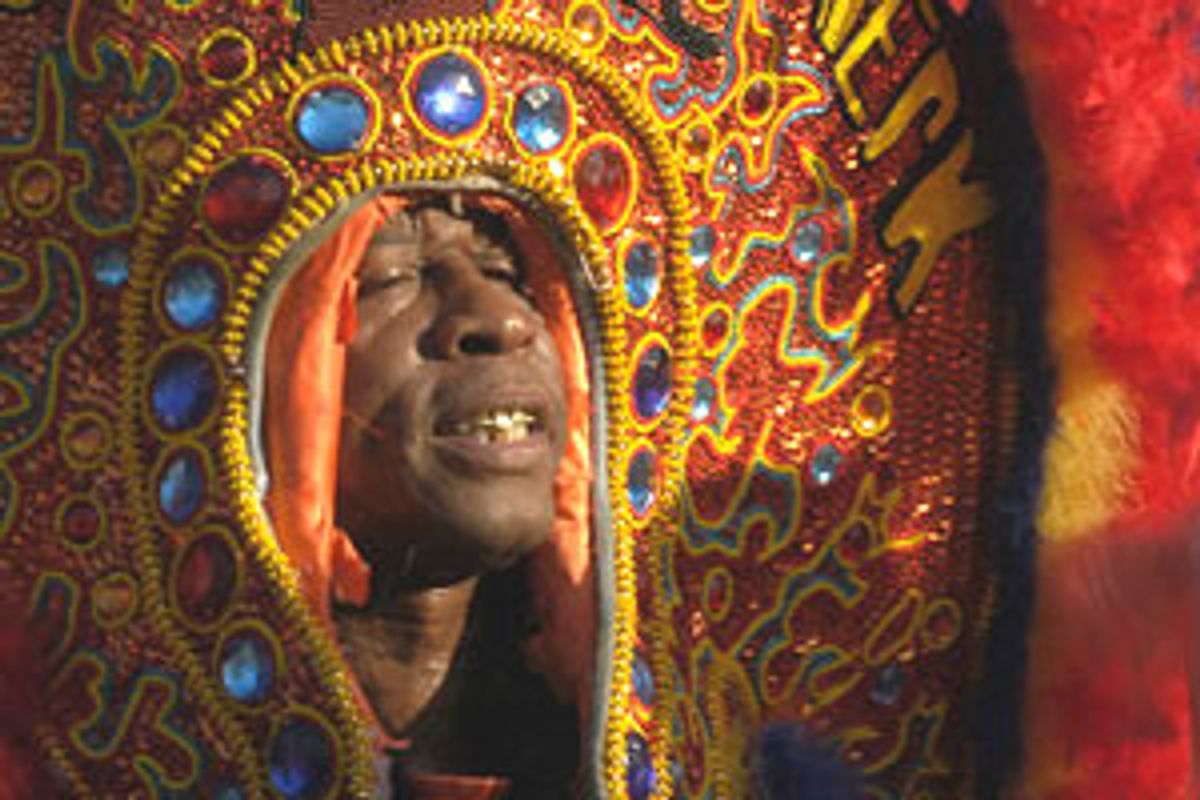
On Sunday afternoon in New Orleans’ Congo Square, Kevin Goodman, Big Chief of the Flaming Arrows, performed with fellow Mardi Gras Indians and musician Cyril Neville in a drum circle, part of a series of performances to bring healing to the city. The event was a memorial to the thousands who lost their lives in Hurricane Katrina or have died in the year since from illnesses and stresses associated with the disaster. Held on the spot where slaves once drummed and the Storyville neighborhood, leveled long ago, gave birth to jazz, the performers were joined by hundreds of the city’s residents in the grand New Orleans tradition of celebrating life while grieving loss.
Goodman’s Flaming Arrows, a tribe founded by his father, Therdot, marched the streets of New Orleans’ 7th Ward for more than 40 years. A lifelong resident of the city who worked as a house painter before the hurricane, Goodman has served as Big Chief for 16 years and had never missed a Mardi Gras. But a year after the storm breached the levees and flooded his neighborhood with 6 feet of water, Goodman, 46, is still living in Austin, Texas, where he was evacuated with literally nothing but the clothes on his back after surviving for days in harrowing conditions.
With people like Goodman gone, New Orleans’ unique culture remains at risk. Many of the neighborhoods that nurtured its wild creativity lie in ruin, their artists and musicians flung apart by the disaster. Goodman’s story also reflects the personal devastation and displacement experienced by so many following a natural disaster and a government failure of historic proportions.
“It still makes me angry when I think of the way we suffered,” Goodman says, his usually infectious smile falling away as he recalls the desperation of the many people who waited days to be rescued.
Everyone important in his life has been scattered across a thousand miles of the South, from San Antonio to Atlanta. Like so many other New Orleanians who loved their city but lived by modest means, he finds that Katrina continues to take a toll. In recent months, two members of Goodman’s family have died and another remains in critical condition in a Dallas hospital, all from illnesses that took a turn for the worse after exposure to toxic floodwaters and the stresses of dislocation.
The New Orleans that Goodman lost was 10 or so blocks of the 7th Ward, where he grew up, centered on the corner of Frenchmen and North Rocheblave streets. Places like the 7th Ward were the soul of a city defined by its patchwork of neighborhoods. Schools and churches, corner stores and bars, and extended families that went back for generations wove a network of support and survival, and were a source of the city’s culture and creativity.
“Even though New Orleans was ragged, it was beautiful to me,” Goodman said recently over a soul food dinner of country-style steak with gravy and butter beans, in his new south Austin apartment. “I know New Orleans like the back of my hand, every Indian and every Indian suit. I loved sewing, I loved masking, I loved singing and dancing — anything that went on with a tambourine and a drumbeat, I was there.”
Goodman believes that the New Orleans he knew will never recover and that, despite their deep ties, many survivors like him will not return. “The city was always about the rich getting richer and the poor getting poorer,” he says. “They didn’t care about us. I don’t want to live in a place where if a hurricane blows through again, then the ones with the money make it out and the ones who don’t get left to drown.”
While long in coming, signs of recovery are beginning to appear in the city’s devastated neighborhoods. New Orleans has reached nearly half its pre-Katrina population, and funds from huge federal block grants are finally arriving to help with the rebuilding. Among hurricane evacuees, Goodman is fortunate to have settled well into life in a new city, finding a warm welcome in Austin and new opportunities in his career as artist and musician. He says he will always be an Indian, and he has performed more in the past year than any other. But the scars of what he has lost may never heal.
After the levees were breached last August, Goodman and his family waded through the floodwaters and used a wood door to float the small children to a nearby church. Huddled with dozens of other survivors with little food or water, they were picked up the next day by some men from the neighborhood with a boat and taken to an I-10 overpass. By then the Superdome had been closed to additional evacuees. They hiked the elevated highway in hundred-degree heat, past unforgettable scenes of suffering. When they reached the drier ground of the Morial Convention Center, more disaster awaited them. They spent four days in the heat with little food and water, no toilets and no electricity. Around them, diabetics went into insulin shock, elderly people died in their wheelchairs, and bodies lay under sheets on the sidewalk.
“I couldn’t even take the smell on me, and everything around smelled worse than I did,” Goodman recalls. “I couldn’t eat — my stomach just shut down. I felt like I was losing my mind, but I knew I wasn’t. What was going on wasn’t supposed to be.” His brother Brian’s two grandchildren, 3-month-old twin girls, nearly died in Goodman’s arms from dehydration. Several times he had to wrap the twins in his body to keep them from being crushed by the crowds, which rushed the curbs expecting rescue buses every time headlights were seen coming down the street. On Saturday, a man was shot dead by police in front of Goodman and a crowd of hundreds. (Amid the wider chaos, the circumstances of the shooting of Danny Brumfield, 45, were disputed. Witnesses claimed he obstructed a police car in the street to plea for help. A statement released by the New Orleans Police Department last October said the shooting was in self-defense.)
“The cops just kept driving like nothing had happened — that was cold-blooded,” Goodman recalls. “What scared me the most was the way they shot like that toward the crowd, with thousands of people for blocks around. That was the straw that broke it for me. I was done. I didn’t care where I was going, as long as it was out of that place.”
Goodman has been back to visit his neighborhood several times in the last year. He found mostly empty streets, gutted houses and a few FEMA trailers.
“Before the hurricane, I could walk three blocks and see most of my family — grandmother, uncles, nieces, nephews, cousins, grandbabies, all of them being raised right there,” Goodman remembers. “I could go out my front door and see my people, the people who loved me — that’s what kept us together. Without the people like that, why should I be there?”
Family, and the art and music that became so important in his life, were woven tightly together. Goodman, an accomplished vocalist, percussionist and visual artist, learned the art of Mardi Gras Indian costuming and masking from his father, who founded the Flaming Arrows in 1963 and reigned for 20 years as “Big Chief Merk.” The fabulous hand-sewn “suits” of feathers, rhinestones and beads can cost $10,000 to make, weigh more than a hundred pounds, and take up to a year to create. Traditionally, a costume can be worn only once, and making a new suit every season is an extended community effort involving family, friends and neighborhood supporters.
During Mardi Gras, tribes take to the street with drumming, singing and dancing, and they stage elaborately choreographed standoffs with other Indian gangs. “We knew that on Carnival morning everybody in the neighborhood was going to be in front of our door, because they knew we were going to have the most beautiful costumes in the world,” says Goodman. “Our grandmothers and old people in the neighborhood looked forward to seeing us on Mardi Gras day. That’s what we did it for, but none of them are there anymore.”
Separated from his family when rescue finally came, Goodman’s art and music would become his lifeline in a new city. On the morning of Sept. 3, buses finally rolled into the convention center and helicopters began airlifting evacuees. The twins were rushed to a triage unit at the New Orleans airport and treated for dehydration. Goodman’s brother and his brother’s immediate family were flown to Dallas. After being airlifted by helicopter to the airport himself, Goodman boarded a plane before being told that he was going to Austin, a city he knew nothing about. A few hours later he was at Austin’s downtown convention center. The mayor shook the evacuees’ hands as they got off the bus. Strangers hugged them. “We had all the food we could eat and could take a shower anytime we wanted,” Goodman remembers.
Camped out at the convention center while the city made housing arrangements, Goodman and other evacuees started playing music on donated instruments. Among them was Kevin Bush, an old friend from the 7th Ward. Wheelchair bound after being paralyzed 10 years ago by a stray bullet, Bush had spent days after Katrina lashed to a rafter in his attic before being rescued. Cyril Neville had relocated to Austin and came by the convention center to join some jam sessions. During the second week, Goodman organized a second-line parade and made Bush his Second Chief for the Austin incarnation of the Flaming Arrows. Later that month, he joined Neville’s new Austin-based band, Tribe 13, for a performance at Antone’s, the famous downtown blues club.
“On a scale of 1 to 10, I’d say the reception we got here was a 10-plus — that’s kinda made me want to stay,” Goodman says. “The people here really enjoy our work and our costumes and our performances. They showed me the music scene here. In a lot of ways it’s like New Orleans.”
Goodman had lost everything in his New Orleans apartment, including sewing material worth thousands of dollars and two Indian suits considered priceless, but was able to send for two other suits that survived the flood at the Backstreet Cultural Museum in New Orleans’ Treme neighborhood. He’s had a full schedule since. In December, he joined several other Mardi Gras Indians for a tour sponsored by Jazz at Lincoln Center that went to India, Sri Lanka and the United Arab Emirates. He marched as Big Chief for Austin’s New Year and Mardi Gras celebrations and appeared at the annual South by Southwest music festival. “I never missed a Mardi Gras in 45 years and I didn’t miss it this year — I just did it here in Austin,” Goodman says. “I still have the Indian spirit that carries me everywhere I go. That gets me through whatever situation I’m in. Right now my focus is on making a new life in Austin.”
Two brothers in San Antonio are his closest family. His mother, sisters and two nieces are in Atlanta and are fine. But his brother Brian, who suffered a severe cut on his leg wading through hurricane debris, contracted meningitis, apparently from exposure to the flood waters. Goodman’s 16-year-old niece, Precious, who suffers from lupus and had undergone a kidney transplant less than a year before Katrina, lost all of her medications in the flood. A few days after their evacuation, she was hospitalized with kidney problems and lapsed into a coma after having surgery to remove her transplant. Under the stress of their displacement and their daughter’s deepening illness, Brian and his wife, Tina, began having more serious health problems of their own. Tina, 54, was hospitalized in the spring for congestive heart failure and died at a nursing home outside Dallas in May. Brian had a relapse of meningitis soon afterward and died following surgery, at the age of 50, in June. Precious remains on life support at the same Dallas hospital.
“She’s more like my daughter than my niece,” says Goodman, who is seeing a counselor in Austin to deal with his losses of the past year. “Precious and I were real close. When she was a girl she masked Indian with me as my queen. She was a happy person who loved to sing and dance. She had a hard time when she got sick and was missing so much school, being away from her friends. Then the hurricane happened.”
Goodman’s 6-year-old daughter, Kavonne, lives in New Orleans’ Gentilly neighborhood with her mother and stepfather, which keeps drawing Goodman back to the city for visits. In April he performed in a Mardi Gras Indian celebration at Jazz Fest, and returned again for the Congo Square appearance. Goodman hopes that he can continue the Indian tradition in Austin — but of course, he says, it’s not the same.
Many in New Orleans have vowed not to give up its ghost. On a recent Sunday night at Les Bon Temps Roule, an uptown club on Magazine Street, the Wild Tchopitoulous and Golden Comanche Indian gangs held a benefit to raise money for making new costumes for Mardi Gras 2007. “A lot of people lost their houses and aren’t back, but they’ll come back — eventually everyone will be back,” said Roderick Childers, Big Chief of the Wild Tchopitoulous, adding that Goodman would still have his place in the Indian pantheon if he returns. “I know Kevin, and he’s my man, and a man can do what he want to do, but the tradition and culture is here. You can go anywhere and costume and play, but it’s not going to be the same.”
Like everything else in New Orleans’ recovery, fortune has lain with higher ground. Most of the uptown tribes lived in neighborhoods that had much less flooding than downtown areas like Goodman’s in the 7th Ward.
“They say you can’t be an Indian anywhere else, but for a lot of us New Orleans isn’t the same place now either,” Goodman says. “We’re all scarred from Katrina. Some people want to come back, but there’s no affordable rental property, and everything is still so tore up. So a lot of people don’t have anything to come back to but bad memories.”
He wonders what life in New Orleans would be like without the neighbors he grew up with at Frenchmen and North Rocheblave.
“I keep thinking about Mrs. Marker,” says Goodman, recalling an elderly neighbor who helped raise him. “She wasn’t my blood relation, but she was like my grandmother to me. She told me, ‘Son, don’t hang out on that street corner. Son, don’t pick up no gun.’ All those elderly ladies out there at the Convention Center were Mrs. Marker to me. We were all brought up to respect these people, and that’s who raised us and taught us right from wrong. So where are we going to be now without them?”
When I saw the date of Charlotte’s wedding, I felt like I’d been hit on the head. What were the chances? Of all the days to get married – of all the cities to get married in – my friend had chosen the exact date that I met Nick, in the city that I met Nick.
I suspect most couples don’t know the exact date of their first encounter. But then most couples probably don’t have a police report.
It took me a few days to decide to contact Nick. I’d been wrestling with that urge for five years now. My inbox was a shame trail of gushy letters typed after midnight, impulsive notes dashed off in the afternoon. All of them had cutesy subject lines, like the titles of Raymond Carver stories, but they should have been labeled the same thing: “Do you love me again? Have you changed your mind yet?”
But one evening in March, I sent Nick an email. My hands were trembling as I typed. It was subject lined “things you may or may not remember,” and this is what it said:
“My friend Charlotte is getting married in New Orleans on May 13, and I will be going. May 13 also happens to be the day I met you, six years ago on Royal Street with a lump on my head the size of a lime. (Life is WEIRD, right?) I’d like to see you. Is that possible?”
I hadn’t seen Nick since he came to New York City in the spring of 2007. The morning he left, we woke early and watched an episode of “The Wire,” and then he walked me to the subway in my Brooklyn neighborhood. As I descended the steps he remained at the top, peering down and smiling. He did this whenever we parted, a habit that unnerved and delighted me at once. I’d wave him away while I stood in the security line at the airport – you can go now, I’m OK – but he would just stand there. Not going anywhere, he seemed to be saying, although that was clearly a lie. A few weeks after the New York trip, he called one Friday night and ended our relationship.
“You deserve someone who can be there for you,” he said.
I responded in the most articulate way I could muster under the circumstances. “Oh, fuck off.”
—–
The story of how I met Nick is one I have told many times. I have told it at parties, and in essays (even in this publication), and so I might as well tell you now.
It begins six years ago, when I was in New Orleans for a different wedding. I was walking along a quiet stretch of the French Quarter with two friends around 1 a.m. when a kid yanked my purse and, when I didn’t let go, clocked me above the left eyebrow with a pistol. Nick was the detective on the case.
“That’s so romantic,” people sometimes say, although I can assure you it was not. It was violent and horrible, and flirting was the furthest thing from both our minds that night as I rattled off a description of the kid while holding an ice pack to the side of my head. (OK, it was not the furthest thing from my mind. I did look for a wedding ring. He had one.)
It never occurred to me that anything would come of that case. This was a year after Katrina. Bodies were still being found in abandoned attics. But eight months later, I received a photo lineup in the mail, and I was surprised to discover that even after so much time had passed, I knew exactly who the kid was, knew it in my bones. Four months after that I was flown to New Orleans to testify at a pre-motion trial. I mean, life is WEIRD, right?
When I came back to New York, I was seized by a feeling that I should send a present to the recently separated detective who sat with me after the trial while I tried to shake off a grief I could not articulate. (I sent him the first season of “The Wire.”) That gift sparked a correspondence that lasted for six months. A few weeks after the kid pleaded guilty and got 15 years, I returned to New Orleans to see Nick.
“It doesn’t seem fair,” I told him once, sitting on his puffy leather couch in the nondescript one-bedroom where he’d moved after the split from his wife. “That kid gets a prison sentence, and we get each other.”
“That’s cute,” he said, threading his fingers through my hair.
“That I care about that kid?”
“That you think life is fair.”
Around the time we began corresponding, Nick moved to the homicide department. It was grueling, thankless work. Little romance in that, either, though I romanticized it anyway, besotted as I was by true crime and mafioso grandeur and David Simon. At the time, I wrote a blog about pop culture for a sex site. Of course I wanted to hear about guns and blood spatter. Nick, meanwhile, was happy to hear about pop culture and sex. We were the perfect escapes for each other, and we had both been searching for open hatches.
When people write about falling in love, I tend to cringe for them, because love requires a delusion that is deeply personal and impossible to explain to the world. So I’ll just say that I have doubted every relationship I’ve ever had, until that one. I was absolutely certain that Nick and I were meant to be together, and I was right. I just failed to specify how long.
When Nick broke up with me, I was devastated. Stunned. Nothing he said that night made sense to me, because it ran so contrary to the 500 conversations we’d had about how the other one was stitched into our DNA.
“The way I felt about you changed,” he said. “I don’t know why.”
If a duck calls you up one night, and tells you he’s an elephant, what do you say? How do you respond?
I responded the best way I knew how. “Oh, fuck off.”
In the five years that have elapsed since that conversation, we have spoken only a handful of times. We have tried to be friends – he missed me, I knew that – but then our conversations would lead me down the same sorrowful path, crying in my Stella Artois, and I’d grow incensed when he didn’t return an email or call me back.
I dated other men. Kind men, whom I quite liked. But in that eye-rolling way that is native to sensitive types, and writers, and alcoholics, and hoarders of memory and other people’s affection – of which I am batting a thousand – I held on to Nick, to the idea of Nick, to the hope represented by Nick through five years of recession woes, drinking problems and personal catastrophe. I did crazy things, which I can only admit now because I don’t do them anymore: I slept in his police shirt. I got insanely drunk one Sunday afternoon and called a dozen friends, begging them to convince me not to call him. Oh, the drama. Oh, the sturm und drang. Self-pity that could rattle the cupboards.
While I bled openly in public, he remained behind a fortress of stoicism. He is as much a cop as I am a drama queen. I don’t mean to say he is callous, because Nick is a tender person. His favorite movie is “Casablanca.” I have found this to be true of other cops, who manage to wall off some soft patch of sentiment behind the barbed wire fence. One night we were at the bar when I saw him talking with great passion to another detective. I figured they were discussing a case. Turns out, they were talking about their love for “The Notebook.”
But the few conversations Nick and I did have were a tangle of “do not cross” tape. I asked him things like, “How are you?”
He said things like, “Great.”
I said things like, “Great?” with a bit of eager anticipation, hoping he might sketch out a more detailed portrait.
Instead, he would say, “Yup.”
There was one thing Nick told me during the breakup that did make sense, and which I held on to with both fists. He said, “I met you at the wrong time.”
I’d be walking along the Hudson River one Saturday afternoon and those words would float up into my head. Well, what would be the right time? And when I moved from New York back to Dallas, a 90-minute flight between us, those words returned. Could the right time be now?
I scoured the landscape for signs that we were supposed to be together, or that he still thought about me. A New Orleans fleur-de-lys insignia at the restaurant where I was dining: What could that mean? A book about an NOPD murder crossing my desk: Why that, why now?
It was ridiculous, it was pathetic – let’s all agree as a group – but I could not stop clinging to the notion that the universe would bend itself so that our lives would entwine once more.
And then came Charlotte’s wedding.
I sent Nick an email late at night, when I suspected he’d still be at his desk, and by the time I woke the next morning, he had sent his response. Yes, he’d be happy to see me again. Lunch, drinks, whatever. It was exactly the answer I anticipated, which brought tremendous relief. But what came next blindsided me.
“If she’s free, can I invite my wife?”
So much can happen in five years. When I took those long walks along the Hudson, I used to wonder if Nick had remarried. I made up so many stories about him, and that was certainly one of them. What she might look like. Who she might be. I also wondered if he’d gotten back together with his first wife, the on-again, off-again high school sweetheart he married at the age of 22, three years after they had a baby together. Divorces take a year in New Orleans, and our relationship tracked exactly with that time period. He broke up with me the same week his divorce was final.
Even now I don’t know if the email he sent refers to his first wife, or his second wife, or his third wife or his 40th, because I could not muster the nerve to ask. The fact that I find it easier to write an essay on this subject is one of a thousand strange quirks that makes me who I am. The fact that he will not tell me any of that stuff until I ask directly is one of his.
In the days that followed his email, though, something shifted inside me. It calved like a glacier. It burst like the prick of a safety pin held up to the swirly rainbow curve of the world’s largest bubble. I would have told you this was impossible. I swear to God I thought I would spend the rest of my days clinging to that stupid blue police shirt, a modern-day Miss Havisham, but now I felt different about him, much as he had once felt different about me. I did not hate him. In fact, I adored him. But I did not want to see him again. The longing was gone.
I emailed Nick a week later. The subject line read, “on second thought.” I told him I thought it was a bad idea that we see each other. I told him I had been mistaken.
I had been mistaken about so many things. I’m not just talking about Nick now. I’m talking about the stories we tell ourselves about our lives: That it is absolutely going to be this way, or it is absolutely going to be that way. It is fated. It is doomed. It is destined. It is done. I have believed so many lies about myself, for so many years, and closed the lid to lie down inside those coffins. I thought I could never stop drinking, but I did. And I thought I could never be happy in the city where I grew up, but I am. And I thought I would go to my grave crying for the cop in New Orleans who didn’t love me back, but I don’t feel that way anymore. In fact, I feel kind of grateful. I’d be a horrible cop’s wife. Are you kidding me?
We don’t know how our stories end, and the greatest plot twists are the ones we never saw coming. There is a line that I love. “God is a first-rate novelist.” It’s from Richard Price’s introduction to David Simon’s book, “Homicide.”
So I went to New Orleans, six years to the day after I’d been pistol-whipped, but that date has a new significance to me. Charlotte’s wedding was so lovely. It was full of personality, and color, and the peculiar language shared by two people as their lives interweave. After the ceremony, we paraded through the French Quarter behind a brass band in a Second Line procession. As we passed crowds watching us on Chartres, I kept wondering if I might catch a glimpse of Nick. I did not. But somebody did run into Leonardo DiCaprio. (Life is WEIRD, you guys.)
The next afternoon I took one last stroll through the Quarter before heading out of town. I snapped a picture of the sign on Royal Street, the same street where I had been mugged, the street where I first told Nick I was in love with him. That street is a knot of complicated meaning to me.
I couldn’t help laughing at the big ONE WAY sign hanging right below it. I know it doesn’t mean anything. But I took it as a message from the universe that it was time to move on.
Continue Reading
Close
This article originally appeared on
AlterNet.
Beneath the veneer of New Orleans’ vibrant culture lies a history of tragedy. From the yellow fever outbreaks of the 19th century, the many catastrophic storms that have visited the city, the violence of the Civil War and Reconstruction, to the vast social dysfunction of contemporary New Orleans, this is a city that has known adversity throughout. It is sadly fitting, then, that Occupy NOLA is one of the few occupations to have witnessed a death at the encampment. Last week, 53-year-old Ronald Dean Howell, known as “Curly” or “Old School” to friends, was found dead in his tent. The coroner’s chief investigator, John Gagliano, stated that the cause of death was “complications from alcohol abuse.” According to other occupiers, the man was homeless, and likely relocated from another tent city at Calliope Street and the Pontchartrain Expressway, which was closed by authorities on Oct. 27.
Occupiers throughout the country have naturally found themselves sharing space with local homeless populations: the most vulnerable and marginalized of the 99 percent. This has been particularly pronounced in New Orleans, which continues to struggle with an acute homeless problem stemming from the devastation of the city’s housing stock during Hurricane Katrina. According to data provided by UNITY of Greater New Orleans, the city’s largest homeless nonprofit coalition, the homeless rate remains 70 percent higher than prestorm levels, with nearly 10,000 people lacking some form of permanent shelter. Many of these suffer from serious mental and physical illnesses, including high levels of alcohol and drug abuse. Howell’s story is typical, and his death would probably have gone largely unnoticed had it not occurred in the midst of this burgeoning movement. Instead, his passing has served to illuminate the systemic problem of homelessness in New Orleans, while also raising suspicions about the city’s motivation in closing down his previous home on Calliope Street.
In post-Katrina New Orleans, affordable housing has become a serious issue. In the immediate aftermath of the storm, four of the most recognized public housing sites were demolished: Lafitte, St. Bernard, B.W. Cooper and C.J. Peete. This came on the heels of contentious debate in the city council, which voted unanimously in favor of the demolition despite vocal opposition from community members. According to the Housing Authority of New Orleans (HANO), these units were replaced by mixed income housing, each managed by various private developers.
Meanwhile, the general housing stock was devastated by the storm. According to HUD, 75,000 units were destroyed, and 45,000 remain abandoned today. The diminished supply has naturally resulted in increased rents across the board. In the same HUD report, the median cost of housing in New Orleans increased 33.2 percent, from $662 in 2004 to $882 in 2009 (adjusted for inflation). Meanwhile, the rate for the most affordable housing has risen dramatically. According to Linda Gonzalez, the Director of New Orleans Mission, a nonprofit providing services for the homeless, “basic apartments cost about $250 before the storm and are now up to $500 to $700 depending on what area of the city.” This is confirmed by data from the HUD report that shows the number of units available in the $300-600 range has fallen from 66,300 in 2004 to 19,300 in 2009. Affordable rents have greatly dissipated in the city, while wages have stagnated as part of the larger, national trend. In response to the HUD report, UNITY Executive Director Martha Kegel was then quoted as saying: “We have more unaffordable rent than even New York City. That’s because we have very high rent and we have very, very low income.”
As such, the homeless population has grown so rapidly that “tent cities” have become a relatively common occurrence. The Occupy NOLA encampment, located at Duncan Plaza, is not the first of its kind. In 2007, a homeless camp took shape in the same location, eventually growing to include 249 individuals, according to UNITY. That encampment was ultimately closed by the city, beginning Nov. 21 of that year. Then-Mayor Ray Nagin’s administration worked with the nonprofit community, including UNITY, to relocate these people to a mixture of hotels or apartments. A similar encampment at Claiborne and Canal with about 150 individuals was broken up in similar fashion the following July. In both cases, the nonprofit community was provided prior notice and allowed to make assessments of the physical and mental health of people at the encampment.
The most recent closure, however, has diverted from this practice. While City Hall spokesman Ryan Berni stated that all of the “usual groups were included in the process,” some relevant organizations say they were not involved. Linda Gonzales, director of New Orleans Mission, which is just across the street from the Calliope encampment, says she was not given any prior notification. When asked if this was unusual, she replied “Yes. They typically call and let us know when they are going to do a sweep. I guess they just didn’t need us.” Meanwhile, Mike Miller, lead outreach worker at UNITY, said “We weren’t involved with the Calliope closing, and the plans did not meet our standards for humanitarian enclosures.” He says they were only given a few days’ notice, and that the city actually fenced off the camp a day prior to the announced closure date.
Miller further explained that his team was unable to make appropriate evaluations prior to the closing. “We knew it was coming. Were we given a specific date? No. We were not given an opportunity to assess the physical and mental health of the individuals at the encampment.” When asked about the city’s claim that the vast majority of the population was provided some form of temporary or permanent housing, he responded “Whatever their numbers are, I take it with a grain of salt. I don’t believe it because we are dealing with the same faces.” He emphasized that the city was essentially just “rearranging the problem” rather than solving it. “By shifting people around, you lose people: the sickest of the sick.”
Given the city’s diversion from the norm in closing this camp, some Occupy protesters have grown suspicious that the city maliciously intended to use the homeless as pawns to help destabilize their movement. Nia, who is integrally involved with the movement, said: “It would be utterly ridiculous to not think of the possibility that this was done with that intent.” While she emphasized that the group has welcomed the homeless population to the camp, she also explained that much of the group’s organizing capacity has been exhausted by attempting to meet their needs: providing food and tents, dealing with security issues, and trying to integrate them into the movement. Furthermore, she points to a potentially coordinated effort of authorities throughout the country to destabilize these movements by displacing homeless communities to the Occupy encampments. She said: “People have been coming here from throughout the country saying they have had the same exact experience with long term homeless (in their occupations).”
City officials, meanwhile, deny such machinations. When asked why the Calliope encampment was closed, mayor’s office spokesman Berni said: “Anytime there is a large encampment, there is a risk to public health and safety. What we did underneath the expressway was a lengthy process, in ensuring the necessary housing and vouchers to help people get back on their feet.” When asked if he thought that anyone from the Calliope encampment may have relocated to Occupy NOLA at Duncan Plaza, he was willing to admit that “some people” probably did.
However, the scene at the camp suggests the effect was probably more pronounced. What began as a few dozen people has grown to over 100 permanent campers, the vast majority of whom are homeless. On the increase in homeless numbers since the Calliope closure, Nia said: “There was an immediate slight increase. Then, a bunch of people were given hotel vouchers, which was fine, until they ran out and they came here.” Another Occupy NOLA organizer, Dehlia Labarre, corroborated the hotel voucher story, saying “We have reports of a number of people who were given a week-long voucher and then ended up here when it expired.” Berni, meanwhile, denied any knowledge about expired vouchers.
Adding to peoples’ suspicions has been the overly compliant nature of the New Orleans Police Department (NOPD) with regards to the encampment. Only one arrest has been made thus far at the site, and that was of a “machete wielding transient” that NOPD public information officer Frank Robertson said “had nothing to do with Occupy NOLA.” He explained that there have been no further reports of violence or noise complaints. When asked if they have any plans to close it down, he refused comment. However, he did admit that the police have “undercover officers in the area of the camp.” This rather surprising admission suggests that the NOPD may be focused on covert means of destabilizing the movement, rather than facing the scrutiny that would come with overt confrontation a la New York, Chicago and Oakland.
Evidence seems to point to intent by the city to diminish Occupy NOLA. If authorities were genuinely interested in protecting protesters’ First Amendment rights as Berni claims, would the NOPD be deploying undercover patrols? Meanwhile, the concurrent closing of the Calliope camp is suspicious, given the break from past trends and discrepancies in reports from the city and homeless nonprofits. Furthermore, the city’s claim that most of the homeless at that camp were provided alternate housing is contradicted by the reality on the ground at Occupy NOLA, where dozens of tents have sprouted up since that closing.
Malicious intent or not, the reality is that authorities have failed to address the underlying issue of inequality at all levels of government. Decades of conservative orthodoxy, attacks on the social safety net, stagnant wages, and rising education and housing costs have culminated in a level of precariousness unseen in decades. It is hard to envision a more appropriate illustration of this than frustrated youth occupying public space together with the most marginalized members of the population in the “city that care forgot.” While the death of Ronald Dean Howell was probably unavoidable, the tragedy of poverty and homeless can be conquered. By refocusing debate on the needs of the marginalized majority, the Occupy movement has taken a significant step forward in this continued struggle.
Continue Reading
Close
Renee Ledoux cried when the National Guard and sheriff’s deputies showed up at her front door and warned her she needed to get out to avoid water gushing from the Mississippi River after a floodgate was opened for the first time in four decades.
But by the 5 p.m. deadline Sunday, the 44-year-old Ledoux and her boyfriend Billy Hanchett decided to ride it out one more night on air mattresses inside the empty home in Krotz Springs. They have a camper they plan to stay in on a friend’s property outside the flood zone.
“We really don’t want to go,” Hanchett said. Ledoux added that she felt blessed that they had the camper because a lot of others have nowhere to go except shelters.
Meanwhile, President Barack Obama planned to fly to Memphis, Tenn., on Monday to meet with families affected when the river flooded there as well as local officials, first responders and volunteers.
Deputies all over Louisiana Cajun country were warning residents to head for higher ground and most heeded it, even in places where there hasn’t been so much as a trickle, hopeful that the flooding engineered to protect heavily populated New Orleans and Baton Rouge would be merciful to their way of life.
Days ago, many of the towns known for their Cajun culture bustled with activity as people filled sandbags and cleared out belongings. By Sunday, some areas were virtually empty as the water from the Mississippi River, swollen by snowmelt and heavy rains, slowly rolled across the Atchafalaya River basin. It first started to come, in small amounts, into people’s yards in Melville on Sunday. But it still had yet to move farther downstream.
The floodwaters could reach depths of 20 feet in the coming weeks, though levels were nowhere close to that yet in the towns about 50 miles west of Baton Rouge.
About 11 miles north of Krotz Springs in the town of Melville, Mary Ryder, her fiance and her fiance’s father were loading up a trailer with as many belongings as they could fit to drive over the levee to stay with relatives on the other side of town. Ryder lives in a mandatory evacuation area, where water is starting to creep into backyards. They worried about what might happen if a broader evacuation is ordered.
“They say we have to leave town. We have nowhere to go,” she said. “What are we going to do? I have no idea. We need help up here.”
The spillway’s opening diverted water from the two major Louisiana cities — along with chemical plants and oil refineries along the Mississippi’s lower reaches — easing pressure on the levees there in the hope of avoiding potentially catastrophic floods.
That choice angers John Muse, who drove from Lafayette to Melville to help his 86-year-old father-in-law Clovis Cole move his belongs. He said officials seem to be paying more attention to the concerns of Baton Rouge and New Orleans than people who live in the basin.
“They hurt a lot of feelings by putting that water in here like they did,” he said. “What’s happening here, I’ll tell ya, it’s not fair.”
In Butte LaRose, some 50 miles downstream from where the Morganza spillway was opened, Chalmers Wheat, 54, was among the few left — and even he was headed for his father’s home in Baton Rouge outside the flood zone. He and his twin brother, Chandler, were making a few final preparations to protect his home with plastic lining and sandbags.
“It’s almost like a ghost town,” said Wheat.
It will be at least a week before the Mississippi River crest arrives at the Morganza spillway, where officials opened two massive gates on Saturday and another two Sunday. There are 125 in all. The Mississippi has broken river-level records that had held since the 1920s in some places.
The Army Corps of Engineers has taken drastic steps to prevent flooding. Engineers blew up a levee in Missouri — inundating an estimated 200 square miles of farmland and damaging or destroying about 100 homes — to take the pressure off floodwalls protecting the town of Cairo, Ill., population 2,800.
The Morganza flooding is more controlled, however, and residents are warned each year that the spillway could be opened. A spillway at the 7,000-foot Bonnet Carre structure in Louisiana also has been opened.
Just outside Krotz Springs, 23-year-old Jake Nolan said National Guard troops knocked on the door of his home in a subdivision to tell his mother of the evacuation order. He said they advised her to have white towels and have access to the roof if they planned to ride it out — presumably in case of a rescue — though that didn’t appear to be part of any official instructions. And besides, he didn’t need an order to leave with his wife and three children.
“I don’t want to be stuck here if the water does get bad,” said Nolan, who planned to stay with a sister in Port Barre.
It seemed animals didn’t want to be stuck anywhere: Deer, hogs and rabbits have started running from the water flowing near the floodgates, said Lt. Col. Joey Broussard of the Louisiana Department of Wildlife and Fisheries. An electronic sign on Interstate 10 warned of a possible animal exodus: “Wildlife crossing possible. Use caution,” it read.
Despite the mandatory evacuation order, Krotz Springs town clerk Suzanne Bellau said it was unlikely the sheriff’s office would force people to leave. For most, the worst part was wondering what may happen. National Guardsmen were building a second levee to bolster protection for the town.
“It’s the unknown, that’s the problem,” Bellau said. “Is it going to come into their homes or not? And the people who are leaving, what are they coming back to?”
Associated Press writer Kevin McGill in New Orleans and AP Video Journalist Robert Ray in Krotz Springs, La., contributed to this report.
Continue Reading
Close
Deputies warned people Sunday to get out as Mississippi River water gushing from a floodgate for the first time in four decades crept ever closer to communities in Louisiana Cajun country, slowly filling a river basin like a giant bathtub.
Most residents heeded the warnings and headed for higher ground, even in places where there hasn’t been so much as a trickle, hopeful that the flooding engineered to protect New Orleans and Baton Rouge would be merciful to their way of life.
Days ago, many of the towns known for their Cajun culture and drawling dialect fluttered with activity as people filled sandbags and cleared out belongings. By Sunday, some areas were virtually empty as the water from the Mississippi River, swollen by snowmelt and heavy rains, slowly rolled across the Atchafalaya River basin. The floodwaters could reach depths of 20 feet in the coming weeks.
The spillway’s opening diverted water from heavily populated New Orleans and Baton Rouge — along with chemical plants and oil refineries along the Mississippi’s lower reaches — easing pressure on the levees there in the hope of avoiding potentially catastrophic floods.
About 11 miles north of Krotz Springs in the town of Melville, water was already starting to creep into some people’s backyards. Parts of the town not protected by levees were under a mandatory evacuation order. Glenda Maddox’s husband had temporarily reopened the gas station he closed in December so people could fuel up before they leave.
“Nobody knows what’s going to happen,” she said. “We don’t know if the levee is going to hold up.”
The station’s shelves were mostly barren, save for a few soft drinks and bottles of motor oil. Only cash was accepted 7/8 7/8– no credit cards.
In Butte LaRose, some 50 miles downstream from where the Morganza spillway was opened, no water was expected until at least later Sunday. But Chalmers Wheat, 54, was among the few left — and even he was headed for his father’s home in Baton Rouge outside the flood zone. He and his brother were making a few final preparations to protect his home with plastic lining and sandbags.
“It’s almost like a ghost town,” said Wheat, who was getting some help from his twin brother, Chandler.
Sandbags were still available in the center of town, but there were few takers Sunday.
Krotz Springs is roughly 30 miles closer to the floodgates, and deputies ordered people to evacuate Sunday morning even though the water hadn’t yet arrived.
Wayne Duplechain, who lives in the parish about eight miles outside Krotz Springs, said he would have his family stay in a camper parked on his son’s property outside the flood zone. He hoped to return, though, and ride out the flooding. He has three layers of sandbags stacked 2 feet high surrounding his ranch-style, brick house and figures the water won’t start lapping against them for seven or eight days. Plus, he has a generator and a boat to escape in if the water gets too high.
“It’s going to be slow-rising, so I’ll get out if I have to. I’m not totally stupid,” he said. “If it comes over the sandbags, I’m leaving.”
It will be at least a week before the Mississippi River crest arrives at the Morganza spillway, where officials opened two massive gates on Saturday and another two Sunday. There are 125 in all. The Mississippi has broken river-level records that had held since the 1920s in some places.
The Army Corps of Engineers has taken drastic steps to prevent flooding. Engineers blew up a levee in Missouri — inundating an estimated 200 square miles of farmland and damaging or destroying about 100 homes — to take the pressure off floodwalls protecting the town of Cairo, Ill., population 2,800.
The Morganza flooding is more controlled, however, and residents are warned each year that the spillway could be opened. A spillway at the 7,000-foot Bonnet Carre structure in Louisiana also has been opened.
Just outside Krotz Springs, 23-year-old Jake Nolan said National Guard troops knocked on the door of his home in a subdivision to tell his mother of the evacuation order. He said they advised her to have white towels and have access to the roof if they planned to ride it out — presumably in case of a rescue — though that didn’t appear to be part of any official instructions. And besides, he didn’t need an order to leave with his wife and three children.
“I don’t want to be stuck here if the water does get bad,” said Nolan, who planned to stay with a sister in Port Barre.
It seemed animals didn’t want to be stuck anywhere, either: Deer, hogs and rabbits have started running from the water flowing near the floodgates, said Lt. Col. Joey Broussard of the Louisiana Department of Wildlife and Fisheries. An electronic sign on Interstate 10 warned of a possible animal exodus: “Wildlife crossing possible. Use caution,” it read.
Despite the mandatory evacuation order for some people, Krotz Springs town clerk Suzanne Bellau said it was unlikely the sheriff’s office would force people to leave. For most, the worst part was wondering what may happen. National Guardsman were building a new levee to bolster protection for the town, in addition to a levee already standing.
“It’s the unknown, that’s the problem,” Bellau said. “Is it going to come into their homes or not? And the people who are leaving, what are they coming back to?”
That was also true downstream in Butte LaRose, where Chalmers and Chandler Wheat had been making last-minute preparations. Chalmers Wheat figured his house would be all right so long as the water level didn’t exceed 2 feet.
“If the water gets higher, we’re pretty much …” Chalmers Wheat said, before his brother chimed in: “Screwed.”
Associated Press writer Kevin McGill in New Orleans and AP Video Journalist Robert Ray in Krotz Springs contributed to this report.
Continue Reading
Close