In 1949, when director Robert Rossen released his juiced-up, noirish adaptation of Robert Penn Warren's Pulitzer Prize-winning novel, "All the King's Men," there were probably some people who felt that a great work had been desecrated. But Rossen's movie has a throbbing pulse: It honors its source material by coming at it with blunt purposefulness. And Broderick Crawford, as the thuggish but efficient career politician Willie Stark (whose character Warren modeled on Depression-era Louisiana Gov. Huey Long), uses sharp left-hook shorthand to telegraph the way sincere populist ideals can all too easily give way to corruption. There's no mistaking what Crawford's Willie Stark is thinking at any given moment. His motives and desires are planted right on Crawford's boxer's mug, like scars.
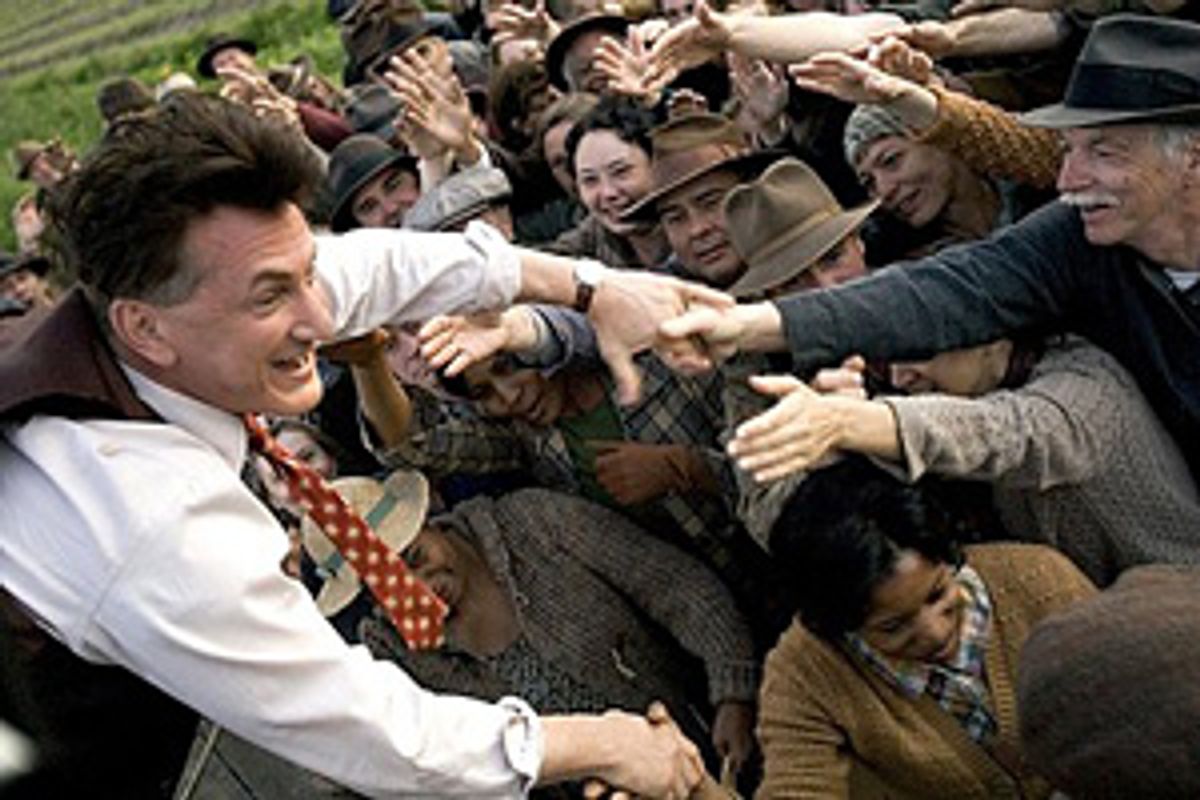
So what the hell does Sean Penn think he's doing in Steven Zaillian's bizarrely conceived re-slapdashtation of "All the King's Men"? Both the performance and the movie around it are virtually incomprehensible. This is supposed to be a story about a charismatic and ambitious politician who earns the loyalty of the populace by telling it to them straight, and yet half the time we have no idea what Penn's Willie Stark is going on about -- or what Zaillian wants us to think about him.
Long, like the character Warren wrote around him, was a fascinating and complicated figure who, before he was assassinated in 1935, changed the face of Louisiana politics by kicking the butts of the old-boy network and standing up for the little guy. He knew how to get things done, bulking up his stature as a leader by building roads, bridges and schools, but he also grabbed more power for himself than any single politician should be allowed -- although even the abuse of power sometimes has its purposes. As Long biographer T. Harry Williams has pointed out, Long couldn't have achieved what he did if he hadn't seized that power: "He could not have lifted Louisiana from a condition of near feudalism into the modern world almost overnight or inspired thousands of poor white people all over the South to a vision of a better life or introduced into all of Southern politics, which had been pervasively romantic, a saving element of economic realism."
No such complexity comes through in Penn's performance, perhaps because there's no room for complexity in Zaillian's conception of the story. In addition to directing, Zaillian adapted the script himself from Warren's novel, and he seems to want to build up Willie Stark as a democratic folk hero while downplaying his capacity for bullying and manipulation. But without those conflicting impulses, Willie Stark's character is rendered static, and the movie has no forward motion. (In a significant plot point, the Louisiana Senate moves to impeach Willie Stark, but we're never told why -- we're left to deduce that it's just because the government is acting in the interest of big business for whom Willie is the enemy simply because he's the humble servant of the people.)
"All the King's Men" tells the story of Willie Stark through the eyes of a rich-kid journalist, Jack Burden (a smooth, mildly believable Jude Law), who eventually becomes Willie's right-hand man. At the beginning of the story, Willie is a man with bold aspirations, but he's going nowhere, fast. He becomes the tool of a political schemer named Tiny Duffy (James Gandolfini), who encourages him to run for governor but who really only wants to use him as a strategic weapon to secure the victory of his own candidate. Willie is tipped off to those machinations first by Jack and then by one of Tiny's own associates, Sadie (the ever-reliable Patricia Clarkson), a sharp-minded professional woman who moves deftly through this old-boy world. At an important rally, Willie sabotages Tiny's crooked plan by trashing the dull stump speech Tiny's people have prepared for him and substituting his own off-the-cuff rallying cry. The audience is electrified, and his political career takes off like a shot.
The movie's windswept plot draws in Jack's long-lost love, aristocratic cool-cat Anne (Kate Winslet, whose fresh-scrubbed appeal feels wasted here); his best friend from youth, Anne's brother, Adam (a bland, tuned-out Mark Ruffalo), a doctor who's supposed to be extremely principled (although we know this only because we're told, not because we ever see him in action); and Jack's surrogate father, Judge Irwin (Anthony Hopkins, who seems to have soaked himself in excess gravitas for the occasion), the man who can ultimately effect Willie's triumph or downfall.
The story zigs and zags around characters' petty jealousies, blind desires, and ferocious clinging to the ways of the Old South. But none of it resonates. Zaillian -- who filmed much of the picture on location in Louisiana -- has moved the action from the '30s, the era in which Warren set his novel, to the '50s. According to the press notes, he felt "that any period before World War II seemed less contemporary and more 'nostalgic'" -- as if the Depression-era South of Huey Long were as distant to us as ancient Greece.
"All the King's Men" feels like a ponderous tract about idealism and politics, one that someone forgot to finish. It toddles around on its noble, self-evident truths as if they were clown stilts, but it always manages to remain safely far above the masses -- we never quite know what Willie Stark does stand for, aside from the fact that we're repeatedly told he's a man of the people. Penn's performance has the opacity of solid brick. In his early scenes, he does manage to convey the blustery power of Willie's inspired speechifying. But Penn's characterization doesn't grow or deepen -- it just gets louder and bigger, and we never really know what's going on behind those shifting, calculating eyes. The Willie Stark that Warren created -- and even the Willie Stark Robert Rossen gave us -- is a conflicted, complicated character, but Zaillian and Penn seem to be afraid of making him too unlikable. Perhaps they were nervous that audiences wouldn't get the point. If that's the case, they're like the most cynical of politicians: How can you possibly serve the public if you have no faith in it?
Shares