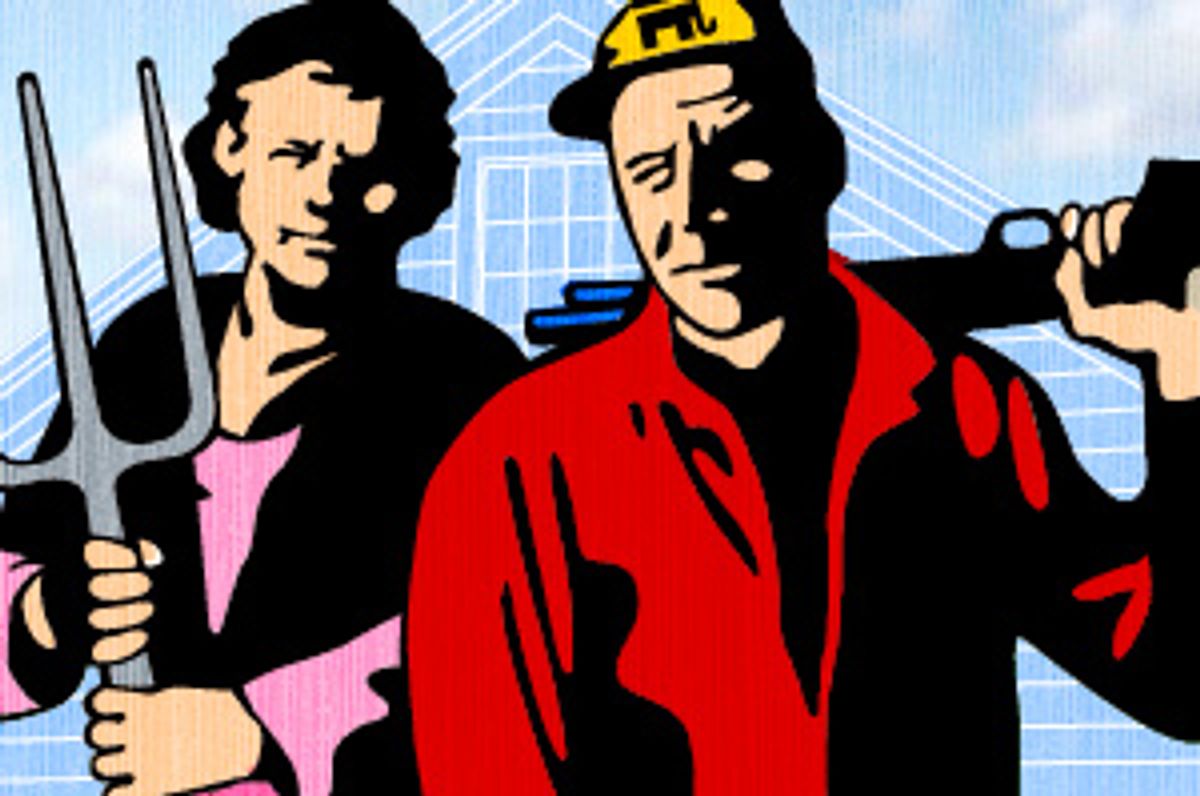
What kind of American are you? Red-state or blue-state? Secular humanist pinko or Bible-thumping loon? Tribe of Coulter or tribe of Franken? If you're a citizen of the United States of America, the odds are good that your sense of identity over the last couple of decades (and especially, exaggeratedly, since the undigested trauma of the 2000 election) revolves around the question of where you belong in this perilously polarized nation.
Sometimes it seems as if the dichotomy in American cultural and political life has itself become the only subject of public discourse. It's contained in every Supreme Court nomination, every death in Iraq and every Gulf Coast hurricane, but it also lies in wait within every hit movie, every No. 1 song, every debate about public architecture, every spoiled superstar athlete, every "American Idol" contestant. Our country right now reminds me of the old joke: There are two kinds of people, the ones who divide the world into two kinds of people and the ones who don't.
One could go further and suggest that, ideological frothing at the mouth aside, we're all the same kind of people, all sharing the same deluded conviction that we live in a functioning democracy. Setting aside such cynicism, if only for the moment, we should notice that the origins of America's bifurcation go back long before the invention of electronic electoral maps coded in warring primary colors. They go back through Nixon and FDR and William Jennings Bryan and Lincoln and Darwin and Jefferson and Voltaire, clear back to the birth of the Enlightenment.
It's not like angry divisions are a new phenomenon in American politics. The Constitutional Convention of 1787 was plagued by intractable disagreements, whose resolution, as Brian Mann points out in his book "Welcome to the Homeland," has directly contributed to today's problems. In our great-great-grandparents' time, the nation pretty nearly destroyed itself, fighting a bloody civil war whose bitterness has not quite faded after 140 years. Bryan's 1896 presidential campaign was a full-fledged populist rebellion, pitting the people of the Great Plains and the West against the moneyed Eastern establishment. Franklin D. Roosevelt may be an untouchable icon of pop history today, but during his 13-year presidency many Americans viewed him as a pseudo-socialist tyrant.
Even if our contemporary political schism is just an old one duded up in new clothes and endlessly blabbed out over the airwaves, that doesn't make it any prettier. Sure, there was a middle-ground liberal consensus that dominated American politics in the postwar years -- if you're willing to skate past the Red Scare and a couple of near-misses with World War III -- but in retrospect its reign looks very short indeed. By the mid-'60s it was crumbling, by the Nixon-McGovern election of 1972 it was fatally undermined, and by the ascendancy of Ronald Reagan in 1980 it was gone for good.
What happened? Well, one could say that old fires of tribal hatred (country vs. city, populace vs. elites) were rebuilt and carefully tended by politicians who could benefit from them. In that sense, what has happened in America in the last quarter-century is not altogether different from what has happened in the Balkans, the Middle East, Rwanda, Sudan and countless other exotic locations. The modalities of conflict are different, for the most part, and that's something to be grateful for.
Neither side in America's cultural and political wars -- Brian Mann calls the two camps the "metros" and the "homelanders" -- can quite get what they want. Homelanders have controlled Congress for 12 years and the White House for six. They've packed the federal judiciary with right-thinking conservatives who view our Constitution as a form of Talmudic writ whose interpretation requires reading the minds of those bickering 18th century farmers, the ones who got together in Philadelphia to figure out how to govern a rural nation of 13 states with a combined population smaller than present-day Arkansas. Yet big government has done nothing but get bigger, abortion remains a legal and (in most states) commonplace medical procedure, HBO programming includes the word "fuck" every 38 seconds, homosexuals show no signs of melting away in shame, fewer and fewer people go to church, and undocumented immigrants have shown up in virtually every corner of the country, where they work hard at the jobs nobody else will do at all. On the other hand, the metropolitan liberals and moderates whose values seem to dominate the texture of actual American life can do nothing to stop a governing party that starts overseas wars for bad reasons, punishes poor people for living in the path of a hurricane, encourages environmental destruction and eagerly hands over as much power as possible (except that of the police state) to big corporations.
This mutual discontent can lead to a fury and frustration, an air of permanent grievance, that makes both ends of the political spectrum seem unstable. Once, seven or eight years ago, I had to get up and leave Christmas dinner after a relative began to speak, with tears in his eyes, about the noble and indeed Christ-like mission of Kenneth Starr. But I also don't want to hear anyone I otherwise admire launch into any more conspiracy theories that connect (or even mention) the 9/11 attacks, the Ohio vote count, Hurricane Katrina and Judith Miller.
Mann, a reporter on rural affairs for National Public Radio and various of its local affiliates, presents himself as a mild-mannered middle-grounder who understands both of America's warring cultures and can translate between them. He was raised in small towns in Kansas, Oklahoma and Alaska, and now lives in northern New York state. He's a metro, all right, but one seasoned with rural mellowing. He describes himself as a lifelong Christian, for example, but writes, "It never occurred to me to believe that the Bible was literal truth." He holds liberal social views on issues like abortion and gay marriage, but says he is fiscally conservative and has voted for Republicans at least as often as Democrats. He remains close to his brother, Allen -- a foil throughout this book -- a bedrock family-values conservative who lives in Washington, Mo., on the exurban-rural fringe outside St. Louis.
Yet the remarkable thing about "Welcome to the Homeland" is not Mann's mostly commonsensical and mildly heterodox analysis of our national divide, nor his admirable attempt to present heartland conservatism as a coherent ideology, nor even his flights into full-fledged hallucinatory idiocy. It's how pissed off he is.
Maybe a moderate like Mann had more to lose than either right-wingers or left-wingers did as the purportedly crisp, cool water of our national rhetoric gradually turned to poisonous sludge. He openly pines for the day when the mainstream of the Republican Party meant Dwight Eisenhower, a self-described liberal who embodied plain-spoken heartland values while presiding over a massive expansion of the social safety net. As Mann later points out, Barry Goldwater, the pioneer of the conservative revival, would probably be rejected by his own movement today for insufficient doctrinal purity. (By the end of his life, Goldwater was pro-choice and supported civil rights for gays and lesbians.)
"Welcome to the Homeland" is no mild-mannered exploration of the common ground between Brian and Allen Mann's visions of the world. It's a full-on metro jeremiad against Allen's people, the homelanders, whom Brian describes as a tiny cadre of right-wing rural revolutionaries who have hijacked the party of Abraham Lincoln, hypnotized the media and convinced many of the rest of us that they represent the truest and most virtuous aspects of our national character. Brian can't help believing that his brother's right-wing views are "troubling, ugly, and morally wrong." (Allen, naturally enough, feels the same way about him.)
Mann's book was conceived in part as a riposte to Thomas Frank's bestseller "What's the Matter With Kansas?" and might also belong on the shelf next to "Kingdom Coming," former Salon reporter Michelle Goldberg's recent treatise on the rise of right-wing Christian nationalism. (Given the timing, Mann cannot possibly have read Goldberg's book before finishing his own.) Where Frank sees a class war inverted and subverted by powerful economic elites who control the Republican Party and convince the exurban lumpenproletariat to vote against its own interests, and Goldberg sees an irresolvable, almost apocalyptic collision between those who see America as a secular republic and those who see it as the kingdom of Christ, Mann sees geography.
Even though we all seem addicted to the terminology, most of us can agree that speaking of entire states as belonging to categories, like "red" or "blue," is meaningless. Mann makes a point that ought to be obvious, but is often overlooked: Small towns in upstate New York or inland California are likely to be just as culturally and politically conservative as small towns in central Nebraska or the Texas panhandle. In Delaware County, N.Y. (where my wife's family owns a summer home), about 140 miles northwest of New York City, George W. Bush had a 15-point edge over John Kerry in the last presidential election. This didn't mean much, of course. There were 21,000 votes cast in that rural and nearly all-white county of hemlock forests and bluestone quarries, while roughly 2.2 million were cast in New York City, where Kerry won 74 percent of the vote.
At least in national elections, right-wing homelanders in states like California, Illinois, Massachusetts and New York are overwhelmingly outvoted by their more liberal and metropolitan cousins. The reverse is also true, but -- and this is highly significant -- not to such an exaggerated extent. Even small and isolated heartland cities tend to tilt Democratic, at least in relative terms. Bush defeated Kerry in both Topeka, Kan., and Lincoln, Neb., but only by small margins. Both cities frequently elect Democrats to local and state office. It was a red tide of Republican voters in those states' rural regions that turned the overall vote into a landslide.
As Mann points out, the more you parse the '04 election results (assuming, for the purposes of argument, that they're on the up-and-up), the more you see this pattern repeat itself. Bush carried almost every non-coastal county of California, but the lopsided Kerry vote in Los Angeles and the San Francisco Bay Area delivered the state to the Democrat's column by more than 1.2 million votes.
Meanwhile, in the crucial battleground of Florida, Kerry narrowly carried the big metropolitan areas, winning by 57,000 votes in Miami-Dade County and essentially running even with Bush in the Orlando and Tampa Bay metropolitan areas. But Okaloosa and Santa Rosa counties, on the "redneck Riviera" of Florida's Gulf Coast, with a combined population less than one-tenth the size of those three urban-suburban regions, delivered an 87,000-vote margin for Bush, more than enough to erase Kerry's metropolitan edge.
In Ohio -- I'm sorry to mention that name at all -- conventional wisdom holds that a Democratic candidate must win Cleveland by 100,000 votes in order to carry the state. Kerry actually piled up a 200,000-vote margin in metro Cleveland, largely thanks to heavy African-American turnout, only to encounter (believe it or don't!) an outpouring of rural Republican passion across southern and western Ohio that was unlike anything seen before in Buckeye State history. One could go on almost indefinitely. Kerry won Las Vegas and ran neck-and-neck with Bush in Reno, but got blitzed in Nevada's rural desert counties and lost the state by 21,000 votes. In New Mexico, Kerry carried Albuquerque, Santa Fe and Taos, but lost overall by about 6,000 votes.
Mann agrees with Frank, and most other commentators, that these results reflect a demographic and cultural schism that has been expertly exploited by Republican political operatives in recent years. Whatever one's conclusions may be about the validity of the 2004 election, Kerry fared dramatically worse among small-town and exurban voters than Al Gore did in 2000. In turn, Gore did much worse in rural areas than Bill Clinton did in either 1992 or 1996.
In much of rural Middle America, as Mann observes, Democrats have either evaporated entirely or remade themselves as low-carb conservatives, not quite as rabidly antiabortion, anti-taxation and anti-gay as the other guys. Meanwhile, Republicans have worked tirelessly to organize, motivate and energize their rural base. During the 2004 election cycle, GOP strategists reportedly identified something like 20 million new potential voters, most of them outside the nation's metropolitan beltways.
Mann's analysis, in fairness, is not entirely incompatible with either Frank's or Goldberg's, and he never claims that the metro-rural split can explain everything in American politics. (Rural counties with African-American or Hispanic majorities tend to vote Democratic, for example.) But he does not see the homelanders as sheep or dupes controlled by the barons of capitalism, nor as the Christian soldiers of a theocratic revolution.
The rural and outer-suburban folks he's talking about represent no more than 20 percent of the American population, and their numbers are declining in both relative and absolute terms. They are a largely homogeneous group, much older, whiter and more religious than the population as a whole. They are far more likely to be military veterans and to own guns than other Americans. As Mann sees it, their lives are dominated by a sense of enduring tradition, whereas the metros in the big cities and inner suburbs are acculturated to constant cultural and demographic change.
Mann tells us that his brother, Allen, for instance, is not a racist or a homophobe or a believer in theocracy (although he is an evangelical Christian). Rather, Allen believes that traditional American small-town life is "beautiful and blessed and besieged," and that we'd all be better off if we reconnected to it. "He thinks there's a better, more decent America out there, a country that somehow got tangled up in niggling multiculturalism, derailed by political correctness, and deformed by tax-and-spend social engineering. He dreams of a future that's a little more honest, a little freer, and a little more prosperous than the one we've actually inherited."
That's an admirably sympathetic attempt to summarize the conceptual underpinnings of right-wing ideology even if "tradition" is one of those words that ought to make you squint your eyes and reach for your rhetorical revolver. Another way of putting it is that homelanders are the highly visible minority of Americans who are least comfortable with the totality of change in our national life over the past 40 or 60 or 100 years. They're uncomfortable with the transformed role of women, the heightened sensitivity to race relations, the declining importance of marriage, the dethroning of Protestant Christianity as a quasi-state religion, the widespread acceptance of homosexuality, the renewed influx of non-English-speaking and nonwhite immigrants, and the constant negotiation required by the polyglot nature of metropolitan life.
Rural, conservative Americans see themselves, Mann writes, as outsiders in our metrocentric culture, but as outsiders who are "uniquely connected to the true vein of national character" and therefore "uniquely qualified to judge and correct the broader society when it goes astray." This conviction is profound and genuine, Mann insists. He paraphrases the message of Focus on the Family's influential radio broadcasts this way: "We're normal. We're healthy. We offer a better way forward."
These days, homelanders will support, with impressive solidarity, political leaders and public figures who share their backgrounds and their values, and whom they trust to reverse, or at least slow down, the pace of social change. Mann makes the point that George W. Bush, Dick Cheney, Dennis Hastert, Tom DeLay, Bill Frist and John Roberts (along with Rep. John Boehner, DeLay's replacement as House majority leader) -- in other words, the conservative movement's most powerful men -- are dyed-in-the-wool homelanders with rural roots. To their supporters, it seems both condescending and ridiculous for a certified metro like John Kerry to don camo for a pheasant hunt, or profess his love for NASCAR.
They're right about that. One could protest, of course, that it's no less ludicrous for the Connecticut-born grandson of Sen. Prescott Bush, and great-grandson of banking magnate George Herbert Walker, to claim heartland authenticity. But what counts here is mythology, not reality. This, I think, is Mann's sharpest insight: Homelander mythology still exerts a hypnotic power in American life, out of all proportion to the country's actual demographics.
Many of us, irrespective of race, creed or political affiliation, half-consciously believe that white Christians who live in small towns -- towns where old ladies bake pies, the fire department's half-breed Dalmatian leads the Fourth of July parade and towheaded boys in overalls play baseball with wooden bats -- are the real Americans, connected to the essence of the country in some way the rest of us are not. It's an archetype that virtually does not exist today (if it really ever did), but we cling to it, perhaps believing we owe it some kind of religious or tribal loyalty.
What was Ronald Reagan's legendary 1984 "Morning in America" commercial but this mythology cooked down to its essence and mainlined like heroin into the body politic? What else can explain why Iowa and New Hampshire, two of the smallest, whitest and most rural states in the country, play such a decisive role in presidential politics? We apparently believe that standing in a cornfield with some monosyllabic hog farmer, or confronting the frozen yokels in some Granite State diner at 6 a.m., will strip the metropolitan veneer away from our candidates and compel them to reveal their genuine plaid-flannel souls.
Some of this mythology stems from the roots of the American republic, which did indeed begin as a society of white, male landholders spread thinly across a rugged continent. Whether this is a grand plan hatched by Karl Rove or just a fortuitous historical irony, the homelander revolution capitalized on the rural bias inherent in American federalism. As a result of the Constitutional Convention's historic compromise between delegates from larger and smaller states, rural states are dramatically "supersized" (Mann's phrase) in the U.S. Senate and, consequently, in the Electoral College.
If the allocation of electoral votes were based simply on population, Mann observes, then Alaska, North Dakota, Vermont and Wyoming would get no more than one vote apiece. Instead, those states have 12 electoral votes, with nine of them pretty much hard-wired to the Republicans. One may be tempted to shrug this off; 12 electoral votes is still fewer than middle-size states like Georgia or New Jersey command on their own. But as Mann demonstrates, the cumulative impact is dramatic.
California has a population of about 36 million and commands 55 electoral votes, far more than any other state. But the 12 inland states of the Great Plains and Far West (all won by Bush in 2004), with a combined population of 23 million, account for 59 electoral votes. Those 13 million extra Californians must not be real Americans after all, since their votes counted for so much less (.00000153 electoral votes apiece) than those of Arizonans, Nevadans, Idahoans or Nebraskans (.00000257 electoral votes each). Similarly, the 44 Democrats in the current Senate actually represent more citizens, and received more votes, than do the 55 Republicans.
Mann correctly observes that there's no point trying to change this system. Why would or should smaller states agree to a constitutional amendment designed to rob them of such decisive power? But when Democrats try to compete on homelander turf, as they clearly must, they run smack into the paradox that bedevils their party today. On one hand, you have heartland Democrats like Nebraska Sen. Ben Nelson, who votes with the GOP on nearly every substantive issue. He opposes abortion, gay rights, redistributive taxation, stricter environmental standards, gun control, immigrant amnesty and, pretty much by default, any other issue likely to be important to metro-liberal types.
At least Nelson knows what he believes, even if his ideological connection to the rest of his party is so tenuous as to be nonexistent. But Democratic presidential candidates have to do a chameleonic two-step that satisfies no one, speaking in liberal code to potential donors in Manhattan or Beverly Hills while waffling or fence-sitting in public on every important issue. If you ask me, Bill Clinton was so successful in this mode because his Jesuitic prevarications came from the heart. Not inhaling and the don't-ask-don't-tell policy and debating the meaning of "is" were fundamental expressions of his being.
Like Democratic strategists since the Reagan administration, Mann feels sure that long-term trends favor his tribe. Demographic shifts in such "red" states as Arizona, Colorado and Nevada seem to be inching toward a metro majority. Occasional progressive Democrats, like Kansas Gov. Kathleen Sebelius, are able to win election in the most homelander-rich states (generally because the Republicans have enthusiastically nominated a total nutbar). Most important, he suggests that most Americans, while they may feel briefly wistful about the homelanders' nostalgic appeal, are pretty happy with the dynamism and opportunity of metropolitan life and don't actually want to reconstruct the society of 1955.
Yes, but. Mann's formulation of America's political division as primarily a matter of whether we live near a big city or not is entirely rational, but rather too abstract. It's a more valuable abstraction than painting, say, Minnesota in one color and Montana in another, but it still falls into the trap of all logical abstractions, i.e., imagining it explains that which cannot be explained. Furthermore, Mann's book is sloppily researched and unannotated, which persistently undermines the quality of his analysis. You can never be quite sure where his information is coming from, and he makes a few egregious errors and several dubious interpretations.
In a laundry list of left-wing excesses of the 1960s (which allegedly drove heartland folks to the right), he writes: "Progressives armed with rifles and pistols occupied college campuses. They clashed with National Guard soldiers, blew up police stations, and robbed banks." Hello? I don't think Rush Limbaugh could utter those two sentences with a straight face. The first one is a flat-out falsehood. There were no armed campus uprisings in the United States in the '60s, period. Not anywhere, not ever. The second sentence, while less of a howler, conflates two entirely different phenomena: Large-scale antiwar protests, in which the National Guard were almost universally the aggressors; and the actions of a tiny clique of nutso revolutionaries, who were not widely supported even on the left.
Unfortunately, the sloppiness, historical ignorance and middle-road bias evident there (and repeated in his dismissive discussion of the 1968 Democratic convention protests in Chicago) also affect Mann's understanding of the right. I suspect he is far too cavalier about the importance of racism, homophobia, anti-Semitism and an especially nightmarish brand of Christian eschatology in homelander thinking. Those elements are not sufficient to explain the homelander phenomenon either, but they are intimately involved with it to an extent Mann is reluctant to face.
He also significantly underplays the importance of evangelical Christianity in the American right and society more generally. Mann refers several times to a Barna Research poll suggesting that evangelicals are only 8 percent of the U.S. population, without explaining that the poll used a strict doctrinal definition of the term, counting only people who held specific theological beliefs. Other polls have suggested that 23 percent of 2004 voters self-identified as evangelical Christians, with 14 percent identifying themselves as belonging to the "Christian right." Similarly, Mann seems to think that only a small core of fundamentalists reject evolutionary theory in favor of the six-day creation described in the Book of Genesis. Polls have consistently indicated that nearly half of all Americans hold such a belief.
His big idea that metro life is about change and homelander life is about tradition is dispensed in a couple of sentences and then swept aside. That's because it doesn't hold up. Maybe rural Republicans cling more fervently to the idea of tradition than urban Democrats do, although I'm not even sure about that. But rural America has changed at least as much as urban and suburban America in recent decades, and arguably more. After the coming of Wal-Mart and the near-total destruction of Main Street business, the corporate consolidation of agribusiness and the depopulation of farm communities, the explosion of the exurbs, the methamphetamine epidemic, and the arrival of immigrant laborers in almost every rural county in America, it's hard to say where any enduring tradition is to be found.
All Americans (and indeed all people everywhere) have confronted extraordinary and ever-accelerating change ever since the beginning of the Industrial Age. How people cope with change and respond to it is a function of their culture. Perhaps the real story in America is the confrontation of two opposing but interlocking and interdependent cultures, one of which is rural-identified but not limited to rural areas. From "All in the Family" to "The West Wing," metro values have been pumped into all parts of the country for years, and in the age of Fox News, talk radio and CMT, the favor has been returned.
A friend of mine who grew up in rural Indiana in the '70s and '80s talks about the way his region has been transformed since his childhood. No one in his hometown cared much about country music or stock-car racing, he says, until those things became attached to a new conception of rural identity. It was a pretty conservative place, but people listened to pop music, watched the same crappy TV shows as everybody else, and voted variously for Democrats or Republicans, depending on context.
These days, if you're rural and you're white and you feel OK about those things, you've got an entire nationwide culture waiting for you: Rush, O'Reilly and Faith Hill for the sober folk, Michael Savage, Neal Boortz and Toby Keith for the hell-raisers and outlaws. Jesus, of course, is for everybody, and the Intimidator is sitting at his right hand. (If you don't know what I'm talking about ... you might be a metro!) Voting for Republicans, supporting any and all present or future foreign wars, and the kind of ultra-patriotism that produces those translucent flag decals, complete with slavering eagle, slapped over the entire rear window of a pickup, just comes with the package.
This new homelander culture is beamed into the cities 24/7, just as urban pop culture has long been available in Podunk. Anybody with their eyes and ears tuned to the monster-mash of contemporary America has observed the result: A Ford F-150 with a Rebel-flag sticker parked on a back road, with 50 Cent's latest hit rocking the sound system and a pungent, ropy odor seeping from the door frames. A posse of African-American guys on the Q train to Brooklyn, sporting do-rags, sideways Black Yankees caps and NASCAR team jackets. At the level of pop culture the boundaries between metro and homelander are porous, unpoliced, prone to infiltration.
Mann halfheartedly suggests that the 75 to 80 percent of Americans who live in cities or metropolitan suburbs will eventually wake up, realize our true power, and grab the reins. (Even then, he predicts a long period of divided, unstable government: Hillary Clinton in the White House, Sam Brownback in the Senate, John Roberts on the bench.) But he never quite grasps the implications of his own keenest insights: The really important thing about the homelander revolution has been its effect on the rest of us.
It's a striking fact of modern American life that rural white conservatives have become smarter, better organized and more militant, and that they now largely vote as a bloc. But the notion that there is some sort of equivalent or larger political grouping that opposes them in some coherent way is pure fiction. (See also: Democratic Party, recent history of.) Mann's supposed metro majority simply does not exist -- it's a welter of races, social classes and economic strata, from the urban poor to the bicoastal intelligentsia to the security-obsessed suburban moms of demographic lore. Being non-rural, non-born-again and non-right-wing does not constitute an identity.
Seen in this light, the right-wing rural revolution is not the wistful resistance movement of a vestigial and declining population. It's the impressive leading edge of a large and thriving minority that's trying to turn the rural bias hard-wired into American governance into a permanent advantage. These revolutionaries set out, some years ago, to push the center of American political life sharply to the right and turn back the cultural clock by 50 years. Their task is half-finished.
American history is the same story told over and over again. The people Mann calls the homelanders are just the latest version of the xenophobic, fire-and-brimstone know-nothings who've been around since the dawn of the American republic. They believe -- no, they know -- that they represent the country's truest and purest spirit. The rest of us, well, some of us are full of big words. But we're starting to think they might be right.
Shares