Food

The cherry on top

Like love and alcohol, the maraschino cherry possesses the rare power to make a kid feel like an adult, and an adult feel like a kid. A sweet history.

  • more
    • All Share Services

The cherry on top

In the Cold War 1970s, with a domino teetering in Southeast Asia, my family stood on guard against another red scare. Most vigilant among us was my father, a physician. Leftward-leaning in his politics but hawkishly conservative on dietary matters, he returned home one day with fresh reconnaissance from the scientific front. The Food and Drug Administration was weighing a ban on red dye 2, a common colorant in candy and cosmetics; studies had linked it to cancer in rats.

In a climate of fear, new house rules were passed. Crimson confections from chewing gum to licorice, never encouraged in our home, were reclassified as strictly forbidden, along with a host of other red-hued sweets. Like most subjects of iron-fisted regimes, my brother and I worked around the crackdown. Red licorice, for instance, could be swapped out for black. And if red M&Ms were now off-limits, well, we still had yellow, green and brown.

Where we found ourselves stymied was in the stubborn case of our favorite scarlet treat — the crowning garnish on our ice cream sundaes, the neon buoy in our ginger ale. There was no substitute for the maraschino cherry. Dejected and deprived, we wound up suffering through special occasions. At birthday parties, or on ice cream outings after Little League games, while other kids scarfed their maraschinos, we dutifully pulled them from our Shirley Temples and plucked them from the top of our banana splits, carefully avoiding the rouge-streaked whipped cream they left behind.

Thirty years went by — close to half a lifetime without a maraschino slipping through my parted lips — and late last spring, I found myself sitting in a San Francisco lounge, watching the bartender mix a Manhattan, a cocktail I’d ordered on a whim. When the drink arrived, I gazed at the cherry, bobbing brightly in its alcohol bath — the torturer and temptress of my childhood, the forbidden fruit that had beckoned me in the serpent-whisper of eternal sin. I’m not sure what inspired me (a long belated act of Oedipal rebellion?) but without thinking, I snapped it up and popped it in my mouth.

The disappointment I experienced wasn’t anticlimactic. This was something closer to disgust. Exploding on my tongue was a noxious starburst of insufferable sweetness, a mutant cross of fruit and candy, with the muscular texture of a pumped-up cherry but coated in a sugary chemical concoction that had pleased my youthful palate but now clung to it with the cloying grip of super-strength cough syrup. Radioactive Robitussin. I spat out the maraschino, sickened, stunned.

In a weaker moment, such a sudden shattering of a childhood idol might have sent me scrambling to the nearest couch. Instead, I bolted back my cocktail, ordered another, and spent the evening in a whiskey-and-vermouth stupor, a jilted suitor slumped on a barstool, reassessing my obsession with a longtime love.

Today, to my surprise, after months of reflection — and inspection — I’m pleased to report that my fondness for the maraschino cherry lives on. Stripped of its gustatory appeal, the maraschino cherry now stands before me as a symbol of Western progress. In it, I see a shimmering ornament of Americana. In its history, I can trace the dusty path of our nation’s past, from Ellis Island to a modern day ruled by media and mass production.

Far from a staple in home kitchens, its nutritional value next to negligible, the maraschino thrives, a triumph of style over substance, a marvel of culinary evolution. An edible Zelig, it is remarkably adaptable, as comfortable in the trailer park as it is in top-shelf restaurants, as suited for kindergartners as it is for cocktail party poseurs. Like love and alcohol, it possesses the rare power to make a kid feel like an adult, and an adult feel like a kid.

Over the past century, the red-dyed cherry has seeped into our lives, reinventing itself even as we reinvent ourselves. It has grown entwined with politics and popular culture; sustained the careers of successful scientists; served as a sidekick to Hollywood stars. In the hallowed halls of academia, the maraschino has launched a thousand theses (or at least a thousand pages of highbrow prose). It has even spawned a college course called Maraschino 101. The United States today produces more maraschinos than any country (though the industry is cagey about the exact number), and Americans lead the world in their consumption of them. “Le maraschino, c’est nous!”

Like many things we think of as American, the story of the maraschino begins as an immigrant’s tale. Its origins reach back centuries to the town of Zadar (formerly known as Zara) in Dalmatia, along what today is the Croatian coast. There, the sour black marasca cherry gave rise, through a mash of its pits, leaves and fruit, to a liqueur called maraschino, which in turn was used to preserve cherries. The motives were both practical and aesthetic. In an age before refrigeration, how nice to keep your fruit in suspended animation!

What’s more, by most accounts, the maraschino harbored a compelling flavor with the sweet-plucky punch of today’s brandied cherries. You would be hard-pressed to find a 17th century Dalmatian who would have taken issue with a snack that imparted a buzz.

How and when the maraschino slipped onto our shores isn’t known exactly. But by the 1860s, Charles Ranhofer, a convention-busting chef at Delmonico’s restaurant in New York, was serving maraschino ice cream. And by the early 1900s, Manhattan’s leisure class had brought the maraschino to their party, like Gatsby summoning Nick Carraway. The difference was that city socialites seemed to like the maraschino cherry simply for what is was. A 1906 lifestyle piece in the New York Times told of a young woman in a trendy hotel who ordered multiple Manhattans but downed only the maraschino, leaving the alcohol behind.

Alcohol, of course, was an issue in its own right, and before too long, the maraschino found itself an indirect target of the temperance movement. In 1908, the Woman’s Christian Temperance Union launched a crusade against all sweets made with alcohol. Four years later, the federal government refined the attack, banning traditionally made maraschinos from soda fountains, where sundaes were popular but incomplete without a cherry on top. These “golden globules of delight,” the New York Times reported poetically at the time, could still appear in cocktails but not on marble counters lined with ice-cream loving kids.

As it turned out, the campaign against the maraschino had all the efficacy of the war on drugs, and it touched, too, on the nation’s puritanical hypocrisy. In 1919, when the Volstead Act was passed, ushering in the era of Prohibition, liqueur-soaked cherries were driven underground. Like Br’er Rabbit banished to the briar patch, nowhere was the maraschino more at home.

One speak-easy custom was to provide guests with a “setup tray” containing glasses, ice, juices and garnishes, among them the maraschino cherry. This was the Jazz Age. The cocktail was king, and the maraschino rode its coattails. Unwelcome in ice cream parlors, the maraschino found a place in the Zombie, the Hemingway Daiquiri and the Angel’s Tit, to name just a few.

Though it emerged from Prohibition as a cultural icon, by then the “maraschino cherry” was no longer the maraschino cherry, at least not one that a denizen of Dalmatia would have recognized. The exotic import had been assimilated, dragged into the maw of American mass production. The maraschino wasn’t alone in being devoured by the production plant. The early 1900s had born witness to the rise of processed foods — to Jell-O, for instance (invented in 1897), and later fruit cocktail, both popular vessels for the maraschino.

As the country marched away from its rural roots, the maraschino rolled along with it. More and more Americans were moving to big cities, eating quick and easy meals. Liqueur-preserved fruit, though well-suited to the tastes and pastimes of Victorian-era Martha Stewarts in country cottages, fell out of step with the rhythms of urbanization. People wanted cheap food, fast.

In the hands of industry, the maraschino morphed from a homemade specialty into the artificial output of assembly lines. Then, as now, the modern recipe called for soaking fresh cherries in a briny bath. Drained of color, the cherries were then dyed, impregnated with sugar, and packed, most often in almond-flavored syrup. They weren’t so much cherries as a chemically enhanced confections. Long before the birth of stultifying suburbs, America had sired a Stepford fruit.

Important actors played a role in the maraschino’s shift. The most prominent was Ernest Wiegand, a food scientist at Oregon State University, who, in the 1920s, launched what you might call his own Manhattan Project with experiments on behalf of the maraschino. Until Wiegand came along, the Royal Ann cherry (the preferred variety of growers in the Northwest, where much of the maraschino industry is rooted) was stricken with an Achilles’ heel. Large and fleshy, it was difficult to pit. Wiegand’s contribution was to add calcium to the brine in which cherries soak on their way to becoming maraschinos. Simple but ingenious. The method, which is still in use today, made the Royal Ann more resilient and pitter-ready, on a cheaper, prettier path to the marketplace. It also made Wiegand something of a hero among maraschino-makers, a man still spoken of in reverent tones.

Wiegand left behind a legacy and a building, Wiegand Hall, home of the food sciences department at Oregon State University, where, decades later, Professor Ron Wrolstad would introduce a class called Maraschino 101, an academic exploration of the cherry that is still offered at the school today. “I got the idea,” says the now-retired Wrolstad, “from a class they were teaching on ice cream at Penn State.”

Wrolstad, as it happens, also spent time working as the maraschino’s agent, summoned by the industry to search for natural alternatives to artificial dyes. (A dye derived from radishes and black carrots proved to be the ticket, though maraschinos colored with that combination make up just a smidgen of national sales.) Those dyes had been an issue since 1960, when Congress amended the Food, Drug and Cosmetic Act of 1938, tacking on the so-called Delaney clause, which prohibited the marketing of any color additive found to cause cancer.

No early-day Jack Abramoff, the cherry industry still lobbied successfully to continue using such dyes until health questions surrounding them could be answered, or until suitable substitutes could be found. But butting in on Congress had a cost. While hardly a scandal on the scale of “Silent Spring,” sticking with the dyes stained the maraschino with an image problem. My family’s paranoia wasn’t the only proof.

Even today, if you want to rankle a maraschino-maker, ask him a question about cancer and colorants. It remains a testy matter. What Carl Payne, a food scientist with the Oregon Cherry Growers Association, will tell you is the industry now relies on red 40, a dye that so far boasts a clean bill of health.

You will also irritate an industry insider by repeating any number of urban myths. I still remember some from my young days in the schoolyard outside Boston, where, as we did with Sasquatch and Carl Yastrzemski, my friends and I trafficked in embellished tales. One story held that maraschinos were made with formaldehyde. (In fact, they’re made with benzaldehyde, a flavoring extracted from almond pits and also used in Dr. Pepper.) Another asserted that a single maraschino took seven years to digest. Unlike oil companies or the Bush administration, the maraschino industry has little power to combat bad press. Operating with an annual marketing budget of roughly $300,000, maraschino makers don’t buy TV or radio ads. “Instead, we get creative,” says Cheryl Kroupa, a Michigan cherry grower and maraschino marketer, whose job involves insinuating preserved cherries into articles and recipes in glossy magazines.

As long as alcohol and ice cream exist, you’d think the maraschino would be an easy sell. But just in case, Kroupa also contracts with UPP Entertainment Marketing, a leading product placement agency, in Los Angeles. “A Price Is Right” appearance, which UPP helped land for the maraschino, clearly stuck with Kroupa. Whether it stuck with American consumers is more difficult to gauge. And that’s not to mention Hollywood films. If you noticed Pierce Brosnan in “Laws of Attraction” brandishing a maraschino between his thumb and finger, or a shirtless Chris Evans in “It’s Not a Teen Movie,” coated in whipped cream and sporting maraschino nipples, then you’ve been moved by the cherry’s subliminal power — and Hollywood’s savvy marketing.

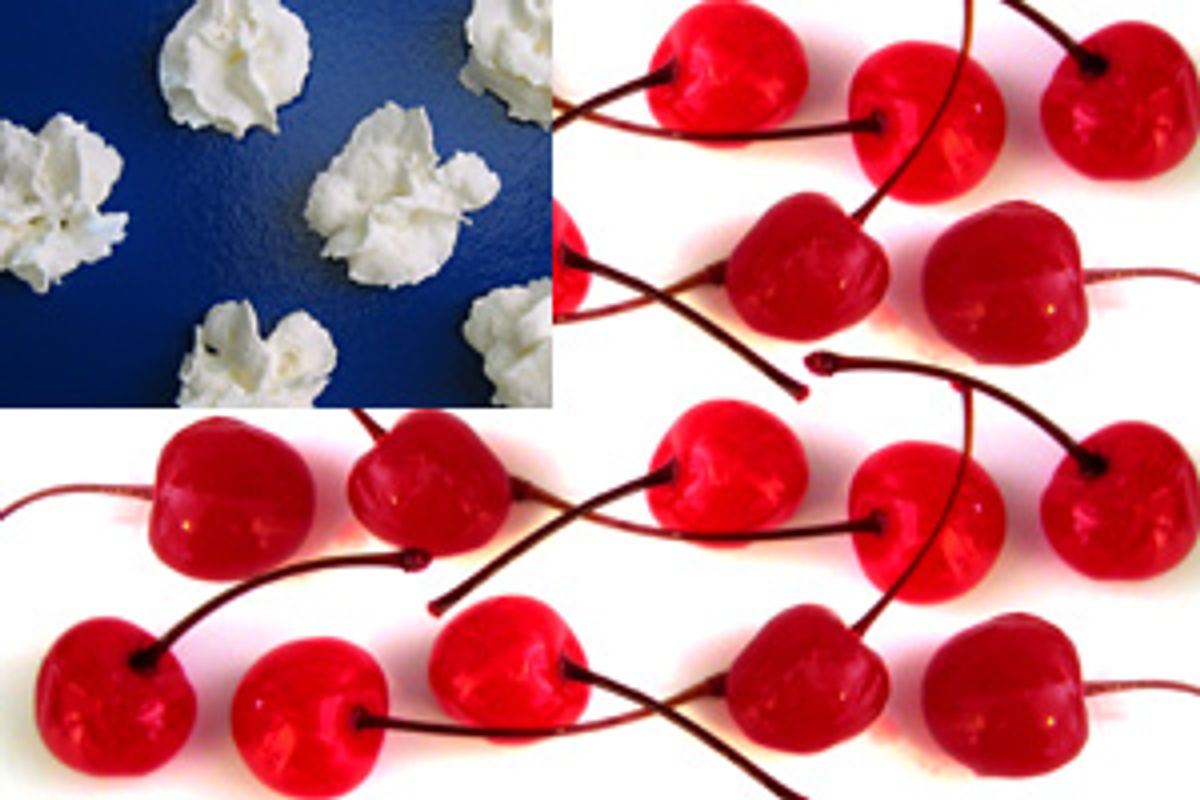
Of course, most media images depict the maraschino as sexy and long-stemmed, like a starlet. But there is a less glamorous, working-man’s maraschino: the stemless cherry found in baked goods and pre-packed ice creams like Cherry Garcia. Like America itself, the maraschino market is not class-blind. Then, of course, there is the custom market. Orange, yellow and pink maraschinos have all been produced for niche consumers. And a few years back, the Omni Hotel Group commissioned a cherry of red, white and blue.

When I heard about this patriotic maraschino, I called my father, the left-wing health nut, and asked him if he’d reconsider his position. Could he find it in his heart to accept the maraschino as something close to wholesome, as something innocent and American in the eat-your-apple-pie and respect-your-mother sense? After a moment’s silence, he announced that he couldn’t, that a flag-waving fruit with artificial colorants was, to his mind, like a “Support the Troops” sticker on an SUV: troubling if you thought about it too much.

Like a lot of old Cold Warriors, he still sees a red menace. But I’m a grown man now, comfortable to claim my own worldview. A few Saturdays ago, I brought my daughter to our local ice cream parlor for a two-person assault on a banana split. We sat across from each other in a vinyl booth, faced with three scoops of vanilla, an avalanche of hot fudge and a mound of whipped cream with a you-know-what on top. The neon maraschino winked up at me, glowing like the lights of the Vegas strip. A red-blooded American, an immigrant adapted, artificial dye tainting its natural roots, its flavor as real as reality TV.

I watched my daughter, a girl just beyond toddlerhood, spoon poised patiently above her sundae, eyeing the cherry with interest and intent. I thought of the hazards that loomed on her horizon — global warming, nuclear apocalypse, teenage boys. I smiled and nodded. A single maraschino didn’t seem so scary after all.

Josh Sens is a freelance writer based in Oakland, and the restaurant critic for San Francisco magazine.

The making of the term ‘pink slime’

A simple nickname that forever changed an entire industry

  • more
    • All Share Services

The making of the term 'pink slime'FILE - In this March 29, 2012 file photo, the beef product known as lean finely textured beef, or "pink slime," is displayed during a plant tour of Beef Products Inc. in South Sioux City, Neb., where the product is made. Gerald Zirnstein, the microbiologist who coined the term "pink slime," says it came to him in the spur of the moment as he was composing an email to a coworker at the U.S. Department of Agriculture a decade ago. Although it's been used as a filler for decades, the product became the center of controversy only after Zirnstein's vivid moniker for it was quoted in a 2009 New York Times article on the safety of meat processing methods. (AP Photo/Nati Harnik, File)(Credit: AP)

NEW YORK (AP) — “Pink slime” was almost “pink paste” or “pink goo.”

The microbiologist who coined the term for lean finely textured beef ran through a few iterations in his head before pressing send on an email to a co-worker at the U.S. Department of Agriculture a decade ago. Then, the name hit him like heartburn after a juicy burger.

“It’s pink. It’s pasty. And it’s slimy looking. So I called it pink slime,” said Gerald Zirnstein, the former meat inspector at the USDA. “It resonates, doesn’t it?”

The pithy description fueled an uproar that resulted in the main company behind the filler, Beef Products Inc., closing three meat plants this month. The controversy over the filler, which is made of fatty bits of beef that are heated and treated with ammonium to kill bacteria, shows how a simple nickname can forever change an entire industry.

In fact, beef filler had been used for decades before the nickname came about. But most Americans didn’t know — or care — about it before Zirnstein’s vivid moniker was quoted in a 2009 article by The New York Times on the safety of meat processing methods.

Soon afterward, celebrity chef Jamie Oliver began railing against it. McDonald’s and other fast food companies later discontinued their use of it. And major supermarket chains including Kroger and Stop & Shop vowed to stop selling beef with the low-cost filler.

Bettina Siegel, a food blogger who posted an online petition asking the USDA to stop using the filler in school lunches, said the controversy isn’t based on the term alone. She said consumers are just upset that the filler is not what they think they’re getting when they buy “100 percent ground beef.”

But Siegel acknowledges that the name doesn’t hurt her cause, either. She said the term “filled a vacuum” in the public arena about the filler; her petition, “Tell the USDA to STOP Using Pink Slime in School Food” had more than 200,000 signatures within a week.

Beef Products, which makes the filler, blames its plant closings on what it calls unfounded attacks. About 650 jobs will be lost when plants in Amarillo, Texas, Garden City, Kansas, and Waterloo, Iowa close on Friday. Another plant in South Sioux City, Neb., will remain open but run at reduced capacity.

Still, the company, based in South Dakota, said it’s not considering changing the filler’s name. Instead, Beef Products set up a website, beefisbeef.com, to combat what it calls “media-perpetuated myths” about the filler.

Meanwhile, the author of the term “pink slime” makes no apologies about his creation. Zirnstein, who has since left the USDA, said he thinks “pink slime” is a better descriptor than “lean finely textured beef.”

“It says it’s lean. Great. But it doesn’t describe what kind of lean it is,” said Zirnstein, who doesn’t think the product should be mixed into beef. “Textured. What does that mean?”


Continue Reading Close

Did slaves catch your seafood?

Thailand, a major source of fish imported to the US, depends on forced labor for its product

  • more
    • All Share Services

Did slaves catch your seafood? (Credit: Alena Brozova via Shutterstock)
This article originally appeared on GlobalPost.

PREY VENG, Cambodia, and SAMUT SAKHON, Thailand — In the sun-baked flatlands of Cambodia, where dust stings the eyes and chokes the pores, there is a tiny clapboard house on cement stilts. It is home to three generations of runaway slaves.

Global PostThe man of the house, Sokha, recently returned after nearly two years in captivity. His home is just as he left it: barren with a few dirty pillows passing for furniture. Slivers of daylight glow through cracks in the walls. The family’s most valuable possession, a sow, waddles and snorts beneath the elevated floorboards.

Before his December escape, Sokha (a pseudonym) was the property of a deep-sea trawler captain. The 39-year-old Cambodian, his teenage son and two young nephews were purchased for roughly $650, he said, each through brokers promising under-the-table jobs in a fish cannery.

There was no cannery. They were instead smuggled to a pier in neighboring Thailand, where they were shoved aboard a wooden vessel that motored into a lawless sea. His uncle had fallen for the same scam five years prior and escaped to warn the others. But Sokha told his son, then just 16, that this venture would turn out differently. He was wrong.

“We worked constantly, for no pay, through seasickness and vomiting, sometimes for two or three days straight,” he said. “We obeyed the captain’s every word.”

Near-daily death threats reinforced the captain’s supremacy. So did his Vietnam War-era K-54 pistol, and the night he carved up another slave’s face in view of the crew. “For 20 hours a day, we were forced to catch and sort sea creatures: mackerel, crabs, squid.” It’s back-breaking work, under the searing tropical sun. “But the fish wasn’t for us,” he added.

So who was it all for?

The answer should unsettle anyone who closely examines Thailand’s multi-billion dollar wild-caught seafood industry and the darkest links in its supply chain.

“It’s an export-oriented market. And we know the countries where these products are exported to,” said Lisa Rende Taylor, chief technical specialist with the United Nations Inter-Agency Project on Human Trafficking or UNIAP. “Do the math.”

For Americans, the calculation is worrisome. Thailand is the United States’ second-largest supplier of foreign seafood. Of America’s total seafood imports, one out of every six pounds comes from the Southeast Asian nation.

In 2011 alone, Thailand exported 827 million pounds of seafood worth more than $2.5 billion to the US, according to National Marine Fisheries Service figures. The only nation that consumes more Thai seafood exports is Japan.

Murder is an occupational hazard. But a monotonous job assembling iPads is heaven compared to slavery on a Thai trawler, where conditions are as grueling and violent as any 19th-century American plantation. The lucky escape within a year or so. Less fortunate are those traded several times over for years on end.

Denying that the fruits of forced labor reach the biggest importers of Thai seafood — Japan, America, China and the European Union — has become increasingly implausible.

The accounts of ex-slaves, Thai fishing syndicates, officials, exporters and anti-trafficking case workers, gathered by GlobalPost in a three-month investigation, illuminate an opaque offshore supply chain enmeshed in slavery.

A long trail of offshore operators — slave boats, motherships and independent fishmongers — can obfuscate the origins of slave-caught seafood before it ever reaches the shore. While the industry’s biggest earners rely on clannish and violence-prone fishing crews for raw material, they’re distanced from the worst abuses by hundreds of nautical miles and several degrees of middlemen.

The result is that many Thai factory bosses have no idea who caught the seafood they process for foreign consumers.

There are caveats. The majority of Thailand’s two largest seafood exports to the US — tuna and shrimp — are sourced differently. Most “Thai” tuna is actually imported from overseas and processed for re-export. The shrimp industry, though routinely accused of abusing poor migrants, is at least vulnerable to spot checks on seaside farms.

The same cannot be said for deep-sea trawlers, the favored vessel of slave-driving captains.

The species caught by Thai trawlers legal and illicit alike include sardines, mackerel, cuttlefish, squid, anchovies and “trash fish,” tiny or foul-tasting catch ground into animal food or preserved to create fish sauce. Americans consume these breeds en masse. One in five pounds of America’s imported mackerel or sardines comes from Thailand, according to US government records. For processed fish balls, puddings or cakes — made from trawlers’ trash fish — the figure is one in three pounds. Thai fish sauce supplies nearly 80 percent of the American market.

All that trawler catch ends up in familiar American fare: anchovy pizzas, squid linguine, smoked mackerel salads and fish fillets on ice. Even pets are entangled: trash fish is a common dog- and cat-food ingredient. But industry representatives in Thailand admit there’s often no way to tell whether a particular package of deep-sea fish was caught using forced labor.

Using bar codes, American shoppers can track packaged Thai-exported seafood to its onshore processing facility, said Arthon Piboonthanapatana, secretary general of the Thai Frozen Foods Association. “You can trace it back to the factories.”

But exporters, he said, are not in the business of policing the fishing syndicates that supply their factories. “We only have the power to enforce our members,” Arthon said. “We have no power to enforce other stakeholders such as boats or fishermen.”

American seafood importers consider themselves similarly powerless in overseeing far-flung Thai boats. “Western regulatory agencies have little or no reach, or authority, over various parts of the value chain,” said Gavin Gibbons, spokesman for the National Fisheries Institute, America’s chief seafood trade organization and lobbying group based outside Washington, DC. The institute will promptly respond to allegations against specific factories, he said. But so far, it has not found an effective way to monitor conditions on deep-sea boats catching US-bound fish.

“We have started discussions with our members about just how far an audit could realistically go and whether, perhaps, there are dockside audits that could be developed,” Gibbons said.

The “nature of boats being at sea,” he said, presents a major challenge to industry’s self-policing efforts.

International pressure to rid Thailand’s seafood trade of slavery is mounting. Thailand teeters just above the US State Department’s worst human-trafficking ranking and could be downgraded this summer. Last year, during a visit that vexed Bangkok officials, a UN rapporteur declared that forced labor is “notoriously common” in Thailand’s fishing sector and even alleged police complicity.

“It’s not like monitoring brothels, plantations or factories … all this labor is at sea,” Rende Taylor said. “So it’s essentially a universe where captains are king. Some are out to make as much money as possible by working these guys around the clock and being as cruel as they want to be.”

Continue Reading Close

Horrors we hide

From slaughterhouses to sweatshops, modern society is constructed to let us ignore atrocities

  • more
    • All Share Services

Horrors we hideWorkers at a Seagate Wuxi factory in China (Credit: Robert Scoble / CC BY 2.0)

Would Americans eat less meat, and would animals be treated more humanely, if slaughterhouses were made with glass walls and we all could see the monstrous killing apparatus at work? This is the query at the heart of Timothy Pachirat’s new book, “Every Twelve Seconds” — the title a reference to the typical slaughterhouse’s cattle-killing rate.

Before you think this is a column merely about food, recognize that Pachirat’s question isn’t (only) about the immorality of the cheeseburger you had for lunch. It’s about the larger phenomenon whereby modern society has reconstructed itself to hide so many horrific consequences from view.

Calling this the “politics of sight,” Pachirat’s blood-soaked experience inside a slaughterhouse spotlights only the most illustrative example of how we’ve divorced ourselves from the means of producing violence — and how, in doing so, we have made it psychologically easier to support such brutality. Sadly, billions of factory-farmed animals dying barbaric deaths are just one subset of casualties in that larger process.

Today, for example, free trade policies that promote offshoring allow Americans to enjoy consumer goods at ultra-low prices without having to see that those low prices represent companies taking advantage of the developing world’s poverty wages, environmental destruction and human rights abuses. A veritable slave may have assembled the iPad you are reading these words on, but thanks to the supply chain’s geography and Apple’s lack of transparency, you can easily avoid dealing with the ethical implications of that reality.

Another example: Many Americans drive gas-guzzling SUVs, proudly slapping patriotic declarations on their bumpers. This seems perfectly reasonable, but only because many either don’t live near polluted oil-drilling sites or don’t have to personally experience the ramifications of our petroleum-focused military policies. Ultimately, by separating the consequences of gas consumption from the driver, we’ve created the psychological conditions for fossil fuel consumption to seem like an honorable statement of strength rather than an endorsement of environmental degradation and war.

Speaking of war, the politics of sight sculpt our martial policies. We ended conscription, separating most of our fellow citizens from the consequences of military action; we conduct combat via unmanned aerial vehicles that remove the pilot-shooters from the populations being bombed; and both the military establishment and the media themselves suppress photographs of coffins or battlefield viscera that might show us what war really looks like.

Some of this, of course, is an inadvertent byproduct of larger trends like globalization that stretch supply chains across the planet. Some of it comes from a culture narcissism that teaches us to consider only on our immediate surroundings and nothing else. Much of it, though, is a deliberate effort to hide the truth. From the Pentagon’s photo policy to agribusiness now championing so-called ag gag laws to punish activists who expose factory farm atrocities, vested interests are exploiting the fact that “out of sight, out of mind” is a default setting in the human mind.

For his part, Pachirat ends his brave journey unconvinced that, unto itself, removing the veil will be enough to make us a more thoughtful — if not moral — society. He’s almost certainly correct. The atrocities that power modern life are now integral to what we define as the norm. And whether that norm is eating meat, driving massive cars or flippantly waging war, changing the status quo warrants more than just knowledge — it requires the will to change once knowledge is available.

Fortunately, history proves Americans can summon that will. However, without knowledge — without an end to the moment’s deceptive politics of sight — the most important changes can never happen.

Continue Reading Close
David Sirota

David Sirota is a best-selling author of the new book "Back to Our Future: How the 1980s Explain the World We Live In Now." He hosts the morning show on AM760 in Colorado. E-mail him at ds@davidsirota.com, follow him on Twitter @davidsirota or visit his website at www.davidsirota.com.

Lessons of a reluctant hunter

A transplant to Oregon teaches me about growing up in rural Mexico, killing iguanas and grilling chicken

  • more
    • All Share Services

Lessons of a reluctant hunterJazmin Rudin with her mother, Esperanza

Jazmin is 27 years old and beautiful. She has the fierce, dark beauty of a Mexican Indian, but she’s tall, and when you see her move, you think Masai warrior or maybe ninja. And it’s true: She does have ninja skills. When I first met Jazmin, she’d just killed a pheasant. She was sitting on the deck talking with a friend when she spotted the bird at the edge of the yard, 20 feet away. She casually picked up a two-by-four and hurled it. The missile hit the pheasant in the head, a neat kill. Jazmin walked over and picked it up. “Dinner,” she said.

She says she doesn’t particularly like killing animals, but she does kill from time to time, if she has good reason. A deer invaded her garden and she killed it with a machete, and she sometimes nets fish in the surf near her home on the coast of Guerrero, Mexico. It’s a skill born from practice and necessity: She grew up rural and poor. Her father abandoned her family when she was 8, and her mother, Esperanza, had to find a way to support seven children. “We ate a lot of natural things,” she says. “Things from the forest.  My brother used to kill iguanas. I’ve got a good iguana recipe if you want it. It’s the best meat as far as I’m concerned. There are two types of iguana: green and black. The black is good to eat. The green is too beautiful to kill. Last winter I found a big black one in my house! Can you believe it? The way you kill them is you step lightly on their heads and then pull on the tail.”

Humans worship athleticism, talent and perfection. We have a fascination with the tiny fraction of people who stand on the other side of the line that separates life from art: the grand master, the prima ballerina. We are drawn to people who embody something of the divine; the ones who, through their grace and inspiration, remind us that to be alive is majestic. Often these heroes in our spotlight are athletes. Sometimes they are leaders — warriors, politicians or rebels. Sometimes they are great chefs or composers or guitarists. But outside the spotlight and the enchantment of our collective worship, there are other artists, who turn mundane actions into magic, who approach humble tasks with perfect artistry. The masters of skills born of necessity and perfected to fulfill a pride that is autonomous from credit or accolades, a pride based on the perfection of the action itself, the economy of movement, the swiftness of results.

Jazmin Rudin is one such person. She possesses the grace and determination to execute any task at hand with astonishing efficiency. For example, she hunts shrimp in the river with a homemade metal spear. ”You take a long sharp piece of metal, filed at the end. It has to be really sharp. You attach that to a piece of surgical tubing so it snaps back to you when you throw it,” she says. She mimes aiming a spear, and remarks that on a good day she can spear two kilos of shrimp this way. I express disbelief. She shrugs.

“It’s a cultural thing. If you learn when you’re really little it’s easy enough. You have to learn because the shrimp are not going to come to your house and knock on your door.” She explains her technique: “The shrimp are under the rocks. You go underwater, and lift each rock. Don’t lift it all the way. You need to lift gently so they don’t see you.” She’s a demonstrative teacher. She talks slowly, and pauses to make eye contact. She’s checking to make sure I understand her. To help me get it, she uses hand motions. “They also like to hide in the roots of the trees that grow into the river; they hang out in there, caved up. Before you go for it, you have to check out all the potential exits they might have.” She mimes looking around and adds, “Sometimes you have to grab them with your hand, which can be prickly. But I say no! You’re for me. I don’t care if you bite me, you’re not escaping me!” She laughs. “But really, it’s all about taking aim. Just like hunting with a gun. When everything is correct you’ve got your shrimp.”

But hunting isn’t Jazmin’s only talent. The lectures on killing iguanas and spearing shrimp are just digressions: I’m here in her Oregon kitchen for a lesson in grilling chicken, estilo Mexicana. She learned this recipe for pollo asado from her mother, who raises chickens. Her mother learned it from her grandmother. Both women have lived their entire lives in the same small Guerrero village. Jazmin describes her grandmother as “muy antiquada,” or very antiquated. “She has Indian ways, folk ways,” Jazmin says. “There’s something a little witchy about her.”

Jazmin starts by butterflying a chicken thigh with a deft stroke of her knife. When I admire her technique she says, “My mother always says: ‘I know how to cook chicken, but you are the chicken maestro.’” There’s too much delight and humor in Jazmin’s countenance for this revelation to sound boastful. Besides, as I watch her demonstration, I realize she’s just stating a truth. “Take the leg,” she says. “Find the thickest part and slice it open, like so. Don’t cut it all the way through. Leave a layer of flesh so that you can fold the meat back. When you fold it open, the bones and meat are on one side, and there’s pure meat on the other side. You want to cut it so both sides are of equal thickness.” She slams the chicken leg flat on her cutting board. “Chickens prepared this way absorb more sauce,” she says and gives me a challenging look. I’m not about to argue with someone who can kill living shrimp with a handmade spear.

After salting the butterflied chicken legs and breasts, she sets the meat aside in a bowl and works on the sauce. “You’ll want to put seven dried chiles guajillos to soak in a bowl of water,” she says, helpfully adding, “It’s important to soak the chiles first, because it helps the chile to retain the red color.” She assembles her spices: powdered oregano, cumin seed, ground cloves and whole peppercorns, which she’ll grind in a stone mortar and pestle, or molcajete. The basalt bowl stands on its own three legs; the grinding stone is the size and texture of an avocado. “In Mexico everyone has the rock,” she says, laughing. “But if you don’t have a molcajete, use the blender. It’s not quite the same, but it works.” To make the sauce, she places two cloves of garlic and strips of wet chile in the molcajete, and then deftly adds spices and water a little at a time. The finished result is a uniform liquid, which she ladles over the chicken.

While the chicken marinates and the grill heats, we talk. Jazmin’s pueblo on the coast of Guerrero sounds a lot like the village in coastal Jalisco where I spent part of my childhood. It’s a rural culture, rooted in farming and fishing and family. Jazmin has always felt different from the other girls in town; she’s never cared for makeup or clothes. “I’m old-fashioned like my grandmother,” she admits. But although her values may be old-fashioned, she’s not exactly a textbook campesina: Her great joy in life is surfing, she raves about Hank Williams III, and she’s taught her dog, Rambo, to ride on the front of her four-wheeler. She married Mark, an older guy from Oregon, when she was 19, so that could help explain her cultural idiosyncrasies. But as I watch Jazmin laugh uproariously at a silly joke, it strikes me that even without the foreign influence, she would have been an oddball. She’s one of those rare individuals who always cleaves true to some inner compass.

“The secret to barbecuing chicken is to make sure the flame isn’t too hot,” she says, holding her hand over the gas grill, which she views with some contempt. We’re standing on a back porch in Bend, Ore., and Jazmin has been waxing poetic about the superiority of Mexican chickens. “In Mexico, we get a chicken that’s been killed that day. And it’s double good when you grill it over real coals; these gas grills have nothing on real charcoal.” She slaps a chicken thigh on the grill. “Keep turning the chicken over and over again,” she instructs. “It’s a totally different style. Not as juicy maybe, but more flavorful.” She’s right; when we pull the chicken off the grill a scant 20 minutes later, the meat has a satisfying, chewy texture and the flavor sings, savory and complex. Jazmin gives me a look, as though to say, “I told you so.”

“What do you call this recipe?” I ask.

“It’s called pollo asado,” she says, grinning. Grilled chicken. The answer is pure Jazmin: no nonsense and uttered with the easy confidence of a maestro. Like any great artist, she knows to let her work speak for itself.

Ingredients

  • 1 chicken, cut into pieces
  • Salt
  • Soy sauce (optional)
  • 7 dried red chiles guajillos
  • 1 teaspoon of ground cloves
  • 1-2 cloves of garlic
  • 1 teaspoon of cumin seed
  • 1 teaspoon of whole peppercorns
  • 1 teaspoon of powdered oregano

Directions

  1. Butterfly chicken.
  2. Splash chicken with soy sauce and sprinkle with salt.
  3. Rinse chiles and put them in a bowl. Fill the bowl with water until the chiles are covered. Let soak for 10 minutes. Reserve water.
  4. When the chiles are the consistency of wet satin, grind or blend them with the garlic and spices.
  5. Add the water left over from soaking the chiles to the spice/chile mixture.
  6. Pour liquid over raw chicken and leave to marinate for an hour.
  7. Heat your grill.
  8. When chicken is marinated and grill is hot, throw your chicken on the grill.
  9. Turn the chicken every minute or two until it’s done.
Continue Reading Close

Felisa Rogers studied history and nonfiction writing at the Evergreen State College and went on to teach writing to kids for five years. She lives in Oregon’s coast range, where she works as a freelance writer and editor.

Pink slime monster runs amok

The beef product processing industry is in a world of pain. Another scalp for social media?

  • more
    • All Share Services

Pink slime monster runs amokThe beef ingredient dubbed “pink slime.” (Credit: AP/Beef Products, Inc.)

The battle over “pink slime” is getting messier. Blaming an “unfounded public outcry over the use of boneless lean beef trimmings” in the nation’s commercially sold ground beef supply, meat processor AFA Foods Inc. filed for Chapter 11 bankruptcy protection on Monday. Beef Products Inc. — the South Dakota-based meat titan that invented the pink slime manufacturing process — is also reeling, idling plants in multiple states. In response, Iowa Gov. Terry Branstad, a politician who hails from a state where there is a whole lot of boneless beef extrusion going on, called for a congressional investigation into the causes of the public uproar.

“We have a smear campaign going on against a product that is healthy and safe,” Branstad said. “If they get by with this, what other food products are they going to attack next?”

Score another scalp for social media. Because when Terry Branstad inveighs against “they,” that’s exactly who he’s talking about: the easily outraged masses of Twitter and Facebook. We’ve known about “pink slime” for years. Food Inc. took us into a Beef Products Inc. factory and showed us the repulsive stuff back in 2008. The New York Times referenced the name (coined by a USDA researcher as far back as 2002) and devastatingly punctured the safety claims in a breakthrough piece of reporting in 2009. Celebrity chef Jamie Oliver blasted it on his reality TV show a full year ago.

But only in the last few weeks has pink slime captured the national consumer consciousness, and in doing so provided us with just the latest example of how quickly social media grass fires can become conflagrations with real dollar-and-cents consequences. On March 5, the Daily reported that the USDA was holding firm to its plans to buy 7 million pounds of pink slime for its national school lunch program. The very next day Bettina Siegel, a blogger who writes extensively about food and kids, created a petition on Change.org titled “Tell USDA to Stop Using Pink Slime in School Food.” Within a week the petition had over 200,000 signatories and an Internet frenzy had been born.

Fox News columnist Dan Gainor would have us believe that the real villain here is ABC News, which jumped on the anti-pink slime bandwagon with particular passion, but make no mistake, “pink slime” is a semantic framing that was born for the Twitter era. When you have only 140 characters to spread the news, “pink slime” packs all the wallop you need. The process itself, in which fatty trimmings left over at the slaughterhouse are heated, disintegrated via centrifuge, and then dosed with ammonia, is easy to express in a simple Facebook illustration. We saw it with Susan G. Komen for the Cure and we saw it with SOPA — when the social media masses get a bee in their bonnet, they can’t be stopped.

Certainly, the beef industry knows whom it is blaming.

From the Kansas City Star:

The outrage over pink slime registered the sort of quick and virulent response that seems to characterize a new media age. Janet Riley, spokeswoman for the industry group the American Meat Institute, said she’d never seen anything like it — not with E.coli outbreaks, passing worries about so-called mad cow disease or sundry health studies.

“It’s been a social phenomenon,” she said. “Twitter just made it crazy.”

The beef processing industry is trying to fight back, with websites – Beef Is Beef, Pink Slime Is a Myth – and even a catchy slogan, “Dude, it’s beef.” Pink slime contrarians are also eager to point out that if we want low prices for our burgers and “efficient” use of our beef resources, we should learn to embrace pink slime. But I suspect that the defenders of “lean, finely textured beef” are unlikely to see a social media wave of support break in their favor.

I may be the wrong person to make this argument, as I am a Berkeley, Calif., resident who feeds his children hamburgers made from grass-fed cows raised in Marin. But the questions of whether “pink slime” is safe or efficient or guarantees us low-cost patties are all beside the point. It is impossible to look at the beef trimmings being transformed into pink goo in “Food Inc.” without being revolted. And when American consumers are revolted, they don’t reach for their wallets. Gov. Rick Perry can warn all he wants about how “social media rumors” and “hysteria” threaten to destroy any industry. Maybe that’s even true. But it’s not social media’s fault that pink slime is getting a bad rap. It’s the inherent disgustingness of the process that deserves the blame. When you see it, or think hard about the process that creates it, you just don’t want to eat it.

What’s amazing about the current social media revolution is that it is bringing to pass something that food activists have been dreaming about for decades: If only consumers were more informed about the nature of the industrial food system, they would change their behavior. Well, guess what, with a little help from grass-roots viral marketing, the activists turn out to have been right.

Continue Reading Close
Andrew Leonard

Andrew Leonard is a staff writer at Salon. On Twitter, @koxinga21.

Page 1 of 238 in Food