2006 Elections

How would Jesus vote?

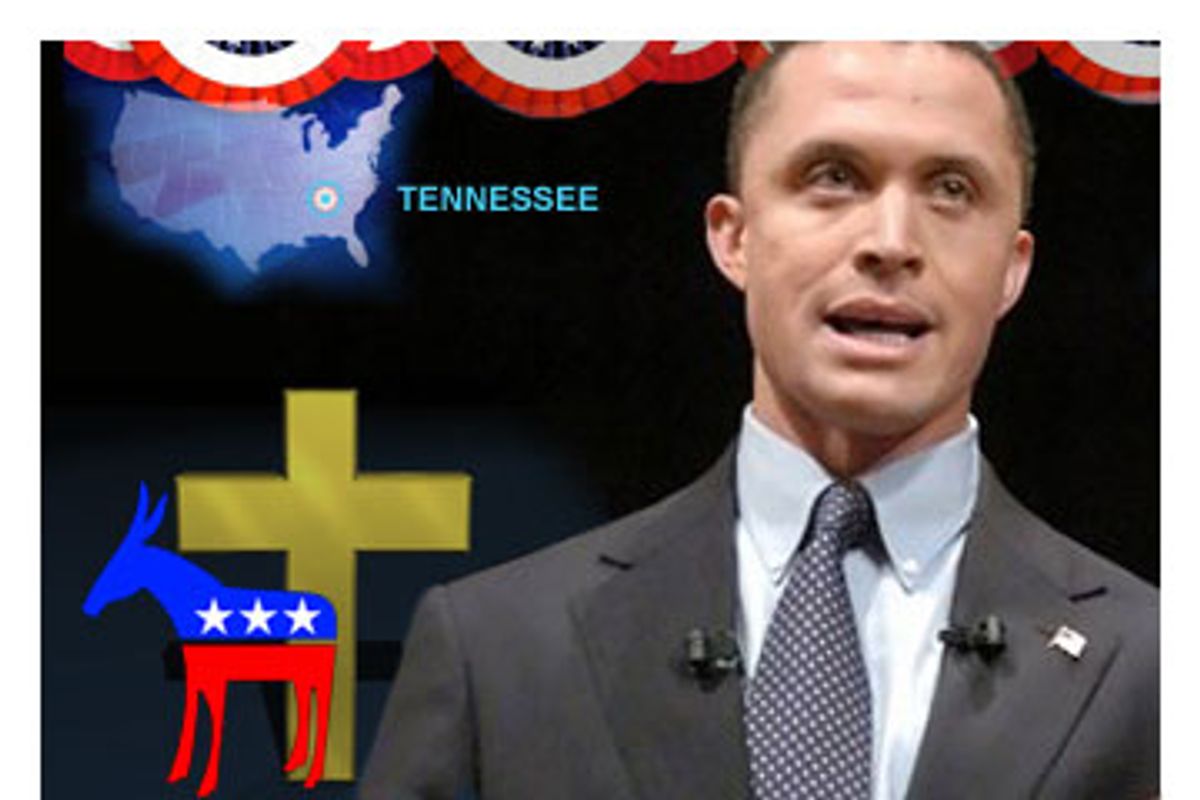
Tennessee Democrat Harold Ford Jr. goes after the GOP's faithful base in the state with the most white evangelicals in the nation. Polls show his campaign is resonating in the pews.

Pastor Chris Stephens runs his church services like a rock show. Colored strobes dance across the stage, electric guitar solos punctuate the hymns, and his sermons are filled with exhortations like, “We need a God explosion.” The roughly 2,000 worshipers who belong to Faith Promise Church know to expect a blunt-talking believer when they come to Sunday services, a man unafraid to take a stand for Jesus.

So it was no surprise two years ago when Stephens devoted a sermon before the presidential election to a discussion of God’s hopes for the ballot box. “If you are a Democrat or a Republican before you are a Christ-ocrat, you are an idol worshiper,” he told his congregation. As he explained it, God cared most about just a few core issues in 2004: ending abortion, opposing gay marriage, appointing conservative judges and ensuring the freedom to pray in the public square. Christian voters, he told his congregation, ignore these issues at their own peril. “If you reject Christ, if you have never been born again, you are not going to heaven,” he said at the end of the sermon.

Pastor Stephens’ message did not endorse any candidate or party, but it clearly pushed a platform more closely associated with Republicans than with Democrats. And versions of that message were repeated at born-again churches across the Bible Belt state of Tennessee, along with Sunday morning voter registration pleas. The effect was spectacular. Among the 51 percent of registered voters who identified as white evangelical Christians in exit polls, the highest percentage of any state in the nation, President Bush won by a margin of 3-to-1, allowing him to carry Tennessee by 14 points.

But visit Stephens this year, and he will freely admit that many of Tennessee’s evangelical voters are more ambivalent about voting for Republicans in this election. The biggest reason, he believes, is the deteriorating situation in Iraq. “So many people are angry at the president,” he said last Sunday, after inviting this reporter into his office after services. Polls nationwide have shown that evangelical support for Republicans is slipping. But in Tennessee a second big reason is the public message of Rep. Harold Ford Jr., the Democratic candidate for Senate, who hopes to become the first black senator from the South since Reconstruction by appealing to religious voters. “The church advertising has been brilliant,” Stephens said. “He presents himself very well.”

Stephens was referring to a 30-second television spot that shows Ford strolling through the pews of his childhood church. “Here, I learned the difference between right and wrong,” Ford tells the camera, explaining that he is glad his family forced him to worship as a child. “If advertising didn’t work, Madison Avenue wouldn’t be spending billions of dollars,” Stephens said of the ad. “And those folks sitting there listening to Harold Ford sit in the pew and talk about his grandmother taking him to church and all that, I think it can be effective for him.”

The church spot is just one part of a campaign by Ford to make his faith a central issue in the campaign, breaking with recent Democratic tradition in the hopes of helping to tip the balance of power in the Senate. On the campaign trail, Ford portrays himself as a moderate, saying he opposes the politics of House Minority Leader Nancy Pelosi, endorses the House Republican immigration plan, and supports a state ban on gay marriage. To prove his point, Ford’s get-out-the-vote rallies often double as prayer meetings. During a recent debate with his Republican opponent, former Chattanooga Mayor Bob Corker, Ford repeatedly asked state residents to give him their prayers along with their votes. On his Web site, under the banner “My Faith Is My Guide,” Ford writes that he is running for Senate “to put my faith and beliefs into action.”

There are signs that Ford’s decision to wear his religion on his sleeve is having an effect. At the end of September, a statewide poll showed that just 47 percent of white evangelicals supported Bob Corker, Ford’s Republican opponent, while 28 percent supported Ford and 25 percent were undecided. The poll results broke a long-standing maxim of state politics: Churchgoing whites reflexively side with the Republicans by overwhelming margins. “In the Senate race that pattern is completely gone,” said Ken Blake, who oversaw the poll for Middle Tennessee State University. According to Blake, Ford’s use of faith has “muddied the waters” for white evangelicals. “It makes them not quite so sure that he is the bad guy and Corker is the good guy.” Among all of the state’s likely voters, numerous recent polls show that the race remains a statistical dead heat.

Outside the University of Tennessee football game on Saturday, Ford had no problem explaining the inroads he appears to be making among evangelical voters compared to 2004, when he worked on the campaign of Democratic presidential nominee John Kerry, who lost the state by double digits. “Kerry and I are very different people,” Ford said, as he hurried toward the gates of Neyland Stadium, having arrived at the game against the University of Alabama deep into the second quarter. “I serve a big God, he gives me strength every day, and I go to work. I am not that smart. I don’t try to outsmart him. I just go to work every day.”

Just hours earlier, Ford’s opponent, Corker, had taken direct aim at those bona fides as he worked the crowd of thousands who had gathered in orange T-shirts and parkas to tailgate the game. In the mountainous eastern end of Tennessee, football games at Neyland Stadium have an importance that rivals Sunday church, and come with just as many unique rituals. Grown men dressed in incandescent orange will wait for hours in the hopes of bumping chests with University of Tennessee players as they make their way into the stadium, which has enough seats for 104,000 spectators, or about 60 percent of Knoxville’s population. For statewide political candidates, it is not an occasion that can be missed. Both Corker and Ford camps came equipped with signs and stickers. Ford’s supporters gave out free chili. Corker’s offered bottles of water and candy.

“I am more fully representative of Tennessean values,” Corker claimed, as he made his way through the orange-clad masses, with Fred Thompson, the former Tennessee senator and television actor. “I mean, we are so different on those issues. I mean, it is like worlds apart.” A short man with a frenetic need to shake hands, Corker came to politics after making millions in construction and real estate, and has earned the support of many in the business elite and the state party establishment. But along the way he has struggled to shore up the support of the Republican evangelical base, having burned many bridges over his past support for abortion. He is uniquely vulnerable to Ford’s attempts to peel off religious voters. “You come across folks who are disenchanted, who feel like they have lost their voice because their candidate wasn’t elected,” explained Jennifer Little, the first vice chairman of the Hamblen County Republican Party, who is working for Corker’s victory. She was referring to the bad blood that remains from Corker’s hotly contested Republican primary, in which he beat out two other candidates with superior credentials among the pro-life community, Ed Bryant and Van Hilleary.

In fact, there are clear signs of strife within the state’s evangelical base. Tennessee Right to Life, the state’s largest pro-life lobby, has declined to endorse Corker because in 1994 he refused to say life begins at conception and in 1995 he opposed a state budget amendment that would have limited state funding for abortions. “That energy certainly is not there for Mr. Corker,” said Brian Harris, the organization’s president. “I think there is a broad sense that Republicans have squandered the opportunity.” But Harris does not stop there. When asked if he is concerned about a Democratic Senate possibly blocking pro-life Supreme Court justices, he said there are risks that the state group will take to stand up for its principles. “I think there could be something gained for the pro-life movement, even if the Republicans have to lose a majority in the House or the Senate,” Harris continued. “I think there is going to have to be a lot of work after the election to see if the Reagan coalition can be put back together in Tennessee.”

Corker blames his lag in the polls among churchgoers less on his own record than on pressures from outside the state. “The national climate, no doubt, is affecting a lot of things,” Corker said, as he walked the crowd. “I would be remiss not to acknowledge that.” There is some evidence to back him up. A Newsweek poll last week found that the GOP’s religious base is badly eroding outside of Tennessee as well, amid concerns about Iraq and the recent Republican page scandal. Only 60 percent of white evangelicals said they planned to support Republican candidates, down from 74 percent nationwide who supported Bush in 2004. Other national polls by the Pew Research Center have tracked steep declines in evangelical support for Republicans ever since Hurricane Katrina.

The GOP seems to believe that Ford’s appeal to its most reliable voters is working. In recent days, the Republican National Committee has attempted to reverse the troubling polls in Tennessee with a television ad that both attacks Ford’s religious credentials and invokes that old standby of American politics, racial fear. The ad attempts to tie Ford to pornographers and Playboy playmates based on rather thin circumstantial evidence. The ad also plays on racial prejudices by showing a fictional white woman asking Ford, a bachelor, to call her for a date. The tactic has earned the condemnation of both the NAACP and Corker himself, who claimed he was unable to convince the party to take it down. (An earlier ad by the National Republican Senatorial Committee, called “What Kind,” attacks Ford over a soundtrack of funk music for a number of votes in Congress.)

The RNC has now announced it will no longer air the Playboy spot, but the message has already sunk in. Ford has been forced to admit attending a 2005 Super Bowl party sponsored by Playboy. At Neyland Stadium, as they waited for their candidate to arrive at the Tennessee game, Ford supporters were taunted by apparently inebriated fans in orange who shouted, “Hugh Hefner and Harold Ford,” and “Ford for senator? How about Ford for Playboy?”

For his part, pastor Stephens says he is still skeptical of Ford’s message, even as he admires his style. As a policy, Stephens does not endorse any particular candidate, or turn away those parishioners who support Democrats. But he says he has heard from churchgoers about concerns over Ford’s record on abortion, which includes several votes against banning so-called partial-birth abortion, a position Ford says he has since abandoned. He also worries that even a conservative Democrat would find himself unable to buck his party on crucial issues in such a polarized political climate. “A senator can’t vote his conscience. He’s got to vote party line,” Stephens said. “That’s what is going to hurt Harold Ford Jr.”

But those concerns have not stopped Stephens and others from paying attention to Ford’s religious message. Blake, the Tennessee pollster, points to recent surveys that describe the large value evangelical voters place on politicians who simply speak about their faith. “What evangelicals really want out of a political leader, in addition to policy, is a leader who will be bold about their faith,” he said. In February of 2005, a statewide poll of white evangelicals found that 54 percent believed Bush could increase belief in God around the country, compared to just 37 percent who thought he could end the ban on prayer in public schools or 31 percent who believed he could outlaw abortion.

Even if Ford does not win a majority of Tennessee’s white evangelical vote in two weeks, he will at least have proved that churchgoing voters are willing to look again at Democratic candidates who are proud of their Christian values, a tidal-wave shift from 2004. “Jesus, he doesn’t ride a donkey, nor does he ride an elephant,” Stephens explained, adding that he will probably not devote an entire sermon this year to the election. “He just doesn’t.” For the moment, that may be all Harold Ford Jr. needs to hear.

Michael Scherer is Salon's Washington correspondent. Read his other articles here.

Do we really have to take Michele Bachmann “seriously” now?

With a history of rapid staff turnover and embarrassing past escapades, she's more credible than Cain how?

Possible 2012 presidential hopeful, U.S. Rep. Michelle Bachmann, R-Minn. speaks during a dinner sponsored by Americans for Prosperity, Friday, April 29, 2011 in Manchester , N.H. (AP Photo/Jim Cole)(Credit: Jim Cole)

There is talk, now, that we should all be taking Michele Bachmann a bit more “seriously.” She is, after all, polling better than Tim Pawlenty, whom we are all definitely supposed to take seriously, no matter how difficult he makes that for us. Jon Chait lays out the case for taking Bachmann seriously at the New Republic. It’s hard to argue with the basic point — true conservatives like her and basically hate the rest of the candidates — but I take some issue with this:

But while Bachmann may be even crazier than Palin on questions of public policy, she seems to manage to hold things together as a candidate. She can answer questions from the news media. She is putting together a professional campaign rather than relying on amateur advisors. She takes care to point out frequently that she is a former tax lawyer, and she does not engage in Palin’s visceral anti-intellectualism, giving herself the aura of a plausible president, at least in the minds of Republican voters. Bachmann may well combine Palin’s most powerful traits without her crippling organizational failures.

Sometimes she skillfully answers questions from the press, and sometimes she has meltdowns. She can also do anti-intellectualism with the best of them — she got into politics in part in order to attack educational standards and push “Intelligent Design” — and while she is not quite as organizationally challenged as Palin, she has had her problems.

In fact, Andy Barr just wrote about those issues in February, when Bachmann’s spokesman and district director both left their jobs:

But even without any fireworks, the two exits add to a long a long line of recently departed Bachmann aides, as her office has had an extremely high turnover rate since the Minnesota Republican was first elected to Congress in 2006.

Bachmann has had four chiefs of staff leave since coming to Congress — Rich Dunn, Ron Carey, Michelle Marston and Brooks Kochvar. The Minnesota firebrand also had her campaign finance director Zandra Wolcott leave during the middle of her reelection campaign last year.

I think Barr may have left out one of her chiefs of staff or two? As an unnamed “conservative Republican House member” told Politico when Marston quit for unknown reasons in 2009: “When your captain’s crazy, it’s time to find a new ship.” (Her current chief of staff is taking a “leave of absence” in order to work on her presidential campaign.)

So, how seriously should we be taking Bachmann? Isn’t it more or less appropriate to continue treating her as a very popular sideshow? (And if she ran for real would she really want people dragging out stories like the time she claimed lesbians kidnapped her and trapped her in a bathroom?)

The fact that she has managed to convince 50% of suburban voters in a Republican district to send her to Washington does not actually make her more a more credible candidate than Herman Cain, who has at least run a major industry lobbying organization.

I agree Jennifer Rubin on one thing: The similarities between Bachmann and Sarah Palin are mainly superficial; they’re both attractive ultra-conservative women who routinely say stupid, extreme things on television. I am pretty sure Michele Bachmann is smarter than Sarah Palin. I also think she more sincerely believes the sort of rube-pleasing bullshit Palin cranks out primarily for attention. Bachmann is relentless, while Palin is erratic. Palin actually governed for a while, before giving it up for celebrity. Bachmann has never legislatively done anything, at all. Palin seems driven primarily by resentment, paranoia, and profit, whereas I imagine Bachmann probably thinks she’s doing the Lord’s work. She really would like to impose some sort of libertarian theocracy, where the government has no authority to regulate anything beyond the stoning of abortionists and homosexuals.

So I dunno. She might do OK in Iowa but the wheels would come off that campaign very shortly afterward.

Continue Reading Close
Alex Pareene

Alex Pareene writes about politics for Salon and is the author of "The Rude Guide to Mitt." Email him at apareene@salon.com and follow him on Twitter @pareene

Michele Bachmann thinks the world is ending and the pope is the antichrist

Her friends want to bring about the end times in Israel and her church has an issue with the papacy

Michele Bachmann

Mother Jones writes about Rep. Michele Bachmann’s, R-Minn., connections to Olive Tree Ministries, an evangelical Christian operation founded by a former Jew for Jesus and longtime friend of Bachmann’s named Jan Markell.

Olive Tree Ministries, based out of Maple Grove, Minn., produces a weekly radio show and a newsletter, and it is also obsessed with Israel because it believes we are living in the end times. Bachmann’s been on Markell’s radio show multiple times, attended an Olive Tree Ministries conference, and left a testimonial on its website. As MoJo says:

When Minneapolis’ City Pages first reported [6] on Bachmann’s relationship with Markell in 2005, the then-state senator denied any knowledge of Olive Tree Ministries. However, Markell tells Mother Jones that she’s known Bachmann off and on for 35 years, and says she spoke about Israel at Bachmann’s church in the late 1970s. “My hunch is that they misquoted her,” Markell says. “She’s been at my conference. Why she would have said [otherwise], I don’t know.”

And boy, according to Olive Tree Ministries, we live in very interesting times:

So Bachmann stands with Israel because she needs the Jews to rebuild the Temple in Jerusalem so that Christ can return, rapture the Christians up to Heaven, convince the Jews to worship him during the Tribulations, and then rule over the Earth from Israel for 1,000 years. (This is what these people believe, very, very literally.)

But wait! Before all that happens the antichrist needs to show up and convince everyone he’s the Messiah! But who could that end up being? Some people say Obama, but Bachmann’s church fingered a different suspect.

Before Bachmann was a Tea Party-affiliated Ron Paul fan obsessed with “liberty,” remember, she was a traditional religious right fanatic with a degree from Oral Roberts University, who got into politics through antiabortion activism and who became famous for a school board run during which she and her allies supported teaching creationism in government-funded charter schools. (She is a home-schooling activist, which made a school board run kind of weird, but she was outraged at the idea of state standards forcing her to teach her children about anything other than Austrian economics and eschatology.)

When Bachmann was running for Congress in 2006, her official website bio said she was a member of the Salem Evangelical Lutheran Church of Stillwater, which belongs to the Wisconsin Evangelical Lutheran Synod. WELS is one of the very conservative “confessional” Lutheran denominations that maintains that the “antichrist” is the pope. You know, the leader of the Catholic Church? That pope. WELS confirms that they still “identify this ‘Antichrist’ with the Papacy,” in case you’re curious.

Bachmann has denied that her church believes this, but … it is definitely one of the fundamental doctrines of her church, according to her Synod’s doctrinal statements. I mean, if Bachmann doesn’t believe it, there are some very nice mainline Lutheran denominations to choose from, though they might be a bit squishy on biblical literalism and hatred of homosexuals.

In 2008, as I’m sure you remember, Michele Bachmann repeatedly called Barack Obama “anti-American” because of his “mentor,” the Rev. Jeremiah Wright. And here, via Dumb Bachmann, is Bachmann’s good friend and minister Bradlee Dean calling the pope “that devil disguised as a minister of righteousness.”

It seems more than fair to ask whether Michele Bachmann is anti-Catholic, and whether, should she be elected president, she’d purposefully sabotage a Middle East peace deal in order to bring about the Second Coming. Or whether she’d launch some sort of tactical strike against Vatican City. I think she would. Look who she pals around with!

Continue Reading Close
Alex Pareene

Alex Pareene writes about politics for Salon and is the author of "The Rude Guide to Mitt." Email him at apareene@salon.com and follow him on Twitter @pareene

Five political books that were doomed before they were even published

"Donald Trump on policy" and other ideas that briefly sounded very good

Donald Trump

On May 12, it was reported that Donald Trump was working on a “policy book,” to be released this summer by the right-wing Regnery Publishing. No surprise there: All candidates and would-be candidates for president release either memoirs or policy books, or both. On May 16, less than a week later, Trump announced that he will not be running for president. Whoops! Now that book is pointless, months before the ghostwriter has finished it.

Trump’s is not the first, and will not be the last political book that was rendered ridiculous or blatantly incorrect before or very shortly after its release. It’s not even the only one released this year! Here are some of our favorite sad, wrong books:

“Where’s the Birth Certificate?” by Jerome Corsi, 2011

Oh, there it is! Sorry, Jerome Corsi, but you couldn’t have realized that your entirely pointless search for the “long-form” birth certificate would end nearly a month before your book’s publication.

Corsi has a lot of other arguments against the president’s constitutional eligibility (he’s British!), but there’s no getting around the fact that the title of the book has been rather definitively answered.

“Condi vs. Hillary” by Dick Morris, 2005

Shameless Republican P.R. guru Jim Wilkinson, inventor of the entirely false Jessica Lynch story, went to work for Condoleezza Rice when Rice took over at the State Department. He did his usual effective if slightly heavy-handed image management. The lowlight was probably when he literally slipped a note to Washington Times editorial page editor Tony Blankley asking if Rice planned to run for president, a thought that had not yet occurred to anyone, because Rice had never run for anything.

While the Beltway press entertained the notion, because it was fun to play pretend, only one man wrote a book about how Condi must run for president, because she and only she could beat Hillary Clinton, who was a 100 percent lock to win the Democratic nomination. That man: Dick Morris, who is wrong so often about so many things that it’s hardly worth pointing it out anymore, except for the fact that this book is such an amazing time capsule of a bizarre time in American politics.

Rice never expressed any interest whatsoever in running, making this book irrelevant before it was ever written.

“The Way to Win: Taking the White House in 2008,” by Mark Halperin and John F. Harris, 2006

Just go back and read this fawning tribute to the influence and genius of Matt Drudge that ABC News published to promote this book upon its publication. “The Way to Win” posited that a campaign based around sucking up to Drudge and emulating Karl Rove in every way was the key to victory in 2008. A month after this lengthy tribute to his infallible genius came out, Rove suffered the humiliation of the 2006 midterms.

“The Good Fight: Why Liberals — and Only Liberals — Can Win the War on Terror and Make America Great Again,” by Peter Beinart, 2006

Peter Beinart is the former editor of the New Republic, and under his leadership, that magazine really, really loved war, a lot. (He is also responsible for the New Republic endorsing Joe Lieberman in 2004, which even sometime owner and all-time nutjob Marty Peretz thought was a bit odd.) Beinart went all-in on the Iraq War, and his magazine spent much more time and energy berating antiwar liberals than it did questioning the Bush administration’s claims about Saddam Hussein’s weapons of mass destruction. After John Kerry lost in 2004, Beinart was pretty sure it was the fault of squishy antiwar Democrats, and Michael Moore.

And so he expanded his essay on the subject of how antiwar liberals are as bad as Communists, plus they love terrorism, into a book, about how Democrats must once again embrace complete and total war, everywhere, like they did in the good old days of the Cold War.

Of course, on the way to filling out his Very Important Foreign Policy book, the Iraq War got worse and worse, and the extent of the Bush administration’s malfeasance became clearer and clearer, so Beinart is a bit apologetic about having been dead wrong about the defining foreign policy issue of his time as a serious and respected political thinker. (He is currently a “senior fellow” at the Council on Foreign Relations.)

Being antiwar helped the Democrats generally in the 2006 elections and a candidate who spoke out against Iraq from the very beginning ended up actually winning the presidency in 2008. (Whereupon he began acting a bit Beinartian, so maybe Peter got the last laugh, as the Democrats who take “tough stands” against pinkos usually do.)

Honorable Mention, Finance and Economics division:

“Dow 36,000,” by James K. Glassman and Kevin A. Hassett, 2000.

“The Bush Boom: How a Misunderestimated President Fixed a Broken Economy,” by Jerry Bowyer (foreword by Larry Kudlow), 2003.

Continue Reading Close
Alex Pareene

Alex Pareene writes about politics for Salon and is the author of "The Rude Guide to Mitt." Email him at apareene@salon.com and follow him on Twitter @pareene

When George W. Bush killed bin Laden: An alternate history

Or: An exploration of Dick Cheney's recent daydreams

The White House said on October 29, 2003 that it had helped with the production of a "Mission Accomplished" banner as a backdrop for President George W. Bush's speech onboard the USS Abraham Lincoln to declare combat operations over in Iraq. This file photo shows Bush delivering a speech to crew aboard the aircraft carrier USS Abraham Lincoln, as the carrier steamed toward San Diego, California on May 1, 2003. REUTERS/Larry Downing/FILE KL/GN/GAC(Credit: © Larry Downing / Reuters)

President Bush announces the news to the nation on May 24, 2006, immediately following the East Coast airing of the finale of “American Idol.” He appears in military fatigues and, for some reason, spurs. Behind him, an oversize Osama bin Laden “Wanted” poster, with the word “LIQUIDATED” stamped on the terrorist mastermind’s face. The camera pulls back to reveal that the president’s East Room audience is in fact made up entirely of firefighters. The Marine band plays “Stars and Stripes Forever” as the president speaks, forcing Bush to address the room, and the nation, through a bullhorn.

“America has won the war on terror,” Bush shouts. “Tonight, I am proud to say, Osama bin Laden is in hell.” The president explains that the terrorist mastermind was “taken out” by American forces in Afghanistan, along with the entire senior leadership of al-Qaida. Crowds spontaneously gather in celebration outside the White House, with handmade signs (“THESE COLORS DON’T RUN,” “LET’S ROLL”) in plain view of cable news cameras set up beforehand according to a White House communications office suggestion. A professional-quality sound system blares Lee Greenwood. Then, fireworks.

Thrilling night-vision footage of a daring firefight in a labyrinthine cave is immediately provided to news channels. All of them air it, without noting that the video was edited by the Pentagon prior to release, and its contents unconfirmed.

In background briefings to national security journalists, the Pentagon credits the kill to one lone unnamed but slightly Schwarzeneggerian special forces officer acting on intelligence procured by one lone unnamed but remarkably Jack Bauer-like CIA officer who personally “interrogated” the al-Qaida courier until he revealed bin Laden’s whereabouts.

One senior administration official speaking on deep background reveals the courier was interrogated instead of monitored and trailed because of credible intelligence indicating an imminent attack — possibly biological or nuclear — on an unknown American landmark.

Files on bin Laden’s captured cellphone reveal him to have been in constant communication with al-Qaida in Iraq leader Abu Musab al-Zarqawi, according to a Pentagon source.

Editorial writers at most major U.S. newspaper proclaim a second moment of harmony to rival the first one directly after 9/11. Once again, there are no Republicans and Democrats, just Americans.

The following day, the president flies to New York where he gleefully models a profane anti-Osama T-shirt sold by a ground zero-area vendor. The photo makes the front page of the New York Post under the headline “LAST LAUGH.” Bush proclaims a “National Day of Celebration” and gives everyone the following Monday off from work.

The Guardian notes that British Ministry of Defense officials cannot confirm any details of the Pentagon’s story.

Newsweek magazine puts Donald Rumsfeld on the cover, naming him “Washington’s King of the Comeback.” (Time goes with a write-around feature on the American Commando.) To combat Rumsfeld’s sudden popular resurgence, Condoleezza Rice aide Jim Wilkinson instructs Washington Times editorial page editor Tony Blankley to ask Secretary Rice whether the death of bin Laden makes her more likely to mount a presidential run in 2008. Rice’s demurrals do nothing to end gleeful cable news speculation that she’ll run against Hillary (and win) in 2008. Chris Matthews can barely contain himself.

Mainstream journalists join a chorus of Republicans and right-wing commentators in jeering and mocking liberals casting doubt on the official story of bin Laden’s death. Those with reservations, based on actual evidence, about the official story are compared to Truthers by Richard Cohen, Joe Klein, Michelle Malkin, Andrew Sullivan, Mickey Kaus and just about everyone else.

A month later, a BBC investigation reveals that bin Laden’s death cannot be confirmed and the entire story as presented to the American media was most likely false. The American press, reluctant to “politicize” the death of bin Laden in the face of overwhelming national support for the president, is very cautious in reporting “new information” out of Afghanistan.

Well after the 2006 midterm elections, leaked memos prove that high-ranking U.S. military commanders warned the White House that the story that OBL had died in a U.S. raid was false and the rumors of his death elsewhere were still unconfirmable.

The next year, a book reveals that the crowd outside the White House the day of the announcement was made up mostly of off-duty Republican congressional aides, lobbyists and political consultants. (None of the firefighters present were from New York.)

In 2007, the Washington Post’s ombudsman and managing editor agree that printing the inaccurate story provided to them by administration officials was the right thing to do. “Each piece had multiple, credible sources,” the M.E. explains, naming none of them.

“We may never know the full truth about the ‘death’ of Osama bin Laden,” Time magazine writes shortly after a Senate committee investigation into the administration’s exaggerations and falsehoods is unable to issue a final report due to a partisan split. While “it seems certain that media accounts of the mission were distorted,” the liberal bloggers and foreign news outlets that exposed the distortions are almost certainly “guilty of exaggeration themselves,” with their claims that the Pentagon “manipulated information.”

President Bush wins a third term.

Continue Reading Close
Alex Pareene

Alex Pareene writes about politics for Salon and is the author of "The Rude Guide to Mitt." Email him at apareene@salon.com and follow him on Twitter @pareene

John Boehner’s policy director gave out Abramoff favor money

He greased the wheels for the symbol of GOP corruption, now he works for the leader of the new majority

Jack Abramoff and Sen. John Boehner

John Boehner is so obviously a favor-trading tool of monied interests — this is the man, it must never be forgotten, who literally handed out tobacco company checks on the floor of the House — that sometimes it hardly seems noteworthy when he again proves that he is nothing but a puppet of well-heeled lobbyists. But we must guard against cynicism and always take opportunities to remind the nation that Speaker Boehner is a corrupt tangerine.

So documentarian Alex Gibney writes today of Boehner’s recently hired policy director, Brett Loper. Before joining team Boehner, Loper was, naturally, a medical device lobbyist, whose job was to protect the profits of the medical device industry at the expense of, among other things, the federal deficit. And before that, he worked for the gloriously amoral Tom DeLay.

While working for Mr. DeLay, Loper took a trip to the Marianas Islands with Michael Scanlon, super-lobbyist Jack Abramoff’s co-conspirator. They went to the Marianas Islands to deliver favor money to two legislators in order to bribe them into switching their votes to support an Abramoff ally in his campaign to become speaker of the House. They switched their votes, Abramoff’s buddy got the job, and Abramoff was rehired and “resumed lobbying for the continuation of abusive labor practices in the islands.”

This guy, a bagman for a corrupt lobbyist before he became a corrupt lobbyist himself, is now in charge of policy, for the speaker.

Continue Reading Close
Alex Pareene

Alex Pareene writes about politics for Salon and is the author of "The Rude Guide to Mitt." Email him at apareene@salon.com and follow him on Twitter @pareene

Page 1 of 89 in 2006 Elections