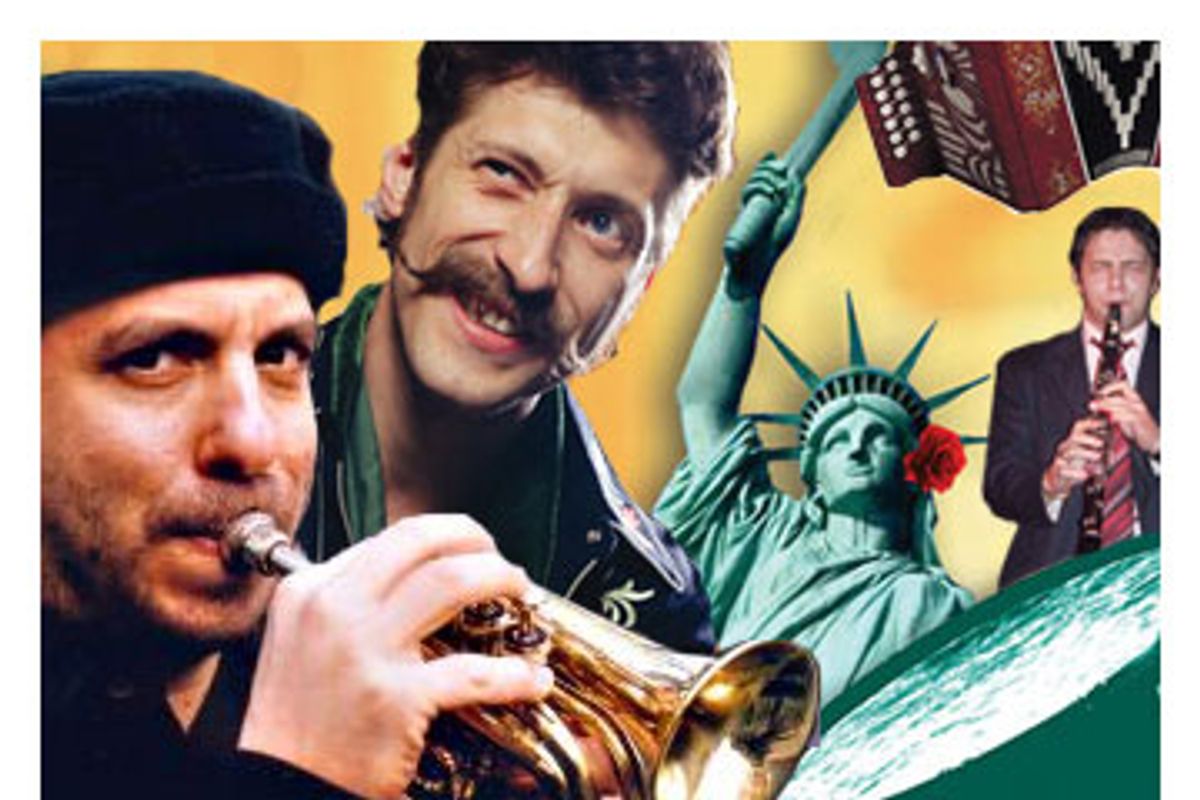
Purity is always a misleading ideal. With the Gypsies, or Roma, an outcast people who've survived by syncretic adaptation since they left India a millennium ago, it's an impossible chimera. Charles Keil, one of many to search hard before concluding that "the real Gypsy music" is a myth, quotes a Kosovo musician: "We do not care whether it is Turkish, Serbian or Albanian. We just play it livelier." Such commonalities as "natural" singing, idiomatic phrasing, behind-the-beat attack, and minor chords don't distinguish it drastically from all the other folkish musics that stick it to Western classical strictures. And the counterclaim that Gypsies don't play their music for gadje, non-Gypsies, merely renders the "real" stuff a tree falling in the forest for gadje who follow various Gypsy musics whether they're pure or not.
Until recently the gadje's choices boiled down to melodramatic, multicultural flamenco, the truncated jazz tradition of Django Reinhardt and then, for too long oh Lord, the mawkish "rumba flamenca" of France's answer to Air Supply, the Gipsy Kings. The only visible export from Eastern Europe, where most Roma live, was gentrified folk Hungarian restaurant music. But post-Soviet Union, a few Western European record labels invaded Eastern Europe and changed this. In 1990 Stephane Karo and Michael Winter of Belgium's Crammed Discs trekked to the Romanian backwater of Clejani to assemble the violin-and-accordion-based Taraf de Haïdouks (Turkish for "band," French for "of," Roma for "outlaws"). In 1996, German producer and future Asphalt Tango head Henry Ernst assembled the Fanfare Ciocarlia brass band in another Romanian village, and Crammed responded by signing Macedonia's Kocani Orkestar (and then wresting the name from trumpeter Naat Veliov). Bulgarian clarinet master Ivo Papasov, Macedonian sax king Ferus Mustafov, and Boban Markovic's Serbian brass band are other major Gypsy-Balkan noisemakers.
Noise is key here. In the Taraf de Haïdouks model, vocals are subsumed in breakneck momentum, strange-tempered melody and sounds that seem extreme from the instruments you recognize and weird from the ones you don't -- especially the cymbalom, a miraculous hammered dulcimer whose rippling sound morphs toward balafon low and mandolin high (listen to a sampler of Gypsy music here). Gypsy brass is far ruder, aggregating modern and traditional trumpets and trubas and trombones and whatever into blowing that is messily melodic at one end and anarchically propulsive at the other -- dancing-on-the-tables music for that special moment when you're finding it hard enough not to collapse to the floor. Horns drive squalling dissonances and frantic drum and tuba rhythms whose funk makes hip-hop's seem tame, because at least you've gotten used to hip-hop's Africanness.
Until Nonesuch dropped the first U.S. Haïdouks album in 1999, I'd always found Gypsy music floridly hyperromantic; until I heard Boban Markovic's swozzled, cacophonous, lyrical, sometimes virtuosic "Boban I Marko" five years later, my distaste for massed brass extended all the way from Stan Kenton to Ray Barretto. But it was really Ukrainian-born, NYC-based Eugene Hutz and Gogol Bordello, a Gypsy-gadje meld that turned into the most exciting new alt-rock band in the world once Hutz learned to write songs, who drew me to this year's New York Gypsy Festival -- Gogol Bordello climaxed last year's inaugural edition, and Hutz hosted 2006's finale. As it turned out, the Gypsy Festival, stretched this year by Turkish-born promoter-restaurateur Serdar Ilhan from Sept. 25 to Oct. 8, wasn't strong on the stuff I was there for, only as it turned out, that didn't matter.
As Ilhan emphasized by showcasing Russia and Italy, Seattle and Brooklyn (not to mention the "Gipsy Kings 'New Generation'" at an ill-attended big-ticket gig), Gypsy music comes from all over. Music has been as much a Roma trade as metal smithing and horse dealing, and while gadje exaggerate Roma vagabondage, musicians do need to be mobile. But though I hated a few acts and heard more than enough of several others, Gypsy music is at such a fascinating point that I don't regret a groan or wince. I ended up more convinced than ever that, varied though Gypsy music is, its Balkan variants represent a special case. That's because, as Bosnia and Kosovo taught us, Muslims aren't immigrants in Eastern Europe. Gypsies' religious beliefs vary. But because the Roma are syncretists, Balkan Gypsy music sounds Islamo-Christian in a way even flamenco, which began in Moorish Spain, does not. For gadje it's mainly some new kind of party. But that party is inextricable from insane 13/8 meters and a tune stock that owes much to centuries of Ottoman domination.
After an insufferable full-length warm-up by Cafe Antarsia, an American theater-music troupe given to lyrics like "I'm just a wayward bramble/ My love is my guitar," the Serbian septet Kal opened the festival at Joe's Pub in the Public Theater on Sept. 25. Kal share their violin-accordion-guitar instrumentation with Gogol Bordello and showed as little interest in authenticity -- at one point their leader, Dragan Ristic, a Roma schoolteacher's son turned theatrical impresario turned bandleader, announced "a sad song" just before they launched into a double-time trifle called "Frutti Tutti." But they were much more mild, playful, and culturally representative about it, and it was fine. The pink-skinned, good-humored Ristic conveyed more savoir-faire with a cocked eyebrow than Cafe Antarsia could stuff into an entire songpoem. Though he wasn't an ace guitarist, he had a great time at it, notably with some Muddy Waters slide powered out not as a reference but as a common resource, just like the Nusrat Fatah Ali Khan speed syllabics. Islamo-Christian, no doubt. In clear English, he told us that he dealt in Romasomes, which were something like chromosomes: "Small social things all around us."
Kal were livelier than their Asphalt Tango album and embodied the contradictions of authenticity. Ristic is an educated Roma activist who formed Kal not just because he loves music, although it's a good thing he does, but also because he has a politico-cultural program. He comes to that program more naturally than Cafe Antarsia because he's Balkan and Roma himself, but more self-consciously than Moscow's theater-rooted Kolpakov Trio, old-fashioned preservationists featured at the finale who have long been staples of the gadje folk circuit -- and much more self-consciously than Taraf de Haïdouks, still unheralded in their homeland, or Fanfare Ciocarlia, also fabricated by a gadje record man. I found little correlation between authenticity and quality at this chaotic bazaar. Cafe Antarsia sucked so bad not because they were tyring to be something they weren't but because they were, at some fundamental level, assholes.
Purer than Kal, but no more or less gripping, were Taraf Costel Vasilescu at NYU's Skirball Center Sept. 30, led by the Romanian trumpeter who graces superb 30- and 40-year-old Asphalt Tango reissues by Ion Petre Stoican and Romica Puceanu. Standing quietly aside, Vasilescu proved the least demonstrative player in a septet that had amassed some breathtaking avoirdupois in its old age: trumpet, clarinet, guitar and vocals, accordion and vocals, violin, swinging double bass, and the only cymbalom to surface in two weeks. But one trumpet doesn't equal Gypsy brass. Instead, the taraf's sound was defined by bassist Marin Marinescu as Gypsy swing, a strikingly original example of a consciously post-Django groove-cum-subgenre that often seems the sole province of tribute bands.
Three true Gypsy brass bands with nary a Gypsy among them did midweek shows at M1-5, a roomy red Tribeca bar with a tiny 12-by-16 stage: Hungry March Band, Frank London's Klezmer Brass All-Stars, and Zlatne Uste. Metaphorically, all three hail from Brooklyn -- lower-case bohemian Brooklyn, not immigrant Brooklyn. Opening for Gogol Bordello at last year's festival, Hungry March deployed approximately 23 brass and drum players plus seven dancers to enact a dazzling not-for-profit spectacle (how much cab fare do you think each musician takes home?) in which frenetic cheerleading spurs on more or less unison blasts that part to admit jazzish solos. Here, 18 or so plus two dancers still couldn't quite squeeze onto the stage, and though the young Korean Archie Shepp fan in the crocheted cap wailed impressively both times, the downsizing undercut Hungry March's attempt to combine the orgiastic abandon of Gypsy brass with individualism American-style. Zlatne Uste, who since 1983 have played "folk music from the brass music traditions of the Balkans" on old-fashioned rotary-valve flugelhorns they call by the Slavic term "trubas," harbor far homier ambitions. Playing to a core of fans who circle-danced without surcease, they were sweet as people and musicians, and no doubt their tunes sink in -- "Caje Sukarije," which I knew from Macedonian singer and Nobel Peace Prize nominee Esma Redzepova, was a catchy closer that sounds fine on their "In the Center of the Village." But up against faster, trickier, harsher, crazier Fanfare, Kocani and Markovic CDs, that album seems anodyne, and the performance barely hit second gear.
Moonlighting Klezmatics trumpeter Frank London got his own dance circle, which included a gray-haired woman who appeared to be the mother of one of his musicians. London is a free thinker who in 2002 concocted a theory of brass bands involving Babel and Freemasonry that he renounces on 2005's highly recommended "Carnival Conspiracy," the wildest, wooziest, and most eclectic of the many attempts by Jewish musicians to reclaim their national as well as cultural roots while giving it up to their fellow outcasts. (Balkan Beat Box, runners-up to Gogol Bordello in the Gypsy rock sweepstakes, is led by two Israeli expats.) The All-Stars shift around a lot; a show last January made room for a Brazilian percussion club and a Hasidic women's chorus. This version featured two trumpets, two clarinets, a saxophone, a trombone, a young trap drummer who arrived on time, an older bass drummer who was late, and the lithe tuba of Ron Caswell, who cannily avoided the New Orleans usages favored by Hungry March Band. The 90-minute set was ramshackle -- London loves loose. But the 20-minute opener relaunched the theme whenever it wandered, the Balkan-not-klezmer number roared back after a jazzy sax solo, and Caswell kept things non-swangin'.
London, who studied with jazz luminary Jaki Byard, favors the politically incorrect term "Oriental" to designate the groove he's after -- a groove where threes and twos are juxtaposed, rather than superimposed as in African-inflected musics. And though I reserve the right to renounce the theory next week, my immersion convinced me that the Balkan-Gypsy synthesis is most powerful at its least African -- which also means its least American. Not to deny that Vasilescu's bassist is the making of that taraf. Nor that borrowings from all the crucial African-American horn players are inevitable. Nor that many experts disagree, notably Garth Cartwright, who studs a dashing, fact-packed report on Balkan Gypsy music called "Princes Amongst Men" with epigraphs from African- American musicians and speculates that "Afro-Roma communities in Louisiana" helped create New Orleans jazz. Which is conceivable. But which doesn't mean Caswell belonged on the downbeat he stayed off.
Proof came with the confusing and exciting Oct. 3 clarinet summit at Joe's Pub. I envisioned some surrogate Gypsy brass, a blowing session pitting Bulgarian-born, Bronx-based Yuri Yunakov's rough-hewn tenor sax against two guys I'd never heard of, 30-year-old Turk Husnu Senlendirici and 22-year-old Macedonian Ismail Lumanovski, I instead spent two and a half hours listening to four separate sets featuring bands whose shifting personnel I never got straight; although three of them featured a 16-year-old Macedonian synth whiz named Muhammad, an Arab-looking kid in a long gelled crew cut whose Casio could do the fake flutes of Algerian rai and whose Korg was a piano. Lumanovski and Senlendirici proved spectacular players who had listened hard to Coltrane and Dolphy -- especially Lumanovski, his sound very soprano sax, lots of burr and flutter and overtone where Senlendirici was cleaner and more flutelike. Sometimes the format got samey, structured like, say, the state-and-blow jazz sets of Argentinian Coltrane devotee Gato Barbieri. But the clarinetists had more chops than Barbieri, and Yunakov, who didn't, simply took the music R&B. A gruff, friendly bear with an ex-boxer's gut, he has a robust, muscular sound and packs a lot of power when he improvises. Later, he used saxophone technology to outloud Lumanovski, and later than that he described Senlendirici as "the greatest clarinet player in the world."
The format was a jazz format, but the Gypsy brass format is too, and Gypsy brass is Oriental. So was this. Borrowings from crucial African-American horn players are healthy, but the melodic incline of the material was Eastern European, which by then I could I.D. sometimes as specifically Roma but which also went all the way "Middle Eastern," tunes that evoked muezzins and bellydancers. I should also mention Hasan Isik on kanun, a zither from Turkey that looked like a small cymbalom. And then there were the rhythms. Three different trap drummers sat in, the last and most accomplished an American named Jordan Pearlman who I found too jazzy. My favorite was Yunakov's guy, a squat, middle-aged, dark- skinned powerhouse with two small extra drums toward the top of his kit. ("I don't know the name, Yuri brought him last minute," e- mailed promoter Ilhan, who thinks he's Macedonian.) He didn't swing at all, just banged out the meters with relish and panache, especially when Yunakov announced, "Now I need to play 9/8 -- it's a Gypsy style, a Balkan style." It was he who took over for the final blow-out, when Yunakov honked and Senlenderici got dirty and Lumanovski smiled and held his boyish own amid melodies that evoked jazz not a whit. Just some new kind of party.
Great music rarely changes the world. It just exemplifies what a good world might be like. None of the acts at Hutz's farewell party Sunday grooved me much. But in addition to being a great bandleader, Hutz is a great DJ, and between sets suddenly my little knot of jawing gadje noticed what he was playing. Was that bhangra, all the way from the ancestral Punjab? Followed by a female village folk dance? Followed by a teched-up Django remix? And was that a ska over that baritone truba line? Small social things all around us, and they all sounded wonderful. What a wonderful world it could be.
Shares