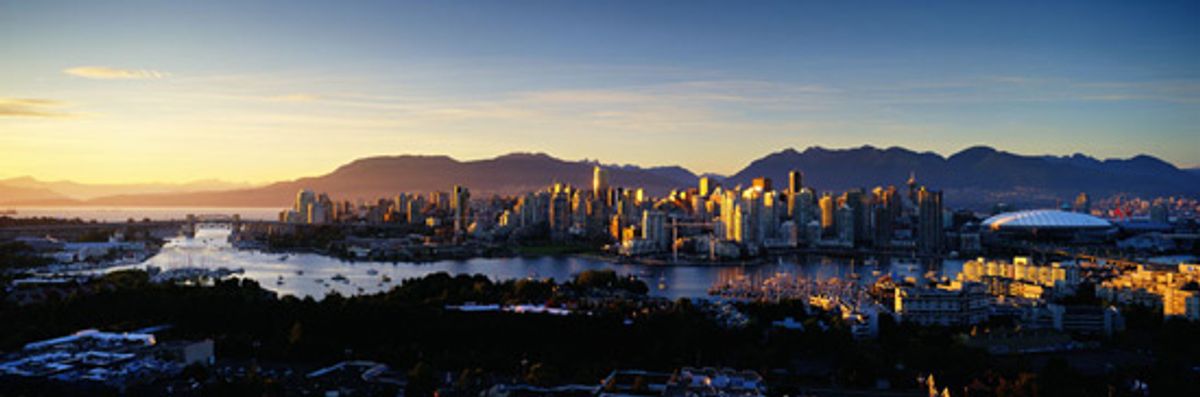
The first thing to know about Vancouver, British Columbia, is that it resembles the last, if not no other, place on earth. A sinewy swoop of land framed by mountains and water, it's the final terminus of the North American frontier, half post-industrial pan-Asian metropolis and half primeval nature. The beacon city of an implausibly clean-scrubbed future in an environment echoing its native people's history, Vancouver looks like the glimmering set design for a dreamy, what-if alternative to "How the West Was Won."
Visiting Vancouver is like simultaneously taking a step forward and back. In its near-future, Vancouver boasts an uncharted, wet-lab urbanity that has inspired author and Vancouver resident Douglas Coupland to call it "the city of glass." Its past, the deep native roots in the region, is also present, right from the international arrivals terminal. Air travelers are greeted by a dramatic installation, festooned with the First Nations iconography of totems, masks and canoes, echoing the aboriginal people's distinct sense of place. Now the native Vancouverite's reverence is for land value, the product of a generation-long development boom instigated by the transition of Hong Kong to China and the waxing of Asia's economies. Vancouver is today among the select handful of world centers -- think Geneva or Sydney -- recognized solely by its livability: a happy accident of freeway-forbidding geography, Canadian social engineering and the best lessons of urban development.
Looks aren't everything, but the city's self-advertisement suggests they may get you by. The province of British Columbia, an expanse of wetland, desert, mountain and fjord larger than Washington, Oregon and California combined, has emerged from the tall shadow of its resource economy for a second act. Vancouver is now a full, on-the-mouth kiss to the revels of 21st century commerce: tourism, Hollywood and video games. The backbeat is a rampaging real estate market to compare with that of San Francisco. But -- imagine California without votes, industry or capital -- it is a parochial place, a branch-plant R&R town better known for its way-chill lifestyle economies of yoga fashion, adventure tourism, culinary cosmopolitanism and the world's finest marijuana.
The inveterate contrasts of the place have not been lost on its artists. Instead, they've been formative to a hermetic literary culture born of the past's remoteness and the future's alien-bright sheen.
Vancouver's literature is suffused with the year-round damp and mild climate, for which the region is dubbed the Rain Coast. (Indeed, according to Margaret Atwood, Canada's literary den mother, all Canadian literature is foremost a product of the nation's physical environment.) Coupland, whose "City of Glass" (2001) is the contemporary Vancouver's unofficial travel guide cum decoder ring, describes the exit from the city: "I want you to imagine you are driving north, across the Lions Gate Bridge, and the sky is steely grey and the sugar-dusted mountains loom blackly in the distance. Imagine what lies behind those mountain -- realize that there are only more mountains -- mountains until the North pole, mountains until the end of the world, mountains taller than a thousand me's, mountains taller than a thousand you's." Here in a soaked-through rain-forest vision of New England, Henry Thoreau would have succumbed to cabin fever.
West of Vancouver, dotting the Georgia Strait, are the Gulf Islands. North is the Sunshine Coast. Here in these places, as in Vancouver, the literary sensibility is less Thoreau's ponderous outdoorsman than a gimlet-eyed castaway. Picture a writer's colony gone feral. Both places are inhabited by aging American draft dodgers, expats of all stripes, organic farmers, artists and others who cleave to alternative lifestyles -- even their own currency, based on resident naturalist Robert Bateman's design. (Neil LaBute's recent remake of "The Wicker Man," which was shot there, finds Nicolas Cage convincingly out-acted by the islands, an apt setting for a pagan cult.) An army of artists, from musician Joni Mitchell to writer Michael Ondaatje, have quietly whiled away decades there in relative obscurity, but never write or speak of the place. Some, like the crime writer William Deverell, jokingly lament letting the secret out about the remote area's charms.
Befitting Vancouver's boom-era reinvention, neither of its two most internationally recognized authors, Coupland or the science fiction luminary William Gibson, are native sons. Yet each draws on Vancouver's 21st century internationalism, and their books -- meditations bisecting mass culture, technology and humanity -- are shot through with a similarly dark-humored, contemplative outlook on the world. Each even launched a trademark-worthy movement. Gibson coined "cyberspace" in publishing the landmark novel "Neuromancer" (1984), itself one of the most influential science fiction works of the last quarter-century. For his part, Coupland put his name on the map by plumbing his peers' psyche with "Generation X: Tales for an Accelerated Culture" (1991).
In his most recent work, "JPod" (2006), Coupland mines an inviting setting for generational anomie in the world of a fictional game company, noticeably modeled after Vancouver-born Electronic Arts. (A previous novel, "Microserfs" [2003], is a cruise down I-5 to the Redmond, Wash., campus of Microsoft.) But it is "City of Glass" that serves as the best street guide to Vancouver's curiously poly-ethnic parochialism: of everything from the city's straight-outta-Harajuku teen tourists to its post-and-beam residential architectural glories. Artist and polymath, perhaps even "his generation's most interesting curator," Coupland looks to continue moving deftly in other artistic mediums, such as these sculptures of his own, personally chewed first editions.
Gibson, for his part, considers Vancouver as an uninvited ghost in his work: "I almost never mention Vancouver in my fiction, but every city in my fiction definitely is, in some oddly Borgesian way, Vancouver. It's a city awaiting the excavation of its own deeper psychogeography." Years ago, Gibson's pure literary talent transcended the boundaries of so-called genre fiction. He is now among the gloomiest and most prescient tourists of where technology is taking human experience, his fiction taking the realized shape of documentary truth.
For its few literary lights, there have been many other writers for whom Vancouver doused their creative fires. Even today, it is a town lacking any public literary life approaching the scale of its coastal peers Seattle and San Francisco. Beyond small press concerns, a media monopoly maintains the culture on a low simmer. While local John Vaillant leapt to the pages of the New Yorker in 2002 with the story that would become "The Golden Spruce" (2006), a widely celebrated book in Canada pondering the actions of a man who cut down a spruce deemed sacred by the natives, the only distinct local writer's group is, appropriately enough, a band of travel journalists.
The best living short story writer, Alice Munro, was a 1950s Vancouverite, and describes the time as her most creatively fallow. A New York Times travelogue of Munro's Vancouver years recently pondered the contradiction: "[T]he urban geography is so exact you can practically map the city off her fictions. But though the addresses match, the vibe is unrecognizable." Munro-era Vancouver was a much smaller, undeveloped place than it is today, but its landscape also perhaps overwhelmed the austere Southern Ontario Gothic that would become her hallmark. "For her, this was always the wrong place, the views too grand, the weather too gray, the trees too tall." Nevertheless, she contemplated the setting throughout her career, from "The Love of a Good Woman" (1998) to "Hateship, Friendship, Courtship, Loveship, Marriage" (2001). Yet Munro bristled at what she called the "enclosed" city suffocating her flame. "I have never even been able to do much with it fictionally because I hated it so much," she revealed to an interviewer.
But it is Munro's very sense of creative dislocation that, oddly, puts her on the map along with Vancouver's greatest literary eminence, Malcolm Lowry. In the 1940s, he was living a life of destitution and alcoholic squalor in a squatter's shack, doggedly biding his time. Despite the fire that burned his dwelling down in 1944, he managed to complete the novel "Under the Volcano" on a fourth rewrite by that Christmas Eve. Days later, he announced in an audacious letter to his publisher its importance: "It can be regarded as a kind of symphony, or in another way as a kind of opera -- or even a horse opera. It is hot music, a poem, a song, a comedy, a farce, and so forth. It is superficial, profound, entertaining, and boring, according to taste. It is a prophecy, a political warning, a cryptogram, a preposterous movie."
A decade in the writing, since its appearance it has come to be seen as one of the mid-century classics of Western literature, a hinge point between the modern and postmodern. Its Joycean plot revolves around the passions animating the last day in the life of a dying alcoholic in Mexico. Lowry himself lived to see some of this success, but not in Vancouver, which he referred to dismissively in letters as the city of the son of Cain. As the possibly apocryphal story goes, "Under the Volcano" was instantly heralded in France, quickly a bestseller in the U.S., and immediately a failure in Canada, where it sold just two copies.
The literary DNA of Vancouver and its corner of the Pacific Northwest speaks to Lowry's cottage-cloistered solitude. A blue-green lagoon perched on the San Andreas fault, Vancouver is Canada's Los Angeles for its similar sense of mirage and cartoon inconsequentiality. But it is also inimitable and may be the millennial city par excellence. Picture the world's best backwater, a cabin with a view.
Shares