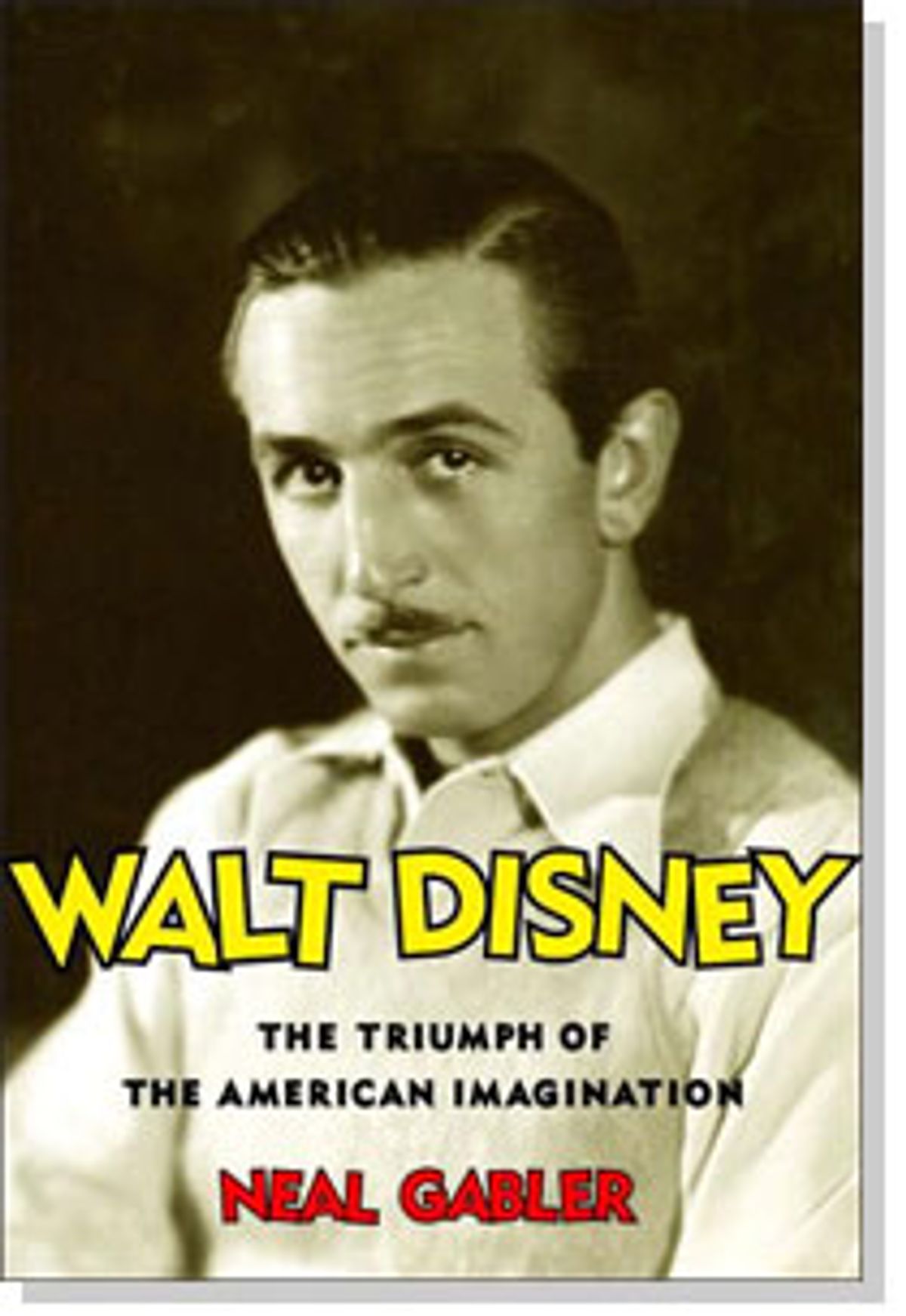
Though in later years he frequently invoked his midwestern roots and called himself a Missourian, Walt Disney was made for Hollywood. He loved dress-up and make-believe, was boisterous, outgoing, self-aggrandizing, and histrionic, and craved attention. Hollywood was his spiritual destination. Even for the general public, roughly forty million of whom, or one-third of the country's population, attended the movies each week in the early 1920s, Hollywood was more than a provider of entertainment. It was the capital of the imagination, the symbolic center of release and recklessness, the "most flourishing factory of popular mythology since the Greeks," as British observer Alistair Cooke would later put it. Hollywood was where one went to realize one's dreams, which was why Walt's grandfathers had both headed to California before being sidetracked and why Walt himself had now gone there. Just as his youthful energy converged with and was intensified by the postwar national spirit, in Hollywood the dynastic Disney dreams of escape -- and Walt's own longing for transport that had been nursed on the farm in Marceline and then expressed in drawing and in animation -- converged with a national vicariousness. In Hollywood he was home.
But if Walt Disney was made for Hollywood, he himself questioned whether Hollywood was made for him. He hardly looked like a movie swell. He arrived early in August 1923 in his borrowed suit with nothing but pluck and his peculiar self-confidence. (Despite his penury, as his wife would later tell it, he had traveled first-class because he "always wanted the best way.") His own clothes made him seem shabby and downscale, as did the months of near-starvation in Kansas City that had melted off the pounds he had gained in France and made him cadaverous. "He looked like the devil," Roy [Disney, Walt's brother] recalled. "I remember he had a hacking cough, and I used to tell him, 'For Christ's sake, don't you get TB!'"
Despite his outward confidence, he was worried about how he would make his way in Hollywood. Though he had brought his reel of "Alice's Wonderland" [a live action-animated film of Walt's] and his drawing implements with him, he was not hopeful about his prospects in animation. He now felt he had gotten into the business too late, that it was too insular, that he would not really be able to break into the big time of animation, which was, in any case, centered in New York. "I had put my drawing board away," he told an interviewer years later. "What I wanted to do was get a job in a studio -- any studio, doing anything," though in truth his aspirations were larger and more fanciful. He now hoped to get a job as a live-action director somewhere.
He loved motion picture studios -- the very source of fantasy. Early one morning that first week he took a bus out to Universal City in the San Fernando Valley and by flashing his old Universal News press card, which he had kept from the time he worked as a stringer shooting newsreels, he managed to wangle a pass. He wandered the lot, walking through the sets, not leaving until late that night. He called it "one of the big thrills I had." Soon afterward he toured the Vitagraph studio with his cousin Alice Allen, who was visiting from the Midwest. He also got onto the Paramount lot, where he ran into an old Kansas City acquaintance who was picking up work as an extra and who encouraged Walt to apply for a job on a Western riding a horse; he got the role, but the shoot was rained out, and Walt was replaced when it was rescheduled. He spent time exploring Metro too.
Roy, who had been working as a door-to-door vacuum cleaner salesman before suffering a relapse of his tuberculosis and landing back in the Veterans Hospital in Sawtelle in what would later become the Westwood section of Los Angeles, thought Walt was lazy and typically overconfident (an "infection," Roy called it) about his employment prospects, only pretending to apply for jobs so that he could linger at the studios. "Tomorrow was always going to be the answer to all his problems," Roy said. "He was hanging around this town and I kept saying to him, 'Why don't you get a job?' And he could have got a job, I'm sure, but he didn't want a job." But contrary to Roy's impression, Walt was not just wandering dreamily through studios. He spent his first two months on those expeditions trying to convince someone to hire him and even had the temerity to approach producers for advice. At the same time he unsuccessfully trudged around Los Angeles with his print of "Alice's Wonderland" hoping to find a distributor. Some suggested he take the print to New York, where the distributors might be more receptive. Since Walt did not have the money to go east himself to lobby, he sent the print to a well-connected intermediary named Jack Alicoate, who represented Lloyd's Film Storage Corp., where the film had been held during the Laugh-O-Gram dust-up with Pictorial, and Alicoate, a generous man, circulated it. Grabbing at anything while it made the rounds and he awaited the distributors' verdict, Walt revived his comic strip, "Mr. George's Wife," and pitched that too, without any more success than he was having with his film. He even had new stationery printed: "Walt Disney Cartoonist."
By September, already despairing of getting a job as a director and having no prospects on "Alice," he reverted to an old plan. One of the first things he had done when he reached Los Angeles was to buy a Pathi camera at Peterson's Camera Exchange -- "Cameras affected him the way alcohol affects dipsomaniacs," his daughter Diane would write -- and rig it up with a secondhand motor. Now he visited the theater impresario Alexander Pantages, a prominent vaudeville promoter who also owned several of the larger motion picture houses in Los Angeles. Walt did not get to see Pantages himself. He met instead with a factotum outside Pantages's office, to whom he suggested a "special little joke reel" just like the Newman Laugh-O-grams, only with "the name of Pantages splashed all over it, to add prestige and keep the name Pantages before his theatre patrons." The man dismissed Walt, saying that they were not interested, but Pantages happened to have overheard the conversation, emerged from his inner sanctum, and said he would like to see a reel. Walt headed back to Uncle Robert's house, where he was staying, and began to animate a sample.
And there was another glimmer of hope. Even before leaving Kansas City, Walt had been sending dozens of letters soliciting distributors for "Alice" with his promise of having "just discovered something new and clever in animated cartoons!" and receiving polite rejections when he received anything at all. But among those to whom he had written while he was still in Kansas City trying to stave off bankruptcy was an unusual distributor named Margaret Winkler -- unusual because she was the first and only female film distributor in the country. An immigrant from Budapest, Hungary, Winkler was a petite, round-faced, plain, and pleasant-looking young woman -- she was twenty-eight -- but her appearance belied what her son would call a feral energy, a quick mind, and a short temper. She had been the secretary to Harry Warner of the Warner Bros. film company, who was stationed in New York, though she was ambitious enough to use her position to travel to film conventions on the West Coast and make connections. By one account, Pat Sullivan, the creator of Felix the Cat, had approached Harry Warner in 1921 to distribute his Felix cartoon series, which had recently been dropped by Paramount. Warner demurred, but he encouraged his secretary to explore the offer. She and Sullivan signed a contract in December. "I think the industry is full of wonderful possibilities for an ambitious woman," she told Exhibitor's Herald, shortly after the signing, "and there is no reason why she shouldn't be able to conduct business as well as the men."
Margaret Winkler did. By the time Walt contacted her in May 1923, she was also representing the Out of the Inkwell series devised by Max and Dave Fleischer, in which Koko the Clown escapes his inkwell into a real, which is to say photographic, world; between Felix and Inkwell she had become one of the leading animation distributors in America. But at the time Walt Disney wrote her, trouble was brewing for Winkler. The Fleischers were threatening to leave, and she and Pat Sullivan, who was so difficult and addled by alcohol that he once allegedly urinated on the desk of Paramount Pictures head Adolph Zukor to force a concession, were locked in a bitter dispute over the renewal of the Felix option. Walt's timing, then, could not have been better, which is no doubt why Winkler wrote back to this unknown novice almost immediately upon receiving his first letter, saying that she would be "very pleased" to have him send a print and that "if it is what you say, I shall be interested in contracting for a series of them." But however encouraged Walt may have been, he did not have the print to send while he was in Kansas City because Fred Schmeltz, the Laugh-O-Gram creditor, had it. He continued to correspond with Winkler, apologizing over the delays while refusing to admit that he did not own the print or that he would have to remonstrate with Schmeltz to show it; by the time he reached Los Angeles, Winkler was getting impatient over his foot-dragging. Corresponding, she wrote him drily early in September, was "about all it [their communication] has amounted to." But in a sign of her own desperation over the Felix and Inkwell threats and not realizing that Walt had no more than one Alice, she asked him "[i]f you can spare a couple of them long enough to send to me so that I can screen them and see just what they are, please do so at once."
Most likely the first week of October via Alicoate, Winkler finally screened "Alice's Wonderland" in New York and pounced. "BELIEVE SERIES CAN BE PUT OVER," she wired Walt on October 15, while emphasizing that the photography of Alice had to be more finely focused and the camera held steadier. She also cautioned, by way of limiting Walt's financial expectations, "THIS BEING NEW PRODUCT MUST SPEND LARGE AMOUNT ON EXPLOITATION AND ADVERTISING THEREFORE NEED YOUR COOPERATION." She offered $1,500 for each negative of the first six films and $1,800 for each of the second six. To show her "good faith," she said she would pay the full $1,500 immediately upon delivery of each of the first six rather than wait until she had gotten bookings or money for them. Walt, clearly with no room to negotiate and ecstatic at having any offer, promptly wrote back accepting. At the same time he abandoned the Pantages project.
The very next day Winkler sent the contracts, incorporating her financial terms and calling for the delivery of the first Alice no later than January 2, 1924. She also included an option for two series of twelve more films each in 1925 and 1926 and a clause that awarded her full rights to all of the films Walt produced during the contract term. That same day, obviously wanting to move quickly, she asked Walt for any photographs of the actress playing Alice and of Walt, and for biographies of each. Most likely in an attempt to impress him, she telegraphed Walt again the same day suggesting that he write Harry Warner, who would attest to her competence. Walt did contact Warner, who wrote back that Winkler "has done very well" and that "she is responsible for anything she may undertake," but by that time Walt, as anxious to proceed as Winkler, had signed the contract, with Uncle Robert serving as his witness. Returning the documents, he wrote Winkler that the first film, "Alice's Day at the Sea," was already in production and would be delivered as early as December 15. She responded a week later, a bit extravagantly: "I see no reason why these should not be the biggest thing brought out for years."
But despite the months he had waited for just this news and despite his promise to deliver a new film quickly, Walt was ill prepared to launch another animation studio. The day he received Winkler's initial telegram on October 15, he headed to the Veterans Hospital, where Roy was convalescing from his tuberculosis. As he later told it, again dramatizing for effect, he arrived late, around midnight, crept onto the screened porch where the patients slept, and shook Roy awake to show him the offer and celebrate. But his enthusiasm quickly elided to panic. "What do I do now?" he asked Roy, and pleaded with him to leave the hospital and help him get started. Roy agreed to meet Walt the next morning at Uncle Robert's house for a strategy session. Roy left the hospital the following day -- he claimed that an examination had shown that he was healed -- and never returned.
Meanwhile Walt had a pressing issue to resolve. Winkler's contract had been predicated on having Virginia Davis play Alice, but Virginia was back in Kansas City. The day he received the contract from Winkler, the day he was meeting with Roy at Uncle Robert's, he wrote Virginia's mother urgently telling her that he had finally gotten a distributor, that he had been screening "Alice's Wonderland" in Hollywood, that "every one seemed to think that Virginia was real cute and thought she had wonderful possibilities," and that if Virginia came out to star in the series, "it would be a big opportunity for her and would introduce her to the profession in a manner that few children could receive." He pressed Mrs. Davis to make a decision as soon as possible since he was hoping to start production in fifteen to twenty days, and he ended rather grandiosely, not unlike Winkler in her letter to him, saying that "it will be but a short time till the series will be covering the world."
In point of fact, Mrs. Davis had brought Virginia out earlier that summer for a movie tryout but found that so many other mothers were attempting the same thing that the studios refused to see them. She had returned to Kansas City and was planning another assault on Hollywood in November when she received Walt's message. Four days after his first letter Walt wrote again, this time offering terms: $100 a month for the first two months, rising in $25 increments every two months to $200 for months nine through twelve, with an option of $250 a month for the next series. He justified what he admitted was a "low salary at start" by pointing to, as Winkler had pointed out to him, the initial advertising and publicity costs.
Though Walt could not have known it, the Davises did not need much encouragement. Virginia's father was a traveling furniture salesman who was on the road most of the time. Her mother was a stagestruck housewife who had enrolled Virginia in dancing school when the girl was two and a half years old, and she seemed determined to get her daughter into the movies. In addition, Virginia suffered from double pneumonia, and doctors told the Davises that the dry California climate would be beneficial for her health. Mrs. Davis convinced her husband that he could sell furniture from California as easily as from the Midwest and that Virginia would have a career, but even Roy was struck by a man giving up thirty years in Kansas City for the promise of only $100 a month. Mrs. Davis wired her acceptance to Walt on October 28.
Now he had his contract and his star, but he had neither a company nor a staff nor, most important, any money to jump-start the operation. So when Walt met Roy on October 16 at Uncle Robert's house on Kingswell Avenue in a quiet residential section of Hollywood, part of the plan was to ask their well-heeled uncle for a loan. Since Robert had encouraged Walt to come to Los Angeles, the brothers assumed that getting the money would be something of a formality. But their uncle balked. Walt's beloved Aunt Margaret, his advocate, had died of pneumonia, and Robert had married a much younger woman -- Ruth Disney [Walt's sister] said that he had dated both the woman and her mother, and there was a "toss-up" over which would get him -- who was pregnant at the time Walt requested the loan, which seemed to put Uncle Robert in a less-than-generous mood. Moreover, Walt and his uncle, who was as stubborn and disputatious as Elias [Walt's father], had gotten into a silly argument over whether Walt's train west had passed through Topeka, as Uncle Robert insisted it had, or had not, as Walt insisted. Even after Robert's new wife, Charlotte, called the railroad and proved Walt right, Robert bristled. "He demanded a lot of respect and didn't think I gave it to him," Walt remarked.
Finally, there was the matter of a sixty-dollar loan Walt had received from his brother Ray. Walt still owed him the money when, the previous Christmas, Roy wrote from California suggesting the brothers pitch in to buy their mother a vacuum cleaner and agreeing to kick in Walt's share since Walt was broke at the time, if Walt would collect Ray's share. Ray refused to contribute, saying that Walt should cover the cost out of what he owed. By the time Walt reached Los Angeles, Uncle Robert had heard that Walt had welshed on his debt and did not think his nephew was a good credit risk. But Walt, who was not about to lose his opportunity with Winkler over petty family squabbles and who did not want to be considered a failure like his father, was persistent and nothing if not ingratiating. By November Uncle Robert had softened and loaned Walt $200 in midmonth, another $150 ten days later, another $75 early in December, and yet another $75 on December 14, for a total of $500, albeit at 8 percent interest, all of which Walt repaid the very day he received his second payment from Winkler early in January. The Disney brothers were also begging money from their friends and other relatives. Even before receiving the offer from Winkler, Walt had gotten a $75 loan from Carl Stalling, the organist at the Isis Theater in Kansas City, and received $200 more from him after signing the contract; $50 from Robert Irion, who was married to Walt's aunt; $25 from Roy's girlfriend Edna Francis and even $200 from Virginia Davis's mother.
Though Roy had helped solicit these funds -- all except the money from Edna, which Walt had requested without his knowledge -- it had never been Roy's intention to join the enterprise, and in any case he had no experience whatsoever in entertainment. "I was just helping him, like you'd help a kid brother," he later said. But Roy could never resist his younger brother. He claimed that Walt, who was so enthusiastic and innocent-seeming, "would win your heart, and you wanted to help him, really," and he admitted that he was afraid that without his protection, his "fervent protection," Walt would have been taken advantage of. To prevent that, Roy, professing a "love of Walt," agreed to become Walt's manager and guardian angel in business as he had been in Walt's life. In late November, when Walt moved out of Uncle Robert's house to a room in the Olive Hill Apartments, Roy joined him there and moved with him again in December when Walt found another, cheaper room, for fifteen dollars a month, at 4409 Kingswell in an apartment building almost directly across the street from his uncle's house. The two even saved money by eating at a cafeteria where they could split the meat and vegetable courses.
The room was just two blocks from a cream-colored, one-story brick storefront at 4651 Kingswell with a large display window. Early that October, either in anticipation of the Winkler deal or as a work space for the Pantages reel, Walt had rented a cramped office at the rear of the building behind the Holly-Vermont Realty Company, which occupied the front. (The rent was only ten dollars a month, which was raised to fifteen dollars in December.) By December, with the contract signed, the brothers were also renting a lot nearby on Hollywood Avenue for outdoor shooting and had bought a new camera, lumber and tools, a curtain to separate them from the realtors, and a box of cigars as a thank-you present for Uncle Robert. They had a name for the studio too: Disney Bros.
Excerpted from "Walt Disney: The Triumph of the American Imagination" by Neal Gabler. Published this week by Alfred A. Knopf. Copyright (c) 2006 by Neal Gabler.
Shares