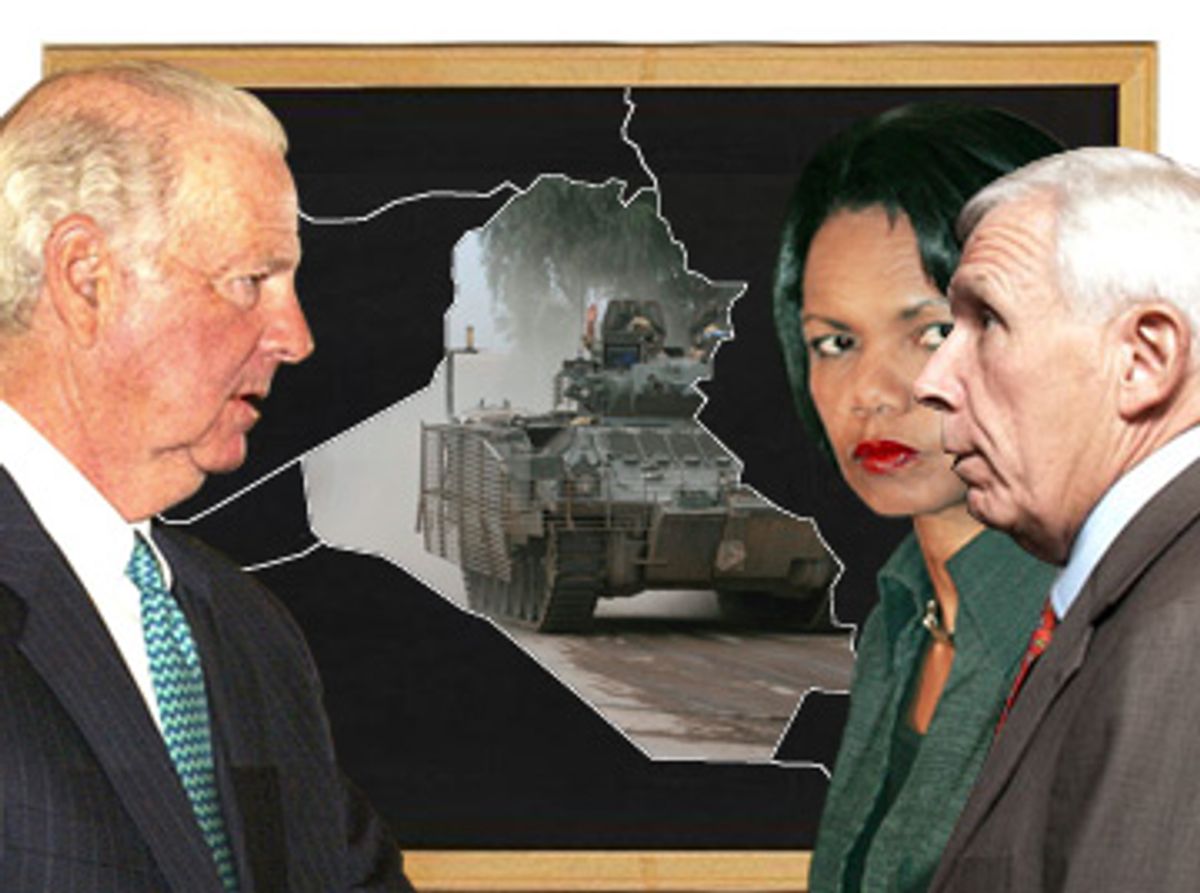
In late 2005, three Washington insiders with foreign policy expertise were summoned to a meeting with Secretary of State Condoleezza Rice -- a little-known event that may end up changing the course of the war in Iraq. The three men were working to help Rep. Frank Wolf, who wanted to create an independent panel to overhaul the Bush administration's strategy in Iraq, after a recent trip there left the Virginia Republican worried that the war was headed from bad to worse.
The three men, to their surprise, were asked to attend a meeting on Nov. 29, 2005, with Rice, who had been among the core defenders of the Bush administration's war in Iraq. At the end of that meeting, Rice agreed to the idea for the panel and pledged to take the case directly to President Bush. At Rice's urging, Bush embraced what would become the Iraq Study Group, co-chaired by former Secretary of State James Baker.
"It was remarkable that Condi Rice took the lead," said David Abshire, president of the Center for the Study of the Presidency in Washington, and one of four people in the November meeting, including Rice. The Iraq Study Group, he said, "happened with her going to the president."
It has been widely speculated that George H.W. Bush, the president's father, turned to his trusted former advisor Baker to help orchestrate the Iraq Study Group to clean up the Iraq mess. But the little-known story of how the panel came into being began not with Baker, but with a congressman's effort to call it like he saw it in Iraq -- and with Rice's maneuvering to sidestep an entrenched Defense Secretary Donald Rumsfeld. It set in motion the unlikely scenario now playing out in Washington in which an independent panel is about to counsel a White House not typically known as receptive to outside advice on the war.
Wolf contacted Abshire in fall 2005 to discuss assembling the panel after Wolf had returned from his third trip to Iraq. At that time, the message from the White House on Iraq was unequivocally upbeat: Things are getting better. Stay the course.
But Wolf's most recent trip left him with the view that security in the country might actually be deteriorating, despite the rosy message from the Oval Office. "Some things were worse," Wolf confirmed about that Iraq trip in an interview. He wanted some "fresh eyes," he said, on the Iraq situation.
Abshire agreed to help. Abshire began working with Richard Solomon, president of the congressionally funded United States Institute of Peace, and John Hamre, president of the Center for Strategic and International Studies, to pull together a plan.
One challenge was finding the right people. They had to be sufficiently independent. Wolf says that he wanted "people who were not connected to the administration nor connected to the Democratic campaign committee," people who could "honestly" tackle the problem.
Former Democratic Rep. Lee Hamilton seemed like an obvious choice. A highly respected voice on foreign policy, Hamilton had been vice-chairman of the 9/11 Commission. Abshire called him first, in November. Abshire then contacted Baker, a man with obvious foreign policy credentials, who maintains close ties to the Bush family.
Abshire bristled a bit when asked about speculation in the press that somehow Baker had set up the group as some sort of favor to help out the president's father. "It is sometimes misunderstood that this is a group that Baker formed," he said.
In fact, Abshire says that when he called him, Baker first showed reluctance, immediately pointing out an obvious hurdle. Without buy-in from the White House, the panel would be dead in the water. "I called Jim Baker in November and he said he would do it if the president really wanted him to do it," Abshire recalls. One problem was that the White House could potentially encourage Republicans not to participate in the panel. That could impede access to key officials. The administration could be stingy with documents. It could, in essence, make the panel useless. "They could have stonewalled it," Abshire said. "They could have killed it."
Abshire is an experienced Washington hand himself who held a number of posts during the Reagan administration, including ambassador to NATO and special counselor to the president. He knew that Baker was right: White House cooperation was essential. "They had been very single track," Abshire said, describing the Bush administration's general attitude toward unsolicited advice. "Courageous, but single track," he clarified.
But Rice's summoning of Abshire, Solomon and Hamre to that November 2005 meeting was an opening. Her support was vital in getting around a wing of the Bush administration that could try to kill the panel idea. Rice's uneasiness with the Cheney-Rumsfeld faction on Iraq was beginning to emerge publicly by then, but there has been little if any public evidence that she has acted aggressively on her concerns. "That was a great triumph that this other wing came out on top," Abshire said.
Wolf did not attend the meeting with Abshire and the others, but he met separately with Rice and National Security Advisor Stephen Hadley around the same time to get support for his idea. He described Rice as the key "entrie" to the White House. "Had she not bought into it, it certainly would not have taken place," he said about the panel.
Wolf, a well-respected moderate Republican, pushed through Congress funding to help create the panel, which was officially unveiled two months later at a March 15 press conference in the Russell Senate Office Building. Baker told reporters then that the Iraq Study Group had the full support of the White House. "The administration as we understand it will welcome the effort," Baker said. "They will cooperate with our effort in terms of access to people and documents."
Political observers say Rice's role in establishing the group is telling, saying that it has the look of a deft strategic maneuver around core hard-liners in the administration who had kept a grip on Iraq policy. "If she is acting on her own it is a bureaucratic end run around the Pentagon, a mechanism to allow her to leverage a new policy," noted Douglas Foyle, a political science professor at Wesleyan University.
"It might be the State Department had been shut out [by the Pentagon] for some time, and this was their way of getting back in," noted Christopher Gelpi, a professor of political science at Duke University.
Asked to comment on this article, a State Department spokesman would say only that Rice supported the idea of the Iraq Study Group from early on. "The department and the administration have embraced this effort from the beginning as a way to show and maintain public support for advancing our goals in Iraq," said spokesman Gonzalo Gallegos.
Though she is supporting a rethinking of Iraq strategy now, as national security advisor in the first Bush administration Rice was part of the cheering squad during the run-up to the war. "We don't want the smoking gun to be a mushroom cloud," she warned famously in a September 2002 television interview. And she confidently asserted before the cameras in February 2003 that the government was "continually learning more about these links between Iraq and al-Qaida."
But Rice also regularly tangled with Rumsfeld when she was in the White House, and after she was appointed secretary of state following the 2004 election. Bob Woodward's latest book, "State of Denial," recounts these frictions with Rumsfeld as well as chronicling Rice's behind-the-scenes efforts as one of the "more subtle champions of change at Defense." In public, though, Rice rarely departed from her persona as a team player.
And while Rice's support for the Iraq Study Group threaded it through the White House, all parties seem to agree that nothing would have happened without Wolf, the Virginia congressman. "The movement for this was Frank Wolf," explained Connecticut Republican Rep. Chris Shays, an early supporter of the study group.
Wolf's congressional district lies in the northern Virginia suburbs just outside Washington. He is considered a strong human rights advocate, and has traveled the world to champion that cause. Shays praised Wolf's political acumen, describing him as just the kind of figure who could convince a cloistered White House to agree to an outside review of the Iraq strategy without ruffling too many feathers. "Frank has a lot of credibility with the White House," Shays said.
Wolf explained that his interest in the panel was driven by what looked like disturbing trends on the ground in Iraq, particularly during his third trip there in late 2005. Voyages to Iraq by members of Congress are strictly scripted affairs, carefully chaperoned by the military. But Wolf traveled in Iraq without an official government escort, hiding his identity as a member of Congress in an effort to get an unvarnished view of the war-torn nation. "We dressed in old clothes. We lived with Iraqis, we actually went to an Iraqi wedding," Wolf recalls of those trips. "We went to all parts of the country."
He was troubled by what he saw there in fall 2005. While he noted that some schools and hospitals had been built, the violence wracking Iraq looked like it was getting worse.
At the same time, the White House was suggesting just the opposite. In his Iraq stump speech that fall, President Bush said things were, in fact, getting better. "Area by area, city by city, we're conducting offensive operations to clear out enemy forces, and leaving behind Iraqi units to prevent the enemy from returning," he told a Washington audience on Oct. 6, 2005.
What Wolf saw in Iraq late last year prompted him to write an editorial that appeared in the Washington Post on Sept. 24, 2005, calling for the creation of "an independent and balanced group of respected individuals" to take another look at Iraq strategy. Then, on Nov. 10, Wolf, Shays and five other House Republicans wrote to Bush, expressing support for an independent panel to "perform a comprehensive review" of the Iraq plan. Four months later, the Iraq Study Group -- with Rice's inside help -- moved into action.
Following various leaks to the media, there has been much hype over the coming recommendations from the Iraq Study Group, expected by the end of the year. But it remains unclear whether the panel will focus on logistical issues like troop levels, or focus on a broader overhaul of U.S. foreign policy in the region, with an emphasis on diplomatic engagement. One thing is clear, though: Washington and the rest of the nation await findings they hope will help bring an end to the downward spiral of the now nearly four-year adventure in Iraq.
Shares