Mysteries

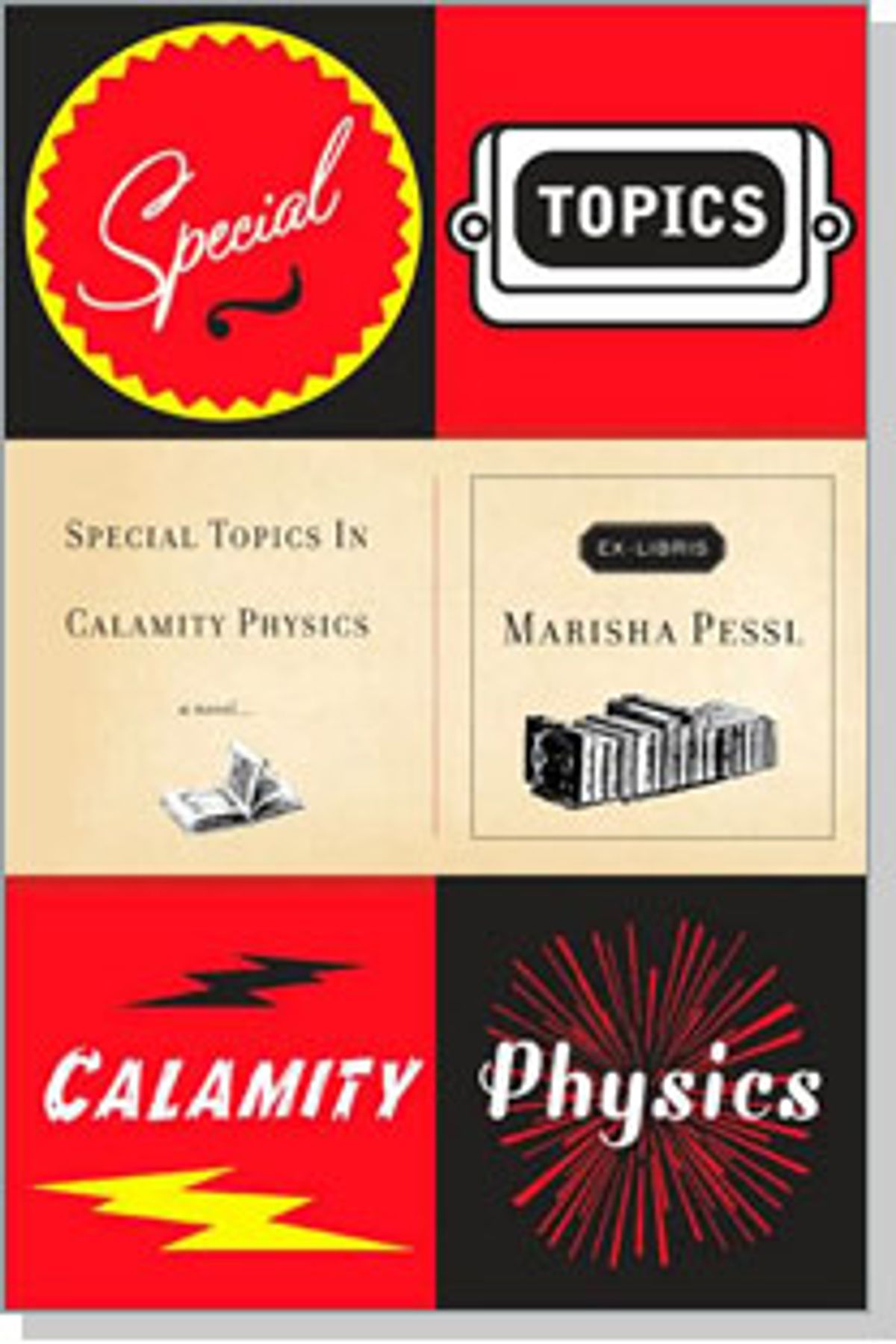
“Special Topics in Calamity Physics”

In an interview with Marisha Pessl and an excerpt from her book, we meet Blue van Meer, this year's most appealing teen.

  • more
    • All Share Services

Each chapter in “Special Topics” bears the name of a great work in the Western canon. Did you actually read all of those books and plays and poems — “Pygmalion,” “Things Fall Apart,” “Women in Love”? What prompted you to organize the book that way?

I did read them — some were assigned in high school, others were for fun, but most I read as a literature major in college. After I’d written a first draft of “Special Topics,” I wanted to find an inventive way Blue would organize the many parts of her story. Throughout the book, particularly at the outset, she interprets the world exclusively through the hundreds of books she’s read, so it seemed a natural extension of her character to organize the story in this way.

You managed to write an ambitious, exciting adult novel about a teenager, which isn’t an easy thing to pull off. What do you think it is about your heroine, Blue van Meer, that makes her so appealing to grown-ups?

I can’t speak for all grown-ups, but I suspect there’s an innate, cross-generational appeal in watching funny outcasts and shy loners like Blue bungle their way through the world. Or maybe it’s simply that everyone has an inner nerd. The other night at one of my readings, someone informed me that Blue was part of a burgeoning trend of American geeks, that there’s a new wave of cool dorks and techies in films and novels and it’s truly hip now to be square. He referenced “Napoleon Dynamite,” but I have to investigate this exciting phenomenon further.

I don’t want to give anything away, but the book has something to do with secret societies and ’60s counterculture. Were those things that you have always been interested in, or did they just come in handy for the book?

In college I studied ’60s and ’70s radicalism, student activism, forms of political violence, groups like the Weathermen, the Black Panthers, the Symbionese Liberation Army, the New Left. Part of this interest was because I’m a history buff, but I was also fascinated by the juxtaposition between ’60s student approaches to politics and the mindset of my own generation. Talk about marching, staging sit-ins today, most kids would laugh and tell you to hand over the remote; they don’t want to miss the latest episode of “The Real World: Tampa.” But a mere 40 years ago, students took these things seriously, saw protest as a viable means of changing civic and international policies. The 1999 arrest of Sara Jane Olson definitely inspired my plot. I also read a lot of Noam Chomsky. After a night reading Noam — secret societies, coverups, conspiracies, grand plots — it doesn’t seem so far-fetched.

I read that before “Calamity Physics,” you’d written two novels that didn’t go anywhere. Were they mysteries as well? How did you decide to work in that form?

They did go somewhere, actually, to the very back of my closet. No, I’ve been asked this question a lot because “mystery” seems to be a tawdry word in literary circles. But I tend to disagree. I think all great books are mysteries and all great characters sleuths. I don’t mean mystery in classic terms of the genre, but in the sense of secrets and unsolved problems; we, as readers, want to be surprised, we don’t want to know where we’re going. And we tend to root for characters who put themselves on the line and search for something, whether it’s a shady, murderous character or some sort of larger truth, like personal freedom or a deeper understanding of the world.

Had you read Donna Tartt‘s “The Secret History” before you worked on “Calamity Physics”? (I had to ask.) If you did, did you like it?

I read it in high school and thought it was fantastic.

What are you reading now?

“The Broken Estate” by James Wood.

Excerpt from “Special Topics in Calamity Physics”:

Pygmalion

The legendary Spanish conquistador Hernando Núñez de Valvida (La Serpiente Negra) wrote, in his diary entry of April 20, 1521 (a day he allegedly slaughtered two hundred Aztecs), “La gloria es un millón ojos asustados,” roughly translated as, “Glory is a million frightened eyes.”

This never meant much to me, until I became friends with them.

If the Aztecs regarded Hernando and his henchmen with fright, then the entire St. Gallway student body (more than a few teachers too) regarded Charles, Jade, Lu, Milton and Nigel with awe and outright panic.

They had a name, as all choice societies do. Bluebloods.

And daily, hourly (possibly even minutely) that posh little word was whispered and whined over in envy and agitation in every classroom and corridor, every lab and locker room.

“The Bluebloods catwalked into the Scratch this morning,” said Donnamara Chase, a girl who sat two seats away from me in AP English. “They stood in the corner and went, ‘Ew,’ to everyone who walked by to the point that Sam Christenson — you know that mannish sophomore girl? Well, she actually broke down at the beginning of Chemistry. They had to cart her off to the Infirmary and all she’d say was that they made fun of her shoes. She was wearing Aerosole pink suede penny loafers in a size nine and a half. Which isn’t even that bad.”

Obviously at Coventry Academy, at Greenside Junior High, there’d been the popular ones, the VIPs who cruised the halls like an arcade of limousines and invented their own tongue in order to intimidate like fierce Zaxoto tribesmen in the Côte d’Ivoire (at Braden Country I was a “mondo nuglo,” whatever that meant), but the asthma-inducing mystique of the Bluebloods was unparalleled. I think it was due in part to their diva foxiness (Charles and Jade were the Gary Cooper and Grace Kelly of our time), their for-real fabulousity (Nigel was so tiny he was trendy, Milton so vast he was vogue), their trippy confidence (there goes Lu proudly across the Commons, her dress on inside-out), but also, most singularly, because of certain tabloidal rumors about them, a lil’ somethin’ somethin’ and Hannah Schneider. Hannah kept a surprisingly low profile; she taught only the one class, Intro to Film, in a squat building at the edge of campus called Loomis, famous for laundering credit fillers like Intro to the Fashion Business and Woodshop. And as Mae West is quoted in the out-of-print “Are You Just Happy to See Me” (Paulson, 1962): “Y’ain’t nobody ’til you’ve had a sex scandal.”

Two weeks after my first dinner at Hannah’s, I overheard two senior girls slinging such sleaze in my second period Study Hall, held in the Central Reading Room of the Donald E. Crush Library, monitored by crossword-puzzle enthusiast Mr. Frank Fletcher, a bald man who taught Driver’s Ed. The girls were fraternal twins, Eliaya and Georgia Hatchett. With curly auburn hair, stout frames, shepherd’s-pie potbellies and alehouse complexions, they resembled two oily portraits of King Henry VIII, each painted by a different artist (see “The Faces of Tyranny,” Clare, 1922, p. 322).

“I don’t get how she got a job at this school,” said Eliaya. “She’s three sandwiches short of a picnic.”

“Who’re you talking about?” asked Georgia absentmindedly as she pored over colored photos in a magazine, VIP Weekly, her tongue sticking out the side of her mouth.

“Duh. Hannah Schneider.” Eliaya tipped her chair backward and drummed her fat fingers on the cover of the textbook on her lap, “An Illustrated History of Cinema” (Jenoah, 2002 ed.). (I could only assume she was enrolled in Hannah’s class.) “She totally wasn’t prepared today. She disappeared for fifteen minutes ’cause she couldn’t find the DVD we were supposed to watch. We were supposed to watch ‘The Tramp,’ but she comes back with friggin’ ‘Apocalypse Now,’ which Mom and Dad would go mental over — the movie’s three hours of harlotry. But Hannah was like planetary — didn’t have a clue. She puts it in, doesn’t even think about the rating. So we see the first twenty minutes and the bell rings, and then that kid Jamie Century, he asks her when we’re gonna see the rest and she says tomorrow. That she’s changing the syllabus around a little. I’ll bet by the end of the year we’re watching ‘Debbie Does Dallas.’ It was ghetto.”

“Your point?”

“She’s tweaked. Wouldn’t be shocked if she went Klebold.”

Georgia sighed. “Well, everyone and their grandmother knows she’s still banging Charles after all these years — ”

“Like a screen in a tornado. Sure.”

Georgia leaned closer to her sister. (I had to be very still to hear what she said.) “You really think the Bluebloods go all Caligula on the weekends? I’m not sure if I believe Cindy Willard.”

“Of course,” said Eliaya. “Mom said royals only bed royals.”

“Oh, right,” said Georgia, nodding, then breaking into toothy laughter, a sound like a wooden stool being dragged across a floor. “That’s how they keep their gene pool from getting contaminated.”

Unfortunately, as Dad pointed out, there’s often a seed of Truth within the Flash and Trash (he himself wasn’t above perusing a few supermarket tabloids while standing in line: “‘Plastic Surgery Smash-ups of the Stars’ — there’s something rather compelling about that headline.”) and I’ll admit, ever since I saw Hannah and Charles together in the courtyard on the first day of school, I suspected there was something clammy going on between them (though I’d decided, after a Sunday or two, while Charles was almost certainly infatuated with Hannah, her attitude toward him was pleasantly platonic). And though I was in the dark regarding the Bluebloods’ weekend activities (and would be until the middle of October) I did know they were quite preoccupied with maintaining the superiority of their line.

I, of course, was the one contaminating it.

* * *

My inclusion into their Magic Circle was as painless as the invasion of Normandy. Sure, we had faces eventually, but for the first month or so — September, the very beginning of October — though I saw them all the time peacocking through campus, and acted as hushed, horrified journalist to the anxieties they inspired (“If I ever see Jade injured, facedown in the street, homeless, riddled with leprosy — I’ll do humanity a favor and run her over,” pledged Beth Price in my AP English class), I only ever hung out with them at Hannah’s.

And obviously, during those first few evenings, the scenario was more than a little humiliating. Obviously it made me feel like a dumpy bachelorette on a reality show called In-sta-love no one wanted to take for drinks and I sure as hell could forget about dinner. I’d sit on Hannah’s shabby chaise lounge with one of her dogs, pretending to be transfixed by my AP Art History homework while the five of them talked in hushed voices about how “hard-core,” how “juiced,” they’d been on Friday at mysterious places they’d nicknamed “The Purple” and “The Blind,” and when Hannah emerged from the kitchen, immediately they’d hurl me greasy little sardine-smiles. Milton would blink, aw-shucks his knee and say, “So how’s it goin’, Blue? You’re awful quiet over there.” “She’s shy,” Nigel would observe, deadpan. Or Jade, who without fail dressed like a famous person working the red carpet at Cannes: “I love your shirt. I want one. You’ll have to tell me where you got it.” Charles smiled like a talk show host with poor Nielsen ratings and Lu never said a word. Whenever my name was mentioned, she examined her feet.

Reprinted by arrangement with Viking, a member of Penguin Group (USA) Inc., from “Special Topics in Calamity Physics” by Marisha Pessl. Copyright © 2006 by Marisha Pessl.

A sex traffic mystery

A new horror novel delves into the dark corners of the Internet as it investigates a girl's murder

  • more
    • All Share Services

A sex traffic mystery

Nobody concludes a novel quite the way Mo Hayder does: with a revelation that leaves the reader staring at the page, poleaxed, willing more words to appear or flicking back to see just how she did it. Hayder’s astonishing 2007 horror novel “Pig Island,” for example, ended with the stunned narrator, framed for murder, watching his nemesis depart and “something coiled and dark, like smoke or a spirit, lifting itself out of the car and hovering near the roof…” Now, on the final page of “Hanging Hill,” a mother lovingly watches her young daughter and a friend drive off to the Glastonbury Festival. “The van turned left. Not right, the way she would have gone…. Leave them alone, she thought…. You just can’t go on worrying about your children for ever.” Worrying: a quaint, domestic impulse; utterly redundant in the terrifying world that Hayder creates.

Barnes & Noble ReviewHere, as always, a Hayder plot that seems straightforward is masterfully skewed. In Bath, England, Lorne Wood, a privileged teenage beauty, is found horribly murdered beside a canal. Detective Inspector Zoe Benedict is led, by instinct as much as evidence, to suspect a connection to the sex trade and Internet pornography, a realm that Hayder evokes in all its dankness. “[M]ost of the time they’re doing it because it’s easier than standing behind a till at Top Shop for eight hours a day,” one avuncular pornographer tells Zoe of his “models.” Less benign are fetishistic practices “all about humiliating the woman.” As one jaded dame explains, this is what sells “by the shedload … Makes you wonder about human nature, don’t it?”

Zoe doesn’t wonder anymore. She has seen too much. And she has secrets of her own. But that is another story, one of a handful that Hayder expertly steers on parallel tracks as she shunts the murder investigation forward, then makes it stall or veer, all the while heightening our sense of dread. While Zoe courts danger by revisiting her past and pursuing Lorne’s likely killer, Zoe’s estranged sister, Sally, becomes the housekeeper for a nouveau-squire who exudes criminality and violence. Divorced, somewhat clueless, and mother to teenage Millie, Sally has little choice. She does, however, have a shady lover who reveals that Sally’s employer is involved with the Ministry of Defense, the UN mission in Kosovo, and sex trafficking.

These are filaments that flicker at the periphery of our anxious vision while Zoe and Sally demand our attention. Especially Zoe, who, like many female Hayder protagonists, is both wounded and feral. Slumped in a toilet cubicle, for example, her own blood dripping onto the floor, she resolves to “…take some time off work…. Sleep rough and drink Guinness out of the can.” Fueled by desperation more than courage, Zoe is as startling as the cinematic action scenes that Hayder so expertly stages. Shocks intensify — a nail gun comes into play, a body is dismembered, foul sex committed — while the tidal pull of Hayder’s intersecting narratives churns up tangled evidence that could incriminate Sally’s vile employer, a local drug dealer or a lovesick teenager. Toward the end, the sisters traverse moonlit farmland — “Two lonely figures casting long blue shadows…feet shushing the dead corn” — to confront Lorne’s killer and the final horror. Which is not, of course, the end at all.

Continue Reading Close

National Review asks why Obama reads critically acclaimed fiction instead of Jonah Goldberg

Conservative "intellectuals" examine the president's vacation book list -- and become concerned

  • more
    • All Share Services

National Review asks why Obama reads critically acclaimed fiction instead of Jonah Goldberg

Barack Obama is reading gritty rural neo-noir by an acknowledged master of the crime fiction genre, and the National Review is not happy with him. The president bought Daniel Woodrell’s “Bayou Trilogy,” along with a number of other novels, at a Martha’s Vineyard bookstore, and Tevi Troy, a “senior fellow at the Hudson Institute and a former senior White House aide” (“senior fellow at the Hudson Institute” means “minor Republican apparatchik in need of a paycheck while his party’s out of power”) is analyzing the president’s reading list for you.

The reports are in about the books President Obama is looking at on his annual trip to Martha’s Vineyard. According to reports from the Los Angeles Times and the AP, Obama purchased five books on his trip to the Vineyard bookseller Bunch of Grapes: Marianna Baer’s Frost, Aldous Huxley’s Brave New World, Daniel Woodrell’s Bayou Trilogy, Emma Donoghue’s Room, and Ward Just’s Rodin’s Debutante.

The second wave came when, according to Alexis Simendinger, White House aides listed for reporters the three books Obama brought with him to the Vineyard: two more novels — Abraham Verghese’s Cutting for Stone and David Grossman’s To the End of the Land — and one nonfiction work — Isabel Wilkerson’s The Warmth of Other Suns: The Epic Story of America’s Great Migration.

This “may constitute the oddest assortment of presidential reading material ever disclosed,” according to Troy. Because Woodrell’s books may be almost universally praised, but they are genre fiction, and genre fiction is too trashy for presidents to read. “Bill Clinton, for example, used to love mysteries, but he did not advertise the titles of what he once called ‘my little cheap thrills outlet.’” Even Bill Clinton knew better than to tell people he read books with crimes in them! (Can you imagine if Barack Obama was found to be hiding the fact that he read crime fiction? IMPEACHMENT.)

Also one of the novels is by an Israeli author, but it is by an Israeli author who criticizes Israeli policy, proving once again that Obama is no friend of Israel. “[R]eading this novel will likely not assuage those concerned about Obama’s views on the Middle East,” says Troy, and he should know, because he is the one using it to attempt to score an insane political point.

The best part (noted by Matt Yglesias) is when Troy asks why this bookstore’s online store doesn’t list horrible books written by National Review contributors as “in stock.”

Obama, like other Democratic presidents, has tended to read mainly liberal books, although he could stand to gain some insight from conservative ones. There could be many reasons for his selection bias, but buying his books at the “legendary” Bunch of Grapes probably is not helping matters. While I have never had the pleasure of shopping there, the store’s website highlights a variety of its offerings, with nary a conservative work. There may be some on the shelves there somewhere, but they are probably not staring Obama in the face when he visits the store.

According to the results of my completely unscientific survey of Bunch of Grapes’s website, Laura Ingraham’s Of Thee I Zing, Jonah Goldberg’s Liberal Fascism, and Mark Steyn’s After America were listed as available for online ordering. Thomas Friedman’s Hot, Flat, and Crowded, which appeared as an Obama book selection twice, in 2008 and 2009, was listed as “In Stock.” This is not meant as a criticism of the bookseller; Bunch of Grapes is running a business, and they need to cater to the liberal crowd at Martha’s Vineyard in order to bring in customers. At the same time, if Obama wants to diversify his reading selections, Bunch of Grapes may not be the place to go.

Why would Bunch of Grapes stock Emma Donoghue’s “Room,” a novel Aimee Bender called “truly memorable” and “remarkable,” when they could stock Jonah Goldberg’s “Liberal Fascism,” a book that the American Conservative says “reads less like an extended argument than as a catalogue of conservative intellectual clichés, often irrelevant to the supposed point of the book”? Liberal bias, that’s why. Liberal fascist bias.

Anyway, the president is “out of touch” and “in a bubble” because he can read, according to a conservative intellectual, at a “think tank.”

Continue Reading Close
Alex Pareene

Alex Pareene writes about politics for Salon and is the author of "The Rude Guide to Mitt." Email him at apareene@salon.com and follow him on Twitter @pareene

The latest “Game of Thrones” casting news

Gwendoline Christie, Natalie Dormer join with houses of Tarth and Tyrell

  • more
    • All Share Services

The latest British actress Gwendoline Christie, a new "GoT" cast member.

George R.R. Martin’s blog, “Not a Blog” (it’s a LiveJournal), posted a cryptic message yesterday, about bunnies and Aussies and barbicans.

Since the tag was “Game of Thrones” and “HBO,” the collective Internet began salivating as it tried to unravel the mystery. Surprisingly, some people got it.

Turns out all these references were clues about the casting of Brienne, Maid of Tarth, a character that appears in the second “A Song of Fire and Ice” book. British actress Gwendoline Christie snagged the coveted role of a woman described as “piggish” and “awkward” in the books, who is mocked with the nickname “Brienne the Beauty” because she is well … not.

Christie however, is quite a looker, though I see where Martin saw the female knight in her: The actress is 6’3.

Martin revealed the meaning of his riddle later that night:

As for my clues … Christie played in a music video called DAMARIS, which includes a song about Isabelle, the She-Wolf of France (wife of King Edward II, for the history nerds out there), and played in Shakespeare’s CYMBELINE at the Barbican theatre. She also posed for Australian photographed Polly Borland for a show called “Bunny.”

She also appears in the recent Imaginarium of Doctor Parnassas, though I did not use that one in my clues.

Here’s Gwendoline in action, in a (very) short NOMAD film called “Ourhouse.”

Oh yeah, she’s going to be great.

An earlier announcement has pegged “The Tudors” actress Natalie Dormer to play 16-year-old Margaery Tyrell.

Continue Reading Close

Drew Grant is a staff writer for Salon. Follow her on Twitter at @videodrew.

Pick of the week: A natural-born Romanian killer

Pick of the week: From the Romanian New Wave's greatest director comes the inside-out murder mystery "Aurora"

  • more
    • All Share Services

Pick of the week: A natural-born Romanian killerCristi Puiu in "Aurora"

It’s tough to say where Romanian director Cristi Puiu’s dark and mesmerizing new film “Aurora” ranks on the “cultural vegetables” scale. On one hand, it’s a bone-dry existential comedy, or perhaps a reverse-engineered murder mystery, that runs almost three hours and is far more concerned with capturing the rhythms and rituals of everyday life than with delivering a plot. On the other hand, “Aurora” tells an inherently dramatic story about the moment when an ordinary guy snaps the tether, goes out and buys a gun, and proceeds to wreak bloody vengeance on the world. This is something like “Falling Down,” that Joel Schumacher movie with Michael Douglas, as remade by Andrei Tarkovsky or Chantal Akerman.

In the first sentence above, I’m referring to a recent kerfuffle among film critics that began with a New York Times Magazine article by Dan Kois and continued with responses by Times critics Manohla Dargis and A.O. Scott and numerous others (including yours truly). This included various allegations of crimes against art and totalitarian groupthink, along with unhelpful discussion of the meaning of the word “boring.” Thankfully, the schism that was conjured up between intolerable art-house snobs and lightweight slaves of Hollywood is mostly imaginary. Hardly anyone who cares about cinema only likes one kind of movie, or judges every movie by the same standard. Right now, I’m suggesting that you should catch “Aurora” (with the parenthesis that it’s not going to be everybody’s cup of bitter Romanian coffee), and I’d say almost the same thing, with slightly more apologetic eye-rolling, about “Transformers: Dark of the Moon.”

Still, that debate provided an interesting background for “Aurora,” which I found to be a gritty, atmospheric and nerve-wracking work that powerfully evokes the disordered mental condition and depressed surroundings of its middle-aged protagonist (played by Puiu himself). I totally get that the idea of watching a three-hour film in Romanian is daunting, but once I adjusted to Puiu’s rhythms I was fully engaged. That said, if you go in expecting a conventional mode of narrative and explication, where every scene advances us further into the plot in some specific way, and you understand who all the people are and how they relate to each other, then this movie will frustrate you and drive you completely freakin’ nuts.

As in the film that made Puiu’s international reputation, “The Death of Mr. Lazarescu,” the narrative of “Aurora” is turned upside-down, or maybe inside out. The earlier movie tells us what’s going to happen in the title, and then we don’t, in fact, witness the death of Dante Lazarescu, only the entirely ordinary day full of quarreling neighbors and distracted nurses and mechanical malfunctions that’s going to be the last one of his life. Instead of the intense subjectivity of most movies, where the hero’s trials and tribulations become the focus of heightened and artificial drama, Puiu pulls back to a more objective view, reminding us that momentous events in the real world don’t come with a pulsing soundtrack or a temporary suspension of the universal tendency toward entropy.

Puiu’s character in “Aurora,” who we eventually learn is named Viorel, may be having a worse day than Mr. Lazarescu, if that’s possible. A taciturn and nearly affectless fellow of 40 or so, he skulks through the streets of Bucharest, by car and by bus and on foot, with a haunted look in his eyes. Viorel appears to be a family man, at least in the deceptively calm opening scene, but things have evidently gone wrong somehow (and trust me, it’s not worth trying to figure it out). He appears to be following a blond woman (not his wife) with small children, although we don’t know who they are; he has fragmentary conversations we can’t hear or can’t understand; he acquires a shotgun and some ammunition and spends some time considering suicide before deciding on, shall we say, a more extroverted path. But the startling eruptions of violence in “Aurora” are momentary, and occur either outside the frame or deep in the middle distance. They emerge from a life full of other things: Even as Viorel is noticeably sliding into insanity, he haggles with movers, stands in line at the deli, collects some ironed shirts from his mother, has a testy exchange with his stepfather and a cordial one with a neighbor over water damage accidentally caused by an enthusiastic kid in the bathtub.

Puiu’s films belong to a recognizable tradition of Eastern European social comedy, and depict post-Communist Romania as a place where everybody feels aggrieved at everybody else and where nothing can ever happen without a great deal of pointless argument and defensive grumpery. In a way, that’s the joke of the film, that even a guy going on a killing spree has to navigate the tremendous hassle of Romanian society, and that nobody much cares. I don’t think Puiu is blaming Romania’s depressed and contentious national mood for Viorel’s crimes, exactly; Americans are all too aware that this sort of thing can happen anywhere. Mordant, anti-psychological and masterfully shot (by Viorel Sergovici), “Aurora” is both a mystery and a mysterious accomplishment. It may demand multiple viewings, both to understand a bit more about what’s going on and also, if you get me, to figure out what the hell is going on.

“Aurora” is now playing at the IFC Center in New York, and will open Aug. 27 at the Harvard Film Archive in Cambridge, Mass., with other cities and dates (and home-video release) to follow.

Continue Reading Close

Heiress’ long-hidden art will go on display

Huguette Clark hoarded works by Monet, Renoir, and John Singer Sargent -- and in her will, has started a museum

  • more
    • All Share Services

Heiress' long-hidden art will go on displayFILE - This Aug. 11, 1930 file photo shows Mrs. Huguette Clark Gower, daughter of the late Sen. William A. Clark of Montana, a copper magnate, in Reno, Nev. Clark, the 104-year-old heiress to a Montana copper fortune who once lived in the largest apartment on Fifth Avenue, died Tuesday, May 24, 2011, at a Manhattan hospital even as an investigation continues into how her millions were handled. (AP Photo, File)(Credit: AP)

Mysterious multimillionaire Huguette Clark was born into privilege and died, more than a hundred years later, in almost total solitude. While there was plenty of interest in her death last month, very little information could actually be reported: She hadn’t been seen in public for decades, and few could guess what might happen to her $400 million fortune and uninhabited luxury properties in California, New York and Connecticut.

In her May obituary, the Los Angeles Times described Clark as “a copper tycoon’s daughter with a taste for exquisite French dolls, baronial homes and solitude;” the New York Times labelled her “the last link to New York’s Gilded Age” — a relic from “the city’s glory days of Astors, Guggenheims and Vanderbilts.” Clark had been raised in a different world, and (or so the papers implied) she seemed to have stayed there, isolating herself from the twenty-first century and its inhabitants.

Indeed, Clark might have died in relative obscurity (as much obscurity as someone worth $400 million can achieve, at least) had it not been for several MSNBC features published last year, including one that questioned the motives of those who cared for the heiress, asking provocatively: “Who protects an old lady who secluded herself from the world, limiting her life to a single room, playing dress-up with her dolls and watching cartoons?” The piece ignited interest in Huguette, ensuring that plenty of eyes would be trained on her estate in the instance of her demise.

Now that Clark has died, questions about her estate and vast personal holdings are finally being answered. The heiress’ will was released this week — you can read the entire document here (pdf), courtesy of the New York Post — and it has some interesting bequests.

Part of Clark’s immense estate will be used to start a new fund, the Bellosguardo Foundation, “for the primary purpose of fostering and promoting the Arts.” The showpiece of the foundation will be Bellosguardo itself: Clark’s grand California home, set on 23 acres and reportedly worth $100 million. The property will be made into a museum — filled with art (including paintings by Renoir and John Singer Sargent), musical instruments (including a Stradivarius), and rare books, all moved west from Clark’s kingly 42-room Fifth Avenue apartments. Clark herself had apparently not visited Bellosguardo “for at least 50 years” before her death; now, the house will likely attract large crowds.

Not all of Clark’s art will go to the California estate, however; a $25 million Monet — one of the “Water Lilies” paintings — has been left to Washington, D.C.’s Corcoran Gallery, which already has a wing named after Clark’s senator father (and owns his 775-piece art collection).

As to the people who will personally profit from Clark’s will — including, prominently, the heiress’ longtime nurse — The Atlantic Wire has assembled a handy cheat sheet. Clark left nothing to her relatives, whom her attorney, Wallace Bock, says she “knowingly and assiduously avoided” over the years.

One million dollars will be split between Bock himself and Clark’s accountant, Irving Kamsler, both of whom fell under suspicion for mismanagement of Clark’s wealth when last year’s MSNBC report was released. “The Manhattan district attorney’s office is investigating how Mr. Bock and Mr. Kamsler have handled Mrs. Clark’s money, according to a person briefed on the case who spoke on the condition of anonymity,” The New York Times reported Wednesday.

Continue Reading Close

Emma Mustich is a Salon contributor. Follow her on Twitter: @emustich.

Page 1 of 17 in Mysteries