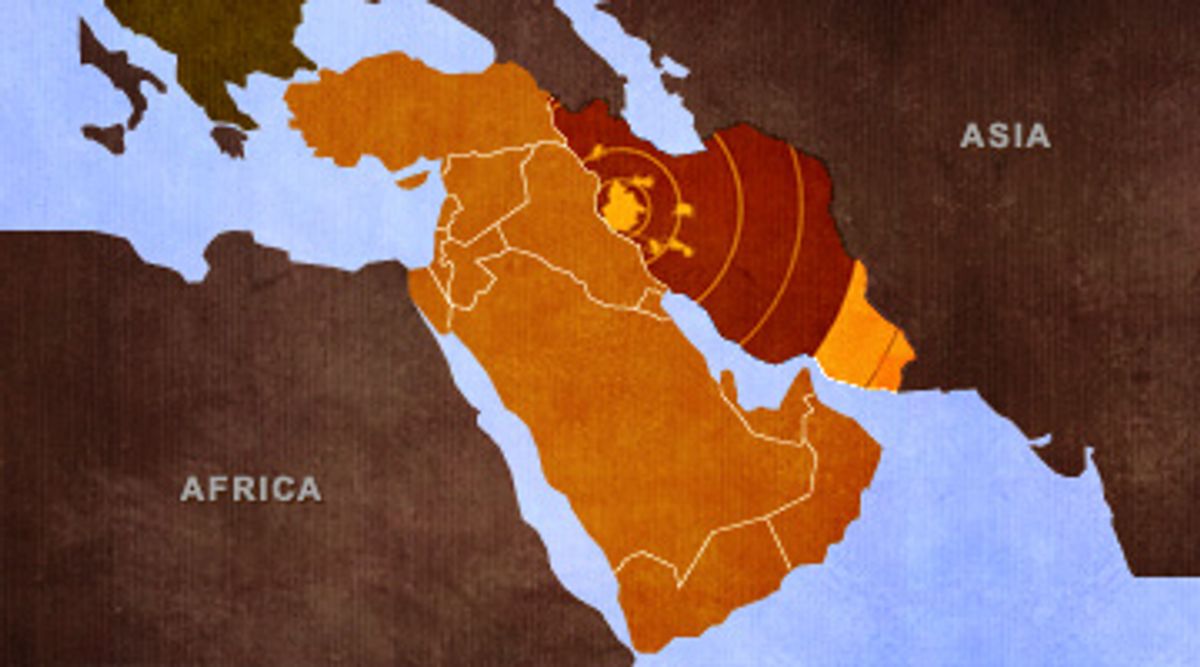
George W. Bush last week announced that American troops in Iraq were henceforth authorized to "kill or capture" any Iranian intelligence agents they discovered in Iraq. The announcement came on the heels of his pledge in the State of the Union address to bring another aircraft carrier into the Persian Gulf, a move that clearly targeted Iran. A prominent Iranian parliamentarian responded to Bush's threat by saying, "Such an order is a clear terrorist act and against all internationally acknowledged norms." Iraq's deputy prime minister, meanwhile, put a pox on both Iran and the U.S. for conducting their geopolitical battle on Iraqi soil.
The danger of Bush's approach may be realized in short order. Tuesday, Jan. 30, marks the 10th day of Muharram, and is the Islamic holy day known as Ashura. Iraq is the Shiite holy land, the site of the passion and martyrdom of revered figures such as Ali, the son-in-law of the Prophet Mohammed, and al-Husayn, the Prophet's grandson. Thousands of Iranians come on pilgrimage to the Shiite shrine cities of Najaf and Karbala in Iraq every year, and the flow of pilgrims peaks at Ashura, which commemorates the martyrdom of al-Husayn. Ashura is an especially important holiday to Shiites, drawing up to 1 million pilgrims to Karbala, 60 miles southwest of Baghdad. In 2004 Sunni insurgents exploited the presence of so many Shiite pilgrims by setting off massive explosions that killed more than 100 people.
Given Bush's new directive, how will U.S. troops distinguish between innocent Iranian devotees and spies? What if U.S. troops kill pilgrims in a mistaken belief that they are covert operatives? Leaving aside whether U.S. law authorizes such a broad, vague use of deadly force against foreign nationals, which is unclear, Shiite religious sensibilities would be inflamed in both Iraq and Iran, furthering the potential for a widening conflict.
Or maybe the spark for a wider conflict is just what the increasingly desperate President Bush seeks. His fixation on Iranian activities in Iraq cannot be explained by his cover story, which is that Tehran is supplying weapons to forces that kill U.S. troops. To date, no hard evidence that the Iranian government is sending high-powered weaponry into Iraq has been made public, and no credible proof may be forthcoming. In general, one should take such claims with a large grain of salt, much like the skepticism with which one should greet the official U.S. story about the firefight in Najaf on the weekend that supposedly claimed the lives of 250 insurgents.
To begin with, some 99 percent of all attacks on U.S. troops occur in Sunni Arab areas and are carried out by Baathist or Sunni fundamentalist (Salafi) guerrilla groups. Most of the outside help these groups get comes from the Sunni Arab public in countries allied with the United States, notably Saudi Arabia and other Gulf monarchies. Washington has yet to denounce Saudi aid to the Sunni insurgents who are killing U.S. troops.
Meanwhile, the most virulent terror network in Iraq, which styles itself "al-Qaida in Mesopotamia," has openly announced that its policy is to kill as many Shiites as possible. That the ayatollahs of Shiite Iran are passing sophisticated weapons to these, their sworn enemies, is not plausible.
If Iran is providing materiel to anyone, it is to U.S. allies. Tehran may be helping the Supreme Council for Islamic Revolution in Iraq and its Badr Corps paramilitary, but the U.S. is not fighting that group. By sale or barter, some weaponry originally given to the Badr Corps might be finding its way to other groups, such as the Mahdi Army of nationalist Shiite cleric Muqtada al-Sadr, that do sometimes come into conflict with the U.S. That problem, however, must be a relatively small one, and cannot explain Bush's hyperbolic rhetoric about Iran.
Some of the reports of "thousands" of Iranian agents in Iraq come from the Mojahedin-e Khalq terrorist group, which is made up of Iranian expatriates who display a cultlike devotion to their leader, Maryam Rajavi. An enemy of Tehran, responsible for numerous bombings inside Iranian borders, the MEK was given a terrorist base, "Camp Ashraf," in eastern Iraq by Saddam Hussein. When the U.S. invaded Iraq, some Pentagon figures wanted to use the MEK against Tehran in the same way Saddam had, and the MEK fighters have not been expelled from the country. They now supply disinformation about Iran to the U.S. in order to foment conflict, much as Ahmad Chalabi lied in order to sell the Americans on invading Iraq.
That the U.S. is in search of a rationale for a wider conflict is supported by the fact that it has arrested Iranian officials inside Iraq on two occasions in the past six weeks. In December, U.S. troops raided the compound of Shiite cleric Abdul Aziz al-Hakim, the leader of the largest bloc in parliament, made up of fundamentalist Shiites, and discovered several visiting Iranians there. Some were briefly detained and then allowed to leave the country. Two others were delivered to Iraqi government custody and accused of being high-ranking intelligence officers of the Quds Force unit of the Iranian Revolutionary Guard Force. Baghdad at length let them go, as well.
Al-Hakim, as well as Iraqi President and Kurdish leader Jalal Talabani, indignantly insisted that they had invited the Iranians to the country, protests that seem strange if the Iranian visitors were harming Iraqi interests. Press reports on the documents the U.S. captured in the raid were contradictory. American newspapers said that they indicated Iranian arms smuggling and included plans for ethnic cleansing of Sunnis in Baghdad. British intelligence officials told the BBC, in contrast, that the documents did not mention arms but indicated that the Iranians had come to consult about the cabinet shuffle planned by Prime Minister Nouri al-Maliki, head of the fundamentalist Shiite al-Dawa party, the largest bloc in the legislature.
The U.S. then launched a raid in the far northern Kurdish city of Irbil on an incipient Iranian consulate, there by the invitation of the Kurdistan Regional Government. Troops captured five Iranians, which the U.S. accused of being intelligence operatives. Again, the Iraqi Kurdish officials expressed annoyance and affirmed that the paperwork had been submitted for the establishment of the consulate.
There are very few U.S. troops in the northern Kurdish regions, and the Iraqi Kurds are close allies of the United States. How Iranian activities in Irbil could possibly pose a threat to American troops is completely mysterious. Why Washington would order arrests of persons designated as guests by Iraqi government officials is also obscure.
Maybe what is really going on is that the Bush administration finds itself competing with Iran for influence with erstwhile allies in Iraq and losing. Abdul Aziz al-Hakim was feted at the White House on Dec. 4 of last year and said he wanted U.S. troops to remain in the country. His contacts with Iranian officials, whether intelligence operatives or not, pose no military threat to the U.S., since he is a Bush ally. They might, however, pose a political threat insofar as al-Hakim's Supreme Council for Islamic Revolution in Iraq can act with more independence from Washington if it receives aid from Tehran. At the invitation of the Iraqi government, Iran has now offered to expand its economic presence in Iraq.
As Washington grows weaker in Iraq, it is concerned that Iran not pick up the pieces and establish hegemony over its smaller neighbor. The Bush administration may also be casting about for some issue that will galvanize the American public and give it a pretext to expand its presence in Iraq despite how badly the war has gone. Any leaders of a failing war effort are always tempted by a strategy of escalation. Announcing open hunting season on all Iranian visitors to Iraq is like playing Frisbee with nitroglycerin. Bush has gone looking for trouble and is likely to find it.
Shares