PBS

Arming our enemies?

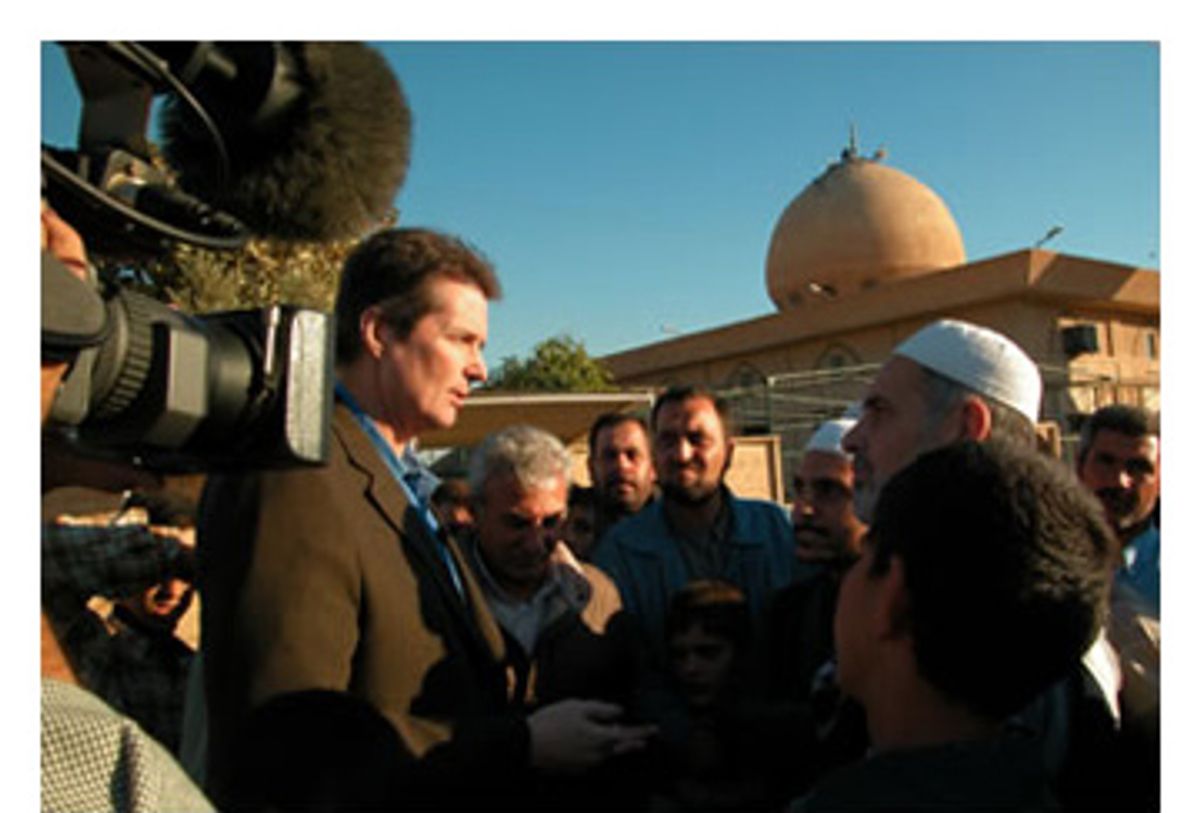
An interview with journalist Martin Smith, the maker of a new PBS documentary on Iraqi militias, about how the U.S. strategy of Iraqification could backfire.

Our strategy in Iraq has long been based on training homegrown security forces there; in the formulation of the president, “As the Iraqis stand up, we will stand down.” But what happens if the Iraqi soldiers and police we stand up have their own agenda, not that of a unified Iraq but that of the sectarian militias that are tearing apart the country, and especially of Muqtada al-Sadr, the radical Shiite cleric who controls the powerful Mahdi Army? According to some observers, including Tom Lasseter, a reporter for the McClatchy chain of newspapers, that’s what’s happening.

Martin Smith has seen the situation up close. In more than 30 years working for ABC News, for PBS’s “Frontline” and for his own independent production company, RAIN media, Smith has won every major television journalism award, including the Emmy and the Alfred I. duPont. “Gangs of Iraq,” an episode of an upcoming PBS series of documentaries called “America at a Crossroads,” which will debut in April, is his fourth movie about the country since the U.S. invasion. It looks at the influence of militias in the country, and how that has hampered the U.S. effort to raise and train functional Iraqi army and police forces. Some of the scenes show just how serious the infiltration of militia and sectarian influence has been — one, for example, depicts Shiite Iraqi soldiers, on a raid with their American trainers, realizing that a bigger arms cache than the one they’ve found is held by a Shiite cleric to whom they are loyal. The Iraqi soldiers don’t tell their American allies.

Salon spoke with Smith on Feb. 2.

What’s the extent of Mahdi Army sympathy or involvement, within the Iraqi army, that you saw while you were in Iraq?

Well, it’s all anecdotal because there’s no scientific measure of this, but if you talk to commanders, whether they’re American advisors to the police or to the army, or if you talk to Iraqi commanders, they’ll all tell you it’s a problem. And you see it most graphically in [U.S. commanders'] refusal to inform the Iraqis of the missions they’re going on. When they’re going out with the Army, the Iraqis are not informed as to where they are going. In [one case] they were told they were going away for several days so they wouldn’t even suspect that the raid was [to occur] less than a mile away from the base.

We were with the police on some routine patrolling, and before the patrol set out, the American in charge, the American who was embedded with the Iraqi police team, frisked all of the policemen, looking for cellphones. And when we asked him why he had to do that, he said, “Because they could call up their friends in the militias” — he was talking about the Mahdi Army in this particular case — “and inform them as to our whereabouts and that we’re coming to this place or that place.” So that’s kind of the sum of what we saw.

Did you get the sense that what the U.S. is doing is essentially training the Mahdi Army?

We’re not training the Mahdi Army by intent, but we’re providing training for people who may take our training program and then go join the militias. This is another problem that we found, and again the American commanders can tell you this; there’s no good accounting system. When police — and I should add that the problem is greater in the police than it is in the army — [graduate] from the training program, [the trainers] don’t have a good way to monitor where they go after that. Because the police go into small villages or into a neighborhood, there’s no effective system set up for figuring out if they in fact after training go and rejoin their regional [police] units. [U.S. and Iraqi authorities] know, in fact, that some of them don’t. As early as August ’04, there are photographs of uniformed Iraqi police celebrating with the Mahdi Army after a battle in Najaf. Starting in April ’04, with the first assault on Fallujah, a battalion refused to go fight; they told their American commander that they didn’t sign up to fight other Iraqis.

There’s a disturbing scene in your film, in which Iraqi soldiers go on a raid with U.S. troops and you catch the Iraqi soldiers talking about how the weapons they found are “child’s play,” not a real arms cache. Can you describe that scene?

We went in on this raid with the Iraqi army in Mahmoudiya, which is in the so-called triangle of death south of Baghdad. We were going into a Shiite neighborhood, and we were told, although the Iraqi army wasn’t told, that we were going to raid what they call a “JAM cache,” a Jaish al-Mahdi, or Mahdi Army, arms cache. When we got there, a cameraman and I, we were both filming; we didn’t have an [Arabic] translator with us because our translator had not been able to join us because his brother had been kidnapped and tortured. So without a translator, we were just filming what we could. And it was pure instinct of Tim Grucza, the cameraman, to film these guys as they were muttering off to the side. We had no way of knowing what they were saying. And when we got back to the editing room here and we had it translated, we discovered that what [the Iraqi soldiers] were talking about, at this raid, was that the weapons the soldiers had collected were just “kids stuff,” and that the real stuff was at [their cleric's] place. They muttered on about how this was just child’s play or kids stuff, and they didn’t tell the Americans anything about this. It clearly shows that they’re not really pulling with their U.S. buddies.

The people who are joining the army and the police force, do they have another agenda for joining separate from helping to create a secure Iraqi state?

In the case of the police force after the January 2005 elections, there were a number of firings of Sunni leaders in the Ministry of the Interior, and Badr Corps [the militia unit of the SCIRI, a Shiite political party] people were brought into leadership positions, and there was a definite sectarian taint for many police units. Whole units were brought in intact from the Badr militia, according to some accounts that we were told. How one goes out and establishes all of this is problematic, but there are numerous reports of whole units of Badr Corps coming intact into the ministry to work in the police forces.

In instances like that or in instances where there’s Mahdi Army infiltration, are we arming the militias?

Well, that’s the fear of one of the principal advisors of the Ministry of the Interior, who said that his greatest fear is that all we have been doing is training and equipping the Iraqis to fight a civil war. It certainly wasn’t our intent to do that, but in practice people have received training who have then gone back and fought with their militia.

So do you think trying to “stand up” a national army at this point might be a futile effort?

It’s the centerpiece of our policy, but as I’ve said, trying to get people to form a national police force in the middle of a civil war is a very difficult, if not impossible, task. It’s like going into Kentucky during our Civil War and getting people from the North and the South. If you put them in a unit together, you expect them to fight together in the interests of what?

It’s just hard to imagine how you train sectarianism out of people when the situation in the country is so insecure that people feel, legitimately, that they need a militia to protect their neighborhood. People don’t trust, don’t have faith, in a neutral army. The Sunnis fear it. It’s a pretty discouraging situation, I’m sorry to say.

We have another scene in the documentary at the [police] training center in Jordan. Back in December [U.S. and Iraqi authorities] opened this massive training center in Jordan. They figured they couldn’t open a police training center in Iraq because of safety issues, so they opened it in Jordan and they brought all these trainers in from all over the world. And we have these scenes of them trying to indoctrinate Iraqis with patriotism, with loyalty to the national entity, and to identify with Iraq and not first and foremost with their sect or their militia. I guess the only way to describe it is to say it’s embarrassing at best to see this guy, kind of like a football coach, trying to get these people to pledge allegiance to their own flag. You have to see it to believe it.

When your documentary premieres, what do you want people to take away from it?

I just want them to understand why there’s so much killing going on. I mean, we open the documentary, we’re with some troops and we find a body on the streets of a Sunni neighborhood, presumably a Sunni man who was kidnapped. He has been mutilated, tortured, killed and dumped near a garbage pile, where we found him. We then have scenes at the morgue, scenes at a graveyard. That’s the reality of Baghdad today, and that’s where we begin — with sort of wanton killing. So what we’re trying to do is go back and try to understand why the killing continues, why the civil war [exists]. We do it through looking at the effort, which is the centerpiece of [U.S.] policy, to stand up the Iraqi troops, and how that has run squarely into the militia and sectarian problems, and how those troops that we’ve tried to train, and spent billions on — I think $14 billion and counting — have been infiltrated by militia, or by people with sectarian loyalties above national loyalties.

We’re hearing a lot about a change in policy, but I don’t understand what that change is. We’re putting in 21,000 extra troops, perhaps, but the centerpiece of the policy remains training the Iraqis to run their own country and [then] getting out. Regardless of what we do in the meantime in terms of quelling some violence, securing and holding for a period of time certain neighborhoods, the fact of the matter is that the only way we [can] get out is either we turn around and walk out now or we continue to train and we get to a point where we think they can handle it, and we walk away. That’s the centerpiece. So our documentary focuses on that training effort and what it has run into.

Alex Koppelman is a staff writer for Salon.

Super PACS hit “Sesame Street”

The recent court ruling to allow political ads on PBS and NPR reflects the same flawed "logic" as Citizens United

A couple of weeks ago, we wrote about how the media giants who own your local commercial television and radio stations have been striking like startled rattlesnakes at an FCC proposal that would shed a light on who’s buying our elections. The proposed new rule would make it easier to find out who’s bankrolling political attack ads by posting the information online.

The stations already have the data and are required by law to make it public to anyone who asks. But you can get only it by going to the station and asking for the actual paper documents – what’s known as “the public file.” Stations don’t want to put it online because — you guessed it — that would make it too easy for you to find out who’s putting up the cash for all those ads polluting your hometown airwaves.

If approved, the new rule would require the ABC, CBS, NBC and Fox affiliates in the top 50 markets to make their files on political advertising available online immediately. Other stations would have a two-year grace period.

In the meantime, the mighty giants of broadcasting have been fighting back. A number of senators serving the industry have spoken up against the proposal and the National Association of Broadcasters (NAB) — led by their top lobbyist and president, the frozen food millionaire and former Oregon Republican Senator Gordon Smith – have been meeting with commissioners urging them to scuttle its proposal or at least water it down until it means nothing.

As Jeffrey Rosen of The New Republic magazine wrote:

“The arguments against transparency offered by the networks show that, having experienced the windfall of advertising dollars that Citizens United unleashed, they have little interest in meeting their legal and ethical responsibility to serve the public interest.”

The FCC is scheduled to vote on their proposal on April 27, and on Monday its chairman, Julius Genachowski, walked into the lion’s den – the really nice one in Las Vegas – and addressed the NAB’s annual convention. He noted that, “Using rhetoric that one writer described as ‘teeth-gnashing’ and ‘fire-breathing,’ some in the broadcast industry have elected to position themselves against technology, against transparency, and against journalism.”

He added, “[T]he argument against moving the public file online is that required broadcaster disclosures shouldn’t be too public. But in a world where everything is going digital, why have a special exemption for broadcasters’ political disclosure obligation?”

Whatever the result on the 27th, those negative attack ads already are cluttering the airwaves like so much unsolicited junk mail and it’s only going to get much, much worse as the super PACs, political parties, the moguls and tycoons, many acting in secrecy, lavish perhaps as much as three billion dollars on local stations between now and November.

But now there’s something new in the mix, especially appalling to anyone who truly cares about public broadcasting. On April 12, by a vote of 2-1, two of three judges on the 9th U.S. Circuit Court of Appeals found in favor of KMTP, a small public station in San Francisco, and struck down the federal ban against political and issue advertising on public TV and radio. For decades there’s been a rule against turning those airwaves over to ads for political campaigns and causes. Now the court has ruled that the free speech rights of political advertisers take precedence.

Imagine if you turned on your TV set someday soon and were greeted by “Sesame Street,” brought to you by the letter C, for “creeping campaign cash corruption.” Perhaps that’s a bit of a stretch, but as the late William F. Buckley, Jr., used to say, the point survives the exaggeration.

If ever there was a camel’s nose under the tent, this is it – and we don’t mean one of those humped creatures that show up on PBS’ “Nature” or an episode about backpacking through Egypt on “Globe Trekker.” The current public system was signed into law by President Lyndon Johnson in 1967. “It will get part of its support from our government,” Johnson said, “but it will be carefully guarded from government or from party control. It will be free, and it will be independent — and it will belong to all of our people.”

The Public Broadcasting Act uses the word “noncommercial” 16 times to describe what public television and radio should be. And it specifically says that, “No noncommercial educational broadcasting station may support or oppose any candidate for political office.” We’ve taken that seriously all these years, and most of us who have labored in this vineyard still think public broadcasting should be a refuge from the braying distortions and outright lies that characterize politics today — especially those endless, head splitting ads.

But in its majority decision the court wrote, “Neither logic nor evidence supports the notion that public issue and political advertisers are likely to encourage public broadcast stations to dilute the kind of noncommercial programming whose maintenance is the substantial interest that would support the advertising bans.”

Sorry, your honors: This is the same so-called “logic” that led the U.S. Supreme Court to issue its notorious Citizens United decision, the one that opened all spigots to flood the political landscape with cash and the airwaves with trash.  “To be truthful” one former PBS board member said, “it scares me to death.” Us, too.

The court decision did uphold the ban on public broadcasting selling ad time for commercial goods and services, although, as corporations and others cover the cost of programming through what’s euphemistically referred to as “enhanced underwriting,” public TV already is close to the line of what differentiates it from commercial broadcasting.

And understandably, with our stations always in a financial pickle, frantically hanging on by their fingertips, it won’t be easy to turn down those quick bucks from super PACs and others. But hang in there, brothers and sisters in the faith: If ever there was a time for solidarity and spine, this is it.

Stations KPBS in San Diego and KSFR, public radio in Santa Fe, have said they won’t do it. If enough of you say no, this invasion might be repelled. And viewers, they need to know you’re behind them.

Continue Reading Close

Bill Moyers is managing editor of the new weekly public affairs program, "Moyers & Company," airing on public television. Check local airtimes or comment at www.BillMoyers.com.

Michael Winship is senior writing fellow at Demos and a senior writer of the new series, Moyers & Company, airing on public television.

What PBS owes the public

The station has pushed its signature documentary series into shoddy time slots. America deserves better

Neither of us is old enough to have been fooled by the Trojan Horse (see Wikipedia). But we each have been working in public television decades enough to remember the days when distribution was handled by physically transporting bulky 2-inch videotapes from station to station — “bicycled” was the word — and much of the broadcast day and night was devoted to blackboard lectures, string quartets and lessons in Japanese brush painting: The old educational television versions of reality TV.

Yet it also was a time of innovation and creativity. As the system evolved we saw bold experiments like “PBL — the Public Broadcasting Laboratory” and Al Perlmutter’s “The Great American Dream Machine,” each a predecessor to the commercial TV magazine shows “60 Minutes” and “20/20.”  The TV Lab, jointly run by David Loxton at WNET in New York and Fred Barzyk at WGBH in Boston, nurtured and encouraged the first generation of video artists — Nam June Paik, Bill Viola and William Wegman among others — and the early documentary work of such video pioneers as Jon Alpert and Keiko Tsuno of the Downtown Community Television Center, Alan and Susan Raymond, and the wild and woolly, guerrilla camera crews of TVTV.

The descendants of those pathfinders are the independent filmmakers whose works have not only re-energized the motion picture industry but also have vastly expanded the realm of the documentary — in both the scope of its storytelling and the size and diversity of its audience. Public television has faithfully provided an enormous national stage where non-fiction films can be seen by far more people than could ever buy tickets at the handful of movie houses willing to put documentaries up on their theater screens.

As Gordon Quinn of the independent documentary company Kartemquin Films (“Hoop Dreams”) told Anthony Kaufman of the website IndieWire, “In terms of having an audience in a democratic society, in terms of getting people talking about things, there’s nothing like a PBS broadcast. PBS is free, and it’s huge in getting into rural areas. That reach, all over the country, it’s a critically important audience that’s vastly underserved.”

Two PBS series have provided outstanding showcases for the work of new and established documentarians and between them have 13 Oscar nominations and 54 Emmys to prove it. For years, “Independent Lens” and “P.O.V.” held a nationwide time slot as part of the PBS core schedule on Tuesday nights, with public TV stalwart “Frontline” as a worthy lead-in, funneling to the independent films just the kind of audience that enjoys and appreciates documentaries.

But this season, PBS chose to move “Independent Lens” and “P.O.V.” to a new time slot — 10 pm, ET, on Thursday nights. This may not seem like such a big deal at first, until you know that on Thursday nights stations can broadcast any program they like in prime time, whether it’s part of the PBS schedule or not. Many take the opportunity to offers viewers locally produced programs, British sitcoms or reruns of “Antiques Roadshow.” As a result, episodes of the independent documentary series can now be run anywhere local stations choose to fit them in (here in New York, WNET airs the films at 11 pm on Sundays) or maybe not at all.

“P.O.V.” does not begin the new season — its 25th — until June, but as Dru Sefton first reported in the public broadcasting trade publication Current, in the first few months since “Independent Lens” was shuffled into its new Thursday time slot last October, ratings plummeted 42 percent from the same period last season. With programs scattered throughout the schedule in different cities, not only is it now more difficult for viewers to find them but coordinated national advertising and promotion campaigns are, at best, extremely difficult.

The team at PBS consists of dedicated people; all are our colleagues and many are our friends. They are constantly looking for ways to increase the audience that watches public television. But there is always a danger, in any organization, of  only seeing the world from the top down, and then counting heads to measure whether something is good or not. An open letter to PBS from Kartemquin Films says it well:

Public television is not just a popularity contest, or a ratings game. Taxpayers support public broadcasting because democracy needs more than commercial media’s business models can provide. PBS’ programming decision makes a statement about PBS’ commitment to the mission of public broadcasting.

It goes on to note the mandate cited in the recently revised and reissued Code of Editorial Integrity for Local Public Media Organizations: “Our purposes are to support a strong civil society, increase cultural access and knowledge, extend public education, and strengthen community life through electronic media and related community activities.”

Most of both our careers have been in public television. Our affection and gratitude for it abideth, but we are not blind to the problems. Public broadcasting’s ever-tenuous funding places it in a perpetual dilemma and forces it into a delicate balancing act. PBS provides programming like “Independent Lens” and “P.O.V.” that may not garner the most viewers but helps fulfill its essential mission of public service — and, candidly, attracts grants from kindred spirits who believe in a robust mix of ideas and visions. But to lure a wider audience, it also airs what our neighborhood diner calls “lighter fare” — whether entertaining, upscale imports  like “Downton Abbey,” home-grown, how-to programs like “This Old House” or  (during pledge drives) nostalgic reruns of  folk musicians, pop crooners, and financial and spiritual gurus — aimed at older viewers with, presumably, more disposable income.

Add to this the constant political pressures, especially from conservative politicians ever eager to cut off its funding (Mitt Romney says he wants to see commercials on “Sesame Street”), plus the self-censorship that all too often results, and you get a tendency toward orthodoxy and an aversion to controversy.

A PBS spokesperson told The New York Times that the service “is fully committed to independent films and the diversity of content they provide.” That can quickly be demonstrated by reversing a bad decision and returning to a national core time slot the independent documentaries created — often at real financial sacrifice — by the producers and filmmakers whose own passion is to reveal life  honestly and to make plain, for all to see, the realities of inequality and injustice in America.

Along with its open letter to PBS, Kartemquin Films published a petition and asked for signatures from independent filmmakers and their supporters. We two are among the more than 300 who have signed it as of this writing. If you think the creativity and unique visions of  life captured by independent producers, journalists, and filmmakers deserve the best possible platform on public television, you can read and sign it yourself.

The effort has made a difference. Talks are ongoing and the Times reports that PBS now has “agreed to find a new home next season” for the two series. An announcement is expected to be made at the PBS annual meeting in May. That’s good news, but until the decision is made, it’s important to keep letting them know how you feel — write PBS or sign that petition.

Continue Reading Close

Bill Moyers is managing editor of the new weekly public affairs program, "Moyers & Company," airing on public television. Check local airtimes or comment at www.BillMoyers.com.

Michael Winship is senior writing fellow at Demos and a senior writer of the new series, Moyers & Company, airing on public television.

The religious zealots we visit on vacation

Twenty million people visit Amish communities every year. A new PBS documentary explores our fascination

A still from "The Amish: American Experience." (Credit: PBS)

How do Americans deal with religious zealots?

In the case of the Amish, many take bus tours through their compounds, buy their goods, take snapshots of their kids from afar and make a weekend trip out of watching their spiritual direction.

There are 250,000 Amish in America in hundreds of different communities, the beautifully made and instructive film “The Amish” points out, in its Tuesday premiere on PBS’ “American Experience.” But they are visited by nearly 20 million Americans annually.

Some of the Amish wonder if this is particularly good idea, since they have to rub shoulders so much with “the English” —  as they call the outside world — with their excess weight, leisure time and unusual questions.

Surrounded by the supercharged evils of modern America, they live in rural settings of hard work and simplicity that must not be so different from life 200 years ago. But it’s different enough to make some striking images: Bands of one-room school-bound kids in bonnets and straw hats but carrying matching new red mini-coolers lunchboxes; a scene of potato pickers at dawn that seems right out of a Corot painting; kids playing outdoors in their old-fashioned clothes but on a new-fangled trampoline.

It may be true that Puritans fled England for religious freedom, but only to a place where they could practice their beliefs and prevent others from practicing theirs. So in the early days of the Amish, according to the film by David Belton, thousands were killed for the outlawed behavior of adult baptism.

That led to these tight-knit communities in outposts that allowed such behavior, and the survival of it today depends on shunning outside temptations, especially for the young people.

Because of a belief not to be photographed, no Amish speak on camera in the documentary; they sit in shadows or more often speak off camera as remarkable, mesmerizing, slow-paced agricultural footage unspools before us. One speaks of the daily schedule as we see a group of young Amish women from afar walking up a road. It seems we see them go about a quarter mile. The voices of the elders explain their thinking, augmented by sociologists and anthropologists (whose faces we do see), speaking with some insight and little condescension.

The Amish have successfully shunned the mainstream all these years, with general success. There are compromises: They’ve had to put those orange triangles indicating a slow vehicle on their buggies (and they generally hate bright colors like pink and red).

There have been local skirmishes about obtaining building permits before a barn-raising or adhering to smoke detector requirements. But they famously won a 1971 Supreme Court case that defended their practice of educating until the eighth grade and that’s it. (Though at the time the sect was so little known that Walter Cronkite, reporting the news, called them AIM-ish).

The key to understanding the rules of the Amish is to understand that each of the communities make their own set of rules and revise them regularly. One community may ride bikes while the next one down the road bans them.

There is a brutality to the choice given to young people: Join forever or forever be shunned, and a couple of people who decided against the Amish lifestyle speak of their experiences.

The Amish have had to adjust, too, to national economic realities. It’s not practical for so much of the community to rely on agriculture as their sole income. So some have enlisted at local factories and a shot of Amish men scrambling at a factory building trailers is the most fast-paced moment in the film.

Continue Reading Close

The Muppets partner with Wal-Mart to fight hunger

Wal-Mart sponsors a "Sesame Street" special. Maybe Lily's hungry because a big company doesn't pay higher wages

The residents of “Sesame Street” have their share of challenges. You’ve got a guy who lives in a garbage can. A cookie-addicted binge eater. And an annoying little ginger who talks about himself in the third person. But on Sunday, the Street will get a Muppet with a different problem, one that nearly one in four American children will relate to — hunger.

In the one-hour prime-time special “Growing Hope Against Hunger,” viewers accustomed to Sesame Street’s usual adventures involving the letter K or the number 6 will learn a different kind of lesson from Lily, a young Muppet who talks about living in a home where a meal on the table’s not always a sure thing. Along with Brad Paisley and Kimberly Williams Paisley, Lily will help Elmo and his friends plan a food drive. They also visit a community garden to see how nutritious produce can be grown locally.

The harsh reality of childhood hunger may not be quite what one would expect from the place where the air is sweet, and it certainly isn’t an issue one would instantly associate with the special’s sponsor — Wal-Mart. You remember Wal-Mart: the company famed for its aggressive anti-union stance, the one that just last year wiped out its profit-sharing program while continuing to award bonuses to top executives? Maybe Lily’s family is hungry because her parents work for a corporation that could easily afford to pay its employees a better hourly wage, but doesn’t.

Yet the much reviled corporate behemoth has in recent years listened to the demands of its patrons in other regards — offering more eco-friendly products, reducing waste, and selling some healthier food. Sure, responsible acts make for good press for a company badly in need it, but they also help people. And you can loathe Wal-Mart’s corporate practices and still note that the company’s $1.5 million anti-hunger initiative is nothing to sneeze at — especially when you’re talking about cash-strapped PBS.

Despite its breezy tone, Sesame Street has never been a place where everything is A-OK all the time. The Muppets have helped kids work through the deaths of loved ones, the challenges of having a parent serving in the military and of living with HIV and AIDS. That in the midst of an ever-worsening economic crisis, the show would take on a painful and all-too-common subject shows its enduring innovativeness and a deep sensitivity to its audience.

Childhood is not all happy songs and manic monsters. The Department of Agriculture estimates that 17 million American children have “limited or uncertain” access to affordable food. In New York City alone, the number of homeless children in the public schools has skyrocketed 41 percent in the just the past few years. A couple of talking furballs and a country singer alone won’t change that. But they can help kids and families understand and empathize — and maybe to see that the school breakfasts and lunches some of their classmates are getting may be the only meals they receive that day. More significantly, they may just inspire families to take actions like participating in local food banks and gardens. Or even add themselves to the growing tide of Americans demanding that executive greed stop interfering with sustainable wages, so fewer real-life Lilys have to go to bed hungry.

Continue Reading Close
Mary Elizabeth Williams

Mary Elizabeth Williams is a staff writer for Salon and the author of "Gimme Shelter: My Three Years Searching for the American Dream." Follow her on Twitter: @embeedub.

Coming soon: The “Reading Rainbow” flash mob

LeVar Burton, former host of the now-defunct PBS show, wants fans to join a public performance of its theme song

Former host of "Reading Rainbow" LeVar Burton, with the program's old logo.

Remember PBS’s “Reading Rainbow”? Chances are that you — or your children — watched it at some point during its more than 25 years on public broadcasting (it aired from 1983 to 2009, making it, according to NPR, the network’s “third longest-running children’s show” ever).

The show’s tenure as a children’s-television fixture (and Emmy Award magnet) has, of course, ended, but last year, former host LeVar Burton revealed on Twitter that a new iteration (“Reading Rainbow 2.0″) was in the works. Now, he says he’s “actively plotting” a “Reading Rainbow flash mob” — an event calculated to raise “literary awareness” (and also, no doubt, stir up the show’s old fan base). He’s seeking celebrity help, not to mention more modest volunteers.

Burton wants participants to join him in performing the show’s opening song, which, if you don’t recall, goes like this:

While this might not be a “flash mob” in the traditional sense — if it stays as well-publicized among Burton’s 1,662,476 Twitter followers as it has been to this point, it could lack a certain element of surprise — there’s no doubt it will succeed in redirecting attention to the now-defunct show, and whatever new projects are up Burton’s sleeve.

[Hat tip: GalleyCat]

Continue Reading Close

Emma Mustich is a Salon contributor. Follow her on Twitter: @emustich.

Page 1 of 12 in PBS