It’s a poignant story, many times told. Immigrant family arrives in America, begins lifelong tug of war between assimilation and cultural identity, struggles to find a foothold on the economic ladder, establishes a flow of information, cash and visa sponsorships (and/or arranged marriages) between those left behind in the old country and those busily becoming citizens of the new.
Kids come home from school speaking English; parents answer in Spanish or Farsi or Cantonese. Parents eat menudo or lavash or jook for breakfast; kids slurp milk pinkened by Fruity Pebbles. Kids grow taller and more cynical than their parents, refuse to attend church or mosque or temple, leave home, marry or intermarry, serve as translators between their parents and their own kids during bilingual holiday dinners, and cobble together a patchwork culture, an often-uneasy union of their customs of origin with new, Americanized traditions of their own.
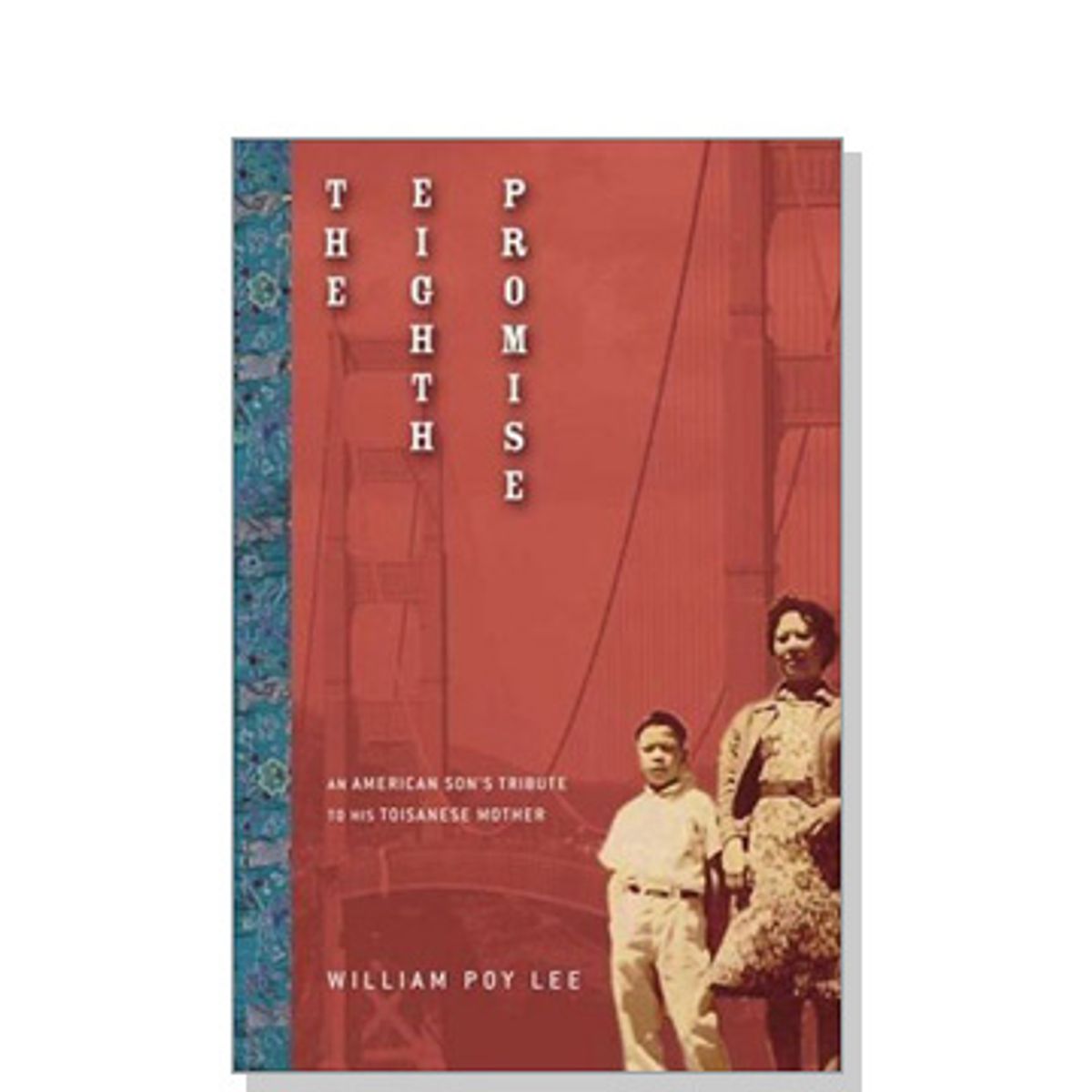
In “The Eighth Promise: An American Son’s Tribute to His Toisanese Mother,” William Poy Lee lends his family’s coming-to-America story a fresh twist by structuring the book in an unusual way. In alternating chapters, Lee lets his mother’s story come through in her own voice; her memories, and perspectives, taped by the author during a series of interviews, are juxtaposed with his, rendering lush and surprising what might otherwise be a somewhat predictable tale. In the tradition of the blockbuster multigenerational epic — “Roots,” “‘Tis” and “Cane River” come to mind — “The Eighth Promise” describes William Poy Lee’s upbringing in, rebellion against, and ultimate return to the bosom of his family, community and culture.
The story begins in China in 1935. Lee’s father, Fook Toon, was summoned from his hamlet to San Francisco’s Chinatown by his father, a U.S. citizen, then sent back to Toisan, a village in China’s Pearl River Delta, to pick a wife from the prospects selected for him by village “go-betweens.” Fook Toon was 26, Poy Jen 21 in 1948 when their meeting and marriage were arranged with the support of Poy Jen’s mother, who was determined to protect her favorite daughter from the ravages of the Chinese civil war by sending her to America. Before she left their village, Poy Jen was trained by her mother in the skills considered essential to every Toisanese woman, whether in Suey Wan or San Francisco: how to amend the soil, harvest bok choy at exactly the right moment, make medicinal chi (energy) soups and use these soups to treat all manner of emotional, physical, environmental and spiritual maladies.
Poy Jen’s mother also instructs her daughter to keep the eight promises to which the book’s title refers: to raise her children to be Chinese, to find suitable Chinese-American husbands for her sisters, to sponsor the emigration of her mother and two brothers to America, to keep alive in her children the dream of a democratic Nationalist China, to keep her children connected to the village of Suey Wan, to keep the Toisan clan alive in America, to cook chi soups for her family, and to raise her children to “live with compassion for all,” as her mother raised her.
William Poy Lee, the first of Poy Jen’s four children, was born in San Francisco in 1951. Following a stellar academic career that began in San Francisco’s Chinatown public schools and culminated in his graduation from the University of California at Berkeley, Lee became an architect, and then a lawyer, and then chief legal officer of Bank of America. In the opening prologue he describes the “paralyzing, crackling, debris-filled” breakdown he experienced in his mid-40s. After spending several decades as an über-achiever in hot pursuit of the American dream, in 1995 he abruptly left his job, his girlfriend and his home. His life, a carefully constructed compromise between his parents’ expectations and the activist awakening he experienced as a college student in the ’60s and early ’70s, came to a crashing halt.
“And that’s when I completely opened up to my ancient past in another land and culture, China,” Lee writes. “I slowly realized that I came from a wonderful beginning, even before I was born in San Francisco … I am born of ancestors who were farmers and lived not as individuals or the mobile nuclear family unit, not even just as an extended family, but as a Clan [who] had lived and loved in one locale and harvested the same fields for a millennium or more … How had I lost touch with those deeper places, spending an entire decade burying them with the shining, expensive, attention-getting, and excessive material marks of success.”
Twenty years after his first visit to Toisan in 1983, Lee “responded to an inner call to write” and began the 30 hours of interviews with his mother that eventually formed the foundation of this book. The duet of voices, mother’s and son’s, sets the reader gently into the boat of one family’s history, then maneuvers it along a river wending between past and present, between an ancient, unchanged Toisan village and the cacophonous streets of contemporary Chinatown, USA.
The accounts of both worlds — especially that offered by Lee’s mother, Poy Jen — are richly drawn and evocative, lending the book the dreamy wish-I-were-there appeal of a travel memoir. Poy Jen paints a picture of young green rice shoots waving in the Toisan breeze. In her narrative the reader can hear the creak of the rope as the water bucket is coaxed up from the stone well; smell the barbecued pork sizzling along San Francisco’s Grant Street, and the shark’s fin soup simmering in her Chinatown housing project kitchen. As she describes her efforts to keep such Toisan traditions as language, food and clan alive, her pride in her heritage is palpable.
“Suey Wan is the name of our village, and it is a thriving village to this day,” Poy Jen explains in the first of her chapters. “Our soil was how sek — rich and wet, for Toisan is in the Pearl River Delta. Water so shiny you have to squint to see it … Life was not easy in the village like it is in America. Sweating and breathing hard. But still, we had lots more time to relax, to chat with one another, and to play. Once everything was done, it was done. You can’t make the crops grow any faster by acting busy.”
In one particularly poignant scene, Lee describes his first day of kindergarten — his teacher the first Caucasian he’d ever met — as “the day I crossed over.” The “crossing-over” process accelerates as he enters high school. His teachers, along with some Chinatown elders, begin to warn him to keep his expectations low. Don’t plan on becoming a CEO or a political leader, they say. Major in accounting. Start a small business.
“After her war-torn youth,” Lee writes, “Mother was ever grateful for Chinatown’s pacific if small cocoon. But for me, born and raised an American and indoctrinated to believe in the Declaration of Independence … I was not so willing to be too readily deprived of my birthright. I wanted to know that America could work for me all the way, and if it couldn’t, I wanted to do something about it.”
Despite his teachers’ admonitions, Lee did become a political leader of sorts. He was elected student body president at Galileo High School, joined a radical theater troupe, became a regular at City Lights Bookstore, and helped to organize the first Chinese-American civil rights march on Grant Avenue. “You were an intellectual at heart, with a strong sense of right and wrong, not a real troublemaker,” Lee’s mother says. “That’s your character and I could stand with you.”
But at 18, her son wanted to stand as far as possible from his family, even his beloved mother. “Like my parents,” he writes, “I knew when it was time to leave the village.” Lee was accepted to U.C. Berkeley and moved to a dorm on campus, 10 miles and a universe away from home. “My strongest memory of my first year of college is of clouds. Clouds of tear gas blanketing protesters … clouds of marijuana smoke in our co-ed dormitory … clouds of mental confusion as Marxists, conservatives, liberals, the Spartacist League … and our outnumbered professors competed for our attention, our allegiance, our lives, and our souls.” Loath to face his parents’ disapproval about the amount of time and energy he was spending organizing campus protests and the diminishing attention he was allocating to his studies, Lee essentially cut himself off from his family — until 1972, when his younger brother Richard was arrested for a Chinatown gang-related homicide.
Based on the testimony of a disreputable snitch and despite evidence that he was across town at a graduation ceremony when the shooting occurred, a jury purged of Chinese-American and African-American jurors convicted Richard of first-degree murder. Sitting in the courtroom beside his non-English-speaking mother, Lee realized as the verdict was being delivered that she didn’t understand what was happening. “Richard lost,” he told her in Chinese. His mother put her hands on the marble courtroom wall and began to wail.
“Maybe I was too busy raising baby John, trying to have some fun when I could,” Poy Jen recalls. “Maybe I didn’t watch over Richard enough. Maybe if I had, he wouldn’t have gone to jail. I failed him as a mother.”
“Mother had no soup that could balance the conflicting passions of justice and law, retribution and punishment, that were at play,” Lee writes. Then in his third year at Berkeley, Lee threw himself into mounting appeal after appeal for his brother. He was on the verge of quitting school, but two caring professors talked him out of it. “Now there was no longer a rift between campus and Chinatown,” Lee writes. The whole family would pile into the car to visit Richard in prison every visiting day, bringing care packages full of Chinese treats. Later, when Richard was allowed weekend-long family visits, his mother would cook chi soups and several-course Chinese meals in the prison trailer.
After years of fundraising, media campaigns and legal maneuvers, Richard’s final appeal was denied. Lee boycotted his own law school graduation in protest, took a job as a lawyer at the Bank of America (where, he says, he was frequently insulted by his co-workers’ racist comments), and fell into the suicidal depression he describes in the book’s opening pages. After nearly killing himself in a motorcycle “accident,” he quit his bank job, began studying Buddhism, and joined a theater troupe. In 2000, for his 50th birthday, he brought his mother back to Toisan for her first visit since she’d left her village more than 50 years earlier.
In the epilogue, Lee concludes, “I am finally at home in America and in Toisan.” And his mother reports that she has fulfilled her eight promises. “I’ve taught [my children] to be nice to everyone, to help people they meet along the way, to not hold on to grudges or resentment at wrongdoing … If I died and a supreme being granted me a choice to come back to this world or to stay in heaven, what would I decide? Oh, I’d come back — no question about it. And oh yes, of course, I would ask to live in America!”
Lee raises pertinent questions that are left unanswered. We never learn what he’s been doing for a living since he quit the Bank of America, nor why and how he became an architect, and then a lawyer. Near the end of the book Poy Jen refers to Lee’s brother Richard as being “busy raising his two daughters” without explaining Richard’s apparent release, at some point, from prison.
Despite these minor omissions, “The Eighth Promise” is a lively read and a significant contribution to the body of literature that continues to bubble up from the steaming cauldron that is the American immigrant experience.
Dear Advice,
The last thing my mom said to me was, “When I was young …” and then she died. I had no idea what she was trying to tell me. Then I found a letter she had written to a friend saying that the man she was in love with is my actual biological father.
My dad and I were in shock with the DNA results and now I have spent countless hours trying to find out who this man is. I can’t ask anyone as they are all dead and my dad said it must have been this guy who was in town for a short time while attending ammunition-inspector school in Savanna, Ill., but didn’t know a name.
I hired an archival researcher and a private investigator but no one can help me. Can you help me? I found out that many people came from all over the U.S. to attend this school and all I need is a list of names from around November 1961. Please, please help me.
Into the Past
Dear Into the Past,
I love a mystery. I’m tempted to begin investigating myself. But I can’t do that. So you will have to keep at it.
It is hard to sustain a search without regular encouragement. So while I can’t fly there and help you look, I can offer encouragement to keep looking. Setbacks are to be expected. It will be slow going. You have to keep moving forward.
You may have begun to feel hopeless and want to give up. But if you give up you’ll never find out. At least if you keep at it until you have exhausted every avenue, you will have an answer. The answer may be that this man’s identity will never be known. At least that would be an answer. You will want the satisfaction of knowing you have done everything possible. So keep at it. If you become discouraged, take a break. Find elements of the investigation you can perform without expending much energy. But keep it going.
Be ready for your mind to play tricks on you. If discovering your biological father’s identity evokes any fear or uncertainty at all, then you may feel tired or discouraged because part of you does not even want to know. You may have thoughts like, Oh, who cares! Why bother! Beware of such thoughts. Your feeling that no one can help you may be one of those thoughts. Beware of the voice in you that says it is hopeless. That is the voice that really does not want to know.
But the real authentic you does want to know. Knowing where we come from is a deep human longing.
You hired an archival researcher and a private investigator. If their initial work turned up nothing, that is not so unusual. Such an investigation requires dogged thoroughness, going over ground already covered, doing things by rote even when it seems senseless, beginning yet again, trying illogical options on the off chance that something may lead to something. It can be maddening.
But there must be an answer! How many people can there be who attended ammunition-inspector school in Savanna, Ill., in November 1961?
The military keeps records. If this was a military operation there must be records. If there are records then they can be found. If you keep looking you will find them.
This column has many astute and creative readers. Perhaps one or more of them will have ideas or knowledge that may be helpful.
Good luck on your quest!
Continue Reading
Close
Dear Cary,
I am 24 years old. Sometimes I get so angry that it is hard to function. Other times I get very anxious and I feel like I am on the verge of a breakdown. I think it stems from my parents. I don’t know what to do, and I need your advice.
My father is an engineer for a large oil company, and my mother works in a doctor’s office. My father has always been steadily employed (although I have lived in three different states growing up because of his job). However, I feel like my family has always been struggling financially. This has deeply affected me, especially when I graduated from college in a time when jobs were difficult to find. One problem is that I am not sure why it is this way — they live in a nice house, but definitely not one out of their means. They do not buy nice cars, and we did not go on vacations growing up. They do not eat out very often or buy anything that would be considered luxurious.
However, they have filed for bankruptcy twice.
My mom has worried about the electricity getting turned off because my dad did not pay it for two months, I have had my cellphone turned off multiple times, and there was a period of time where creditors were constantly calling. They have not been able to provide for me in a way where I felt like my basic needs were met (not just financially). The only thing that makes sense is that I am the oldest of four children and my youngest brother is autistic. He is 14, and was diagnosed 10 years ago. He is very bright, and is high-functioning (although it was worse when he was younger, and he would get violent). My mom was obsessed with trying to make him better and paid for expensive therapists of all kinds — supplements, medicine, you name it. That probably contributed to it significantly, but the first time they filed for bankruptcy, I don’t even think he was born.
I feel no sense of security in my life. I feel like I have had to shoulder a lot of responsibility prematurely. My mother was abused growing up, and she was absent from most of my childhood (not literally, but absent as a parent). The only real memories I have of her were of when she would lay in bed all day, and very little else. I was told a lot later in my life that when I was young she went to a treatment facility for a nervous breakdown and once was close to killing herself. Even when I was young, I had to do most things for myself, since my dad worked. I have an OK relationship with her now, but I don’t think it’s a typical mother-daughter relationship. If I have a problem, she does not offer to help in any way, she merely says, “sorry.” She has told me that she has too many problems going on in her life and that she can’t hear any of mine.
My mom and dad are still married, but their marriage is dysfunctional, and I have never seen them happy. My dad seems to be harboring a lot of anger and resentment from things that happened many years ago, and he doesn’t know how to deal with it. He spent my whole childhood telling me that we were a normal family and I believed it for a long time. I assumed a lot of dysfunctions were OK.
Most people consider me to be smart, and I did well in high school and college, even though it didn’t seem to matter that much to anyone else that I did well. When I was 18 and applying for colleges, my dad said he’d pay half if I went to one of the large public universities that was fairly close to home. It was not my first choice, but I went. The day before my new student conference, my mom told me I couldn’t go there because they didn’t have any money to pay for it and I needed to go to a cheaper school. With school starting in a couple weeks, that wasn’t even a viable option. My dad was still in denial about the whole thing, and I was left to fend for myself again. I went there, and I got by the first year without having to take any loans, and I got a few scholarships, but I ended up having to take some private loans after that. I filled out the FAFSA, but my parents made too much for me to qualify for anything other than some meager federal loans and the work-study program. I felt like college was supposed to be this liberating experience where I learned all this great information that challenged me. It was like that in some ways, but it was also extremely stressful because I had no money and did not know how I was going to make it sometimes. I worked through college, but that barely paid for anything. Almost every person I encountered had parents that were well-off. Very rarely did I encounter someone in my situation. I have been struggling financially trying to manage everything, but I feel so overwhelmed. When I get like this, it’s like my anger toward my parents gets unleashed, and I can’t keep it together. I feel like I could’ve gone to a much more prestigious school and not been saddled with debt if they had helped me like they were supposed to. I had always wanted to go to law school, but that was something I couldn’t even consider because of my undergrad debt. My best friend in college went to an Ivy League for law school, and sometimes I feel like I should’ve been there too. I am just as smart and capable. With the horror stories I hear about law school though, I am somewhat grateful I didn’t go. I wish I had had the opportunity to choose though.
My relationship with my dad is very strained now. We were very close when I was younger, and I am not sure why it changed. My dad has anger problems, and those have scarred a lot of my memories as a teenager.
A couple of years ago, I took my first job out of college and had to relocate for six months for a training program. While I was there, I was raped by a co-worker. My dad didn’t even call me to see if I was OK, and my mom said she couldn’t visit me because she didn’t have enough money for a plane ticket. That was a very low point in my life because I was in a state where I didn’t know anyone and the job made me feel completely isolated. I saw a therapist who helped me realize that I had a big drinking problem, but I did not deal with the anger. My whole goal was just to be able to function and get through it so I could move back.
The rape was traumatic, but there are many instances in my life where I feel I have been victimized. I feel like it’s because I have always sort of had to fend for myself, and I do not know how to respond or deal with it appropriately. Right now I work with someone who is always yelling, and I feel like I become a little girl again just trying to make the yelling go away. This makes me hate my job, which is already very stressful. I want a new job, but it’s not that easy to just get a new one.
The only person who has been supportive is my boyfriend, but he can’t solve my problems. He is still in school, which is a sore subject for me. I feel like I have very few friends that I can reach out to. I feel like a loner a lot of the time. I think I have learned to hide a lot of this well, though. I think a lot of people that don’t really know me think I am materialistic and somewhat high maintenance. I don’t think I am really that way, but it makes me feel better to have people think that than to think I am a very damaged person who can barely keep it together.
I am sorry this is so long and convoluted, but I am trying to make sense of everything and get past my negative emotions. I see a therapist, I took an antidepressant for three years (which I think was not very helpful), I try to exercise regularly, I have stopped drinking. I just feel like without the drinking I have all these emotions that are haunting me, and I have no way of numbing them.
I have tried very hard to deal with them and move on, but I can’t. I just get stuck focusing on it. Sometimes I feel like things in my life have gotten better, and then something will happen to me that knocks me on my ass and I am back to facing the same emotions. I have made a lot of progress in the last three years, but I still have so much more to go. Sometimes I feel like there’s no point in trying to keep living, because it’s just a vicious cycle that never ends. I feel like I only have one person that really cares, but he doesn’t know how to make it better.
Don’t get me wrong, I felt like I was in hell three years ago. I have made great strides since then. However, all of this makes me feel like one day I’ll trip and fall and just not be able to get back up.
Thanks,
Angry
Dear Angry,
This advice column runs long letters. People have long stories. We like to hear the whole story. That doesn’t mean we can fix everything.
Plumbing can be fixed. But here, there is no little problem to fix. There is instead a life to honor.
You have been hurt by your family. You have been raped by a co-worker and then abandoned by your family when you needed them. You wanted things and thought you would have them and then they were snatched away. Secrets have been kept from you. You feel great anger at your family, and you have drowned that anger in drinking, and now you feel confused and don’t know what to do.
So what can you do? I suggest you continue therapy and look into the archetypal, emotional and philosophical roots of your feelings about money — perhaps by looking into Inner Economics. Also, examine the teachings of Murray Bowen in family systems, which can help you decode the baffling effects of your family life.
Money is treated by many as a problem to be solved analytically, but often we feel too crazy about money to calmly do the problem-solving. We need first to confront our emotional conflicts about what money is and what it means.
This may sound out of the blue, but it is what I want to say: Ask yourself, What is the best part of you? What is the most alive, creative, singing part of you? What part of you really shines? Where is it that you feel most alive, most sure of yourself, in control — the place where forces greater than you seem to come into play and you work in tandem with them? In what situations do you achieve flow? Concentrate on these things for a while.
Train yourself to take note of your attractions. When you are attracted to something — clothes, or music, or ideas — give yourself permission to investigate. I suggest this because when we are dysfunctional about money, when things have been withheld from us, when we have been betrayed, we tend to believe that there is nothing in life we can have; everything is too expensive or beyond our means, or will be snatched away from us. So we impoverish ourselves. There are ways to get the things you truly need, the things that will complete you. This sounds a little mystical, but it need not be at all. It is as simple as saying, Hey, I like to play a round of golf on the weekends. “Normal” people do this all the time. It’s just those of us who grew up in strange and mysterious dysfunctional houses who think we can’t have any of those things.
You can have the things you want. Allow yourself to feel sad about the things that have happened. Allow yourself to work for the things you want.
Allow yourself.
Continue Reading
Close
Dear Reader,
I’m taking a little vacation down in Florida. It may be possible to conduct a couple of writing workshops while I’m down there, if a space and people can be arranged. I’ll be in Fort Lauderdale Thursday the 5th, then the Gainesville area from Friday the 6th until Sunday or Monday, and then back in Fort Lauderdale the 10th through 12th. Email me if you’d like to attend or help set something up. It would be great to meet some interested people and write together.
The column should resume Monday, April 16.
Dear Cary,
I’m a 20-year-old female. I’ve been married for just a little under one year now. I also have a healthy 7-month-old son. I only had a relationship with my husband for one month before we got engaged. Two months after that I got pregnant.
Everything was great up until the engagement. The pregnancy made things a little better for about two months. We got married around the time I was 4 months. As time passed things got worse and we got distant. He has been all about himself and only did things for me to get stuff out of it for himself. He has been tempted to cheat and has talked inappropriately to other girls during our whole marriage. I finally got tired of it and I’m now at my mom’s. He wants me to come home but I can’t bring myself to do it.
He is horrible with money and we would have to get money from family to get the baby what he needs and get us food too. He left me in the hospital while I was 8 and a half months pregnant.
He still tries to bribe me to come back and it’s all about him again. He wants me to give him the rest of my money but I’m about to get my license and my sister is giving me her old car. It feels like he doesn’t want me to have money so I can’t get anything and I’ll need him. He makes $600 biweekly while I make less than $300. Although I love him I’m not in love with him. It feels like I stayed with him for the baby. Now I don’t know what to do. Should I go back and try to work it out even though I gave him a bunch of chances before and he hasn’t changed, or should I leave him for good? I’m torn between the two. Everyone says I should finally leave him but I’m not sure. Can you help?
Torn
Dear Torn,
It’s probably best for now that you take care of your baby and stay at your mother’s. You’re safe, you’re healthy and you have a healthy baby. If your mother will keep you there, then you have a stable place to raise this kid. You don’t need a man in your life right now. You need to concentrate on surviving, making a decent living and providing for your kid.
That may seem hard at times. You may feel lonely and truly want your husband. You may miss the intimacy and the good times. But your life has changed. You have some very grown-up challenges now.
It won’t be like this forever. At least maintain the situation as it is for a year or two and see how things go. Make stability your chief priority. Try to eliminate all the distractions and drama from your life right now, and just concentrate on raising your baby. Be grateful for your mom’s help and support. These are crucial months for your baby. The stronger you are, the more secure you feel, the better it will be for your baby.
Later, when you feel you have some breathing room, you can think about longer-term plans. Maybe your husband will fit into those plans and maybe not.
Can you stay with your mother while you endeavor to perhaps finish a college degree or get some training in a business or trade? Can she take care of the child while you are out of the house, or does she also have many outside obligations? How long can you imagine living with her? Are things OK or are they tense? If things are OK now, it may be that you and she could raise this child for the next few years. Then you could move out when the child is a little older and you’re on your feet financially.
These are the kinds of things you will need to think about.
Time is going to fly by. Since you are young, your perception of time is that of a young person. But marriage and child-rearing happen over years and decades. So does your relationship with your mother. These are slow-moving, evolving things. They require the long view. Your best decisions will not be based on how you feel right this moment, but on how things will be in three to five years.
So take some time to visualize how you want things to be in three to five years. Think about your baby and what will be happening then.
It’s hard for some people, myself included, to do this kind of thinking. We like to live in the moment. But planning does not necessarily require a calendar and a calculator. One way to start planning is to simply visualize things. Think about how you want it to be. Clip pictures from magazines or print images from the Internet that represent how you want things to be. Surround yourself with images of your ideal life. When you feel tense or frightened or confused, spend time visualizing the life you want to have. If you can imagine it, you can at least head in that direction. Then when people with some experience in life see your vision they can say, Hey, here is how you get from here to there.
Your child’s father at some point will most likely want to be in his life. That could be a positive thing. Your child will probably want to know his or her father. So do what you can to maintain a good relationship with him, even if you are apart. Just don’t let him take over your life; don’t believe his promises. Believe only what you see. He may not be mature enough and stable enough right now but that could change. So try not to burn your bridges. Just tell him that right now you have to do what’s healthiest and most financially stable for you and the baby.
Be kind to your mother. She may get on your nerves from time to time but she is really saving your life. Take advantage of her willingness to help. She is probably excited about having a grandchild and will enjoy helping, but may feel at times that she’s overworked.
All the important people in your life are growing up. You’re all changing. There are great surprises and challenges ahead. Welcome to adult life!
Just take it one day at a time. You’ll be OK. You’ll get through this, things will get easier, and one day you’ll look back in amazement.
Continue Reading
Close
Dear Cary,
I need your help in determining if I am an ungrateful daughter or person reacting to a shitty situation. I am a 38-year-old woman who, like many Americans, has lost my job due to the recession. However, I do bartend part time. Needless to say, I was experiencing financial difficulties and because I couldn’t find a job I decided to attend school in an effort to make myself more employable. My father expressed how impressed he was with my educational endeavors and made me an offer that I could not refuse. He said that I could live in one of his rental houses until I was out of school and I would only be responsible for utilities. This was music to my ears. Within no time I was packing my bags and moving out of my apartment. I moved to the house and paid to get new carpet and tile installed as well as have the house painted. My father was working on getting the house up to code so that it would pass inspection and after the inspection he was supposed to go back to live out of state. Here it is one and a half years later and my father has not left. The carpet that I purchased is completely ruined and so are the tile floors.
Why? you may ask. Because he is a complete and utter slob! He grew up on a farm and spends lots of time outside tending to his garden and fixing his many lawnmowers that he has fished out of the trash. I spend hours cleaning, all for him to destroy the house in literally a matter of minutes. It is ridiculous. To add insult to injury he does not wash his hands … EVER. Not even after going poo … I feel like I was hoodwinked and bamboozled, because there is no way in hell I would have ever put myself in a situation to live with one of my parents at this point and time in my life. I have expressed my frustration with the situation, but he doesn’t want to ever talk about it. I want to move, but right now I am not financially stable and I am so close to finishing school, I don’t want to jeopardize my studies.
Grown Woman Living in Daddy’s House
Dear Grown Woman Living in Daddy’s House
I don’t think you are an ungrateful daughter. I think you are a person reacting to a shitty situation in an understandable way.
After years of being self-sufficient you’ve been thrown back into dependent daughterhood. That has got to trigger some feelings you’re not prepared for. That’s got to be tough on the ego. It would be hard for it not to matter how well your father handled it.
And he’s not handling it all that sensitively, one must say. When our survival is symbolically threatened, we sometimes reassure ourselves by making our immediate surroundings clean and healthy and spotless. It’s a good thing to do if you’re feeling threatened and insecure; it can cheer you up to clean house. So here’s an interesting symbolic contradiction: Here you have come to your dad to help you survive, and he is providing for you, yet also doing things that symbolically threaten your survival: Dirt, poo, infection, disease, loss of control!
Subconsciously it may be felt as aggression: Your dad is threatening your survival rather than nurturing it. He’s bringing danger into the house. He’s bringing dirt and disease into the house, meaning, symbolically, into your body. So he’s polluting you when you are trying to regain your strength. The literal-minded may quibble but we’re talking about emotions that take place below our conscious awareness, in the language of symbols.
On the surface he’s doing you a favor, and good for him. But he’s also not admitting your personhood or your power: He’s retaining his own power over his own place. That’s the prerogative of property ownership in a society that worships property. You are expected to grant him the prerogatives of ownership. But he’s not accommodating you, really, as a person. It may even feel as though he’s trying to push you out.
His hospitality may be begrudging; his messing up the house may be passive-aggressive; he probably wants to go on living as he is accustomed to living. There may also be some unspoken disapproval of your reversal of fortune, and perhaps a little unspoken “I told you so,” if you have been too independent for his liking. He may even be enjoying being the father to a relatively helpless daughter once again — a daughter who cannot force him to wipe his feet.
Assuming your parents are divorced, is he also repeating a pattern of conflict he had with your mother? Could be. They could have had fights over just such things. If those fights led to their divorce, you may also be experiencing uncomfortable memories of an earlier symbolic threat to your survival. Also, not to jump ahead, but this could also be a preview of the role reversal that happens as your dad ages and weakens and you take on the role of caretaker, being sure he washes his hands and wipes his feet, as a mother would do in raising a child.
But that’s just the messy symbolic stuff it’s my job to dredge up. On the surface, in the practical present, you’re a capable adult woman in control of her life and career. You’ve made yourself a plan that requires you to do some compromising. That’s what this is: It’s a conscious compromise. You’re still making your own choices. This is just temporary.
You’ve found shelter in a bad time. Your dad is your ally. He loves you. He’s providing you a place. He’s doing what he can, in his way.
Hang in there, finish your course of study, thank your dad and stay positive. When you look back on this, as uncomfortable as it is now, you’ll be grateful there was a place for you to go. With the passage of time it may even become a fond if bittersweet memory.
Continue Reading
Close
Dear Cary,
I’ve read your column often, and I think you can help me since you yourself have dealt with the consequences of addiction.
I really don’t know who else to turn to with this particular problem since most self-help books don’t deal with people who don’t drink.
I am in my mid-20s. In a nutshell, I was raised as an only child in a single-parent home with an alcoholic mother, who self-medicated with wine to deal with depression.
I know she loved me more than anything, and she sacrificed a lot to try to give me a good life, but as a kid, I felt as if I was battling her alcoholism for her. I would constantly find single-serving wine bottles stuffed between couch cushions, and it was an almost nightly occurrence for her to drink herself to sleep, leaving the house a mess and me to throw away the empty bottles and rinse out the glasses she would leave next to the couch. After she would go to bed, it was usually a coin flip whether or not she would rise from her sleep to stalk around the house staring blindly at everything and shouting incoherently. More than once she, thoroughly drunk, thought I was a burglar and tried to attack me. The first time this happened I was 11, and in her mind she had gone back in time and thought I was going to steal her baby (me). She nearly strangled me.
What made my childhood much easier was the fact that I had grandparents nearby who did not seem to struggle with alcoholism or poverty or depression. They were good people who seemed to rise above all the stupidity we are capable of. In fact they helped my mother make ends meet on a few occasions, and they always seemed to come to the rescue when we were in a jam. I felt more often than not that my grandparents were like my real parents, and my mother was like some big crazy sister who loved me a lot but was still trying to figure things out.
And from a young age, the lesson they kept quietly teaching me was that alcoholism was a demon in our family. It ran in our blood, and had ruined cousins, uncles and sisters. And the best way to avoid this fate was not to start at all.
And for my part I promised myself that I would never drink, or smoke, or do drugs.
And I never did.
A lot of people may not believe me, but I have never so much as sipped a beer, or taken a drag from a cigarette. And there is my problem. Everyone who knows me knows that I don’t drink, and I feel like I’ve put myself in this box where I will never drink.
This was fine for my early 20s, and in some ways I felt superior for not having blown hundreds of dollars at the bars, or woken up with hangovers, or been so drunk I couldn’t remember what happened to me. I have always been in control of my life, and that is something I take pride in.
But I also feel like there is this whole side to life that I may be missing out on, and that maybe I should relax these rules I’ve created for myself. I feel that a lot of people can’t relate to the fact I don’t drink, and I also would sometimes really like to be able to have a beer with my friends and be their equal, and not this always-sober outsider. A few weeks ago at a champagne brunch with friendly strangers who didn’t know I don’t drink, the waiter poured me a glass of champagne, and when they toasted I held it up and looked at it for a long time before I realized my wife was staring at me.
What to do?
Dear What to Do,
Testing yourself for alcoholism is like testing yourself for flammability. You’re probably not. But what if you are?
“Given the fact that alcohol-dependence seems highly heritable,” why take the risk?
Why not instead ask what needs alcohol might satisfy, and then find other ways to satisfy those same needs? Why not seek safe, life-enhancing alternatives to drinking? Why not read Abraham Maslow and design your life around the quest for peak experiences?
We raise our glasses and drink ceremonially to sanctify some event or passage. We all drink from the same bottle. By imbibing the same drink, we are joined; it is a kind of sacrament. You can mime the gestures but something pulls you to fully engage. Of course it does. This is not just about getting a little champagne in your mouth. It is a powerful ritual.
My suggestion is to find even better ways, more direct, honest and compelling ways to have this same ritual bonding and expression of shared esteem and purpose. I suggest you make this a lifelong pursuit. Make it a way of undoing for good the perhaps multigenerational history of alcoholism in your family.
This way, if those who dispute the role of genes in alcoholism are correct, and behavioral factors are more important, then you will still be doing something to eradicate certain behaviors that were leading to case after case of alcoholism. You will be finding something that members of your family have a particular need for, and satisfying that need.
Look for something that seems cool but not too cool, something you’ve always wanted to do, something you’re drawn to, that’s maybe a little outside your normal range but not totally kooky and weird.
For instance, it may be possible to participate in the ecstatic communality of a sweat lodge. I don’t know. Maybe a sweat lodge would be too weird for you. I don’t know how much facial hair you have, or what your body mass index is. I’m just saying, identify the underlying principle and then find something that suits your social tastes.
That there are things wrong in the world, that there are things so awful in this world that knowledge of them drives us to want to blot them out of consciousness. Read today’s piece by Noam Chomsky, for instance, for a reminder of how thinly “normal American life” veils our history of brutal atrocities.
How are you supposed to think about these things and not feel as though you are going mad? How are you supposed to have a conscience and not feel trapped by history? How are you to take all this in, as a young person? How to reconcile knowledge of evil done in one’s name with the innocent desire to believe in one’s country, to identify with one’s countrymen, to feel strong and patriotic and confident about the future?
These, too, are legitimate questions. So, my friend, I urge you to take seriously the genetic and environmental risk factors for alcoholism, and actively seek ways to have ecstatic experiences in this insane world without killing yourself. Adopt adaptive behaviors that don’t make things worse.
Continue Reading
Close