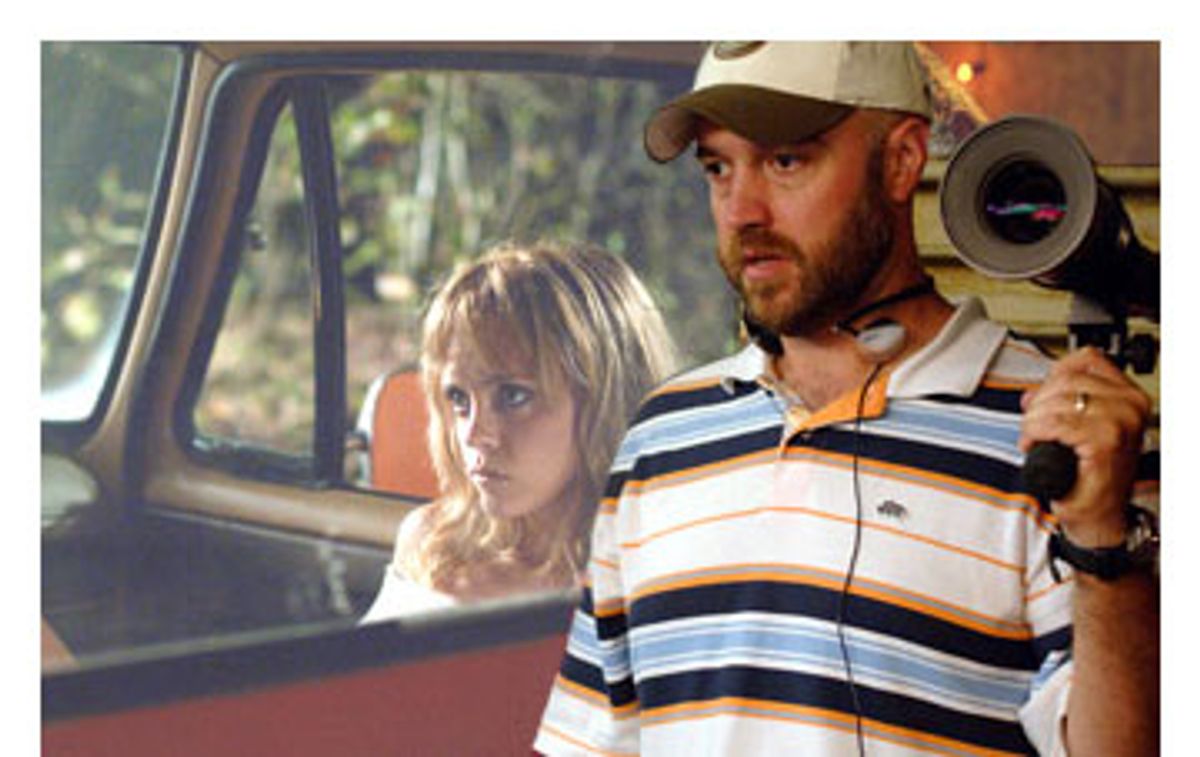
In this interview and podcast, "Black Snake Moan" director Craig Brewer talks about the spirit of the South, the power of the blues and tackling tough issues in delicate times.
To listen to a podcast of the interview, click here.
To subscribe: Click here to add Conversations to iTunes or cut and paste the URL into your podcasting software:
Craig Brewer admits he’s asking for trouble. In 2005 he made “Hustle & Flow,” a movie about a pimp — played by Terrence Howard — that had the temerity to suggest that we might feel some sympathy for the guy. In Brewer’s new movie, “Black Snake Moan,” Samuel L. Jackson plays a God-fearing but messed-up bluesman-turned-farmer who takes a promiscuous young woman, played by Christina Ricci, into his home to help save her from the devil, or perhaps just from herself. And because she resists being saved, he chains her to a radiator.
The unapologetically lurid posters for “Black Snake Moan,” showing a chained-up Ricci in a crop top and cut-off shorts, are designed to shock, and they seem to be doing the trick: When Salon’s Andrew O’Hehir wrote about “Black Snake Moan” from Sundance, plenty of readers chimed in to denounce the movie for its misogyny, despite the fact that none of them had yet seen it.
But no matter what “Black Snake Moan” looks like, either from the trailers or from the poster, there’s more to it than Ricci’s skimpy outfits. This is a picture about the redemptive possibilities of the blues (Jackson does his own singing), and it also features Justin Timberlake, as Ricci’s soldier boyfriend, in a nonsinging role. Salon met with Brewer, 35, in New York, where he talked about his hometown of Memphis, about making movies in the South, about how, when you need it the most, music sometimes miraculously finds you — and about why he’s the woman chained to the radiator.
In both “Black Snake Moan” and “Hustle & Flow,” the South — particularly Memphis — is practically a character. Your parents’ families are from Memphis, and you live there now. Tell us about what it’s like for you to make a movie in the South, and how that experience might be different from that of someone who just jets in to film on location.
The first thing is the notion of regional filmmaking. For a lot of people, it’s almost like saying “regional theater.” They feel like, “Well, regional filmmaking isn’t Hollywood filmmaking. Once you move up to the big leagues — that’s moviemaking.”
But what regional filmmaking means to me is not only utilizing the actors of your area, the musicians and the artists, but probing what it means to be of that region. And for me, the thing about Memphis that I’ve always responded to is its music scene, from Sam Phillips recording Howlin’ Wolf, Rufus Thomas, Elvis Presley, Johnny Cash, Jerry Lee Lewis, Charlie Rich.
It’s a maverick town. It’s a town that doesn’t have professionals. Jerry Lee Lewis can’t really play the piano all that well. He plays it a certain way. You can’t really give him a Bach piece and expect it to sound like Bach. It’s going to sound like a Jerry Lee Lewis song, because the energy he uses to attack the keys is specific to himself.
Also, in the South, you do a lot with not much. And that makes what you’re making more unique and more lasting and memorable. You look at Johnny Cash singing “I Walk the Line.” They couldn’t have drums on the stage of the Grand Ole Opry, and he really wanted that song to cross over to the country charts. So he just took a dollar bill and wove it through the strings of his guitar. And it created that chk-chikka-chik-chikka-chik. You look at Ike Turner coming up from Clarksdale, Mississippi, in a jalopy filled with his band, and he’s writing a song about a car that passed, called the Rocket 88. He gets pulled over by a cop, and the amplifier falls off his car and smashes on the pavement. He goes into Sun Studios, and there’s Sam Phillips, this crazy white man from Mississippi. And Phillips says, “Aw, don’t worry about that, Ike.” He starts shoving newspaper inside the amplifier. They plug in the guitar and it has this raw, distorted sound. And now all amplifiers try to duplicate that sound.
There’s something about that spirit, where we know, when we listen to music, when we make music, when we worship, when we go to football games. And especially when we eat. We’re bound to each other more than people outside of the South give us credit for. I guess I respond to that kind of spirit. It makes me feel I can be creative and not be judged. I can be poor and not be ashamed.
I go to L.A. and people lease their cars. They don’t want you to see that they can’t afford a big, important place. The men in Memphis? I’ll go to a concert one night, and I’ll see somebody up on the stage, like a rock god, covered in sweat, women clawing at him. And the next morning he’s serving me coffee, and there’s no shame in it. That to me, that’s the safety of regionalism. That’s the safety of living in a place where, if your movie tanks with critics or at the box office, you just feel at home. Everybody knows you and still loves you.
A lot of critics didn’t like “Hustle & Flow” because they couldn’t have any sympathy for a pimp. Do you think there’s something in our culture, some kind of moralism, that prevents people from having sympathy for characters they don’t also approve of?
The first time I experienced the problem with that particular scenario happened in Hollywood as the movie was getting made, or trying to get made. There were many studios that said, “Could you please make him funnier?” or “Could you perhaps make it more violent?”
In Hollywood sometimes you take these notes and you try to see what’s underneath the note. I finally realized what it was — finally somebody just spelled it out for me: It’s dangerous for us to identify and sympathize with somebody that reprehensible. It’s so much easier to lampoon him. Then we can keep him at a distance.
I think what bothered people about “Hustle & Flow” was that I was allowing for a narrative where you could actually be sympathetic to him. And why should anybody be sympathetic to somebody who exploits women? And where they came after me is that I did not address the issue of exploiting people.
But to be honest with you, I wasn’t interested in it because I don’t think my character was interested in it. He was at a time in his life where he knew that his whole existence was based on manipulation. His whole job was talking people into buying what he was selling. I think many people identified with that. They just had a problem with him being a pimp.
I think people are going to be a lot easier on “Black Snake Moan” because it takes place in a more fabled type of Southern town. But I look at Rae and I look at DJ, and I think they’re quite similar. I tell people, “The nymph to this movie is the pimp to the other movie.” Because people, for the first half hour, are kind of mad at her. And it’s the same way with DJ. And they begin to soften, at least toward her heart, and begin to understand what she wants.
There seem to be quite a few people who have decided that this movie is sexist because the Christina Ricci character is chained to a radiator. What’s your response to people who are ready to judge the movie without having seen it?
To me it seems a little limiting. I sometimes do this little flip thing, where I say, Lemme tell you about this movie I wanna do, where this guy’s playing dominoes with his boys, and his pregnant wife is in the other room, playing music really loud, and he gets mad at her, he goes in there and throws the radio out the window. And he starts punching on his pregnant wife with a closed fist. And everybody’s ripping him off of her, and they’re like, “Oh, man, you can’t be hittin’ on her.” And they take the girl upstairs, and he’s punching at everybody, and they try to sober him up under the shower. And then he goes outside, calling up to his girl, “Come down here, bring my girl down here! Yo, Stella!”
And then Stella goes downstairs and she fucks him. And I think to myself, Wow, that’s taught in high schools. “A Streetcar Named Desire,” if you just kind of updated it a little bit — I think people would just cry unbelievable misogyny and sexism about that movie, whereas some of those people have Marlon Brando on their walls, and we can get some distance from it.
So can we actually have movies where a woman chained up can be a character in a narrative, like you would in a Flannery O’Connor short story, and not represent my take on women? I question anybody to come to the end of “Black Snake Moan” and really believe I’m a misogynist — the definition of which is a hatred of women.
I’m exploring something that has nothing to do with race or gender. I’m the crazy girl on the end of that chain. I’m the one who felt I was losing control of my mind and my body because I was not tethered to anyone. And I needed to be snapped back. I needed my father, who died at 49 of a heart attack, to tell me, “It’s gonna be OK, and you’re not alone. Everybody goes crazy at certain times in their life. You’re entitled to some happiness, you’re entitled to some unconditional love. And it will never stop. You will constantly be getting punched in the gut, being exploited, being judged.”
So I think it’s foolish to immediately jump to sexism because of the imagery. But I will give them this: I’m asking for it. I guess I could have chosen some other way to do it. But, look, you can’t do a movie about the blues and not explore biblical imagery and Southern iconography. And it is an obvious flip to see that black man with a white woman on the end of a chain, walking with her in his beautiful bean field, with her in those white cotton panties and a crop top with a Confederate flag and an American flag on it. I can’t believe people are thinking this is, like, a documentary — that this goes on in the South every day.
It doesn’t, but “Tobacco Road” doesn’t happen every day in the South, either. “Baby Doll,” the Elia Kazan movie, doesn’t happen every day either. But we give those movies a pass. We’re in a very cautious culture, and to some extent I think that means we’ve created a bigger divide.
You’ve got a God-fearing but troubled black man chaining a promiscuous young white woman to his radiator. That imagery is pretty combustible, for reasons that have to do with both race and sex, and even though we live in supposedly enlightened times, people are bound to have trouble with it. Do you see people’s potential discomfort as a liability, or is it really more of a tool? A way to shake people up?
Sure, I guess I view it as a tool. But I guess it’s a liability to some. I remember the first time I read “To Kill a Mockingbird.” My dad really wanted me to read it, and we had discussions about each chapter, and we finally got to the end. In the book, a black man is on trial for raping a white girl. And by the end of the trial it’s so clear that this man was asked to come into her house to move a chifforobe, I mean just to move something — and she attacked him. He didn’t attack her. So when he gets a guilty verdict, I remember asking my dad, “How could he have gotten a guilty verdict? His hand couldn’t even have done the bruises on her face. It’s so obvious her dad did that. Why did this guy go to jail?”
I’ll never forget what my dad said. He said, “Well, you gotta understand the South and you gotta understand white people’s fear about black sexuality with their women. They sent that guy to jail not because he did anything wrong, but because she wanted him. He had to pay for that.”
That’s when I realized that that never goes away. I don’t explore race or gender when these two characters [Rae and Lazarus] are together. Just them being in a room together does a lot. There’s a moment where Ricci’s character, in an incoherent state, lunges forward and kisses Sam on the lips. There is nothing sexual between these two in the whole movie, except that one kiss. And audiences flinch like it’s a horror movie. Now that says a lot about that audience. They audibly shout when she lunges forward and kisses him.
So it’s still very much in the ether, this tension and titillation with the whole thing. But nobody wants to talk about it … So that’s where we are. I don’t know if I’m ever going to be able to change that. But I definitely don’t want to not make a movie, and explore issues for myself, in my own region, where, by the way, we have blacks and whites who fuck with each other and do all kinds of stuff with each other — and it’s no big thing, and yet at the same time it’s the thing.
I’m not writing from a place of progress. I’m not writing a movie that I want people to necessarily intellectualize. And I think that really messes with people who feel that they need to make a statement against this, and they don’t quite know what it is they’re against.
Because man alive, you look at this imagery on this poster, and I’m so obviously banging this drum. It’s like, you really believe that I believe this? That women need to be chained up? Can we not think metaphorically once race and gender are introduced? … Can we never go back to that time when people can be people and we can explore whatever the hell we want to? Of course we can, but there are going to be people who take exception to that.
In this country, especially, there are people who believe actors shouldn’t sing and singers shouldn’t act. Yet in France, actors like Jeanne Moreau and Catherine Deneuve make records that become huge hits. And singers can be amazing actors: Frank Sinatra, Dean Martin, Bette Midler, Dean Martin, Willie Nelson, Kris Kristofferson. In “Black Snake Moan,” you’ve got an actor, Samuel L. Jackson, singing, and a singer, Justin Timberlake, acting.
And in “Hustle & Flow,” there are rappers who don’t rap. All these artists are coming together and they’re all just a little bit out of their comfort zone. So they all work a little harder. Also, perhaps I write a bit differently than other people. I don’t think, “Oh, this would be a good story, and wouldn’t it be cool if blues music were a part of it.” The music is the cake; it’s not the frosting.
I was having these bad anxiety attacks when we were trying to make “Hustle & Flow.” We couldn’t get it going, we didn’t have any money, we’d just had a baby. I was selling furniture just to pay my mortgage.
They say that music finds you sometimes in life. I had known about blues all my life, I’d loved it and studied it. But it wasn’t until those moments of absolute crippling fear — I thought, I’m going to check out, just like my dad did, at 49. I had this image in my head, of a radiator with a chain around it, with that chain yanking up against this radiator. And I had to explore what that idea was.
So the actors kind of have to do the same thing. You discover your character through the music … We took Sam down to Clarksdale, Mississippi. We got him with Big Jack Johnson, Kenny Brown, Alvin Youngblood Hart, Sam Carr. And he just soaked it up like a sponge. So one day he went into his trailer with his makeup artists. He came out, and he had the forehead of R.L. Burnside, he had the chops of Robert Belfour, he had the big, open-crown gold grill that Big Jack Johnson had, he had the moles of Junior Kimbrough. And to me, that’s an artist who found his character by way of the music.
So I’m discouraged when people say actors shouldn’t be singing, or singers shouldn’t be acting. They’re artists. And Ludacris of course should be in movies. Justin Timberlake should absolutely start his acting career. I think he’s doing a great job, and now everyone’s coming around to it.
Sometimes the blues are treated like a cliché, maybe especially among Northerners. People think, “Oh, it’s just all about suffering and hard times.”
They don’t realize it’s true exorcism music. These men of the Delta were not Uncle Toms. They were bad-asses in a time when you could get hung from a tree for speaking your mind. They were the first to sing about injustice and pain. And to sing about the injustice of the heart. I think they had fear in their heart, and they were the first to articulate that in a club, out loud, with everyone shouting back. And they began to take control of their fear instead of their fear controlling them.
It’s call and response.
It’s total call and response.
And the Oscar goes to … “Twilight”!
What if the Academy honored movies that people really liked? The "Twilight" vs. "Melancholia" showdown, at last
I’m here to make a modest proposal. What if the Oscars — an imaginary Oscars, a thought-experiment Oscars, the Oscars of an alternate universe — honored movies that people actually liked?
No, I know, I know — they sometimes do, pretty much on the stopped-clock-occasionally-correct principle. And somebody must like each of this year’s best-picture nominees, with the possible exception of the universally allergenic “Extremely Loud & Incredibly Close.” (I appreciated one reader’s recent comment that the hidden virtue of that film lay in combining the annual quota of schmaltzy Tom Hanks and Sandra Bullock vehicles into one compact package.) After all, the whole reason why “The Artist” appears to be the front-runner is because it’s charming and unpretentious and nearly impossible to dislike — although I don’t happen to think it’s all that great — whereas the other nominees do not share that quality.
Still, you know what I’m talking about. Generally speaking, in recent years only certain kinds of movies have been serious candidates for the major Oscar categories, and in particular for best picture. While it’s impossible to lay out a precise description, it’s like Justice Stewart’s famous definition of obscenity: You know it when you see it. Earnest, middleweight dramas that teach life lessons and feature major emotional climaxes always leap to the forefront. They should make you laugh before they make you cry, or vice versa. Classic three-act structure; a major star playing slightly against type; at least one odd or gruesome or humorous supporting performance from a name actor. (Notice that I have just precisely described “The Descendants,” a tailor-made Oscar-winner if ever there was one, which for both extrinsic and intrinsic reasons is likely to fall short this year.)
Even Oscar winners that appear to violate some of these rules hew to the overall pattern. “No Country for Old Men” is an open-ended, nihilistic, ’70s-style American drama, but also one that alternates dark and light, features identifiable stars and a classic Western landscape. “The Hurt Locker” has no name actors, but offers an archetypal tale of courage in warfare that straddled the nation’s ideological divide. (It was also the least successful best-picture winner in history.) “Slumdog Millionaire” also had no stars and was set in a foreign country, but was essentially an old-time Hollywood drama filtered through India and then through canny stylemonger Danny Boyle.
I think we all understand that the 6,000-plus voters of the Academy of Motion Picture Arts and Sciences are a peculiar and self-selected group, and that they aren’t selecting the winners based on criteria that are important to anyone else. They aren’t picking movies the public likes. Indeed, over the last two decades the Academy’s taste has wandered increasingly far from that of the mass audience. And while artistic merit is an inherently nebulous and subjective concept, I don’t think that’s what they’re using either. Seriously, Academy members — let’s go out for coffee, and then you can sit there and look me in the eye and tell me that “War Horse” or “Midnight in Paris” or “Extremely Loud & Incredibly Close” (for the love of Jesus!) is a better movie than “Melancholia” or “Take Shelter” or “Coriolanus” or “Drive” or about 30 other things I could come up with.
For that matter — and this one’s just as important — try to convince me that those nominated films are a better example of what Hollywood does best than such big, spectacular and hugely popular films as “Harry Potter and the Deathly Hallows: Part 2,” or “The Twilight Saga: Breaking Dawn Part 1″ or “Mission: Impossible — Ghost Protocol.” Sorry, but no. The thing is, Oscar voters are picking the movies that make people who work in the film industry feel better about what they do, for reasons that perhaps a highly-paid shrink could puzzle out. When we get involved in obsessive horse-race coverage of the Oscar campaign, we’re using voodoo and amateur psychology and meaningless statistics and other forms of hokum to try to get inside the heads of those 6,000 voters. I say the hell with it.
OK, I don’t quite say the hell with it. I’m as professionally interested in the outcome as anybody else who covers this business for a living, and as my editor recently observed, the Oscars are quite a bit like the Republican presidential contest. Just because the whole thing’s a charade doesn’t mean that nobody cares, or that we can ignore it. But my proposal for an Alternate-Dimension Oscars tries to imagine what the awards might be like if they didn’t disqualify, de facto, almost every kind of movie that people like to watch.
Believe it or not, I’m not envisioning an awards show geared toward the artsy-fartsy films that pointy-headed intellectuals like me tend to favor. If the best-picture race were between “Melancholia” and “Uncle Boonmee Who Can Recall His Past Lives,” and Nick Cave were getting ready to rip open that envelope and announce the winner, wouldn’t that have America on the edge of its sofa? Please, no. I think the “Dark Knight” problem is a much bigger one, by which I mean the Academy’s propensity to ignore large-scale, well-crafted, ambitious entertainments — the kind of movies at which Hollywood excels, like it or not — if they seem too violent or too pulpy or too fanboyish or too free of tedious message-delivery.
This isn’t exactly breaking news, but most popular genres of film are de facto ineligible for Oscar consideration: superhero movies, thrillers, crime dramas, romantic comedies and franchise pictures of any kind. On the other side of the coin, despite a recent reputation for indie-ness, the Academy largely steers away from the kinds of serious art-house dramas that play film festivals and keep upscale big-city audiences excited about the possibilities of the form. Instead, the real-life Oscars find themselves hopelessly trapped in the middle, endorsing calculated middlebrow pablum that everybody involved knows is a big pile of unmemorable meh. If the aim of the entire organization and its awards show is to present the best face of the American film industry to the world, then this whole situation is ridiculous and self-destructive.
Hence my proposal for an Alternate Universe Academy Awards, an unholy blend of the MTV Movie Awards and the Indiewire critics’ poll that will get people excited, lead to considerable fighting and weeping, and produce some genuinely unexpected moments on Oscar night. This is my alternate universe, at least for now, so I’m announcing the best-picture nominees. I hope you’ll play along, with your own lists, emendations and angry deletions. In recognition of the fact that there’s at least a little Venn-diagram overlap between my manufactured universe and the real one, I’ve kept the unlikeliest of this year’s Oscar nominees on the list.
Harry Potter and the Deathly Hallows Part 2 I’m not a big fan of the series, or the books, but that’s not what this is about. A tremendous technical accomplishment and a huge worldwide hit, managed with considerable dramatic chops and without selling out the source material.
The Lincoln Lawyer We can talk about the best-actor category later, where I think Matthew McConaughey’s underappreciated comeback role should be a strong contender. But from its ’70s-style L.A. noir vibe to its combination of sleaze, humor, emotion and violence, “Lincoln Lawyer” was arguably the year’s best Hollywood genre film.
Melancholia No need to repeat all the praise I and other critics have lavished on Lars von Trier’s hybrid of Chekhovian wedding comedy and apocalyptic masterpiece, with terrific performances from Kirsten Dunst and Charlotte Gainsbourg. Cinematic accomplishment of the year.
Mission: Impossible — Ghost Protocol Tom Cruise back in his borderline creepy, control-freak comfort zone, and a dynamite live-action debut from director Brad Bird added up to an enormous hit and the year’s most satisfying action flick by far.
A Separation Yeah, it’s a real-world nominee in the foreign-language category, but Asghar Farhadi’s continually surprising Iranian domestic drama, with its hidden stories about class conflict and its tense, involving portrait of life inside the Islamic Republic, is the year’s best example of global realism.
Take Shelter For my money this apocalyptic weather thriller — or is it a private tale of madness? — captured the American national mood better than anything else I saw all year, with a shattering lead performance by Michael Shannon and terrific supporting work by Jessica Chastain.
Tinker Tailor Soldier Spy Gary Oldman actually is nominated as best actor for his disturbing, ultra-quiet role as George Smiley, and deservingly so. But Tomas Alfredson’s chilly, modernist period piece is a witty and brilliant reimagining of John le Carré’s most famous spy novel.
The Tree of Life I was as surprised as anybody to see Terrence Malick’s long-brewing history of humanity and the universe on this year’s real-world best-picture list, and I think that’s largely due to the performances by Brad Pitt and Chastain in the more comprehensible Texas-childhood scenes. Given its reputation among critics (not necessarily including me) and Malick’s near-godhead status, it belongs here too.
The Twilight Saga: Breaking Dawn Part 1 Go ahead and laugh, superior-minded Salon readers. Laugh, I tell you! This is a strongly crafted pulp movie, so pretty you want to bite it. Director Bill Condon fully satisfied the worldwide Twihard base while also hinting at some of the genuine perversity that underlies the saga. I won’t indulge my Twilight-vs.-Harry Potter riff right now, except to restate my view that the best of the former (this one) is probably superior to the worst of the latter.
Pick of the week: A spectacular Cuban-jazz love story
Pick of the week: Surprise Oscar nominee "Chico & Rita" is a smoldering animated romance, with killer music
A still from "Chico & Rita"
A dazzling and delightful work of modernist animation, a classic movie romance and a hip-swinging, finger-popping tale of musical revolution, “Chico & Rita” is the first big serendipitous surprise of 2012. Like a lot of other people, I saw this title on the list of Oscar-nominated animated features and gave a baffled shrug. I’d barely heard of it: A movie about Cuban jazz, co-directed by Fernando Trueba, a Spanish filmmaker who won a foreign-language Oscar in 1993 for “Belle Époque,” the erotic roundelay that helped bring Penélope Cruz to international stardom. It sounded, you know, somewhat interesting, a niche film, perhaps a bit educational and spinachy.
Well, I’m here to tell you that the niche for “Chico & Rita” includes you, if you are interested in music or art or movies or love. Or, for that matter, in Havana or New York or Las Vegas or Hollywood or Paris, the cities captured with such verve, passion and style by Javier Mariscal, the well-known Spanish designer and artist who crafted this film’s visual universe. (Mariscal and Trueba co-directed “Chico & Rita” with Tono Errando, who is Mariscal’s brother.) Balancing the tropical primary colors of pre-revolutionary Cuba with a wintry, neon-flavored vision of bebop-era Manhattan, “Chico & Rita” is an ecstatic musical and visual celebration, taking its cues from Gauguin and Picasso in one direction, from Dizzy Gillespie and Tito Puente in another.
I should tell you straight out that “Chico & Rita” isn’t for kids, unless your kid is a sophisticated character who has the birds-&-bees stuff down, and a worldly view of human passions to boot. That’s almost too bad, because there’s so much 20th-century cultural history, and so much pure delight, packed into this 94-minute package. But this is an animated movie that features abundant nudity, sex, betrayal, moral cowardice and heartbreak, along with a supremely romantic conclusion that left me weeping in the dark. I’m pretty sure I wasn’t alone, because the press screening I attended broke into spontaneous applause during the closing credits (and that pretty much never happens).
There’s another creator of “Chico & Rita” who’s just as important as the three directors, and that’s Cuban pianist and bandleader Bebo Valdés, a major figure in Cuban pop and Latin jazz whose career was recently revived after a long exile from both music and his homeland. (His son, pianist Chucho Valdés, is arguably even more famous.) Still vigorous and still working at age 93, Valdés has composed and arranged a dynamic soundtrack that embraces the rhythmic Cuban pop music of his youth — especially the mambo and the batanga, which was his invention — and also the extraordinary moment of fusion when Afro-Cuban music entered the New York-centric, African-American world of jazz.
Valdés has made two previous films with Fernando Trueba, the Latin jazz documentary “Calle 54″ and the concert film “Blanco y Negro,” which captured Valdés’ collaboration with flamenco singer Diego El Cigala. It’s reasonable to assume that the character of Chico (voiced by Eman Xor Oña), whom we first meet as an elderly Havana shoeshine man who hasn’t played piano for years, is drawn from his biography. (Valdés has actually lived in Europe since the early ’60s, but only resumed his musical career in 1994.) From there we leap back to the late ’40s, when Chico is a brash and handsome young piano player from the hinterlands who arrives in Havana planning to set the town on fire. When Chico and his best friend Ramón (Mario Guerra) first lay eyes on fast-rising singer Rita (voiced by Limara Meneses) they understand right away that she’s the musical talent, as well as the eye candy, that they need to strike it rich. Chico is obviously smitten on a more personal level as well, but Rita — a city girl used to, um, “dating” visiting Yanks –wants nothing to do with this small-town hick. Until she hears him play.
Chico’s piano playing is handled by Valdés, of course, and Rita’s singing is done by the marvelous Cuban singer Idania Valdés (no relation, I believe), who turns the schmaltzy Mexican pop hit “Bésame mucho” into a smoldering torch song. Bebo Valdés really was the house bandleader at Havana’s swanky Tropicana Club during the years before the Cuban revolution, and I think we can assume that the wide open, musically fertile and almost Darwinian atmosphere captured in the film is true to life. The night when Chico and Rita become lovers is one of the steamiest, and most romantic, sequences in the history of animated cinema, and the pain of young love improperly nurtured is acute.
If the screenplay by Trueba and Ignacio Martínez de Pisón follows a familiar “Star Is Born” trajectory — boy gets girl, boy loses girl; their careers take off in different directions yet we know they will meet again — the images are so inventive and the music so magical that it all feels new. You certainly don’t have to be a jazz aficionado to appreciate “Chico & Rita,” but fans will find treasures inside treasures here: Jimmy Heath playing tenor sax “as” Ben Webster, Michael Philip Mossman playing Dizzy Gillespie, Germán Velazco playing Charlie Parker, Amadito Valdés as Tito Puente and Freddy Cole impersonating his far more famous brother, Nat.
Lured by the almighty Yankee dollar, and by the musical revolution known as bebop, Chico, Rita and Ramón all make their way from the vibrant, horizontal warmth of Havana to the forbidding, vertical and almost monochromatic landscape of New York. As famed percussionist Chano Pozo — whose recordings with Gillespie launched the Latin-jazz fusion — warns them, Cubans in New York faced a double whammy, being both blacks and Spanish-speaking immigrants. There were other hazards too; Pozo himself died in a Harlem bar fight in 1948, supposedly after buying a bag of low-grade marijuana from his assailant.
While Chico becomes a prominent pianist on the jazz circuit, Rita becomes something much bigger and less stable — a celebrity, a Latin bombshell packaged to the public as a star of Broadway and Hollywood and Vegas showrooms. (Like Sammy Davis Jr. and Harry Belafonte and other black stars of the period, Rita discovers that she can perform at the big Las Vegas hotels, but can’t stay in them.) How long can a black girl from Havana keep on driving pink Cadillacs and dating rich white guys? And when fate throws Chico and Rita back together, and they set a date for a Vegas wedding, why doesn’t he show up?
I don’t think Rita is based on any one real-life figure; it’s true that Valdés spent several years as pianist and arranger for Tropicana headliner Rita Montaner, but she was almost 20 years older than him, and died in 1958. Valdés emigrated from Cuba in 1960 along with singer Rolando La Serie, his friend and frequent collaborator, and married a Swedish woman after moving to Stockholm. Arguably the film’s Rita is a fantasy woman, but it’s a fantasy of the best and most beautiful kind, infused with the passion and tragedy of the Cuban experience. “Chico & Rita” is a big and glorious love story, with only a few glancing allusions to politics. But along the way it argues that Cubans have given the world — and American culture — so much, and have only suffered for it. Isn’t it long past time for Americans to end our bizarre policy toward that beautiful island?
“Chico & Rita” opens this week at the Angelika Film Center in New York, with wider national release to follow.
Woody Harrelson’s Oscar-worthy moment
The underrated star is mesmerizing as a sleazeball '90s cop in Oren Moverman's claustrophobic "Rampart"
Woody Harrelson in "Rampart"
There are all kinds of reasons, good and bad, why Woody Harrelson doesn’t usually play leading roles: He’s not handsome in exactly the right way (although I’m confident lots of people find him sexy), he’s associated with comedies and action flicks rather than romance or drama, he’s losing his hair, he doesn’t seem quite the right age and never did. (For the record, Harrelson is exactly the same age as George Clooney and a year older than Tom Cruise.) Another problem is that this big, loping, vulpine guy with the enormous head and the electric-blue eyes sometimes seems as if he’s going to swallow the movie whole, which is what happens in Oren Moverman’s intriguing indie cop drama, “Rampart.” This movie’s too small and too dark to have gotten Harrelson into the overcrowded best-actor race, but it’s without question one of the year’s great performances.
Mind you, Harrelson is one of those actors who frequently upstages his material. His performance as Justin Timberlake’s ferociously gay co-worker is the only thing I can remember about “Friends With Benefits.” In fact, that role deserves special mention in the pantheon of straight actors playing gay, because Harrelson makes no effort to score political points or deliver messages. It’s a Woody Harrelson character, a slouchy, funny, irresistible horndog dude who chases guys rather than girls. When Timberlake’s character awkwardly informs him that he’d be happy to go out drinking but he’s not actually gay, Harrelson shrugs it off with an eager grin: “Means more pipe for me!”
I could go on: “Zombieland,” “Transsiberian,” “North Country,” “She Hate Me” — all movies that have pretty much been erased from my memory, except for the oddly sticky Harrelson moments. “Rampart” is quite a different matter, because Harrelson is in every scene of the film, and indeed almost every shot. Co-written by director Moverman (who also made “The Messenger” with Harrelson) and L.A. noir novelist James Ellroy, this is an ambitious voyage into the heart of darkness, LAPD style, that suggests both Abel Ferrara’s “Bad Lieutenant” and the intense, semi-improvised character studies of John Cassavetes. Some of it’s brilliant and some of it set my teeth on edge, but Harrelson gives a moving, terrifying, titanic performance as the most compelling dirty cop since Denzel Washington in “Training Day.”
If you live in Southern California or have otherwise followed the Los Angeles Police Department’s extensive history of corruption and abuse, you may remember the Rampart scandal of the late ’90s, in which an entire anti-gang squad of 70-some cops was implicated in numerous kinds of misconduct. (Typically, no cops were convicted of anything, and only a handful were fired, but the city wound up paying out more than $125 million in the resulting civil suits.) This movie doesn’t even try to tell that story, but the Rampart Division and the scandal serves as backdrop to the tale of Officer Dave “Date Rape” Brown (Harrelson), an old-school LAPD warrior who enforces a “military occupation” (his term) on the black and brown streets of East L.A.
I won’t explain the origins of Dave’s cop “monicker,” except to say that it isn’t exactly what you’re thinking. (Could be better, could be worse; that’s up to you.) Dave breaks the law every day and doesn’t care, but hews closely to his own private version of the cop code: He’s doing the “people’s dirty work,” and if you’re a bad guy who crosses his path, you had it coming. His home life is a bewildering semi-bohemian mélange involving his current, somewhat estranged wife (Anne Heche), his ex-wife (Cynthia Nixon), who happens to be the first wife’s sister, and two daughters, one of them a righteously pissed-off teen lesbian played by Brie Larson. None of this stops him from randomly hooking up with women in bars, including a steamy liaison with Audra McDonald and an even steamier one with a lying, slutty, drunken lawyer played by Robin Wright. (“You are the most beautiful woman I’ve ever seen,” Dave tells her — one, two, three — “in this bar.”)
As you can tell, Moverman has assembled a terrific ensemble (also included are Sigourney Weaver, Ned Beatty, Ben Foster, Ice Cube and Steve Buscemi), and the intimate, eye-level cinematography of Bobby Bukowski and staccato editing of Jay Rabinowitz create a seductive, threatening atmosphere that pushes right to the edge between realism and total head-trip. But what “Rampart” doesn’t really offer is a story worthy of its tremendous antihero, who almost convinces us of his essential honor, until we notice that he’s actually a sociopath inflicting pain on everyone around him. Dave gets dragged into some kind of murky, sub-”Chinatown” conspiracy, and may be the LAPD brass’ designated fall guy for the entire Rampart snafu, but that’s about all I understand.
But if Dave’s slide into alcohol and drug abuse and worsening criminality seems a bit foreordained, Harrelson remains mind-bendingly magnetic, so much so that you’ll keep rooting for Dave to straighten things out long after that’s become impossible. Harrelson himself, of course, is a noted left-wing activist who would probably despise Dave Brown in real life, but that doesn’t stop him from infusing the guy with unquenchable humanity and his own brand of Sinatra-style doomed dignity. Moverman is an intriguing talent who may yet make a great film; if this isn’t quite it, it’s still a memorable and distinctive showcase for one of our greatest actors.
“Rampart” opens this week in New York and Los Angeles, and Feb. 17 in Boston, Chicago and San Francisco, with wider release to follow.
Oscar 2012: Chicken soup for the Hollywood soul
In 2012, an industry in crisis will honor a bunch of movies about depressed people. What does it say about us?
Clockwise from upper left: Asa Butterfield in "Hugo," George Clooney in "The Descendants," Thomas Horn in "Extremely Loud and Incredibly Close" and Brad Pitt in "The Tree of Life"
It’s beyond redundant to say that the Academy Awards are Hollywood’s way of making itself feel better. Self-congratulation is the foundational axiom of the whole enterprise, which for many years amounted to a version of American triumphalism. We had the most powerful nation in the world and the dominant manufacturing economy, and nothing symbolized the global hegemony of American culture and values like the worldwide popularity of America’s dream factory.
If in those days the Oscar campaign was a question of burnishing the imperial brass, this year it’s something quite different. These are the Oscars of wounded dads and autistic kids, of orphans in love with old movies and lonely guys struggling to break free of nostalgia. When you look at this year’s nominated films, it’s not like there’a a tenuous theme that halfway threads them together. There’s more like a torrent of male grief, sadness and loss that pretty well drowns you. These are the maudlin Oscars, “boats against the current, borne back ceaselessly into the past”; the Therapy Oscars, the Oscars of Healing, the Oscars of Chicken Soup for the Hollywood Soul. I’m just not sure the therapy is likely to meet the patient’s needs.
As you may have noticed, the economy has changed a bit in recent years. Our corporate overlords have outsourced our entire industrial economy to Asia — the invisible hand made them do it! — and the largest global crisis since the Great Depression has left us mired in seemingly permanent debt and stagnation. (Socks are much cheaper than they used to be, though, so it was all worth it!) Movies, along with military hardware, remain almost the only economic sector where America still reigns supreme. (The multilingual industries of India make more films and sell more tickets, but remain far behind in terms of global revenue.) Indeed, it can sometimes be difficult — as with “Transformers: Dark of the Moon,” the second highest-grossing film of 2011 — to tell the difference between the movies and the military gear.
But despite producing a series of enormous worldwide hits last year, Hollywood has been badly hurt by the recession, and faces a mounting crisis with no obvious solution. Box-office results last year were not merely bad overall, they were a lot worse than they looked. In terms of actual dollars, the decline in United States box-office receipts from 2010 to 2011 was around 3.5 percent, but higher average ticket prices masked a 5 percent drop in attendance, following another 5 percent drop the year before that. That’s right: There were roughly 10 percent fewer tickets sold in 2011 than in 2009, and fewer people went to the movies last year than in any year since 1995. Given that a disproportionate amount of last year’s dollars came from franchises that have either definitely or probably played out the string — “Harry Potter,” “Transformers,” “Pirates of the Caribbean,” “The Hangover” — some people in Hollywood are forecasting a Maya-style apocalypse in 2012.
And then there are the Oscars. I don’t think you need to be Dr. Freud — or Viggo Mortensen playing Dr. Freud — to see this year’s Academy Awards campaign as the film industry’s half-conscious attempt to lick its wounds, buck itself up, whistle a cheery tune and imagine that prosperity lies right around the corner. For one thing, that’s the only way I can make sense of the best-picture nomination given to “Extremely Loud & Incredibly Close,” which is pretty much the Ur-example of an earnest, sentimental, middlebrow Oscar-bait vehicle that nobody actually liked. Furthermore, Jesus — if only the tune were a bit cheerier. Have you ever seen such a parade of depressed, wounded and dysfunctional men and boys as in this year’s roster of best-picture nominees? During the first Great Depression, we got “It Happened One Night,” “Grand Hotel,” “42nd Street,” “Top Hat,” “You Can’t Take It With You” and a little something called “Gone With the Wind” (all of them Oscar winners or nominees). This year we get a washed-up movie star, a cuckolded and about-to-be-widowed dad, a weird kid with a dead dad (times two), a guy trapped in the past, a divorced dad running a losing baseball team, and an emasculated hardass dad with a flying wife who’s trapped in the past in a movie nobody can understand. Oh, and a horse.
Seriously, the only movie among this year’s nine best-picture nominees that isn’t a study in masculine suffering is “The Help,” simply because it doesn’t have any men in it. (I’ll grant half a point to the decidedly odd “War Horse,” whose human characters don’t matter much and tend to die rapidly.) But “The Help” can serve in its own way as analogy and salve for Hollywood’s (and America’s) current predicament, since it presents itself as a moral fable about how we all faced a Difficult Time and became stronger and better people. It, too, is an ambivalent, Gatsby-flavored tale about time (more ambivalent than it wants to be, maybe), struggling to balance the desire to rescue what is beautiful from the past — as the eponymous hero of “Hugo” and Oskar in “Extremely Loud & Incredibly Close” and Owen Wilson’s dazed Yank in “Midnight in Paris” all want to do — with the imperative of closing the door and moving forward, as do George Clooney’s Matt King in “The Descendants” and Brad Pitt’s Billy Beane in “Moneyball.”
Viewed through this prism, the Oscar front-runner status of Michel Hazanavicius’ “The Artist,” which seems so unlikely at first glance, starts to make sense. Last spring at Cannes, when I wrote about the possibility that a black-and-white silent with an unknown star, by a French director with an unpronounceable name (roughly: ah-ZAH-na-vee-syoose), might become a hit, the only response I got from readers was derisive laughter. I didn’t really believe it either, to be fair, but the alchemy of “The Artist” turned out to be unique: A lightweight but confident entertainment for adults, in a year virtually bereft of same, and a big wet kiss to Hollywood’s golden age, delivered by those normally snooty, snail-eating Europeans.
Even if the psychological parable in “The Artist” was unintentional on Hazanavicius’ part, it has so far proved irresistible to Academy voters. Not only is this a movie about a guy who faces a career crisis and a major economic crash and comes back, it’s also about the biggest and most traumatic transformation in the history of the film business, the transition from silent movies to talkies. One might almost say the biggest and most traumatic transformation until now; today’s Hollywood executives, embattled by YouTube, mobile devices, online piracy, HDTV home theater systems and the explosion of HBO-style television drama, may feel like they’re living through the birth of the talkies all over again.
In other words, I think “The Artist” as an Oscar contender is a phenomenon specific to 2012. It’s a nice enough little movie, but if it wins a pile of awards later this month, people may well look back at the whole thing later with some degree of puzzlement or buyer’s remorse (as with, say, “Shakespeare in Love” or “Dances With Wolves”). The thing is, there’s no other obvious Oscar winner amid all these lugubrious films about angst-ridden heroes wrestling with the legacy of the past, and compared to this collective depresso-fest “The Artist” feels vigorous, loaded with brio and eager to please.
If we’re tempted to revert to old stereotypes of the French as a constitutionally melancholy race obsessed with their past glories, we might want to take a look in the mirror. Of the American films among this year’s nominees, only “Moneyball” and “The Help” seem essentially optimistic in tone, and both are about lonely outsiders challenging the failure of conventional wisdom and pushing forward toward a more enlightened world. (The fact that one is about massive social injustice and the other is about statistical analysis and information flow tells you all you need to know about their Oscar chances.) “The Descendants” seems to have all the basic ingredients of a surefire Oscar winner — spunky kids, a dad who cries, life lessons and beautiful scenery — but packages them together as a series of lazy teachable moments and boozy Hawaiian postcards. George Clooney’s measured, careful performance is an obvious Bill Clinton attempt to feel our pain, whereas Jean Dujardin’s performance in “The Artist” is a delightful surprise.
In both “Hugo” and “Extremely Loud & Incredibly Close,” preteen boys try to recover from the calamitous deaths of their beloved fathers, and pursue obscure keys to the hidden secrets of the past. While I found the first quite lovely, and the second tedious, there’s little doubt that “Hugo” was an expensive folly, a personal foray into cinema history with Martin Scorsese that was too sad and strange for mass audiences. (And while Hazanavicius paid tribute to early Hollywood, Scorsese reminded us that spectacle cinema was born in Europe.) As for “Extremely Loud,” I genuinely don’t know who got anything from that movie or what it was; it’s supposed to be a tear-jerker about 9/11 and autism and growing up fatherless and contemporary economic anxiety and race relations in New York and a bunch of other so-called big topics, but ends up instead as a mildly irritating combination of Wes Anderson shtick and afterschool special.
While Woody Allen’s “Midnight in Paris” and Terrence Malick’s “The Tree of Life” are flawed and idiosyncratic personal works by important directors who could hardly be more different, both stick to the grand theme of Oscar 2012: the irresistible allure of the past and the forbidding uncertainty of the future. Of course, Malick is thinking about the past of the entire universe and the future in terms of our return into that vastness after death, whereas Allen’s interest in the past is limited to early 20th-century literature and music, and all he sees ahead is the final punctuation to a cruel joke. As I read the films, Owen Wilson’s Gil in “Midnight” and the Malick stand-in played by Sean Penn in “Tree of Life” arrive at similar understandings of their disparate universes: The past is in us, whether genetically or cosmologically or culturally, and it always will be. But we can’t live there.
Arguably that’s the same pseudo-Zen lesson absorbed by Matt King and Oskar and Hugo and George Valentin, the silent-movie Ozymandias played by Dujardin in “The Artist.” The days of American specialness and bigness — whether you’re talking about Cecil B. DeMille or Henry Ford or Gen. MacArthur — are pretty much gone, and just to veer into unauthorized political commentary, voting for Tweedledum or Tweedledee in November won’t bring them back. Our economy and society aren’t what they used to be, and neither are our movies. Whatever wins this month will not be remembered alongside “Gone With the Wind” and “Lawrence of Arabia” and “The Godfather.” Hollywood did not entirely bring this crisis upon itself, but to the extent that the Academy Awards can take the institutional temperature of America’s film industry, it seems to be wallowing in self-pity and lamenting its lost past, like the characters in these films as they hit bottom. At least at the end of “The Artist,” George figures out that he’s got to dance for a living.
Cinema’s ultra-dark unknown genius
Master of sinister showmanship and ultra-long takes, art-film god Béla Tarr bids an apocalyptic farewell
A scene from "The Turin Horse"
So Hungarian director Béla Tarr has apparently made his last film, without most people in America and around the world ever noticing him in the first place. Not that he particularly cares about that. Often held up as the last grizzled lion of the European modernist art-film tradition, Tarr has made just nine features in a 35-year career, most of them shown only at film festivals, art museums and other one-off events. Even so, his reputation among film critics, his fellow directors and other hardcore cinephiles rests mainly on two of those movies, one of which is so daunting that virtually no one has ever sat through it all the way without a break. (That would be “Sátántangó,” or “Satan’s Tango” — the English title has never really stuck — a seven-hour saga about a decrepit post-Communist agricultural commune invaded by a sinister con man. Susan Sontag praised it as one of the greatest films ever made, but she didn’t claim that she watched it without a bathroom break.)
In more than a decade of writing about film for Salon, I’ve made only a few glancing references to Tarr’s work — not because anyone was stopping me, but because there didn’t seem to be much point. Most people likely to be interested in his masterfully constructed, time-stretching, profoundly enigmatic fables or allegories (even to say that Tarr’s films have stories is somewhat misleading) probably already knew about them. Furthermore, his films screened only sporadically at a handful of big-city venues — only one, “Werckmeister Harmonies” from 2000, received an official American theatrical release — and until recently were largely unavailable on Region 1 DVD or Blu-ray. But now, with the theatrical release of “The Turin Horse,” a bracing, downbeat and even devastating work that will supposedly be Tarr’s final film — he’s very much alive and only 56, but has announced that he’s shifting to producing and running a film school — and a complete career retrospective at New York’s Lincoln Center, you too can follow along at home if you’re curious.
All eight of Tarr’s previous films — from the documentary-style realism of Communist-era dramas like “Family Nest” (1977) and “The Prefab People” (1982) to “Werckmeister Harmonies” (2000), easily his best-known picture, and “The Man From London” (2007), which is, of all things, a film noir starring Tilda Swinton — can now be found on home video through the usual channels. “The Turin Horse” will play in honest-to-God movie theaters in at least half a dozen cities (see below), and it’s quite likely that the Lincoln Center retrospective will be exported to other venues as well. That leads us to the inescapable question of what it’s like to watch Tarr’s films — and if most movies are difficult to describe in words, his are trebly so. How can I possibly convince you to watch a film that features a 10-minute traveling shot amid a roaming herd of cows? (“Sátántangó” again.) Nobody can; you’re either game to try something like that or you’re not. Comparisons and parallels will do no good. Tarr’s best films are beautiful, forbidding, strange, often laced with black humor and almost always deeply pessimistic. Watching them is an experience unlike any other.
Tarr has been written about quite a bit, but I don’t think most of that writing gets us anywhere. (Here’s a 2001 essay by film scholar Peter Hames that provides a good overview of Tarr’s career to that point.) He’s been variously compared to such big names as Bergman, Tarkovsky, John Cassavetes, Theo Angelopoulos and Jim Jarmusch, but that’s such a motley crew as to be meaningless. It’s more about marking out territory and saying, “If you like those drugs, try this one too.” Tarr himself mostly rejects such comparisons, and has said his favorite filmmaker is the famously decadent and prolific R.W. Fassbinder, whose pictures could hardly be more different from his. Except, and it’s a big except, for the fact that both directors are primarily focused on the look and atmosphere of the film. Both want to show us the world as it is — or at least as they see it — and aren’t much interested in conventional psychological drama or spiritual speculation.
One way of explaining Tarr’s moral vision, I think, is to say that he grew up in the Eastern bloc learning that communism was total crap, found out after 1989 that capitalism was crap too, and knew all along that religion was crap. Mix that earned cynicism with the lushness and severity of his cinematographic vision, and his famous penchant for ultra-long, elaborately choreographed deep-focus takes — “Werckmeister Harmonies” is 149 minutes long, and consists of 39 shots — and you get some of the most beautiful and most melancholy images you’ll ever see on-screen. Tarr was never going to have a mainstream crossover moment because he doesn’t tell stories (and his attempts to do so, including “The Man From London” and 1987′s “Damnation,” are arguably weaker films). I find his films moving and involving — and much less “challenging” than, say, the most slow-moving of Tarkovsky’s or Angelopoulos’ films — but in a completely different direction from a conventional, plot-centric entertainment. They are literally “moving pictures,” paintings or photographs that move from one spectacular episode and image to another, hinting at narrative possibility or metaphysical significance but never laying it out.
In “The Turin Horse,” Tarr and his customary ensemble of collaborators — these include co-writer László Krasznahorkai (himself a prominent Hungarian novelist), composer Mihály Vig and editor/co-director Ágnes Hranitzky (who is Tarr’s wife) — use a mysterious episode from the history of philosophy as the jumping-off point for an apocalyptic saga that suggests Cormac McCarthy’s “The Road” by way of Samuel Beckett. In March 1889, Friedrich Nietzsche suffered a mental breakdown after witnessing a cab driver whipping his reluctant horse on the streets of Turin, Italy. I can see why this story appeals to Tarr — the man who pronounced God dead, laid low by a routine act of cruelty — but if the horse and driver in this movie are meant to be the same ones, that’s only because Tarr says so.
Nietzsche is nowhere to be found in this movie (although you could argue that his spirit is all over it, I guess), and neither is Italy. An elderly man, apparently named Ohlsdorfer (János Derzsi), and his battered but somewhat young daughter (Erika Bók), live in a miserable stone hut on some blasted, windswept Thomas Hardy-style heath, which seems more like the surface of Mars than the outskirts of Turin. They eat potatoes, struggle out to the well for water, drive the recalcitrant horse out of her stall for another futile effort to harness her, lock her up again, go back inside and eat more potatoes. (Tarr, who can be quite genial in person, told New York Film Festival audiences last year that the real-life horse was unharmed, and had recently given birth to a foal.) The only sound is the incessant howling of the wind, with intermittent interruptions from Vig’s haunting, minimalist musical score. The man and woman hardly speak, and indeed the sheer brutality of their struggle for survival requires no explanation. The silence is broken when a drunken neighbor stops by, unleashing a bitter monologue about how everything good and decent and noble in the world has been destroyed. A band of gypsies pass by in a cart, bringing a moment of vivacity but trailing chaos and darkness in their wake. The horse stops eating, the well dries up, and the last points of light in the world seem to go out.
A laugh riot, as you can tell. But I left the theater oddly exhilarated — to see daylight again was so great! — and, odder still, eager to see it again (although perhaps not today). Tarr’s films can be arduous, even wrenching, but they’re not boring. Watching them is something like visiting the world’s most fantastic art museum and taking an ice-cold shower, both at the same time. Tarr claims never to watch mainstream movies and to despise Hollywood, but he has more in common with, say, Martin Scorsese than he’d like to admit. He wants to dazzle us and hypnotize us while we sit there in the dark; he doesn’t care about whether we search our souls for deeper meaning. In his own deep, dark, post-Nietzschean, post-Marxist and post-Christian way, he’s a showman, and he has rung down his own final curtain with a bang. I’ll let him have the last word, from a fine interview he did last year with Peter Sbrizzi of Hammer to Nail:
I remember when I did my “Sátántangó,” this seven hour, 15 minute-long movie, everybody said, ‘You are totally crazy, nobody wants to see this stupid movie,’ and I didn’t care, and you know what is happening? This movie is still running around the world since 16 years — and I do not remember the movies that were started and released at the same moment that we did this. [Note: The top grossers of 1994 were "The Lion King," "Forrest Gump" and "True Lies."] I don’t remember that because you forget them; after two months they are finishing in the garbage and nobody remembers this because it’s just simple, stupid storytelling. If you have a real movie, you can watch it 20 or 25 years later or 50 years later; the time will judge it, OK? And by the end now we have more audience than this stupid box office hit.
“The Last Modernist: The Complete Works of Bela Tarr” plays through Feb. 8 at the Film Society of Lincoln Center in New York. “The Turin Horse” opens Feb. 10 at the Elinor Bunin Munroe Film Center in New York; Feb. 17 at Webster University in St. Louis; March 2 at the Laemmle Music Hall in Los Angeles and the Miami Beach Cinematheque; March 9 at the Harvard Film Archive in Cambridge, Mass.; March 22 at the Walker Art Center in Minneapolis; March 30 at the Belcourt Theatre in Nashville; April 6 at the UWM Union Theater in Milwaukee; and April 20 at the Northwest Film Forum in Seattle, with more cities to follow.
Page 1 of 695 in Movies
A match made on Craigslist adult services
Can’t see the forest for the wood
The things I carry
When I lost the ability to type
Pop art, the beaded edition
The beautiful banality of high school
The unemployed meet MacArthur’s tanks
Demi’s last night out
One day you’re in
Pitch and catch 

