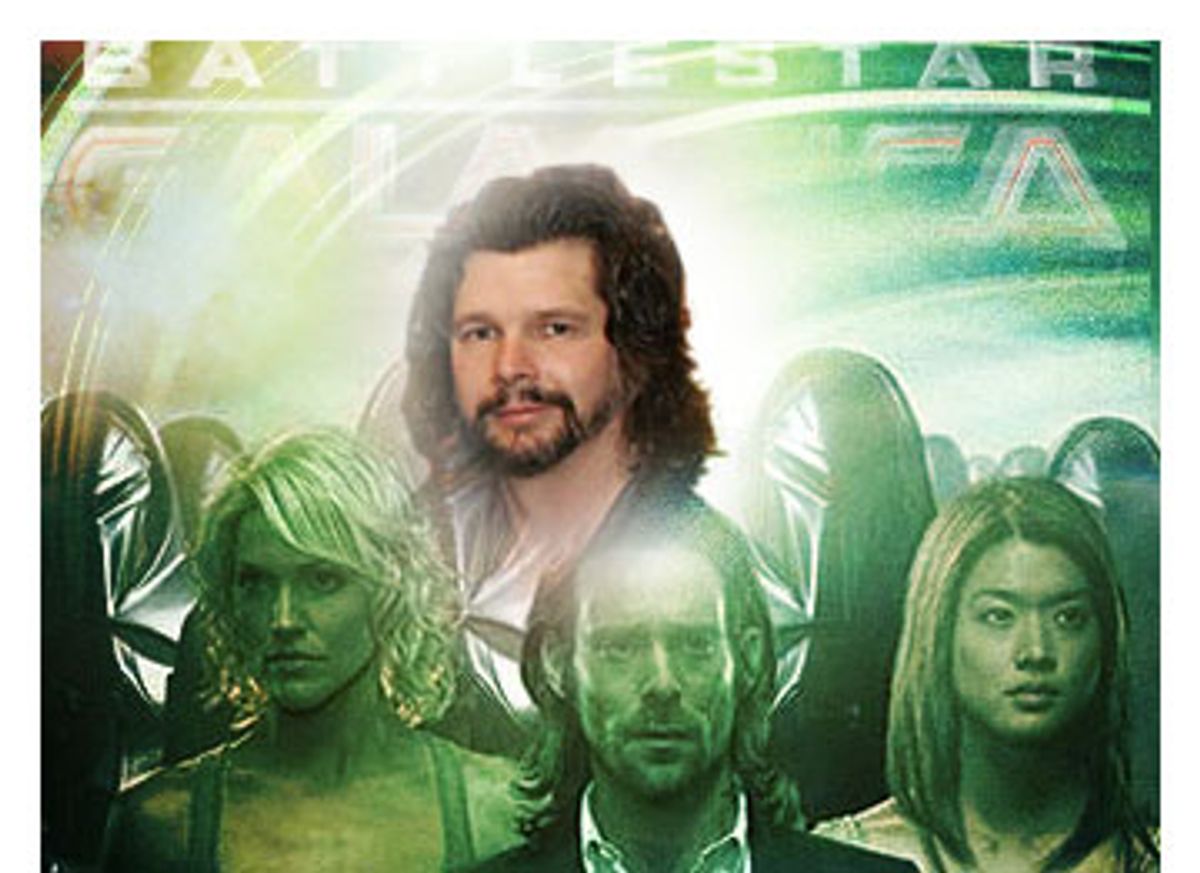
"Battlestar Galactica," the celebrated, Peabody Award-winning SciFi Channel drama, will conclude its third season on Sunday night, with a climactic human rights trial featuring some downright spooky resonances with today's headlines. Although the challenging and unconventional series commands a devoted following, its ratings have been anemic, and so fans received the announcement earlier this week that the SciFi Channel has picked it up for another 22 episodes with much rejoicing. Salon spoke by telephone with executive producer and show-runner Ronald D. Moore about what it's like to comment on the Iraq war in a show set in outer space, the fear-based mentality of the entertainment industry, and the difficulty of making TV that doesn't pretend to solve the world's most vexing problems in 60 minutes. [Warning: Spoilers for Sunday night's finale will follow.]
One of the things people like about "Battlestar Galactica" is the way it seems to touch upon the issues of our time without stooping to obvious connect-the-dots political commentary. In last week's episode, the lawyer prosecuting the big human rights trial in the season finale told an aide to President Laura Roslin to back off, and then added, "Of course, I do serve at the pleasure of the president." I thought you either had to be working much faster than is humanly possible, or "Battlestar Galactica" has become prophetic.
Wasn't that wild? We wrote and filmed that line months ago, before it became part of the current conversation. That was shot in November or October. It's a phrase I've been familiar with and I put it in the show because that's the expression used about people who serve for the president.
Do you often find the show echoing current events even when you didn't intend it to, or is that pretty rare?
It happens. It's an odd confluence of events sometimes. When we're working on a show and developing the story lines and scripts we're certainly keenly aware of what's going on in the world. You can project some things out to where the world might be when the show airs. But with some things, like that line, there's a bit of serendipity that happens.
What's especially weird about it is that the situation is so similar to the ones that led to the Alberto Gonzales scandal.
Yeah, it is. It's Laura trying to tell the prosecutor what to charge, what crime to prosecute. It's been interesting to watch that.
How hard do you try to link what's going on in "Battlestar Galactica" to real-world politics? Or do you find yourselves trying to resist that impulse?
It's part of the brief. The premise of the show lends itself to those topics so naturally. It's about an apocalyptic attack, a group of survivors on the run and they're dealing with issues that are inherently about freedom and security. There's the civilian and the military, and lots of issues it seems very natural for them to grapple with that mirror events in the real world. We talk about it at length in the writers' room and with the cast and directors, trying to figure out where the lines are for us. We never want to go into direct allegory for today's events because there's nothing really interesting about that.
What is interesting to you?
It's interesting for me as a writer when we can move the chess pieces around a little bit, when you're dealing with suicide bombing on the show but suddenly it's not those other people who are doing it, but your characters. You're able to examine the moral questions of it in a different context because you're not burdened by the direct analogy of saying, "If Laura is George Bush and the cylons are the enemy, how do you deal with it?" That to me isn't great drama because everything is so loaded and so apparent. Science fiction gives you the opportunity to mix and match the elements and the circumstances. You can deal with the deeper themes and issues because you've scrambled the chess pieces. You're coming at it from a different point of view.
I get the impression you want to avoid parroting a boiler-plate political position, whatever your own politics might be.
I do try not to do that. I'm not naive enough to think my politics don't influence the show. I'm certain that they do, but the show's mission is not to present answers to what I think are really complicated, difficult questions. One of the mistakes TV often makes is that it tries to tackle complicated moral and legal issues and wrap them up in an hour and give you a neat, tidy message by the end: "And here's the way to solve Iraq!" I don't think that's helpful, and I don't think that's good storytelling or great to watch. Our mission is more about asking questions, asking the audience to think about things, to think about uncomfortable things, to question their own assumptions.
I like the show best when you get to a place where you're not sure who you're rooting for anymore, you're not sure whose side you're on. And you're confused and you might even be angry about what we're doing but at least it's forced you to a place of trying to define your own point of view on something.
Moral ambiguity is unusual not only in television, but in pop culture in general. You worked on several of the "Star Trek" series, which I associate with moral stances that are a lot more pat. What's difficult about making a TV series that aims for something different?
The challenge is that TV wants to bend you and your characters to neat moral decisions and arguments. Ultimately, the forces of television want your heroes to be heroic. It wants the leading characters to make the "right" choice each week and it wants there to be a clearly defined "bad" person in the show. Or at the most, the character does the right thing and maybe at the end he looks wistfully off-camera and ponders how it might have been different. There's a certain phony-baloney quality to a lot of the moralism on TV. It does serve up pat answers to difficult questions. And when you try to make it more morally ambiguous, you immediately run into the buzz saw of "It makes the characters unlikable. There's no one to root for. The audience won't like the character if they can't say he's making the right choice and that's what separates him from his enemies."
We set out to make a very different kind of show. The difficulty is that when you go into these morally ambiguous areas, you have to have morally questionable decisions and motives for all your characters.
The objection that this makes the characters unlikable doesn't even turn out to be true. I'm sure you're well aware of that after seeing the response to what you've decided to do with Starbuck, a person who consistently made bad decisions for bad reasons but who was very popular with viewers all the same. To say she's "unlikable" sounds like an executive's objection.
It's a very fear-driven culture, the entertainment business. It's all about fear. You're afraid the audience isn't going to like it. You're afraid that they'll be turned off and that they're not as smart as you are. They won't get what you're going for. Can't it be safer? Can't it be happier?
It's also got to be difficult to go that route in a show that's substantially about the military. The armed services is an aspect of society people tend to be absolutist about. Was the military setting one of the things that got you interested in the project to begin with?
Well, that was in the concept itself. The original show was a war show. From my point of view, updating it meant that I wanted to treat the military aspects differently. I wanted to make it clear that the people who are serving are human beings, not exalted icons. They do have flaws and make bad judgments and are afflicted by the same curses as everyone else. There are drunks and womanizers and all kinds of different people who go into the military because they're just people.
It was important to me to portray it like that partly because of working on "Star Trek" for so long. One of the central ideas of "Star Trek" is that the people on the Enterprise and in Star Fleet were the best of the best. They were better than you and I, a better breed of human beings who were not torn with petty differences, jealousies and all the things that make people human. That stuff was almost bred out of them at Star Fleet, and that made the drama hard to convey. You were more distant from them as characters.
So I wanted the people on Galactica to be a very different crop. It wasn't going to be the best ship in the fleet crewed by an elite crew. It was going to be an old ship getting ready to go into retirement, and there were going to be a lot of misfits on that ship. What happens when the fate of humanity rests on their shoulders? That's a far more interesting question to me.
Again, science fiction gives me a lot of license. This is not an aircraft carrier. I don't have to be so careful not to offend people who serve in the Navy or have relatives in the Navy, or people who just want to posture about what people are really like in the Navy and you're besmirching the names of our fair soldiers and sailors and all that crap. This is a made-up universe. It's certainly modeled on the U.S. military and we do a lot of the interior character work centering around military culture and how they treat each other, but it's not meant to be a direct representation of the people who are serving.
But before this you weren't sitting around thinking about how much you wanted to do a show about fighter pilots?
No, but it is one of my lifelong interests. My father was a veteran. He was a Marine officer in the Vietnam War. He had a library full of military books. I had an interest in history and read a lot about the military. I was briefly in Navy ROTC [Reserve Officers' Training Corp] in college. When I was at "Star Trek" I jumped at opportunities to do things like go on an aircraft carrier for a weekend, and when I was in ROTC I spent a week on a nuclear submarine. I've always been fascinated by the military culture. It was one of the things that appealed to me about the project, but no, I wasn't setting out to find a military project.
"Battlestar Galactica" is a bit like "Lost" in that it's what's called a highly serialized drama, with a long continuing plotline. If someone misses a few episodes, they may stop watching entirely, thinking they'll never be able to catch up. At the same time, once you get past the first season, new viewers can be put off by how much they don't know about what's going on. So you can lose the viewers you already have much more easily than you can acquire new ones, and both shows have suffered dips in their ratings. Yet this also seems to be one of the most fertile and exciting formats in the medium. How do you deal with those challenges?
I don't. It's a genuine problem I have no solution for. We have long conversations with the network about the extent of the serialized nature of the show. It's certainly not something they're in love with. We the writers are always pushing to make it more serialized because it makes for better storytelling. We've done a few stand-alone episodes here and there, and they're almost never very successful for our particular series. They're not what the audience tunes in for. But the network's legitimate concern is just what you were saying: The audience tends to attenuate over time. It's hard to bring new people on board. There's the hurdle of them having to catch up on all the old episodes, and any hurdle you put in front of the audience is just a bad thing. I don't know what to say. This is the kind of show I like to do, and we're just going to keep doing it. Hopefully, we can persuade people to buy the DVDs and catch up at home and keep watching the show, but the show is what it is.
The availability of DVD sets seems to have made it more possible to do this kind of series.
I think it has. It's really changed the landscape. People are much more comfortable getting on to shows like this because they can pick up a boxed set and catch up.
Another thing: I don't know how reliable the ratings are anymore. I'm among those who cast a skeptical eye at the Nielsen Co. and the demographics and ratings they deliver. The fragmentation of the audience is so profound I don't know how the samples can even tell me how many people are watching my show anymore. It seems like such a crap shoot. It's like where the music industry used to be a few years ago, before they got -- what's that thing called? -- SoundScan. Before they got that it was like Nielsen; they called up store owners and asked them what was selling and what wasn't. When they shifted to a legitimate way of tracking each and every sale, it upended the charts. Suddenly, country music was huge, much bigger than anyone had thought. I think TV is in the same ballpark. We're relying on a really old system based on this sample of people, and it's not really accurate anymore. God knows how many Nielsen families are sci-fi fans.
Creatively, serialized dramas are tricky because you can plan some of it out in advance, but not all of it. Do you have story arcs plotted out over the whole series or over the season, and how much of it do you decide as you go along?
A good amount of it is improvised in terms of how we develop story, which is how I like to do it. At the beginning of the season, we arc out about 10 episodes. I can think in groups of 10.
Then we break all the interior shows. But as those shows get translated into teleplays and we get into production, things will change. We'll get different ideas or get inspiration in the middle of a scene I'm writing and think, "Oh, know what? We should make a hard left turn here." Then all the planning goes out the window and we have to make a change on the fly. But we still try to maintain that goal. We still aim to get to that same place by the end of the 10th episode, but the path to get there I consider much more flexible.
As you get deeper into the series and start planning the next 10 and what's the season finale, it's the same process. You think you've laid out a path, but as you do it you find that there's this other more interesting path to get there. It causes chaos and you have to scramble to change things that you've already set in motion. But I find that it's just a more organic way to do it. It's more interesting, it's more fun, it allows the writers' creativity to come to the fore. It certainly has its downside, because sometimes you make big mistakes. Something that sounded really good at that moment, and you grabbed onto it, doesn't really pan out. Then you have a bad episode.
What's an example where that process really worked well for you?
In this season's finale, I decided on the fly to give Laura her cancer back. It's been bubbling in the back of my mind for a while. When we cured her cancer in the second season, I knew I didn't want that to be a permanent thing. I knew at some point I wanted to bring it back, because we'd changed her character in a way I wasn't happy with. But it wasn't until I was sitting down doing a rewrite of the finale that I decided this is the moment, let's do it. Tigh losing his eye was done in the same way. I was writing the teaser for the season opener and I decided on the fly that Tigh's lost an eye. That became a huge thing for the character and shifted a lot of things in the show. It just worked.
And when did this method not work so well?
We'd developed a whole story line this season about a colony called the Sagitarions, and they were going to be an issue in the trial of [former president] Gaius Baltar. During the missing year on New Caprica, when Baltar was president, a massacre had taken place among the people from this one colony that had isolated themselves from the rest of the people. It was this long intricate back story built into a lot of the previous episodes of the show and it just didn't work. And I basically decided to throw it out while I was writing the finale, on the spur of the moment. We then had to go back into previous episodes and take that out, reshooting and re-editing. Some of those episodes suffered from that decision. It was important because it saved the finale and made it much stronger, but certain episodes in the second half of the third season are weaker as a result of that.
One of the delicate issues with serialized dramas is that they can run out of gas.
Well, you can argue that daytime soap operas never seem to run out of gas -- they go on for 20 years! But we're not really set up to do that. Ours has a beginning, middle and end. Our main title every week says "A Search for Earth," and at some point you gotta find earth, or it becomes "Gilligan's Island." The audience loses faith that you're ever going to get anywhere and the cylons are never going to destroy the Galactica and what's the point. We've always felt that there's an end to this show, and we've moved into the third act of a three-act structure. Especially after this season's finale, we've moved the story to a place where we're talking about conclusions and climaxes and what's it all about -- getting into the endgame. How long it takes to finish out the saga is another matter.
So you couldn't say now whether you think of Season 4 as the last of the series?
I'm considering that right now, to be honest. It's in the air. I don't know. It hasn't been formally decided and I haven't made my own decision. It's a possibility.
The worst thing that could happen to us is if we overstayed our welcome and got to a place where we had not finished the story and then we got canceled. I'd rather go out on my own terms creatively and go out strong.
We won't be seeing Season 4 until January 2008, but I understand there's going to be some kind of miniseries or movie coming before then?
There is something that they're calling "extra episodes" or "extended episodes" -- they keep shifting the nomenclature. Essentially, we are shooting two hours of "Galactica" that will be broadcast on SciFi Channel sometime in the fall. Let's say they broadcast it on a Friday; then, on the following Monday, it will be available on DVD.
That story will not pick up our cliffhanger at the end of Season 3. That didn't seem right. The story will be set on the Battleship Pegasus and will take place in the past, relative to where we are in Season 3. But the events set up in that story will then pay off in Season 4.
What was the reasoning behind doing that?
They came to us. It gives Home Video something to sell in the stores. Since we won't be back until January, which is a long time to be off the air, it gives the fans something to see and keeps the show alive. So it serves multiple masters. There was no way we could pick up the cliffhanger in that format, and then ask people to wait to really start the season later. One of the story lines everyone had really liked was the Pegasus story and the character of Admiral Cain, so we decided to go with that.
There's been talk of you doing another series called "Caprica," set before the cylon attack on the colony of that name. Is that still happening?
It's possible. It's been in development at SciFi for a while and they haven't picked it up. And I don't know if they're going to pick it up at this point. There's talk of doing it as a TV movie and seeing how that works, as a back-door pilot, much as we did with the "Galactica" miniseries. Right now there's nothing telling me that they're going to move on it anytime soon, so I'm starting to feel that it's going to remain on the development shelf.
It was a different kind of show. Instead of an action-adventure sci-fi piece, it was more of a prime-time soap, a sci-fi "Dallas." It was about a family, the Adamas, and a company, and it was about the creation of the cylons 50 years ago. It was not going to be space-based, but set entirely on the planet of Caprica. But it would have sci-fi touches, and it would deal with issues like artificial intelligence and the various schemings and backbitings that you get in the traditional soap opera.
Are you already at work on Season 4 of "Battlestar Galactica"?
Yep, we've broken the first eight episodes. We're pretty happy. There are a lot of things coming; a lot of things change in the season finale of this season and propel us into the story lines of next season.
Can we expect something in this Sunday's season finale that will be as surprising as the finale to Season 2?
Well, the Season 2 finale is a pretty high bar. It certainly had some shocks. I don't know if we can really top Season 2, but it's up there.
Shares