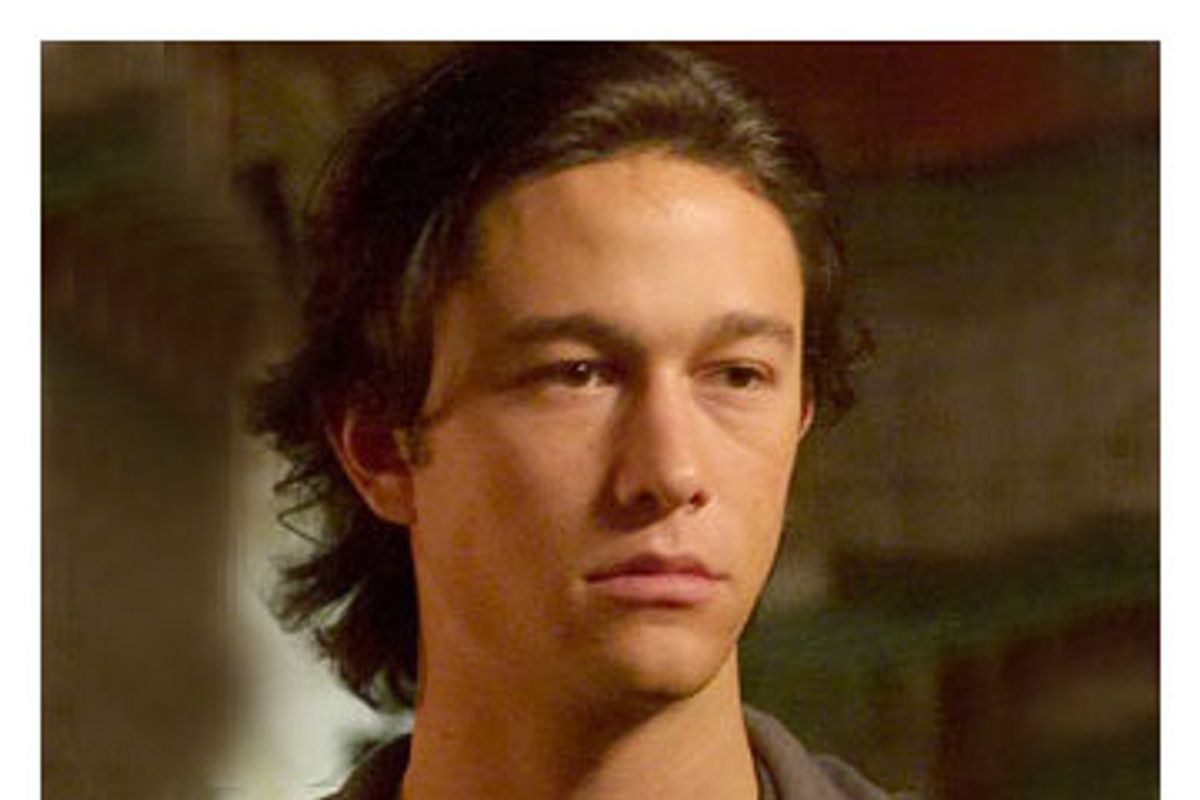
In this interview and podcast, Joseph Gordon-Levitt talks about his new film "The Lookout" -- and why movies should be as complex as people are.

To listen to a podcast of the interview, click here.
To subscribe: Click here to add Conversations to iTunes or cut and paste the URL into your podcasting software:

Joseph Gordon-Levitt has been acting professionally for 18 of the last 20 years, which would be a remarkable statistic for someone twice his age. But he’s 26, and has made the highly unusual transition from adorable child star to complicated and even dark adult actor.
Essentially, Gordon-Levitt has had two different and almost diametrically opposed acting careers. He began appearing in films when he was just 7 years old, but attracted wide notice for his role in Robert Redford’s “A River Runs Through It,” released in 1992 when he was 11. Then came an extensive cute-kid television career, on “China Beach,” “L.A. Law,” “Quantum Leap,” “Roseanne” and 66 episodes of “3rd Rock From the Sun,” in which he played Tommy Solomon.
His second career began in earnest in 2001 with the little-seen indie film “Manic,” in which Gordon-Levitt played a violent, institutionalized teenager. Although the cute kid had grown up into a strikingly handsome young man, he didn’t seem innocent or wet behind the ears anymore. Abruptly Gordon-Levitt emerged as one of the most interesting leading men in independent film, a thoughtful performer, simultaneously outspoken and introverted, who specializes in playing troubled characters at war with themselves and the world. (He also has his own Web site, which he describes as his “alternative outlet of where I get to be a little less professional and just freak out a little bit.” Click here to watch one of his shorts.)
Filmgoers first noticed the new Gordon-Levitt for his highly charged role as a haunted and morally ambiguous gay hustler in Gregg Araki’s cult hit “Mysterious Skin,” and then he stole the show as the hard-boiled high-school detective hero of “Brick.” I met him in a hotel suite in Austin, Texas, where his new film “The Lookout” was premiering at the South by Southwest Film Festival.
A stark, shifty thriller written and directed by Scott Frank (screenwriter of “Out of Sight” and “Little Man Tate,” among other films), “The Lookout” is the closest thing to a Hollywood film Gordon-Levitt has made in his second career. Still, it fits the pattern: He plays Chris Pratt, a one-time high-school stud athlete who’s trying to recover from the physical, psychological and emotional effects of a disabling brain injury (one caused by a hideous car crash that was his fault). Chris becomes the focus of a group of predatory gangsters, hoping to use his disability and vulnerability to help them rob the bank where he works as a janitor.
Gordon-Levitt greeted me in his hotel room with excessive politeness, clad in a prep-school-neat shirt and tie that made him look like a new wave guitarist, circa 1982. He was friendly and seemed eager to have a real conversation, but has already learned the guardedness that comes with being a celebrity. It applies even to the minor-key celebrities, the self-debunking and self-deflating ones, the ones who have walked away from one kind of stardom in search of a more grown-up one.
You played the damaged, charismatic strange guy in “Mysterious Skin,” and then the hard-boiled teenage detective in “Brick,” and now you’re playing a guy who’s recovering from a serious brain injury. It’s like everything has to have enormous challenges.
Well, life is challenging. I think movies without a little darkness are boring, because the world ain’t like that.
But I suppose you’re going to tell me that, despite all these characters, you’re a completely normal, likable guy.
Oh, far from it. No one likes me. Will you be my friend? [Laughs]
I don’t know. You seem like a dangerous character.
Be careful.
So what was it that drew you to this role? I know this project has been kicking around. Leonardo DiCaprio was going to be in it. David Fincher was going to direct it. What drew you to it?
Simply a good script. At first, this is what draws me to any movie. It sounds obvious but it’s unfortunately very rare to find a script that’s got some really good writing to it. I think our movies in general are being controlled by people who think that special effects and gimmicks are going to sell more tickets than a good story. I think they’re wrong. Scott Frank, who wrote and directed “The Lookout,” knows how to tell a story, and it was immediately apparent when reading the script. And he’s an inspirational guy. He’s really passionate about what he does; that’s what I’m always attracted to — passion and love. I was lucky to get to work with him.
I remember Rian Johnson talking about you preparing for his movie “Brick” and how you would try to do all this work to figure out the difficult dialogue in it. What were the challenges as far as getting ready to play this guy?
Preparing for “The Lookout” was obviously focused a lot around what would it be like to have a traumatic brain injury. But as I did my preparation and research, and hung out with people who had been through accidents and situations similar to Chris Pratt and suffered injuries similar to the one portrayed in the movie, I found that not only is everybody an individual but the boundaries that we draw between the “us” and the “them” are actually really faint. It grew apparent to me that I wanted to make Chris certainly have his new life and condition be present at all times, but actually I wanted to point out the similarities between him and someone without a traumatic brain injury more than I wanted to point out the differences.
It’s definitely not one of those roles where you’re thinking about the person’s disability all the time.
Right. That’s what I found. When I was hanging out with these guys who were “disabled,” it was only in isolated moments when that would really surface and the rest of the time you’re just hanging out with somebody like you’d be hanging out with anybody else.
And it seems like you hit on the idea that one of the main things that manifests for Chris is that he gets angry when he’s not able to do something the way that the so-called normal part of him would want to. Was that one of the key things for you?
It’s true, there’s two edges to an injury like this. There’s the injury itself, which does change your brain, but then I think the even more severe and painful truth of the condition is that he remembers who he used to be and wishes so badly that he could be that and isn’t. So it makes him insecure and it makes him feel bad about himself, and that’s way more painful than not being able to have your brain work like it used to — way more painful. I think that’s something he has in common with everybody. Everybody’s fears and insecurities, those are the real demons. The problem is when you’re scared. The problem is when you don’t love yourself. And Chris has a healthy portion of lack of self-love, and that’s what’s really holding him back, I think, even more than the brain injury.
If you’re talking about his lack of self-love, isn’t that what also makes him vulnerable to these people who want to take advantage of him?
That’s exactly it, and I think they at first want to take advantage of him because they know he has this injury, but as they get to know him they see that really what they’re taking advantage of is just a sad and lonely guy. That’s what’s so vicious about the villain, Gary, is that Gary doesn’t know anything about traumatic brain injury but he does know about people. He knows how to play somebody, and he does so to intense effect.
Scott Frank makes these genre films, but they’re really based in the reality of what these people are like.
That’s ultimately why I loved the script so much. I can see whole people in the pages. A lot of movies, every character is kind of this one-dimensional device: This is the good guy, this is the bad guy, this is the girl. It’s so boring, and people aren’t like that. Life isn’t like that. Life’s not simple. Nothing is black and white. And I don’t know why people think that black and white makes good stories. It doesn’t. It makes boring stories. You know what’s going to happen. The way Scott writes, yes, there’s a hero and a villain, but it’s a little more complicated than that, and that’s what keeps you interested in watching.
Given your recent performances, you’re going to get offered parts in films that are a little bit more black and white in terms of their structure and that maybe also pay really, really well. Are you really going to be able to say that you don’t want to do those kinds of movies?
I just want to do good movies, and by the way, “The Lookout” paid really well.
Well, good. I’m glad to hear it.
I’m so lucky to have a job like this. It’s funny to me when I hear actors talk about “littler” movies like “The Lookout.” “The Lookout” is a huge movie! It cost like $20 million to make! Come on. The point is not how much it cost to make or what corporation backed it, the point is that it was a good script and that the people making it loved what they were doing. It doesn’t matter what the budget or what the corporate structure is if you have that kind of love and that kind of integrity. So if you ask me what I’m going to do next, I’m going to do the same thing: I’m going to try to find movies made by people who love what they’re doing, who have something to say, who know how to write, and hopefully it will turn out good.
How did you start on this track of movie acting? Were you one of the kids who was acting in school theater starting from an early age?
I’ve been acting professionally since I was 6 years old. I actually just hit my 20 years.
Not too many people who start as little kids are able to keep doing it as adults so that’s an accomplishment in itself. You obviously never got sick of it, though.
I did. I quit for several years actually. In fact, that number 20 maybe isn’t exactly true because I did quit for about two years.
Did you consider other careers?
I went to college. I wanted to have a wide-open future with endless possibilities. [Laughs] It wasn’t so much that there were other careers in particular that I was considering so much as I just wanted to stop acting. I really wanted to move away from home and go to college, and I think it’s the smartest thing I ever did. Moving to a new place and seeing how you fit in without any of the crutches that hold you up in the old place is so good for the soul, I think, and it was good for mine. Ultimately it brought me back to acting, but I had to find that for myself.
So when you got back to acting, was there a transition between the old acting career and the new one or did it feel like the same thing?
It was different. It took a while to find a filmmaker who would believe that I could do something other than what I was known for doing, because the Hollywood structure was not going to believe that. It’s against its principles to go against the formula like that. But Jordan Melamed, who made “Manic,” Gregg Araki, who made “Mysterious Skin,” Rian Johnson, who made “Brick,” and Scott Frank, who made “The Lookout,” all of them kind of flew in the face of what most people thought of me and believed that I could do anything I wanted to.
Are you working on another project now?
I shot three movies last year. “The Lookout” is the first one that’s come out. Then there’s going to be “Killshot” and a movie that is probably going to be called “Stop Loss.” All three of them are really cop-intense, violent movies in a way. This one is a heist. In “Killshot” I play a killer next to Mickey Rourke, and then in “Stop Loss” I play a soldier. It was a hard year. It was a good year. I feel like more of a man.
Famous face behind a tiny project
In a Salon exclusive, the actor discusses his art-based social network, its new book and the inspiration of Occupy
Joseph Gordon-Levitt (Credit: AP/AP/Mark Mainz)
What began as a personal project — an online screening room where actor Joseph Gordon-Levitt could share the fruits of his creative labors with the public — has, over the past few years, morphed into an impressive, interactive online salon.
HitRECord.org, where tens of thousands of contributors now bring their original music, text, illustrations and footage, lets people really “share” their work — not in the YouTube sense of simply posting something and hoping for an enthusiastic response, but in the true spirit of collaboration. Work posted to the site is regularly adapted or “remixed” by other users. Next week, a new book from HarperCollins’s It Books — “The Tiny Book of Tiny Stories” — collects some of the best pieces.
When he’s not working on a movie (you know, small films like “The Dark Knight Rises” and “Lincoln”), the actor still posts material to the site himself –including several hours of raw footage from his visit to Occupy Wall Street on the mid-November night when protesters were evicted from Zuccotti Park.
Over the phone, Gordon-Levitt talked to Salon about the origins of hitRECord, the joys of editing and his high hopes for an OWS-inspired project in the near future.
Can you talk a little bit about the inspiration for hitRECord — how it started, and whether you ever expected it to grow into what it is now?
Well, it started a long time ago, and no — when it started, I really, to be honest, did not expect it to become what it has. It started as my own kind of moniker for my own self-expression, when I was making little videos and doing bits of writing and music and just kind of acknowledging to myself, when I was in my early 20s, that as much as I really loved being an actor, that wasn’t all I wanted to do.
HitRECord was this web site where I would put up these little things that I made, and over the years this community sprouted up around it. After a while, I sort of said, why not — rather than all these people just talking about the things that I’ve made, what if we started making things together? And it actually started going really well — and so it very, very gradually and organically grew, and then at the top of 2010, we started it as a professional production company. And we’ve been going strong since.
In a 2007 interview with Salon’s Andrew O’Hehir, you called hitRECord an “alternative outlet” where you could “be a little less professional and just freak out a little bit.” Is it less of that now that it’s a bigger project? Can you still relax as much?
That’s really a very interesting question. That’s hilarious! Back in 2007, not a lot of reporters were asking me about hitRECord. But you’re 100 percent right, actually. In 2007, it was very informal. And now it has become quite a bit more professional.
Personally, I enjoy that. If I’m hanging out with my friends and we’re just making something for fun, I’m the guy who’s like, “It’s not done! Put your drink down! We have to finish this!” I don’t know if it’s because I’m a workaholic, or just because that’s what gets me off — making something good — but the fact that hitRECord is more professional hasn’t really changed any of its [appeal]. I’m still doing it for the same reasons; it’s not like now it’s a subdivision of some larger corporation and I have bosses that I have to answer to or anything like that. It’s still what I love to do, the things I love to make — it’s just that now I’m doing it on a much grander scale, with a lot more people.
You posted some videos from Occupy Wall Street a couple of weeks ago; in some of the footage, you were interviewing people you met on the street. Do you enjoy the fact that this project lets you be on the other side of the camera — not only as a director and artist, but also almost as a journalist?
Yeah! Very much so. I’m of the opinion that the news and show business are basically two different genres of the same thing. Whenever I watch the news, or a documentary — to me, it’s all someone telling a story.
I was really inspired going down there to Occupy. And I’m really excited about what hitRECord and I will make together [about Occupy]. My footage is just three hours of footage from one night. But since I posted that, there’s been a ton of different contributions; people putting up their footage, writing out their thoughts — and then people downloading the footage that’s up there, and cutting it together in different ways to say different things. It’s really just begun. … We haven’t made anything yet that I would consider finished and screenable, but soon we will. And I love it.
All the hitRECord contributors whose work was selected for this book will be paid a cut of its earnings. Do you think other content-sharing websites tend to undervalue talent by encouraging people to post their work online for free?
Yeah, that’s interesting. I mean, first of all, 8,000-some people contributed to the “Tiny Stories” collaboration, and I think 60 of those artists have work that’s featured in the book. So it’s not like we’re paying everybody who contributed — we’re only paying people whose work ended up in the final book that’s making money. But what I find really kind of touching, actually, is that when we do pay people, they tend to be way more excited about just the concept of getting paid, and getting to be in the credits, than the money itself.
Would you say that’s true of you, too, as an artist?
Me, I mean — I’m lucky. I was on a hit sitcom for years, so I made money. [That's] honestly been a luxury that’s afforded me the opportunity to do all sorts of work in my life, as an actor and on hitRECord. I was able to do movies like “Mysterious Skin” and “Brick” and “Manic” in my early 20s — movies that don’t really pay very much money — because I had made money on TV, just to be honest. And those are movies that, because I was able to do them, got me jobs in the future. I guess the reason I’m bringing that up is, I wouldn’t be so naive as to say that money doesn’t matter. It costs money to make a movie. It costs money to publish a book. That’s why hitRECord is a for-profit company in the first place. Back in 2007, when your colleague asked me that question, hitRECord was nothing like that — there was no money at all. And I thought long and hard about bringing money into the equation. The reason that I ultimately decided to do it was that I wanted to do things like this: I wanted to publish books. I wanted to have shows in big theaters. I wanted to eventually make TV shows and feature films. And to do those things, money is necessarily going to be part of the equation. That’s why hitRECord is a for-profit company. But I think ultimately, the reason why anybody who’s on hitRECord contributes their work to hitRECord is not to make money, but because they love doing it.
Where did the “tiny stories” idea come from to begin with?
The idea came from this artist named “wirrow,” who joined the site in the spring of 2010. He’s a really wonderful, virtuosic illustrator, writer, musician and animator, and he’s done a bunch of great work on hitRECord. He started this collaboration called “Tiny Stories”; he said he got that concept first in a bar, when he wrote a story on a beer coaster, and left it there for someone to find.
He started posting little illustrated tiny stories on our site, and people just really liked doing [their own] — it’s sort of perfectly conducive to our collective, creative process.
Would you say you have a strong editorial presence on the site, and in this book? Do you read or see most of the things people post every day?
I spend quite a bit of time on hitRECord, but there’s absolutely no way I could read everything. There are a thousand new records a day right now. It truly is a collaborative effort, and a communal effort. I didn’t see all 8,000 “Tiny Stories” entries, for sure — but the community kind of goes through them, and the things that resonate with the community pop out, whether that’s because several people recommended them by hitting the heart button, or because several people “remixed” them.
Now and then I’ll find one that I like; oftentimes I’ll tweak it a little bit, rewrite it some, which is really fun for me — I get a big kick out of that kind of game, the challenge that comes with thinking: Here’s a cool idea for a story; how can I change these words around (if it needs it) to make it as brief and as graceful as possible?
What’s your dream for this project — in five, 10 years? Will you stay involved? Do you have an ultimate goal, or are you just enjoying the ride for now?
It’s both. I have lots of very ambitious goals. We’ve been touring around, doing live shows; that’s really grown in the past year. Last year we played at a 100-person capacity bar in downtown Manhattan; this year, we played a 2,000-seat theater in L.A.
I think eventually we could accomplish any number of things. I think we could have a TV show; I think we could make feature films. And most importantly, I just think that the further hitRECord is out there, and the more artists that want to contribute to it — the better the work will be. I’m excited to see what we’re making together in five years.
To contribute your own work to the hitRECord community, make a profile here.
Pop Torn: 10 pieces of culture we’re feeling iffy about
We're on the fence about another "Face/Off," Lindsay dropping her last name, 3-D Musketeers, and so much more!
Good or bad? Help us decide!
Wednesday in New York, it managed to snow, hail and be passingly warm out, all at the same time. Now imagine that these little tidbits of cultural news from this week were like the weather in New York. Now you see what we’re getting at, right?
1. Lindsay Lohan dropping her last name: Problem is, we’ll still know those are her parents.
2. Michael Scott proposes to Holly on “The Office”: Good episode, but it really took this much hype to get people talking about “The Office” again? Not a great sign for when Carell leaves.
3. “The Big Lebowski” Monopoly game: Awesome when we thought it was a real thing. Turns out to be a Photoshop from Reddit. Which is still cool, but someone out there needs to market this!
4. “The Three Musketeers” in 3-D: Oh come on, that title was just begging to be called “The 3-D Musketeers!” Also, this is one of those times where putting it in three dimensions won’t make kids think it’s any less boring. Lets hope “Resident Evil” director Paul W.S. Anderson can pull it off!
5. Nicolas Cage and John Travolta might “face off” again in not one, but two possible indie flicks: This time, though, let’s give less screen time to Travolta, because I just watched “Face/Off” again and after they do the, uh, surgery, the movie is kind of boring. Nicolas Cage needs to be let out of his crazy cage!
6. “Mildred Pierce” miniseries on HBO begins this weekend: Love Kate, love Guy … but Evan Rachel Wood? I still haven’t forgiven her for the accent in “True Blood.”
7. The “Lesbians Who Look Like Conan O’Brian” Tumblr: This is where we go after we run out of ladies who look like Justin Bieber?
8. “Boardwalk Empire’s” Michael Shannon may play the villain in new “Superman” film: Man, just for once I’d like to see someone give Michael a role in a romantic comedy. Still, he’d be great.
9. Joseph Gordon Levitt to play mob son in “Dark Knight Rises“: OK, this errs too much on the side of rom-com casting. How could Joey ever be evil??
10. We now know Oprah’s last show is in exactly two months: It’s kind of like knowing when you’re going to die, isn’t it?
“Inception”: A clunky, overblown disappointment
Christopher Nolan's much-hyped thriller is a joyless, awkwardly constructed mess
Joseph Gordon-Levitt and Leonardo DiCaprio in "Inception"
Director Christopher Nolan is such a master movie technician — a combination of engineer, architect, game designer and God — that it’s startling to realize how constricted his vision is and how clumsily he tells stories. “Inception,” Nolan’s first film since his mega-googolplex hit with “The Dark Knight,” and his first as a solo writer-director since the now-legendary puzzler “Memento” in 2000, is supposed to be a dreamscape movie. At one point, in fact, we travel with its central Scooby-gang of characters into a dream within a dream within a dream, and then into some deeper, still more unconscious, psychological limbo-state below that.
Managing all these nested levels of narrative is a marvelously nerdy accomplishment, no doubt — but this is the most tight-assed vision of the innermost human psyche I’ve ever seen. While Nolan’s images are visually impressive and powered by state-of-the-art digital effects and accomplished stunt work, they’re always ordered and organized with anal precision. They don’t look or feel anything like dreams. (Or, at least, not like my dreams.) They look instead like mediocre action films from the ’90s, or in the case of the supremely boring ski-patrol vs. Arctic fortress shootout found on Level Three, like the Alistair MacLean adaptation “Ice Station Zebra” from 1968. (With Rock Hudson! And Ernest Borgnine!) “Inception” may have been directed by Christopher Nolan, but Nolan’s dreams are apparently directed by Michael Bay.
OK, I know — you want me to back off the high-minded analysis and tell you whether “Inception” is a good destination for those summer moviegoing dollars eager to leap out of your wallet. Sure, I guess so. It’s a cool-looking action movie, carefully constructed and edited, that uses all kinds of nifty locations and a lot of portentous-sounding expositional yammering. It inhabits a Philip K. Dick-style universe of psychological warfare that suggests “The Matrix,” “Total Recall” and “Minority Report” — all of them, by the way, better movies — but it’s fairer to call “Inception” a maze movie or a labyrinth movie than a puzzle movie. Because, as the wisecracking fellow critic sitting next to me observed, every time the story gets puzzling the characters call a timeout and explain it.
So, yeah, if you approach “Inception” with lowered expectations it’s a pretty good time. Problem is, there are no lowered expectations around Christopher Nolan, whose adherents have proclaimed him as the heir to Kubrick and Hitchcock and declared “Inception” a masterpiece. I don’t want to get sidetracked here, but let me suggest that the comparisons aren’t entirely misguided. They’re just not helpful. Nolan has inherited some of Kubrick and Hitchcock’s worst tendencies, most notably their defensive, compulsive inclination to work everything out about their stories and characters to the last detail, as if human beings and the world were algebraic or geometrical phenomena requiring a solution.
But the mysterious power of Hitchcock’s “Vertigo” cannot be explained by the ludicrous official story revealed in the final act — indeed, it nearly scotches the whole movie — and the attack of “The Birds” is never explained. As Kubrick’s career progressed he was increasingly drawn to stories that defied or challenged rational analysis, like “2001: A Space Odyssey” or “The Shining.” (I think I’d put “Full Metal Jacket” and “Eyes Wide Shut” in that category too, but let’s discuss some other time.) Nolan seems to have learned exactly the wrong lessons from these mentors. For all the complexity, craftsmanship and color of “Inception,” it’s yet another of his ultra-serious schematic constructions with no soul, no sex and almost no joy, all about some tormented dude struggling with his ill-managed Freudian demons. That same guy sitting next to me cracked that Nolan needs to stop seeing a therapist; there’s not nearly enough sublimation in his movies.
At least Nolan hasn’t cast frequent collaborator Christian Bale on this occasion (they’ll presumably be reunited on the next Batman movie), but he’s only traveled as far as go-to tormented dude Leonardo DiCaprio, last seen as the psychiatry-textbook protagonist of Martin Scorsese’s “Shutter Island.” DiCaprio’s only 35, but he’s become a vastly different actor in his post-pretty-boy phase, and always seems to play guys who have a dead wife, a sweat-gland malfunction and a really urgent need to find the toilet. In “Inception” that would be Cobb, a dream-state spy or “extractor” who earns big bucks by entering and manipulating people’s dreams to drag out their most closely held secrets.
Nolan throws us into the deep water right away, and in many ways the dazzling first quarter-hour of “Inception” is the best part. There are no opening credits. In the first couple of shots, Cobb washes up on a beach, possibly in Japan, and is dragged into a luxurious house for an audience with an aging yakuza gangster. No, wait — now Saito (Ken Watanabe), the gangster, is much younger. Cobb and his sharp-dressed partner, Arthur (Joseph Gordon-Levitt), who seems to have materialized out of nowhere, offer to train him to protect himself from dream raiders. No, wait — this is Saito’s dream, and Cobb and Arthur have set a trap for him. Unless he’s also setting a trap for them! But who’s the sultry foreign bombshell (Marion Cotillard) who aligns herself with Saito against Cobb, and doesn’t really seem to belong here?
After that setting dissolves into a chaotic shootout, all these people (or most of them) wake up in a modest apartment somewhere in Asia or the Middle East — Iran? Pakistan? the West Bank? — where an angry mob is closing in outside. Saito isn’t pleased; he was auditioning Cobb and Arthur for a difficult espionage job, and they failed. No, wait — maybe they didn’t. How and when can the dreamer be absolutely sure he has woken up?
So the themes, ideas and characters of “Inception” are all introduced with brilliant economy, along with its moral and philosophical universe. And then Nolan proceeds to hammer them relentlessly into the ground with an increasingly clumsy, clunky plot and an allegedly profound mystery that just sort of fizzles out into what-if-this-world-isn’t-real sophomoric musing.
Cobb and Arthur are gray-market or black-market entrepreneurs, and Cobb has warrants hanging over his head that keep him from going home to his kids in the United States. (I’ll say no more about that.) His dead wife, Mal (Cotillard), only visits him in dreams — his own and other people’s, even though that’s not really supposed to happen — and doesn’t act all that friendly. Let’s just say that as obvious names for ominous female characters go, that one pretty nearly takes the cake. You didn’t want to call her Fatale, Chris? Or Eve L. DeMenta B. Yotch?
These guys are experts at extracting stuff from people’s minds, but Saito wants them to do something more difficult: “Inception,” where an idea will be planted in someone’s mind so deeply that he’ll believe he thought of it himself. (This is supposed to be so hard, someone explains, because the brain can always track ideas back to their source. Take that, Joseph Goebbels and Fox News! You only think it’s working!) The subject is a youthful energy tycoon named Fischer (Cillian Murphy), who must be persuaded to break up his dying father’s superpower-scale corporation because that’ll be a good thing for the planet. For once I am not being snarky; that is the stated reason.
So Cobb and Arthur have to round up the team of globetrotting rapscallions always demanded by a movie like this: College-girl genius Ariadne (Ellen Page) as the “architect” who designs the dream worlds; chemist Yusuf (Dileep Rao) to administer the designer sedatives; shape-shifter Eames (British actor Tom Hardy, always a delight) to act out key roles inside Fischer’s mind. It’s basically “Mission: Impossible II” minus Tom Cruise and John Woo, plus “Ocean’s Eleven” minus a sense of humor and Las Vegas, plus “A Nightmare on Elm Street 3: Dream Warriors,” with Marion Cotillard standing in for Freddy Krueger. Except that I just made it sound a whole lot more fun than it really is.
Nolan is completely uninterested in the plot superstructure involving Saito and Fischer, which never amounts to anything and holds no surprises. He is, of course, supremely invested in the details of the three (or four) levels of dream narrative into which our terrorist heroes drag Fischer. Drugging him in awkward and implausible fashion on a Sydney-to-Los Angeles flight, they first pull him into a noir-ish kidnapping drama in a gray, rain-swept city, before all going to sleep again and waking up in a corporate-espionage yarn set in a luxury hotel, where they snooze down another level to the aforementioned Arctic Circle shootout, which could be in one of the Roger Moore Bond movies or an abandoned Cold War drama with Sylvester Stallone. (“No man’s ever broken out of the Soviet Union’s super-secret Northern Fortress. But one man’s going to break IN.”)
All of this involves a bunch of big-ass guys shooting at each other with automatic weapons, which has to be the most arid and depressing depiction of the dream state I’ve ever encountered. There are no surreal images or nonsense dialogue, no illogical shifts of scene from the first-grade classroom to Mom’s kitchen to a whorehouse. It’s all meticulously, ass-clenchingly worked out: One person has to stay awake at each level to retrieve the others from the mind-melting waters of Lethe, and time passes more slowly as the dreamers go deeper. If there’s one thing that dream-state movies need more of, it’s math, and genderless geek-girl Ariadne is all over it: “That means 10 seconds before the van hits the water! That’s three minutes for Arthur in the hotel — and 16 minutes for us!” (I made up that particular line, but it’s representative.)
Sometimes Nolan’s technical expertise produces its own kind of beauty, as in a startling zero-gravity scene in the hotel corridors when the laws of physics apparently rebel on Level Two. But for the most part “Inception” is a handsome, clever and grindingly self-serious boy-movie, shorn of imagination, libido, spirituality or emotional depth. Nolan establishes a fascinating world, loaded with trapdoors, symbols and hidden secrets, and then squanders the opportunity on an overpriced “Twilight Zone” episode. He casts Cotillard, one of the foxiest actresses alive, as a smoldering temptress who embodies all the female, erotic energy absent from this universe, and then literally locks her in the basement. Mal yearns to escape and get her claws into these constipated, narcoleptic boys (and maybe into Page’s prim androgyne as well), and this movie would be a hell of a lot better if she did. But she’s a girl — no, she’s a woman — and even in dreams it’s too dangerous to let those run around loose.
Sundance: An Ozark noir; Pat Tillman revealed
A dynamite backwoods crime thriller; Pat Tillman's life and death; Adrien Brody and Sarah Polley make a monster
Jennifer Lawrence in "Winter's Bone"
PARK CITY, Utah — It’s only Day 4 of Sundance, and I’m already reduced to blurbage. Here are quick hits on the films I’ve liked so far this weekend, one of them an early contender for the much-coveted O’Hehir Sundance Grand Jury Prize, handed out annually by a committee of one with no rewards attached, either on earth or in heaven.
We’ve all acclimated to the altitude by now, and to the fact that it’s apparently going to keep on snowing throughout the festival, rendering traffic and transit issues between the sprawling Sundance venues even more fun than usual. Various actors and directors seem to be skipping out quickly, or not showing up at all; I’ve had two interviews fall through at the last minute, and other journalists report similar results. Honestly, though, no complaints from this quarter. It’s a terrific Sundance to this point, and the dramatic conditions outside only heighten the indoor dramas in those nice, warm theaters.
Among the films I haven’t seen yet, there’s been a tremendous reaction to the Internet-romance documentary “Catfish,” which apparently has quite a sting in its tail. (Here’s Christopher Kelly of the Fort Worth Star-Telegram.) I’ve also heard furious back-and-forth debates about the confrontational drama “Hesher,” which stars Joseph Gordon-Levitt as a long-haired anarchist grief therapist. (Here’s Dennis Lim’s thoughtful but negative review on his Sundance blog.)
“Winter’s Bone” Debra Granik’s blend of low-budget regional realism and crime thriller (adapted from the novel by Daniel Woodrell) is an absolute knockout, for me the narrative film of the festival so far. Young Jennifer Lawrence is sensational as Ree, fierce teenage scion of an Ozark family of bootleggers, outlaws and meth-cookers. When she finds out that her dad has put up her family house and 300 acres of virgin timber on bond, and then jumped bail, Ree has a week to track him down or be evicted, along with her younger sister and brother and her near-catatonic, pharmaceutical-addled mother. Problem is, the only people who might know where Pa is are the meanest and scariest members of her extended family, and what they know might not be stuff Ree wants to learn.
Granik captures the details of life in the ruined and beautiful backwoods villages of Missouri in thoroughly convincing, documentary-like detail, but there’s not much meandering or contemplation. This is a woman who knows how to direct a damn movie; “Winter’s Bone” builds to an ominous, almost breathless tension, every moment pregnant with violence and disaster. John Hawkes adds a powerful performance as her wiry, speed-freak Uncle Teardrop, who virtually oozes menace but is Ree’s closest capable relative and her only source of succor. Channeling both urban myths (“The Sopranos”) and rural ones (“The Texas Chain Saw Massacre”), Granik reveals herself as a lean and forceful tale-spinner, as courageous in her own way as the indomitable Ree.
“The Tillman Story” Just before Sundance, director Amir Bar-Lev changed the title of his documentary from “I’m Pat Fucking Tillman,” reportedly the last words that the NFL star-turned-Army Ranger said while being gunned down by his own comrades in Afghanistan. But this seemingly nondescript new title has a resonance that becomes clear when you watch Bar-Lev’s fascinating account, made with the consent and cooperation of Tillman’s family. You see, “The Tillman Story” isn’t just about the fact that Tillman was killed by friendly fire and the military brass lied about it, and essentially have never stopped lying. It’s also about the fact that from the moment of his death, and even before, the former Arizona State and Arizona Cardinals star became a mythic, über-patriotic hero, the centerpiece of a right-wing, pro-military propaganda fable. He was never allowed to be who he was, a surprising, curious, and even eccentric individual who didn’t fit the mold of either football player or gung-ho soldier.
Tillman returned from a tour of duty in Iraq convinced that the war there was both ill-advised and illegal; he reportedly had read essays about American foreign policy by Noam Chomsky and expressed an interest in meeting him. But as Bar-Lev’s film makes clear, it isn’t fair for the left to try to steal Tillman back and make him into its own hero figure. He joined the military in the first place, it appears, out of a genuine belief in patriotic self-sacrifice (although he never discussed the decision in public), and reading Chomsky was part of Tillman’s wide-ranging self-education, which also included Ralph Waldo Emerson and the Book of Mormon. (He was personally an atheist, but had an almost academic interest in religion.) In this funny, profane and profoundly sad film, Bar-Lev depicts Tillman and his similarly unconventional parents and brothers as belonging to a vanishing species: Americans who hew to no ideological standard, and who actually think for themselves.
“Cyrus” Do shlubby John C. Reilly and ultra-hot Marisa Tomei make a plausible couple? They kinda do, in this enjoyably off-kilter romantic comedy from filmmaking brothers Jay and Mark Duplass (“Baghead,” “The Puffy Chair”), who have ascended from zero-budget DIY movies to a mildly more expensive version. (“Cyrus” was actually produced by Ridley and Tony Scott!) Reilly plays a depressed loser whose ex-wife (the Sundance-ubiquitous Catherine Keener) is shoving him back out on the romance market. Tomei’s character is immediately drawn to his lack of pretense (her first words to him: “Nice penis!”), and perhaps to his intense neediness as well. After all, she’s got her overweight, 21-year-old, socially maladjusted son, the eponymous Cyrus (scene-stealing oddness from Jonah Hill), living with her, in a relationship that’s just this side of totally creepy. All the improvised dialogue, herky-jerk camerawork and social discomfort of previous Duplass films is here, along with name actors playing damaged but ultimately human characters. Fox Searchlight will release this later in the year.
“Splice” It’s the parenting movie of the year! Canadian genre director Vincenzo Natali takes a page from his countryman David Cronenberg’s old playbook in this slick, enjoyable, black-comic monster movie about Clive (Adrien Brody) and Elsa (Sarah Polley), a hot-shit scientific couple infected with bottomless corporate dollars and boundless arrogance. They’ve already created a genetically engineered life form — a pustulent giant caterpillar whose body produces useful pharmaceutical agents — but of course the next stage will involve blending in some human DNA. Good idea, right? Polley and Brody tackle the film’s ludicrous situations with total deadpan commitment; Polley’s Mama Macbeth bonding scenes with the hairless rabbit-cum-alien baby-cum-winged scorpion they produce are almost touching. But don’t kids sometimes come between Mom and Dad, especially when they’re seductive, gender-switching, super-powerful new life forms? I’ve heard some critics complaining about Natali’s tongue-in-cheek blending of every possible monster-movie trope, but for me “Splice” went down smooth, with its sleek surfaces, terrific special effects and disturbing sexiness.
Joseph Gordon-Levitt: Caught between two worlds
After starring in a summer rom-com and kicking ass in "G.I. Joe," the one-time TV teen returns to "Uncertainty"
Joseph Gordon-Levitt in "Uncertainty."
At the ripe old age of 28, Joseph Gordon-Levitt is simultaneously a showbiz old pro and one of the hottest young acting talents to emerge in this decade. When Gordon-Levitt played his first high-impact dramatic roles in edgy, independent films like “Mysterious Skin” (2004) and “Brick” (2005), there were a handful of snickers at first: Wait, isn’t that Tommy, the teenage kid from “3rd Rock From the Sun”? It was indeed, but Gordon-Levitt has been acting since early childhood. He had an extensive TV résumé long before the first of his 133 “3rd Rock” episodes — with recurring roles on “Roseanne,” “The Powers That Be” and the early-’90s “Dark Shadows” reboot — and he damn sure hasn’t let that role define his subsequent career.
Gordon-Levitt’s movies since his “Brick” breakout have quite frankly been hit and miss, with an accent on miss. Scott Frank’s intriguing neo-noir “The Lookout” generated a cult following, but highly anticipated films like Kimberly Peirce’s “Stop-Loss” and Spike Lee’s “Miracle at St. Anna” wound up impressing neither audiences nor critics. Frankly, I think Gordon-Levitt is a difficult actor to cast correctly. He’s handsome, intelligent and funny, but his demeanor always seems a little aloof, as if he’s hiding a secret or smiling at a private joke. He’s too charismatic to play the second banana in most movies, but doesn’t seem perfectly suited as the romantic lead either.
At least, he didn’t — not until busting out his Hall & Oates dance moves in this summer’s chronologically challenged rom-com “(500) Days of Summer,” which became a modest hit. This year he has also established himself as a viable action-spectacle supporting character in “G.I. Joe: The Rise of Cobra” (he’s in both the film and the video game), before returning to home turf with the low-budget New York indie “Uncertainty,” a tricky narrative experiment from the writing-directing duo of Scott McGehee and David Siegel (“The Deep End” and “Suture”).
“Uncertainty” is a carefully structured but largely improvised film — that’s actually not a contradiction — which is two different movies at once, both of them about Kate (Lynn Collins) and Bobby (Gordon-Levitt), a semi-hip young urban couple facing an unexpected pregnancy and all the Big Life Questions that come with it. In the opening of the film, they flip a coin on the Brooklyn Bridge, and then sprint away on foot into two parallel but separate story lines: “Yellow,” a Manhattan thriller involving a lost cellphone, armed assassins and mysteriously large sums of money; and “Green,” a low-key domestic drama, mostly set at the Queens home of Kate’s South American immigrant parents.
I can’t explain it a whole lot better than that, except to say that both actors are tremendous and that there’s a lot of poetry and ambition to McGehee and Siegel’s project. Even though the stories are so disparate, and the characters themselves come to seem like different people, there are areas of near-intersection: The doubled twosomes drink coffee at the same time, have sex at the same time and go (or do not go) to the same downtown party. The Green couple pick up a stray dog on the street; the Yellow couple kill some time, during their ill-advised extortion scheme, by going to see “Stray Dog,” the 1949 Kurosawa noir.
I’m not quite sure that “Uncertainty” hangs together as well as it might — if anything, the Yellow story is too outrageous, and the Green story too muted — but the unshowy, street-level cinematography by Kathy Li is wonderful and, as I told Gordon-Levitt when he called me last week, it’s great to see a film supposedly set in New York that was actually 100 percent shot there.
“Shooting on the street like that — I mean, it was explosive,” he said. “Maybe that’s a bad word for it. There’s so much energy pulsing through New York City, and film sets are already very high-energy places. When you put that in the middle of New York, it gets pretty intense.”
As ever, Gordon-Levitt was among the most pleasant and personable conversationalists in the business. He claimed to remember an interview we did two and a half years ago in Austin, Texas, and signed off (as he did the last time) by urging me to plug his “collaborative online art project,” which gives him a way to engage with the public that’s distinct from his movie-actor persona. As far as his reported role goes in Christopher Nolan’s upcoming — and much blog-drooled — “Inception,” Gordon-Levitt would only say that yes, he’s in it, and he’s promised not to talk about it. Like I say, an old showbiz pro, in a 28-year-old body.
I guess one of the things that’s nice about shooting on the streets of New York is that people just aren’t that impressed, right? They’re like, “Ah, another film shoot? Who cares?”
True enough. They just want to get where they’re going. It’s hard to shoot a scene when you have to watch out for bike riders on the Brooklyn Bridge. Staying in character, and making sure you don’t get hit. Acting is a challenge, man.
With “(500) Days of Summer,” “G.I. Joe” and now “Uncertainty,” you seem devoted to appearing in every possible kind of movie within a single year.
Well, thank you. I guess I have an eclectic taste, I don’t just like one thing. Contrast is key. What do they say? Variety is the spice of life. My favorite actors are the chameleons, guys like Daniel Day-Lewis, Billy Bob Thornton, Meryl Streep, people who are always different.
But do you concentrate on that? I mean, are you thinking, “I want to do something totally different from the role I just did?” Or did things just fall out that way?
To be honest, that’s not really what I think about. Here’s the way it works: I just see a lot of scripts, and if I like one of them, then I try to get the part. A lot of the scripts I see I don’t particularly like, so I don’t try to get those parts. And then some of the ones I do like, I don’t get the part. But somewhere in there there’s a decision, whether or not I want to pursue a given piece of material. I wouldn’t say I think that much about what I just did, so much as I think about how I feel about the piece that’s in front of me right now.
This particular movie, “Uncertainty,” was created in a highly unusual fashion. Have you ever done anything before with this much improvisation to it?
No, no. This was a unique creative process that the filmmakers, David and Scott, pretty much innovated. I don’t know, maybe other people have done it this way before, but I certainly haven’t done it this way before. They wrote a script, it just didn’t have any dialogue. The story was all very meticulously and thoroughly thought through. It’s not one of those improvisational movies that sort of meander along the way real life does.
And, by the way, I love some of those movies, like Cassavetes, you know, “A Woman Under the Influence,” something like that. I love that movie, and I don’t exactly know what their creative process was on those Cassavetes movies. But “Uncertainty” is different. It’s not so much a slice of life. It’s a highly structured, precisely told story. It’s just that any given moment was left up to that actual moment.
So the movie diverges, right at the beginning, into these two stories, the Yellow story, which is a thriller, and the Green story, which is more like a quiet, indie-film-type family drama. Did you shoot them separately?
Yeah. We shot all of the Yellow story first, and then we shot all of the Green story.
And when you shot them, were you aware of the parallels, or the areas where the stories kind of imitate each other or brush up against each other? Was all of that in the script?
Yeah, we were really aware of that. Those were things that Scott and David were very precisely orchestrating. It’s all there in the script. It’s not like we just shot two different stories and then mingled them together in the editing room. That’s, I think, where a lot of the most beautiful and telling parts of the movie are, in the juxtapositions between what’s happening in one world and what’s happening right at the same time in the other world. Which is a construct that definitely doesn’t exist in your more conventional movie, and I think it’s one of the most stimulating aspects of this one.
Since you shot the Yellow story first, that must have affected the experience of shooting the Green story.
Yeah, definitely. I think it raised the stakes. And I think we weren’t forced to make those Green scenes real dramatic, you know what I mean? The stakes were already so high, the tension and intensity of the movie were there already. We’d done that, we’d been yelling and running and shit. I think that gave us the freedom and confidence to let the Green scenes be very organic and natural, not force them. Often what happens in drama is that people don’t want them to be boring, you know? So they try real hard to make it really intense. The truth is, that’s not how a lot of those conversations really go.
I understand you and Lynn Collins and the directors did an unusual amount of rehearsal before the shoot.
Yeah, we did a lot of rehearsal. We spent a solid month hanging out, walking around New York, going to different places, talking about the characters and playing some of the scenes. We also played out a lot of scenes that weren’t in the story, stuff that happened before the story takes place: How the characters met, how they fell in love, what it was like the first time they had sex, when they first started getting serious. We had all that under our belts by the time we started shooting.
And wasn’t there some kismet at work in the casting too? You and Lynn are so great together, and I’ve heard that you auditioned together, even though you hadn’t even met each other before.
Pretty much. I think we had met before, but we didn’t really know each other at all. We auditioned together, and that audition was one of the favorite audition experiences of my life. I’ve been on a lot of fucking auditions, and to be honest auditions are generally devoid of any creative spark. [Laughter.] Everyone understands that it’s a process you have to do, but it’s not ideal. You’re in some office and you’re reading some scene in the wrong place or whatever. This audition was just Scott and David and me and Lynn — and I still feel like it was some of my favorite acting I’ve ever done. It was just really immediate and resonant. I loved it. As soon as we were done with that, I was like, “I really want to do this. I hope they let me do this. I hope they let me do this with her.”
Filmmaking is so mysterious in that way. Some directors rehearse and rehearse and rehearse, and some don’t want to rehearse at all — show up, do the scene in a take or two, and go home.
Yeah, in “Mysterious Skin” we didn’t rehearse, almost at all, and I think it was a wise choice for that movie. Filmmaking is like catching lightning in a bottle. You only have to capture that thing once, and then you have it. So you do whatever needs doing to try to ramp up to it happening right then and there. You don’t want it to happen before the cameras are rolling.
“Uncertainty” was different from a normal rehearsal process because “Uncertainty” is different from a normal filmmaking process. The scenes weren’t written, so you could almost classify the rehearsing as writing. Not that we were writing anything, but we were creating what the movie was going to be, not just practicing what we already knew it was going to be.
“Uncertainty” is now playing at the IFC Center in New York, with more cities to follow. It’s also available on-demand via IFC In Theaters, on many cable-TV systems.
Page 1 of 2 in Joseph Gordon-Levitt
Our non-withdrawal from Afghanistan
“We don’t need someone to think”
How rough it’s gotten for Mitt
The Grammys’ most memorable moments
A passport to utopia
“The Fault in Our Stars” and “There Is No Dog”: Not kids’ stuff
Ricky Gervais: My conscience never takes a day off
Lessons of a very sexy pirate costume
America’s failed promise of equal opportunity
Is gay literature over? 

